
International Research Journal of Engineering and Technology (IRJET) e-ISSN: 2395-0056
Volume: 13 Issue: 02 | Feb 2026 www.irjet.net p-ISSN: 2395-0072
International Research Journal of Engineering and Technology (IRJET) e-ISSN: 2395-0056
Volume: 13 Issue: 02 | Feb 2026 www.irjet.net p-ISSN: 2395-0072
1Student, Dept. of Delhi Technological University
2Professor Dept. of Delhi Technological University
Abstract - A lot of concrete structures are destroyed in India and other countries. The quantity of demolition waste recycled is however low. This willleadtosevereenvironmental destruction and the need to have a lot of space to dispose of wastes. Our concept therefore tries to recycle a concrete in demolished buildings. The demolition waste that we studied was obtained in the Shastri park, MCD Construction and Demolition Waste Recycling Process Plant of Indo Enviro Integrated Solution Limited. Any concreteconstructionshould be constructed using a substantial amount of natural coarse aggregate. Thus, it can reduce the price of the purchase of natural coarse aggregateusingthedemolitionmaterial.Inour research, the coarse aggregate will be substituted with demolition material in various mix proportion of 10 percent, 20 percent, 30 percent, 40 percent, 50 percent and 100 percent. The cubes and cylinder were cast under different proportions of various mixes and left to cure after 7 days and 28 days. Upon curing, Split tensile strength of the concrete cylinders and compressive strengths of concrete cubes were examined
Key Words: Demolished material, Compressive strength, Split tensile strength, Natural coarse aggregate.
In developing countries like India, where infrastructure development is rapidly increasing, there is a significant demandforconstructionmaterials.Atthesametime,these countries produce large quantities of construction and demolitionwaste.Properdisposalofthiswasteisessential due to environmental pollution and land requirements. Conservation of natural resources such as sand and aggregatesisalsonecessarytomaintainecologicalbalance. Several studies have reported that a large portion of demolition waste consists of concrete debris that can potentiallybereusedinconstruction[1]–[4].Aftersuitable processing and separation, these materials can replace naturalaggregatesinconcreteorbeusedasbasematerialin pavementstructures[5]
Previousresearchhasshownthatrecycledaggregatescan successfullyreplaceaportionofnaturalaggregateswithout significantlyaffectingconcreteperformance[6] Ithasbeen reported that replacing up to 20% of natural aggregate resultsinonlyminorchangesinmechanicalproperties[7].
Further studies indicate that the addition of recycled fine aggregateupto20%orrecycledcoarseaggregateupto30% does not significantly reduce the strength of concrete [8]. However,strengthgraduallydecreasesasthereplacement levelincreasesbeyondtheselimits[9].
Thequalityofrecycledaggregatesignificantlyinfluencesthe mechanical properties of concrete, especially at lower water–cementratios[10],[11] Someresearchersobserved thathigherwater–cementratiosreducethenegativeeffects ofrecycledaggregatesoncompressivestrength[12]–[14].
Khatib reported that concrete containing recycled aggregatesmayshowfasterstrengthdevelopmentafter28 daysduetothepresenceofoldcementpaste[15] Similarly, KhalafandDeVennydemonstratedthatrecycledaggregate concrete can still be used in many structural applications despite having slightly lower strength than conventional concrete[16]
Recent studies also highlight those recycled aggregates derived from construction and demolition waste can improve sustainability in the construction industry while reducingenvironmentalimpacts [17]–[20]
Thespecimensforthecementmaterialstestwerecast usingOPCcementofgrade43.
Table -1: Cementproperties
International Research Journal of Engineering and Technology (IRJET) e-ISSN: 2395-0056
Volume: 13 Issue: 02 | Feb 2026 www.irjet.net p-ISSN: 2395-0072
2) Fine Aggregate
Riversandthatisreadilyavailableintheareaisprocessed througha4.7mmscreentoproducefineaggregate.
Table -2: AggregateProperties
3) Coarse Aggregates
NaturalCoarseAggregate(NCA)
Table -3: Coarse Aggregateproperties
Recycled Coarse Aggregate (RCA)
Aggregatewasteisaproductofthedismantlingofconcrete structures.Therecycledaggregateusedinthisresearchis obtained in one of the plants of Indo Enviro Integrated SolutionLimitedinShastriPark,whichisknownastheMCD ConstructionandDemolitionWasteRecyclingProcessPlant. Afterstrictlypassingthrough20mmandkeeping10mmIS sieve,thismaterialisused.
Table -4: RecycleCoarseAggregateProperties
2.2 Mix Proportion
Concrete of grade M25 was prepared with RCA replacing NCAat: 0%,10%,20%,30%,40%,50%,and100%.
2.3 Specimen Preparation
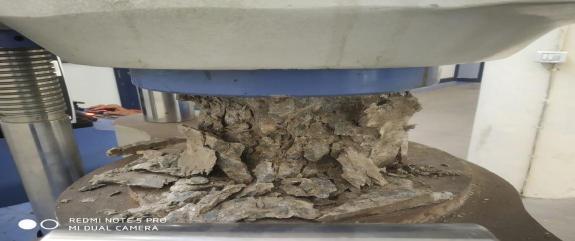
Concrete specimens were prepared for both compressive and tensile strength evaluation. Cubes of dimensions 150 mmx150mmx150mmwerecastforcompressivestrength testing,whilecylindricalspecimensof150mmdiameterand 300 mm height were prepared for split tensile strength testing. After casting, all specimens were demolded and curedinpotablewaterfordurationsof7and28days.The curingtemperaturewasmaintainedbetween27oCand30oC to ensure uniform hydration and proper strength development.
The results of numerous tests performed on concrete specimens,includingtensilestrengthtests,andcompressive strength,arepresented.
3.1 Slump test
The results of measuring the slump of the concrete with recycledcoarsematerialsareshownbelow
International Research Journal of Engineering and Technology (IRJET) e-ISSN:
Volume: 13 Issue: 02 | Feb 2026 www.irjet.net
Table -4: WorkabilityComparisonbetweenDifferent PercentagereplacementofRCA
5
6
7
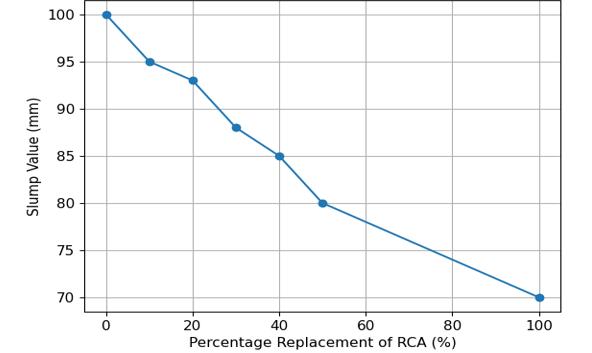
-1: Workabilityofdifferent%replacementofRCA
Theslumpvalueisdecreaseasthepercentageofreplacement ofRCAincrease.
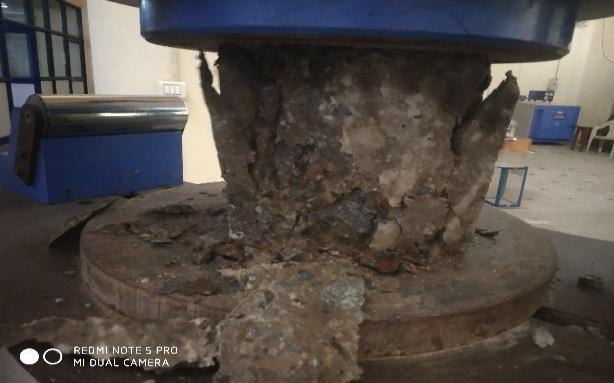
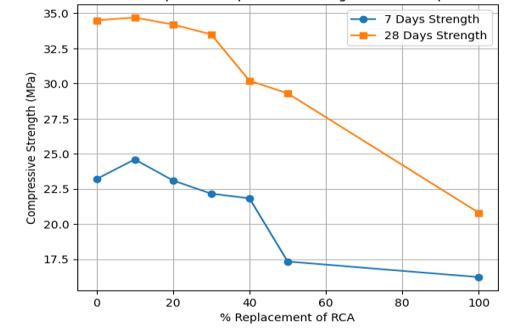
Cubecompressiontestswereconductedtofindoutthe influence of the substitute of coarse aggregate with demolition waste. Replacement ratios were considered as 0%,10,20,30,40,50and100.Theexaminationsweredone onboththe7andthe28days.
Compressive
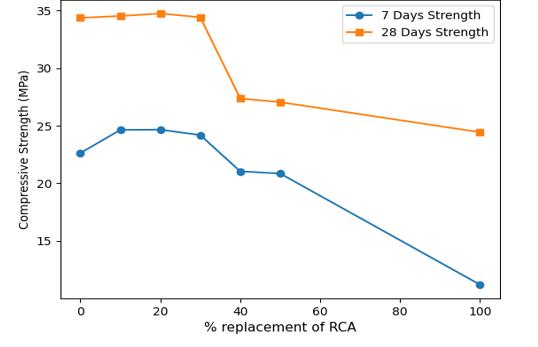
forVarious%Replacementof RCAin
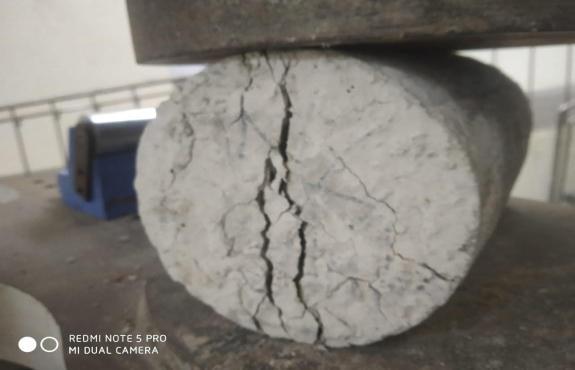
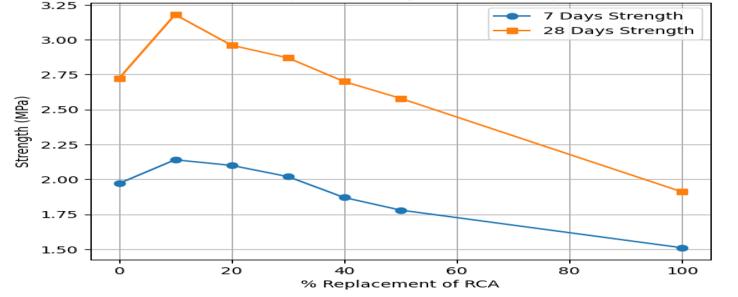
Oncylinders,thesplittensilestrengthwasassessedby partially replacing coarse aggregate with demolition waste at different ratios: 0%, 10%, 20%, 30%, 40%, 50%,and100%onthe7thand28thdays.
International
Volume: 13 Issue: 02 | Feb 2026 www.irjet.net
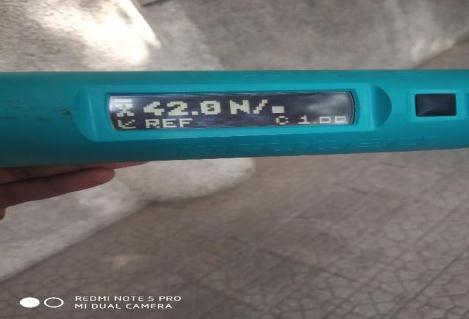
Whenconductingthereboundhammertest,theinstrumentis positionedperpendiculartothesurfaceofthematerialunder examination.Theplungeristhenappliedtothesurfacewitha predeterminedforce,oftenachievedbyfullycompressingthe spring-loaded mechanism. It is important to note that the plungershouldbepressedatfivedifferentlocations,andthe averageofthesefivereadingsshouldbetakenintoaccountfor accurate results. This approach helps ensure a comprehensive assessment of the material's compressive strength.
International Research Journal of Engineering and Technology (IRJET) e-ISSN: 2395-0056
Volume: 13 Issue: 02 | Feb 2026 www.irjet.net p-ISSN: 2395-0072
By using concrete crushed to partially substitute coarse aggregates, we have another way to recycle material and createsomethinguseful.
Becausethedensityofthedemolishedconcretehasalower densitythanthatofnormalconcrete,itislessexpensiveand morereadilyavailable.
Demolition waste aggregate exhibits substantially greater waterabsorption,moisturecontent,impactcriteria,fineness modulusandlowerunitweight,specificgravityascompare tonaturalaggregate.
The minimum value of compressive strength of 7 days strength after replacing 100% normal aggregate with demolitionwasteis11.19.
The maximum value of compressive strength of 28 days strengthafterreplacementof20%naturalaggregatewith demolitionwasteis34.74.
The ideal replacement rate for natural aggregate with demolitiondebrisis30%.
Splittensilestrengthandcompressivestrengthofconcrete are sufficient up to 30% replacement, however after that pointdemolitionaggregatereducesthestrength'svalue.
I give God the glory for guiding me the entire semester. I wanttoconveymyappreciationtoeveryonewhoprovided mewithhelpfulcritiqueandwhoassistedmeincompleting my task. I appreciatetheDepartmentofCivilEngineering, Prof.AlokVerma,andtheentireCivilEngineeringfacultyfor givingmethegreatestworkspace,guidance,andsupportfor mycreativework.Iconsidermyselfextremelyfortunateto havehadabosswhogenuinelycaredaboutmyworkandwho repliedtomyinquiriesandconcernsinatimelymanner.In particular,Iamgratefultomyparentsbecausewithouttheir help,Idonotabletoaccomplishmygoal.
[1] T. C. Hansen, Recycling of Demolished Concrete and Masonry.London,U.K.:E&FNSpon,1992.
[2] P. K. Mehta and P. J. M. Monteiro, Concrete: Microstructure,Properties, andMaterials.NewYork,USA: McGraw-Hill,1993.
[3]R.J.Collins,TheUseofRecycledAggregatesinConcrete Watford,U.K.:BuildingResearchEstablishment,1994.
[4] P. T. Sherwood, Alternative Materials in Road Construction.London,U.K.:ThomasTelford,1995.
[5]J.DesmysterandJ.Vyncke,“Useofrecycledmaterialsas aggregates in the construction industry,” in Proc. RILEM WorkshoponRecycledMaterials,Paris,France,2000.
[6]C.F.HendricksandH.S. Pieterson,“Concrete:Durable butalsosustainable,”in Proc.Int.Conf.RecycledConcrete Aggregates,London,U.K.,1998,pp.1–18.
[7]R.K.Dhir,M.C.Limbachiya,andT.Leelawat,“Suitability ofrecycledconcreteaggregateforuseinBS5328designated mixes,”Proc.Inst.CivilEng. StructuresandBuildings,vol. 134,pp.257–274,Aug.1999.
[8]J.S.Ryu,“Anexperimentalstudyontheeffectofrecycled aggregate on concrete properties,” Magazine of Concrete Research,vol.54,no.1,pp.7–12,2002.
[9] K. Ramamurthy, A. K. Padmini, and M. S. Matthews, “Influence of recycled aggregates on concrete properties,” CementandConcreteResearch,vol.32,pp.377–384,2002.
[10] H. J. Chen, T. Yen, and K. H. Chen, “Use of building rubblesasrecycledaggregates,”ConstructionandBuilding Materials,vol.17,pp.109–115,2003.
[11]J.M.Khatib,“Propertiesofconcreteincorporatingfine recycledaggregate,”CementandConcreteResearch,vol.35, pp.763–769,2005.
[12]F.M.KhalafandA.S.DeVenny,“Performanceofbrick aggregate concrete at high temperatures,” Journal of MaterialsinCivilEngineering,pp.899–906,2004.
[13]A.Rao,K.N.Jha,andS.Misra,“Useofaggregatesfrom recycled construction and demolition waste in concrete,” Resources,ConservationandRecycling,vol.50,no.1,pp.71–81,2007.
[14] M. Bravo, J. de Brito, J. Pontes, and L. Evangelista, “Durability performance of concrete with recycled aggregatesfromconstructionanddemolitionwasteplants,” ConstructionandBuilding Materials,vol.77,pp.357–367, 2015.
[15]S.Santos,P.R.daSilva,andJ.deBrito,“Self-compacting concrete with recycled aggregates – A literature review,” JournalofBuildingEngineering,vol.22,pp.349–371,2019.
[16] J. Oluwafemi, A. Ede, O. Ofuyatan, S. Oyebisi, and D. Bankole,“Recyclingofconcretedemolitionwaste:Pathway tosustainabledevelopment,”inIOPConf.Series:Materials ScienceandEngineering,vol.640,2019.
[17]K. Mikulica etal.,“Propertiesofconcrete with partial replacement of natural aggregate by recycled concrete aggregates,” Procedia Engineering, vol. 151, pp. 360–367, 2016.
International Research Journal of Engineering and Technology (IRJET) e-ISSN: 2395-0056
Volume: 13 Issue: 02 | Feb 2026 www.irjet.net p-ISSN: 2395-0072
[18]J.V.Puthussery,R.Kumar,andA.Garg,“Evaluationof recycled concrete aggregates for their suitability in construction activities,” Waste Management, vol. 56, pp. 113–120,2016.
[19]A.Akbarnezhad,K.C.G.Ong,M.H.Zhang,C.T.Tam,and T.W.J.Foo,“Microwave-assistedbeneficiationofrecycled concreteaggregates,”ConstructionandBuildingMaterials, vol.25,no.8,pp.3469–3479,2011.
[20] A. Katz, “Properties of concrete made with recycled aggregatefrompartiallyhydratedoldconcrete,”Cementand ConcreteResearch,vol.33,no.5,pp.703–711,2003.
[21] Bureau of Indian Standards, IS 456: Plain and Reinforced Concrete – Code of Practice. New Delhi, India, 2000.
[22]BureauofIndianStandards,IS8112:OrdinaryPortland Cement,43Grade–Specification.NewDelhi,India,1989.
[23] Bureau of Indian Standards, IS 6461: Properties of Concrete.NewDelhi,India,1973.
[24]S.K.SinghandP.C.Sharma,“Useofrecycledaggregates inconcrete–Aparadigmshift,”NBMCWJournal,Oct.2007.
[25]T.Pavlu,“Testingandpropertiesofrecycledaggregate foruseinconcrete,”CzechRepublic,2013.
[26] V. W. Y. Tam, C. M. Tam, and K. N. Le, “Removal of cementmortarremainsfromrecycledaggregateusingpresoaking approaches,” Resources, Conservation and Recycling,vol.50,pp.82–101,2007.