
International Research Journal of Engineering and Technology (IRJET) e-ISSN:2395-0056
Volume:13Issue:03|Apr2026 www.irjet.net p-ISSN:2395-0072

International Research Journal of Engineering and Technology (IRJET) e-ISSN:2395-0056
Volume:13Issue:03|Apr2026 www.irjet.net p-ISSN:2395-0072
Chetan Suryawanshi 1 , Shubham Ahirrao 2 , Ajinkya Paste 3 , Rushikesh Ahirrao 4 , Sanchit Chuadhari5 , Prof P.E.Patel6
Under the guidance Of Information Technology Met’s Institute Of engineering, Nashik
Abstract - In today’s world, online and digital exams are becoming more common, but many still face problems like question paper leaks, data tampering, and unfair result manipulation. These issues make it difficult to fully trust the current examination systems. To solve this, a new approach using blockchain technology can make exams more secure, transparent, and reliable. Blockchain is a digital ledger that stores data in a way that cannot be changed or deleted, ensuring every action in the exam process is recorded safely. The proposed Blockchain-Based Secure MCQ Examination System uses this technology to manage exams from question creation to result declaration. Each step such as setting questions, submitting answers, and grading is securely stored as a blockchain transaction. Smart contracts automaticallycheckandgradeanswers,ensuringfairnessand accuracy without human interference. This eliminates the need for a central authority and prevents manipulation. Overall, the system makes the entire examination process trustworthy, efficient, and tamper-proof for schools, universities, and certification bodies
Key Words: Blockchain Technology, Decentralized Architecture, Smart Contracts, Data Integrity, System Transparency, Immutable Ledger, Automated Evaluation, Secure Assessment, Cryptographic Validation,TamperResistance
Inthemoderndigitaleducationsystem,onlineexaminations have become a common mode of assessment due to their convenience and scalability. However, many traditional onlineMCQ(MultipleChoiceQuestion)examinationsystems stillfacemajorchallengessuchasdatatampering,question paper leaks, unauthorized access, and manipulation of results. These issues raise concerns about fairness, transparency, and trust in the examination process. To overcome these problems, this project introduces a Blockchain-Based Secure MCQ Examination System that ensurestransparency,immutability,andsecuritythroughout the examination process. The system uses blockchain technologytorecordeveryevent,suchasquestioncreation, exam sub mission, and result generation, as a secure transactiononadistributedledger.Smartcontractsareused toautomategradingandensurethatoncedataisrecorded,it cannotbealteredordeleted.Thisdecentralizedandtamperproofstructureeliminatestheriskofunauthorizedaccessor
manipulation,ensuringafairandtrustworthyexamination experienceforbothstudentsandexaminers
2.1TransformingEducationThroughBlockchain:A Systematic Review of Applications, Projects, and Challenges Wang et al. (2025)
Provides a broad review of blockchain applications acrossvariouseducationalprocesses.
Highlightsbenefitssuchastransparency,dataintegrity, anddecentralizedrecordstorage.
Limitation: Does not address online examination workflows, automated grading, or question paper security.
Relevance: Establishes the overall potential of blockchainbutlacksatargetedsolutionforexamination management.
2.2 Blockchain-based Solutions for Education Credentialing System: Comparison and Implications for FutureDevelopment Li,Liu,and Yu (2022/2023)
Focuses on blockchain for secure academic credential verification.
Compares public and private blockchain models for certificateauthenticityandtamperresistance.
Limitation:Scopeisrestrictedtocredentialverification; does not handle exam data, leakage prevention, or automatedevaluation.
Relevance: Shows strong use of blockchain in authentication but exposes the need to extend it into examsecurityframeworks
2.3 The Use of Blockchain Technology in the Educational Domain IEEE Blockchain 2023 Proceedings
Presentsmultipleblockchainapplicationsineducational environments, including assessment platforms and securerecord-keeping.
Emphasizessmartcontractsanddecentralizedstorage toenhancetransparency.
International Research Journal of Engineering and Technology (IRJET) e-ISSN:2395-0056
Volume:13Issue:03|Apr2026 www.irjet.net p-ISSN:2395-0072
Limitation: Most contributions remain conceptual or partially implemented; lack a complete, end-to-end examsecurityandevaluationmodel.
Relevance:Indicatespromisingdirectionsbuthighlights that a fully integrated examination workflow is still missing.
2.4 Practices of Using Blockchain Technology in eLearning Lin et al. (2021)
Demonstrates practical use of blockchain for authentication, learning activity tracking, and secure contentdistribution.
Shows how decentralized verification improves trust andaccountabilityine-learning.
Limitation: Provides limited discussion on exam security, question paper leakage prevention, or automatedMCQevaluation.
Relevance: Reinforces the usefulness of blockchain in learning systems but underscores the need for comprehensiveexamination-focusedsolutions
Table-1: ComparisonofLiteratureSurvey
1 Wangetal. (2025) Blockchainin overall education Nofocuson exams, automated grading, paper security
2 Li,Liu&Yu (2022/23) Credential verification using blockchain Onlyon credentials; noexam securityor evaluation
3 IEEE Blockchain Proceedings (2023) Blockchainin educational platforms Mostly conceptual; notend-toendsolution
4 Linetal. (2021) Blockchainin e-learning systems Limitedexam security,no auto evaluation
3. THEORETICAL BACKGROUND
3.1 Blockchain-Based Examination Framework
Thetheoreticalfoundationoftheproposedsystemliesinthe integration of blockchain technology with online examinationprocessestoensuretransparency,immutability, and decentralization. Traditional online examination platforms rely on centralized databases where question papers,studentcredentials,andresultsarestoredonsingle
servers.Suchsystemsarepronetounauthorizedaccess,data alteration, and internal manipulation, resulting in compromisedexaminationintegrity.
Theblockchain-basedframeworkaddressesthesechallenges bydistributingexamination-relateddata across a peer-topeer network. Each transaction whether it involves question paper creation, encryption, result generation, or verification is recorded as a block in the chain. These blocksarecryptographicallylinked,makingretroactivedata modificationvirtuallyimpossible.Thisdesignensuresthat every examination event remains verifiable and tamperresistant. By incorporating smart contracts, the system furtherautomatesgradingandresultdeclaration,removing the need for manual intervention and enhancing fairness acrossallstagesoftheexaminationprocess.
Atitscore,blockchainoperatesasadistributedledgerthat maintainsacontinuouslygrowinglistofrecordsknownas blocks. Each block contains a unique cryptographic hash, timestamp, and transactional data. The integrity of the blockchain is maintained through consensus mechanisms suchasProofofWork(PoW)orProofofStake(PoS),which validate transactions across all participating nodes. This decentralized validation ensures that no single entity can alterormanipulatestoreddatawithoutdetection.
Intheproposedexaminationsystem,consensusmechanisms serveasthefoundationformaintainingtrustamongmultiple educational stakeholders. When a teacher uploads an encrypted question paper or when student responses are recorded, these actions are verified and approved by network nodes before being permanently added to the blockchain. The consensus protocol thereby eliminates singlepointsoffailureandguaranteesthatallexamination transactionsremainauthenticandtransparentthroughout theprocess.
Smartcontractsareself-executingdigitalagreementsstored on the blockchain that automatically enforce predefined conditions. In the context of this study, smart contracts manage examination operations such as paper release scheduling, access authorization, and automated grading. Once deployed, these contracts function autonomously, ensuringthatnoparticipantcanmanipulateorbypassthe examinationrules.Thisautomationreduceshumanbiasand enhancesthefairnessandreliabilityofevaluations.
International Research Journal of Engineering and Technology (IRJET) e-ISSN:2395-0056
Volume:13Issue:03|Apr2026 www.irjet.net
Cryptographicencodingmechanismsformthesecondcrucial layerofsecuritywithintheframework.Advancedalgorithms suchasSHA-256areusedtogeneratehashvaluesforevery uploadedquestionpaperandsubmittedanswer,creatingan immutable digital fingerprint. These hashes prevent duplication,unauthorizedmodification,ordeletionofstored data. Combined with blockchain’s distributed nature, cryptographicencodingensuresend-to-endconfidentiality, authenticity, and non-repudiation of all examination activities foundation of the proposed blockchain-based examination system is built upon three core principles: decentralization, automation, and cryptographic security. The distributed ledger structure eliminates the vulnerabilities of centralized systems by providing immutabledatastorageandtransparentvalidation.Smart contracts enable autonomous and rule-based execution of examinationtasks,whilecryptographichashingsecureseach transactionagainstunauthorizedmodifications.
Together,thesemechanismsestablisharobustandtamperproof digital environment for academic institutions. The integration of blockchain technology into examination systemsnotonlyenhancestrustandefficiencybutalsosetsa foundationforfutureinnovationssuchascross-institutional verification,AI-assistedmonitoring,andadaptiveassessment management.
Themethodologybeginswiththecreationandencryptionof question papers by authorized teachers. Each paper is securely uploaded to the system, where it is encrypted to preventunauthorizedaccessormodification.Onceuploaded, theencryptedfileisconvertedintoablockchaintransaction, generating a unique hash value that ensures the paper’s authenticity and immutability. This information is then stored on a distributed ledger, making any tampering or deletionimpossible.
Next,smartcontractsaredeployedtodefinetheexamination rules,includingaccesscontrol,timing,andevaluationlogic. These contracts automate the process of distributing questionpapersonlyatthescheduledtimeandtoverified users, effectively preventing early leaks or unauthorized access. During the examination, students log in through a secure portal to attempt the test. Their responses are recordedinrealtimeandstoredasblockchaintransactions, ensuringtheintegrityandtransparencyofeverysubmission.
Once the exam is completed, the smart contracts automatically evaluate the responses for multiple-choice questions.Theresultsarecalculatedinstantlyandsecurely stored on the blockchain, eliminating the possibility of manual manipulation or human bias. Both teachers and students can later verify the question papers and results through their unique blockchain hash identifiers. This transparentandtamper-proofverificationprocessensures
p-ISSN:2395-0072
trust, fairness, and reliability throughout the entire examinationcycle
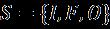
The proposed Paper Leakage Prevention System Using Blockchain can be formally model as a deterministic transformationprocessthatmapsexaminationdataintoa tamper-proof blockchainledger.Theentiresystemcan be representedmathematicallyasatriplet:
where:
S-represents the complete blockchain-based examination system,
I-isthesetofallinputparametersprovidedtothesystem,
F-denotesthesetoffunctionsorprocessesexecutedbythe system,and
O-defines the verified and immutable outputs generated afterblockchainprocessing.
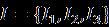
Theinputset(I)isdefinedas:
where:
I₁=Questionpapergeneratedbyauthorizedteacher.
I₂=Teachercredentialsandinstitutionalauthorizationdata.
I₃=Scheduledexaminationtimeandcandidateaccesslist.
Eachinputparameterrepresentsacriticalcomponentofthe examinationprocess.Thequestionpaperisencryptedbefore being transmitted, and all access credentials are authenticated through blockchain validation to ensure securityandlegitimacy.
The function set (F) defines the sequence of logical operationsperformedbythesystemtotransforminputsinto immutableblockchaintransactions:

International Research Journal of Engineering and Technology (IRJET) e-ISSN:2395-0056
Volume:13Issue:03|Apr2026 www.irjet.net
where:
f₁=EncryptionFunction appliescryptographicalgorithms suchasAESorSHA-256tosecurethequestionpaperbefore uploading.
f₂ = Blockchain Transaction Function converts the encrypted question paper into a blockchain transaction, generatingauniquehashvalue.
f₃ = Smart Contract Function establishes predefined examinationrules,includingpaperreleasetiminganduser verification.
f₄=DistributionControlFunction ensuresthatquestion papers are accessible only to authenticated users at the scheduledtime.
f₅=IntegrityVerificationFunction validatestheuploaded paper and detects any unauthorized modifications by comparingstoredhashvalues.
Together,thesefunctionsformacontinuous,rule-governed process that eliminates human dependency and enforces dataconfidentialitythroughouttheexaminationcycle.
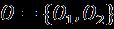
The output set (O) defines all immutable records and validated outcomes generated by the system after the examinationprocessisexecuted.Itcanberepresentedas:
where:
O₁=Verifiedblockchainrecordofencryptedquestionpaper transactions.
O₂=Immutableauditlogofquestionaccess,validation,and smartcontractexecution.
Each record in the blockchain is uniquely identified by a cryptographichash,whichguaranteesthatnopapercanbe altered, deleted, or redistributed without detection. The transformationrelationbetweenthesetscanbeexpressed as:


p-ISSN:2395-0072
Thismappingclearlyillustratesthattheinputdata(question papers, credentials, and timing) pass through a series of blockchain-based validation and encryption functions to producesecure,verifiableoutputsstoredpermanentlyinthe ledger.
Thecompletemodeldemonstratesthattheproposedsystem operatesasadeterministicandirreversibletransformation process governed by blockchain consensus and cryptographic verification. Once a question paper is uploadedandverified,itscorrespondinghashvaluebecomes immutable, ensuring that no unauthorized alteration or leakagecanoccur.
Formally,theoverallprocesscanbedefinedas:
This ensures that for every valid input and functional operation,thesystemconsistentlyproducestamper-proof and verifiable outputs. By integrating blockchain’s distributed validation and smart contract automation, the proposed model establishes a mathematically provable guarantee of data integrity, transparency, and leakage preventionwithintheexaminationecosystem
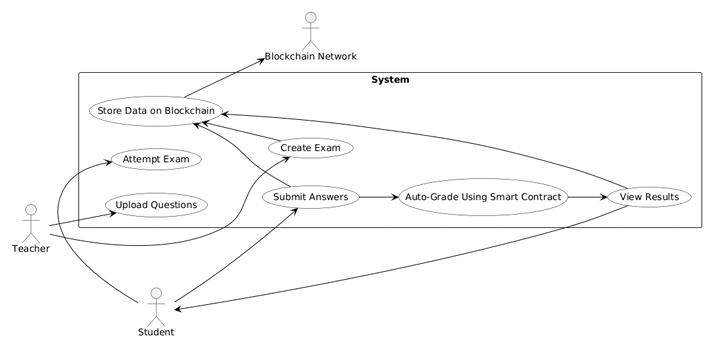
Fig-1: UseCaseDiagramExplanation
Thisdiagramislikeasimplestorymapoftheentireexam process.Itstartswiththeteacher:theyuploadthequestions, and those questions are immediately saved on the blockchain so nobody can ever change them. Then the teacher officially creates the exam. When the student is ready,theyopentheexam,answerallthequestions,andhit “submit.”Themomenttheysubmit,asmartlittleprogramon theblockchainautomaticallycheckseveryanswer,calculates themarks,andlocksthosemarksontheblockchainforever. Fromthatpointon,neithertheteachernoranyoneelsecan secretly alter the score. Finally, both the teacher and the studentcanopenthe“ViewResults”pageandseeexactlythe samemarksthatareguaranteedtoberealandunchanged.
International Research Journal of Engineering and Technology (IRJET) e-ISSN:2395-0056
Volume:13Issue:03|Apr2026 www.irjet.net p-ISSN:2395-0072
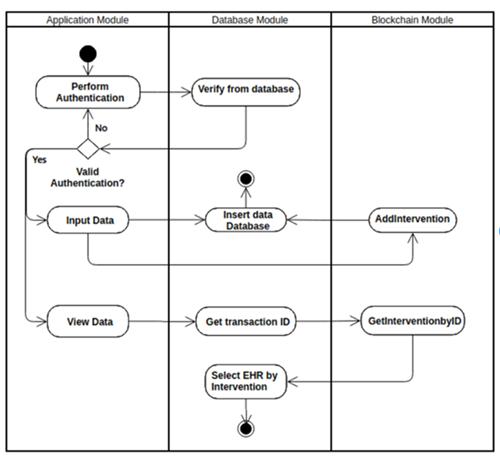
Fig-2 ActivityDiagram
Thisdiagramshowsthethreemainpartsthatworktogether likethreeteammates.Thefirstpartistheapporwebsiteyou actuallyseeandclickon–it’swhereyouloginandtypeyour answers.Whenyoulogin,itquicklyasksthesecondpart(a normaldatabase)“Isthispersonallowed?”andthedatabase says yes or no. The third and most important part is the blockchain–thinkofitasagiant,unbreakablenotebook.All thereallyimportantstuff(thequestions,youranswers,and yourfinalmarks)getswrittenintothisnotebook.Whenever anyonewantstocheckresultslater,thesystemgoesstraight totheblockchainnotebook,findsthepageusingaspecialID, andshowsthemarksexactlyastheywerewrittenthefirst time–nochangespossible.
5.6 Sequence Diagram Explanation
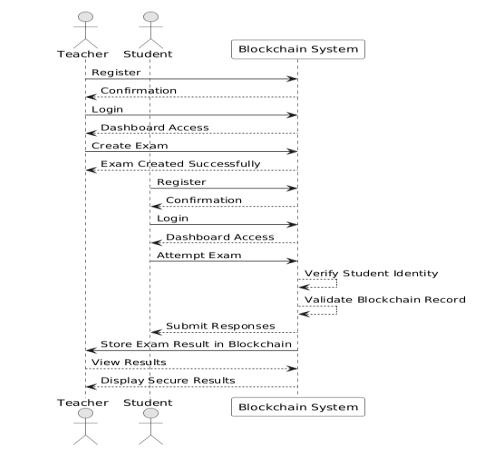
Fig-3 SequenceDiagram
Thereadingatextmessagethreadbetweentheteacher,the student,andtheblockchainitself.First,boththeteacherand studentsignupandlogin.Theteachercreatesanexamand the blockchain replies, “Exam created successfully!” The student signs up for that exam and gets a confirmation. Whenit’stimetotakethetest,thestudentlogsinandstarts answering.Assoonastheysubmittheiranswers,thesystem checksthestudent’sidentity,double-checkseverythingwith theblockchainrecords,calculatesthemarks,andwritesthe finalscoreontotheblockchainwithamessagelike“Result storedforever.”Later,whentheteacherorstudentwantsto seethemarks,theyjustask,andtheblockchainsendsback theexactsamesecure,unchangeableresultforeveryoneto see.It’sacomplete,honestconversationthatleavesnoroom forcheatingormistakes.
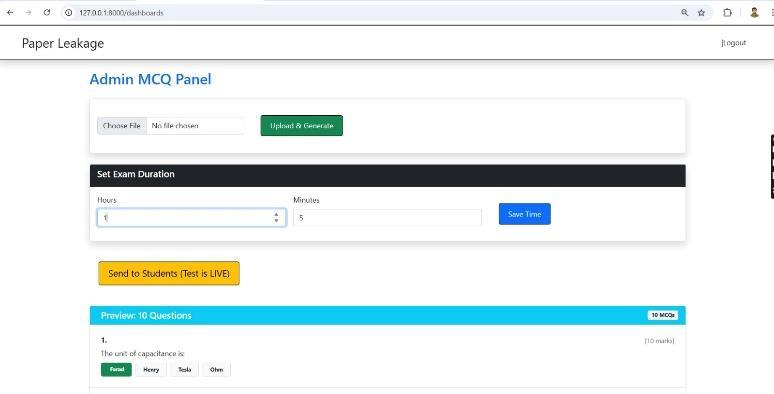
Fig-4 AdminMCQPanel
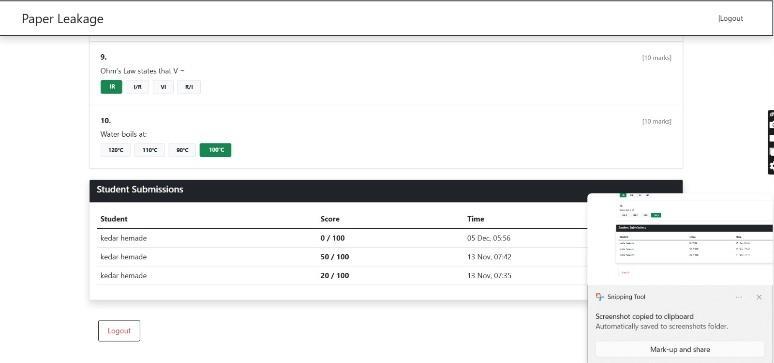
Fig-5 Dashboard
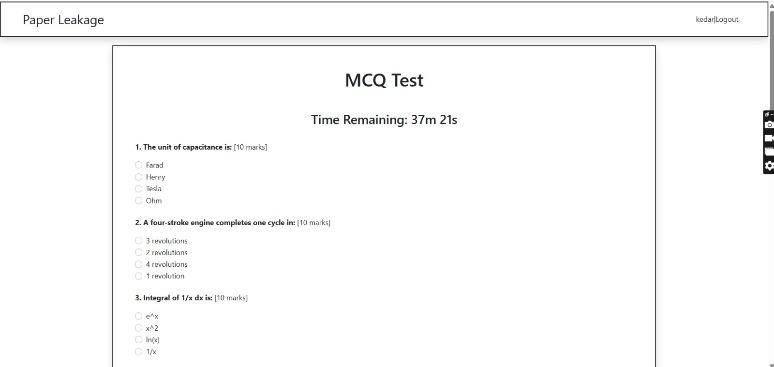
Fig-6 MCQTest
International Research Journal of Engineering and Technology (IRJET) e-ISSN:2395-0056
Volume:13Issue:03|Apr2026 www.irjet.net p-ISSN:2395-0072
The images collectively illustrate the key interfaces of the Blockchain-Based Examination System, showcasing the workflow from exam creation to student evaluation. The AdminMCQPanelallowstheinstructortouploadquestion files, set the exam duration, preview the generated MCQs, and make the test live for students. Once the exam is activated, students access the MCQ Test Interface, where they view and answer questions within a time-bound environment,supportedbyacountdowntimerthatensures strict control over exam duration. After submissions are completed, the system displays results on the Student Submissions Panel, where the admin can review each student'sscoreandsubmissiontimealongwithapreviewof the question set and correct answers. These interfaces togetherdemonstratehowtheplatformstreamlines exam generation, secure delivery, student participation, and automated evaluation in an efficient and user-friendly workflow
In conclusion, the Exam System Using Blockchain ensures secure,transparent,andimmutableonlineexaminations.It uses SHA256 hashing to store exam and result data in blockchainblocks,preventinganyalterationortampering. The Django framework simplifies system implementation and integration, while Bootstrap provides a clean, userfriendly interface. This system enhances the credibility of onlineassessmentsandprovidesatrustworthyexamination platformforeducationalinstitutions.
[1] X. Wang, M. Younas, Y. Jiang, M. Imran, and N. Almusharraf, “Transforming Education Through Blockchain: A Systematic Review of Applications, Projects, and Challenges,” IEEE Access, vol. 13, pp. 13264–13284,2025.
[2] Z.Z.Li,J.K.Liu,andJ.Yu,“Blockchain-basedSolutions for Education Credentialing System: Comparison and Implications for Future Development,” in Proc. IEEE InternationalConferenceonBlockchain,2022/2023.
[3] (Variousauthors),“TheUseofBlockchainTechnology intheEducationalDomain,”inProc.IEEEInternational ConferenceonBlockchain,2023.
[4] J. Lin, B. Li, L. Cui, and C. Miao, “Practices of Using Blockchain Technology in e-Learning,” in Proc. 16th International Conference on Computer Science and Education(ICCSE),2021,pp.55–60.
[5] H. Precht, F. Schwarm, and J. M. Gómez, “Enhancing SmartContractQualityThroughContinuousIntegration Pipelines,”inProc.IEEEBlockchainConference,2022.
[6] X. Larrucea and C. Pautasso, “Blockchain and Smart ContractEngineering,”IEEESoftware,vol.37,no.4,pp. 23–29,2020.
[7] B. Do, V.-T. Nguyen, H.-N. Dinh, and N. Nguyen, “BlockchainforEducation:VerificationandManagement ofLifelongLearningData,”Comput.Syst.Sci.Eng.,2022.
[8] Z. Wang, Y. Chen, and Q. Li, “Graph Neural Network Enhanced Smart Contract Vulnerability Detection for Educational Blockchain Platforms,” in Proc. IEEE BlockchainConference,2023.
[9] A.DasandN.Roy,“DecentralizedLearningAssessment System Using Blockchain,” in Proc. IEEE International ConferenceonBlockchain,2021.
[10] M. Li, X. Chen, and H. Li, “Decentralized Online ExaminationFrameworkUsingSmartContracts,”IEEE TransactionsonLearningTechnologies,2022.
[11] S.Tanwar,R.Sharma,andN.Kumar,“Blockchain-Based Framework for Examination Security,” IEEE Systems Journal,vol.15,no.4,pp.5671–5682,2021.
[12] A.S.Albahri,A.A.Zaidan,andB.B.Zaidan,“BlockchainBasedArchitectureforSecureAcademicAssessment,” IEEEAccess,vol.10,pp.9153–9170,2022.
[13] R.JayaramanandP.Mohanty,“SecureQuestionPaper DistributionUsingBlockchain,”IEEEAccess,vol.8,pp. 205720–205731,2020.
[14] C. Manogaran, R. Varatharajan, and Z. H. Khan, “Blockchain and AI-Based Automated Student AssessmentSystem,”IEEEAccess,vol.9, pp. 124860–124872,2021.
[15] H. Hu and W. Xie, “Optimized Decentralized Content StorageforE-AssessmentSystems,”IEEEAccess,vol.11, pp.11242–11255,2023.
[16] R. Bose and K. Ghosh, “IPFS-Integrated Blockchain Framework for Secure Examination Data Storage,” in Proc.IEEEINFOCOMWorkshops,2023.
[17] X. Zheng, S. Garg, and J. Chen, “Blockchain Challenges andOpportunities:ATechnicalReview,”IEEEInternet ofThingsJournal,2020.
[18] P.VoraandM.Dave,“SecureDataRecordingUsingSHA256 and Blockchain for Academic Applications,” Proc. IEEEICCSP,2023.
[19] T.MehtaandR.Gupta,“Hash-BasedAuthenticationfor ExaminationSystemsUsingBlockchain,”inProc.IEEE InternationalConferenceonComputing,Communication andSecurity,2024.
[20] L.Chen,M.Santos,andD.Park,“DesignandDeployment ofDecentralizedExaminationPortalsUsingBlockchain and Python,” Proc. IEEE International Conference on SmartComputing,2024.