
International Research Journal of Engineering and Technology (IRJET) e-ISSN: 2395-0056
Volume: 12 Issue: 11 | Nov 2025 www.irjet.net p-ISSN: 2395-0072
International Research Journal of Engineering and Technology (IRJET) e-ISSN: 2395-0056
Volume: 12 Issue: 11 | Nov 2025 www.irjet.net p-ISSN: 2395-0072
Jayshri S. Sirsat1, Prof. D. M. Pandit2
1M-TECH student, Department of Civil Engineering, CSMSS Chh. Shahu College of Engineering, Chhatrapati Sambhajinagar.431005, MAHARASHTRA, INDIA
2Assistant Professor, Department of Civil Engineering, CSMSS Chh. Shahu College of Engineering, Chhatrapati Sambhajinagar.431005, MAHARASHTRA, INDIA
Abstract - The stability of tall and slender reinforced concrete buildings is strongly influenced by second-order effects,particularlytheP–Deltaphenomenonarisingfromthe interaction of gravity loads and lateral displacements. Neglecting these geometric nonlinearities can lead to underestimated structural responses and unsafe design decisions, especially under seismic and wind loading. This study investigates the influence of P–Delta effects on a multistoryRCbuildingandevaluatestheeffectivenessofshearwalls in mitigating associated instabilities. A G+24 building model wasdevelopedinETABSandanalyzedunderidenticalloading conditions using linear static analysis and nonlinear P–Delta analysis, both with and without shear walls. Key response parameters story displacement, drift, base shear, and overturning moments were examined to quantify the amplification induced by second-order behavior. The results indicate a significant increase in lateral deflection and drift when P–Delta effects are considered, emphasizing their relevance for high-rise structures. Incorporating shear walls markedly improved stiffness and reduced adverse P–Delta impacts, demonstrating their effectiveness as a lateral loadresisting system. The findings highlight the necessity of incorporating geometric nonlinearity in the analysis of tall buildings and optimizing shear wall placement to enhance seismic performance and structural safety.
Key Words: P–Delta effect, geometric nonlinearity, shear wall, ETABS, storey drift, seismic response, second-order analysis.
The rapid increase in urbanization has led to a growing demand for high-rise reinforced concrete (RC) buildings, wherestructuralstabilityunderdynamicandlateralloadsis acriticaldesignconsideration.Asbuildingheightincreases, the influence of geometric nonlinearity becomes more pronounced, particularly the P–Delta effect, which results from the interaction between axial gravity loads (P) and lateral displacements (Δ). This interaction generates secondary moments that magnify structural deformation and may compromise stability during seismic or wind actions. While linear static analysis is widely used in conventionaldesignpracticeduetoitssimplicity,itneglects
thesesecond-ordereffects,potentiallyleadingtoinaccurate predictionofdrift,stiffnessdegradation,andinternalforces intallstructures.
AdvancednumericaltoolssuchasETABSallowengineersto simulate both first-order and second-order behaviors, enablingamorerealisticevaluationoftallstructuresunder lateral loads. Additionally, the use of lateral load-resisting systems particularlyreinforcedconcreteshearwalls has proven highly effective in reducing deformation and improvingtheoverallstiffnessandstabilityofRCstructures. Integrating shear walls within structural frames can help counteract the detrimental effects of P–Delta actions, especiallyinslenderbuildingssubjectedtoseismicforces.
Given the limitations of linear analysis and the increasing emphasis on performance-based design, a systematic investigation of the P–Delta effect becomes essential, particularlyforbuildingswithandwithoutshearwalls.This researchaimstoevaluatethesignificanceofP–Deltaeffects in multi-storey buildings and assess the contribution of shear walls in mitigating instability under seismic conditions.
Tall and slender RC buildings are highly susceptible to second-ordergeometricnonlinearities.However,inroutine practice,theP–Deltaeffectisoftenignoredorinadequately accountedfor,leadingtounderestimationofdisplacement, drift,bendingmoments,andshearforces.Thissimplification can compromise structural safety during strong ground motion or lateral loading. Moreover, the effectiveness of shear walls in reducing P–Delta-induced amplification remainsinadequatelyquantifiedforbuildingsofintermediate tohighrise.
Therefore,theproblemaddressedinthisstudyis:
“TodeterminehowP–Deltaeffectsinfluencetheseismic responseofa multi-storeyRCbuildingandtoevaluatethe extenttowhichshearwallscanmitigatethesesecond-order effectswhenanalyzedusingETABS.”
International Research Journal of Engineering and Technology (IRJET) e-ISSN: 2395-0056
Volume: 12 Issue: 11 | Nov 2025 www.irjet.net p-ISSN: 2395-0072
Areviewofexistingliteraturerevealsthefollowinggaps:
[1] Insufficient comparative studies for buildings with different structural configurations
Many studies have examined P–Delta effects, but only a limitednumberhavecomparedwithvs.withoutshearwall configurations under identical loading and geometric conditions.
[2] Lack of systematic quantification of response parameters
MostavailableresearchhighlightsthesignificanceofP–Delta effectsbutdoesnotcomprehensivelyquantifythevariation in storey displacement, drift ratio, base shear, and overturningmomentusingaconsistentanalysisframework.
[3] Limited studies focused on mid-rise and high-rise buildings using modern IS 1893:2016 provisions
Earlier research often used outdated seismic codes or focused primarily on low-rise buildings, leaving a gap in understandinghowP–Deltabehaviorevolvesunderupdated coderequirements.
[4] Insufficient analytical evaluation using advanced ETABS nonlinear capabilities
WhileETABSiswidelyused,fewstudiesemployitsiterative nonlinear P–Delta procedure in a detailed parametric approach,especiallyforpracticalstructurallayouts.Despite numerousstudiesacknowledgingtheimportanceofP–Delta effects,thereis nocomprehensive,code-based, non-linear comparative evaluation of multi-storey RC buildings with and without shear walls using modern seismic analysis procedures. This gap justifies the need for the present investigation.
TheEquivalentStaticMethodisasimplifiedseismicanalysis procedure in which the actual dynamic earthquake forces acting on a structure are represented by an equivalent horizontal static force. This approach does not require detaileddeterminationofhighermodeshapesordynamic characteristics, making it suitable for regular and moderatelytallbuildings.Basesheariscomputedusingthe structure’sseismic weightandacceleration coefficients as per code provisions. The calculated base shear is then distributed across the height of the structure to estimate storey-level forces. Modern software tools automate the computation of the fundamental time period, lateral load distribution,overturningmoments,torsionaleffects,shear
forces,anddisplacements,allowingfasterandmoreaccurate implementationofthismethod.
Second-order analysis considers the additional displacements,forces,andmomentsthatarisewhenloads act on the deformed configuration of the structure. These effects, commonly known as second-order or geometric nonlinear effects, cause increases in deformation and internal forces beyond those predicted by first-order analysis. The influence is most significant in members subjected to both axial compression and bending often referred to as beam-column elements. While first-order analysis can provide a preliminary estimate, accurate assessment of these additional effects requires a true second-order analysis, particularly for slender or heavily loadedstructures.
TheP–Deltaeffectisaformofgeometricnonlinearitythat arises when vertical loads (P) act on a structure that has undergone lateral displacement (Δ). This interaction producesadditionalbendingmomentsandshearforcesthat are not accounted for in simple linear analysis. As the structure drifts laterally under seismic or wind loads, the gravityloadscontributetosecondaryoverturningmoments, amplifying the total lateral forces acting on the system. TheseP–Deltamomentsareoftenoverlookedinbasicstatic or dynamic analyses, but they can significantly influence stability,especiallyintall,slender,orflexiblebuildings.The magnitudeoftheeffectisdirectlyrelatedtotheappliedaxial loads(P)andthelateraldisplacement(Delta),makingitan important consideration in the design of multi-storey buildings.
The P–Delta effect represents a form of geometric nonlinearityinwhichverticalgravityloads(P)interactwith thelateraldisplacement(Δ)ofastructure.Thisinteraction generatesadditionalshearforcesandbendingmomentsthat arenotcapturedinconventionallinearanalyses.P–Deltais one of several second-order phenomena that arise when loadsactonthedeformedconfigurationofastructurerather than its original geometry. When a building undergoes lateralswayduetowindorseismicforces,itsmassshiftsto a displaced position, causing secondary overturning moments.Theseadditionalmoments,whichresultfromthe productoftheaxialload(P)andthelateraldisplacement(Δ), are often underestimated or ignored in basic static and dynamic analyses. Because these effects significantly influencethestabilityanddriftoftallorslenderstructures, theymustbeconsideredtoensureareliableandsafedesign.
International Research Journal of Engineering and Technology (IRJET) e-ISSN: 2395-0056
Volume: 12 Issue: 11 | Nov 2025 www.irjet.net p-ISSN: 2395-0072
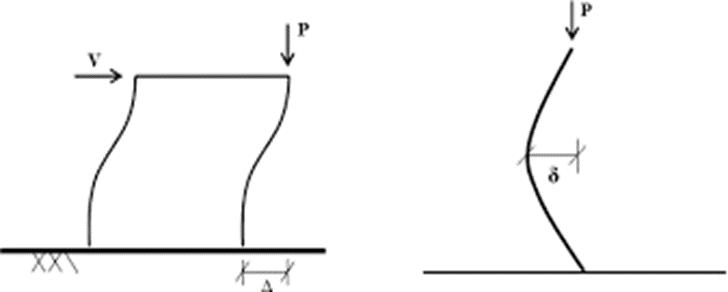
TheP–Δeffectreferstotheglobalsecond-orderbehaviorof theentirestructure.Whenabuildingissubjectedtolateral forcessuchaswindorearthquakeloads,itundergoeslargescale horizontal displacement. At the same time, vertical gravity loads (P) continue to act on the structure. The multiplication of the total vertical load (P) by the overall lateral displacement (Δ) produces additional secondary moments, which further increase the lateral drift and overturningtendencyofthestructure.Thiseffectbecomes particularly significant in high-rise buildings with greater flexibility.
TheP–δeffectdescribeslocalsecond-orderbehaviorwithin individualstructuralmembers.Itoccurswhenanaxialload acts on a member such as a column that exhibits curvatureorlocaldeflectionbetweenitsends.Theaxialload (P) acting on the localized deformation (δ) induces additional internal bending momentsinthat member.For example,acolumnthatexperiencescurvatureduetobeamcolumninteractionorunequalendrotationsisaffectedby thisphenomenon.TheP–δeffectiscriticalforevaluatingthe stability and buckling behavior of individual compression members.
reinforced concrete building and to assess the role of shear walls in mitigating these effects. The specific objectivesare: Theprimaryobjectiveofthisresearchistoevaluatethe influence of geometric nonlinearity, specifically the P–Deltaeffect,ontheseismicperformanceofamulti-storey
•Toperformlinearstatic(firstorder)andP–Delta (second order) analysis on multi–storey RC buildings.
• To study displacement, drift, base shear and overturningmomentfordifferentbuildingshapes.
• To evaluate the influence of shear walls on reducingP–Deltaeffects.
•Toidentifythemoststableconfigurationamong sharpedge,cutshape,andrecessedshapebuildings.
Themethodologyadoptedinthisresearchisdesignedto systematicallyevaluatetheinfluenceofP–Deltaeffectsona G+24 multi-storey reinforced concrete building, with and without shear walls. The entire process involves model creation, load assignment, analytical procedures, and comparison of structural response parameters. The steps followedinthisstudyaredescribedbelow. A24-storeyRC building (G+24) with a uniform storey height of 3 m was modelledandanalyzedusing ETABSsoftware.Fourdifferent analyticalcasesweredeveloped:
1. LinearStaticAnalysis(LSA)withoutshearwall
2. P–DeltaAnalysiswithoutshearwall
3. LinearStaticAnalysiswithshearwall
4. P–DeltaAnalysiswithshearwall
Table 1: Geometry of Model
Table 2: LoadProportions
DeadLoad(IS875Part-1)
Volume: 12 Issue: 11 | Nov 2025 www.irjet.net
B. ImposedLoad/LiveLoad(IS875Part-2) Sr.
2.3 Different Models considered for Analysis
2.3.1 Sharp edges at the Corners of building
4
5
6
C. EarthquakeLoad(IS1893:2016Part-1)
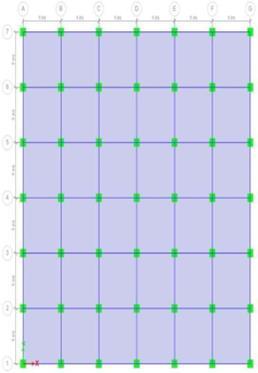
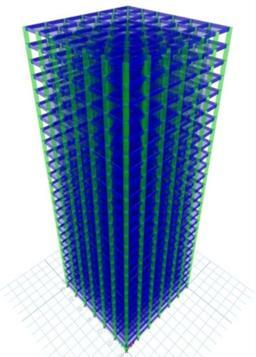
Fig 2.1-2-Dand3-DViewofSharpedgeatthecornersof thebuilding
2.3.2 Cut Shape at the Corners of building
Table 3: LoadCombinations(IS1893:2016Clause 6.12.3.2)
Sr.No.
1
(DL+LL) 2
(DL+LL+EQX) 3
(DL+LL−EQX)
4 1.2(DL+LL+EQY) 5 1.2(DL+LL−EQY)
6 1.5(DL+EQX)
7 1.5(DL−EQX)
8 1.5(DL+EQY)
9 1.5(DL−EQY)
2.2 Modelling Steps in E-TABS
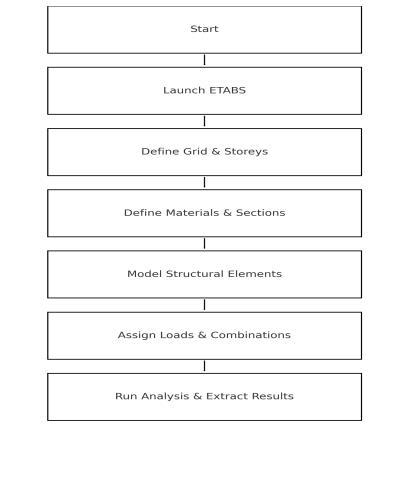
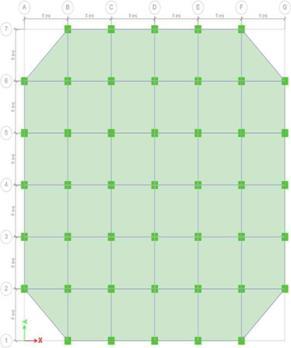
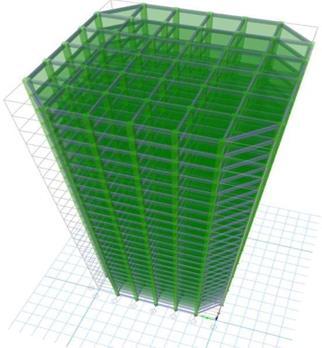
Fig 2.2: 2-Dand3-DRenderedviewofCutShapeatthe cornersofthebuilding
2.3.3 Recessed shape at the Corners of building
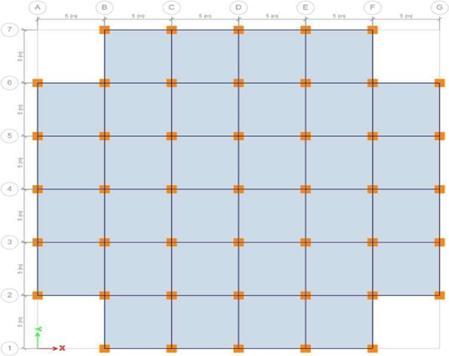
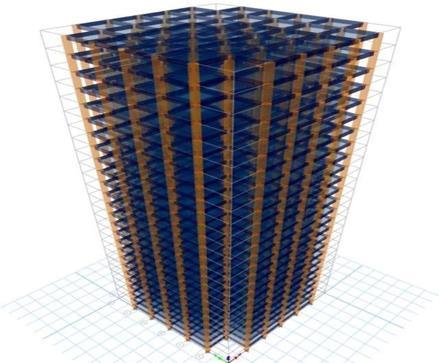
Fig 2.3:2-Dand3-DRenderedviewofRecessedShapeat thecornersofthebuilding
3. RESULT
Thischapterpresentstheanalyticalresultsobtainedfrom theE-TABSmodelsforallfourcasesWithDifferentModels:
1. LinearStaticAnalysis(LSA)–WithoutShearWall
2. P–DeltaAnalysis–WithoutShearWall
3. LinearStaticAnalysis–WithShearWall
4. P–DeltaAnalysis–WithShearWall
International Research Journal of Engineering and Technology (IRJET) e-ISSN: 2395-0056
Volume: 12 Issue: 11 | Nov 2025 www.irjet.net p-ISSN: 2395-0072
Thebuildingresponsewasevaluatedusingthefollowingkey parameters:
StoreyDisplacement
StoreyDrift
BaseShear
OverturningMoment
The results derived from both linear and second-order analyses are compared to understand the influence of geometricnonlinearityandtheeffectivenessofshearwalls.
3.1 Comparison of Overturning Moment
Overturningmomentswerecalculatedforallfour models.
Key Observations:
P–Delta analysis results in slightly higher overturningmomentscomparedtolinearanalysis.
Shear walls contribute to reduced overturning moments,astheyincreasestiffnessandlimitoverall sway.
Thereductionismoreevidentfortheupperstoreys wherelateraldisplacementishighest
Table-3.1 ComparisonofOverturningMoment
Recessed Shape 6776022 6876640 6485441 6586976
SharpEdge 7450903 7541517 7124290 7228521
CutShape 7120793 7218634 6883849 6991222
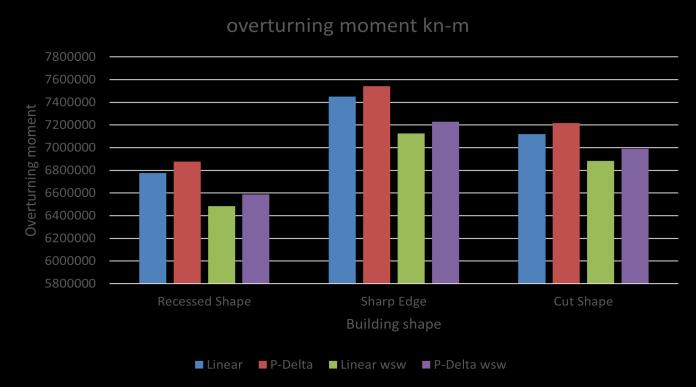
Figure-3.1 ComparisonofOverturningMoment
3.2 Comparison of Base Shear
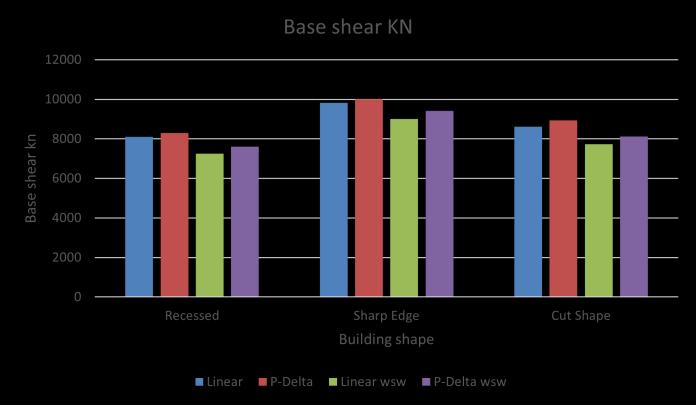
Base shear values for linear and P–Delta cases were extractedinbothXandYdirections.
Key Observations:
Only a small variation in base shear is observed betweenlinearandP–Deltaanalyses.
The presence of shear walls increases the lateral load-resisting capacity, but base shear values remaincloseacrossallcases.
The difference in base shear is not as large as displacement or drift changes, indicating that P–Delta effects mainly influence deformation rather thanbasereaction.
3.3 Comparison of Storey Displacement
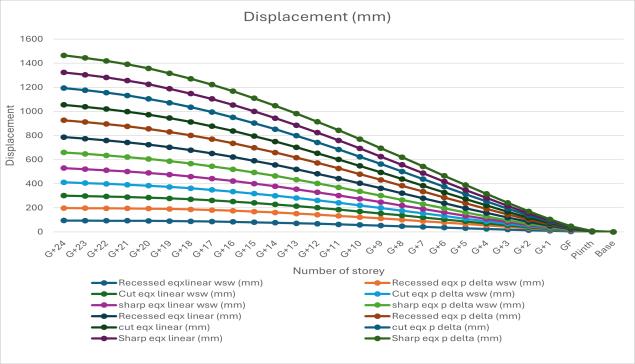
Thestoreydisplacementgraphshowsagradualincreasein displacementwithheightforallbuildingshapes.Sharp-edge buildingsexhibitthemaximumlateraldisplacement,while recessedshapebuildingsdisplaytheleast.Theapplicationof shearwallsresultsinasubstantialreductionindisplacement values, indicating their critical role in enhancing overall stiffnessandminimizinghorizontaldeflectionduetoseismic orwindloading.
Table.3.3.1 RecessedShapeDisplacement
Storey No
International Research Journal of Engineering and Technology (IRJET) e-ISSN: 2395-0056
Volume: 12 Issue: 11 | Nov 2025 www.irjet.net p-ISSN: 2395-0072
Table.3.3.2
Table.3.3.3 SharpEdgeShapeDisplacement
International Research Journal of Engineering and Technology (IRJET) e-ISSN: 2395-0056
Volume: 12 Issue: 11 | Nov 2025 www.irjet.net p-ISSN: 2395-0072
G+14 0.001883 0.002015 0.002169 0.002351
G+13 0.001955 0.002107 0.002324 0.002462
G+12 0.002017 0.002188 0.002234 0.00256
G+11
3.4 Comparison of Storey Drift
• Thestoreydriftcomparisonhighlightsthatsharpedgebuildings experience thehighestdrift ratios, especiallyaroundmid-storeylevels.
• The inclusion of P-Delta effects further increases drift, while shear walls effectively control this deformation.
• Recessed shape buildings show the lowest drift, demonstratingsuperiorlateralstiffnessandbetter controlofinter-storeymovement.
Table.3.4.1 RecessedShapeStoreyDrift
CutShapeStoreyDrift
International Research Journal of Engineering and Technology (IRJET) e-ISSN: 2395-0056
Volume: 12 Issue: 11 | Nov 2025 www.irjet.net p-ISSN: 2395-0072
G+12 0.002053 0.002203 0.002056 0.002205
G+11 0.002097 0.002255 0.002101 0.002274
G+10 0.002133 0.002291 0.002144 0.002333
G+9 0.002155 0.002318 0.002174 0.002381
G+8 0.002127 0.002306 0.002196 0.002421
G+7 0.002179 0.002279 0.002209 0.002450
G+6 0.002045 0.002223 0.002213 0.002473
G+5 0.002400 0.002318 0.002240 0.002492
G+4 0.001840 0.002000 0.002193 0.002479
G+3 0.001672 0.001815 0.002155 0.002445
G+2 0.001564 0.002044 0.002069 0.002348
G+1 0.001481 0.001808 0.001892 0.002140
GF 0.000777 0.000846 0.001310 0.001400
Plinth 0.000288 0.000310 0.000451 0.000488
Base 0 0 0 0
Table.3.4.3 SharpShapeStoreyDrift
Storey No SharpEQX Linear WSW (mm) Sharp EQX P-Delta WSW (mm)
EQX Linear (mm)
EQX PDelta (mm)
G+24 0.00048 0.00049 0.00109 0.00111
G+23 0.00063 0.000654 0.00116 0.00118
G+22 0.000834 0.000854 0.001227 0.001248
G+21 0.000909 0.00102 0.001302 0.00132
G+20 0.001016 0.001037 0.00136 0.00139
G+19 0.00132 0.00137 0.00143 0.00146
G+18 0.00156 0.0016 0.0015 0.00158
G+17 0.00156 0.0016 0.00158 0.00166
G+16 0.00162 0.00166 0.00167 0.00179
G+15 0.00167 0.00171 0.00178 0.00191
G+14 0.00171 0.00175 0.00188 0.00201
G+13 0.00173 0.00179 0.00195 0.0021
G+12 0.00175 0.00181 0.00202 0.00218
G+11 0.00176 0.00182 0.00207 0.00225
G+10 0.00175 0.0018 0.00211 0.00231
G+9 0.00175 0.00182 0.00214 0.00234
G+8 0.00169 0.00174 0.00217 0.00241
G+7 0.0016 0.00167 0.00218 0.00246
G+6 0.00156 0.00161 0.00218 0.00246
G+2 0.001 0.00104 0.00204 0.00234
G+1 0.00083 0.000864 0.00184 0.00209 GF 0.00055 0.000593 0.00131 0.00140 Plinth
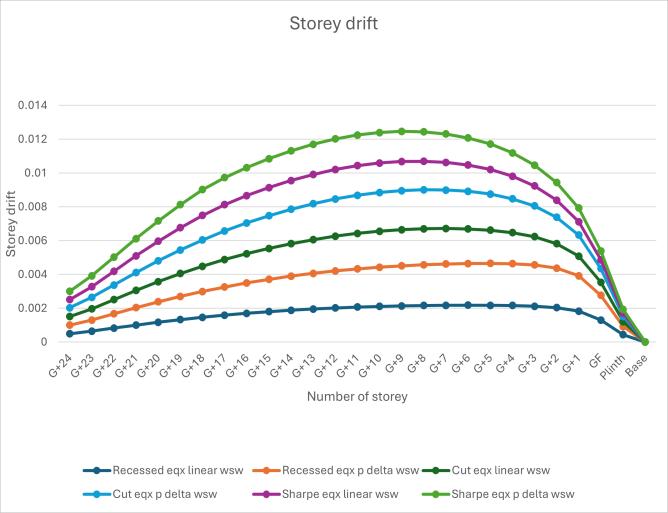
Figure.3.4.1 Comparisonof StoreyDrift
4. CONCLUSION
• P–Deltaeffectsaresignificantfortallstructures.
• Displacements, drift, base shear and overturning momentincreasedwithP–Deltaconsideration.
• Shearwallsreduceddisplacements,drift,baseshear andoverturningmoment.
• Recessed shape configuration performed best in seismicresistance.
• Sharp edge buildings experienced highest Displacements, drift, base shear and overturning moment
• P–Delta analysis should be included in design of high–risebuildings.
[1] WagnerAlmeidaFerreira,JefferRoussellCordovaDeLa Cruz, “Modal P-Delta Simplified Geometric Nonlinear Method by Using Modal and Buckling Analysis,” IBRACONStructuresandMaterialsJournal,Vol.16,No. 2,pp.1–10,2022.
[2] S.Bhavanishankar,PatilRita,“P-DeltaAnalysisofMultiStorey Building,” International Research Journal of
International Research Journal of Engineering and Technology (IRJET) e-ISSN: 2395-0056
Volume: 12 Issue: 11 | Nov 2025 www.irjet.net p-ISSN: 2395-0072
ModernizationinEngineeringTechnologyandScience, Vol.3,Issue5,pp.1–7,2021.
[3] PhaniKumarV.,M.Deepthi,SaikiranK.,R.B.N.Santhosh, “BehaviorofP-DeltaEffectinHigh-RiseBuildingswith andWithoutShearWall,”InternationalJournalofRecent TechnologyandEngineering,Vol.8,Issue2,pp.2060–2068,2019.
[4] DeekshithaY.L.,KiranKuldeepK.N.,“LinearandNonLinear Dynamic Analysis of Multi-Storied R.C. Frame Buildings with Plan and Vertical Irregularities Using ETABS,”InternationalResearchJournalofEngineering andTechnology,Vol.5,Issue7,pp.1506–1517,2018.
[5] VijayalakshmiR.,BinduN.Byadgi,Vahini,“EffectsofPDeltaonHighRiseBuildingsLocatedinSeismicZones,” International Research Journal of Engineering and Technology(IRJET),Vol.4,Issue8,2017.
[6] ManikRao,RajendrakumarS.Harsoor,“EffectofP-Delta in Seismic Analysis of Multi-Storey Buildings,” International Journal of Research in Engineering and Technology,2016.
[7] PushparajJ.Dhawale,“AnalysisofP-DeltaEffectonHigh Rise Buildings,” International Journal of Engineering ResearchandGeneralScience,2016.
[8] Ashish Chandra, “Geometric Non-Linear Analysis of High-Rise Buildings under Seismic Loading,” International Journal of Engineering Research and ManagementStudies,2016.
[9] NeerajKulkarni,S.M.Maheswerappa,Dr.J.K.Dattatraya, “StudyofP-DeltaEffectonTallSteelStructure,”IJAPRR InternationalPeerReviewedRefereedJournal,2015.
[10] PrashantDhadve,AlokRao,AtulRupanvar,DeokateK., Admile P. R., Dr. Nemade P., “Assessment of P-Delta EffectonHighRiseBuildings,”InternationalJournalon Recent and Innovation Trends in Computing and Communication,2015.
[11] Taranath B. S., “Wind and Earthquake Resistant Buildings:Structural AnalysisandDesign,” CRCPress, 2004.
[12] SmithB.S.,CoullA.,“TallBuildingStructures:Analysis andDesign,”WileyPublications,2003.(Book)
[13] KalkanE.,KunnathS.K.,“EffectsofP-DeltaonSeismic Performance of Reinforced Concrete Buildings,” EngineeringStructures,2002.
[14] ChenW.F.,LuiE.M.,“StabilityDesignofSteelFrames,” CRCPress,2001.
[15] WoodR.H.,“TheStabilityofTallBuildingsUnderLateral Loads,”TheStructuralEngineer,2000.


JayshriShrirangSirsat Student of M-TECH (CSMSS Chh. Shahu CollegeofEngineering,Aurangabad)
Prof.D.M.Pandit Assistant ProfessorCSMSS Chh. Shahu College of Engineering, Aurangabad)