
International Research Journal of Engineering and Technology (IRJET) e-ISSN: 2395-0056 p-ISSN: 2395-0072

Volume: 11 Issue: 12 | Dec 2024 www.irjet.net


International Research Journal of Engineering and Technology (IRJET) e-ISSN: 2395-0056 p-ISSN: 2395-0072
Volume: 11 Issue: 12 | Dec 2024 www.irjet.net
Sukhi Patil1 , Sinchana N G2 , Keerthana P3 , Jeevitha N S4
1234 Bachelor of Engineering, Information Science and Engineering,Bapuji Institute of Engineering and Technology, Davangere, affiliated to VTU Belagavi, Karnataka, India.
Abstract - One of the most common causes of illness and death among female cancers is ovarian carcinoma. It is the seventh most deadly cancer in women globally and is a leading cause of mortality from gynecological carcinoma. It is made upofadiverserange ofneoplasms. Variations inthe severity and patterns of ovarian cancer are specific to various regions of the world, and the disease's situation is always evolving. As a result, the current research on ovarian cancer has to be updated and reviewed. From PubMed and Google Scholar, reviews of ovariancancer from 2000 to 2015 were retrieved, and a few chosen seminal studies that used historical data were also included. Consolidating a current worldwide perspective on epithelial ovariancarcinoma,the mostcommon kind of ovarian cancer, is the main goal of this work. The epidemiology, types, diagnosis, prognosis, and therapy of epithelial ovarian cancer are all covered in this article.
Key Words: diagnostic, prognosis, treatment, epidemiology,andovariancancer.
The seventh most deadly cancer in the world for women (and the eighteenth most prevalent type of carcinoma overall),ovariancarcinomaisadiversegroupofneoplasms that contribute significantly to gynecological carcinomarelated deaths in the western world. The ovarian surface epitheliumorpostovulatoryinclusioncysts,whichdevelop followingfollicularruptureandhealing,hadpreviouslybeen proposed as the source of the majority of ovarian carcinomas. Numerous theories exist regarding the incidence of ovarian cancer in females. Every ovulation causesawound,whichleadstogreatercellproliferationto heal the epithelial cells, according to the "incessant ovulation" theory. This could lead to a higher risk of malignant mutation and DNA damage. According to a differenttheoryinvolvinggonadotropin-basedstimulation, highergonadotropinlevelsduringmenopauseareassociated withanincreasedincidencerateofovariancancer.Ovulation isstronglylinkedtoovarian cancer,andtheinflammation hypothesissuggeststhatinflammationmayplayaroleinthis process. However, progesterone stimulation has shown a protectiveeffectandlowerstheriskofovariancarcinoma. The hormonal theory, on the other hand, suggests that excessandrogenstimulatestheovariansurfaceepithelium, increasing the risk of ovarian carcinoma. About 75% of womenwhohavetheillnessarefoundtohaveitinamore advancedstage Accordingtohistology,ovariancarcinoma

can be divided into three main categories based on the ovarian tissues that cause it: sex cord-stromal cell tumor (whichproduceshormones)andgermcelltumor(whichis made up of cells that develop into ova and its subtypes include dysgerminoma immature teratoma and yolk sac tumor), as well as epithelial ovarian tumor (which covers theovary and its subtypes that include serous, mucinous, endometrioid,andclearcell) Theepithelialcellsarewhere ovariancanceroccursmostfrequently(around85%).Serous tubal intraepithelial carcinoma is the precursor lesion in high-gradeserousovariancarcinomaandisarelativelynew discovery in the understanding of ovarian carcinoma development.
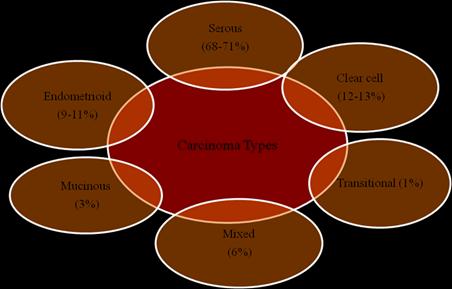
Fig-1: Relativefrequenciesofovariancarcinomasubtypes.
Althoughtheexactoriginofovariancarcinomaisuncertain, epidemiologicstudieshaveshownthatthebiggestriskfactor isapositivefamilyhistoryofbothbreastandovariancancer. Patientswithovariancarcinomahaveapoorprognosisdue to a number of factors, including the cancer's localization withintheperitonealcavity,thelackofearlysymptoms,the difficultyofsurgicallyeradicatingthecancercompletely,and patientresistancetochemotherapy,whichresultsina45% five-yearsurvivalrate.Thediseaseistreatedwithantibody therapy, immune checkpoint inhibitors, vaccination methods, adoptive cell therapy, and combinatorial immunotherapy. The genesis and progression of ovarian cancer, its kinds and subtypes, diagnosis, prognosis, and treatment are all covered in a large number of review publications.Asaresult,currentknowledgeaboutovarian cancer has to be reviewed and updated. Since epithelial ovarian carcinoma (EOC) is one of the most common gynecologicalcarcinomas,thegoalofthisstudyistoprovide the most recent worldwide perspective on this condition.

Volume: 11 Issue: 12 | Dec 2024 www.irjet.net
International Research Journal of Engineering and Technology (IRJET) e-ISSN: 2395-0056 p-ISSN: 2395-0072
The epidemiology, diagnosis, prognosis, and therapy of epithelialovariancancerareallcoveredinthisreview.
Anovariancancerliteraturesurveywouldnormallyentail compiling and summarizing important research papers, reviews, clinical trials, and other pertinent literature on a range of topics related to the pathophysiology, diagnosis, therapy, and prognosis of ovarian cancer. Anexampleofhowtoorganizeyourliteraturereviewisas follows:
Introduction to Ovarian Cancer: A succinct summaryofthedisease'stypes(e.g.,stromal,germ cell, and epithelial), prevalence, risk factors, and importancetowomen'shealth.
The molecular pathways and pathogenesis: An outline of the molecular and cellular processes linked to the onset and spread of ovarian cancer, such as interactions between the tumor microenvironment and genetic abnormalities (TP53,PTEN),aberrantsignalpathways(PI3K/AKT, MAPK),andothers.
DiagnosticApproaches:Anoverviewofthecurrent approachestoovariancancerdiagnosis,including imaging tools (MRI, ultrasound), tumor markers (CA-125, HE4), and newer procedures including molecularprofilingandliquidbiopsies.
TreatmentModalities:Examiningtheconventional approaches to treating ovarian cancer, such as hormone therapy, immunotherapy, targeted medicines (such as angiogenesis inhibitors and PARPinhibitors),chemotherapy(suchasplatinumbasedregimens),andsurgery.clinicalstudies,new developments,andcustomizedmedicalstrategies.
The diverse character of ovarian cancer and patient outcomes are highlighted in this summary, which offers a comprehensivereviewofthemainconclusionsandtopicsof interest within the literature survey. Survival variables and prognostic factors Results: Numerous factors, including tumor stage, subtype, genetic profile, and response to treatment, influence prognosis; research is continuously being conducted to improve prognosticmarkers.
Issues and Prospects: Research is being directed towards new therapeutic targets, biomarkers, and personalized medicine strategies in response to issues with ovarian cancer management, such as late diagnosis, treatment resistance,andrecurrence.
Compared to middle- and low-income countries, highincome countries have a higher incidence of ovarian cancer. About 239,000 instances were reported in 2012, representing over 4% of all new cases of carcinoma in women (2% total). Globally,the incidence rate of ovarian canceris4.1per100,000inChina,5per100,000inAfrica, 11.7 per 100,000 in the United States, 5.2 per 100,000 in Brazil, and 11 per 100,000 in Central and Eastern Europe. Anestimated65,697newcasesand41,448 fatalitiesoccur year in Europe. According to the US Center for Disease ControlandPrevention,around20,000womenreceivean ovarian cancer diagnosis each year, and 14,500 of them passawayasaresultofthecondition.Withanoverallfiveyearsurvival rateof44.2%,themortalityrateforovarian carcinoma has remained constant over the past 50 years, despite a decline in the mortality rate for many solid tumors. Awomanhasa1in75chanceofgettinginvasive ovariancancerinherlifetime,andshehasa1in102chance ofdyingfromit.Everyyear,some9,600womeninGermany get malignant ovarian tumors, and 5,500 of them pass awayfromovariancarcinoma.Becauseofthelatestateof the disease at diagnosis, the cure rate for epithelial ovarian carcinoma (EOC), which accounts for 14,030 of the 22,240 cases identified in the United States, is less than 40%. The information above clearly shows that ovarian carcinoma is one of the most deadly gynecologic cancers, accounting for the greatest number of deaths. Ovarian cancer has various morphological subtypes, each of which has a unique pathogenesis, natural history, prognosis, and molecular changes. According to various population-based cancer registries, the incidence of ovarian cancer in India (age- adjusted rate per 100,000) rangedfrom1.7to15.2overthe2012–2014period.InIndia, 45,231and59,276incidencesofthiscancerareanticipated in2015and2020,respectively.
International Research Journal of Engineering and Technology (IRJET) e-ISSN: 2395-0056 p-ISSN: 2395-0072
Volume: 11 Issue: 12 | Dec 2024 www.irjet.net
The prevalence of ovarian carcinoma is influenced by a number of factors, and epidemiologic studies have shown that a positive family history of breast and ovarian carcinomasisoneofthehighestriskfactors.Thechanceof contracting the disease may also be influenced by environmental variables and age. However, there is currently no conclusive evidence linking therapeutic radiationorindustrial exposuretocarcinogenstoovarian cancer. On the other hand, a lower incidence of ovarian cancer is associated with a number of reproductive characteristics,includinghysterectomy,breastfeeding,tubal ligation,oralcontraceptiveuse,and(multi)parity.Women up to the age of 70 have a 30% lifetime chance of getting ovariancancerduetogermlinemutationsintheBRCA1and BRCA2 genes, which appear to be a part of the family's phenotype. The length of time and duration of usage determinetheoveralladvantagesanddisadvantagesoforal contraceptives. The gene expression profile includes overexpressionofgenes(HNF-1beta,HER2/neu,AKT,HLAG,APO-E),microsatelliteinstabilitylinkedtotypeIandtype IIovariancancers,andgeneticinstabilitywithmutationsof genes(PTEN,AR1D1A,CTNNB1,KRAS,BRAF,ERBB2,TP53).
Becauseoftheelevatedlevelsoffolliclestimulatinghormone (FSH) and luteinizing hormone (LH), women undergoing infertility treatment are at a significantly higher risk of developingovariancancer.
5.1 Types of epithelial ovarian carcinoma:
Type I and type II are the two classes into which EOC is divided according to the dualistic paradigm. New histopathological,molecular,andgeneticinvestigationshave beenbasedonanimprovedmodelofthetwomainkindsof ovarian carcinogenesis, namely type I and type II. Type I tumorsareindolent,slow-growingneoplasmsthatdevelop fromatypicalhyperplasia,awell-definedprecursor.These tumors do not exhibit TP53 mutations within a stable genomeandarelimitedtotheovaryatthetimeofdiagnosis. On the other hand, somatic mutations are often linked to specific genes in the case of type I tumor. Endometrioid adenocarcinoma,mucinouscarcinoma,clearcellcarcinoma, andlow-gradeserouscarcinomaareallclassifiedastypeI tumors. Most type II tumors have TP53 mutations, are discovered at an advanced stage, are high-grade clinically with more aggressive neoplasms, and are genetically extremelyunstable.Previousinvestigationshave revealed thattheovariansurfaceepitheliumand/ortheepitheliumof thefimbrialpartofthefallopiantubemaybetheoriginof typeIIcancers,includinghigh-gradeserouscarcinoma.
Tumortype-1:Serouscarcinomaoflowgrade.IntheUnited Kingdom, serous carcinoma is now classified as low-grade andhigh-grade. TheMD AndersonGroup (Houston, Texas, USA)firstdevelopedthistwo-tieredgradingsystem,whichis currentlyusedbymanygynecologicalpathologists.Froma benignserouscystadenomatoaserousborderlinetumorto
aninvasivelow-gradeserouscarcinoma,low-gradeserous carcinomaisbelievedtodevelopinawell-definedadenomacarcinoma sequence in a stepwise manner. This kind of tumor has less than or equal to 12 mitoses per 10 high power fields, mild atypia, and neither necrosis nor multinucleation. With glands and papillae encircled by intracytoplasmic mucin and clefts or non-epithelial lined spaces, psammoma bodies are quite prevalent. Although TP53 mutations are not linked to low-grade serous carcinoma,KRASorBRAFmutations whicharemutually exclusive are linked to two-thirds of its cases. Some doctors do not use adjuvant chemotherapy because lowgradeserouscarcinomasdonotreactwelltoconventional chemotherapeuticdrugs.
Mucinous carcinoma: It affects people of several ages, includingoccasionallychildrenandteenagers,andisquite rare. It has been determined that smoking is a significant riskfactorformucinous,benign,andborderlinecarcinoma. Smallandbilateraltumors,ovarianinvolvementintheform of nodules, destructive stromal invasion, single cell infiltration with signet ring cells, cells floating in mucin, extraovarianspread,andsignificantlymphovascularspace invasionarecommoncharacteristicsofovarianmucinous carcinomathatfavormetastasis.Althoughgobletcellsand occasionallypanethorneuroendocrinecellsarepresentin manyovarianmucinouscarcinomas,themajorityareofthe intestinal type. KRAS mutations are frequently seen in ovarian mucous carcinoma, just like in low-grade serous carcinoma.However,ovarianmucouscarcinomadoesnot have a BRAF mutation, in contrast to low-grade serous carcinoma.
Clear cell carcinoma: Approximately as common as endometrioid adenocarcinoma, clear cell carcinoma is mostlymadeupofcells with a robust cell membraneand an abundance of clear cytoplasm. While clear cell carcinomais often either positive or negative for the p16 gene, it is typically triple negative for the p53, Wilms tumor (WT1), and estrogen receptor (ER) genes. Most of these cancers originate in the endometrium and are identified early on (stage I or II). A stage I disease has a comparatively excellent prognosis, despite the fact that suchcancerhasaratherbadprognosis.Thesetumorshave a low proliferation index and are not responsive to the transitional chemotherapy drugs used to treat ovarian cancer.Previously,therewerenoknownmolecularevents associated with clear cell carcinoma; however, it has subsequently been discovered that the ARID1A mutation playsaroleinthesecases.
Endometrioidadenocarcinoma: Usuallyunilateral,with10% being bilateral, endometrioid adenocarcinomas are lowgradetumorswithalowstaging(stageI);however,some ofthesetumorsmaybehigh-grade.Theytypicallydevelop from an underlying borderline adenofibroma or from the implantation of endometrial tissue, particularly an endometriosis cyst. Mutations in the phosphatase and tensin homolog (PTEN), which are removed from the
Volume: 11 Issue: 12 | Dec 2024 www.irjet.net
International Research Journal of Engineering and Technology (IRJET) e-ISSN: 2395-0056 p-ISSN: 2395-0072
chromosome 10 tumor suppressor, are commonly observed in ovarian endometrioid carcinomas. Similar molecularevents,includingasPTEN,β-catenin,KRAS,and PIK3CAmutations with microsatellite instability, are seen in ovarian endometrioid adenocarcinoma and uterine endometrioidadenocarcinoma.
TumorType-2:High-gradeserouscarcinoma.Comparedto low-gradeserouscarcinoma,high-gradeserouscarcinomais moreprevalent.Thiskindoftumorishigh-gradefromthe beginning,developsswiftly,andisusuallydiscoveredatan advanced stage. Numerous high-grade ovarian serous carcinomashavebeenshownintheliteraturetoarisefrom the distal fimbrial part of the fallopian tube's epithelium. Withmorethan12mitosesper10highpowerfields,highgrade serous carcinoma exhibits mild to considerable nuclear atypia, necrosis, and multinucleate cells. TP53 mutationorp53malfunctionisfrequentlyimplicatedinsuch situations,anditseemstohappenduringtheearlystagesof neoplasticgrowth.Patients withlow-gradeneoplasms who receivedchemotherapyhaveasubstantiallyhighersurvival ratethanthosewithhigh-gradetumors.
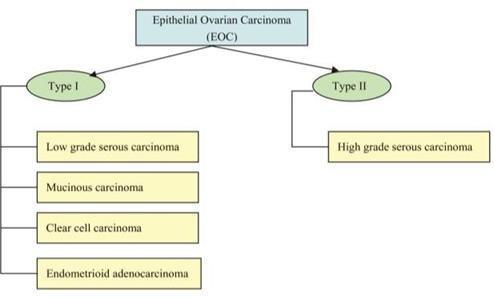
Fig-3: Differenttypesandsubtypesofepithelialovarian carcinoma
6. Screening and diagnosis
Thelackofcertainsymptomsinpatientsmakesitextremely difficult to diagnose ovarian carcinoma at an early stage, whichlowersthepatient'schanceofsurvival.Accordingto the International Federation of Gynecologists and Obstetricians(FIGO)committee,imagingisacrucialfactorin determining the location and degree of ovarian cancer dissemination as well as the best course of treatment. Magneticresonanceimaging(MRI),computed tomography (CT) scans, and ultrasound are frequently utilized imaging techniques.Exploratorylaparotomyisdonetoconfirmthe etiology of ovarian cysts, and physical examination and transvaginal ultrasonography are utilized to diagnose tumors.CombiningtheSymptomIndex(SI)withabloodHE4 orCA125testcanenhancethescreeningprocessforovarian cancer. A statistical technique called the risk of ovarian cancer algorithm (ROCA) is used to screen for EOC by estimating the likelihood of a change-point based on a woman'sageandCA125profile.
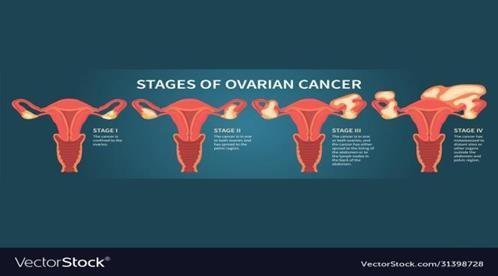
Following diagnosis, the International Federation of Gynecologists and Obstetricians (FIGO) developed a stage system for ovarian carcinoma that is primarily based on whether the cancer is confined to the ovary or has progressed to other parts of the body. Stage IIC was eliminated from the previous staging system when it was changed in 2014, and new sub-stages of IC (IC1, IC2, and IC3),IIIA(IIIA1andIIIA2),andIV(IVAandIVB)wereadded. Figure4illustratesthevariousstages.Bloating,edema,and overallabdominaldiscomfortarepossibleearlysymptoms.
Sevenmicroarrayresearchhavebeencarriedouttopredict thegeneprofilesinovariancarcinomacells,andmicroarray studies have been utilized to analyze gene expressions in carcinoma cells. Numerous parameters, including the patient'sage,performancestatus,tumorstageandascites, tumorgrade,histopathologicsubtype,obesity,surgicaldebulking,gene expression (CYP4B1, CEPT1, CHMP4A),and immunologicalfactors,werefoundtobeconnectedwiththe prognosisofEOCinarecentstudy.
Surgeryalone,withoutadjuvantchemotherapy,cancurethe cancerinthemajorityoflow-riskcasesthatareidentified early.However,patientswithahigh-gradediseasestaging (FIGO IC) have been observed to benefit from adjuvant treatment. Currently, the stage and grade of the tumor rather than its type determine the adjuvant therapy. Chemotherapycan,however,havecertainadverseeffects, including infertility, menopause, rashes on the hands and feet, mouth sores, hair loss, nausea, and vomiting. Chemotherapyoccasionallycausesbonemarrowdestruction as well, which raises the risk of infection. As a result, patients who exhibit these adverse effects cannot benefit from chemotherapy; instead, they require other forms of treatment.Womenwithadvancedovariancarcinoma(stage III–IV) who undergo surgical cytoreduction (complete abdominalhysterectomy,bilateralsalpingo-oophorectomy, removal of pelvic and para-aortic lymph nodes, and
International Research Journal of Engineering and Technology (IRJET) e-ISSN: 2395-0056
Volume: 11 Issue: 12 | Dec 2024 www irjet net
omentectomy) and platinum-based chemotherapy have shown a survival rate of 10%–30%. Another study found thathavingabilateraloophorectomyatthesametimeasa hysterectomy increased the risk of lung cancer, coronary heart disease, both fatal and nonfatal, and all-cause mortality. Patients who were given combinational chemotherapyhadasignificantlyhighersurvivalratethan those who received single chemotherapy, according to a study done on platinum-sensitive patients with ovarian carcinoma to compare the effectiveness of single chemotherapy (platinum alone) versus combinational chemotherapy(platinumpluspaclitaxel).Oneweeklydose of paclitaxel is less harmful than three weekly doses, accordingtoarecentstudy.Althoughtheuseofbiomarkers to select ovarian cancer cells has been promoted, finding these markers has proven difficult. As of right now, two indicators have been found: the overexpression of folate receptor-α in this form of cancer and the mutation in the BRCA gene, which indicates a lack of DNA repair via the homologous recombination pathway. A novel approach to treatingovariancancerincludesdose-densechemotherapy, intraperitonealchemotherapy,moleculartargetedtherapy, and optimum cytoreductive therapy. Investigating immunological checkpoints the process bywhichcancer cellsdisablethe immunesystem representsa promising treatment option for ovarian cancer in recent years. Lipkowitz and Kohn have reported using hormone replacementtherapytotreatcancer.Anotherpromisingand securemethodfortreatingovariancancerisfertilitysparing surgery(FSS).Recently,early-stageepithelialovariancancer and borderline ovarian cancers have been successfully treatedwithFSStherapy.Inadditiontobeingusedinlogical pathway-targeted therapeutic combinations, such as cotargeting PI3-kinase signaling, and dosing strategies to prevent or delay drug resistance and achieve long-term survival benefit, BRAF inhibitors (vemurafenib and dabrafenib) and MEK inhibitors (trametinib) provide ovariancarcinomapatientswithamorepromisingoption. The US Food and Drug Administration (FDA) has licensed poly(ADP-ribose) polymerase (PARP) inhibitors as a monotherapyforpatientswhohavereceivedchemotherapy inthepast.Becauseofoxygenationchanges,theinhibitors have also demonstrated synergistic activity with antiangiogenic medicines. For patients with BRCA-deficient ovarian cancer in the US and Europe, the use of these inhibitors has created an entirely new therapeutic option. medications that damage DNA, such as doxorubicin and bleomycin,havebeendemonstratedtoinhibittheexpression ofPTTG1(pituitarytumortransforminggene)andactivate p53. These medications cause cell cycle arrest in order to repairthedamagedDNA.Additionally,throughcontrolling cellulartranscription,p53facilitatesprogrammedcelldeath. Following vaccination, patients with advanced refractory gastrointestinal malignancies showed improved T-cell identification of p53 in the first human trial of the p53targeting modified vaccinia Ankara (p53MVA) vaccine. Nivolumab,ananti-PD-1immunotherapy medication,was foundtobebeneficialinapriorresearchincludingpatients withadvancedplatinum-resistantovariancancer.
p-ISSN: 2395-0072

Fig-5: Differenttreatmentsforovariancancer
characteristics Epithelialtumours Cell tumours germs
Prevalence Much more common Lesscommon
Agegroup Mainly adult women Mainly female child andyoungwomen
Affectedrace More commonin whitewomen More common in black and Asian women
Laterality Malignant serous and mucinous tumourcells bilateral
Tumourmarkers Cancer-125 a-fetoprotein
Endocrine Manifestations No Resulting from hormoneproduction.
Withahighincidencerateofupto15per100,000,ovarian canceristhemostdeadlycancerinwomenandtheleading causeofdeath.Oftheseveralformsofovariancancer,EOCis the most common. Based on the genes implicated in carcinogenesis,thestage,andtheriskfactorsinvolved,EOC isclassifiedaseitherTypeIorTypeII.Themostwidelyused methodsforovariancancerscreeninganddiagnosisinclude ultrasound,CT,andMRI.Meanwhile,thetreatmentiseither chemotherapy,surgery,ora mixofthetwo.Thecondition cannowbetreatedwithavarietyofmorerecentmedicines. Researchisunderunderwaywiththegoalofcreatingnew, efficientscreeningtechniquestoidentifytheillnessearly.
For his important advice and assistance during the successfulcompletionofthisproject,Iwouldliketoexpress myprofoundthankstomyfacultymentor,Prof.NagashriJA, of the Bapuji Institute of Engineering and Technology's InformationScienceandEngineeringDepartment.Ialsolike to thank the department head, Dr. Poornima B, for her promptsupportandencouragement.Theireffortshavebeen crucialinhelpingusaccomplishourgoals.
International Research Journal of Engineering and Technology (IRJET) e-ISSN: 2395-0056 p-ISSN: 2395-0072
Volume: 11 Issue: 12 | Dec 2024 www.irjet.net
1. MokSC,KwongJ,WelchWR,SamimiG,OzbunL, et al. Etiology and pathogenesis of epithelial ovarian cancer.Dis Markers 2007; 23(5–6): 367–376.doi:10.1155/2007/474320.
2. Landen CN Jr, Birrer MJ, Sood AK. Early events in the pathogenesis of epithelial ovarian cancer. J Clin Oncol 2008; 26(6): 995–1005. doi: 10.1200/JCO.2006.07.9970.
3. Fathalla MF. Incessant ovulation – A factor in ovarian neoplasia? Lancet 1971; 2(7716): 163. doi: 10.1016/S0140-6736(71)92335-X.
4. Tortolero-Luna G, Mitchell MF. The epidemiology of ovariancancer. J Cell Biochem 1995; 59(Suppl 23): 200–207.doi:10.1002/jcb.240590927.
5. Rao BR, Slotman BJ. Endocrine factors in common epithelial ovarian cancer. Endocr Rev 1991; 12(1): 14–26.doi:10.1210/edrv-12-1-14.
6. Risch HA. Hormonal etiology of epithelial ovarian cancer, with a hypothesis concerning the role of androgens and progesterone.J Natl Carcinoma Inst 1998; 90(23): 1774– 1786. doi: 10.1093/jnci/90.23.1774.