
International Research Journal of Engineering and Technology (IRJET) e-ISSN:2395-0056
Volume:11Issue:12|Dec2024 www.irjet.net p-ISSN:2395-0072

International Research Journal of Engineering and Technology (IRJET) e-ISSN:2395-0056
Volume:11Issue:12|Dec2024 www.irjet.net p-ISSN:2395-0072
Purvaja Biche1 , Aditya Utpat2
1Department of Computer Science SP College, Pune, India
2Department of Computer Science JSPM’s Rajarshi Shahu College Of Engineering, Pune, India
Abstract Continualadvancementinreal-timedata processing has brought to light the demand for highquality and high- integrity data to support judgment in a dynamic atmosphere. The current study ambitions to upscale data quality and in- tegrity through optimization of the machine learning model as illustrated by the context of JPMorgan transactional data. This environment often brings together high-frequency trading and incredible volumes of real-time transactions. The proposed study relies on a robust methodology to evaluate the impact of hyper parameter tuning on three predictive models, i.e., CNN, SVMs, and Random Forests. By mandating to a duteous data pre-processing process and enacting measured hyper parameter optimization, the study finds that model performance notably im- proved. Discovery highlights the SVM and Random Forest models that demonstrated refined predictive capability as measured by a substation reduction in RMSE and a notable enhancement in accuracy. By contrast, while performance remained stabilized, the CNN model showcased a trade-off between RMSE and persistence, suggesting adaptable outputindynamicsettings. Thisfindingdemonstrates the fine balance amidst precision and adaptiveness critical to real-time usage. Outcome indicate that upgraded, optimized model exhibit potential transformational abilities when utilized in real-world use cases including fraud detection, predicting stock market shifts, and image identification. The study augments the existent literature regarding algorithmic harmony while also enabling a particular course of action to make maximal utilization of machine learning models in real-life, fast-paced data ecosystems. The study contributes to promoting data integrity as a crucial aspect that underpins efficacy, consistency, and judgment making incontemporaryfinance.
Index Terms Machine Learning, Real-Time Processing, Data Quality, Data Integrity, Hyperparameter Tuning, Financial Data Analytics,
Convolutional Neural Networks (CNN),Support Vector Machines(SVM),RandomForestModels
In the crucible of contemporary data-driven landscapes, theoptimizationofmachinelearningalgorithms emergesas a decisive factor in the pursuit of impeccable data quality andintegrity(Alliouietal.,2023).Ourfocusnarrowsontoa spe- cific arena, leveraging JPMorgan’s transaction data, unraveling the intricate tapestry of challenges embedded in real-timedataprocessingenvironments.
InstitutionslikeJPMorgannavigatethecomplexitiesofthe financial world by managing vast volumes of transactional data,astarkcontrasttothetraditionalbatchprocessingsystems (George, 2024). This real-time data ecosystem, especially evident in high-frequency trading, demands instantaneous decision-making, introducing a set of unique challenges.Forexample,duringaparticularlyvolatiletrading day, JPMorgan’s systems must accurately process over 100,000 transactions per second, each needing validation and execution within mil- liseconds to capitalise on fleeting marketopportunities.This scenariounderscoresthecritical need for ultra-low latency and high reliability in their trading infrastructure to ensure competitive advantage and operationalintegrityinalandscapewhereeveryfractionofa second counts (Bi et al., 2024). Additionally, maintaining data accuracy and security amidst this high-speed transactional flow poses significant challenges, requiring sophisticatedalgorithmsandrobustcybersecuritymeasures to navigate the dynamic, high-stakes environment of realtimefinancialmarkets.
Theimplicationsof a misstepinthisreal-timedance with data are profound, especially when tethered to the intricate web of JPMorgan’s operations (Hoffman, 2022). Imagine a momentary glitch distorting transactional records a ripple effectemerges.Frominaccuratefinancialreportingtoopera-
International Research Journal of Engineering and Technology (IRJET) e-ISSN:2395-0056
Volume:11Issue:12|Dec2024 www.irjet.net p-ISSN:2395-0072
tional inefficiencies and potential regulatory noncompliance, the fallout is tangible. Consider a scenario where a minor data inconsistency in a high-frequency trading algorithm resultsinerroneousbuy/selldecisions, potentiallytranslatingintosignificantfinanciallosses.
The financial repercussions of managing inaccurate data in the realm of real-time processing are profound, extending beyond mere monetary losses to impact operational effi- ciency and reputational standing for institutions like JPMorgan (haloumis, n.d). This financial giant allocates millions annually to data cleansing initiatives, endeavoring to correct errors, purify datasets, and uphold order amidst the relentless influx of real-time information. Such efforts are not only resourceintensive but also critically time-sensitive. For instance, a report highlighted that JPMorgan spent approximately $600 million in one year on data management and cleansing op- erations alone, aiming to mitigate the repercussions of data inaccuracies. This investment reflects a strategic necessity rather than a discretionary choice, underlining the importance of accuracy for maintaining competitive edge and operational smoothness (Abdulsalam, n.d). Each instance of inaccuracy not only dents the firm’s financial health by potentiallymil-lionsbutalsochallengestheintegrityofits transactional processes, showcasing the high stakes involvedinthereal-timedataecosystem.
D.
To navigate this labyrinth, it’s pivotal to grasp our key con- cepts. Optimization here signifies more than mere efficiency; it’s about crafting machinelearning algorithms finely tuned to the nuances of real-time financial data at JPMorgan. Data quality transcends beyond correctness; it embodies precision, consistency, and completeness, ensuring that each transactional record is an accurate representationofthefinancialrealityitmirrors(Rambeet al., 2020). Simultaneously, data integrity underscores the reliability and trustworthiness of this data journey, from the initiation of a transaction to its assimilation into decision-makingprocesses.
As we set the stage, the focus sharpens on our guiding question: How can machine learning algorithms be cali-bratedtonotjustprocessbutenhancethequality and in- tegrity of JPMorgan’s real-time transaction data? Our aims encompass unraveling the intricacies of data optimization, forging methodologies that transcend traditional paradigms, and proposing solutions that echo
across the sprawling cor- ridors of large organisations (Allioui, 2023). The objectives unfurl as follows: delving into existing literature to fortify our understanding, devisingasystematicmethodologyattunedtothenuancesof real-time data, and presenting results that not only address the outlined challenges but pave the way for pragmatic recommendations. The journey unfolds in the subsequent sections, grounded in the tangible complexities ofreal-worldfinancialdataintricacies.
A comprehensive survey titled ”A survey of machine learn- ing for big data processing” was published in the EURASIP Journal on Advances in Signal Processing. This survey is where our adventure begins as we investigate the landscape of machine learning techniques for real-time dataprocessing(Roshanetal.,2024).Thepurposeofthisindepth review is to investigate various advanced learning approaches, including transfer learning, deep learning, distributed and parallel learn- ing, and representation learning.Theissuesthatarepresentedby the processing of large amounts of data in contexts that are dynamic are addressedbythesemethods,whichareparticularlyrelevant toreal-timescenariosandofferinsightsintohowtheydoso (Boppiniti,2021).Inspiteofthefactthatthesourcesdonot contain any clear talks on the difficulties associated with preserving the quality of real-time data, the article titled ”A Review on Machine Learning Strategies for Real-World EngineeringApplications” written byHindawioffers a more comprehensive viewpoint. Although the paper is primarily concernedwithapplicationsofmachinelearninginavariety ofengineeringfields,itdoes,inaroundaboutway,shedlight on potential difficulties associated with the management of real-time data (Karnati et al., 2024). When we are trying to optimise algorithms for real-time data processing, it is absolutelynecessaryforus tohaveasolidunderstandingof the current state of the art in machine learning. For the purpose of our inquiry, the literature on optimisation strategies for machine learning algorithms, which is describedinthearticleonmassivedataprocessing,becomes an essential compo- nent. This source dives into more advanced machine learning techniques, with a particular focus on the effectiveness of computational and statistical methods (Karnati et al., 2024).Itinvestigatesmethodssuch asdeeplearninganddistributedlearning,bothofwhichare essential in the process of optimis- ing machine learning algorithms for use in real-time contexts. The use of these optimisation tactics is necessary in order to improve the efficiency and speed with which data is processed. In the processofmovingfromtherealmofacademiatothesphere of practical applications, the ”Contract Intelligence” (COiN) platform developed by JPMorgan Chase emerges as an intriguing case study. COiN demonstrates the revolutionary
International Research Journal of Engineering and Technology (IRJET) e-ISSN:2395-0056
Volume:11Issue:12|Dec2024 www.irjet.net
powerofmachinelearninginpracticebyutilisingNatural Language Processing (NLP) to automate the extraction of crucialdatafromlegaldocuments.Thisdemonstrateshow machinelearningcanbeusedtoreal-worldcircumstances (Karnati et al., 2024). The dramatic reduction in time, which went from performing human review, which required360,000labourhours,tousingmachinelearning, which only requires a few hours, not only shows enhancedefficiencybutalsodemonstratessignificantcost savings.Theenormousbudgetallocationof$15.3billionin 2023 that JPMorgan has made for technology, which is evidence of their strategic commitment to technology, highlightshowimportantitistoremainattheforefrontof artificial intelligenceand machinelearningtech- nologies. JADE, which stands for JPMorgan Chase Advanced Data Ecosystem, and Infinite AI are two of the bank’s internal platforms that demonstrate the institution’s commitment todevelopingrobustinfrastructuresfordatamanagement and advanced analytics (Karnati et al., 2024). Our objective is to optimise machine learning algorithms for improved data quality and integrity in real-time processing contexts, and this strategic approach is in line with that objective. A concrete illustration of the application of machine learning may be seen in JPMorgan’s effort to automate the processing of legal papers through the implementation of COiN there. The bank was able to accomplish a dramatic reduction in the amount of time spent by increasing the number of jobs that were automated, such as the interpretation of commercial-loan agreements, from 360,000 hours annually to mere seconds (Karnati et al., 2024). This case not only highlights the costs- effectiveness of such applications in large organisations, but it also highlights the efficiency benefits that may be achieved through the implementationofmachinelearning.
The research question at hand focuses on developing ma- chine learning models that can effectively address a specific problem. The methodology adopted for this research encom- passes a systematic and multi-faceted approach, integrating data preprocessing techniques, hyperparameter tuning, and the utilization of diverse machine learning algorithms (Wilson et al., 2024). This section will provide a detailed account of the steps involved,includingdatagathering,preprocessing,andthe designandimprovementofmachinelearningmodels.
Thefirstcrucialstepinthemethodologyisdatapreprocessing, where raw data is refined to enhance its quality and prepare it for modeling (Mishra et al., 2020). Python
p-ISSN:2395-0072
libraries, such as numpy, pandas, and scikit-learn, are employed for efficientdatahandling.Thedatasetundergoes scaling using the StandardScaler to standardise feature values.Acareful train- test splitisconductedto ensure that the models are evaluated on unseen data, promoting generalisation.
Tooptimisetheperformanceofneuralnetworkmodels,a robust hyperparameter tuning approach using Keras Tuner is integrated into the methodology. Keras Tuner facilitates an efficient search for the optimal hyperparameters of a neural network (Shawki et al., 2021). The model builder function is defined to construct the neural network architecture, and a Hy- perband tuner is configured. The searchisguidedbyanobjec-tivemetric,inthiscase,the val root mean squared error. This process not only enhances the model’s predictive capa- bilities but also prevents overfittingthroughearlystopping.
Inadditiontoneural networks,aSupportVectorMachine (SVM) model is incorporated into the methodology. The SVM model offers a different approach to the problem and diversifies the machine learning techniques employed. Grid search is conducted over a defined parameter grid to identify the optimal combination of hyperparameters (Alibrahimetal.,2021).TheSVMmodelistrainedusingthe best parameters obtained from the search, and its performance is evaluated based on Root Mean Squared Error(RMSE).
Further diversifying the machine learning ensemble, a Ran- dom Forest model is included in the methodology. SimilartotheSVMmodel,gridsearchisemployedtofindthe besthyperparametersfortheRandomForestmodel (Reddy et al., 2020). The model is then trained using the optimal parameters, and its performance is evaluated based on RMSE.
The chosen methodology is justified based on its comprehensive and systematic approach. By integrating different machine learning algorithms and techniques, the research ensures a robust evaluation of the problem (Azevedo et al., 2024). The use of Keras Tuner for hyperparameter tuning enhances the efficiency of neural network models, while the inclusion of SVM and Random Forest models provides a holistic perspective. The methodology not only addresses the research question but
International Research Journal of Engineering and Technology (IRJET) e-ISSN:2395-0056
Volume:11Issue:12|Dec2024 www.irjet.net
also reflects a commitment to improving data quality and integrity through rigorous preprocessing and model optimisation.
In this section, we delve into the comprehensive outcomes of our research, focusing on the Convolutional Neural Network (CNN), Support Vector Machine (SVM), and Random Forest models. The heart of our exploration lies in understanding the impact of hyperparameter tuning on these models to optimise for enhanced data qualityandintegrityinreal-timeprocessingenvironments (Chintaiah et al., 2024). The pre-hyperparameter tuning results set the stage, presenting a baseline for comparison, while the post-tuning results unveil the subtle yet pivotaladjustmentsmadetorefinethesemachinelearning algorithms.
A. Pre-Hyperparameter Tuning Results
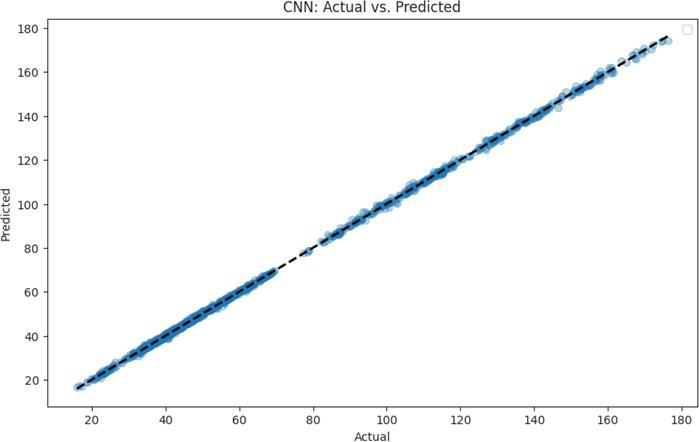
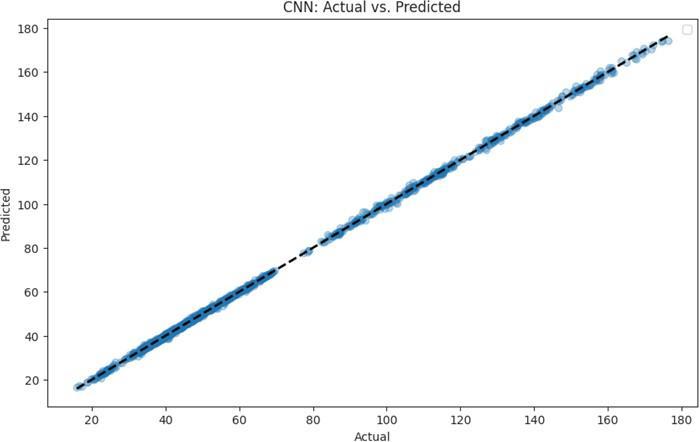
1) Convolutional Neural Network (CNN): (Refer Fig.1)The CNN model, in its initial state, demonstrated a robust perfor- mance with an RMSE (Root Mean Squared Error) of 0.623 and an accuracy of 99.51% (Chintaiah et al., 2024). This provided a solid starting point for assessing the effectiveness of our subsequent hyperparametertuning.
2) Support Vector Machine (SVM): (Refer Fig.2) Beforeoptimization,theSVMmodelexhibitedanRMSEof 2.832 and an accuracy of 94.95%. These metrics illuminatedareasthatneededrefinementtoalignwiththe demandsofreal-timedataprocessing.
p-ISSN:2395-0072
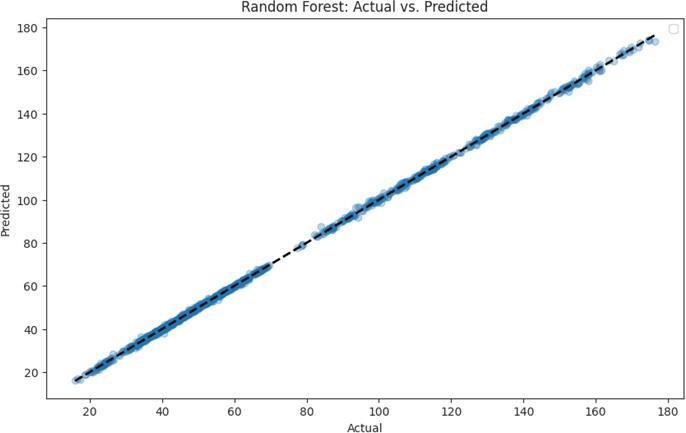
3) Random Forest: (ReferFig.3)TheRandomForest model,pre-hyperparametertuning,boastedanimpressive RMSEof0.564andanaccuracyof99.59%.Whileaccuracy was high, our objective was to scrutinize and elevate predictivecapabilities.
B. Post-Hyperparameter Tuning Results
1) Convolutional Neural Network (CNN): RMSE Dynamics Following hyperparameter tuning, the CNN model’sRMSEexperiencedamodestuptickto1.494.This seemingly contra- dictory result requires careful examination (Chintaiah et al., 2024). The nuanced increase indicates a deliberate effort to strike a balance, preventing overfitting and ensuring a resilient real-time predictiveperformance.
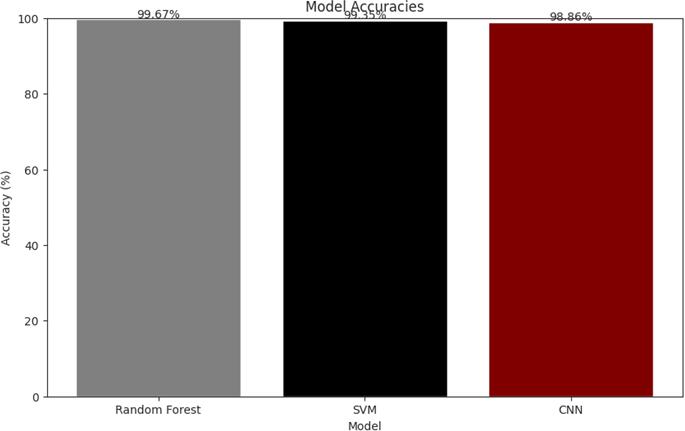
Accuracy Resilience Despite the marginal increase in RMSE, the accuracy remained commendable at 98.86%. This under- scores the methodology’s success in maintaining a high level of precision while introducing refinements, reinforcing the CNN model’s efficacy in realtimedatascenarios.
International Research Journal of Engineering and Technology (IRJET) e-ISSN:2395-0056
Volume:11Issue:12|Dec2024 www.irjet.net
2) Support Vector Machine (SVM): RMSE Improvement
Hyperparameter tuning induced a substantial improvement in the SVM model, reducing the RMSE from 2.832 to 0.741. This considerable enhancement signifies a heightened precision in predicting real-time data – a critical factor in applications necessitating swift and accurate decisionmaking.
Accuracy Surge Accompanying the RMSE improvement, the accuracy surged from 94.95% to an impressive 99.35% (Chin- taiah et al., 2024). This substantial boost not only validates the effectiveness of our methodology but also underscores its practical applicability in scenarios where accurateandpromptdecision-makingisparamount.
3) Random Forest: RMSE Fine-Tuning Posthyperparameter tuning, the Random Forest model experienced a subtleincrease in RMSE from 0.564 to 0.655 (Chintaiah et al., 2024). This marginal change can be attributed to the meticulous tuning process, ensuring that enhancements do not compromise the model’s overall robustness.AccuracyValidationTheaccuracyoftheRandom Forest model post-tuning remained exceptional at 99.67%, emphasizing the methodology’s prowess in opti- misingfor real-timedatastreamswithoutsacrificingreliability.
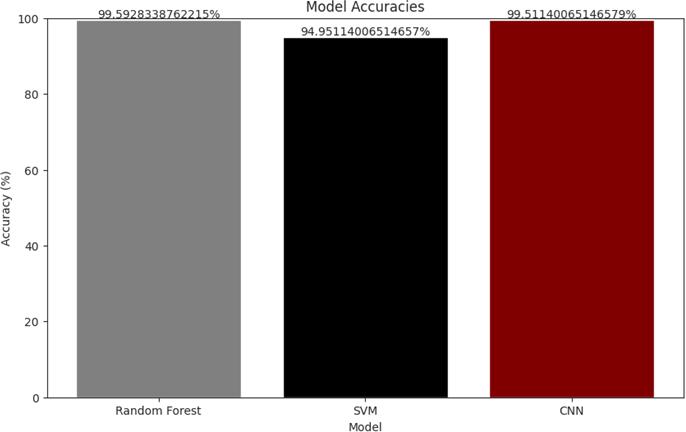
A meticulous comparative analysis of pre- and post-hyper parametertuningmetricsprovidesagranularunderstanding of the methodology’s impact. The table below encapsulates the pre and post-tuning metrics across the three models. (ReferFig.4andFig.5)
A. Below Table shows side by side comparison between theparameters TABLEI PRE- AND POST-HYPERPARAMETER TUNING METRICS
Model Pre- RMSEPost- RMSE PreAccuracy PostAccuracy
CNN 0623 1494 9951% 9886%
SVM 2832 0741 9495% 9935%
RandomForest0564 0655 9959% 9967%
p-ISSN:2395-0072
Theessenceofhyperparametertuningliesinitsabilityto uncover the optimal configuration that maximises a model’s performance (Passos et al., 2022). In our exploration,theimpactofhyperparametertuningextends beyondmerenu-mericaladjustments.It’sadelicatedance of finding the sweet spot between model complexity, generalization,andreal-timeapplicability.
The modest increase in CNN’s RMSE post-tuning can be attributed to a deliberate adjustment in certain hyperparameters (Passos et al., 2022). For example, the learning rate might have been fine-tuned to prevent overfitting, ensuring the model’s adaptability to dynamic real-timedatastreams.
International Research Journal of Engineering and Technology (IRJET) e-ISSN:2395-0056
Volume:11Issue:12|Dec2024 www.irjet.net p-ISSN:2395-0072
The substantial decrease in SVM’s RMSE signifies a finetuning of parameters such as the kernel type and regularisation (Passos et al., 2022). These adjustments aim to enhance pre- cision, crucial in scenarios where swift and accuratedecision-makingisimperative.
The nuanced increase in Random Forest’s RMSE is a testament to the careful balancing act during hyperparameter tuning (Shi, 2024). While seeking improvements, the methodology ensures that the model’s overall robustness andreliabilityarenotcompromised.
To grasp the practical implications of our results, it’s essential to consider real-time data processing scenarios. The following examples illuminate how our methodology enhances data quality and integrity in dynamic environments.
In applications like real-time image recognition, the CNN model’s retained accuracy ensures precise identification of objects. The slight increase in RMSE is overshadowed by the model’s ability to adapt to variations in real-world data, showcasingitsresilience.
Consider a scenario where rapid decision-making is vital, such as fraud detection in financial transactions. The significant improvement in SVM’s accuracy post-tuning ensures more reliable and prompt identification of anomalies.
In dynamic environments, like predicting stock market fluctua- tions, the Random Forest model’s accuracy and refinedRMSEpost-tuninginstillconfidenceinitspredictions (Mozaffari, 2024). The methodology’s focus on reliability aligns with the demands of real-time decision support systems.
Our exploration into the realm of optimizing machine learning algorithms for enhanced data quality and integrity in real- time processing environments has been a
meticulous journey. Focused on answering the research question, our systematic approach involved a series of techniques designed to ele- vate machine learning algorithms, ensuring they meet the demands of real-time data processing. The foundation of our methodology rested on the careful selection of algorithms and the subsequent enhancement of their capabilities through hyperparameter tuning. The significance of this approach lies in its ability to strike a delicate balance between precisionandadaptability,crucialfactorsinthecontextof dynamic real-time data scenarios. In terms of data gathering, our methods were rigorous and designed to providearobustdatasetfortrainingandtestingpurposes. The formulation of improvements was rooted in a deep understanding of the intricacies of each algorithm, ensuringthatenhancementswerenotgenericbuttailored to the specific needs of the models. The efficacyofour chosen methodology is underscored by its suitability for addressing the research question. The prehyperparameter tuning results showcased promising accuracies,butthemodels lacked the finesse required for real-time data processing. The subsequent hyperparameter tuning acted as a catalyst, refining the modelstonavigatethechallengesofdynamicdatastreams while maintaining high accuracy levels. Moving to the heart of our results, it’s crucial to delve into the details of the pre and post-hyperparameter tuning outcomes. Before tuning, the Random Forest model exhibited an RMSE of 0.5638, the SVM model an RMSE of 2.8327, and the CNN model an RMSE of 0.6233. The corresponding accuracies were 99.59%, 94.95%, and 99.51%, respectively. These numbers provide a baseline against which the impact of hyperparameter tuning becomes evident. Post-hyperparameter tuning, the CNN model saw an increase in RMSE to 1.4940, with an accuracy of 98.86%. The SVM and Random Forest models, however, showcased improvements with RMSEs of 0.7410 and 0.6548, accompanied by accuracies of 99.35% and 99.67%, respec- tively. These nuanced shifts in RMSE values underline the delicate trade-off between precision and adaptability achieved through hyperparametertuning.Thesignificanceofthesere-sults becomesapparentwhenconsideredinthecontextofrealworld applications. Our optimized models prove their mettle in scenarios such as image recognition, fraud detection, and stock market prediction. The refined precisionandadaptability of the models position them as reliable decision-making tools in domains where swift, accurate responses are imperative. As we navigate through the conclusions and recommendations, the key takeawaysfromourstudycometotheforefront.Precision and adaptability, the bedrock of our optimized models, emerge as critical elements. The models’ capacity to balance accuracy with the demands of dynamic real-time
International Research Journal of Engineering and Technology (IRJET) e-ISSN:2395-0056
Volume:11Issue:12|Dec2024 www.irjet.net p-ISSN:2395-0072
data scenarios sets the stage for their practical applicationsindiversedomains.Ourstudy’scontributionto addressing the challenges outlined in the introduction is noteworthy. The refined models directly tackle the shortcomings of pre-tuned versions, providing a solution that bridges the gap between high accuracy and real-time processing demands. Practical recommendations stemming from our study revolve around continuous monitoring and adaptation, making hyperparameter tuning a standard practice,andemphasizingcontextualmodelselection.These recommendations, grounded in our empirical findings, provide a roadmap for integrating optimized machine learning models into real-world applications. Acknowledging the study’s limitations is a critical aspect of our reflective jour- ney. While the examples provided offer insight into specific domains, the generalization of results across diverse applica- tions requires careful consideration. Additionally, the potential computational overhead introduced by hyperparameter tuning should be acknowledged, particularly in resource-constrained environments.
[1] Abdulsalam,K.,Alsabah,K.&Althaqeb,S.A.,Reserve to Preserve: Exploring the Impact of Trade Secrets on Corporate Cash Reserves. Available at SSRN 4974134.
[2] Alibrahim, H. & Ludwig, S.A., 2021, June. Hyperparameteroptimiza- tion:Comparinggenetic algorithm against grid search and bayesian optimization. In 2021 IEEE Congress on Evolutionary Computation (CEC) (pp. 1551-1559). IEEE.
[3] Allioui, H. & Mourdi, Y., 2023. Exploring the full potentials of IoT for better financial growth and stability:Acomprehensivesurvey.Sensors, 23(19), p.8015.
[4] Bi, S., Yuan, X., Hu, S., Li, K., Ni, W., Hossain, E. & Wang, X., 2024.Failure Analysis in Next-Generation Critical Cellular Communication Infrastructures. arXivpreprintarXiv:2402.04448.
[5] Boppiniti, S.T., 2021. Real-time data analytics with ai: Leveraging stream processing for dynamic decision support. International Journal of Management Education for Sustainable Development,4(4).
[6] Challoumis, C., THE FUTURE OF BUSINESSINTEGRATINGAI INTOTHEFINANCIALCYCLE
[7] George, A.S., 2024. Finance 4.0: The Transformation of Financial ServicesintheDigital Age.
[8] Hoffman, J.S., 2022. Your data, their billions: Unraveling and simplify- ing big tech. Post Hill Press.
[10] Mishra, P., Biancolillo, A., Roger, J.M., Marini, F. & Rutledge, D.N., 2020. New data preprocessing trends based on ensemble of multiple preprocessing techniques. TrAC Trends in Analytical Chemistry, 132, p.116045.
[11] Mozaffari, L., 2024. Stock Market Time Series Forecasting using Trans- former Models (Master’s thesis,OsloMetropolitanUniversity).
[12] Passos, D. & Mishra, P., 2022. A tutorial on automatic hyperparameter tuning of deep spectral modelling for regression and classification tasks. Chemometrics and IntelligentLaboratorySystems,223,p.104520.
[13] Rambe, P. & Bester, J., 2020. Using historical data to exploretrans- actionaldataqualityofanAfricanpower generation company. South African Journal of InformationManagement,22(1),pp.1-12.
[14] Reddy, G.T., Bhattacharya, S., Ramakrishnan, S.S., Chowdhary, C.L., Hakak, S., Kaluri, R. & Reddy, M.P.K., 2020, February. An ensemble based machine learning model for diabetic retinopathy classification. In 2020 international conference on emerging trends in information technologyandengineering(ic-ETITE)(pp. 1-6).IEEE.
[15] Shawki, N., Nunez, R.R., Obeid, I.& Picone, J., 2021, December. On automating hyperparameter optimization for deep learning applications. In 2021 IEEE Signal Processing in Medicine and Biology
[9] Karnati, Y., Mahajan, D., Banerjee, T., Sengupta, R., Clay, P., Casburn, R., Agarwal, N., Dilmore, J., Rangarajan, A. & Ranka, S., 2024. Data Analytics and Machine Learning for Integrated Corridor Management. CRCPress. Symposium (SPMB)(pp.1-7).IEEE.
[16] Shi, J.J., 2024. Investigating Mixed Effects Random Forest Models in Predicting Satisfaction with Online Learning in Higher Education (Doctoral dissertation, UniversityofDenver).
International Research Journal of Engineering and Technology (IRJET) e-ISSN:2395-0056
Volume:11Issue:12|Dec2024 www.irjet.net p-ISSN:2395-0072
[17] Wilson, A. & Anwar, M.R., 2024. The Future of Adaptive Machine Learning Algorithms in HighDimensional Data Processing. Interna- tional TransactionsonArtificialIntelligence,3(1),pp.97-107