
International Research Journal of Engineering and Technology (IRJET) e-ISSN: 2395-0056
Volume: 12 Issue: 01 | Jan 2025 www.irjet.net p-ISSN: 2395-0072

International Research Journal of Engineering and Technology (IRJET) e-ISSN: 2395-0056
Volume: 12 Issue: 01 | Jan 2025 www.irjet.net p-ISSN: 2395-0072
Santosh kumar Gupta1, Devesh kumar 1
1Department of Mechanical Engineering, Madan Mohan Malaviya University of Technology, Gorakhpur, Uttar Pradesh -273010, India
Abstract - Pure water is essentialfor humanlifealongwith agriculture, industry, and environmental sustainability, necessitating efficient purification methods. This study investigates an innovative solar distillation system incorporatingapassivebuilt-insolarwaterheatertoenhance efficiency in regions with abundant solar energy. Solar stills augmented with phase-change materials and nanoparticles were evaluated through combined experimental and theoreticalapproaches.
The integration of nano additives, particularly with paraffin wax, significantly improved system performance, yielding higher productivity, efficiency, and CO₂ reduction. The modifiedstillsdemonstratedenergyefficiencyimprovements of 35.23%, 44.12%, and 46.81%, alongside productivity increasesof37.8%,22.5%,and33.5%.Theresultsunderscore the economic and environmental viability of enhanced solar desalination systems, offering a promising solution for sustainable water purification.
Key Words Hybrid Solar stills; Exergy Approach; Yield; Phase change material; Nanoadditives
1.INTRODUCTION
Energyisafundamentalandessentialelementinourdaily lives.Solarenergyisaparticularlypromisingsourcesince it'svirtuallyinexhaustible.Theavailableenergyofabundant sunshineinIndia,particularlyinruralandtropicalregions, isavaluablenaturalresourceforharnessingsolarenergy.As mentioned,theglobalsolarradiationreceivedinaparticular location is affected by various factors, like cloud cover, amount of water vapor in the atmosphere, and other elementslikedustparticles,carbondioxide(CO2),nitrogen (N2), oxygen (O2), and ozone (O3). The quantity of energy from sun which comes the Earth's outer surface can be influenced by these variables [1-2]. Most of this solar resource,it'sessentialtoanalyzelong-termmeteorological data on solar radiation [3]. Such data can help in understanding not only the interrelationships between different components of solar radiation but also the statisticalcharacteristicsoftheirdistributions.Thisanalysis can be critical for designing and optimizing solar energy systemsandpredictingenergygenerationpatterns[4].
Oneapproachmentionedisthecalculationoftotalradiation hourly values by comparing them to daily solar radiation.
This approach is common in solar energy modeling and forecasting.Byexamininghowdailysolarradiationrelates to hourly values, researchers and engineers can develop modelsandalgorithmstoestimatesolarradiationlevelsat finertimeintervals.Thesemodelsconsiderfactorslikecloud cover,atmosphericconditionsandgeographicallocationto provide more accurate and detailed solar radiation predictions[5][6].
InIndia'scontext,wheresolarenergypotentialishigh,such analysesandmodelingeffortsareimportantfortheeffective deployment of solar power systems. Additionally, advancements in solar technology and improvements in forecastingtechniquescanfurtherenhanceandimprovethe utilizationofenergyfromsuninthecountry[4].Oneofthe bigissuesofcleandrinkingwateravailabilityfacestheworld today, particularly in coastal areas [11]. The most vital element in our daily existence is water; without it, life is impossible.Thegrowingpopulationincreasestherequisite fordrinkingwater.Asolardesalination processisusedto solvethisissueandproducedrinkingwaterbyconverting saltywaterintofreshwaterbyharnessingsolarenergy[10].
Solar stills are indeed a simple yet effective method for distilling water using the heat of the sun. They are Specificallyvaluableinareaswhereaccesstocleanandsafe drinkingwaterislimitedorimpractical[5][6].Mainlytwo basictypesofsolarstills:theboxtypeandthepittype,each withitsowndesignandoperationalcharacteristics[7].Solar stillsareareliablesourceofpuredrinkingwaterinvillages and rural remote areas, the places where access to conventionalwatersourcesislimited[8][9].However,it’s important to remember that solar stills' efficiency can be impactedbyanumberofvariables,likeweatherconditions, theangleandorientationofthestill,andthequalityofcover material [10]. therefore, the output of pure water from a solarstillmayberelativelysmall,anditmaynotbesuitable for large-scale water supply. Nevertheless, they are a valuabletoolforprovidingcleanwaterinspecificsituations and can be a life-saving technology in areas with water scarcity[10][11].
The conventional solar still unit is a system designed to purify impure or saline water by using energy of sun. It operates on the principle of harnessing the sun's heat to evaporateimpurewater,leavingbehind
International Research Journal of Engineering and Technology (IRJET) e-ISSN: 2395-0056
Volume: 12 Issue: 01 | Jan 2025 www.irjet.net p-ISSN: 2395-0072

Figure 1 Distillationprocessonsolarstill contaminantsandsalt,andthencondensingthewatervapor to obtain pure, drinkable water [12-13]. Water from differentsourcesiseithertoosalinized(i.e.,havingdissolved salts) or microbe that are harmful to drink [15-16].The processofdesalination,whichtransformssaltywaterinto fresh water, provides a crucial remedy for these issues [17].The capacity of desalination worldwide is currently estimatedtobeapprox.664lakhm3/d,in2015,whileitis predictedtoreachroughly1000lakhm3/d[18].Incountry like Arabian country 17.5%, UAE 14.8%, United States 16.2%, Spain 6.4%, and Kuwait 5.8% have the highest desalinationcapacity[19].
Solarstillsareaneffectivechoiceforself-sufficientandlowcapacitywatersupplysystems,astheysolelyrequiresolar radiationtogeneratepotablewater,avoidingtheneedfor externalenergysourceslikefuelorelectricity[20].Because of its poor productivity, solar stills are not widely used. Variousresearchershaveconductednumerousstudiesinan attempttoincreaseoutputandefficiencyofstills[21][22]. Important variables influencing productivity performance andefficiencyofsolardesalinationlikestillsinclude wind speed, thickness, material of glass cover, depth of basin water, location, ambient temperature, and solar radiation intensity[23].Thesolarstill’smaximumefficiencyrecorded was 5 L/m2.day of production of fresh water under ideal operatingconditions[27-29].
Parsaetal.[26]foundthatemployinganexternalcondenser and nanofluid, solar desalination outperformed CSS. They found that the silver nanoparticles increased productivity andhadantimicrobialpropertiesatthesametime.Shoeibiet al. [32] used nanofluid to enhance the evaporation and condensationareathroughdoubleslopesolardesalination.A varietyofnanoparticles,likeTiO2,AL2O3,MWCNandCuO, weremixedwithwatertocreateananofluid.Thefindings showed that concentrations of nano powders are directly impacted by CO2 mitigation. Thermoelectric power solar desalination'senvironmentalparameterswereassessedina numerous study conducted by Shoeibi et al. [37]. The findings showed that the system's environmental parametersareincreasedwhenathermoelectricmoduleand heat sink are used. D.B. Singh et al. [45] worked with
medium-clustered nanoparticles in their system. Water + TiO2 and Water + Al2O3 are employed as nanoparticles at variedconcentrations.C.Gnanaveletal.[46]conductedan experimental analysis of productivity in Chennai and corroboratedtheirfindingsusingCFDstudies.Karthikeyan Alaguetal.[47]usedPCM’stoimprovesolarstillefficiency andperformancewhichmixed1%concentratednanofluidin water. Productivity of solar desalination improves and enhancesbyusingnanoadditivesalongwithphasechange material’s[49-51].
Themoleculesofwatervaporarecontainedintheareathat the solar still encloses and large number of air particles. These molecules are moving randomly and could collide withtheglasscoverandthewallsurfacesinside.Whenthe sun rises in the early morning, solar radiation intensity enters the solar still via transparent glass material and strikesthewaterwithin.Becauseofkineticenergy,thestill's interiortemperaturerises,increasingmolecularmotion.Asa result,themoleculescrashintooneanotherquickly.Because ofthis,themoleculesofvapornearthewallsadheretothem and release condensation heat, changing their phase from vapor to liquid. As a result, yielding begins very early because of solar radiation, which only produces distillate when glass covers (caused by opaque, toughened transparentglasssheetsandthewalls'sides)receiveenough solarradiation.Asthesunmovesfromduesouthtowest,the wallsandtheglasscoveringsallowthemostsolarradiation to enter. Because of their high absorptivity, the wall and basinlinerabsorbasignificantportionofthisradiation.The waterevaporatesasaresultofconvection,whichtransfers heatbythebasinintothewater.Thecondensationprocess beginswhenmoleculesofvaporcomeintocontactwiththe glasscoversand wallsthroughcollisionof molecules. The condensate is directed by the troughs into the outside collectionjars.
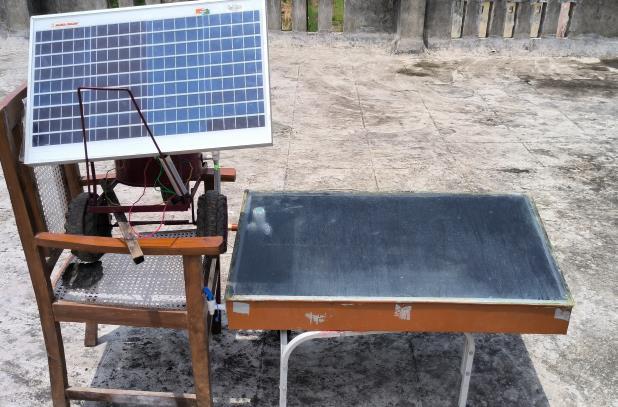
In this paper two experimental setup are constructed to analyze the productivity, heat transfer and exergy. The presentexperimentalsetupmadesingleslopetypesolarstill using opaque and crystal-clear toughened glass having a thickness of 7 mm as cover and also another setup of a modified Single slope PCM and nano particle based solar still.Inthepresentsetupflatplatetypesolarcollectorcouple withwaterheaterisusedtoenhancetheproductivityofstill.
Toevaluatetheinfluenceofvariousparametersonsolarstill productivity, hourly measurements are conducted under controlledconditions.Keyparametersrecordedincludesun intensity, wind speed, ambient temperature, wet and dry bulbtemperatures,glasssurfacetemperatures(insideand outside),vaportemperature,basinwatertemperature,plate temperature, and distilled water output. With a constant
International Research Journal of Engineering and Technology (IRJET) e-ISSN: 2395-0056
Volume: 12 Issue: 01 | Jan 2025 www.irjet.net p-ISSN: 2395-0072
basinwatermassof3.2kg,thewaterlevelinthesolarbasin is initially maintained at 15 mm, and readings are taken hourly until sunset. The same procedure is repeated by changing PCM ensuring comprehensive data collection to assessthesystem'sperformanceundervaryingconditions.
4.Thermal analysis of solar desalination
Accordingtotheenergybalanceequationsatdifferentparts ofthesolarstill[53,54],therateatwhichenergyislosttoair isequaltotherateatwhichenergyisacquiredbytheglass andfromthewatersurfacetotheglassthroughradiation, convection,andevaporation.
4.1 Heat transfer outside Surface of Glass cover:
Rateofenergyreceivedfrominnerglasscoverbyconduction = Rate of energy lost to the ambient by convection and radiation
Kg/Lg Tgi Tgo qr ,g a qc, g a. (1)
Kg/Lg (Tgi Tgo qr ,g a Tgo Ta (2)
4.2 Heat transfer inside Surface of Glass cover:
Rateofenergyabsorbedfromsolarradiation+Rateofenergy received from water mass by convection, evaporation and radiation = Rate of energy trans- ferred to glass outside surface Kg/Lg Tgi Tgo g I t s qr
(3)
4.3 Heat transfer in basin liner
Rateofenergyabsorbedfromsolarradiation+Rateof energylosttowatermassbyconvection=Rateofenergy losttotheambientbyconductionandconvec-tion qw qb (4)
4.4 Energy balance for mass of water
Rateofenergyabsorbedfromsolarradiation+Rateof energyreceivedfromba-sinlinerbyconvection+Rateof energyreceivedfromexternaldevices=Rateofenergy stored+Rateofenergylosttotheglassinnersurfaceby convection,evaporationandradiation
(5)
4.5 Total Overall thermal efficiency


Thesolarstillunit'soverallthermalefficiencyisas follows: (6) (7)
5.Result and discussions
Byraisingthetemperaturedifferentialbetweenthewater mass and condensing cover, solar radiation which is impacted by location and climate significantly increases the productivity of solar stills and increases distillate production.

International Research Journal of Engineering and Technology (IRJET) e-ISSN: 2395-0056
Volume: 12 Issue: 01 | Jan 2025 www.irjet.net p-ISSN: 2395-0072

4 VariationinBasinTemperaturewithVariousPCM inSolarStill
Figure 4 showsandexplainshowtemperatureofthebasin changes with the surrounding air temperature for various PCMsAdditionally, it is discovered that the paraffin wax havingbasintemperatureishigherthantheotherPCMbasin temperatures.Thefigure4depictsvariationofbasinambient temperaturewithrespecttotimefrom8amto7pmevening

Figure 5 : HourlyProductivityofstillwithPCM’sand withoutPCM’s
Figure 5 illustratesthehour-basedproductivityvariationof thesolarstillinallsetupsandcomparesthehourbasedyield productionofpurewarefromthesolarstillwithPCMfrom morning8:00toevening19:00.ItisdeterminedthatPCM1 resultsin36.61%higherproductivitywhencomparedtoa solarstillwithoutPCM.Whenweuseasolarwaterheater, theyieldsincreaseby28.17%more.

Figure 6 irreversibilityrateinhourlyvariation
Figure 6 comparesthehourlyproductivityvariationusing differentconstraintsonasolarstillanddisplaysthehourly yieldproductivityfrommorning8:00hrstoevening19:00 hrs.ItcomparestheyieldwhenthereisnoPCM,whenthere is a PCM . Both with and without a solar water heater attachedtoaflatplatecollector,

Figure 7 Temperaturevariationonstill these yields are found in SSSS and MSSSS. Through experimentation,itwasdiscoveredthatusingPCMandCuO inconjunctionwithasolarheaterproducedahigheryield, peaking at 3 p.m. Additionally, it is discovered that using PCM still results in a higher yield when compared to not usingPCM.
International Research Journal of Engineering and Technology (IRJET) e-ISSN: 2395-0056
Volume: 12 Issue: 01 | Jan 2025 www.irjet.net p-ISSN: 2395-0072
Figure7illustratestemperaturevariationsovertime,from 8:00 to 16:00 hrs, for three lines represented by blue, orange, and gray dashed lines. The orange line shows the water temperature inside the still having highest temperature trend, peaking at around 70°c around noon before gradually declining in the afternoon. The glass temperatureofstillingrayfollowsamoderatetrend,with temperaturesreachingamaximumofapproximately60°Cat midday. The ambient temperature in solar still in blue represents the lowest temperature, remaining relatively stable at around 40°C throughout the day. Overall, temperaturesforallthreesetsriseduringthemorning,peak atnoon,andthendeclineintheafternoon.

Figure 8 illustrates the variation of heat transfer to the workingfluidbyaSolarstillovertheexperimentduration. PCM integrated Solar still was used to preheat water by directing sunlight toward the focal line of the with and withoutPCM.Heattransferimprovementwasfoundtobe 13412,whileusingPCM
6. CONCLUSIONS
Solarstillsplayavitalroleinprovidingpurepotablewater, especially in remote and rural coastal areas. This study evaluated the performance of solar desalination devices enhanced with phase change materials (PCMs) such as paraffinwax,stearicacid,andlauricacid,alongwithcopper oxide nanoparticles as energy storage and efficiencyboostingelements.Twosolarstills,onemodifiedwithPCMs and nanoparticles and one unmodified, were constructed and analyzed under identical conditions. A solar water heaterwasalsointegratedintothesystemtoinvestigateits effect on performance. Hourly productivity of both conventional and modified solar stills was recorded and comparedtoassessimprovements.
Theresultsrevealedthatthemodifiedsolarstill,especially when connected to the solar water heater, demonstrated significantly higher productivity than the conventional system.TheuseofPCMsandnanoparticlesenhancedenergy storage and thermal performance, while the solar water heater amplified temperature differences, leading to increaseddistillationrates.Thesemodificationshighlighta promising approach to improving the efficiency of solar desalinationsystemsforsustainablewaterproduction.
[1] Akash, B.A.; Mohsen, M.S.; Osta, O.; and Elayan, Y. (1998)“Experimental evaluationofa singlebasin solar still using different absorbing materials “RenewableEnergy,14(1-4),307-310.
[2] Alawee,W.H.(2015).“Improvingtheproductivityof single effect double slope solar still by simple modification”JournalofEngineering,21(8),50-60.
[3] Alawee, W.H.; Dhahad, H.A.; and Mohamed, T.A. (2015) “An experimental study on improving the performance of a double slope solar still” The seventh International Conference on Sustainable Agriculture for Food, Energy and Industry in RegionalandGlobalContext.Selangor,Malaysia,110.
[4] Al-Jayyousi, O.” Renewable Energy in the Arab World: Transfer of Knowledge and Prospects for ArabCooperation”FriedrichEbertStintung:Bonn, Germany,2015;ISBN978-9957-484-54-5.
[5] Solar Still using Phase Change Material (Paraffin Wax)Meganathan. V, SrimanSaii. P. V, Sreerag. S, Santhanakrishnan. S Department of Mechanical Engineering,MeenakshiSundararajanEngineering College,TamilNadu,India2019
[6] Kantesh D.C ,’Design of solar still using Phase changing,materialasastoragemedium”(2012).
[7] R. Dhivagar et al.,“A case study on thermal performance analysis of a solar still basin employing ceramic magnets” Case Studies in ThermalEngineeringJournal(2022).
[8] MahmoudS.El-Sebaey etal.,”Experimental study andmathematicalmodeldevelopmentfortheeffect ofwaterdepthonwaterproductionofamodified basin solar still” Case Studies in Thermal EngineeringJournal(2022).
[9] Velmurugan V, Sritha K, Performance analysis of solar still based on various factors affecting the productivityareview.Renew.Sustain.EnergyRev; 15:1294-304(2011).
International Research Journal of Engineering and Technology (IRJET) e-ISSN: 2395-0056
Volume: 12 Issue: 01 | Jan 2025 www.irjet.net p-ISSN: 2395-0072
[10] G.N. Tiwari, “Solar energy: fundamentals, design, modeling and application,” New York/New Delhi NarosaPublishingHouse.
[11] R.H. Myers & and D. Montgomery, “Response surface methodology: process and product optimizationusingdesignedexperiments,”2ndedn. Wiley,USA(inpress)
[12] A.S.Nafey,M.Abdelkader,A.Abdelmotalip,andA.A. Mabrouk, Energy Convers Manage 937–946, 43 (2002).
[13] A.Sarı,EnergyConversManage2277–2287,44(14) (2003).
[14] S.K. Shukla, and V.P.S. Sorayan, Fuel Energy Abstr 683–699, 30(5) (2005).
[15] D.C. Montgomery, “Design and analysis of experiments,”5thedn.Wiley,NewYork.
[16] P.H. Gleick “The World’s Water 2008-2009 the Biennal Report on Freshwater Resources,” Island Press,Chicago(inpress)
[17] Global Water Intelligence (GWI/IDA Desal Data), Marketprofileanddesalinationmarkets,2009–2012 yearbooksandGWI
[18] A.Khawaji,I.KutubkhanahandJ.Wie,Desalination 47–69,221(2008).
[19] E.l.Sebaii,A.A.l.Ghamdi,F.Al-HazmiandA.Faidah, AppliedEnergy1187-1195,86(2009).
[20] H.Mousa,andM.AbuArabi,DesalinationandWater Treatment1296-1301,51(2012).
[21] S. M. Shalaby, E. El-Bialy and A. A. El-Sebaii, Desalination247-255,398(2016).
[22] A. Kabeel and S. El-Agouz, Desalination 1-12, 276 (2011).
[23] R.F. Service, Desalination freshens up. Science 1088–1090,313(2006).
[24] Sandia, Desalination and Water Purification Roadmap – A Report of the Executive Committee. DWPRProgramReport#95.U.S.Departmentofthe Interior,BureauofReclamationandSandiaNational Laboratories(2003).
[25] ParsaSM,RahbarA,KoleiniMH,AberoumandS, Afrand M, Amidpour M. A renewable energy‐driventhermoelectric‐utilized solar still with external condenser loaded by silver/
nanofluid for simultaneously water disinfection anddesalination.Desalination.2020;480:114354.
[26] DhivagarR.Aconcisereviewonproductivityand economic analysis of Auxiliary‐component‐assistedsolarstills. Energy Technol.2021;9(11):2100501.
[27] Dinesh Mevada et al.,”Experimental performance evaluationofsolarstillwithzig-zagshapeaircooled condenser: an energy exergy analysis approach” EnergyRep.(2023).
[28] A.Saxenaetal.,”Athermodynamicreviewonsolar stills”Sol.Energy(2022)
[29] R.Sathyamurthyetal.,”Areviewofintegratingsolar collectorstosolarstill”Renew.Sustain.EnergyRev (2017).
[30] A.K.Thakuretal.,”Synergeticeffectofabsorberand condensernano-coatingonevaporationandthermal performanceofsolardistillationunitforcleanwater productionSol.”EnergyMater.Sol.Cells(2022).
[31] Parsa SM, Rahbar A, Javadi Y D, Koleini MH, Afrand M,AmidpourM.Energy‐matrices,exergy, economic, environ- mental, exergoeconomic, enviroeconomic, and heat transfer (6E/HT) analysis of two passive/active solar still waterdesalination nearly 4000m:altitudeconcept. J Clean Prod.2020;261:121243.
[32] Elango C, Gunasekaran N, Sampathkumar K. Thermal models of solar still a comprehensive review. Renew Sustain Energy Rev. 2015; 47:856‐911.
[33] ShoeibiS.Numericalanalysisofoptimizingaheat sink and nanofluid concentration used in a thermoelectric solar still: an economic and environmental study. Environ Res Eng Manag 2021;77(2):110‐122.
[34] Tiwari G.N, Solar Energy, Fundamental design, modelling and application: Naraosa Publication NewDelhi;ReviseEdition2013.
[35] A.K. Thakur et al.,” Augmented perfor- mance of solardesalinationunitbyutilizationofnano-silicon coated glass cover for promoting drop-wise condensation”Desalination(2021).
[36] Shoeibi S, Rahbar N, Abedini Esfahlani A, Kargarsharifabad H.,” Improving the thermoelectric solar still performance by using nanofluids–experimental study, thermodynamic modelingandenergy matrices analysis” Sustain Energy Technol Assess,2021;47:101339.
2025, IRJET | Impact Factor value: 8.315 | ISO 9001:2008
International Research Journal of Engineering and Technology (IRJET) e-ISSN: 2395-0056
Volume: 12 Issue: 01 | Jan 2025 www.irjet.net p-ISSN: 2395-0072
[37] ShoeibiS,KargarsharifabadH,RahbarN,AhmadiG, SafaeiMR.Performanceevaluationofasolarstill using hybrid nanofluid glass cooling‐CFD simulation and environmental analysis.Sustain EnergyTechnolAssess.2022;49:101728.
[38] Shoeibi S, Kargarsharifabad H, Rahbar N, Khosravi G, Sharifpur M. An integrated solar desalinationwithevacuatedtubeheatpipesolar collector and new wind ventilator external condenser.SustainEnergyTechnolAssess.2022; 50:101857.
[39] Hassani M, Rahbar N. Application of thermoelectric cooler as a power generator in waste heat recovery from a PEM fuel cell–an experimental study. Int J Hydrogen Energy. 11/16 2015;40:15040‐15051.
[40] Sharma et al., Incorporating the Social Dimension intotheAssessmentofUrbanWaterServices:witha particularfocusonGreenfielddevelopment”National researchflagship,waterforhealthycountry(2009).
[41] Mohammed MFarid,Amar MKhudhair,Siddique Ali KRazack,SaidAl-Hallaj, ”A review on phase changeenergystorage:materialsandapplications” Energy Conversion and Management Volume 45, Issues9–10,June2004,Pages1597-1615(2004).
[42] L.F.Cabeza,A.Castell,C.Barreneche,A.de Gracia,A.I.Fernández,“Materials used as PCM in thermal energy storage in buildings: A review” RenewableandSustainableEnergyReviews,Volume 15,Issue3,April2011,Pages1675-1695(2003).
[43] AtulSharma a ,V.V.Tyagi b ,C.R.Chen a ,D.Buddhi b,” Reviewonthermalenergystoragewithphasechange materials and applications” Renewable and Sustainable Energy Reviews,Volume 13, Issue 2,February2009,Pages318-345(2009).
[44] AshokkumarSingh,D.B.Singh,V.K.Singh,A.Guptta; “Water purification using solar still with/without nano fluid: A Review” Material Today: Proceedings.(2019).
[45] C. Gnanavel, R.Saravanam , M. Chandrasekaran; “CFD analysis of solar still with PCM” Material Today:Proceedings.(2020).
[46] Karthikeyanalagu.SivaReddy,M,Narendeakumar, AndersonArunGnanaDhas; “Solar desalinationusingsolarstillenhancedbyPCMand nano fluid” (2020),AIP Conference Proceeedings2311,090008(2020).
[47] Shiparo and Moran , A book “A Fundamental of Thermodynamics”, seventh edition, John Wiley & Sons,Ltd,NewJersey,U.S.,(2014).
[48] SantoshkumarGupta,Deveshkumar,”Performance EnhancementofSolarStillCouplesWithSolarWater Heater by Using Different PCM's and Nanoparticle Combinations”,EnergyStorage,(2024),JohnWiley& SonsLtd,https://doi.org/10.1002/est2.70023
[49] Z. Ling, J. Liu, Q. Wang, W. Lin, X. Fang, Z. Zhang, MgCl2.6H2O-Mg(NO3)2·6H2Oeutectic/SiO2composite phase change material with improved thermal reliabilityandenhancedthermalconductivity, Sol. Energy Mater Sol. Cells 172 (2017) 195-201, https://doi.org/10.1016/j.solmat.2017.07.019.
[50] Y. Zhang, X. Zhang, Thermal properties of a new type of calcium chloride hexahydrate-magnesium chloridehexahydrate/expandedgraphitecomposite phase change material and its application in photovoltaicheatdissipation,Sol.Energy204(2020) 683-695, https://doi.org/10.1016/j.solener.2020.05.037
[51] V.K. Singh, D. Kumar, Sanjay, Thermal characteristicsofhydratedsaltblendedwithTiO2for thermalenergystorage,HeatTransf.51(6)(2022) 5368-5385,https://doi.org/10.1002/htj.22551
[52] V.Pethurajan,S.Sivan,Fabrication,characterisation and heat transfer study on microencapsulation of nano-enhanced phase change material, Chem. Eng. Process. 133 (2018) 12-23, https://doi.org/10.1016/j.cep.2018.09.014
[53] Omar Badran, O. (2011) Theoretical Analysis of Solar Distillation Using Active So- lar Still. International Journal of Thermal & Environmental Engineering, 3, 113-120. https://doi.org/10.5383/ijtee.03.02.009
[54] Tripathi, R. and Tiwari, G.N. (2006) Thermal Modelling of Passive and Active Solar Stills for Different Depths of Water by Using the Concept of Solar Fraction. Solar Energy, 80, 956-967. https://doi.org/10.1016/j.solener.2005.08.002