
International Research Journal of Engineering and Technology (IRJET) e-ISSN: 2395-0056
Volume: 13 Issue: 03 | Mar 2026 www.irjet.net p-ISSN: 2395-0072

International Research Journal of Engineering and Technology (IRJET) e-ISSN: 2395-0056
Volume: 13 Issue: 03 | Mar 2026 www.irjet.net p-ISSN: 2395-0072
Mayank Saxena1 , Vivek Kumar2
1Research Scholar, Department of Civil Engineering, Mewar University, Chittorgarh, Rajasthan
2Vivek Kumar, Assistant Professor, Department of Civil Engineering, Mewar University, Chittorgarh, Rajasthan***
Abstract - Geogrid reinforcement is increasingly used to improve the durability and structural efficiency of flexible pavements subjected to weak subgrades, repeated traffic loading, and environmental distress. This manuscript reorganizes the submitted M.Tech. thesis into an SCI-style research paper and evaluates the influence of biaxial and triaxial geogrids on laboratory and field performance of flexible pavement systems. The research combines California Bearing Ratio (CBR), wheel-tracking, repeated-load triaxial, flexural fatigue, and plate-load testing with six months offield monitoring and life-cycle cost analysis. Geogridreinforcement increased soaked CBR from 4.7% to 7.6%, reduced laboratory rut depth from 17.5 mm to 8.65 mm, improved resilient modulus from 144 MPa to 239 MPa, and increased fatigue life from 18,000 to 32,650 cycles. In field sections, average rut depth decreased from 15.2 mm to 7.3 mm and average FWD deflection decreased from 1.99 mm to 1.23 mm. Economic evaluation over a 20-year period showed a lower net present value for the reinforced pavement (₹76.1 lakh) than for the control section (₹94 lakh), with a benefit-cost ratio of 1.66. The results demonstrate that geogrid reinforcement improves aggregate confinement, stress distribution, and rutting resistance while providing long-term cost advantages. Among the evaluated options, triaxial reinforcement and shallower placement within the loaded zone produced the strongest response.
Key Words: flexible pavement; geogrid reinforcement; rutting resistance; resilient modulus; fatigue life; lifecycle cost analysis.
Flexible pavements are widely adopted because of their comparatively low initial cost, rapid construction, and maintainability. Their long-term performance depends on efficient stress transfer across the asphalt layer, base, subbase, and subgrade. Under modern traffic demand, premature rutting, fatigue cracking, and moisture-related deterioration have become common, especially where granular layers lose confinement or the supporting soil is weak.
Geogrids are polymeric reinforcement products designed with open apertures that mechanically interlock with aggregates.Whenplacedatcriticalinterfaces,theyreduce lateral aggregate movement, increase layer stiffness, and spreadwheelloadsoverawiderarea.Thethesisonwhich
thismanuscriptisbasedinvestigatedwhetherthesebenefits translateintomeasurablegainsinpavementcapacity,field durability,andeconomicefficiencyunderIndianconditions.
The study had four principal aims: (i) quantify the mechanical benefits of geogrid reinforcement in flexible pavementlayers;(ii)comparerutting,fatigue,modulus,and deflection behavior between reinforced and unreinforced sections;(iii)identifyfavorablegeogridtypeandplacement depth;and(iv)evaluatelong-termcost-effectivenessusing life-cyclecosting
2. Literature Survey & Survey Gap
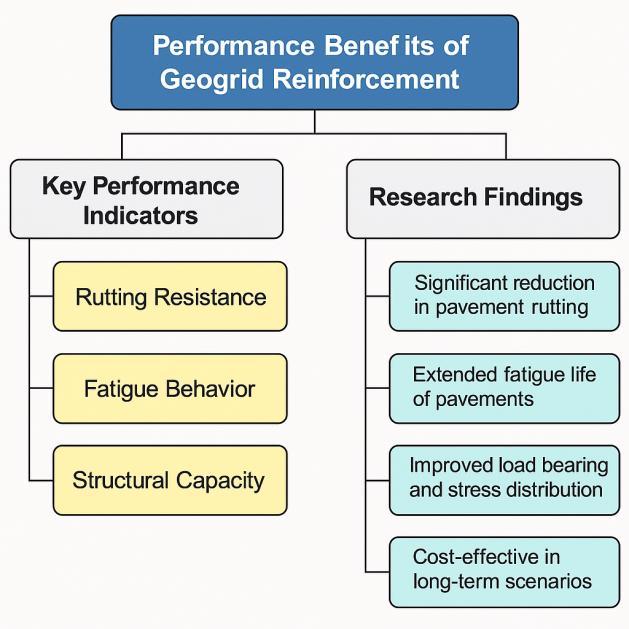
Fig -1:Conceptualsummaryoftheperformancebenefits reportedforgeogridreinforcement
Table -1: Keyfindingsandresearchgapssummarized fromtheliteraturereview
S. N. Author (s) & Year Title Methodol ogy Key Findings Research Gaps Identified
1 Ahmed &Khan (2017) Geogrid Reinforce mentin Flexible Pavement
Reviewof published laboratory andfield
Reported betterload transfer, improved confinement
Limitedrealtimefield monitoringand long-term performance
International Research Journal of Engineering and Technology (IRJET) e-ISSN: 2395-0056
Volume: 13 Issue: 03 | Mar 2026 www.irjet.net
s literature of aggregates, andreduced rutting potentialin reinforced sections
datasetsacross varyingtraffic andclimate conditions
2 Gupta & Yadav (2018)
Effectof Geogrid on Pavement
3 Sharma &Das (2016)
Rutting& Durabilit y
Laborator ytests withfield assessmen tusing FWD
Measurable reductionin surface deformation and deflection; improved stiffness responseof granular layersdueto interlock
Wheel tracker testunder controlled loading
4 Lee& Kim (2019)
Mechanic sof Reinforce d Pavement s
Finite Element Modelling (mechanis tic analysis)
Notable reductionin rutdepth andbetter resistanceto permanent deformation inwheel paths
Improved stress distribution, reduced vertical strainon subgrade, and enhanced structural response under repeated loading
Fatiguelife, crack initiation/prop agation,and performance under temperature variationsnot documented
Shorttest duration;does notcapture long-term densification, moisture effects,or aging-related behaviour
Material variability, construction imperfections, andinterface behaviour (bonding/slipp age)not adequately considered
7 Thoma s& Kumar (2020) Stateof theArt Review
Literature reviewof global practices
p-ISSN: 2395-0072
load spreading parameters
Summarized reinforceme nt mechanisms, placement locations, and performance benefits across regions
Needfor localized Indiandesign guidance, calibrationto localmaterials, andclimatespecific validation studies
8 Hossai n& Islam (2016)
Structura lCapacity with Geogrids
Fieldstudy with performan ce compariso n
Increased servicelife reported (approx.30–40%),with improved bearing behaviour andreduced distress formation
Seasonal performance (wetvsdry cycles), drainage influence,and moisture sensitivitynot capturedin detail
9 Singh& Reddy (2019)
Soil Reinforce ment Study
CBRand plateload tests
Strengthene dweak subgrades and improved load carrying capacity; reduced deformation under applied loads
Durability underrepeated trafficloading, chemicalaging, andlong-term stiffness retentionnot addressed
5 Patel& Joshi (2017)
Urban Road Case Study
Fieldtrial inurban traffic corridors
Performance improved notablyin heavytraffic zoneswith reduced ruttingand betterride quality retention
Limited transferability torural/lowvolumeroads; subgrade variabilityand drainage conditionsnot broadly evaluated
10 Jha& Bansal (2020) HighTraffic Pavement
Testtrack evaluation under heavy loading
Effectiverut controland improved deformation resistancein high-load corridors
Maintenance frequency, rehabilitation requirements, andlong-term roughness progression werenot studied
6 Ram& Soni (2018)
Pavement with Geogrids
Accelerate d pavement testing
Reinforced sections showed improved structural response, lower deformation accumulatio n,andbetter
Costanalysis andlife-cycle economic justification notsufficiently detailed; limited discussionon optimaldesign
11 Zhang etal. (2015)
Multilayer Reinforce ment FEM+ laboratory validation
12 Dixon &Jones UK Pavement
Improved stiffnessand responseat base/subbas e;reduced stresses transmitted tolower layers
Site monitorin gand
Reductionin pothole formation
Interaction effects between multiple reinforcement layersand interface conditions werenotfully verified experimentally
Costdetails, construction variability,and
International Research Journal of Engineering and Technology (IRJET) e-ISSN: 2395-0056
Volume: 13 Issue: 03 | Mar 2026 www.irjet.net
(2014)
Trials condition surveys and improved surface performance trendsover monitoring period
13 Wong &Tang (2016)
Subgrade Geosynth etics
Largescale modeltest
broader replication acrossdifferent siteswerenot included
Delayed failureonset and improved stability; reduced deformation rates comparedto unreinforce dsections
Moisture impact, drainage effects,and post-saturation performance notsufficiently investigated
p-ISSN: 2395-0072
(2022) Interactio n onand interface evaluation terface performance ;improved bondingrelated behaviour indicated tested;limited generalization acrossgrid geometries, coatings,and asphaltmixes
19 Hadi& Yousef pour (2017) Triaxial Geogrid Performa nce Rutting and deflection measurem ents
14 Rahma netal. (2020)
15 Xu& Chen (2018)
Economic Evaluatio n LCCA (Life-Cycle Cost Analysis)
Fatigue Life Enhance ment
Asphalt beam fatigue testing
Long-term costsavings and improved valueover servicelife reported under assumed conditions
Increased fatigue cyclesand delayed cracking behaviour with reinforceme ntinfluence
Region-specific costinputs, trafficgrowth uncertainty, andclimaterelated deterioration modelslacking
Hightemperature performance, thermal cracking sensitivity,and combined rutting–fatigue interactionnot assessed
20 Khanna &Singh (2011) Traffic Simulatio nModel
Triaxial geogrids performed betterthan biaxialinrut resistance and structural response Cost comparison, constructabilit ychallenges, and performance acrossdifferent aggregate typesnot addressed
VESYS-5W pavement performan ce modelling
Improved life prediction accuracy and performance projections for reinforced cases Requires calibrationfor Indiantraffic spectra,axle loads,and environmental deterioration conditions
21 Pradha n&Rao (2019) Pavedvs. Unpaved
In-situ CBRplus laboratory evaluation Reinforceme ntbenefit more pronounced in unpaved/lo w-support systems; improved bearing response Weathering, UVexposure (where relevant),and environmental degradation effectsnot accountedfor
16 Patel& Tiwari (2021) Indian Highway Applicati on
IRC37based design complianc ewith performan ce evaluation
Reported performance increaseup to~50% with reinforced sections; improved structural adequacy
Long-termfield validation acrossmultiple yearsand varying monsoon/drai nage conditionsstill pending
22 Ghosh & Mandal (2015) Wastestabilized base+ Geogrid Sustainabl ematerial trialswith reinforce ment
Reduced required layer thickness while maintaining strengthand performance indicators
Long-term strength retention, moisture susceptibility, anddurability ofstabilized layersneed moredata
17 Rames h& Nataraj an (2013) Geogrid at Different Depths Repeated loading laboratory tests
Optimum depthoften nearbase–subgrade interface; improved load distribution andreduced deformation
Influenceof soiltype, gradation variability,and different moisturestates not comprehensive lystudied
18 Nithya etal. BitumenGeogrid Binder modificati Enhanced adhesion/in Onlyone geogridtype
23 Singh& Patel (2022) Machine Learning Predictio n ANNbased modelling using available datasets Accurate predictionof pavement life/perform ance indicators for reinforced sections
24 Xuet al. (2017) Crack Propagati onStudy Fracture mechanics -based assessmen
Reduced crackwidth andslower crack
Real-time validationwith fielddatais missing;model transferability across regions/materi alsuncertain
Nopost-fatigue residual strength analysis;
International Research Journal of Engineering and Technology (IRJET) e-ISSN: 2395-0056
Volume: 13 Issue: 03 | Mar 2026 www.irjet.net
t propagation reported with reinforceme ntinfluence
limited discussionon reflective crackingunder overlays
25 Venkat eshet al. (2018)
Aggregat e Interlock Study
26 Mani& Iyer (2020)
Comparat iveCost Study
Image analysis and interlock characteri zation
Market data compariso nand economic metrics
Higher aggregate interlock and confinement when geogridsare used; improved stability indicators
Benefit–cost ratio
reported> 1.5in several scenarios; potential economic advantage highlighted
Traffic-based aging, contamination ofaggregates, andlong-term field correlationnot established
27 Thakur &Jain (2016)
Resilient Modulus Test
28 Hussai n& Abbas (2021)
MultiAxleLoad Analysis
Laborator yresilient modulus testing
Dynamic load simulator (controlle dloading)
Higher modulus and improved stiffness response observedin reinforced granular layers
Reduced stress concentratio nsand improved response undermultiaxle configuratio ns
Seasonal effects, uncertaintyin maintenance costs,and sensitivityto trafficgrowth notfullytested
Onlygranular base considered; combined effectswith different subbasetypes andmoisture statesnot explored
Onlysimulated loadsused; needsfield validation undermixed trafficand realistic temperature–moisturecycles
p-ISSN: 2395-0072
measurem ent early-life performance onlowvolume roads sourcesnot fullyanalyzed
Theexperimentalprogramusedanintegratedlaboratoryfielddesign.Twocommercialgeogridconfigurationswere examined: a biaxial geogrid, selected for reinforcement in orthogonal directions, and a triaxial geogrid, selected for multidirectional load transfer and improved confinement. Crushed aggregates conforming to IRC:SP:53-2010 were used in the base and subbase layers. The bituminous concretemixwaspreparedinaccordancewithIRC:SP:982013.ThesubgradesoilwasaclayeyCIsoilwithplasticity indexof18%,optimummoisturecontentof12%,andCBRin therangeof4-5%.
Laboratory testing included soakedand unsoakedCBR on natural and reinforced soil, wheel-tracking up to 20,000 passes, repeated-load triaxial testing for permanent deformationandresilientmodulus,flexuralfatiguetestingof beam specimens, and plate-load testing for modulus of subgrade reaction. A 100 m field trial section was then constructedwithacontrolsectionandageogrid-reinforced section and monitored under mixed traffic for six months using rut-depth surveys and falling weight deflectometer measurements.Threerepetitionswereadoptedforeachtest set.
29 Mehta & Kumar (2015)
IRCbased Field Monitori ng
Two-year fieldtrial monitorin g Pavement condition index improved ~40%; lower distress growthrate inreinforced sections
Onlytwo regions covered; limitedclimatic diversityand insufficient long-term monitoring beyond2years
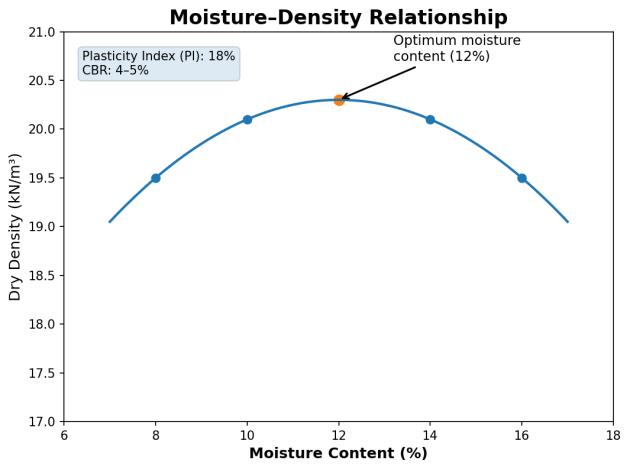
intheexperimentalprogram.
30 Lal& Sharma (2023)
LowVolume Roads Field compactio nstudy withrut
Reducedrut depth ~45%; improved
Costsensitivity androbustness acrossdifferent soils/material
4.1 CBR behavior of reinforced subgrade Geogridreinforcementimprovedbothsoakedandunsoaked CBR values, indicating enhanced subgrade support and better resistance to penetration. The best result was obtainedwhenthegeogridwasplacedatapproximatelyone-
International Research Journal of Engineering and Technology (IRJET) e-ISSN: 2395-0056
Volume: 13 Issue: 03 | Mar 2026 www.irjet.net p-ISSN: 2395-0072
thirddepth,suggestingthatreinforcementismosteffective when located close to the critical stress bulb developed underloading.
Table 2. CBR test results for the evaluated subgrade configurations
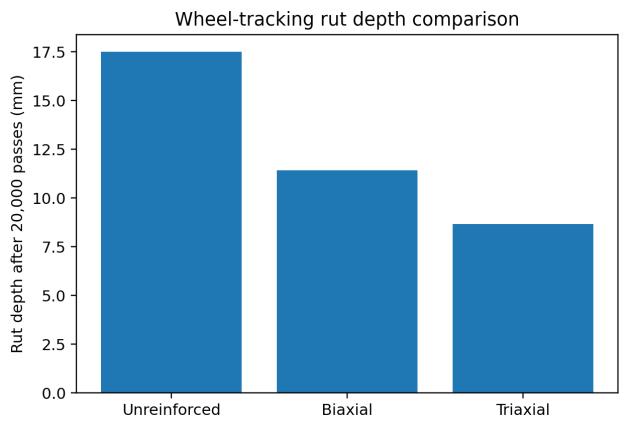
Figure 5. Wheel-tracking rut depth comparison for unreinforced, biaxial, and triaxial configurations.
4.3 Resilient modulus and fatigue response
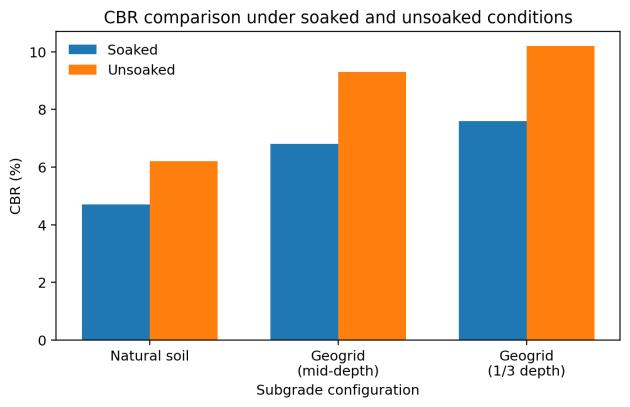
Figure 4. Comparison of soaked and unsoaked CBR values for natural and geogrid-reinforced subgrade.
4.2 Rutting resistance under wheel tracking
Wheel-trackingresultsshowedasubstantialreductioninrut depthafter20,000passes.Theunreinforcedslabexhibited 17.5mmofdeformation,whilebiaxialandtriaxialgeogrids reduced rut depth to 11.4 mm and 8.65 mm, respectively. The superior triaxial response is consistent with its multidirectional rib geometry and improved stress distribution.
Table 3. Laboratory rut depth after 20,000 wheel passes.
Repeated-load triaxial testing demonstrated a marked increase in resilient modulus with reinforcement. The modulusincreasedfrom144MPaintheunreinforcedbase to209MPawithbiaxialgeogridand239MPawithtriaxial geogrid. Flexural fatigue testing similarly showed a neardoublingoffatiguelife,indicatingimprovedcrackresistance andbettertolerancetorepeatedloading.
Table 4. Resilient modulus of the investigated baselayer materials
Material Type Resilient Modulus (MPa)
UnreinforcedBase 144
ReinforcedwithBiaxial 209
ReinforcedwithTriaxial 239
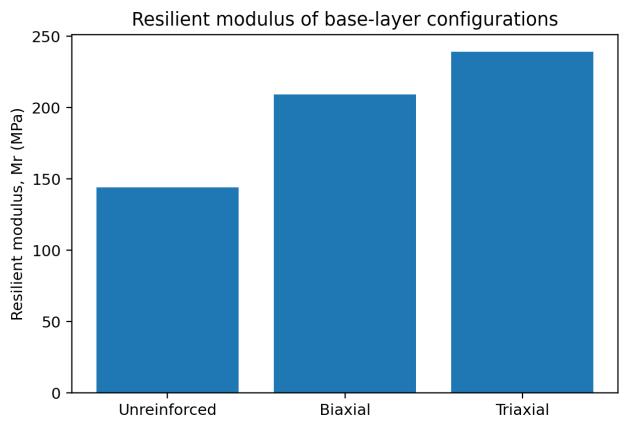
6. Resilient modulus for control, biaxial, and triaxial base configurations.
International Research
Volume: 13 Issue: 03 | Mar 2026 www.irjet.net
Table 5. Flexural fatigue life comparison between control and reinforced specimens.
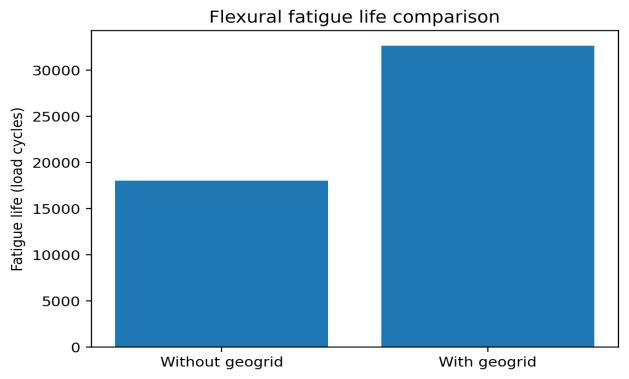
Figure 7. Improvement in fatigue life with geogrid reinforcement.
4.4 Plate-load behavior and field performance
Staticbearingresponseandfieldmonitoringsupportedthe laboratory findings. The modulus of subgrade reaction increasedfrom57to93kN/m²inplate-loadtesting.After sixmonthsoftraffic,thereinforcedfieldsectionexhibited approximatelyhalftherutdepthofthecontrolsection,and FWDdeflectionwasreducedbyabout38%,indicatingbetter structuralcapacityandlowerdeformationsusceptibility.
Table 6. Plate-load test results.
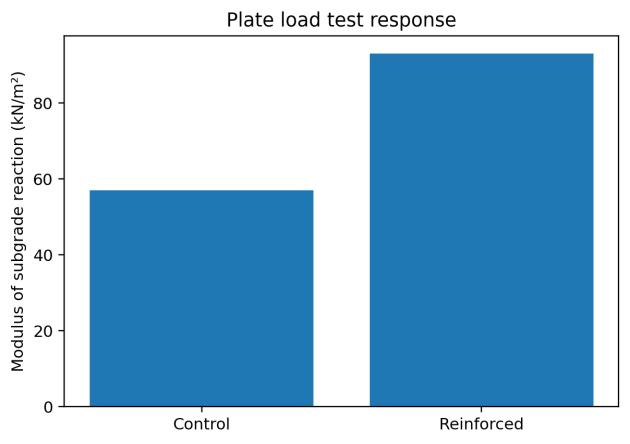
8. Plate-load test comparison for control and reinforced sections.
Table 7. Average rut depth measured in field sections after six months.
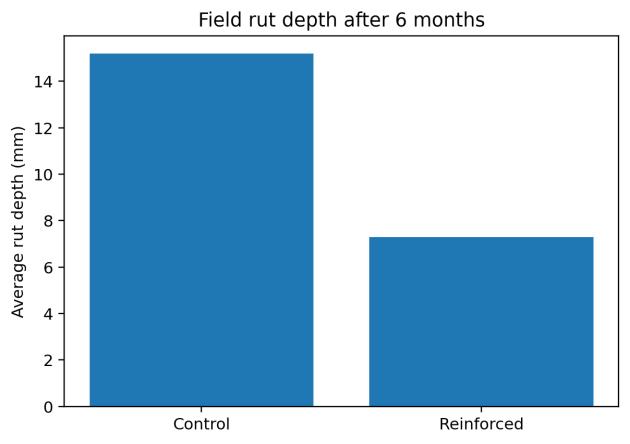
Figure 9. Field rut depth comparison between the control and reinforced pavement sections.
Table 8. Average FWD deflection values for the field sections.
International Research Journal of Engineering and Technology (IRJET) e-ISSN: 2395-0056
Volume: 13 Issue: 03 | Mar 2026 www.irjet.net p-ISSN: 2395-0072
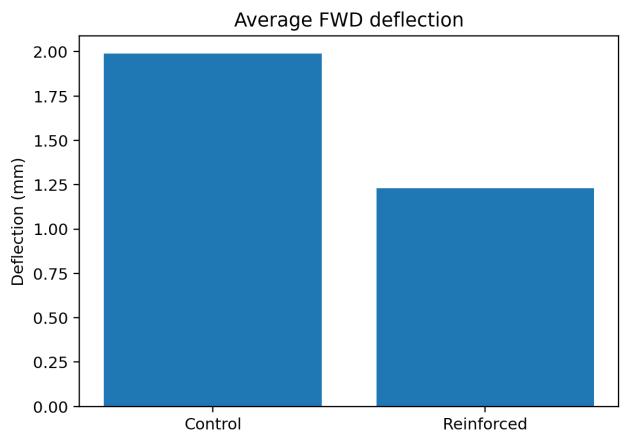
10. Average FWD deflection comparison.
4.5 Statistical and economic analysis
The thesis reportedstrong statistical relationshipsamong the measured variables. A summary dataset showed consistentgainsineverykeyperformanceparameterforthe reinforced section. Regression between resilient modulus and laboratory rut depth indicated a strong inverse relationship,andcorrelationcoefficientssimilarlyshowed that higher stiffness and CBR are associated with lower deformation. Life-cycle cost analysis demonstrated that despite a slightly higher initial construction cost, the reinforced pavement produced lower maintenance and rehabilitationcostsovertime.
Table 9. Summary of experimental data used for statistical analysis.
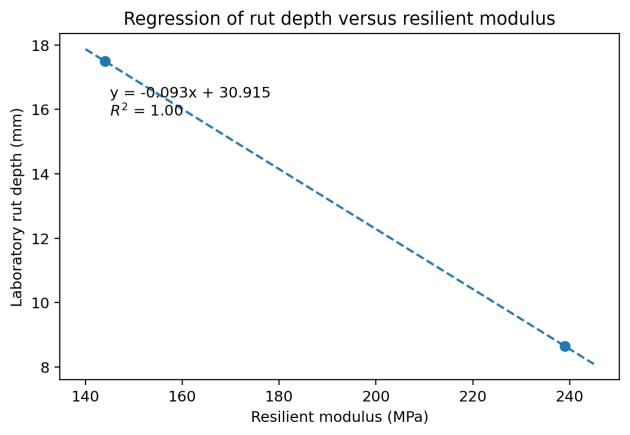
Figure 11. Regression of laboratory rut depth against resilient modulus.
Table 10. Pearson correlation coefficients among selected pavement variables.
Table 11. Life-cycle cost summary for control and geogridreinforced pavement.
International Research Journal of Engineering and Technology (IRJET) e-ISSN: 2395-0056
Volume: 13 Issue: 03 | Mar 2026 www.irjet.net p-ISSN: 2395-0072
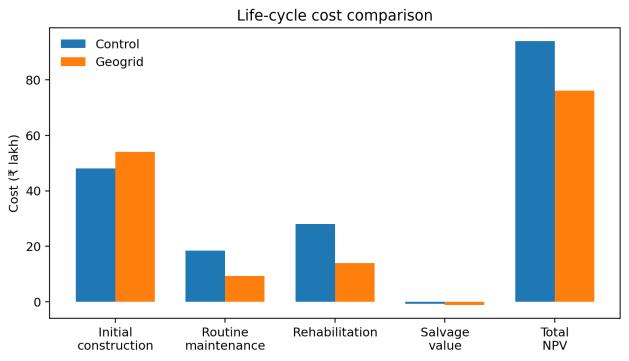
Figure 12. Life-cycle cost comparison for control and reinforced pavements.
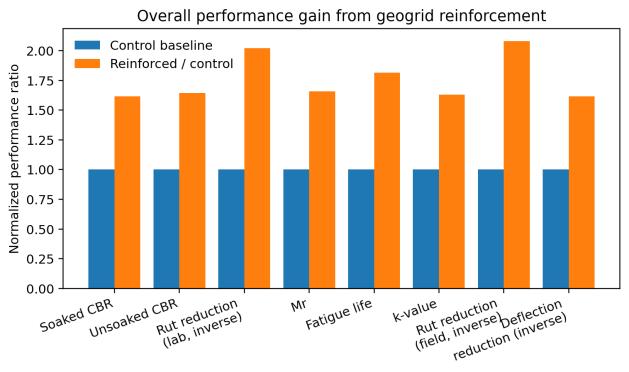
Figure 13. Normalized performance gain achieved with geogrid reinforcement across the measured indicators.
Theexperimentalprogramusedanintegratedlaboratoryfielddesign.Twocommercialgeogridconfigurationswere examined: a biaxial geogrid, selected for reinforcement in orthogonal directions, and a triaxial geogrid, selected for multidirectional load transfer and improved confinement. Crushed aggregates conforming to IRC:SP:53-2010 were used in the base and subbase layers. The bituminous concretemixwaspreparedinaccordancewithIRC:SP:982013.ThesubgradesoilwasaclayeyCIsoilwithplasticity indexof18%,optimummoisturecontentof12%,andCBRin therangeof4-5%.
5. Discussion
The results consistently demonstrate that geogrid reinforcement improves both mechanical response and short-termfieldperformanceofflexiblepavements.Gainsin CBR, modulus, and plate-load response indicate better confinementandloaddistributioninthereinforcedsystem. The rutting reductions recorded in laboratory and field sectionssupporttheinterpretationthatgeogridssuppress lateral aggregate movement and reduce permanent deformationaccumulation.
The triaxial geogrid outperformed the biaxial system in rutting and modulus outcomes, suggesting that multidirectionalribgeometrymoreeffectivelystabilizesthe granular matrix under repeated load. Reinforcement also improvedfatiguelife,whichimpliesthatastifferandbetter-
confinedsupportsystemcandelaytheonsetofcrackingin theoverlyingpavementstructure.
Theeconomicresultsareparticularlyimportantforpractice. Althoughthereinforcedpavementhadahigherinitialcost, the lower maintenance and rehabilitation requirement reduced the 20-year net present value. This supports the thesis argument that geogrids are most attractive where traffic is heavy, subgrades are weak, or maintenance interventionsaredisruptiveandcostly.
Some limitations remain. The field validation period was only six months, the study was performed on CI clay subgrade, and only two commercial geogrid types were evaluated. Longer monitoring under varied climatic conditions is therefore necessary before the findings are generalizedtoallroadclassesandenvironmentalsettings.
• Geogrid reinforcement substantially improved the mechanicalandstructuralperformanceofthetestedflexible pavementsystem.
•ThebestsubgradeCBRresponsewasachievedwhenthe geogridwasplacedatapproximatelyone-thirddepthwithin thestressedzone.
•Triaxialgeogridproducedthelowestlaboratoryrutdepth and the highest resilient modulus among the evaluated configurations.
•Reinforcementnearlydoubledfatiguelifeandsignificantly reducedfieldruttingandFWDdeflection.
• Life-cycle costing showed that geogrid reinforcement is economicallyjustifiedovera20-yeardesignperioddespite higherinitialconstructioncost.
1. Ahmed, S., & Khan, M. (2017). Geogrid reinforcement in flexible pavements: A review. InternationalJournalofRoadEngineering,12(2), 56–64.
2. Gupta, R., & Yadav, A. (2018). Effect of geogrid reinforcementonpavementperformance.Journal ofGeotechnicalEngineering,19(4),102–108.
3. Sharma,R.,&Das,S.(2016).Impactofgeogridon pavement rutting and durability. Journal of Civil Engineering,21(1),77–85.
4. Lee, J., & Kim, P. (2019). Mechanics of geogrid reinforcedpavements.ConstructionMaterialsand TechnologyJournal,18(3),44–50.
International Research Journal of Engineering and Technology (IRJET) e-ISSN: 2395-0056
Volume: 13 Issue: 03 | Mar 2026 www.irjet.net p-ISSN: 2395-0072
5. Patel,D.,&Joshi,S.(2017).Comparativestudyof geogrid reinforced pavements in urban areas. UrbanInfrastructureJournal,25(2),32–40.
6. Ram,K.,&Soni,R.(2018).Performanceanalysisof pavementswithgeogridreinforcement.Journalof PavementEngineering,14(3),99–105.
7. Thomas, M., & Kumar, R. (2020). Geogrids in pavement design: State of the art. Journal of TransportationEngineering,29(1),120–128.
8. Hossain, M., & Islam, R. (2016). Enhancement of flexible pavement performance with geogrid reinforcement. Journal of Road and Pavement Engineering,12(4),72–79.
9. Singh, A., & Reddy, K. (2019). Soil reinforcement withgeogridsforpavementdesign.Geotechnical EngineeringJournal,17(2),58–64.
10. Jha, P., & Bansal, H. (2020). Effectiveness of geogridsinpavementdesignforhightrafficloads. TrafficEngineeringandControlJournal,16(3),40–47.
11. Zhang,Y.,Wu,Y.,&Gao,S.(2015).Performanceof geogrid-reinforced base layers under cyclic loading.JournalofInfrastructureSystems,21(4), 04014042.
12. Dixon, N., & Jones, D. R. (2014). Monitoring geosynthetic-reinforced road structures. TransportationResearchRecord,2401,45–53.
13. Wong, W. P., & Tang, Y. L. (2016). Evaluation of geosynthetics in weak subgrade stabilization. GeotextilesandGeomembranes,44(3),321–330.
14. Rahman,M.M.,Hossain,M.,&Islam,R.(2020).Life cycle cost analysis of geogrid-reinforced flexible pavements. International Journal of Pavement ResearchandTechnology,13,567–576.
15. Xu, J., & Chen, S. (2018). Fatigue behavior of geogrid reinforced asphalt pavement. Materials andStructures,51(6),1–11.
16. Patel,R., & Tiwari, D.(2021).Implementationof geogrid reinforcement in national highways: A case study. Highway Engineering Journal, 15(1), 11–19.
17. Ramesh, K., & Natarajan, P. (2013). Effect of geogrid depth on pavement response. Indian Highways,41(10),17–23.
19. Hadi,M.N.S.,&Yousefpour,A.(2017).Laboratory investigation of triaxial geogrid in flexible pavements.ConstructionandBuildingMaterials, 153,245–254.
20. Khanna,S.K.,&Singh,C.E.(2011).Performance modeling of reinforced pavements using VESYS5W.IndianGeotechnicalJournal,41(3),171–178.
21. Pradhan, B., & Rao, K. (2019). Performance comparison of reinforced unpaved and paved roads. Transportation Infrastructure Geotechnology,6(2),215–232.
22. Ghosh, R., & Mandal, A. (2015). Sustainable pavement design using industrial waste and geogrids.JournalofCleanerProduction,87,796–804.
23. Singh, A., & Patel, K. (2022). Machine learningbasedpavementlifepredictionusinggeogriddata. AutomationinConstruction,136,104189.
24. Xu,C.,Wang,X.,&Yu,T.(2017).Geogrideffecton crack propagation in flexible pavements. EngineeringFractureMechanics,185,180–194.
25. Venkatesh, K., Rao, G. V., & Reddy, D. V. (2018). Investigation on aggregate interlock in geogrid pavements.MaterialsToday:Proceedings,5(11), 24631–24638.
26. Mani,B.,&Iyer,S.R.(2020).Cost-benefitanalysis of geosynthetic-reinforced road projects. International Journal of Sustainable Transportation,14(5),356–366.
27. Thakur, R., & Jain, N. (2016). Modulus enhancement in granular layers using geogrids. ProcediaEngineering,143,870–877.
28. Hussain, R., & Abbas, S. (2021). Response of geogrid-stabilized roads under dynamic loads. TransportationGeotechnics,26,100438.
29. Mehta,A.,&Kumar,A.(2015).Fieldmonitoringof flexible pavements reinforced with geogrids. IndianRoadCongressJournal,76(12),34–41.
30. Lal, P., & Sharma, M. (2023). Performance of geogrid-reinforced low-volume roads. International Journal of Pavement Engineering, 24(2),127–140.
18. Nithya, S., Iqbal, K. K., & Prakash, B. (2022). Evaluation of bitumen–geogrid interface performanceusingDSR.JournalofMaterialinCivil Engineering,34(4),04022015.