
International Research Journal of Engineering and Technology (IRJET) e-ISSN: 2395-0056
Volume: 12 Issue: 03 | Mar 2025 www.irjet.net p-ISSN: 2395-0072
International Research Journal of Engineering and Technology (IRJET) e-ISSN: 2395-0056
Volume: 12 Issue: 03 | Mar 2025 www.irjet.net p-ISSN: 2395-0072
Satyam Kumar1 and Purusharth Agarwal2
1Student, Department of AIML, Manipal University Jaipur, Rajasthan, India
2Student, Department of AIML, Manipal University Jaipur, Rajasthan, India
Abstract - In Facial Expression Recognition (FER), the landscapehasundergonearemarkableevolutioninrecent years, driven by significant breakthroughs in deep learning(DL),imageprocessing,andcognitivesciences.This study endeavors to push the boundaries of FER precision and efficacy by delving deep into the intricate nuances of facialmovementfeaturesinstaticimages.Theeffectiveness ofourproposedmethodologyissubstantiatedbycompelling results shown in Table 1. Notably, Densenet121 + GRU demonstrates exceptional performance, achieving an impressive accuracy of 99.65% on the Facial Emotion Recognition Image Dataset (Table 1). Our methodology capitalizesonthefusion of DL modelswithRNNs,namely DenseNet121 + GRU, VGG16 + GRU and Xception + GRU, theseresultsunderscoretherobustnessandeffectivenessof our approach in accurately discerning facial expressions fromstaticimages.Moreover,ourfindingsshedlightonthe untappedpotentialofintegratingdynamicfacialmovement features into FER systems. By bridging the gap between staticanddynamiccharacteristics,ourmethodologyholds promiseinenhancingtheaccuracyandreliabilityofemotion recognitionsystemsinreal-worldscenarios.Inessence,this study contributes to the ongoing advancements in FER. It pavesthewayforfutureresearchendeavorstoharnessthe full spectrum of facial movement features for superior emotionrecognitioncapabilities.
Key Words: Facial Emotion Recognition, Deep Learning, VGG16,Xception,MultimodalIntegration,TransferLearning, Real-worldDeployment.
Facial expression recognition (FER) is a pivotal domain within AI, garnering increasing attention as it forms the linchpin for effective human-computer interaction (HCL). Emotions, conveyed through facial expressions, are fundamentalcomponentsofhumancommunication[3].FER systems aim to decipher these expressions from static images or dynamic video sequences to discern the underlying psychological states of individuals [4]. Furthermore, in fields like counseling psychology, retail sales, social robotics, and e-learning, accurate FER holds profound implications for improving service delivery and userexperience.ThesignificanceofFERisunderscoredby itsdiverseapplicationsacrossmultipledomains.However, the journey towards achieving robust and accurate FER
systemsischallenging.TraditionalapproachestoFERoften relied on handcrafted features and shallow learning methods.Nevertheless,withtheadventofDL,particularly convolutional neural networks (CNNs), significant strides have been made in improving FER accuracy. CNNs are capableofautomaticallyextractingdiscriminativefeatures from facial images, thus offering promising avenues for advancingFERtechnology.
The dataset utilized in this study play a pivotal role in trainingandevaluatingourproposedFERmodels.TheFacial Emotion Recognition Image Dataset (Kaggle) comprises 18,000 images annotated with diverse emotional states, furtherenrichingthetrainingdata.Thisstudyexploresthe efficacyofseveralDLarchitecturesintegratedwithRNNsfor FER tasks. Specifically, we consider DenseNet121 + GRU, VGG16+GRUandXception+GRUmodels.Thesemodelsare meticulouslydesignedtocaptureintricatefacialexpression patternsfromstaticimages,thusenablingaccurateemotion recognition.Acomprehensivemethodologydetailingthese models' architecture and training process is elucidated in Section 4. Notably, our experimentation yields compelling results,withtheDenseNet121+GRUmodelshowcasingthe highest accuracy of 99.65% on the Facial Emotion Recognition Image Dataset (Kaggle), underscoring the robustnessofourproposedapproach.Detaileddiscussions ontheseresultsareprovidedinSection5,sheddinglighton theefficacyofourproposedFERmodels.
This paper comprehensively investigates DL-based FER, leveraging attention mechanisms to enhance model performance. Through extensive experimentation and analysis, we demonstrate the efficacy of our proposed approach in achieving accuracy levels on diverse FER datasets. The remainder of this paper is organized as follows: Section 2 presents related work in FER, while Section 3 delineates the motivation behind our proposed methodology.Section4providesadetailedexpositionofour methods, encompassing dataset descriptions, data vectorizationtechniques,andmodelarchitectures.Section5 presentsourexperimentalresultsandanalyses,followedby concluding remarks and avenues for future research in Section6.
International Research Journal of Engineering and Technology (IRJET) e-ISSN: 2395-0056
Volume: 12 Issue: 03 | Mar 2025 www.irjet.net p-ISSN: 2395-0072
Nanetal.(2022)introducedA-MobileNet,leveragingmobile architecture for efficient FER. Their approach emphasizes the importance of lightweight models for real-time applications.[1] Wen et al. (2023) proposed a Multi-head Cross Attention Network, "Distract your attention," enhancing FER performance by capturing high-order interactions among facial features. Their method demonstratestheefficacyofattentionmechanismsinFER tasks.[2] Li and Lima (2021) utilized ResNet-50 for FER, showcasing the effectiveness of CNN in capturing facial features.Theirstudyhighlightsthepotentialoftraditional DL architectures in FER.[5] Wang et al. (2020) proposed Region Attention Networks, emphasizing pose and occlusion-awareattentionmechanismsforrobustFER.Their approachhighlightstheimportanceofincorporatingspatial attention for accurate expression recognition.[6] Mollahosseinietal.(2016)introducedDLarchitecturesfor FER, demonstrating the potential of DL in capturing facial features.TheirstudyunderscorestheeffectivenessofDLin FER tasks.[7] Uddin et al. (2017) utilized DL for FER, showcasing the effectiveness of unsupervised feature learninginFER.Theirapproachhighlightstheimportanceof leveragingunsupervisedlearningforfeature extraction in FER.[8] Zhaoetal.(2021)proposedGeometry-awareFER via Attentive Graph CNN, emphasizing the importance of incorporatinggeometricinformationforaccurateexpression recognition. Their method demonstrates the efficacy of graphCNNinFERtasks.[9]Zhangetal.(2023)introduceda Transformer-basedMultimodalEmotionalPerceptionmodel fordynamicFER,highlightingtheimportanceofleveraging multimodal information. Their study emphasizes the significanceoftransformer-basedarchitecturesinFER.[10].
Wang etal.(2023)proposedPose-AwareFER Assisted by Expression Descriptions, showcasing the importance of incorporating pose information for accurate expression recognition.Theirapproachdemonstratestheeffectiveness of pose-aware models in FER tasks.[11] Zhu et al. (2023) introducedKnowledge-conditionedVariationalLearningfor one-class FER, highlighting the importance of leveraging knowledge for robust expression recognition. Their study underscores the significance of incorporating prior knowledgeintoFERmodels.[12] Maetal.(2023)proposeda Transformer-augmented Network with Online Label Correction for FER, emphasizing the importance of online learningforadaptiveexpressionrecognition.Theirapproach demonstrates the efficacy of online label correction in improving FER accuracy.[13] Kommineni et al. (2021) introduced a hybrid feature extraction technique for accurate FER, showcasing the importance of combining multiple features for robust expression recognition. Their study highlights the effectiveness of hybrid feature extraction in FER tasks.[14] Liu et al. (2023) proposed Uncertain FER via Multi-task Assisted Correction, emphasizing the importance of addressing uncertainty in FER. Their approach demonstrates the effectiveness of
multi-tasklearninginhandlinguncertainexpressions.[15] Karnatietal.(2023)introducedaBlendedFeatureAttention NetworkforFERin-the-wild,emphasizingtheimportanceof attention mechanisms for handling complex facial expressions. Their study highlights the significance of attention-basedmodelsinreal-worldFERscenarios.[16] Li et al. (2023) proposed Cross-domain FER via Contrastive WarmUpandComplexity-awareSelf-training,showcasing theimportanceofdomainadaptationforrobustexpression recognition. Their approach demonstrates the efficacy of contrastivelearningincross-domainFERtasks.[17]Chenet al. (2023) introduced Cross-domain Sample Relationship LearningforFER,highlightingtheimportanceofcapturing samplerelationshipsfordomainadaptation.Theirapproach demonstrates the effectiveness of sample relationship learning in cross-domain FER scenarios.[18] Gao et al. (2024) proposed Adaptive Global-Local Representation LearningandSelectionforCross-DomainFER,emphasizing theimportanceofadaptivefeaturelearningforcross-domain expression recognition. Their method demonstrates the efficacy of global-local representation learning in crossdomainFERtasks.[19]Voetal.(2020)introducedPyramid withSuperResolutionforin-the-wildFER,showcasingthe importanceofsuper-resolutiontechniquesforhandlinglowresolutionfacialimages.Theirapproachdemonstratesthe effectiveness of super-resolution in real-world FER scenarios.[20]Dominguez-Catena et al. (2024) proposed Metrics for Dataset Demographic Bias, emphasizing the importance of evaluating dataset bias for fair FER. Their study underscores the significance of addressing demographic bias in FER datasets.[21] Qin et al. (2023) introduced Swinface, a multi-task transformer for FER, showcasing the importance of multi-task learning for comprehensivefacialanalysis.Theirmethoddemonstrates the efficacy of transformer-based architectures in multimodalfacialanalysistasks.[22] Zhaoetal.(2023)proposed DFME, a new benchmark for dynamic facial microexpression recognition, highlighting the importance of addressing temporal dynamics for accurate microexpression recognition. Their benchmark provides a comprehensive evaluation framework for dynamic FER tasks.[23]Yeetal.(2024)introducedDep-FER,amethodfor FER in depressed patients based on voluntary facial expression mimicry, showcasing the importance of personalizedFERformentalhealthmonitoring.Theirstudy demonstrates the efficacy of personalized FER models in identifyingemotionalcuesindepressedpatients.[24]
Themotivationbehindthispaperstemsfromtheprofound impactthatFERtechnologycanhaveonvariousaspectsof our lives. In today's digital age, where human-computer interaction is becoming increasingly prevalent, FER holds immense potential to revolutionize numerous domains, rangingfromhealthcareandsecuritytoentertainmentand communication. Understanding human emotions through
International Research Journal of Engineering and Technology (IRJET) e-ISSN: 2395-0056
Volume: 12 Issue: 03 | Mar 2025 www.irjet.net p-ISSN: 2395-0072
facialexpressionsiscrucialfordevelopingempatheticand intuitive human-computer interfaces. By accurately interpreting facial cues, machines can better comprehend useremotions,leadingtomorepersonalizedandresponsive interactions.Thisnotonlyenhancesuserexperiencebutalso opens up new avenues for applications such as virtual assistants,emotion-awareeducationaltools,andtherapeutic interventions.Furthermore,infieldslikehealthcare,FERcan play a pivotal role in mental health monitoring and diagnosis.Detectingsubtlechangesinfacialexpressionscan aid in the early detection of conditions like depression, anxiety,andautismspectrumdisorders,facilitatingtimely interventionsandimprovedpatientoutcomes.Intherealm ofsecurity,FERtechnologycanbolstersurveillancesystems by enabling the detection of suspicious or abnormal behavior based on facial cues. This can help in crime prevention, crowd management, and border security, enhancingpublicsafetyand securitymeasures. Moreover, FERholdspromiseinentertainmentandgamingindustries, whereimmersiveexperiencescanbecreatedbasedonrealtime analysis of user expressions. From interactive storytellingtoemotion-drivengameplaymechanics,FERhas thepotentialtoelevateentertainmentexperiencestonew heights. Overall, the motivation behind this paper lies in harnessing the transformative power of FER to address societal needs, improve human-computer interaction, and pave the way for innovative applications across various domains.
4.1
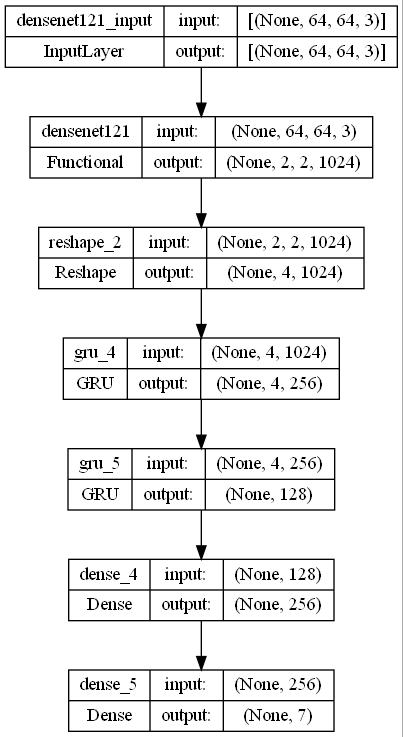
The model is designed to incorporate DenseNet121 as its core architecture. It includes a reshape layer to adapt the outputforsequentialprocessing,followedbytheadditionof twoGRUlayers,eachwith256and128units.Theselayers aim to capture temporal dependencies within facial data effectively.Furthermore,adenselayerwith256unitsand ReLU activation facilitates feature aggregation. Finally, a denselayerwithsoftmaxactivation,comprisingsevenunits for emotion classification, completes the model. This approachenablesfeatureextractionvia DenseNet121and sequentialdataprocessingthroughGRUlayers,facilitating accurateemotionrecognitionfromfacialimages. Proposed Architecturesummaryisinfig1.
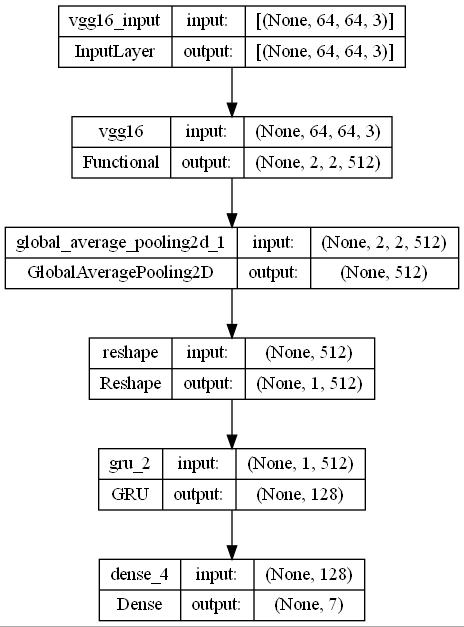
ThemodelintegratestheVGG16pre-trainedmodelwitha GRU (Gated Recurrent Unit) layer to analyze emotions depicted in facial images. Initially, VGG16 is utilized as a feature extractor after removing its top layers. Following this, a Global Average Pooling layer aggregates spatial information, while a Reshape layer introduces a temporal dimension for sequential processing. Then, a GRU layer capturestemporal patterns inherentinthedata.Finally,a Dense layer with softmax activation enables multi-class classification.ThisarchitectureeffectivelycombinesVGG16 for feature extraction and GRU for sequential analysis. ProposedArchitecturesummaryisinfig2.
International Research Journal of Engineering and Technology (IRJET) e-ISSN: 2395-0056
Volume: 12 Issue: 03 | Mar 2025 www.irjet.net p-ISSN: 2395-0072
4.3 Xception + GRU :
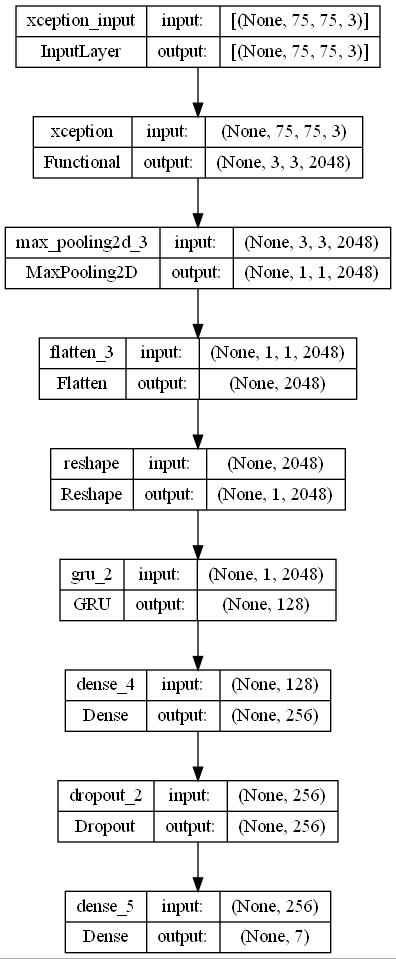
ThemodelarchitectureblendstheXceptionframeworkwith aGRUlayertoanalyzefacialimagesandforecastemotions. Initially,Xceptionisemployedtoextractfeatures,succeeded by a MaxPooling2D layer to downsize spatial dimensions. Followingthis,theoutputisflattenedandreshapedintoa3D tensortoaccommodatetheGRUlayer,crucialforcapturing temporal nuances.Furtherfeature extraction isfacilitated throughaDenselayeremployingReLUactivation,alongside dropoutregularizationtopreventoverfitting.Ultimately,a Dense layer using softmax activation predicts emotional states.Thisamalgamationoptimizesbothfeatureextraction and temporal modeling, thereby refining the accuracy of emotionclassification.ProposedArchitecturesummaryisin fig3.
4.4 Dataset Description
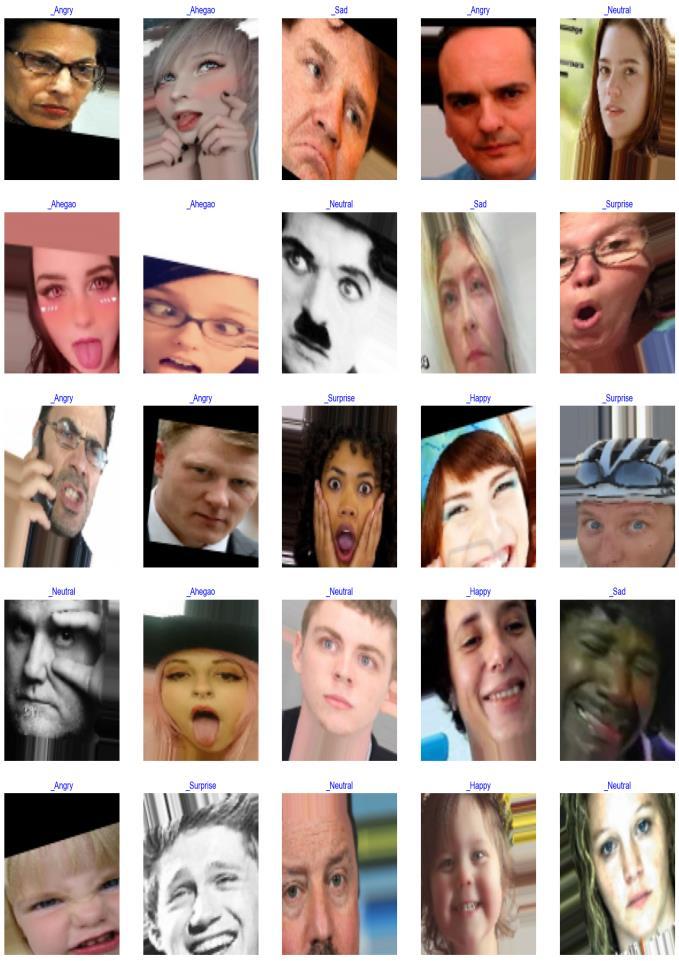
Thedatasetemployedinourstudy,namelythe"OAHEGA: EMOTION RECOGNITION DATASET," encompasses RGB imagesportrayingcroppedfacialexpressionsdenotingsix
International Research Journal of Engineering and Technology (IRJET) e-ISSN: 2395-0056
Volume: 12 Issue: 03 | Mar 2025 www.irjet.net p-ISSN: 2395-0072
distinctemotions:Happy,Angry,Sad,Neutral,Surprise,and Ahegao. In its raw form, the dataset initially comprised around18,000images.However,throughmeticulous data preprocessing and cleaning procedures, we refined and distilled the dataset to a more streamlined set of approximately17,000images.Thiscurationprocessensured a high-quality dataset, poised for robust training of facial emotion recognition models. The dataset's origin lies in a comprehensive amalgamation of sources, including social mediaplatforms,framesextractedfromYouTubevideos,and integrationofdatafromestablishedrepositorieslikeIMDB and AffectNet. Structured for ease of use, the dataset is packaged as a zip file, featuring folders categorizing each emotion,complementedbyadata.csvfileprovidingimage paths and corresponding emotion labels. This curated datasetstandsasavaluableanddiverseresource,poisedto enhancetheeffectivenessandgeneralizationcapabilitiesof facial emotion recognition models. The reference for the datasetis[26].
Meticulousevaluationofemotiondetectionmodelsacross variousclassifiers,asdepictedinthetablebelow:
Table 1: Results based on Facial Emotion Recognition Image Dataset
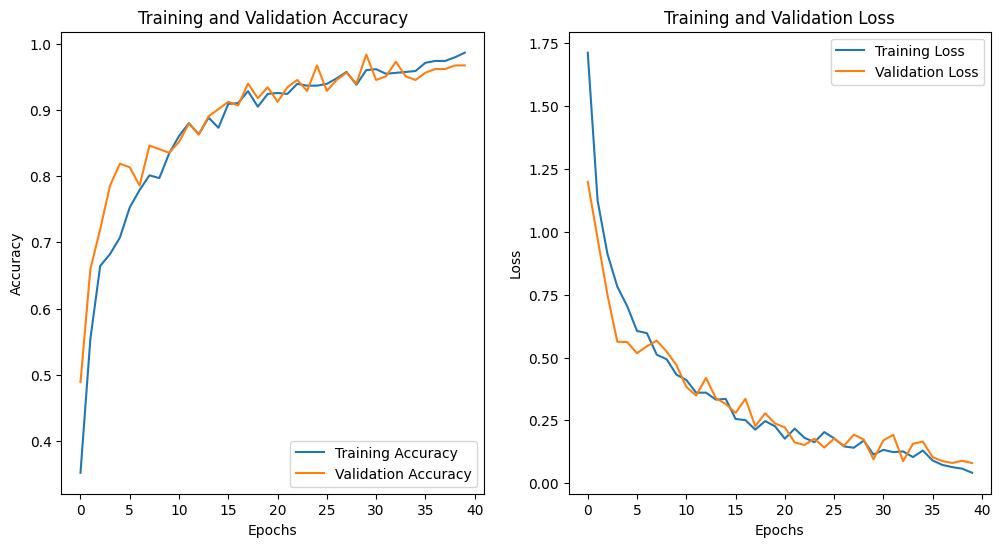
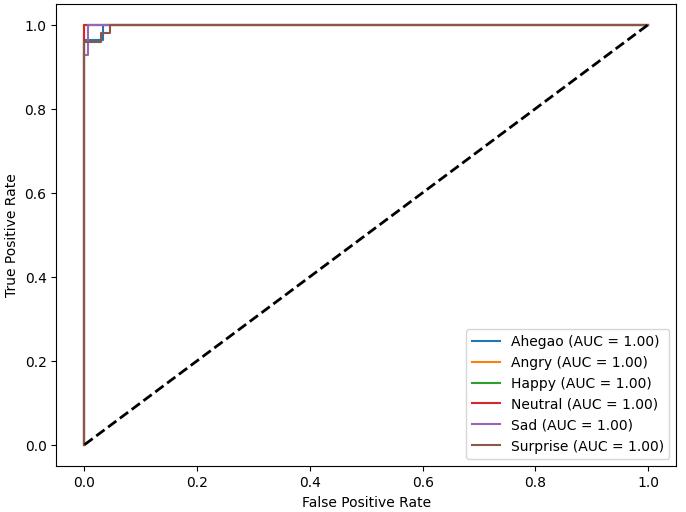
Table 1 provides a comprehensive examination of the performancemetricsfordifferentDLclassifiersinthecontext of FER. DenseNet121 combined with GRU achieved exceptional results, demonstrating near-perfect accuracy (99.65%)andF1-Score(99.57%),withperfectrecall(100%) indicating robust classification capabilities. DenseNet121 coupledwithGRUdemonstratesoutstandingperformance, achieving nearly flawless accuracy (99.65%) andF1-Score (99.57%), alongside perfect recall (100%), highlighting its robustclassificationcapabilities.VGG16integratedwithGRU deliverscommendableresults,particularlyinrecall(99%), with an accuracy of 97.58%, precision of 96.95%, and F1Score of 98%. Xception with GRU demonstrates strong performance across all metrics, achieving an accuracy of 98.27%,precisionof97.65%,recallof99.23%,andF1-Score of 98.47%, indicating its capability in handling diverse datasetsandcomplexpatterns.Accuracycurveandroccurve forDenseNet121+GRUmodelareshowninfig5&6
International Research Journal of Engineering and Technology (IRJET) e-ISSN: 2395-0056
Volume: 12 Issue: 03 | Mar 2025 www.irjet.net p-ISSN: 2395-0072
ThisresearchhasdelvedintotherealmofFER,leveragingthe power of DL to decipher the intricate nuances of human expressions. In conclusion, our exploration of FER using variousDLmodelshasunveiledinsightfulfindingsregarding theirefficacy.OuranalysisrevealsthatDenseNet121coupled withGRUdemonstratedexceptionalperformance,achieving impressive evaluation metrics on FER image dataset, showcasing its robust capability in accurately discerning facial emotions. Both VGG16 integrated with GRU and XceptionwithGRUdeliverednoteworthyperformanceacross all evaluated metrics, demonstrating their versatility and effectivenessacrossvarieddatasets.
Moving forward, our study identifies several promising avenues for future research. Exploring ensemble methods that integrate the strengths of multiple models could potentially enhance overall performance in FER systems. Furthermore, investigating transfer learning techniques, wherein pre-trained models are adapted to specific FER datasets, may mitigate the need for extensive annotation efforts and improve generalization to unseen instances. Additionally, efforts to enhance the interpretability of DL models in FER tasks hold promise in providing deeper insights into decision-making processes critical for realworld applications. Moreover, considering the temporal dynamicsoffacialexpressionsandincorporatingmultimodal data,suchasaudioandtextinputs,mayfurtherenhancethe accuracy and robustness of emotion recognition systems. Lastly,exploringreal-timeimplementationsofthesemodels on edge devices could facilitate deployment in diverse applications,includinghuman-computerinteraction,virtual reality,andaffectivecomputing.Overall,ourstudylaysthe foundationforfutureresearchendeavorsaimedatadvancing thefieldofFERanditspracticalapplications.
[1] Nan, Yahui, et al. "A-MobileNet: An approach of facial expressionrecognition."AlexandriaEngineeringJournal61.6 (2022):4435-4444.
[2] Wen,Zhengyao,etal."Distractyourattention:Multi-head cross attention network for facial expression recognition." Biomimetics8.2(2023):199.
[3]Li,Bin,andDimasLima."Facialexpressionrecognitionvia ResNet-50."InternationalJournalofCognitiveComputingin Engineering2(2021):57-64.
[4] Pham,Luan,TheHuynhVu,andTuanAnhTran."Facial expression recognition using residual masking network." 202025Thinternationalconferenceonpatternrecognition (ICPR).IEEE,2021.
[5] Ma, Fuyan, Bin Sun, and Shutao Li. "Facial expression recognitionwithvisualtransformersandattentionalselective fusion." IEEE Transactions on Affective Computing 14.2 (2021):1236-1248.
[6] Wang,Kai,etal."Regionattentionnetworksforposeand occlusion robust facial expression recognition." IEEE TransactionsonImageProcessing29(2020):4057-4069.
[7]Mollahosseini,Ali,DavidChan,andMohammadH.Mahoor. "Going deeper in facial expression recognition using deep neural networks." 2016 IEEE Winter conference on applicationsofcomputervision(WACV).IEEE,2016.
[8] Uddin,MdZia,etal."Facialexpressionrecognitionutilizing local direction-based robust features and deep belief network."IEEEAccess5(2017):4525-4536.
[9] Zhao, Rui, et al. "Geometry-aware facial expression recognition via attentive graph convolutional networks." IEEETransactionsonAffectiveComputing14.2(2021):11591174.
[10]Zhang,Feifei,MingliangXu,andChangshengXu."Weaklysupervised facial expression recognition in the wild with noisy data." IEEE Transactions on Multimedia 24 (2021): 1800-1814.
[11] Zhang, Xiaoqin, et al. "Transformer-based multimodal emotional perception for dynamic facial expression recognitioninthewild."IEEETransactionsonCircuitsand SystemsforVideoTechnology(2023).
[12] Wang, Shangfei, et al. "Pose-aware facial expression recognition assisted by expression descriptions." IEEE TransactionsonAffectiveComputing15.1(2023):241-253.
[13] Zhu, Junjie, et al. "Knowledge conditioned variational learning for one-class facial expression recognition." IEEE TransactionsonImageProcessing(2023).
International Research Journal of Engineering and Technology (IRJET) e-ISSN: 2395-0056
Volume: 12 Issue: 03 | Mar 2025 www.irjet.net p-ISSN: 2395-0072
[14] Ma, Fuyan, Bin Sun, and Shutao Li. "Transformeraugmented network with online label correction for facial expression recognition." IEEE Transactions on Affective Computing15.2(2023):593-605.
[15] Kommineni, Jenni, et al. "Accurate computing of facial expression recognition using a hybrid feature extraction technique." The Journal of Supercomputing 77.5 (2021): 5019-5044.
[16] Liu,Yang,etal."Uncertainfacialexpressionrecognition via multi-task assisted correction." IEEE Transactions on Multimedia(2023).
[17] Karnati,Mohan,etal."Facialexpressionrecognitioninthe-wild using blended feature attention network." IEEE TransactionsonInstrumentationandMeasurement(2023).
[18] Li, Yingjian, et al. "Cross-domain facial expression recognitionviacontrastivewarmupandcomplexity-aware self-training."IEEETransactionsonImageProcessing(2023).
[19] Chen, Dongliang, et al. "Cross-Domain Sample Relationship Learning for Facial Expression Recognition." IEEETransactionsonMultimedia(2023).
[20]Gao,Yuefang,etal."AdaptiveGlobal-LocalRepresentation LearningandSelectionforCross-DomainFacialExpression Recognition."IEEETransactionsonMultimedia(2024).
[21] Vo,Thanh-Hung,etal."Pyramidwithsuperresolutionfor in-the-wild facial expression recognition." IEEE Access 8 (2020):131988-132001.
[22] Dominguez-Catena, Iris, Daniel Paternain, and Mikel Galar."MetricsforDatasetDemographicBias:ACaseStudy on Facial Expression Recognition." IEEE Transactions on PatternAnalysisandMachineIntelligence(2024).
[23] Qin,Lixiong,etal."SwinFace:amulti-tasktransformerfor facerecognition,expressionrecognition,ageestimationand attribute estimation." IEEE Transactions on Circuits and SystemsforVideoTechnology(2023).
[24] Zhao,Sirui,etal."DFME:ANewBenchmarkforDynamic FacialMicro-expressionRecognition."IEEETransactionson AffectiveComputing(2023).
[25] Ye,Jiayu,etal."Dep-FER:FacialExpressionRecognitionin Depressed Patients Based on Voluntary Facial Expression Mimicry."IEEETransactionsonAffectiveComputing(2024).
[26]
(https://www.kaggle.com/datasets/sujaykapadnis/emotionrecognition-dataset)(KaggleDataset)