
International Research Journal of Engineering and Technology (IRJET) e-ISSN: 2395-0056
Volume: 12 Issue: 09 | Sep 2025 www.irjet.net p-ISSN: 2395-0072
International Research Journal of Engineering and Technology (IRJET) e-ISSN: 2395-0056
Volume: 12 Issue: 09 | Sep 2025 www.irjet.net p-ISSN: 2395-0072
Dr. Sarita Sanap1, Shrushti Baviskar2
1Department of Electronics and Computer, MIT, Chht. Sambhajinagar, Maharashtra, India, 2Post Graduate Student, MIT, Chht. Sambhajinagar, Maharashtra, India
Abstract - The paperdetailsthedesignandimplementation of a high-speed Fast Fourier Transform (FFT) processoratthe Register Transfer Level (RTL) usingVHDL,optimizedforFPGA deployment. The FFT is integral to digital signal processing, and the need for efficient,high-throughputhardwaresolutions is emphasized by the growing demands in applications like5G communications, audio/image processing, and medical imaging. The project focuses on a radix-2 approach for simplicity and scalability, developing essential components such as the butterfly computation unit, twiddle factor ROM, shift registers, and a finite state machine controller. Xilinx tools were used for simulation and synthesis, verifying correctness and resource efficiency. The modular, pipelined architecture achieves high throughput and is well suited for real-time DSP systems, bridging theoretical concepts and practical hardware realization. Future work may extend the design to support higher-point FFTs and reconfigurable architecture
Key Words: Fast Fourier Transform (FFT), Digital Signal Processing (DSP), FPGA (Field-Programmable Gate Array), VHDL (VHSIC Hardware Description Language), Radix-2 algorithm, Butterfly unit, Twiddle factor, Register Transfer Level (RTL)
The Fast Fourier Transform is a cornerstone algorithm in DigitalSignalProcessing,whichiscrucialforanalyzingand transforming signals between the time and frequency domains.Itsefficiencyhasmadeitindispensableina vast arrayofapplications,includingtelecommunications,audio andimageprocessing,medicalimaging,andradarsystems. ModernDSPsystems,particularlythoseinrapidlyevolving fieldssuchas5Gcommunication,requirehigh-speed,lowlatency,andresource-efficientimplementationsoftheFFT. The increasing complexity and performance demands of these applications necessitate robust and optimized hardwaredesignsforFFTprocessors.
Despite the widespread use of FFT, the challenges of realizing these algorithms efficiently in hardware remain significant. Achieving high throughput while minimizing resourceconsumptionandpowerisapersistentdesigngoal, particularlyforembeddedandreal-timesystems.Existing research has explored various optimization techniques,
includingdifferentradixalgorithms,pipelinedarchitectures, and multiplier-free designs, often leveraging FieldProgrammable Gate Arrays due to their flexibility and parallelism.
ThisprojectdirectlyaddressestheneedforoptimizedFFT hardwarebyfocusingonthedesignandsimulationofahighspeed FFT processor using a Very High-Speed Integrated Circuit Hardware Description Language. The primary objectivesofthisstudyareasfollows:
TodesigntheRegisterTransferLevelarchitecture ofanFFTprocessorusingVHDL.
IndividualVHDLmodulesforessentialcomponents, including the butterfly unit, twiddle factor ROM, shiftregisters,andcontrolunit,weredeveloped.
The design was simulated and rigorously verified usingXilinxtoolstoensurefunctionalcorrectness andperformance.
To synthesize the FFT processor for FPGA implementation, with a focus on achieving high speed,lowlatency,andefficientresourceutilization.
Through this project, we aim to bridge theoretical DSP conceptswithpracticalhardwarerealization,demonstrating a VHDL-based RTL design that yields an optimized digital hardwaresolutionforcritical signal-processingtasks.The remainderofthispaperdetailsthetheoreticalbackgroundof theFourierTransform,architecturaldesignoftheproposed FFT processor, implementation and verification methodologies,anddiscussionoftheresultsobtainedfrom synthesisandsimulation
FastFourierTransform(FFT)hasbeenextensivelystudied in hardware design because of its fundamental role in various digital signal processing applications. This review exploreskeydevelopmentsandarchitecturalconsiderations in FFT processor design, particularly focusing on FPGA implementations and their relevance to modern communicationsystems.
International Research Journal of Engineering and Technology (IRJET) e-ISSN: 2395-0056
Volume: 12 Issue: 09 | Sep 2025 www.irjet.net p-ISSN: 2395-0072
EarlyeffortsinFFThardwaredesign,suchasthosebyJosue SaenzS.etal.,demonstratedthefeasibilityofimplementing radix-2 DIT FFT processors on FPGAs for fixed-point transformations (e.g., 16- and 32-point). This study highlightedtheuseofcustomVHDLpackagesforcomplex numberrepresentationandeffectivedatamovementusing shift registers to optimize FPGA resource utilization, confirming the practicality of small-scale, accurate FFT processorsforfixed-sizetransformations.
Ascommunicationtechnologieshaveevolved,thedemand formoreadaptableandhigher-performanceFFTsolutions has become paramount. Daud Khan et al. addressed this need by proposing a reconfigurable and scalable FFT processorspecificallyoptimizedforLTEand5Gnetworks. Theirarchitecturefeaturesarun-timeconfigurablebutterfly structure,pipeliningforhighthroughput,in-placememory computation, and dynamic twiddle factor generation, achieving throughputs of over 245.76 Msamples/s. Complementingthis,Bautistaetal.introducedefficientserial butterflystructuresforFFTarchitectureswithnon-powerof-twolengths,cateringtotheflexibledemandsof5Gand beyond-5G systems. Their design minimizes hardware resources and memory overhead while maintaining a competitivethroughput.
Optimization techniques for hardware efficiency are a recurring theme in the design of FFT processors. Taesang Cho and Hanho Lee presented a modified Radix-25 FFT processorforhigh-speed,low-powerWirelessPersonalArea Network applications, emphasizing a simplified twiddle factor approach and a multi-path delay commutator to reducecomplexity.Inanothersignificantcontribution,Godi etal.exploredmultiplier-freeparallel-pipelinedFFTdesigns for FPGAs. By employing addition-based twiddle factor calculationsanddigitslicing,theysignificantlyreducedthe areaandpowerconsumption,makingthesedesignssuitable for resource-constrained or battery-powered DSP applications.
Beyond traditional DSP, FFT processors are becoming increasinglyintegraltoemergingapplications.ChowdaryA. etal.investigatedhybridradarandcommunicationsystems whereFFT-basedsignalprocessingenablesjointsensingand data transmission,demonstrating the potential for shared hardware and multi-functional roles in 6G and IoT infrastructure.Furthermore,theroleofFFTinOFDM-based systems is critical, as shown by Liu et al. in their work on low-complexity Peak-to-Average Power Ratio reduction usingreal-valuedneuralnetworks,whereFFTplaysakey roleinsignaltransformation.Similarly,Baigetal.discussed new multi-carrier waveform designs for 5G and future wirelesssystems,highlightingtheimportanceofFFT/IFFTbased architectures for flexible subcarrier spacing and dynamicbandwidthallocation.
Khanetal.(2025)proposedarun-timereconfigurableFFT enginecapableofperformingRadix-8,Radix-4,Radix-3,and Radix-2 computations, targeting the high-throughput and flexiblebandwidthdemandsofLTEand5Gnetworks.Their architecture addresses the challenge of supporting both power-of-twoandnon-power-of-twoFFTsizessuchas1536, whichisessentialforLTEbandwidthallocation.Bysharing resources across different butterfly configurations and employing in-place multi-bank memory with dynamic twiddle factor generation, the design optimizes hardware utilization and reduces latency while maintaining high throughput.Thedesignachievesathroughputexceeding245 Msamples/sec at a 310 MHz clock frequency, validated throughsimulationandsynthesisforFPGAplatforms.This work highlights the importance of adaptability, efficient memorymanagement,andmulti-radixcomputationtomeet the evolving requirements of next-generation wireless communicationsystems
In summary, the reviewed literature highlights a clear progressioninFFTprocessordesignfromfixedandsmallscale implementations to scalable, reconfigurable, and application-specificarchitectures.Keyadvancementsinclude thedevelopmentofoptimizedalgorithms,efficienthardware mapping techniques (e.g., multiplier-free designs and pipelining), and integration into complex systems beyond traditional signal processing. FPGA technology, due to its inherentflexibilityandparallelism,hasconsistentlyservedas a crucial platform for implementing these advancements, providinga robust foundation for high-speed,low-latency, andresource-efficientFFTsolutions.Thisextensivebodyof workunderpinsthefocusofthecurrentprojectondesigning and implementing a high-speed RTL-level FFT processor usingVHDLandXilinxtools.
ThedesignoftheFastFourierTransformprocessoroutlined in this project emphasizes modularity, high-speed computation, and efficient resource utilization, targeting Field-ProgrammableGateArrayimplementation.Theoverall operation of the processor was partitioned into three primaryprocesses:DataInput,FFTComputation,andData Output.Thissequentialprocessingallowsastreamlinedflow from raw sampled data to transformedfrequency-domain results.
ThearchitectureoftheFFTprocessorisbuiltaroundasingle radix-2butterflyunitoptimizedforiterativecomputation. Thecorecomponentsincludethefollowing:
Butterfly Processing Element: The fundamental computationalunit.
International Research Journal of Engineering and Technology (IRJET) e-ISSN: 2395-0056
Volume: 12 Issue: 09 | Sep 2025 www.irjet.net p-ISSN: 2395-0072
Dual-Port FIFO RAM: For data storage and retrieval.
Coefficient ROM:Tostore pre-computedtwiddle factors.
Controller:Tomanagetheoperationalflow.
Address Generation Unit:ToSuppliesthecorrect memoryandROMaddresses.
Cycles Unit:Thissynchronizesinternaloperations acrossdifferentclockphases.
Counter Unit:Fortiming-specificdelayswithinthe processingcycle.
Datapathwayswithintheprocessorareconfiguredfor32bitsignedfractions,whereascoefficientsarestoredas32-bit words,ensuringappropriateprecisionforDSPoperations.
2.1 Butterfly Processing Element
Thebutterflyisthecorecomputationalblockresponsiblefor performing a two-point FFT. It operates in an in-place manner,meaningthattheresultsoverwritetheinputdatain memory,therebyoptimizingmemoryusage.Eachbutterfly computationrequiresfourclockcyclesandhasalatencyof five cycles, which accounts for input dependencies and pipelinedRAMoperations.TheBPEarchitectureconsistsof one multiplier and two adders, enabling the complex additionsandmultiplicationsessentialfortheFFTalgorithm.
TheRAMservesastheprimarystorageforboththeinput dataandintermediateFFTcomputationresults.Itsdual-port nature allows simultaneous read and write operations, which is crucial for the pipelined execution of the FFT algorithm.Duringthedatainputprocess,thesampleddata werewrittenintotheRAM.FortheFFTcomputation,data areread,transformedbythebutterflyunit,andtheresults are written back to the same memory locations. Finally, duringtheoutputprocess,thedataarereadfromtheRAM andprovidedtotheexternalenvironment,withbit-reversal appliedtoensurethecorrectoutputorder.
2.3
The ROM stores the sine and cosine coefficients (twiddle factors) required by the butterfly unit for complex multiplication. The Address Generation Unit provides the correctaddresstotheROM,ensuringthattheappropriate twiddlefactorissuppliedforeachbutterflyoperation.
TheAGUisacriticalcomponentresponsibleforgenerating accuratereadandwriteaddressesfortheRAMandtheread addressesfor the coefficient ROM.Itsfunctionsarehighly dependent on the current operational mode (input, FFT computation, or output) and specific stage of the FFT computation.TheAGUcomprisesseveralsubunits:
Butterfly Generator: Tracks which butterfly is beingcomputedwithinastage.
Stage Generator: Keeps track of the current FFT stage (e.g., for an 8-point FFT, there are three stages).
Stage done_IO done block: Generates control signalsindicatingthecompletionofI/Ooperations, stages,ortheentireFFTcomputation.
IO-Address Generator:ManagesRAMaddressing duringdatainputandoutput,includingbit-reversed addressingfortheoutput.
Base Index Generator:Complexlogictogenerate addresses for the butterfly input data (A and B) basedonthestage,butterflycount,andcycles.
Shifters: Implement read address shifting necessary to account for the pipeline latency between reading input data and writing back the transformedoutput.
ROM Address Generator:Providesthecoefficient ROMwiththecorrectaddressesbasedonthesignal flowgraph.
TheControlleractsasa FiniteStateMachinethatgoverns the overall operation of the FFT processor. It transitions throughvariousstates(e.g.,rst1torst7)tomanagetheData Input, FFT Computation, and Data Output processes. It supplies critical mode information to the AGU and other units, ensuring the synchronized and correct execution of theFFTalgorithm.
The design and implementation of this FFT processor leverageaspecifictechnologystacktoachieveitsobjectives, assummarizedinTable4.1.
International Research Journal of Engineering and Technology (IRJET) e-ISSN: 2395-0056
Volume: 12 Issue: 09 | Sep 2025 www.irjet.net p-ISSN: 2395-0072
Technology Stack for FFT Processor Design
Layer Tools Purpose Layer
Algorithm Design VHDL Signal modelling, validation Algorithm Design
HDL Design VHDL RTL architecture ofFFT HDLDesign
Simulation ISESimulator Verify functionality andtiming Simulation
Synthesis
Synthesis
Xilinx Vivado /ISE FPGA compilation& resource estimation Synthesis
Xilinx Vivado /ISE FPGA compilation& resource estimation Synthesis
Target Device Spartan-3 FPGA Hardware platform for deployment Target Device
Waveform Analysis ISEWaveform Viewer Analyze input-output timing and correctness Waveform Analysis
Table 1. Technology Stack for FFT Processor Design
This architectural breakdown provides a clear understanding of how the FFT processor is designed to handlehigh-speedsignal-processingtasksefficiently.
TheFastFourierTransformprocessor,designedusingVHDL, underwent rigorous verification through simulation and synthesis using Xilinx tools. This section presents the key results, including the Register Transfer Level (RTL) schematics,behavioralsimulationwaveforms,anddetailed synthesis reports, demonstrating the successful implementation and performance characteristics of the proposedarchitecture.
The Register Transfer Level schematic provides a visual representation of the hardware architecture of the FFT processor,asautomaticallygeneratedbyXilinxISE10.1.
Overall Processor Schematic:Thetop-level RTL schematicillustratestheinterconnectionofmultiple modular blocks, including butterfly units, twiddle read-onlymemory(ROM),shiftregisters,andfinite statemachinecontroller.Thisstructuralintegration
confirmsthesuccessfulmappingoftheVHDLcode to a hardware representation, thereby validating themodular-designapproach.
Butterfly Unit Schematic:Adetailedschematicof theinternalstructureoftheButterflyUnit,thecore computational element, shows its components: multipliersandadders.Thisunitperformscomplex addition and multiplication on the input samples. The schematic highlights the pipelining paths, indicatingadesignoptimizedforspeedandreduced latency.
BehavioralsimulationwasconductedusingtheXilinxISim simulator to verify the functional correctness of the fft_controllermodule.
Controller Validation: The waveform shows the clk, reset, start, done, state, and stage_sel signals. Critically,itdemonstratesthatatapproximately500 ns, the start signal triggers the controller to sequence through the FFT stages, and the done signalassertsuponcompletion,therebyconfirming theFSMlogicfunctions.
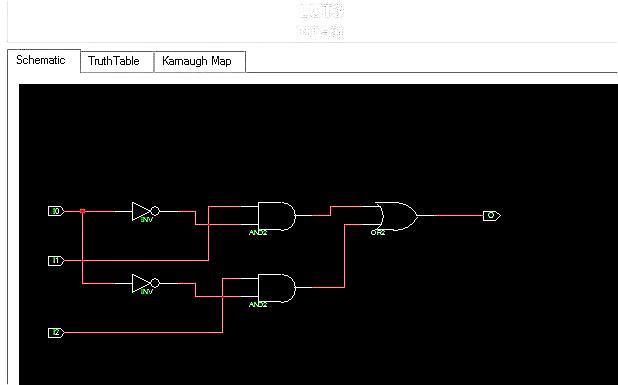
The implementation utilizes Look-Up Tables for combinatoriallogic.TheLUT3exampleillustrateshowlogic gatesaresynthesizedtoachievespecificfunctions.
Logic Schematic: The schematic for LUT3 demonstratestheuseofNOT,AND,andORgatesto combine input terms, which is an autogenerated realizationbasedonthedefinedtruthtable
International Research Journal of Engineering and Technology (IRJET) e-ISSN: 2395-0056
Volume: 12 Issue: 09 | Sep 2025 www.irjet.net p-ISSN: 2395-0072
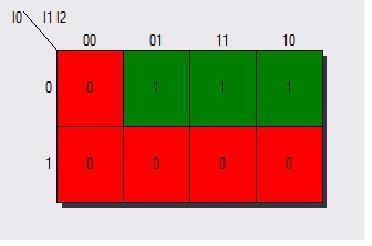
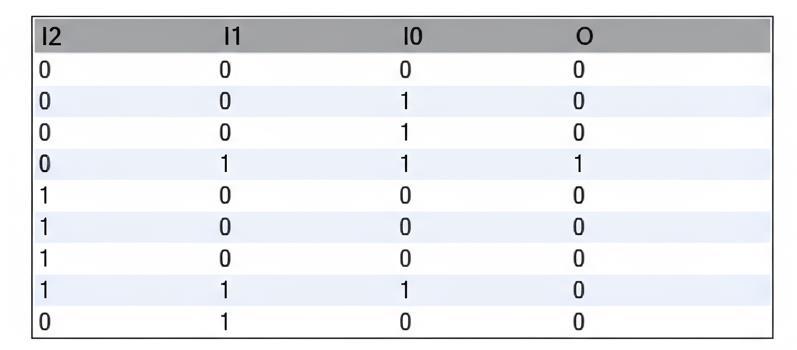
Truth Table and K-Map:Theprovidedtruthtable definestheoutputforallpossiblecombinationsof threehe 3 input bits. A Karnaugh Map further visualizestheLUT3'sbehavior,showingoutputs(1s and0s)forvariousinputcombinations,confirming specificlogicconditionsforanoutputof1.
5.4 Synthesis Report
The synthesis report generated by Xilinx provides crucial insightsintotheresourceutilizationandtimingperformance ofthedesignwhenmappedtothetargetFPGA(Spartan-3 3s1000fg320-4).
Finite State Machine Details
o States:5
o Transitions:6
o Inputs:1
o Outputs:5
o Clock:clk
o Reset:reset(asynchronous)
o Encoding:Automatic
Resource Utilization:
o Logic Elements: The design utilized 10 Basic Elements (LUT2, LUT2_L, LUT3, LUT3_L,LUT4,andMUXF5).
o Flip-Flops/Latches: Six FDC flip-flops wereusedforstateelementsandregisters (done,stage).
Clock Buffers:OneBUFGPwasusedfortheclock signal.
IO Buffers:FiveIObufferswereusedforexternal connections.
Device Utilization Summary (for 3s1000fg320-4):
o Number of Slices: 5outof7680(0%)
o Number of Slice Flip Flops: 6 out of 15360(0%)
o Number of 4 input LUTs: 9outof15360 (0%)
o Number of Bonded IOBs: 6 out of 221 (2%)
o Number of GCLKs: 1outof8(12%)
Timing Summary:
o SpeedGrade:-4
o Minimumperiod:3.429ns(corresponding to a maximum clock frequency of approximately291.6MHz)
o Minimuminputarrival timebeforeclock: 3.508ns
o Maximumoutputrequiredtimeafterclock: 7.241ns
o Maximum combinational path delay: No pathfound
Theseresultsindicate thatthedesign ishighly efficient in terms of resource utilization, occupying a negligible percentageofthetargetFPGAlogiccells,flip-flops,andLUTs. Theachievedminimumperiodof3.429nsdemonstratesthe high-speedcapabilityoftheimplementedFFTcontroller.
The final step in the FPGA implementation flow is the generationofaprogrammingfile(bitstream).Thisprocess convertsthesynthesizeddesignintoabinaryfilethatcanbe loaded onto the target FPGA. The key options configured duringbitstreamgenerationincludecompression,readback, andvariouspinandcyclesettings.
Thisprojectsuccessfullydemonstratesthecomprehensive process of modelling and designing a high-speed Fast FourierprocessorattheRegisterTransferLevelusingVHDL. The core of this work involved a meticulous analysis and implementation of the FFT algorithm, a fundamental component in digital signal processing, adapted to a
International Research Journal of Engineering and Technology (IRJET) e-ISSN: 2395-0056
Volume: 12 Issue: 09 | Sep 2025 www.irjet.net p-ISSN: 2395-0072
hardware-friendly architecture based on the radix-2 approachforbothsimplicityandscalability.
Key components of the FFT processor, including the butterfly computation unit, twiddle factor ROM, shift registers, and finite state machine controller, were meticulouslydesignedinVHDLandstructurallyintegrated. The functionality and performance of the design were rigorously verified through behavioral simulations using Xilinxtools,confirmingitscorrectnessandpracticalviability forreal-worldapplications.
Theadoptionoffixed-pointarithmeticinthedesignensured optimal resource efficiency while maintaining acceptable levelsofprecision,whichis necessaryforDSPoperations. Furthermore, the pipelined and modular nature of the architecturecontributestothehighthroughput,rendering thedesignwell-suitedforintegrationintovariousreal-time DSPsystems,suchasthoseusedinOFDM,audioandimage processing,andcommunicationreceivers.
In essence, this project serves as a bridge between theoretical DSP concepts and their practical hardware realizations. This demonstrates how a VHDL-based RTL design can be leveraged to produce an optimized digital hardware solution. The successful completion of this endeavornotonlyfulfilstheproject'sprimaryobjectivesbut alsoestablishesasolidfoundationforfutureenhancements, including the potential for supporting higher-point FFTs, exploring radix-4 or split-radix implementations, and incorporatingdynamicFFTsizeconfigurability.
[1] S.JosueSaenz,“FPGAdesignandimplementationof radix-2FastFourierTransformalgorithmwith16 and 32 points,” 2015 IEEE International Autumn Meeting on Power, Electronics and Computing.
[2] Daud Khan, Latif Jan, Mohammad Haseeb Zafar, “OptimizedFFTDesignsforHigh-PerformanceLTE and5GNetworks,” Arabian Journal for Science and Engineering,received:24May2024/Accepted:23 January 2025 Research Article-Electrical Engineering.
[3] Víctor Manuel Bautista, Mario Garrido, Senior Member, IEEE, and Marisa López-Vallejo, Senior Member,IEEE,“SerialButterfliesforNon-Power-ofTwo FFT Architectures in 5G and Beyond,” IEEE Transactions on Circuits and Systems I: Regular Papers,Vol.70,No.10,October2023.
[4] Taesang Cho, Hanho Lee, “A High-Speed LowComplexity Modified Radix−25 FFT Processor for HighRateWPANApplications,” IEEE Transactions on Very Large-Scale Integration Systems (Volume: 21,Issue:1,January2013).
[5] DaudKhan;LatifJan;MohammadHaseebZafar; OptimizedFFTDesignsforHigh-PerformanceLTE and5GNetworks https://doi.org/10.1007/s13369-025-10009-z