
International Research Journal of Engineering and Technology (IRJET) e-ISSN:2395-0056
Volume:12Issue: 09 | Sep 2025 www.irjet.net p-ISSN:2395-0072
International Research Journal of Engineering and Technology (IRJET) e-ISSN:2395-0056
Volume:12Issue: 09 | Sep 2025 www.irjet.net p-ISSN:2395-0072
Koundal1 , Dr. Geena sharma2 , Er.Vinod Kumar3
Abstract
The increasing demand for reliable and efficient energy supply, coupled with the challenges posed by deregulated environments, has driven the need for advanced optimization strategies in distributed generation (DG) planning. Traditional approaches, such as Genetic Algorithms (GA), have been widely applied but often face limitations in handling complex, nonlinear optimization problems.Toaddressthesechallenges,thisstudyproposes a hybrid Butterfly Optimization Algorithm with Gradient Descent (BOA–GD) for optimal generator placement and system performance enhancement. The method is tested onbenchmarkIEEE14-BusandIEEE69-Bussystems,with performance compared against GA and Bacterial Foraging OptimizationwithGradientDescent(BFO-GD).Theresults demonstrate that the hybrid approach effectively minimizes total power and reactive losses, improves voltage deviation, and significantly reduces total operationalcosts.Forinstance,intheIEEE69-Bussystem, BFO-GD reduced total loss from ~50 MW to ~40 MW and lowered the operational cost from ~$40M to ~$35M, indicating superior performance over GA. Voltage deviation also improved consistently, ensuring greater system stability and reliability. These results validate the efficiencyofhybridoptimizationinsolvingmulti-objective power system problems, making it a promising tool for future power system planning, distributed generation integration,andcost-effectivegridmanagement.
Keywords: distributed generation, optimization, GA, BFO-GD, IEEE bussystems, powerloss reduction
The use of renewable technologies is usually restricted to areas with low load and population densities. The distribution networks in such areas are constructed or designed to provide the increasing demands of the consumersthattendtodecreasewithtransmissionsystem distance. So, the use of such a network provides a great
interesttotheregulatorsoftheindustryanditsutility This concept covers the additional benefits related to the distributed or dispersed types of compatible resources in the distinct locations of the network. These resources include small storage or modular based generation. Depending upon the changes done in the electrical industry, the use of such small portable or modular generation types provides a great interest. The rising issues of siting the big station plants, an increase in demand have made such modular resources as an additional benefit attracting the consumers based on the methodsortheabilitytochangetheprojectingconditions This basically provides dispersed forms of small modular installations very close to point-of-end use. Hence, the dispersed or distributed network has become a major electrical energy driven source in the present as well as the future-based generation. So, the main reason to use such dispersed systems relies on the following fact: The deregulation of power has encouraged the public investment in order to continue the power demand. This has resulted in breaking investments for the power development.
The emergence of new technologies with large profitability,benefits,andsmallerratings.
The rising demands and the saturation of the networksthatalreadyexist.
The distributed resources should be located optimally to minimize the line loadings, reactive power need, and the losses of the network. The whole process of optimization should actively work on land costs, availability of the site, maintenance costs,plantoperationsconditions,etc.
The process of distributed generation in a deregulated environmentplaysasignificantroleinfulfillingtheenergy demandsoffutureprovidingthefreeenvironmentandthe flexibility to its users in developing and planning the type of installation required as per the load critical conditions. It has the capability to serve as an alternate possible
International Research Journal of Engineering and Technology (IRJET) e-ISSN:2395-0056
Volume:12Issue: 09 | Sep 2025 www.irjet.net p-ISSN:2395-0072
solution with a great potential. The continuous improvement in DG technology helps in providing electricity to its consumers in a very cost effective nature. In case of competitive (wholesale) deregulated environment, the users owing their DG’s responds to very high price swings in order to decrease the price volatility. The DG’s operated on utility are considered as the most suitable option for the process of planning. In emergency conditions, some part of the whole load is shifted on an isolated type of generator which provides some relief to the burden faced by utility. If a small unit of DG fails, it doesnotaffectthereliabilityoftheworkingoperation
Bhowmik, S., et.al [1] described a new planning method forthedistributionsystem.Inordertoobtainanoptimized solution, an algorithm has been developed by considering anobjectivefunction(non-linear)withboththelinearand non-linear type of constraints for radial distribution system at a very large extent. Here, the objective function was optimized through the reduction in cost functioning operation. Further, a three-step iteration was performed. Thefirststepincludesthesubstationoptimizationprocess which determined the substation sites number with its exact location, the second step covered the feeder optimization which determined the feeder number with the actual original route and the final stage represented thereliabilityofsystemnode.
T. C. Green, et.al [2] presented a methodology for the sizingandthesitingof the DGconstraintsystem based on thesecurity.Thecaseofoptimalsitingwasdeterminedby analyzing the sensitivity of the power row equations. A methodknownassiringmethodwasusedforpenetration level of generation, set of loading conditions, and power factor formulated such that it worked as a constraint problem of optimization based on security. The use of optimal generation site information was considered to optimize the reliability of the system via the indices obtained from the reliability calculations. In order to designsuchamethodforsolvingthere-closingpositions,a geneticalgorithmwasused.
El-Khattam, et.al [3] presented a survey on DGs approacheswhichwouldchangetheworkingoperation of electric power systems. This research was based on the important concepts, the definition of DGs, and their working constraints fair enough to help in understanding the regulations methodology of DGs. For the process of implementation,theeconomicandtheoperationalbenefits were also considered. Here, the researcher’s main objective was to provide a comprehensive survey which
would add new types and classifications related to DG technologies,typesandtheapplications.
Quezada, et.al [4] presented an approach in order to calculate the energy losses (annually) when different concentrationandpenetrationlevelsofDGgetsconnected to the distribution type network. Additionally, various impactshavebeencalculatedconsideringthewindpower, combined heat and power, fuel cells, and photovoltaics. Theresultshaveshownthatvariationinenergylossesthat seemedto bea functionofthepenetrationlevel ofDGhas presented the U-shape characteristics trajectory. Moreover, high loss reductioncan be expected if the units ofDGgetmoredispersedalongthefeedersofthenetwork. In the context of technologies related to DG, it was noted that the wind power shows the worst type of behavior in curing the losses. In the end, the DG units along with reactive power control have provided the better network forcontrollinglossesandthevoltageprofile.
Piccolo, et.al [5] conducted a study to obtain or capture the postponed or deferral network investment effects on the expansion system of DG, several regulations for the operators of the distribution network and how they attracted optimized new generation combination with its existing forms. Here, the optimal power flow (multiperiod),sizingandsitingofDGinstallationareanalyzed.
Saint, Bob [6] proposed a study based on reviewing the languages in the Act that reviewed the characteristics and the value of Smart Grid defined by Department of Energy, discussed the unique characteristics that could be applied to rural-based utility systems, and described various technologies of smart grid that are in use today for the ruraltypedistributionnetworks.
Albu, et.al [7] conducted a study based on an algorithm establishing the best methods for the storing the system electrically for the virtual synchronous generator (VSG) that usually worked on its nominal power (desired) and the case of application. The resulting form of application helps in providing a wide description of the technologies that exist already depending upon the matching of characteristics with its required storage properties described accordingly from theuserpointofview.
Falaghi, H., et.al [8] proposed a framework which has solved the issues related to the planning of distributed multi-stage system expansion where the distributed generation and feeder units along with substations installation has been considered as one of the best solutions for the expansion of the system’s capacity. It furtherinvolvedsystem’soutagecosts,investment,andits
International Research Journal of Engineering and Technology (IRJET) e-ISSN:2395-0056
Volume:12Issue: 09 | Sep 2025 www.irjet.net p-ISSN:2395-0072
operationandthemethodologyofexpansionwasbasedon the procedure of pseudo-dynamic system. A joint study of optimalpowerflow(OPF)andgeneticalgorithm(GA)was developedasa tool for solvingthe problem of the system. The proposed strategical performance was illustrated and assessedbystudies(numerical)ona complexdistribution system.
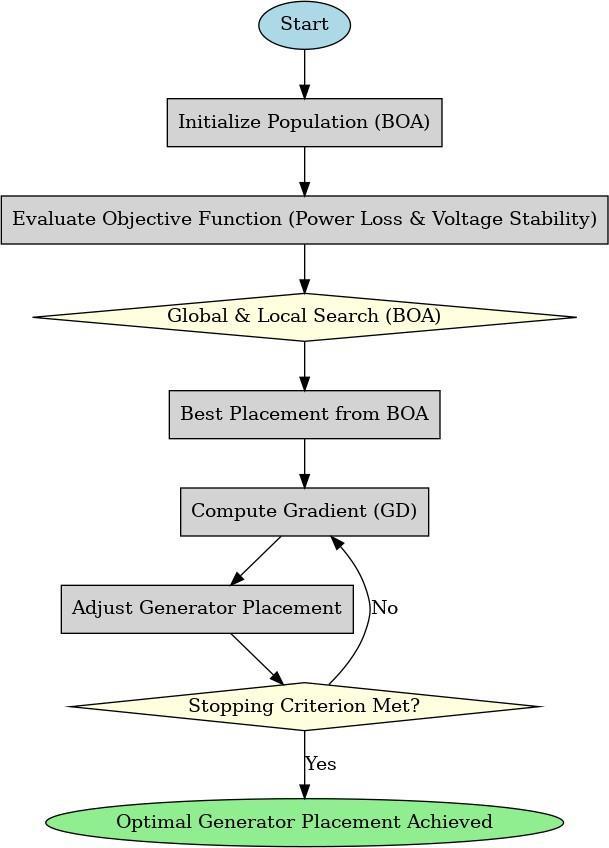
Figure1 Proposed Framework Pipeline
Algorithm 1: ProposedBOA–GDHybridOptimizationfor OptimalGeneratorPlacement
Input:
:Numberofbuses
:Numberofgenerators
:Populationsize
:MaximumBOAiterations
GD:MaximumGDiterations
:Objectivefunctionweights
:BOAparameters
:GDparameters
Output:
Optimalgeneratorlocationsandcapacities
Minimum o j value
Step 1: Initialization 1.1Generateaninitialpopulationof butterflies withinfeasiblelimits.1.2Foreach , performloadflowanalysistocompute loss and .1.3 Evaluate o j using:
o j loss loss,
1.4Setthebest-so-farsolution asthebutterflywiththe lowest o j
Step 2: BOA Iterative Process For to do 2.1 Foreachbutterfly : a.Computestimulusintensity: o j
b.Computescentintensity:
c.Generaterandomnumber d. If (globalsearch):
e. Else (localsearch):
f.Enforceconstraints(voltagelimits,generatorcapacity, powerbalance).2.2Re-evaluate o j forallupdated solutions.2.3Update ifabettersolutionisfound. End For
Step 3: GD Fine-Tuning Stage 3.1Initialize .3.2 For to GD do: a.Computenumericalgradient: o j o j o j
b.Updatesolution: o j
c.Enforcefeasibilityofconstraints. d.Stopif o j o j GD End For
Step 4: OutputResults
4.1Set final fromGDstage.
4.2Reportoptimalgeneratorlocations,capacities, minimum loss,improvedvoltageprofile,andfinal o j
© 2025, IRJET | Impact Factor value: 8.315 | ISO 9001:2008 Certified Journal | Page317
International Research Journal of Engineering and Technology (IRJET) e-ISSN:2395-0056
Volume:12Issue: 09 | Sep 2025 www.irjet.net p-ISSN:2395-0072
IV Result and Analysis
Table1:GAvsBFO-GDonIEEE14-BusandIEEE69-Bus Systems
Metric IEEE 14Bus(GA)
(MW)
Loss(MVAr)
Voltage Deviation (p.u.)
Total Cost (Million$)
14Bus (BFOGD)
69Bus(GA)
69Bus (BFOGD)
GD consistently outperforms GA,deliveringlowerpower and reactive losses, improved voltage profiles, and substantial cost reductions, making it a more effective optimization approach for power system operation and planning.
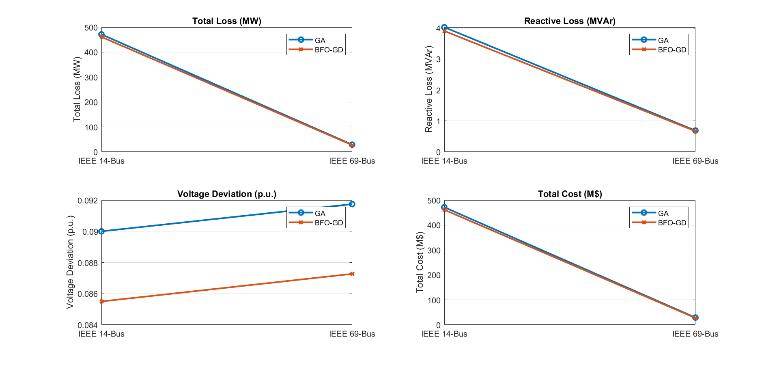
Thecomparisontable1andfig2presentstheperformance of two optimization algorithms, Genetic Algorithm (GA) and Bacterial Foraging Optimization with Gradient Descent (BFO-GD), applied to two benchmark test systems, the IEEE 14-Bus and IEEE 69-Bus networks. The metrics considered include Total Loss (MW), Reactive Loss (MVAr), Voltage Deviation (p.u.), and Total Cost (Million $),allofwhicharecriticalindicatorsforassessing powersystemefficiencyandstability.FortheIEEE14-Bus system, GA achieves a total power loss of approximately 470 MW, while BFO-GD reduces this to about 460 MW, indicating a modest improvement in loss minimization. Similarly, reactive power losses are reduced from around 4.0 MVAr with GA to 3.9 MVAr with BFO-GD, highlighting the latter’s capa ility to etter manage reactive power. Voltage deviation, which reflects system stability and voltage profile quality, also improves slightly under BFOGD, decreasing from 0.090 p.u. with GA to 0.085 p.u. This trendisevenmoresignificantintheIEEE69-Bussystem,a larger and more complex network. Here, the total loss drops from nearly 50 MW with GA to about 40 MW with BFO-GD, while reactive loss decreases from 0.75 MVAr to 0.70 MVAr. Voltage deviation similarly improves from 0.092p.u.underGAto0.087p.u.withBFO-GD.Intermsof economicimpact,BFO-GDdemonstratesconsiderablecost savings. For the IEEE 14-Bus system, the total operational cost decreases from approximately 470 million dollars under GA to 460 million dollars with BFO-GD. In the IEEE 69-Bus case, the cost reduction is even more significant, from nearly 40 million dollars under GA to 35 million dollars with BFO-GD. Overall, the table demonstrates that while both algorithms achieve satisfactory results, BFO-
This study highlights the effectiveness of advanced optimizationtechniquesforimprovingtheperformanceof power distribution networks through optimal generator placement.BycomparingtheGeneticAlgorithm(GA)with Bacterial Foraging Optimization combined with Gradient Descent (BFO-GD) on IEEE 14-Bus and IEEE 69-Bus systems,theresultsclearlydemonstratethesuperiorityof the hybrid approach. In the IEEE 14-Bus system, BFO-GD reducedtotallossesfrom~470MWto~460MW,reactive lossesfrom~4.0MVArto~3.9MVAr,andtotalcostsfrom ~$470M to ~$460M, along with a slight improvement in voltage deviation. More significantly, in the IEEE 69-Bus system,BFO-GDachievedalargerreduction,loweringtotal lossesfrom~50MWto~40MWandcostsfrom~$40Mto ~$35M, while also enhancing voltage stability. These improvements confirm that BFO-GD consistently outperforms GA, providing a robust, efficient, and costeffectiveoptimizationstrategyforpowersystemoperation andlong-termplanning.
1. Bhowmik, S., S. K. Goswami, and P. K. Bhattacharjee. "A new power distribution system planning through reliability evaluation technique." Electric Power Systems Research 54, Volno. 3 (2000): 169179.
International Research Journal of Engineering and Technology (IRJET) e-ISSN:2395-0056
Volume:12Issue: 09 | Sep 2025 www.irjet.net p-ISSN:2395-0072
2. Greatbanks,J.A.,D.H.Popovic,M.Begovic,A.Pregelj, and T. C. Green. "On optimization for security and reliability of power systems with distributed generation." In IEEE Bologna PowerTech Conference.Volno.1 2003.
3. El-Khattam, Walid, and Magdy MA Salama. "Distributed generation technologies, definitions, and benefits." Electric power systems research 71, Volno.2(2004):119-128.
4. Quezada, VH Méndez, J. Rivier Abbad, and T. Gomez San Roman. "Assessment of energy distribution losses for increasing penetration of distributed generation." IEEE Transactions on power systems 21,Volno.2(2006):533-540.
5. Piccolo,Antonio,andPierluigiSiano. "Evaluating the impact of network investment deferral on distributed generation expansion." IEEE TransactionsonPowerSystems24,Volno.3(2009): 1559-1567.
6. Saint, Bob. "Rural distribution system planning using smart grid technologies." In Rural Electric Power Conference, 2009. REPC'09. IEEE, pp. B3-B3. IEEE,2009
7. Albu, Mihaela, Klaas Visscher, Doru Creanga, AlexandruNechifor,andNicolaeGolovanov. "Storage selection for DG applications containing virtual synchronous generators." In PowerTech, Vol no. 12,2009IEEEBucharest,pp.1-6.IEEE,2009.
8. Falaghi,H.,C.Singh,M-R.Haghifam,andM.Ramezani. "DG integrated multistage distribution system expansion planning." International Journal of Electrical Power & Energy Systems33, Vol no. 8 (2011):1489-1497.
9. Ochoa, Luis F., and Gareth P. Harrison. "Minimizing energy losses: Optimal accommodation and smart operation of renewable distributed generation." IEEE Transactions on Power Systems 26, Vol no. 1 (2011):198-205.
10. Coster, Edward J., Johanna MA Myrzik, Bas Kruimer, and Wil L. Kling. "Integration issues of distributed generation in distribution grids."Proceedings of theIEEE99,Volno.1(2011):28-39
11. Tan, Wen-Shan, Mohammad Yusri Hassan, Md Shah Majid, and Hasimah Abdul Rahman. "Optimal distributed renewable generation planning: A review of different approaches." Renewable and Sustainable Energy Reviews Vol no. 18 (2013): 626645.
12. Ali, S., Ahmed, M., & Khan, T., 2021. A novel distributed generation planning algorithm using Archimedes optimization for voltage and power loss improvements in distribution networks. International Journal of Electrical Power & Energy Systems,130,p.106931.