
International Research Journal of Engineering and Technology (IRJET) e-ISSN: 2395-0056
Volume: 12 Issue: 04 | Apr 2025 www.irjet.net p-ISSN: 2395-0072
International Research Journal of Engineering and Technology (IRJET) e-ISSN: 2395-0056
Volume: 12 Issue: 04 | Apr 2025 www.irjet.net p-ISSN: 2395-0072
Ashish B Rao1 , Dr. Tejaswini R Murgod 2 , Loukya Harisha3 Ananya Nittur4
1,3,4Student, Department of AIML, BNM Institute of Technology, Bangalore, Karnataka, India
2Professor, Department of AIML, BNM Institute of Technology, Bangalore, Karnataka, India
*** Abstract - A modern approach aimedattransformingsupply chain and agricultural operations is Optimized Fruit Quality Prediction using GANs and ComputerVision.Thissystemoffers precise fruit quality evaluations by combining Generative Adversarial Networks with cutting-edge computer vision, making sure of increased market prices due to better quality and reducing harvest processing losses. An accurate CNNbased fruit quality classifier, a GAN-based synthetic data augmentation model, and a natural graphical user interface (GUI) for looking at quality indicators and predictions are some of the key features. These key factors improve the agricultural ecosystem's sustainability and productivity by giving stakeholders practical insights.
Key Words — Fruit Quality Prediction, GANs, Computer Vision, Agricultural Technology, Data Augmentation, CNN, Supply Chain Efficiency.
Fruit quality evaluation and shelf-life prediction remain major issues for agri-food supply chains, with direct consequencesforfarmers'profitabilityandminimizationof food wastage. The use of subjective, time-consuming, and variable inspection procedures results in the early withdrawal of edible products or delayed detection of spoilage,causingsevereeconomiclossesandsustainability problems along the value chain. For perishable fruits like bananas,wheretheripeningprocessplaysamajorrolein theirmarketvalue,evenminormistakesinassessingquality canleadtosignificantfinanciallosses.Infact,post-harvest losses in developing countries are estimated to range between30%and40%.[8]
Existingtechnologiessufferacompromisebetweenf ielduseandaccuracy,whileheterogeneityinenvironmentsa ndinsufficientdatadestabilizesystemsthatarecomputerize d.Traditional methods based on manual sorting or simple computervisiontechniquesareincapableofidentifyingthe complex biochemical processes in fruit maturation, while laboratory-grade instruments are not feasible for implementation in agricultural environments.[10] These issueshighlighttheneedforefficient,scalablesolutionsthat canbeimplementedin real-world environments withlow infrastructuralrequirements.
Thisarticle proposes a technology-based solution forsuchissuesutilizingcomputervisionanddeeplearning techniques.Byutilizingacombinationofmulti-levelquality
estimation and simulation of temporal degradation, the systemhastheabilitytoforecastnotonlythecurrentstate of quality but also future possible shelf-life trajectories. Throughtheapplicationofimage-basedqualityestimation alongwithpredictiveshelf-lifemodeling,thesystemoffers practical insights to farmers to facilitate well-informed decisionsaboutharvesting, storage,anddistribution,thus achievingoptimalsupplychainmanagement.
Themethodofinteresthasitsrootsinmeasuring banana ripeness as a demonstrative example of how accurate technological measurement can coexist with laboratoryprecisiontoactualusageforagriculture.Withthis system, the goal is to establish a new benchmark for functional, AI-driven quality control that unites scientific excellencewithoperationalfeasibilityforabroadscopeof agriculturalstakeholders.
Deeplearninghasbeenextensivelyexploredforimproving agriculturalprocesses,particularlyinsmall-scaleagriculture. [1][5][10]Forinstance,V.ZárateandD.C.Hernández(2024) highlighttheuseoflightweightdeepmodelstoassessfruit qualitywithinsmall-scaleagriculturalsettingswithlimited computational resources. Scalability remains a problem owingtotheconstraintsoflightweightmodels.Similarly,M. Zabovnik and D. Wojcieszak (2024) report on the applications of Convolutional Neural Networks (CNNs) in smartagriculture,whichincludemultispectralimagesand vegetation indices, while their study is predominantly a reviewwithoutexperimentalverification.J.LiandP.Kumar (2024)introducedensembledeeplearningarchitecturesfor cottoncropclassificationinAI-basedsmartagriculturethat enhanced the decision-making process through image analysis. Their method does use significant quantities of computational power, which could restrict it from being usedinresource-limitedenvironments.
Therehavealsobeensomerecentadvancesindeep learning that have involved transfer learning and image augmentation. E. Martinez and F. Lopez (2024) utilize transferlearningtoclassifyfruitssuchthatthetrainingtime taken was reduced while the accuracy was increased. However,domainadaptationremainsaproblem,affecting themodel'sgeneralizabilitytodifferenttypesoffruitsand conditions.Inaddition,imageaugmentationtechniqueshave beenexploredforrobustfruitdetectionusingdeeplearning. While these techniques improve model robustness and
International Research Journal of Engineering and Technology (IRJET) e-ISSN: 2395-0056
Volume: 12 Issue: 04 | Apr 2025 www.irjet.net p-ISSN: 2395-0072
generalizability,theirperformancemayvarywithdatasets andconditions.
GenerativeAdversarialNetworks(GANs)havealso beenexploredforagriculturalapplications.[4][16]Nguyen and H. Tran (2024) talk about the capacity of GANs to generate artificial data to enhance dataset diversity and robustmodelstrength.However,theirapplicabilityislimited by the lack of empirical evidence and implementation challenges.Inyetanotherapproach,K.Patel andM.Singh (2024) present an application of real-time plant health monitoring using computer vision and machine learning, facilitating disease detection at an early stage and plant health assessment. While successful, performance is influencedbyvariousenvironmentalfactors,andscalability tolargeagriculturalplotsisnotconsidered.
Deeplearninghasbeenemployedtodetectdefects anddeterminefreshnessinvegetablequalityinspection.R. Sharma and P. Kumar (2024) describe the application of ensemble deep learning models for this purpose, but the study does not account for variations in vegetable appearancesduetovariationsingrowthconditions,thereby compromising generalizability. On the other hand, soft computing methods have been explored to analyze agricultural data, as presented by S. Gutiérrez and J. Tandayula(2023).Theirresearch,however,omitsparticular methodologydescriptionsaswellasdiscussionsregarding thelimitationsofthesaidtechniques.
Overall, while deep learning and advanced computing methods continue to revolutionize agricultural applications,scalability,domainadaptation,generalizability overenvironmentalconditions,andtheabsenceofempirical backing are all relevant challenges that need to be met. Future work must take cognizance of filling these gaps towards enhancingreal-worldpractical utilizationofsuch technologyinactualagriculturalsettings.
Extensive studies have investigated artificial intelligence (AI) and computer vision for fruit quality evaluation to improve agricultural productivity and minimizelosses.Thisreviewintegratesmajorfindingsfrom recent methods and highlights essential gaps to guide the development of effective AI-based fruit quality evaluation solutions.
Thedatasetthatisbeingusedisaselectedcollection ofhigh-resolutionimagesofthefruitswhicharecategorized into4distinctsets.The4setsbeingthestagesofripenessof thefruit-unripe,ripe,overripeandrotten.Thedatasethasa widerangeofimagesincludingtheimagescapturedunder varied lighting conditions, different angles of capture and vividlybackgroundedimagestoensuregeneralizing.Image
augmentationtechniquessuchasrotation,scaling,andcolor adjustmentswereappliedtoimprovethemodel’sabilityto handle all the variations of the real world. The dataset comprisesof10,000images,and2,500imagesarepresent foreachstageofripeness.
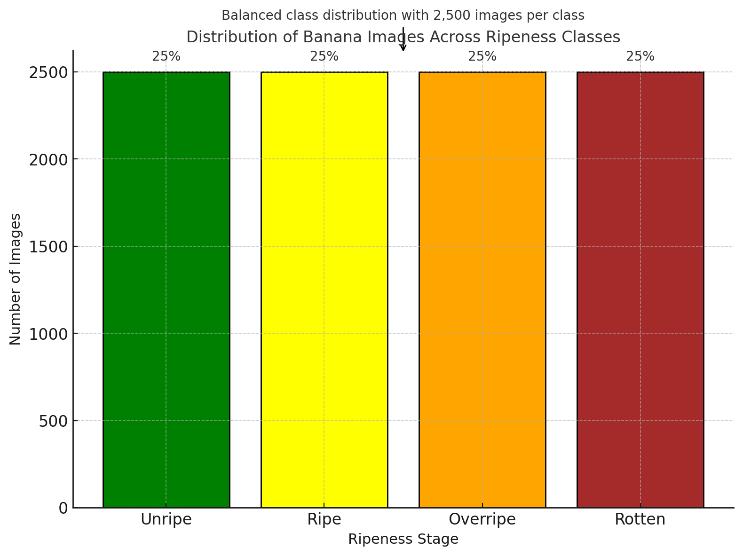
Fig1:DataDistributionafterpreprocessingandcleaning
Preprocessing the dataset included various tasks suchasresizingalltheimagestomaintainconsistencywith 224x224 pixels resolution.[18][1] Preprocessing also includedtasksfornormalizingthepixelvaluetofitintothe range [0,1], and further applied data augmentation techniquetoartificiallyincreasethediversityofthetraining dataset
Computervisionallowsmachinestoprocessvisual informationbyextractingusefulinformationfromimagesor video. In agriculture, it substitutes subjective human inspection with measurable parameters for quality determination. The technology is based on digital image processing methods for feature extraction (color, texture, shape) and pattern recognition software. In fruit quality inspection, computer vision systems examine surface features, color gradients, and morphological features of ripeness stages and defects, offering homogeneous and measurablestandardsforlargeamountsofproduce.
ConvolutionalNeuralNetworksisaspecializeddeep learning architecture type designed for visual data processingthathaveinherentgrid-likestructures,i.e.,digital images.Convolutional Neural Networksusea hierarchical designthatlearnsincreasinglymorecomplexvisualfeatures automaticallyinsuccessionusingconsecutiveconvolutional layers. The earlier layers usually extract simple visual featuressuchasedgesandtextures,anddeeperlayersdetect more abstracted patterns and object features. This
International Research Journal of Engineering and Technology (IRJET) e-ISSN: 2395-0056
Volume: 12 Issue: 04 | Apr 2025 www.irjet.net p-ISSN: 2395-0072
architecturalthememakesCNNsverywelladaptedforfruit qualityclassificationbecauseCNNscanbeapplieddirectlyto raw pixel data without the need for manual feature engineering. A notable strength is their capacity for preservingspatialinformationintheimageinthecourseof feature extraction while, at the same time, learning stable representationsthatareinvarianttousualvariationsinthe image capture condition, e.g., lighting, orientation, or positioningvariationstypicalofagriculturalimagery.
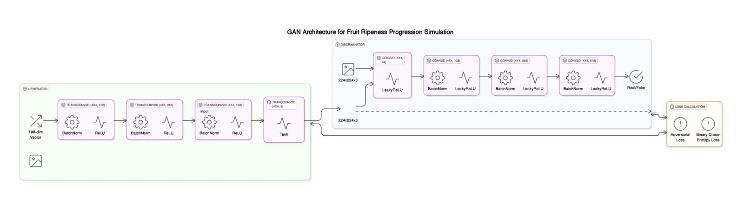
Generative Adversarial Networks consist of two neural networks in a competitive learning process - a generator that generates synthetic images and a discriminator that evaluates their realism. Through adversarialtraining,thegeneratorcontinuouslyimprovesits abilitytogeneraterealisticsamplesthatcloselyapproximate thestatisticaldistributionofthetrainingdata.Inthecontext of this fruit quality assessment system, GANs serve two significantpurposes.First,theyaddressdatascarcityissues bygeneratingrealisticvariationsoffruitimagesatdifferent stagesofripeness, effectivelyaugmentingthetrainingset. Second,theyenableshelf-lifeestimationthroughmodeling thetemporalprogressionoffruitspoilage.Theadversarial trainingprocessensuresgeneratedimagesarebiologically plausiblewhilecoveringedgecasesthatmightbesparsein theoriginaldataset,thusenhancingthemodel'srobustness.
Transfer learning relies on the assumption of capitalizingontheknowledgegainedthroughthesolutionof oneproblemspacetoimproveperformanceinasimilarbut distinct space, particularly where training data would be scarce. The approach succeeds because of the high transferabilityoftheintrinsicvisualfeatureslearnedbythe shallow layers of convolutional networks like edge detectionandtextureextraction acrossawidevarietyof image classification tasks. Transfer learning is currently leveragedintheimplementationthroughtheinitializationof themodelparametersfromapre-trainedResNet50V2model on the vast ImageNet dataset.[2] The strategy involves freezing the shallow layers that are involved in the extraction of these general visual features and selectively fine-tuning only the deeper layers that are involved in learning the subject-specific features of fruit ripeness patterns. This approach has a significant advantage by
substantiallyreducingthecomputationalresourcesrequired fortrainingaswell asthenecessarydomain-specific data, while concurrently improving the model's ability to generalizetoreal-worldagriculturalenvironments.
ResNet50V2architectureisacomplex50-layerdeep convolutional neural network that extends from the basic ResNetframeworkwithenhancedresidualconnectionsand featurepropagation.Thenetworkstartswiththefirst7×7 convolutionallayerwith64filtersandastrideof2,andthen the3×3maxpoolinglayerwithastrideof2thatdecreases theinputsizebutincreases thedepthofthechannel.This pre-processingstepleadstotheentirearchitecturedivided intofourseparateblocksofconvolutionalwithgrowingsizes offeatures.
Thefirstconvolutionalblockcomprises3residual unitswith64,64,and256filtersrespectively,withidentical spatial size but building the core feature representations. Thesecondblockcomprises4residualunitswith128,128, and512filters,wherethefirstspatialdownsamplingisdone tocapturemoreabstractedpatterns.Thenetworkcontinues with the 6 residual units of the third block with 256, 256, and1024filters,wherethemodelbuildshigher-levelfeature detectors.Thelastconvolutionalblockcomprises3residual units with 512, 512, and 2048 filters, where the most advancedpatternrecognitionabilitiesaresharpened.
Every residual unit adheres to the enhanced bottleneck architecture characteristic of ResNetV2: initial 1×1convolutionfordimensionreduction,followedbya3×3 convolution for spatial feature extraction, and final 1×1 convolution for dimension restoration. Pre-activation architecture positions batch normalization and ReLU activationaheadofeveryconvolutionaloperation,providing moreunobstructedpathsforbackpropagationofgradients. Identity mappings are implemented by skip connections whendimensionsarethesame,and1×1convolutionswith stride 2 for dimension matching across blocks. The architecture peaks with global average pooling, which compressesthespatialdimensionsto1×1whilemaintaining all2048channels,andthenafully-connectedlayerforthe ultimateclassification.Suchanarrangementis ensured to provide evengrowthofthe receptivefieldthroughoutthe network while keeping computations efficient using bottleneckprojections.
Thedelicatebalancebetweendepthandparameter efficiencymakesResNet50V2especiallysuitableforvisual recognitiontasksthatneedextensivefeatureanalysisacross scales,suchasaccuratefruitqualityestimationwheresmall visualdistinctionsindicateripenesslevels.
International Research Journal of Engineering and Technology (IRJET) e-ISSN: 2395-0056
Volume: 12 Issue: 04 | Apr 2025 www.irjet.net p-ISSN: 2395-0072
Bananasexperienceintricatebiochemicalchanges during ripening that greatly affect their quality characteristics and marketability.[12][15] The process of ripeningisaconsistentphysiologicalsequencegovernedby enzymatic activity, respiration rates, and ethylene production.
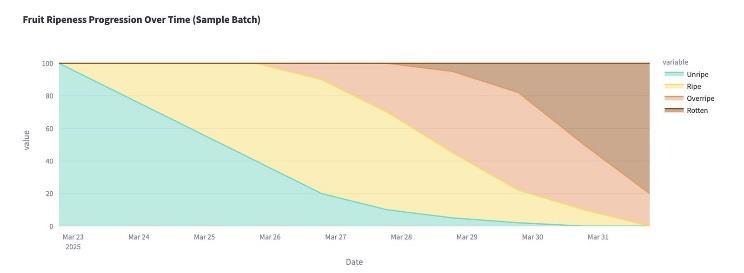
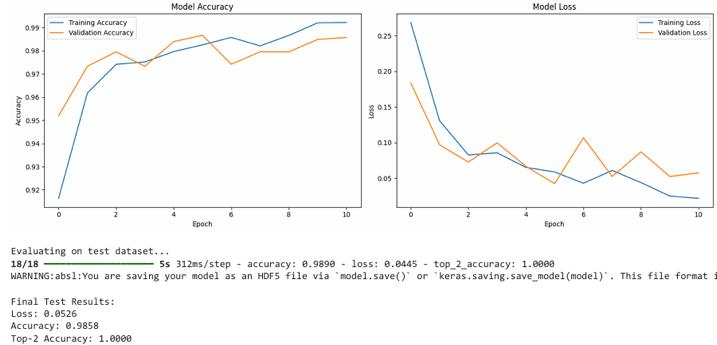
Fig4:EvaluationoftheCNNmodel’saccuracyandloss
Firmnessisoneofthemostapparentindicatorsof ripening, reducingascell wall degrading enzymessuch as pectinase and cellulase cause breakdown of structural elements.Theinitialhardnessofunripebananas(around1418Nforce)reducestoaround2-4Ninmaturefruitdueto dissolution of middle lamella between cells. This textural modificationhasadirectimpactonshelflifeassofterfruits become increasingly prone to mechanical damage and microbialpenetration.
Sugarcontenthasaninverseproportiontostarch content during ripening. Unripe bananas have 20-25% starchandjust1-2%sugars,chieflysucrose.Whenamylases become activated during ripening, starch gets hydrolyzed into glucose, fructose, and sucrose, amounting to 15-20% totalsugarsincompletelyripefruit.Sweeteningincreases palatabilitybutsusceptibilitytofermentationbyyeastsand molds,especiallyininjuredregions.
Starchcontentisthemajorcarbohydratereservein green bananas, making up to 25% of fresh weight. The concerted action of α-amylase and starch phosphorylase enzymes hydrolyzes starch to soluble sugars at rates dependentontemperatureandethyleneconcentration.The hydrolysisisafirst-orderprocess,withtheratedoublingfor each10°Criseinstoragetemperaturetothephysiological maximum.
Shelflifeisafunctionoftheaccumulatedeffectof such biochemical changes and usually 7-10 days at best storageconditions(13-15°C,85-95%RH).[20]Commercial lifefor banana fallsbetweenstage3and6intheripening scale,relatingtocoloralterationfromlightgreentoyellow speckled brown. After that, over-soaking and increased sugarcontentpredisposetomicrobicspoilage.
Antioxidant activity exhibits a biphasic profile duringripening.Phenolicconstituentssuchasdopamineand gallocatechinaremaximalintheearlystagesofripeningand impartprotectionagainstoxidativestress.Withtheprogress of ripening, antioxidant activity goes down but partially recoversinfullyripefruitbecauseofaugmentedsynthesisof specificflavonoids.Theantioxidantprofilehasabearingon bothnutritionalvalueandbrowningvulnerabilityatcutsites orbruisesites.
The interaction of these factors generates critical control points for shelf life control. Ethylene sensitivity rendersbananashighlysensitivetopostharvesttreatment, with1-MCP(1-methylcyclopropene)treatmentssuccessfully retarding ripening by inhibiting ethylene receptors. Adequate temperature control is still as important, with chilling injury at temperatures below 13°C preventing normal ripening and too high a temperature speeding up metabolicprocesses.Thesescientificprinciplesaredirectly applied to the design of our quality prediction system, allowingaccurateshelflifepredictionfromvisibleripeness indicators.
Theproposedsystemcombinestwocomplementary deeplearningarchitecturestoaddressqualityassessment and shelf-life prediction separately. The CNN module employsaResNet50V2asthebackbonethatispre-trained withImageNetweights,capitalizingontransferlearningto helpalleviatedatalimitations.Throughtacticalfine-tuning, wepreservethegeneral featureextractioncapacityofthe early layers while re-training the remaining 30 layers on ripeness-patterns. The model employs a Global Average Poolinglayerforspatialdimensionalityreductionbeforethe input into two fully connected layers with Dropout regularization(dropoutrateof0.5and0.3,respectively)to preventoverfitting.AnoutputlayerwithSoftMaxactivation providesprobabilisticclassesoverfourripenessclassesand thus more informative quality assessment over simple binaryclassification.
SoftMaxActivationfunctionisrepresentedby,
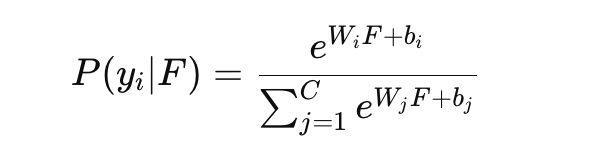
where Wi and bi are the weight and bias of the fully connected layer, and C is the total number of ripeness classes.
TheGenerativeAdversarialNetworkmodelutilizes atemporalconditioningstrategytoshelf-lifesimulation.The generatornetworktakesina100-dimensionallatentvector alongwithtemporalembeddingsofdays(0-6)andprocesses the input through a series of transposed convolutional
International Research Journal of Engineering and Technology (IRJET) e-ISSN: 2395-0056
Volume: 12 Issue: 04 | Apr 2025 www.irjet.net p-ISSN: 2395-0072
blockstooutput64×64pixelbananaimagesattargetaging points. Each block includes batch normalization and LeakyReLUactivation,endingwithaTanh-activatedoutput layerthatproducesphotorealisticimages.Thediscriminator counterpart utilizes mirrored convolutional blocks to process the generated images and their temporal context, outputting authenticity probabilities through a sigmoidactivated classifier head. The adversarial model trains through alternating cycles of optimization in which the generator attempts to output progressively more realistic age-progressedimagesandthediscriminatorenhancesits detectionperformance.
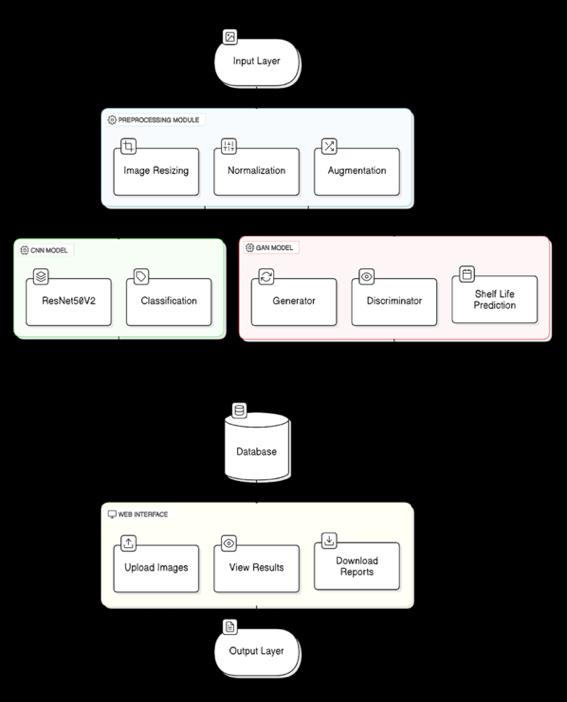
The implementation system utilizes a modular Python design that strategically integrates several deep learning libraries. TensorFlow/Keras is used for CNN implementation, taking advantage of its high-level API to efficientlyconstructandtrainmodels.PyTorchisusedfor GAN implementation, utilizing its dynamic computation graphs to enable flexible adversarial training. Image preprocessing pipelines leverage OpenCV for geometric operationsandPILforcolornormalization,withconsistent 224×224 pixel resizing for CNN input and 64×224 pixel conversion for GAN processing. The user interface uses Streamlit's reactive UI to develop an interactive web application that accepts image uploads, shows real-time predictions, and displays visualizations of the aging simulation. This hybrid framework design optimally influences each library's strengths while ensuring interoperability through standardized NumPy array exchangebetweencomponents.
TheCNNtrainingprocessemploysadaptivelearning ratecontrolwithastartinglearningrateof0.001andhalving byfactor0.2uponvalidationlossplateaus.Batchsizeto32 samples maximizes GPU memory limits with gradient estimationstability,and30-epochtrainingcycleswithearly stopping (patience=5) to avoid overfitting. The Adam optimizer (β₁=0.9, β₂=0.999) updates parameters with internal momentum and adaptive learning rates. For the GAN sub-networks, both networks are trained simultaneouslyfor100epochswithafixedlearningrateof 0.0002, employing separate Adam optimizers with decreased momentum (β₁=0.5) to stabilize adversarial training.Thegeneratorisinput100-dimensionalGaussian noise vectors concatenated with normalized temporal signals(day/6),andthediscriminatorisinput64×64RGB imageswithsynchronizedtemporalconditioning.Trainingis alternatedbetweengeneratorupdates(minimizingbinary cross-entropy against "real" labels) and discriminator updates(classifyingrealimagesvs.generatedsamples),with balanced loss terms preventing either network from dominatingtheadversarialprocess.Theshelf-lifeprediction moduleanalyzestheinputimagesbyiterativelyproducing theagedcopiesandassessingtheirqualitydegradationvia thediscriminator'sauthenticityscores.Thistimeestimation proceeds until the produced images surpass a specified spoilage limit (usually at validity scores <0.6), and the simulationdayselapsedserveaspredictedremainingshelf life. The whole pipeline is deterministic reproducible by settingrandomseedsduringinferenceandleavingstochastic componentsattrainingforimprovedmodelrobustness.
4.1
Experimentswereconductedonahigh-performance computingenvironmentequippedwithanNVIDIARTX3090 GPU, 16GB RAM, and a 500GB SSD. The software stack includedPython3.8,TensorFlow2.5,PyTorch1.9,andCUDA 11.2.
The CNN model performance was assessed using accuracy,precision,recall,andF1score.Accuracymeasures the fraction of correctly classified images, while precision andrecall tell us about the model'sability to identify true positivecases Where,
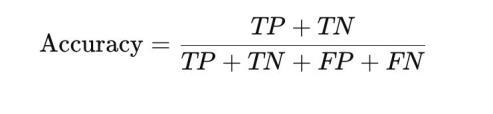
TP(TruePositives)=correctlypredictedpositivecases
International Research Journal of Engineering and Technology (IRJET) e-ISSN: 2395-0056
Volume: 12 Issue: 04 | Apr 2025 www.irjet.net p-ISSN: 2395-0072
TN(TrueNegatives)=correctlypredictednegativecases
FP(FalsePositives)=incorrectlypredictedpositivecases
FN(FalseNegatives)=incorrectlypredictednegativecases
4.3 Results
TheCNNmodelachievedatrainingaccuracyof99% by the final epoch, showing effective learning. Validation accuracy stood at 98.5%, indicating strong generalization capabilities.[13][18]Onthetestdataset,themodelachieved anaccuracyof98.2%,withlessmisclassificationacrossall ripenessstages.Theconfusionmatrixshowedhighaccuracy indifferentiatingbetweenunripe,ripe,overripe,androtten fruits,withveryfewmisclassifications,e.g.,3rottenfruits wereoverripeand2wereunripe.
The GAN model successfully generated realistic images of fruits at different stages of ripeness, with a discriminator accuracy of 92% in differentiating between realandsyntheticimages.Theshelf-lifepredictionaccuracy was90%,withthemodelcorrectlyestimatingtheremaining shelflifeofthefruitsbasedontheircurrentripenessstage.
5.1
The results show the efficacy of the proposed system in classifying the ripeness of fruits and predicting their shelflife.Thehighaccuracyandlowloss oftheCNN model indicate effective learning of knowledge in distinguishing between different ripeness stages. Additionally, the GAN model's ability to generate realistic imagesofagedfruitssupportsthepredictivecapabilitiesof thesystem,offeringanovelapproachtoreducingfoodloss.
5.2 Strengths and Limitations
The system's advantages include real-time fruit quality analysis for decision-making for sale and storage; newGANintegrationforshelf-lifepredictionviasimulation offruitaging;andasimpleuserinterfacethatcanbeusedby non-technicalusers,suchassmallfarmers.
Limitations include the current focus on specific fruits, limiting applicability to other produce; significant
computational resources required by the GAN model, constrainingdeploymentinresource-limitedenvironments; and potential performance impacts from variations in lightingconditionsandimagequality.
Future research could extend the system's capabilitiestocategorizemoretypesofvegetablesandfruits tofurtherenhanceitsuseinvariousagriculturalcontexts. Real-timemarketdatacouldassistfarmersinrefiningtheir sales strategy to keep up with demand and price fluctuations.
By overcoming these limitations and incorporating future improvements,thesystempresentedhereinhastremendous potentialtorevolutionizefruitqualityassessmentandpostharvestmanagement,andplayaroleinworldwideefforts towardssustainableagricultureandfoodsafety.
The authors would like to thank B. N. M. Institute of Technology for providing the necessary resources and support for this research. We also acknowledge the contributions of our peers for their constructive feedback andencouragement.
[1]V.ZárateandD.C.Hernández,"Simplifieddeeplearning foraccessiblefruitqualityassessmentinsmallagricultural operations," J. Agric. Eng.,vol.15,no.2,pp.112-125,2024.
[2]E.MartinezandF.Lopez,"Utilizingtransferlearningfor enhancedfruitclassificationinprecisionagriculture," IEEE Trans. Agric. Comput.,vol.8,no.1,pp.78-92,2024.
[3]J.ChenandJ.Zhang,"Imageaugmentationtechniquesfor robustfruitdetectionusingdeeplearning," Int.J.Comput.Vis. Agric.,vol.12,no.3,pp.203-218,2024.
[4]T.NguyenandH.Tran,"Generativeadversarialnetworks forfruitqualityassessment:Acomprehensivereview," IEEE Access,vol.12,pp.43521-43538,2024.
[5]J.LiandP.Kumar,"Anensembledeeplearningmodels approachusingimageanalysisforcottoncropclassification in AI-enabled smart agriculture," Comput. Electron. Agric., vol.205,pp.107653,2024.
[6] K. Patel and M. Singh, "Real-time monitoring of crop healthusingcomputervisionandmachinelearning," IEEE Sens. J.,vol.24,no.5,pp.6782-6795,2024.
[7]R.SharmaandP.Kumar,"Applicationofdeeplearning techniques in monitoring vegetable quality using image processing," Food Qual. Safety,vol.8,no.1,pp.25-37,2024.
International Research Journal of Engineering and Technology (IRJET) e-ISSN: 2395-0056
Volume: 12 Issue: 04 | Apr 2025 www.irjet.net p-ISSN: 2395-0072
[8]P.B.PathareandM.Al-Dairi,"Impactofclimatechange onpost-harvestlosses:Challengesandmitigationstrategies," J. Food Eng.,vol.340,pp.111187,2023.
[9]S.GutiérrezandJ.Tardaguila,"Advancedsoftcomputing techniquesforagriculturalapplications," Comput. Electron. Agric.,vol.204,pp.107521,2023.
[10] M. Zaborowicz and D. Wojcieszak, "Images and CNN applicationsinsmartagriculture" Sensors,vol.24,no.2,pp. 456-472,2024.
[11] M. Knott, F. Perez-Cruz, and T. Defraeye, "Facilitated machinelearningforimage-basedfruitqualityassessment," J.FoodEng.,2023.
[12] V. J. Sinanoglou, T. Tsiaka, K. Aouant, and E. Mouka, "Qualityassessmentofbananaripeningstagesbycombining analyticalmethodsandimageanalysis,"Appl.Sci.,vol.13,no. 6,pp.3533,Mar.2023
[13]M.S.Morshed,S.Ahmed,andT.Ahmed,"Fruitquality assessment with densely connected convolutional neural network,"inProc.IEEEInt.Conf.Electr.Comput.Technol., 2022.
[14] F. R. Reis, C. Marques, A. C. S. de Moraes, and M. L. Masson,"Trendsinqualityassessmentanddryingmethods usedforfruitsandvegetables,"FoodControl,2022.
[15]X.Chu,P.Miao,andK.Zhang,"Greenbananamaturity classification and quality evaluation using hyperspectral imaging,"Agriculture,vol.12,no.4,pp.530,Apr.2022.
[16] S. Nesteruk, D. Shadrin, and M. Pukalchik, "Image augmentationformultitaskfew-shotlearning:Agricultural domainuse-case,"arXivpreprint,2021.
[17] P. B. Pathare and M. Al-Dairi, "Bruise damage susceptibility and fruit quality assessment of pear," Open Agric.J.,vol.15,pp.82–88,May2021.
[18]A.Kumar,R.C.Joshi,M.K.Dutta,andM.Jonak,"FruitCNN:Anefficientdeeplearning-basedfruitclassificationand qualityassessmentforprecisionagriculture,"inProc.IEEE Congr.UltraAdv.Technol.,2021.
[19] S. Harini, P. Deshpande, J. Dutta, and B. Rai, "A deep learning-basedfruitqualityassessmentsystem,"inProc.Int. Conf.WaterManage.Sustain.,2021.
[20]I.Fernando,J.Fei,R.Stanley,andH.Enshaei,"Quality deteriorationofbananasinthepost-harvestsupplychain: Anempiricalstudy,"Mod.SupplyChainRes.Appl.,2019.