
International Research Journal of Engineering and Technology (IRJET) e-ISSN: 2395-0056
Volume: 13 Issue: 04 | Apr 2026 www.irjet.net p-ISSN: 2395-0072

International Research Journal of Engineering and Technology (IRJET) e-ISSN: 2395-0056
Volume: 13 Issue: 04 | Apr 2026 www.irjet.net p-ISSN: 2395-0072
Mr. Atul S. Chandanshive 1, Mr. B. N. Kyatam2, Mr. R. V. Kolpyak3, Mr. P.N. Jodh4, Mr. S. S. Salunke5, Mr. M. S. Mandkal6
1 Lecturer Civil Dept., Solapur Education Society’s Polytechnic Solapur, Maharashtra, India-413002.
2 Research Scholar at Solapur Education Society’s Polytechnic Solapur, Maharashtra, India-413002
3 Research Scholar at Solapur Education Society’s Polytechnic Solapur, Maharashtra, India-413002.
4 Research Scholar at Solapur Education Society’s Polytechnic Solapur, Maharashtra, India-413002.
5 Research Scholar at Solapur Education Society’s Polytechnic Solapur, Maharashtra, India-413002.
6 Research Scholar at Solapur Education Society’s Polytechnic Solapur, Maharashtra, India-413002.
Abstract - The construction industry significantly impacts the environment due to high energy use, resource consumption, and emissions. Green building practices offer a sustainable solution, but existing guidelines in India often overlook regional climatic needs. This study focuses on the Konkan region, where hot, humid conditions and heavy rainfall affect building performance. It evaluates current green building norms and suggests improvements tailored to theregion. Theresearch highlightsthe importanceofpassive cooling,rainwaterharvesting,localmaterials,andrenewable energy, while also integrating traditional and modern techniques.Overall,itemphasizestheneedforregion-specific strategies to create sustainable and climate-responsive buildings.
Key Words: Green Building, Konkan Region, S Environmental Impact, Region-Specific Approach, Traditional Architecture, etc.
The construction sector significantly contributes to environmental degradation through high energy use, emissions, water consumption, and material exploitation. Green building practices have emerged as a sustainable solution,supportedinIndiabyframeworkslikeIGBC,BEE, andGRIHA,thoughtheseoftenoverlookregionaldifferences. ThisstudyfocusesontheKonkanregion,whereahot,humid climate and heavy rainfall strongly influence building performance. It examines how standard green building normscanbeadaptedtolocalconditionsbyincorporating strategiessuchaspassivecooling,rainwaterharvesting,and the use of local materials like laterite stone and clay tiles. The research also highlights the importance of blending traditionalarchitecturalpracticeswithmoderntechnologies and explores renewable energy options like solar and biomass.Ultimately,itproposesaregion-specificframework to promote sustainable, efficient, and climate-responsive development while supporting local ecosystems and livelihoods.
Todevelopa region-specificframework forgreenbuilding practices by analyzing and segregating standard green building norms and evaluating their applicability to the KonkanRegion,withafocusonsustainabledesign,energy efficiency,andclimate-responsivestrategies
1) 1. To study existing green building guidelines and ratingsystemssuchasIndianGreenBuildingCouncil (IGBC), GRIHA Council (GRIHA), and Bureau of EnergyEfficiency(BEE).
2) To analyze the climatic, geographical, and environmentalcharacteristicsoftheKonkanregion, includingtemperature,humidity,rainfall patterns, andlocalresources.
3) Toidentifyandsegregategreenbuildingnormsthat aresuitableandadaptabletotheregionalconditions ofKonkan.
The literature on green building emphasizes sustainable construction practices that reduce environmental impact throughenergyefficiency,waterconservation,andclimateresponsivedesign.Whileestablishedguidelinesandresearch provideastrongfoundation,theyhighlighttheneedtoadapt theseprinciplestolocalconditions.InregionslikeKonkan, with its hot, humid climate and heavy rainfall, combining moderngreenstrategieswithtraditionalpracticesandlocal materials is crucial. Overall, the review underscores the importance of developing region-specific approaches for effectiveandsustainablebuildingdesign.
Contributionsofresearchersarepresentedasfollows,
Kibert (2016) [1] The author presents a comprehensive understandingofsustainableconstructionandgreenbuilding principles, emphasizing the need to reduce the environmentalimpactofbuildingsthroughouttheirlifecycle. The study explains how energy efficiency, water conservation, and material selection play a crucial role in
International Research Journal of Engineering and Technology (IRJET) e-ISSN: 2395-0056
Volume: 13 Issue: 04 | Apr 2026 www.irjet.net p-ISSN: 2395-0072
achievingsustainability.Ithighlightsthatgreenbuildingis not only a technological approach but also a design philosophy that integrates environmental, economic, and socialaspects.Theauthorfurtherdiscussestheimportanceof adapting these principles according to regional climatic conditions rather than applying a universal model. This researchissignificantforthepresentthesisasitestablishesa foundation for analyzinghow global green building norms canbemodifiedforspecificregionsliketheKonkanRegion Givoni (1998) [2] The researcher focuses on climateresponsive architecture and passive design strategies for buildingsinhotandhumidregions.Thestudyexplainshow naturalventilation,buildingorientation,shadingdevices,and thermal mass can significantly reduce the need for mechanicalcooling.Itemphasizesthatunderstandinglocal climateisessentialfordesigningenergy-efficientbuildings. Theauthoralsodemonstratesthatimproperdesigninhumid climates can lead to discomfort and increased energy consumption. This paper directly supports the thesis by providinginsights into passive coolingtechniques thatare highly applicable to the climatic conditions of the Konkan region
Ramesh, Prakash, and Shukla (2010) [3] The authors analyzeenergyconsumptionpatternsinthebuildingsector and discuss the importance of energy-efficient design in reducing carbon emissions. The study examines various factorssuchasbuildingmaterials,constructiontechniques, and operational energy use. It highlights that buildings in developingcountrieslikeIndiahavesignificantpotentialfor energysavingsthroughtheadoptionofgreenbuildingnorms. The research also compares conventional and green buildings, demonstrating the long-term benefits of sustainablepractices.Thisstudyisrelevanttothethesisasit supportstheneedforimplementingenergy-efficientnorms inregion-specificcontexts.
Indian Green Building Council (2019) [4] The IGBC guidelinesprovidea structuredframework forsustainable buildingdesign,coveringaspectssuchassiteplanning,water efficiency, energy optimization, and material conservation. The report explains various rating systems developed for residential, commercial, and institutional buildings. It emphasizesperformance-basedevaluationandencourages theuseofrenewableenergysources.However,theguidelines are largely generalized and may require adaptation for differentclimaticzones.Thisstudyisimportantforthethesis as it serves as a primary source for identifying standard green building norms that need to be segregated and modifiedforapplicationintheKonkanregion.
GRIHA Council (2015) [5] TheauthorsdescribetheGRIHA rating system, which focuses on minimizing resource consumptionandenvironmentalimpactthroughalifecycle approach. The study explains criteria such as energy efficiency,watermanagement,wastereduction,andoccupant comfort. It also highlights the importance of site-specific planningandclimate-sensitivedesign.Thereportprovides detailedbenchmarksandevaluationmethodsforsustainable
construction.Thispaperishighlyrelevanttothethesisasit offers measurable parameters that can be assessed and adapted for the specific environmental conditions of the Konkanregion
Priyadarsini et al. (2009) [6] Theresearchersinvestigatethe performanceofbuildingsintropicalclimatesandtheroleof passive and active design strategies in improving energy efficiency.Thestudyfocusesontheimpactofsolarradiation, humidity,andventilationonindoorcomfortlevels.Itexplains that integrating passive cooling techniques with energyefficient systems can significantly reduce energy consumption. The findings highlight the importance of climate-specificdesignsolutions.Thisresearchsupportsthe thesis by providing a scientific basis for selecting suitable greenbuildingnormsforhumidcoastalregionslikeKonkan.
Singh and Sharma (2018) [7] Theauthorsexploretheuseof locally available materials and traditional construction practicesinsustainablebuildingdesign.Thestudyexplains howmaterialssuchaslateritestone,claytiles,andnatural fibers can reduce embodied energy and improve thermal performance.Italsohighlightsthesocio-economicbenefitsof usinglocalresources,includingcostreductionandsupport forlocalcommunities.Theresearchemphasizesthatmodern green building practices should incorporate traditional knowledgeforbettersustainabilityoutcomes.Thispaperis particularlyusefulforthethesisasitalignswiththeobjective of integrating regional construction practices into green buildingnormsfortheKonkanregion.
Analyzing the applicability of green building norms in the Konkan Region requires a comprehensive and multidisciplinary framework that integrates climatic, environmental,socio-economic,andtechnologicalaspects. Thisapproachensuresadetailedunderstandingofregional characteristicsandsupportsthedevelopmentofsustainable, climate-responsivebuildingstrategies
This study begins with an in-depth review of established greenbuildingguidelinesandratingsystemsdevelopedby organizationssuchasIGBC,GRIHA,andBEE.Itfocuseson understanding key factors including energy performance, waterefficiency,materialusage,andindoorenvironmental quality.Thestudyalsoexamineshowthesesystemsevaluate building performance and the procedures involved in certification.
2.
AdetailedanalysisoftheKonkanregion’sclimateiscarried out, including temperature variations, humidity levels, rainfall intensity, and wind patterns. The study also considers geographical characteristics such as coastal
International Research Journal of Engineering and Technology (IRJET) e-ISSN: 2395-0056
Volume: 13 Issue: 04 | Apr 2026 www.irjet.net p-ISSN: 2395-0072
conditions,lateritesoilcomposition,andnaturalvegetation. Environmental challenges like high moisture, corrosion risks, and the effects of intense monsoon conditions are carefullyevaluated.
3.
Green building guidelines are systematically grouped into categories such as energy, water, materials, and indoor environmentalquality.Eachnormisassessedtodetermine whetheritcanbedirectlyapplied,needsadjustment,oris unsuitablefortheKonkanregion.Necessarymodifications are suggested to better align these standards with local climaticconditions.
Theresearchexplorestraditional architectural features of the Konkan region, including sloped roofs, verandas, and laterite-based construction. Their effectiveness in maintainingthermalcomfortandsustainabilityisanalyzed. The study also emphasizes combining these time-tested practiceswithmoderngreenbuildingapproaches.
The feasibility of renewable energy sources is assessed based on regional conditions. Solar energy potential is examined with consideration of monsoon-related limitations,whilebiomassenergyisevaluatedusinglocally availableorganicwaste.Thepossibilityofsmall-scalewind energygenerationincoastalareasisalsoexplored.
Giventheregion’sheavyrainfall,thestudyinvestigatesthe scope for rainwater harvesting and efficient water use. It alsoexaminesgroundwaterrechargemethodsandsurface water management. Suitable drainage systems and water conservation techniques are proposed to address local challenges.
Allfindingsareintegratedtodevelopapracticalandclimateresponsive framework tailored to the Konkan region. The proposedapproachconsidersenvironmentalsustainability, economic viability, and ease of implementation, offering clearrecommendationsforimprovedconstructionpractices.
The Konkan region is a narrow coastal strip along India’s westernshoreline,situatedbetweentheArabianSeaandthe Western Ghats. In Maharashtra, it includes districts like Raigad,Ratnagiri,andSindhudurg,featuringamixofcoastal plains, rivers, estuaries, and hilly terrain. This diverse landscapeplaysamajorroleinshapingtheregion’sclimate,
vegetation,andsettlementpatterns.Theregionexperiences a hot and humid tropical climate, with temperatures typically ranging from 25°C to 35°C. It receives very high rainfall duringthemonsoon season,oftenexceeding3000 mmannually.Theseconditionsleadtopersistentmoisture, waterlogging, and maintenance challenges for buildings. High humidity also impacts indoor comfort and material durability.Lateritesoiliswidelyfoundinthisregionandis commonlyusedinconstruction.Traditionalbuildingsreflect strong climate adaptation, incorporating features like sloping tiled roofs for quick drainage, shaded verandas, raised plinths to prevent flooding, and large openings for ventilation. These design elements help maintain comfort while reducing reliance on artificial cooling. The region is richinnaturalresources,includingforests,plantations,and coastalecosystemslikemangroves.Economicactivitiessuch asfarming,fishing,andhorticultureinfluencelanduseand settlement.However,increasingurbanizationandmodern construction practices are gradually replacing traditional methods,leading tohigher energy use and environmental concerns. Understanding these regional characteristics is essential for evaluating and adapting green building principles effectively, ensuring sustainable and resilient development.
Green building standards in India aim to reduce environmentalimpactthroughefficientuseofresourcesand sustainabledesignpractices.Theseguidelinesaddressareas such as energy efficiency, water management, material selection,and indoor environmental quality.Inthis study, thesenormsarecarefullyexaminedandcategorizedbased on their relevance to the Konkan region. Each category is analyzedinrelationtolocalclimaticconditions.Forexample, energy strategies focus more on passive cooling methods like natural ventilation, shading, and proper building orientation instead of heavy reliance on air conditioning. Water-relatedguidelinesareassessedwithanemphasison rainwaterharvesting,stormwatercontrol,andgroundwater rechargeduetotheregion’sheavyrainfall.Materialselection isevaluatedbasedondurabilityinhumidconditionsandthe useoflocallyavailableresourceslikelateritestoneandclay tiles.Indoorenvironmentalqualityisalsoconsidered,with attention to ventilation and moisture control to prevent dampnessandmold.Thestudyidentifieswhichguidelines canbedirectlyimplemented,whichneedadjustments,and whicharelesssuitable.Thisapproachhelpsbridgethegap betweengeneralstandardsandregionalneeds,leadingtoa morepracticalandeffectivegreenbuildingframework.
The Konkan region has strong potential for renewable energyduetoitsnaturalandclimaticconditions.However, the suitability of each energy source depends on seasonal changes and local limitations. Solar energy is widely available for most of the year and can be effectively used
International Research Journal of Engineering and Technology (IRJET) e-ISSN: 2395-0056
Volume: 13 Issue: 04 | Apr 2026 www.irjet.net p-ISSN: 2395-0072
through rooftop installations. However, its efficiency decreases during the monsoon season due to cloud cover and rainfall, making energy storage or hybrid systems necessary.Biomassenergyishighlysuitablefortheregion becauseoftheavailabilityofagriculturalandorganicwaste such as coconut husk and cashew by-products. It offers a reliable and sustainable energy source, especially in rural areas, while also supporting waste management. Wind energyhasmoderatepotentialincoastalareaswherewind speedsare higher,thoughlarge-scaleinstallationsmay be limitedbylandavailabilityandenvironmentalconstraints. Smallwindsystemscanstillcontributetolocalenergyneeds. Additionally, micro-hydropower can be explored in hilly areas where streams flow during and after the monsoon, although thisoption isseasonal.Overall,a combination of solarandbiomassenergy,supportedbyproperplanningand integration,cansignificantlyimproveenergysustainability intheregion.
the results obtained from the analysis of green building norms and their applicability to the Konkan Region are presentedanddiscussed.Thefindingsareillustratedusing tabulardataandgraphicalrepresentationstoprovideaclear understandingoftheperformanceandsuitabilityofdifferent sustainability parameters. The study evaluates green building norms in terms of energy efficiency, water management, material suitability, and renewable energy potential,consideringtheclimaticconditionsoftheregion suchashighhumidity,heavyrainfall,andcoastalinfluence
This section presents and interprets the results of green buildingnormsbasedonguidelinesfromIGBCandGRIHA. Thenormsaregroupedaccordingtotheirrelevancetothe Konkanregionandassessedacrossdifferentsustainability parameters.
4.1.1 Applicability of Green Building Norms
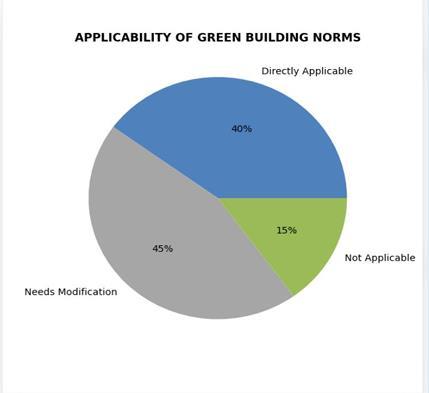
Theanalysisindicatesthatnearly40%ofthegreenbuilding guidelinescanbeimplementedintheKonkanregionwithout anychanges.Thesemainlyincludefundamentalstrategies suchasnaturalventilation,efficientdaylightuse,andbasic waterconservationmethods.
Around45%ofthenormsrequireadjustmentstosuitlocal conditions, particularly due to high humidity and intense rainfall. For instance, insulation methods and building envelope designs must be modified to address moisturerelatedconcerns.
Theremaining15%oftheguidelinesarenotsuitableforthe region, as they are designed for climates that differ significantly,especiallydryconditions.
Overall, the findings suggest that most green building standards need to be adapted to local environmental conditionsforeffectiveuse.
4.1.2
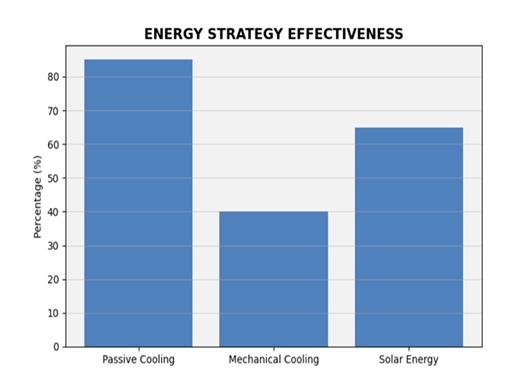
Thestudyshowsthatpassivedesignstrategiesarethemost effective in improving energy efficiency in the Konkan region.Techniquessuchascross-ventilation,properbuilding orientation, and shading devices significantly reduce the needforartificialcooling.
In contrast, mechanical cooling systems increase energy consumption and are less sustainable due to continuous humidity.
Solarenergysystemsperformreasonablywellthroughout mostoftheyearbutexperiencereducedefficiencyduring themonsoonseasonbecauseofcloudcoverandrainfall.
Theseobservationsconfirmthatpassivedesignapproaches arethemostsuitableandsustainableenergysolutionsfor theregion.
International Research Journal of Engineering and Technology (IRJET) e-ISSN: 2395-0056
Volume: 13 Issue: 04 | Apr 2026 www.irjet.net p-ISSN: 2395-0072
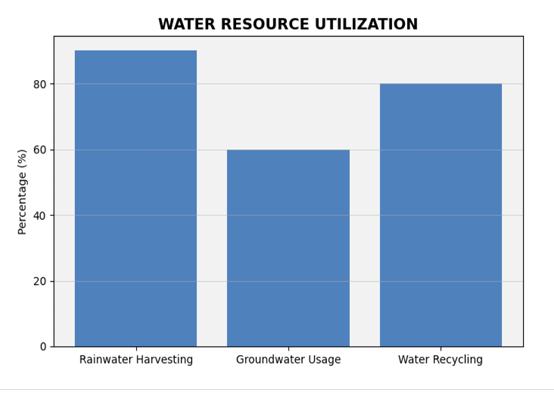
Graph no.3 Water Resource Utilization
Rainwaterharvestingemergesasthemosteffectivewater management strategy due to the region’s heavy rainfall, makingithighlyreliableforwaterconservation.
Groundwater use is moderate, though it faces challenges suchasseasonalfluctuationsandoveruseincertainareas.
Waterrecyclingandreusesystemsalsoprovetobehighly efficientinloweringoverallwaterdemand.
Theseresultshighlightthecriticalroleofwell-plannedwater management systems in achieving sustainability in the Konkanregion.
4.1.4
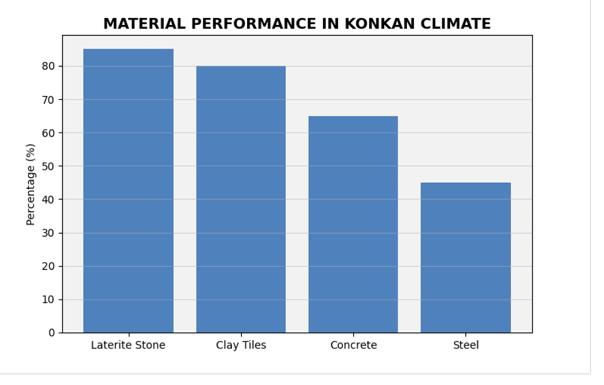
Graph no.4 Material Performance in Konkan Climate
Locallyavailablematerialslikelateritestoneandclaytiles perform very well due to their compatibility with the region’sclimateandgoodthermalproperties.
Concrete shows average performance but needs proper treatment and maintenance to prevent damage caused by moisture.
Steelislesssuitableinthisregionbecausehighhumidityand coastalconditionsincreasetheriskofcorrosion.
Thefindingssuggestthatlocalmaterialsaremoreeffective and sustainable compared to many modern construction materials.
4.1.5
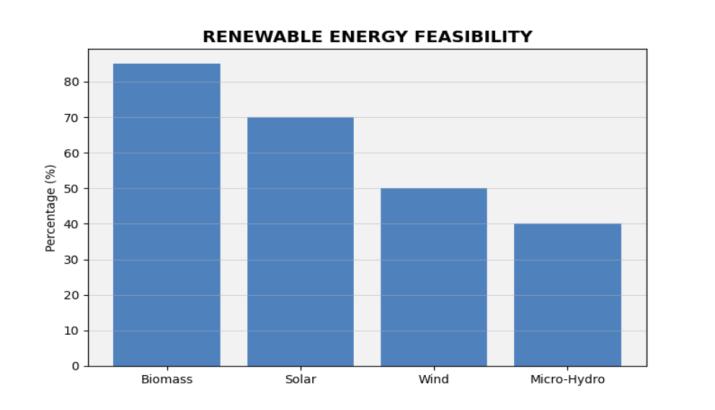
Graph no.5 Renewable Energy Feasibility
Biomass energy has the highest potential in the Konkan regionduetotheeasyavailabilityofagriculturalandorganic waste.
Solar energy also plays an important role, although its efficiencydecreasesduringthemonsoonseason.
Windenergyhaslimiteduseandismainlyfeasibleincertain coastalareas.
Micro-hydropower contributes very little and depends on seasonalwaterflowfromtheWesternGhats.
Overall,combiningsolarandbiomassenergyoffersthemost practical and efficient solution for sustainable energy generationintheregion.
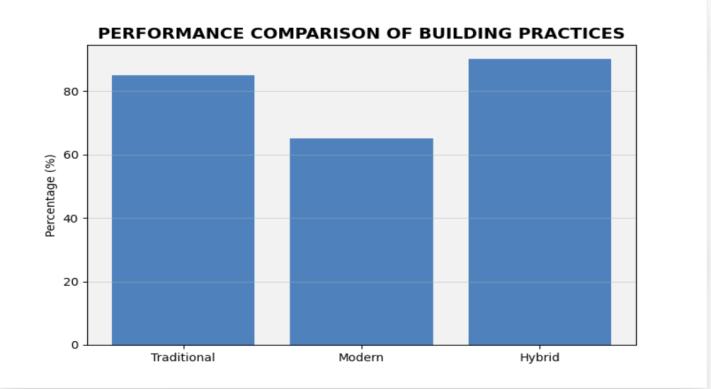
Graph no.6 Performance Comparison of Building Practices
International Research Journal of Engineering and Technology (IRJET) e-ISSN: 2395-0056
Volume: 13 Issue: 04 | Apr 2026 www.irjet.net p-ISSN: 2395-0072
Traditional architecture in the Konkan region performs exceptionallywellinadaptingtotheclimate.Featuressuch as sloping roofs, natural ventilation, and the use of local materialshelpmaintaincomfortanddurability.
Modernconstructionmethodsshowmoderateperformance butoftenlacksensitivitytolocalclimaticconditions.
Acombinedapproachthatintegratestraditionalknowledge with modern green building techniques provides the best resultsintermsofsustainability,energyefficiency,andlongtermperformance.
These findings emphasize the importance of blending traditional wisdom with modern technology to achieve effectiveandsustainablebuildingdesign.
Thisstudyexamineshoweffectivelygreenbuildingnorms can be applied in the Konkan region, considering its hot, humidclimate,heavyrainfall,andcoastalconditions.While existingframeworkslikeIGBCandGRIHAofferasolidbase for sustainable construction, they cannot be fully applied without modification. The findings show that only about 40%ofthenormsaredirectlysuitable,whilemostrequire adjustments to match local conditions. Passive design strategiessuchasnaturalventilation,shading,andproper orientationarefoundtobethemostefficientforreducing energyuse,whereasrelianceonmechanicalcoolingisless suitable.Acombinationofsolarandbiomassenergyemerges as a practical renewable solution. Effective water management,especiallythroughrainwaterharvestingand recycling, is essential due to high rainfall. The study also highlights that local materials like laterite stone and clay tilesperformbetterthanmodernalternativesinthisclimate. Additionally,integratingtraditionalarchitecturalpractices withmoderntechniquesprovidesthemostsustainableand efficientoutcomes.Overall,thestudyemphasizestheneed forregion-specificapproachestoachieveenvironmentally responsibleandclimate-responsivedevelopment.
[1] Charles J. Kibert (2016) “Sustainable Construction: Green Building Design and Delivery”, University of Florida,USA.
[2] Baruch Givoni (1998) “Climate Considerations in Building and Urban Design”, John Wiley & Sons, New York,USA.
[3] T.Ramesh,R.Prakash,K.K. Shukla (2010)“LifeCycle EnergyAnalysisofBuildings:AnOverview”,Energyand BuildingsJournal,Elsevier.
[4] Indian Green Building Council (2019) “IGBC Green BuildingRatingSystemsandGuidelines”,Confederation ofIndianIndustry(CII),Hyderabad,India.
[5] GRIHACouncil(2015)“GRIHARatingSystemManual”, TheEnergyandResourcesInstitute(TERI),NewDelhi, India.
[6] Rajendra Priyadarsini et al. (2009) “Thermal Comfort andEnergyConsumptioninTropicalBuildings”,Energy andBuildingsJournal,Elsevier.
[7] R. Singh, S. Sharma (2018) “Sustainable Building Materials and Construction Practices in India”, InternationalJournalofSustainableBuiltEnvironment.




Mr. Atul S. Chandanshive.
Working as Lecturer in, Civil Engineering, Solapur Education Society’s Polytechnic, Solapur, Maharashtra, India. Graduated in civil engineering and did masters in structure from Solapur University,andhavingexperience ofmorethan4yearsinteachingas wellasinindustry.
Mr. B. N. KYATAM
Diploma in Civil Engineering (pursuing)Research Scholar at Solapur Education Society’s PolytechnicSolapur,Maharashtra, India-413002.
Mr. R. V. KOLPYAK
Diploma in Civil Engineering (pursuing)Research Scholar at Solapur Education Society’s PolytechnicSolapur,Maharashtra, India-413002.
Mr. P.N. JODH
Diploma in Civil Engineering (pursuing)Research Scholar at Solapur Education Society’s PolytechnicSolapur,Maharashtra, India-413002.
International Research Journal of Engineering and Technology (IRJET) e-ISSN: 2395-0056
Volume: 13 Issue: 04 | Apr 2026 www.irjet.net p-ISSN: 2395-0072


Mr. S. S. SALUNKE
Diploma in Civil Engineering (pursuing)Research Scholar at Solapur Education Society’s PolytechnicSolapur,Maharashtra, India-413002.
Mr. M. S. MANDKAL
Diploma in Civil Engineering (pursuing)Research Scholar at Solapur Education Society’s PolytechnicSolapur,Maharashtra, India-413002.