
International Research Journal of Engineering and Technology (IRJET) e-ISSN: 2395-0056
Volume: 12 Issue: 12 | Dec 2025 www.irjet.net p-ISSN: 2395-0072
International Research Journal of Engineering and Technology (IRJET) e-ISSN: 2395-0056
Volume: 12 Issue: 12 | Dec 2025 www.irjet.net p-ISSN: 2395-0072
Mohammad Faiz Khan1 , Ajay Kumar Singh2
1M.Tech (ME) Scholar, Department of Mechanical Engineering, B.N. College of Engineering & Technology, Lucknow, Uttar Pradesh, India
2 Assistant Professor, Department of Mechanical Engineering, B.N. College of Engineering & Technology, Lucknow, Uttar Pradesh, India
Abstract- Friction Stir Processing (FSP) is a sophisticated surface modification method that uses a stirrer's motion against the surface that has to be improved to increase the mechanical characteristics of materials. The effects of several FSP factors, such as tool angle, stirring speed, and reinforcement type, have been examined in this study. During FSP, heat generation is essential to plastic deformation and has a direct effect on the effectiveness and results of the process.
Derived from Friction Stir Welding (FSW), FSP is a unique, energy-efficient, and environmentally friendly method that is especially useful for creating surface composite. AZ31 was chosen as the matrix phase in this study, and MgO and B4C were used as reinforcements. The creation of surface composite, such as AZ31+B4C, AZ31+B4C+MgO, and AZ31+MgO, was thoroughly examined. The impact of tool type, tool angle, and rotational speed on the composite' characteristics was the main focus of the investigation.
The main conclusions emphasise how the composite formed uniform, fine-grained microstructures. Grain size was shown to be inversely related to rotational speed, with finer grains produced at greater speeds. This study highlights the significance of parameter optimisation for reaching desired material properties and offers insightful information about the creation and improvement of AZ31based surface composite using FSP
Keywords: Friction Stir Welding (FSW), AZ31-based surface composite, MgO and B4C as reinforcements, Microstructural analysis etc.
Nowadays, the manufacturing industry is seeing a continuous increase in demand for new kinds of engineering materials. Such materials need to have extraordinary properties, such high strength to weight ratio and outstanding electrical and thermal conductivity.Combiningthesetypesofcharacteristicsin a particular unique material promotes materials like composite and speeds up manufacture. [1] Metal Matrix Composite (MMC) rate well among all composite kinds for technological applications. When two distinct materials combine, a homogeneous phase known as
MetalMatrixComposite(MMC)isproduced.Themetallic phase of the matrix and the non-metallic phase of the reinforcement disperse across the metallic phase [2]. Thetechniquesemployedwereeithermeltingthematrix materialorhotpressingitintothefibre.Inanothercase, the production of these uncommon composite depends on high temperatures. Reinforcement phases including oxides, nitrides, and carbides have high strength and evenlydistributedmodulesinmetallicmaterials.
CrudeMMChavebeendemonstratemakebetterphysical and mechanical properties, ability of structure, reliability. Crude MMC make certain towards enhances the engineering performances compare to nonreinforcement matrix [3]. In form of matrix material, somecommonmaterialsareusedmainlylikealuminium, magnesium, titanium, copper etc. Whereas reinforcement material like AL2O3 Aluminium oxide, Boron, Carbide [B4C] , Silicon Carbide [SIC] and Magnesium Oxide [MgO] are used[4]. Magnesium-based MMCs are widely employed in the automotive sector becauseoftheiradmirablequalities,whichincludetheir light weight and ability to promote mechanical and thermal properties. When compared to other manufacturing materials, these qualities make them better for engineering applications. [5] For better execution, mmcs are a healthier substitute for large constructionmaterialslikesteelorcastinginthepresent day.[6] MMC can be elaborate by some technique which varies gradually according to type of reinforcement are used. [7] The selection of development techniques depends on the homogeneous scattering of the reinforcement into the matrix alloy and precision of the MMC.
Currently, MMCs are widely used in the transportation, maritime, automotive, structural, and aerospace sectors. They are extremely valuable and appropriate for a varietyofapplicationsduetotheir exceptional qualities, which include their high strength-to-weight ratio, high specificstiffness-to-weightratio,andlightweightnature. Usually, MMCs are created by adding liquid or particle reinforcementtothebasemetal(matrixmaterial).
International Research Journal of Engineering and Technology (IRJET) e-ISSN: 2395-0056
Volume: 12 Issue: 12 | Dec 2025 www.irjet.net p-ISSN: 2395-0072
The acceptability of the produced MMCs is significantly influenced by the friction stir processing process parameters, including plunging speed, traverse speed, tool tilt angle (pin and shoulder), and percentage of reinforcement. Figure 1.1 displays the specific parametersalongwiththeirunderlyingreasons.

In their study, R.S. Mishra et al. [8] examined (a) how frictionstirprocessingrefinesthemicroscopicstructure ofalloysofmetalsand(b)howprocessvariablesimpact the final metal's mechanical characteristics. Aluminium alloys were the subject of the majority of their studies. FSPisnowacknowledgedasausefulinstrument.
ThereinforcementofSiCwithAl356wasinvestigatedby Ma et al. [9]. A 6.35 mm thick plate, variable traverse speeds,single-passFSP,andvarioustoolrotatingspeeds wereallusedintheirinvestigation.
The microstructure of aluminium alloy 7065 under FSP was examined by Su et al. [10], who discovered that friction stir processing did not result in a consistent graindistributioninthestructure.
IntheiranalysisoftheFSP approach,Thomaset al.[11] discovered that qualities like tensile strength & fatigue strength are enhanced when the tool is rotated on the lateral surface of an element. The produced sample showed improved microstructure and fine-grained aluminiumMMC(MetalMatrixComposite).
TheimpactoffeedrateandtoolrotationspeedonAZ31 magnesium alloy was examined by Gupta et al. [12]. TheydiscoveredthatanidealSiCcontentisnecessaryto boostthestrengthofmagnesium-basedcomposites. For alloys made of magnesium and aluminium, friction stir processing has been used extensively. But since FSP
toolmaterialshaveadvancedsomuch,newstudieshave looked into applying technique to high-melting-point materials including titanium, nickel-based alloys, and iron-magnesium-basedalloys[13-14].
IntheirstudyofthemagnesiumAE42alloy,AroraH.S.et al. [15] discovered that FSP improves microstructure andhardnesswhileloweringwearrates.
The mechanical characteristics of aluminium alloy 2024 were investigated by Mahendra Boopathi [16]. They treated the MMC under FSP and reinforced Al2024 with flyashandSiCinvariouscompositions.Theycametothe conclusion that the MMC became harder. Multi-pass FSP on zircon-reinforced Al MMCs and its corrosion behaviour were investigated by Sucitharan et al. [17]. They proposed that zircon reinforcement enhances the wear resistance characteristics of aluminiumalloycomposites.
Mishra et al. [18] examined the casting of Al356 and proposed that friction stir processing on temperatures ranging from 470°C to 570°C improves superplastic properties in aluminium alloy. Fadhel A. et al. [19] examined the effects of FSP on aluminium alloy and discovered that yield strength increased by 9% and tensile strength increased by 15% following friction stir processing.
Inordertoproducefineraluminiumgrains,Darrasetal. [20] investigated the friction stir processing of AZ31 by regulating heat input and persistent deformation in the material.
Theobjectivesofthepresentworkareasfollows:
1. Development of MMCs using Friction Stir Processing (FSP)
(a)Selectionofmaterial
(b)SelectionofprocessparametersforFSP
2. Characterization of Developed MMCs
(a) Microstructural Observations
(i)macroscopicobservationsthroughoptical macrography
(ii)Microscopicobservations(morphology)usingSEM images
(iii)SEMimagesforfractureanalysisaftertensiletesting
(b) Elemental and Chemical Composition Analysis
(i) Through energy-dispersive spectroscopy (EDS)
(ii)ThroughX-raydiffraction(XRD)
International Research Journal of Engineering and Technology (IRJET) e-ISSN: 2395-0056
Volume: 12 Issue: 12 | Dec 2025 www.irjet.net p-ISSN: 2395-0072
3.1. Selection of Material
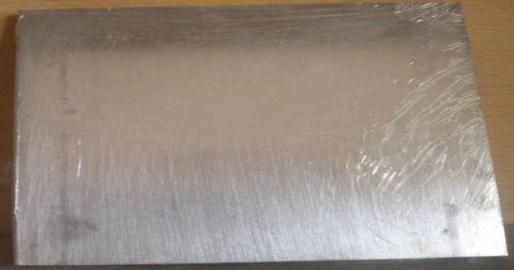
At present, various materials are available that can undergo different machining processes. Among them, aluminum (Al) and magnesium (Mg) have unique and attractiveproperties.Manyresearchershaveextensively studied Al metal alloys and their properties. Therefore, for innovation, it is essential to explore alternative materials.Magnesium has a hexagonal lattice structure, which contributes to the fundamental property enhancementsofMgalloys.ThelightweightnatureofMg alloys helps reduce fuel consumption, lower emissions, andimproveenvironmentalsustainability.
Table 3.1:MGalloy(%)composition[AZ31B]
3.2. Selection of Process
A method that does not change the material's phase while processing is necessary for the assessment of microstructure and the creation of metal matrix composite(MMC). The objectiveistoproducea refined microstructurewithafine,equiaxed grainstructure. To achievethesequalities,frictionstirprocessing(FSP)isa goodfit.
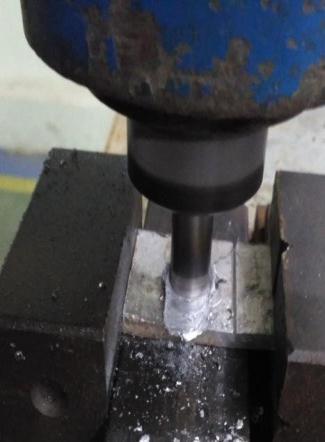

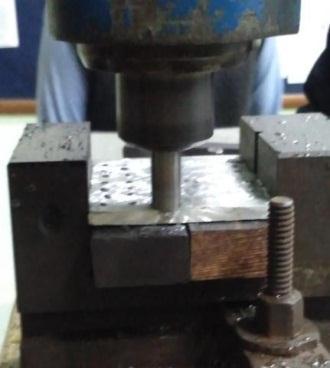
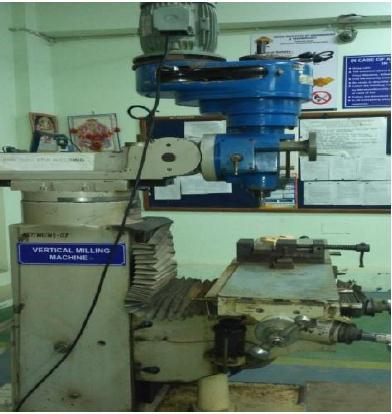
Inthiswork,aVerticalMillingMachine(VMM)isutilised for Friction Stir Processing (FSP). A vertical milling machine is a high-precision instrument used to shape and fabricate metal objects. It can also be applied to plastics, depending on the kind of material and the equipment.
AVMMcanbeoperatedmanuallyorbyuseofComputer NumericalControl(CNC)techniques. Becausethetoolis secured within the spindle, it can travel both up and down. Milling, which uses rotary cutters to remove undesirable material from the workpiece, is one of the mainprocessescarriedoutonaverticalmillingmachine. ThespecificationsoftheVerticalMillingMachines(VMC) used in this work are provided in Table 3.2, and Figure 3.4showstheactualmachineused.
Table 3.2: SpecificationofFSP.
MODEL X6323
TRAVELx,y,z 610,350,380
Tabledimensionwidthandlength230,1070
HEADSTRUCTURE PHASED GEAR HEAD
VERTICALSTEELHEAD(VSH) NONPHASEDHEAD(NPH)
SPINDLESPEED PGH805400 VSH808400 NPH604200
MOTOROUTPUT 3HP
RAMTRAVEL 305mm
MACHINESIZE 250kg
International Research Journal of Engineering and Technology (IRJET) e-ISSN: 2395-0056
Volume: 12 Issue: 12 | Dec 2025 www.irjet.net p-ISSN: 2395-0072
3.4. Tool
The tool is essential to the creation of the final result in FSP.Itcarriesouttwoprimarytasks:materialmovement and localised heating. This instrument consists of a 50mmcylinder,apin,ashoulder,andatinycylinderlock drill. In addition to these components, two new pins have emerged: Flared Tri flute: the pin has vertical engravings; A skew is when a pin's axis is angled towardsaspindle'saxis.
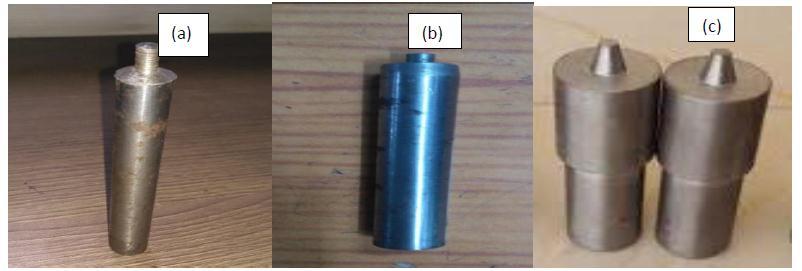
Figure3.5:Toolusedinthestudy(a)Threadcylindrical pin(b)PlainCylindricalpin;(c)Taperedcylindricalpin
3.5. Muffle Furnace
Muffle furnace is box type furnace which has a heating chamber it is used in all lab work up to 3000 degree Celsius. It is used for high temperature application such as milling glass, creating enamel coating soldering and brazing.
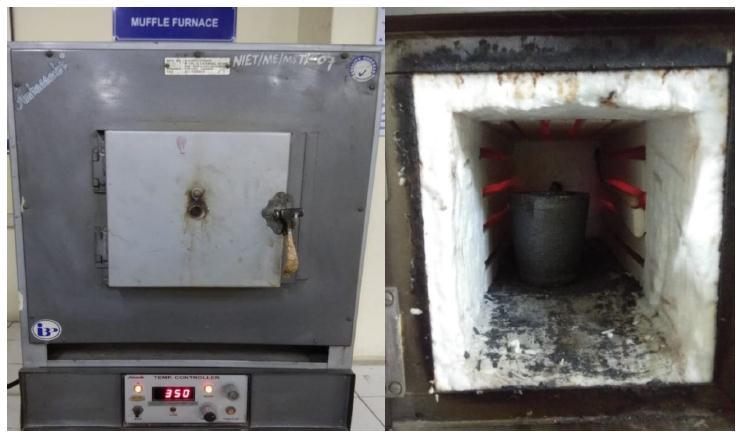
3.6:(a)MuffleFurnaceFigure3.6(b).Heating
3.6 Experimental Procedure
The magnesium alloysheetsare used inthis study. The magnesium alloy AZ31B's composition is listed in table 3.1. A vertical milling machine is used to friction stir process magnesium alloy sheet. The FSP magnesium alloy sheet is treated using a stirrer as the tool under various tool angles, variable speeds, and varying reinforcement material compositions. Because of the heatinside,therotatingtoolisabletopenetratetheseat while turning. The magnesium alloy sheet becomes entangledwiththereinforcementmaterial. Itisaheated
working procedure because of the plastic deformation caused by the mixing of the reinforcement material and magnesium. First,thesheetisdrilled,andthentheVMM isprocessedusingastirrerunderFSP.
AftertheFSPofMgalloythesamplesfromthesheetare cut down and the samples are cleaned by the use of proper use of abrasive paper. The size of samples has been chosen wisely according to the sizes provided by the microscopy machine. Now these samples are prepared by use of appropriate grit papers of different size. After this sample are to be moulded with use of mounting press machine with Bakelite powder. Afterwards these samples undergo testing in the electron microscopy machine. Through this we get the Grain refined region and the size of grain and grain boundary.
4.1 Micro structural analysis
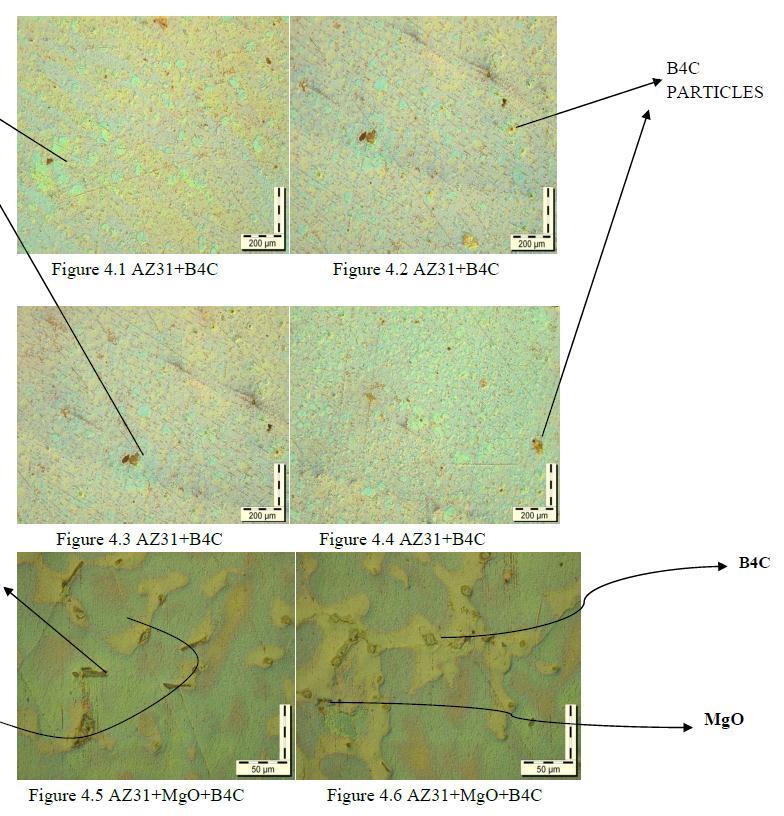
Thefiguredisplaysthemicrostructureofthemagnesium alloy'sFSPatvariousrotationalspeedsandwithvarying reinforcement materials. The uniform mixing of reinforcedparticlesinthemagnesiumalloy's basemetal isshowninFig4.1-4.10
After a while, less heat is produced and the boron particlescontinue to be larger. Thisis becausemixingis useless. By generating turbulence and speeding up the stirrer's spin, this can be decreased. The microstructure picturesofvarioussamplesareshownbelow.


International Research Journal of Engineering and Technology (IRJET) e-ISSN: 2395-0056
Volume: 12 Issue: 12 | Dec 2025 www.irjet.net p-ISSN: 2395-0072
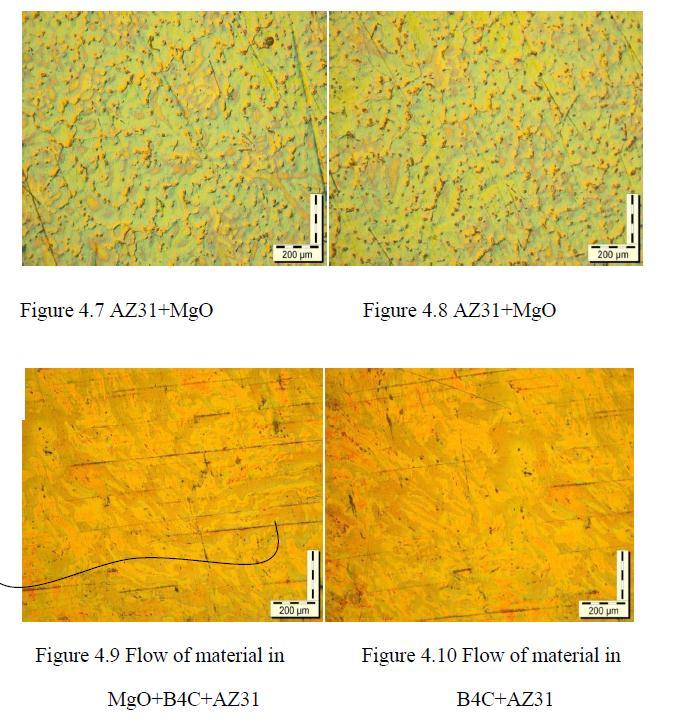
SEM image of FS processed samples at different magnificationofsamples

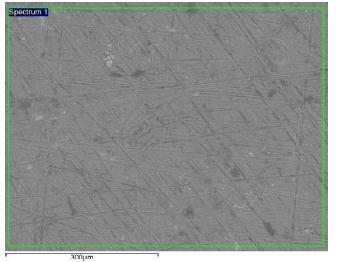
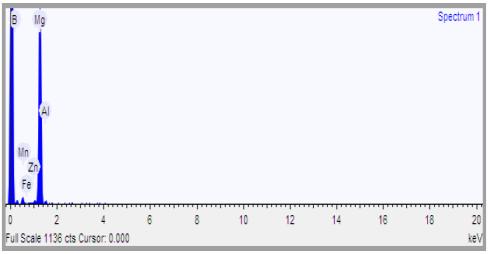
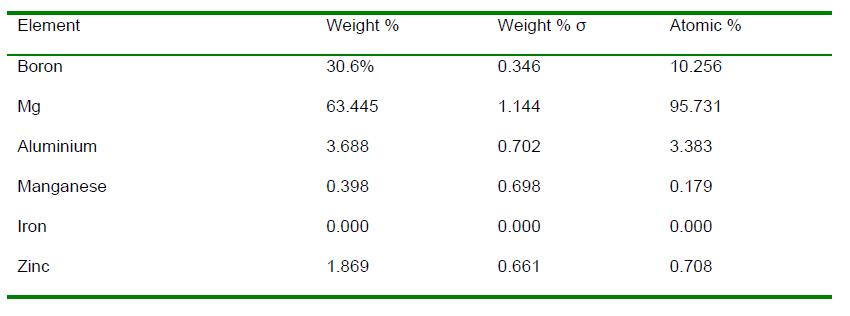
Energy dispersive x-ray analysis or EDAX test is performed for determining the different elements present in MMC . By EDX calculation of their chemical composition atomic weight % is calculated. Test of materialreinforcedwithB4C+MgOisdonehere.
4.3.1 (AZ31+B4C+ MgO)
TestofmaterialreinforcedwithB4C+MgOisdonehere. Composition of Boron and Mg can be seen from graph. There is also the presence of Mn and Fe is there due to thecompositionpresentinthebasemetal.
International Research Journal of Engineering and Technology (IRJET) e-ISSN: 2395-0056
Volume: 12 Issue: 12 | Dec 2025 www.irjet.net p-ISSN: 2395-0072
4.4. Summary results
Table4.1:TableofcompositionofAZ31+B4C+MgO
5.1 Conclusion
The project's outcome indicates that the process has been impacted by a number of FSP process parameters, including tool angle, speed, and reinforcement. Accordingtothemicrostructureofmagnesiumalloyand its reinforcement, the grain of that portion processed at low speed is less refined than the grain of that part processed at high speed. Grain growth and plastic deformation are significantly influenced by heat generation during processing. Therefore, the effect of processparameterscanbe usedtoanalyseand evaluate the entire process as well as demonstrate how to optimiseitforbetterfuturepurposes.
5.2. Future Work
By adjusting additional process parameters, more experimental research may be conducted togainadeeperknowledgeoftheprocess.
Preheating, or heating the specimen, may assist usimprovethesample'sgraingrowthcause.
The literature review indicates that fine grain has superior strength and ductility; therefore, this might be another topic of focus for future research.
[1] Kumar G. B. Veeresh, RaoC. S. P., Selvaraj N., Mechanical and tribo logical behavior of particulate reinforced aluminium metal matrix composite -a review, Journal of Minerals & MaterialsCharacterization &Engineering, 2011, 10(1),59-91.
[2] HullD.,ClineT.W.,Anintroductiontocomposite materials, Cambridge, UK: Cambridge Univ. Press,1996.
[3] Rohatgi P.K., Low-cost fly-ash-containing aluminium-matrix composite- overview, JOM1994,(46),55-59.
[4] Rohatgi P.K., Guo R.Q., Huang P., Ray S., Friction andabrasionresistanceofcastaluminiumalloyfly ash composite,Metallurgical and Materials Transactions-A,1997,(28),245-250.
[5] Miller W.S., Zhuang L., Bottema J., Wittebrood A.J., Smet P. De, Haszler A., Vieregge A., Recent development in aluminium alloys for the automotive industry, Materials Science and Engineering,2000,A(280),37-49.
[6] NaherS.,BrabazonD.,andLooneyL.,Simulation of the stir casting process, Journal of Material Processing and Technology, 2003,(143-144), 567–571.
[7] Srinivasan,A.,ArunachalamR.M.,RameshS.andSen thilkumaarJ.S., Machiningperformancestudyon metal matrix composite-a response surface methodology approach, American Journal of AppliedSciences,2012,9(4),478-483.
[8] BergesonA.,Non-ferrousMaterials, Nucleus,1996,8(5),5-11.
[9] KellyA.,Thenatureofcompositematerials,Science American,1967,217(3),161-176.
[10]SuchetclanVan,PhilipsRes.Reports,1972,(27),28.
[11]BeheraR,DasS,Chatterjee,D.andSutradhar,G, 2011.Forgeabilityand machinability ofstircast aluminumalloymetalmatrixcomposite.Journalof Minerals & Materials Characterization &Engineering,(10),923-939.
[12]SurappaM.K.,Rohatgi,P.K.,Preparationandproper tiesofaluminiumalloyceramicparticlecomposite, Journal of material sciences,1981, (16), 983–993.
[13]Gupta M and Surappa MK, ProcessingMicrostructure-Mechanical properties of al basedmetalmatrixcompositesynthesizedusing casting route, Key to Engineering Materials, 2003,(104-107),259-274.
[14]Das S., Development of Aluminum Alloy Composite for Engineering Applications, Indian InstituteofMaterials,2004,27(4),325-334.
[15]TrostyanskayaE.B.,Polymericmaterialsinfibrereinforced composite material, Polymer Matrix Composite,1995,R.E.Shalin(Eds.),1-4.
[16]Upadhya K., Ceramics and composite for rocket engines and space structures, Journal of the
International Research Journal of Engineering and Technology (IRJET) e-ISSN: 2395-0056
Volume: 12 Issue: 12 | Dec 2025 www.irjet.net p-ISSN: 2395-0072
Minerals, Metals and Materials Society, 1992, 44(5),15-18.
[17]ChawlaK.K.,Ceramicmatrixcomposite,secondeds. ,KluwerAcademicPublishers,Massachusetts, 2003,1-10.
[18]ClyneT.W.,AnintroductoryoverviewofMMCsyste m,typesanddevelopments,T.W.Clyne(Eds.), Comprehensive Composite Materials, 2000, (3), 1-26.
[19]Rohatgi,P.K.,Gupta,N.,Daoud,A.,Synthesisand processing of cast metal matrix composite and theirapplications,ASMHandbookCasting,2008, (15).ASMInternational,1149-1164.
[20]IbrahimA.,MohamedF.A.,LaverniaE.J.,Particulate reinforcedmetalmatrixcomposite-areview, JournalofMaterialSciences,1991,26(5),11371156.