
International Research Journal of Engineering and Technology (IRJET) e-ISSN: 2395-0056
Volume: 13 Issue: 04 | Apr 2026 www.irjet.net p-ISSN: 2395-0072
OPTI-BUDGET ENGINE - AI QUERY-DRIVEN EXPENSE MANAGEMENT AND BUDGET MONITORING SYSTEM
Dr. Vivek Jaladi1 , Abdul Kareem Khan2, Md Khustar Ahmed3, Mohammed Afzanuddin4, Syed Shah Mustafa Hussaini5
1Professor & Head, Department of Computer Science & Engineering, Lingaraj Appa Engineering College, Bidar, Karnataka, India
2,3,4,5BE Final Year, Department of Computer Science & Engineering, Lingaraj Appa Engineering College, Bidar, Karnataka, India
Abstract - Personal expense management has become increasinglycomplexduetothegrowthofdigitaltransactions anddiversespendingpatterns.Conventionalexpensetracking systems depend on manual data entry and static interfaces, whichoftenleadstoincompleterecords,lowuserengagement, and weak financial insight. This paper presents Opti‑Budget Engine, an AI query‑driven expense management and budget monitoring system designed to simplify and automate personal finance tracking. The system enables users to manage expenses through natural language interaction, allowing them to add, query, update, and delete financial recordsconversationallyinsteadoffillingtraditionalforms.An integratedAIagentinterpretsuserintent,extractskeyentities such as amount, category and date, and executes verified operationsdirectlyonthebackendSQLitedatabase, ensuring real‑time synchronization between data storage and visual analytics. The platform also offers dynamic dashboards, category‑wise and trend‑based insights, and professionalPDF report generation to support informed financial decision‑making. Overall, Opti‑Budget Engine transforms conventional expense tracking into an intelligent financial assistance process by reducing user effort, improving record accuracy, and enhancing usability, providing a modern and user‑centric solution for personal finance management.
Key Words: Personal finance, Expense management, Budget monitoring, Conversational AI, Large language model, Flask, SQLite, Dashboard
1. INTRODUCTION
In the contemporary digital era, personal financial managementhasemergedasacriticalyetchallengingtask due to the increasing volume, diversity, and frequency of daily transactions. Individuals often struggle to maintain accurateexpenserecords,analyzespendingbehavior,and derivemeaningfulinsightsfromfragmentedfinancialdata. Conventional expense management applications largely depend on manual data entry and static categorization, which not only demands sustained user effort but also increases the likelihood of errors, inconsistencies, and incompleterecords.WiththerapidadvancementofArtificial Intelligence,particularlyinnaturallanguageprocessingand
intelligent automation, new opportunities have arisen to transform how users interact with financial systems. The Opti-Budget Engine is introduced as an AI query-driven expense management and budget monitoring system designed to simplify and modernize personal finance handling
1.1 Background Survey
Thegrowingcomplexityofmodernlifestyleshassignificantly increasedtheneedforefficientpersonalfinancemanagement systems. With the rise of digital payments, online subscriptions,andfrequentmicro-transactions,individuals generate large volumes of financial data daily. Traditional expensemanagementsystemstypicallyrequireuserstoinput transactiondetailsthroughstructuredforms,whichistimeconsumingandpronetoinconsistency.Recentadvancements in Artificial Intelligence, particularly in natural language processing and intelligent agents, have introduced new possibilities for improving user interaction with software systems. However, in many existing finance-related applications, AI functionality is confined to providing suggestionswithoutdirectauthoritytomodifytheunderlying financial database. This gap forms the foundational motivationfordevelopinganintelligent,AI-drivenexpense managementplatform.
1.2 Problem Statement
Despite the widespread availability of digital expense trackingapplications,individualscontinuetofacesignificant challengesineffectivelymanagingtheirpersonalfinances. Existingsystemslargelydependonmanualdataentry,rigid input forms, and predefined categories, which require continuoususereffortanddiscipline.Thisrepetitiveprocess often leads to delayed updates, incomplete records, and inaccuratecategorization.Additionally,mostconventional toolsofferlimitedinteractionmechanisms,restrictingusers to static dashboards and fixed query options. Users are unable to interact with their financial data in a natural mannerusingeverydaylanguage.Anothercriticallimitation lies in the lack of real-time synchronization between user actions,dataprocessing,andvisualanalytics.Therefore,the
International Research Journal of Engineering and Technology (IRJET) e-ISSN: 2395-0056
Volume: 13 Issue: 04 | Apr 2026 www.irjet.net p-ISSN: 2395-0072
coreproblemaddressedinthisprojectistheabsenceofan intelligent, user-centric expense management system that canseamlesslyinterpretnatural languageinputs,perform direct database operations, and present real-time, meaningfulfinancialinsights.
1.3 Motivation
Effective personal financial management has become increasinglyimportantinaneracharacterizedbyfrequent digitaltransactionsanddiversespendingchannels.Despite theavailabilityofnumerousexpensetrackingapplications, manyusersstruggletomaintainconsistentfinancialrecords duetotherepetitivenatureofmanualdataentry.Another key motivation arises from the gap between how users naturally think about their finances and how traditional systems require them to interact. Users tend to recall expenses in conversational terms rather than filling structured forms. The motivation behind developing the Opti-Budget Engine is to eliminate this disconnect by transforming expense management into an intuitive, conversationalexperience.Byenablinguserstointeractwith theirfinancialdatausingnaturallanguageandallowingan intelligentAIagenttodirectlyexecutedatabaseoperations, thesystemsignificantlyreducesusereffortwhileimproving accuracyandconsistency.
1.4 Aim and Objectives
Aim: The primary aim of the Opti-Budget Engine is to developanintelligent,AI-drivenexpensemanagementand budgetmonitoringsystemthatsimplifiespersonalfinance tracking by minimizing manual intervention and enabling natural,conversationalinteractionwithfinancialdata.
Objectives:Thekeyobjectivesare:
Toautomatetheprocessofexpenserecordingand managementbyinterpretinguserintentexpressed through natural language commands, thereby reducing dependency on traditional form-based dataentry.
Toenableconversationalqueryingoffinancialdata, allowing users to retrieve summaries, analyze spendingpatterns,andmodifyrecordsthroughan interactivechatinterface.
To provide real-time visual analytics through dynamicdashboardsandchartstosupportbetter financialawarenessandinformeddecision-making.
To ensure data portability and usability by generatingstructured,professionalfinancialreports inPDFformat.
To include a manual fallback mechanism to maintaindataaccuracyandusercontrol,ensuring reliabilityinscenarioswhereconversationalinput mayrequirepreciseadjustments.
2. LITERATURE REVIEW
Johri etal.proposedanexpensemanagementsystem that digitizes daily financial transactions using category-based logging,centralizedstorageandsummary-orientedfinancial reports [1]. While it improves accuracy over manual bookkeeping, the system still depends on explicit userdrivendataentryandstaticworkflows,withnointelligent intenthandlingorautomateddatabaseactions.Bhateleetal. introduced TrackEZ, a web-based categorized expense tracker that combines structured input forms with dashboard visualizations to support short-term financial analysis[2].However,itsrelianceonmanualformfillingand predefined categories limits scalability toward intelligent, adaptiveautomation.
Sabab et al. presented eExpense, an early digital platform that simplifies everyday expense tracking through ease of entry and periodic summaries [3]. The approach reduces reliance on physical logs but remains deterministic and retrospective, lacking adaptive intelligence or natural languageinteraction.Naiketal.exploredautomaticexpense trackingsystemsusingsemi-automated,rule-basedpipelines to capture and process transactions [4]. Their framework reducesmanualinterventionbutremainssystem-triggered ratherthanuser-intent–driven,withnoconversationallayer controllingthedatabase.
Saheletal.developedaweb-basedexpensetrackerfocused oncleaninterfacedesign,categorizedexpenditureviewsand improvedaccessibility[5].Despiteitsusability,thesystem behaves mainly as a passive digital ledger, requiring continuoususereffortandofferingnointelligentquerying. Singlaetal.designedadailyexpensetrackerthatenhances financial insight through categorized visualization and summary analytics [6], yet its intelligence is confined to post-processing,withoutreal-timeconversationalcontrolor AI-drivendatabaseactions.
Kamra et al. proposed a full-stack expense monitoring system that integrates frontend, backend and database layerstoachievemodular,end-to-endarchitecture[7].The solutionnonethelessoperatesonpredefined,user-triggered operationsanddoesnotemploylargelanguagemodelsor agentic AI to execute financial commands. Girdhar et al. focused on a mobile expense app emphasizing portability and ease of use [8], but the interaction remains static, without intelligent automation or learning from user behavior.
Raihan et al. investigated user readiness for AI-powered personalexpensetrackingandreportedstrongdemandfor intelligent,automatedfinancialassistants[9].Theirfindings supportthetransitionfrommanualorsemi-automatedtools toconversational,AI-drivenplatforms.Finally,anenterprise expense reimbursement system based on association rule
International Research Journal of Engineering and Technology (IRJET) e-ISSN: 2395-0056
Volume: 13 Issue: 04 | Apr 2026 www.irjet.net p-ISSN: 2395-0072
mining demonstrates how structured data mining can optimize financial workflows in organizations but lacks conversational adaptabilityanduser-level personalization [10].Together,theseworkshighlightagapforsystemslike Opti-BudgetEnginethatcombineconversationalAI,direct database control and real-time analytics for personalized, intent-drivenexpensemanagement.
Therefore, existing systems lack a unified platform that supports conversational expense entry, direct AI-driven database execution, and synchronized real-time analytics, whichmotivatestheproposedOpti-BudgetEngine.
3. SYSTEM DESIGN AND METHODOLOGY
TheOpti-BudgetEngineisdesignedasalayered,web-based applicationthattightlyintegratesconversationalAI,backend business logic and structured financial data. The system followsanend-to-endmethodologywhereusercommands, given through natural language or uploaded bills, are translatedintoconcretedatabaseoperationsandreal-time visualanalytics.Theoveralldesignaimstominimizemanual effort, maintain data consistency and provide immediate insightintopersonalspendingbehavior.
3.1 System Architecture
The system architecture adopts a four-layer structure: presentation layer, application layer, data layer and visualizationandreportinglayer.Atthepresentationlayer, usersinteractthroughawebinterfacebuiltwithHTML,CSS and JavaScript. This interface provides a login page, dashboard, conversational chat window, manual expense entry forms and report download options, ensuring a responsiveanduser-friendlyexperience.
The application layer is implemented using a Flask-based backend that handles request routing, authentication, session management and coordination between the AI moduleandthedatabase.Withinthislayer,anAIinteraction module receives natural language inputs, performs intent recognitionandentityextractionandmapseachrequesttoa valid financial operation such as add, query, update or delete.
The data layer consists of an SQLite database that stores structured expense records, including fields such as date, category, amount and description, along with user details and metadata. All CRUD operations originate from the backendlogic,ensuringcontrolledaccessanddataintegrity. Abovethis,thevisualizationandreportinglayeraggregates the latest expense data to generate real-time dashboards, charts and PDF reports so that analytical views stay synchronizedwiththeunderlyingrecords
3.2 Data Flow and Sequence
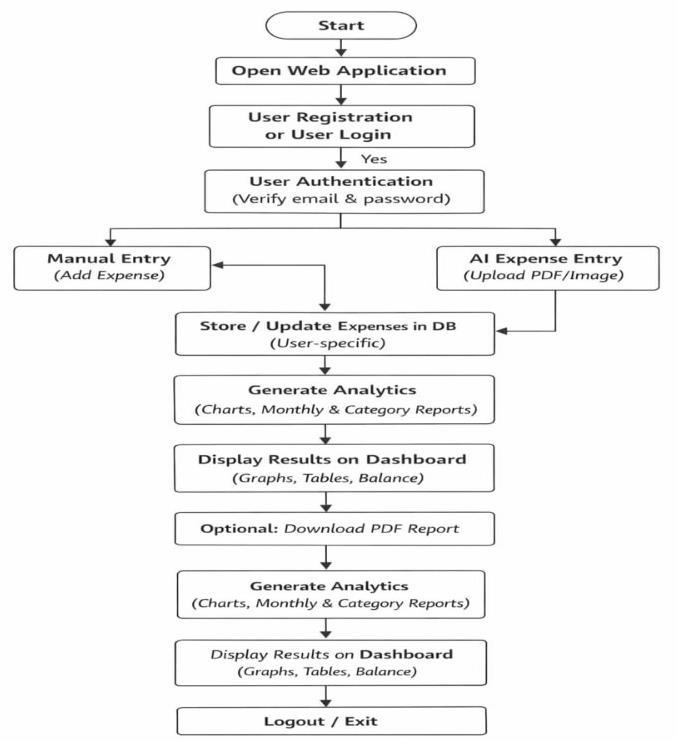
The data flow of Opti-Budget Engine begins when an authenticated user issues a command through the web interfaceoruploadsabill/document.Thefrontendforwards thisinputtotheFlaskbackend,whichdetermineswhether therequestisconversationalormanual.
Conversational inputs are routed to the AI processing module, where the language model interprets user intent andextractskeyentitiessuchasamount,categoryanddate. Once identified, the backend translates the extracted informationintodatabaseoperationsontheSQLiteexpense store,performingcreate,read,update ordeleteactionsas required.
The updated expense records are then processed by the analytics component to recompute totals, category-wise distributionsandmonthlyspendingtrends.Theseresultsare immediately reflected on the dashboard for real-time visualization. When the user requests documentation, the processeddataispassedtothereportgenerationmodule, whichproducesstructuredPDFreports. Overall,eachrequestfollowsthesequence:
Volume: 13 Issue: 04 | Apr 2026 www.irjet.net p-ISSN: 2395-0072
Thisensuresthatconversationalactionsresultinpersistent changes to the financial dataset and synchronized visual insights.
3.3 Use Cases
The primary actor in Opti-Budget Engine is the end user managing personal finances. Afterlogging in, the usercan addexpenseseitherthroughnaturallanguagecommandsor by filling a manual form. In both cases, the transaction is storedsecurelyintheexpensedatabase.
The user can issue conversational queries to obtain total spending,category-wisebreakdownsormonthlysummaries, and the system responds by fetching and aggregating relevant records. Additional use cases include editing and deleting expenses through chat commands or record selection,allowinguserstocorrectmistakesandmaintain accuratedata.
Theplatformalsoprovidesreal-timedashboardswithkey indicators and trend charts, along with professional PDF report generation for selected time periods. A manual fallback mechanism is available whenever conversational inputisambiguous,ensuringfullusercontroloverfinancial records.
4. IMPLEMENTATION
The Opti-Budget Engine was implemented as a full-stack webapplicationthatintegratesconversationalAI,backend database control, and real-time financial analytics. The system was developed using a modular architecture to ensuresecureexpensestorage,intelligentautomation,and responsive visualization. The implementation focuses on enablinguserstomanagepersonalexpensesthroughboth manualformsandAI-drivennaturallanguageinteraction.
4.1 Technology Stack
TheOpti-BudgetEnginewasdevelopedusingalightweight full-stackwebtechnologyframeworktosupportintelligent expense tracking and real-time analytics. The frontend interface was implemented using HTML, CSS and JavaScript,providingresponsivepagesforlogin,dashboard, expense forms and AI chat interaction. The backend was builtusingthe Flask framework in Python,whichmanages routing, authentication and coordination between the AI moduleandthedatabase.Expenserecordsarestoredinan SQLite database, ensuring structured and user-specific transactionmanagement.TheconversationalAIcomponent isintegratedthroughthe HuggingFace API,enablingnatural languageunderstandingandautomatedexpensehandling. Interactive dashboards and charts are generated using visualizationlibraries,andaPDFexportmoduleisincluded toproduceprofessionalfinancialreports.
Table 1: TechnologyStackUsed
Module
Frontend
Technology
HTML,CSS,JavaScript
Backend PythonFlask
Database SQLite
AIModelAccess HuggingFaceLLMAPI
Visualization
Reporting
Chart-BasedDashboards
PDFReportGenerator
4.2 AI Agent and Database Control
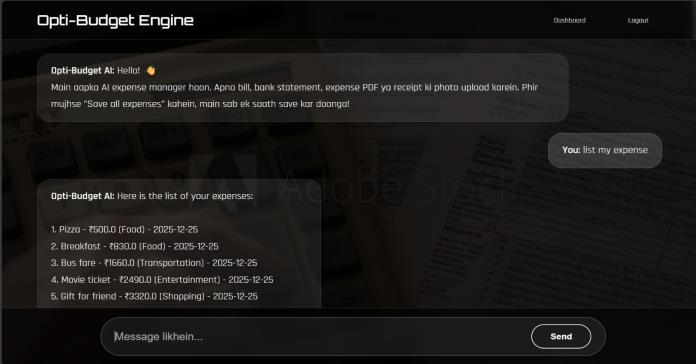
A major contribution of Opti-Budget Engine is the integration of an AI expense agent that performs direct database-grounded operations instead of functioning as a simplechatbot.Userscaninteractwiththesystemthrough conversationalcommandssuchas “Add ₹500 spent on food today” or “Show my monthly expenses.” The AI module interprets the user’s intent and extracts key entities includingamount,categoryanddate.Theseextracteddetails are validated by the Flask backend and translated into corresponding CRUD operations on the SQLite expense database.
Onceanexpense isadded,updated ordeleted, thesystem immediatelyrecalculatestotals,category-wisespendingand monthlytrends,ensuringreal-timesynchronizationbetween stored data and dashboard analytics. This agentic AIdatabase integration reduces manual effort, improves accuracy and enables an intelligent, user-centric finance managementexperience.
5. RESULTS AND DISCUSSION
TheOpti-BudgetEnginewassuccessfullyimplementedand testedasanAIquery-drivenexpensemanagementplatform. The system demonstrates effective integration of conversationalAI,real-timedatabasecontrolandinteractive financialdashboards.Theresultsconfirmthattheplatform
International Research Journal of Engineering and Technology (IRJET) e-ISSN: 2395-0056
Volume: 13 Issue: 04 | Apr 2026 www.irjet.net p-ISSN: 2395-0072
reduces manual effort while improving usability and accuracyinpersonalfinancetracking.
5.1 Functional Results
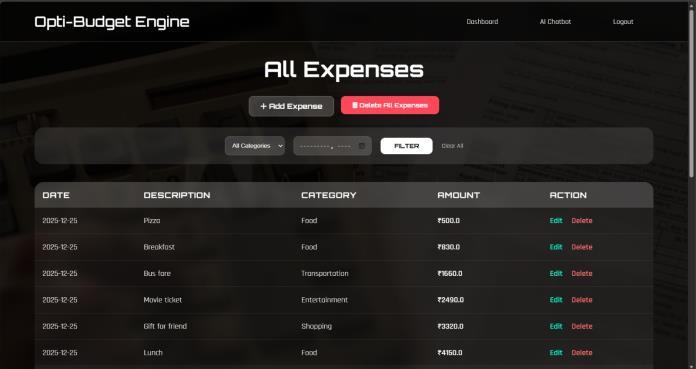
The developed system provides complete expense management through both manual and AI-assisted workflows.Userscanaddexpensesusingstructuredforms or natural language commands through the AI assistant interface.AlltransactionsarestoredsecurelyintheSQLite database and can be retrieved instantly through conversationalqueriesorlistviews.
5.2 Comparative Analysis
Acomparisonwithconventionalexpensetrackingsystems highlights the advantages of the proposed approach. Traditionalapplicationsrelyheavilyonmanualdataentry and static dashboards, whereas Opti-Budget Engine introducesconversationalAIwithdirectdatabaseexecution andreal-timesynchronization.
Table 2: ComparativeAnalysisofExpenseTrackers
Feature TraditionalTrackers Opti-BudgetEngine
ExpenseEntry Manualform Manual+AI
NaturalLanguage QuerySupport Notavailable Fullysupported
DatabaseControl
User-driven AI-controlledCRUD
DashboardUpdates Static Real-time
ReportGeneration Limited PDFexport
InteractionStyle FixedUI Conversational
6. CONCLUSION AND FUTURE WORK
6.1
Conclusion
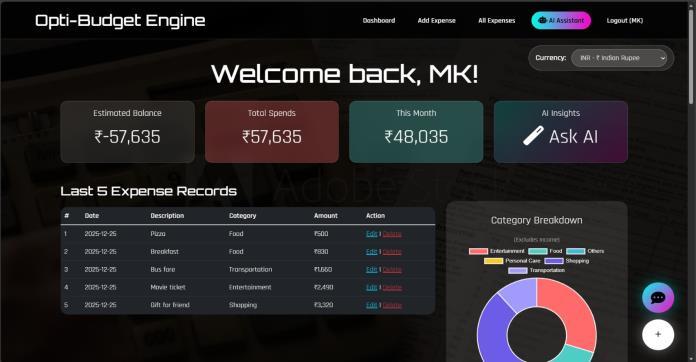
Thedashboardmoduledisplaysreal-timeanalyticsincluding total spending, balance estimation, category-wise expense distribution and monthly spending trends. CRUD functionalitywasverifiedthroughsuccessfulexpenseediting and deletion, ensuring data consistency. Additionally, the system supports PDF report generation, allowing users to exportstructuredsummariesoftheirfinancialactivity. Overall, the functional testing confirms that Opti-Budget Enginedeliversanintelligent,responsiveanduser-centric solutionformodernexpensemonitoring.
ThispaperpresentedtheOpti-BudgetEngine,anAIquerydrivenexpensemanagementandbudgetmonitoringsystem designed to simplify personal finance tracking. Unlike traditionalexpensetrackersthatrelyonrepetitivemanual data entry, the proposed system enables users to manage expensesthroughnaturallanguageinteractionsupportedby an integrated AI agent. The system performs verified database operations directly on an SQLite backend and providesreal-timedashboards,category-wiseanalyticsand professionalPDFreportgeneration.Theresultsdemonstrate that Opti-Budget Engine improves usability, reduces user effortandenhancesfinancialawarenessthroughintelligent automationandsynchronizedvisualization.
6.2 Future Work
FutureenhancementsoftheOpti-BudgetEnginecanfocuson expandingautomationandscalability.IntegrationwithrealtimebankinganddigitalpaymentAPIscanenableautomatic transactionimportwithoutmanualinput.Advancedmachine learning models may be incorporated for expense forecasting,anomalydetectionandpersonalizedbudgeting recommendations. Additional improvements such as multilingual conversational support, mobile application development and enhanced document-based receipt understanding can further increase accessibility and adoption.Theseextensionswouldstrengthenthesystemas acompleteintelligentfinancialassistantformodernusers.
International Research Journal of Engineering and Technology (IRJET) e-ISSN: 2395-0056
Volume: 13 Issue: 04 | Apr 2026 www.irjet.net p-ISSN: 2395-0072
REFERENCES
[1] E. Johri, P. Desai, P. Soni, H. Jain, and N. Sanganeria, “ExpenseManagementSystem,”Proceedingsofthe4th IEEE Global Conference on Computing, Power, and CommunicationTechnologies,IEEE,2023.
[2] P.Bhatele, D.Mahajan,B.Mahajan,N.Mahajan,andP. Mahajan,“TrackEZExpenseTracker,”Proceedingsofthe 4thInternationalConferenceonIntelligentComputing andCommunication,IEEE,2023.
[3] S. A. Sabab, S. S. Islam, Md. J. Rana, and M. Hossain, “eExpense: A Smart Approach to Track Everyday Expense,” Proceedings of the 4th International ConferenceonElectricalEngineeringandInformation& CommunicationTechnology,IEEE,2018.
[4] S.K.LokeshNaik,G.RaviKumar,A.Kiran,D.Ganesh,N. K,andM.Madgi,“AutomatingFinancialManagement:An Exploration of Automatic Expense Tracking Systems,” Proceedings of the International BIT Conference on EmergingTrendsinEngineeringandTechnology,IEEE, 2024.
[5] M.Sahel,S.Ismail,S.Sohail,S.Srilekha,andF.Unnisa, “Streamlining Personal Finances: An Expense Tracker Website Study,” Proceedings of the International Conference on Advances in Computing and Communication,IEEE,2024.
[6] S.Singla,A.Kaur,Anju,A.Soni,R.Dhaiya,andG.K.Kaur, “UnveilingFinancialInsights:TheDailyExpenseTracker System Approach,” Proceedings of the International Conference on Intelligent Systems and Applications, IEEE,2024.
[7] V. Kamra, T. Saini, N. Shishodia, M. Singh, and P. Sehrawat, “A Novel Approach Towards Full Stack Comprehensive Expense Monitoring System,” Proceedings of the International Conference on EmergingSmartTechnologies,IEEE,2025.
[8] G. Girdhar, S. Kumar, A. Bhardwaj, and M. Sharma, “DesignandDevelopmentofExpenseApp,”Proceedings oftheInternationalConferenceonSmartComputingand Informatics,IEEE,2024.
[9] S.M.R.Raihan,I.Asad,K.W.Rahman,Md.A.Rahman,S. Banik, and M. Hasan, “From Manual Logs to Smart Finance: Assessing User Readiness for AI-Powered Personal Expense Tracking,” Proceedings of the International Conferenceon Artificial Intelligenceand DataEngineering,IEEE,2025.
[10]“Design of Enterprise Financial Sharing Expense ReimbursementSystemBasedonDataAssociationRule
Algorithm,”ProceedingsoftheInternationalConference onDataScienceandBusinessAnalytics,IEEE,2022.
BIOGRAPHIES

Professor with 12 years of experience in Electrical, Electronics, and Communication Engineering, specializing in curriculum development, innovativeteaching,andacademic leadership. Served in key roles includingPrincipalIncharge,Head of Department, and Controller of Examinations, while fostering critical thinking and interactive learningamongstudents.

Final-year Computer Science Engineeringstudentwithastrong foundationinC,Java,Python,and SQL. Interested in artificial intelligence, web and app development, with a focus on building optimized solutions to real-world problems. Seeking opportunities to apply technical skills, contribute to impactful projects, and gain practical experienceindynamic,innovative environments.

Final-year Computer Science Engineering student, dedicated and sincere with a foundational understanding of programming and software concepts. Eager to learnnewtechnologiesandbegina professionaljourney,withastrong interest in gaining real-world experiencethroughinternshipsor entry-levelopportunities.Focused onapplyingknowledge,growingas a developer, and contributing to impactfulprojects.

Final year Computer Science Engineeringstudentwithskillsin Pythonfullstackdevelopmentand data science using Python, with contributions to advanced typing machinesandmovierecommender systems. Focused on applying knowledge, growing as a
International Research Journal of Engineering and Technology (IRJET) e-ISSN: 2395-0056
developer, and contributing to impactfulprojects

Volume: 13 Issue: 04 | Apr 2026 www.irjet.net p-ISSN: 2395-0072 © 2026, IRJET | Impact Factor value: 8.315 | ISO 9001:2008
Final year Computer Science Engineeringstudentwithresearch interests in Data Structures and Algorithms,softwaredevelopment, and web-based systems. Has practical experience in building a movierecommendersystemandis motivated toward solving realworld problems through computing.