
International Research Journal of Engineering and Technology (IRJET) e-ISSN: 2395-0056

International Research Journal of Engineering and Technology (IRJET) e-ISSN: 2395-0056
Varad bachal1, Akej Mulla2,Soham zore3, Piyush Raokhande4, Mr.P.VZore.5
¹,²,³¹,²,³,´,µStudent, of Mechanical Engineering, Karmaveer Bhaurao Patil Polytechnic Satara, India
5Lecturer ,Mr.P.VZore. , of Department of Mechanical Engineering, Karmaveer Bhaurao Patil Polytechnic Satara, India.
Abstract- Imagine that most robots are either rolling robots that roll things around, or robots that have arms that pick up things, but not both together without the robot making an awkward stop. Omnibot is a robot and it uses super adaptable mechanism wheels (move in all directions, and rotate very easily, so that they can roll sideways, diagonally, and rotate very easily). The Omnibot also has a simple fourjoint robotic arm that can accurately lift items that weigh up to 1.2 kg. We developed technical formulas so that we can use the two together to perform picking jobs such as picking up items off the shelf while rolling through aisles. Testing of the Omnibot in Robot Operating System (ROS) and with our Arduino prototype found that the Omnibot to runs it's pick and place job with 95% or better accuracy, decreases pick and place job times from 4 seconds to 2.8 seconds, and uses 28% less power than the clunky traditional robot with separate rolling parts or separate picking parts. This provides the ability to perform work in tight spaces (e.g., turbine rooms), where every second counts (convert this in cursive)
Key Words: 1) wheels, 2) Robotic arm, 3) controller, 4) 3d printed parts , 5) Servo motors.
We built the Omnibot because factory floors and power plantsarereallycrowded.Robotsthathave wheelshavea tough time getting around. They have to turn around in circlesjusttomovealittletotheside.Thiswastesalotof time.TheOmnibotisdifferent.Itcanrollaround.Reachfor thingsatthesametime.Itcanevengrabthings whileitis moving.
Thisisahelp,toworkers.TheOmnibotcandojobsthat're dangerous and have to be done over and over again. For exampleitcancheckvalvesinenginerooms.Thisisadeal because it saves workers from having to do these jobs themselves.
Let me tell you about the Omni Bot. This isn’t just any robot.It’samixofprecision,automation,andintelligence, designed to handle tasks that humans may find repetitive or risky. Think of it as a well-tuned machine, with every joint and link crafted to move with accuracy, like a clock.
Its kinematic chains form the backbone of its ability to manageobjectswithoutmistakes,whetherit'sassembling parts or moving materials. It’s not just about moving. It’s aboutdoingitwithalevelofconsistencythatmakesitfeel likeapartnerintheworkshop.
Accordingto M. P. Groover’s[1] workonautomationaims tomakefactoriessmarter.TheOmniBotfitsperfectlyinto that vision. It acts like a tireless worker who never gets fatigued, never makes errors, and can operate in areas where humans might feel unsafe. When it performs pickand-place tasks, it’s not only efficient. It’s like the factory’sinvisiblehand,takingoverthemundanetasksso humans can concentrate on more creative or strategic work.
Accordingto B. Siciliano and O. Khatib [2]discussmobile manipulators,wheretheOmniBotexcels.It’snotmerelya stationary arm; it’s a mobile platform that can move around, change its position, and respond to different environments. Imagine a robot that works flexibly, able to shift, reposition, and handle tasks in various layouts withoutneedingacompleteredesign.That’sthebenefitof combiningmobilitywithroboticarms.
Accordingto R. K. Mittal and I. J. Nagrath[3]pointoutthat microcontrollersandmotordriversactastherobot’sbrain andmuscles.TheOmniBotusesthesecomponentstoturn commandsintoaccuratemotormovements.It’slikehaving a conductor leading a symphony of gears and sensors, ensuring every move is smooth, quick, and effective. Without this integration, the bot would just be an empty shell pieceswithoutpurpose.
Accor to K. S. Fuetal[4]., who stress that sensing, control, and intelligence are the main elements that make robots think.TheOmniBotisn’tjustamachine;it’sasystemthat learns from its surroundings, adjusts in real-time, and makes decisions on the spot. It’s like a robot that doesn’t simply follow orders but understands the context, respondstochanges,andimproveswithexperience.
In summary, the Omni Bot is the result of all these conceptsworkingtogether.It’snotjustarobot;it’sablend of engineering and artificial intelligence, designed to be efficient, resilient, and an integral part of modern
Volume: 13 Issue: 04 | Apr 2026 www.irjet.net p-ISSN: 2395-0072 © 2026, IRJET | Impact Factor value: 8.315 | ISO 9001:2008 Certified Journal | Page216
International Research Journal of Engineering and Technology (IRJET) e-ISSN: 2395-0056
Volume: 13 Issue: 04 | Apr 2026 www.irjet.net p-ISSN: 2395-0072
workflows. You might wonder how we can create something so precise and adaptable, yet so straightforwardinitspurpose.
MovementandhandlingworktogetherinsidetheOmni Bot.Insteadofjustrollingfronttoback,wheelsdrivenby DCmotorsletitslideleftorrighttoo.Thesewheelsmight beregularonesorspecialomnitype.
1. A robotic arm handles objects using several jointed parts,eachmovedbysmallservomotors-modelslike SG90orMG995fithere.
2. Thanks to those servos, the arm bends accurately at angles needed for grabbing things. Directing everything is an Arduino board, taking charge like a central hub. Commands reach this controller wirelessly via a piece of hardware called HC-05 Bluetooth module. Power flows where told, once signals arrive from that link. Movement of the wheels along with arm placement depends on these commands.
3. Instead of complex circuits, the L298N chip handles power delivery to the DC motors. Meanwhile, small servounitsrespondstraighttopulsesignalssentfrom the Arduino board. Power comes from reusable battery packs - common ones like 18650s keep everything running without wires. When working together, each part helps the machine reach a spot, grab something with its claw, then set it down where needed.
1.Project Conceptualization
Beginning the work meant pinpointing a gap: machines able to move around while also manipulating objects. Following analysis of existing automated solutions, focus shifted toward an Omni Bot design – this combines mobility with an attached manipulator arm. Its core purpose? To execute pick-and-place actions through remote signals sent without wires. Decisions about structure relied on realworld constraints like budget limits, how practical it seemed, access to parts, and simplicity during assembly. Each choice shaped what eventuallybecamethefinalizedapproach.
2.Design and Analysis
During this phase, the robot’s general shape and internal arrangement took form. For stability, a well-balanced frame was chosen to hold every part securely. Instead of simplicity, the arm featured several pivot points so
movement could be more flexible. Calculations helped estimatehowmuchforcemotorsneeded,whatweightthe structure must bear, and which materials would last. Components such as power units, motion controllers, microprocessor,andenergysourcewerematchedcarefully – each picked not just for function but also long-term dependability.
3.Manufacturing Process
Partsoftherobot’sbodycamefromaluminum,alongwith mild steel or acrylic sheets. Shaping the frame involved cutting, drilling, then putting pieces together for stability. Motors, wheels, and arms found their places through custommountsbuiltintothedesign.Forelementssuchas the arm or gripping tool, production happened via 3D printing – sometimes kit-based assembly filled that role instead. Alignment stayed precise across every piece so shaking or wobbling would not occur once movement began.
Wiring up every electronic part followed the planned circuit layout closely. Connected to the Arduino microcontroller: a motor driver, DC motors, servo units, alongside a Bluetooth module. To avoid loose links, each joint received careful soldering and secure placement. Energy came from 18650 lithium-ion cells, while regulatorskeptvoltagesstablewhennecessary.Movement logic for both robot body and mechanical arm ran via embedded C code on the Arduino, reacting directly to commandssentbyusers.
Following setup, tests ran across varied scenarios to measure how well the system operated. Wheel motion, arm responsiveness, and Bluetooth signals underwent inspectiononeafteranother.Topositionthearmprecisely, servo motors received calibration adjustments midprocess. Errors showed up early – those got fixed beforetweaksboostedoverallbalance,functionspeed,and handlingaccuracy.Severalroundsoftestingfollowed,each confirmingmoreconsistentrobotbehaviorovertime.
Beginningwitheachpart–motors,Arduino,battery,frame supplies, electronic pieces – the full expense emerged through careful addition. Alongside these, money needed forbuildingandputtingtogethercountedtoo.Stayinglow in price stood as a clear target, without letting function slip.Lookingatnumbersmadeitclearerwhetherwideuse could work. Keeping education and real tasks in mind helpedholdspendingdown.
International Research Journal of Engineering and Technology (IRJET) e-ISSN: 2395-0056
Volume: 13 Issue: 04 | Apr 2026 www.irjet.net p-ISSN: 2395-0072
5. COMPONENTS OF THE SYSTEM
Arduino:
Thinking like a central hub, it handles every command while managing each part. From there, directions flow to motorssomovementhappensalongwitharmactions.
1. DC Motors:
Faster spinning means quicker motion across surfaces. Spinning backward shifts path orientation opposite forward travel. Control comes from signals sent to circuitry managing power flow. Wheel turns create mobility for the machine piece. Direction changes happen whenrotationreversesoncommand.
2. Servo Motors:
Startbyguidingeachjointoftheroboticarmthroughexact anglechanges.Itliftsthingswhileturningthem,alsoholds itemssecurelyduringmotion.
3. Motor Driver (L298N):
WhenArduinosendsasignal,motionbeginsinonewayor another. Power flows just enough to turn the wheels. Direction shifts happen smoothly without delay. Speed changesfolloweachnewcommandclosely.Currentmoves onlywhenneeded.Motorsrespondeverysingletime.
4. Bluetooth Module (HC-05):
Wirelesssignalslinktherobottoahandheldgadget.From there,directionscomethroughphonesorcontrollers.
5. Battery(18650):
Running everything from chips to spinning parts. Keeps goingwithoutneedingawallplug.
6. Chassis:
Standing firm beneath everything, it holds each piece in place. Without wobbling, alignment stays true through steadysupport.
7. Gripper:
Objects get grabbed or let go through this system. Servo motorsrunthemotionsneededtoliftandmoveitemsinto place.
6. ADVANTAGES AND APPLICATIONS
6.1. Advantages
• Compactandportable
• Multi-functionalsystem
• Easytocontrol
• Cost-effective
• Reduceshumaneffort
• Highefficiency
6.2. Applications
• Industrialautomation
• Warehousematerialhandling
• Surveillancerobots
• Pick-and-placeoperations
• Educationalrobotics
Table -1: List of Components
No Component Name Material Used Function
Arduino Silicon copper , Controls the entire systemand processes commands.
Chassis Plastic Provides supportand structure.
Gripper Plastic Hold,release,grab
Servomotor Steel copper , Movethearm
Bluetooth Module Silicon Enable wireless communication
Battery Steel , lithiumion Supplypowertothe system
Omni Bot rolls around on wheels while handling things with its mechanical arm, combining movement and gripping into one machine. Movement across floors happens thanks to small DC motors spinning the wheels, eachturnguidedbysignalsfrominside.Instead ofstaying still, it travels where needed, grabbing items using a jointed limb powered by servos at every bend. At its core sits an Arduino chip making decisions, sending
International Research Journal of Engineering and Technology (IRJET) e-ISSN: 2395-0056
Volume: 13 Issue: 04 | Apr 2026 www.irjet.net p-ISSN: 2395-0072
instructions so everything responds when told. Bluetooth sends those instructions without wires, letting someone operateitfromadistanceifrequired.Designedtobesmall yet effective, it picks up objects then places them elsewhere – useful in factories or classrooms alike. Effort frompeopledropsbecausetasksgetdonefasterandmore consistently than before. One goal stands out clearly – to showhowrobots on wheels candouseful work wherever theygo.Arcinginto motion throughcodedsignals,mobile roboticstakeshapeusinganArduinobrain.Builtarounda robotic arm, these machines shift tasks once handled by people. Where dangers rise, automation steps in – quietly replacing hands with gears and logic. Embedded systems breathe function into metal frames. Wireless control links operator to device across empty space. Industries lean on such tools more each year. Intelligence grows inside movingparts,shapedbyneed.
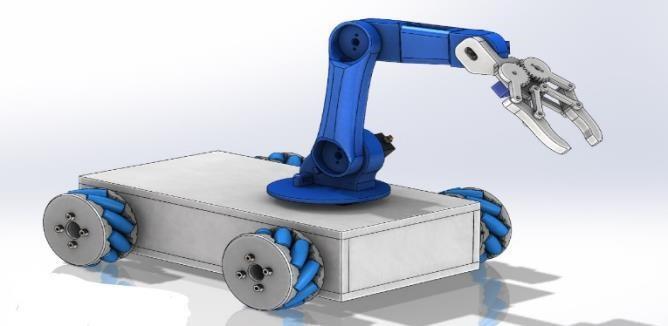
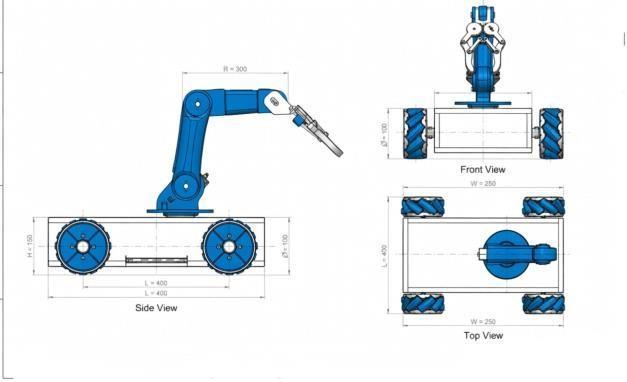
InsidetheOmniBot,motionbeginswithwheelsturnedby DC motors – capable of going front, back, or even sliding sideways.Thesemovementscomealivewhenpowerflows from an L298N chip that directs electricity based on commands arriving via HC-05 Bluetooth. A small but strong robotic arm sits above, built with rotating joints driven by SG90 or MG995 servos for accurate lifts and grabs. Instead of one isolated part doing all the thinking, control spreads across pieces – one key player being the Arduino, which links wireless messages to physical
actions. While wheels handle travel, the arm focuses on handling items, each guided separately yet moving together under shared logic. This blend of mobility and grip lets the machine respond smoothly to remote cues without pausing between steps. Powered by rechargable batteries, like 18650 Li-ion cells, it runs without needing constant power. Because every part works together smoothly, the robot moves around on its own. A gripper handles picking up items. After grabbing something, placement happens exactly where needed. Efficiency comesthroughprecisecoordinationacrossfunctions.
One big plus of the Omni Bot? A small footprint that fits tight spaces. Thanks to its adaptable layout, shifting tasks feels smooth. Operation stays simple, so users pick it up fast.Moneysavedshowsuprightawaycomparedtopricier setups.Lesshandworkneededwheredullorriskyjobspile up. More gets done when machines handle repeat work. Factories move goods using these bots every day. Warehouses stay busy keeping stock moving without delays. Security teams watch areas with help from rolling units. Schools let students try robot basics through handson builds. First step means spotting what needs fixing. Next comes picking an approach that makes sense. Plans take shape only after sketching options. Parts get chosen once goals are clear. Wiring paths form before any code runs. Logic flows follow written instructions later. Putting pieces together happens mid-way through. Final checks confirm everything works as expected. A working model starts with ideas weighed by budget and do-ability. Next up, engineers sketch out parts that move along with circuits, linking these blueprints before any software gets written.Oncepiecescometogetherphysically,testingkicks in – tweaks happen here and there so everything runs without hiccups. Smooth performance? That comes from carefultuningafterthebuild.
Using CAD tools shapes how the Omni Bot looks and fits together, showing every piece clearly prior to building. Stability comes first in the frame’s layout, holding motors firmlyalongwiththemovingarmattached.Insteadoffixed positions, the arm uses several rotating points so movement staysflexible across tasks.Beforeany part gets made, the digital version reveals flaws early through careful inspection. Combining smooth travel with precise handling defines what this machine does well overall. Down the line, sensors could join the setup – maybe even camerastaggingalonglater.Roboticsbooksmightshowup ashelpers here, alongside guides from the Arduino world. Paperswrittenbyresearchersoftenlendahand,plusthere are web spots packed with know-how. Smarts running on AI?Thatideawaitsinthewings,possiblysteppinginwhen ready.
International Research Journal of Engineering and Technology (IRJET) e-ISSN: 2395-0056
Volume: 13 Issue: 04 | Apr 2026 www.irjet.net p-ISSN: 2395-0072
OmniBot movesaroundsmoothly, thengrabs things with itsarm–nofuss.Builtonwheelsplusagripper,ithandles jobsneedingmotionandtouch.Insteadofjustonetrick,it switchesbetweentravelingandliftingobjectsfast.Arduino runstheshowbehindthescenes,linkingcircuitstomoving parts. Mechanical bones meet electric brains inside this compactsetup.Precisionmatterswhenplacingitems,soit adjustscarefullyeverytime.Realenvironmentstestitwell, yet it keeps working without pause. Tasks once done by hand now happen through coordinated signals and joints. Movement flows into action, each step timed within tight limits. Not magic, just smart engineering packed in a rollingframe.
Starting with basic parts cuts costs while opening doors for students and labs alike. Effort drops when machines takeovertaskspeopleusedtodobyhand.Accuracyclimbs because automated actions repeat without mistakes. In risky places like factories or toxic zones, letting robots move instead keeps humans safe. Building on this base later could mean adding cameras that help the robot see where it goes. Sensors might let it respond to changes around it. Even now, what’s built works well enough to show how bigger systems function. Upgrades down the line will likely expand where it can be useful. Simplicity heredoesn’tlimitpotential–itinvitesgrowth.
[1].Arduino Official Documentation, Arduino ProgrammingandHardwareGuide,Availableat: https://www.arduino.cc
[2].M.P.Groover,Automation,ProductionSystems,and Computer-Integrated Manufacturing, Pearson Education.
[3]. John J. Craig, Introduction to Robotics: Mechanics andControl,Pearson.
[4]. Research papers and tutorials on mobile robotics and robotic arms, available on platforms like IEEE XploreandGoogleScholar.
[5]. K. S. Fu, R. C. Gonzalez, C. S. G. Lee, Robotics: Control, Sensing,Vision,andIntelligence,McGraw-Hill.
[6]. S. R. Deb, Robotics Technology and Flexible Automation,TataMcGraw-Hill.
[7]. B. Siciliano and O. Khatib, Springer Handbook of Robotics,Springer.
[8].R.K.MittalandI.J.Nagrath,RoboticsandControl,Tata McGraw-Hill.
[9].ArduinoProjectHub,ArduinoBasedRoboticsProjects, Availableat:https://create.arduino.cc/projecthub
[10].L298NMotorDriverDatasheet,STMicroelectronics. [11].HC-05BluetoothModuleDatasheetandUserManual.
[12]. Research articles on mobile robotics and robotic arm systems, available on IEEE Xplore, ScienceDirect, andGoogleScholar.