
International Research Journal of Engineering and Technology (IRJET) e-ISSN: 2395-0056
Volume: 13 Issue: 02 | Feb 2026 www.irjet.net p-ISSN: 2395-0072
International Research Journal of Engineering and Technology (IRJET) e-ISSN: 2395-0056
Volume: 13 Issue: 02 | Feb 2026 www.irjet.net p-ISSN: 2395-0072
Mr.N.Paparayudu1 , Anusha.R2 , Muneeb ur Rahaman.Shaik 3 , Sowmith.P4 , Dileep.S5
1Professor, Department of IT, TKR College of Engineering and Technology, Telangana, India 2,3,4,5B.Tech Students, Department of IT, TKR College of Engineering and Technology, Telangana, India
Abstract - Examinations play a crucial role in evaluating students’ academic performance and integrity. Traditional invigilation methods depend heavily on human supervisors, which often leads to limitations such as fatigue, bias, and inability to continuously monitor large examination environments. To overcome these challenges, this project proposes anOffline AutomatedInvigilationSystemwithGmail Alert Integration that detects examination malpractice using computer visionandmachine learningtechniques.Thesystem works in real-time through webcam video monitoring and identifies suspicious activities such as mobile phone usage, abnormal head movements, and unethical eye gaze patterns. Detection is performed locally without requiring continuous internet connectivity, making it suitable for rural and lownetworkregions.Whenevermalpracticeisdetected,thesystem captures visual evidence with timestamps and stores it securely in local storage. Once internet connectivity becomes available, the system automatically sends Gmail alerts with attached evidence to the examination controller for quick action. By integrating YOLO-based object detection, Haar Cascade-basedeye tracking, andheadmovementanalysis,the proposed system improves monitoring accuracy, reduces human dependency, and enhances examination fairness. This solution is cost-effective, scalable, and reliable for modern academic institutions.
Key words : Automated Invigilation, Offline Proctoring, Computer Vision, Cheating Detection, YOLO, Haar Cascades, Eye Tracking, Head Movement Detection, Gmail Alerts, Machine Learning.
Examinationsareoneofthemostimportantmethodsused to evaluate students’ academic knowledge, skills, and learningoutcomes.However,maintainingacademicintegrity duringexaminationsisamajorchallengeforinstitutionsdue to the increasing number of malpractice incidents. Traditionalinvigilationsystemsrelyonhumansupervisors to monitor candidates, which becomes difficult in large examinationhallsduetolimitationssuchasfatigue,lackof continuous attention, bias, and delayed response to suspiciousbehaviour.
WiththerapiddevelopmentofArtificialIntelligence(AI)and Computer Vision, automated invigilation systems have emerged as a reliable solution for detecting cheating behaviours. Modern proctoring systems use video surveillance and machine learning models to monitor
candidatesanddetectactivitiessuchasunauthorizedobject usage, abnormal head movement, eye gaze deviation, and collaboration attempts [1]. Many existing solutions are designedforonlineexaminationsandrequirestableinternet connectivity for cloud-based processing and remote monitoring[2].
However, internet dependency makes such systems unsuitable for rural or low-connectivity regions. In such cases, an offline invigilation system becomes essential to ensure uninterrupted monitoring and evidence recording. Therefore, this project proposes an Offline Automated Invigilation System with Gmail Alert Integration that performs detection locally using computer vision models suchasYOLOforobjectdetectionandHaarCascadeforeye tracking.Thesystemalsostoresevidencelocallyandsends automatedGmailalertswheneverconnectivityisavailable, ensuringtimelycommunicationandquickintervention.
Themainmotivationbehindthisprojectistoovercome thelimitationsofmanualinvigilationandonlineproctoring systems. Manual monitoring requires more manpower, becomes inefficient in large exam halls, and often fails to detectsubtlecheatingbehaviours.Similarly,mostAI-based proctoring systems require continuous internet access, whichisnotfeasibleinmanyinstitutions.Hence,anoffline intelligentinvigilationsystemisneededtoprovidereliable monitoring, reduce cheating, and improve examination fairness.
Traditional invigilationdependsonhumansupervisors, which leads to challenges such as limited monitoring capacity, subjectivity, delayed detection, and high operationalcosts.Onlineproctoringsolutionsrequirestable internetandcloudconnectivity,makingthemunsuitablefor offlineenvironments.Therefore,thereisaneedforasystem thatcandetectsuspiciousbehaviourlocally,storeevidence securely, and send automated alerts when internet access becomesavailable.
Thescopeofthisprojectincludesthedevelopmentofan offline invigilation system that can be deployed in classrooms, labs, and examination halls. The system is
International Research Journal of Engineering and Technology (IRJET) e-ISSN: 2395-0056
Volume: 13 Issue: 02 | Feb 2026 www.irjet.net p-ISSN: 2395-0072
scalableformultiplecandidatesandcanbeenhancedfurther byintegratingadditionalmodulessuchasvoicedetection, multiple-face detection, and exam session reporting. The proposed system aims to support both small and large examination environments while ensuring accuracy, reliability,andintegrity.
The proposed Offline Automated Invigilation System with Gmail AlertIntegrationisdesignedto ensureexamination integrity by continuously monitoring candidates using a webcamanddetectingsuspiciousactivitiesusingmachine learning and computer vision techniques. The system operates primarily in offline mode, where all video processing,behaviouranalysisandevidencerecordingare performed locally without requiring continuous internet connectivity.Thismakesthesolutionsuitableforinstitutions locatedinruralorlow-networkregions.
The system focuses on detecting common malpractice behaviours such as unauthorized object usage, abnormal head movements, and suspicious eye gaze deviation. Whenever any suspicious event is identified, the system capturestheframeasevidence,storesitinlocalstoragewith proper timestamps, and maintains a log for future verification.Onceinternetconnectivitybecomesavailable, thesystemsendsautomatedGmailalertstothecontrollerof examinations or authorized invigilators along with the captured evidence, enabling quick action. The proposed system reduces dependency on manual invigilators, improvesmonitoringaccuracy,andprovidesacost-effective andscalablesolutionformodernexaminationenvironments.
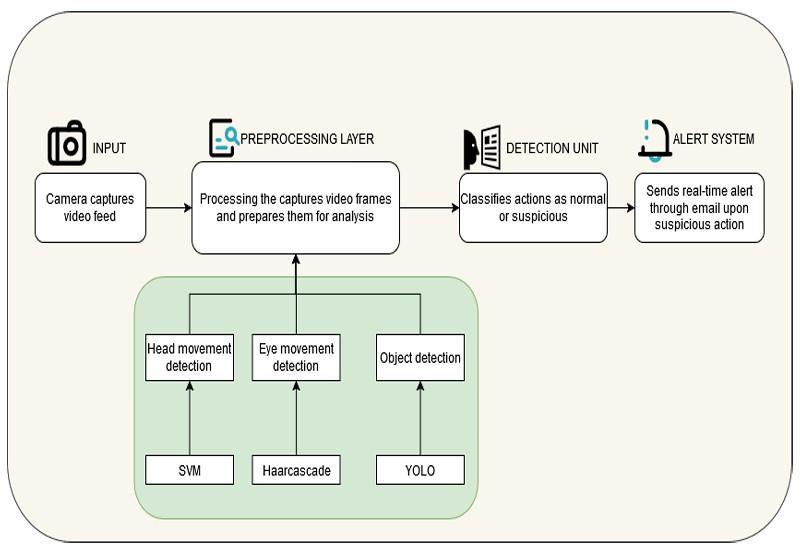
Thesystemcontinuouslycaptureslivevideofromawebcam installedintheexaminationhall.Eachframeisprocessedin realtimeusingOpenCV-basedvideocapturemethods.The system performs offline analysis of frames by applying preprocessingoperationssuchasresizing,noisereduction, and conversion to grayscale when required. This ensures efficientprocessingonstandardhardwarewhilemaintaining high accuracy in detection. Offline processing enables uninterrupted monitoring even in environments where internetconnectivityisunavailableorunstable.
TheproposedsystemintegratesmultipleAI-baseddetection modules to identify unethical behaviours during examinations.Unauthorizedobjectdetectionisperformed using the YOLO algorithm, which is capable of detecting prohibiteditemssuchasmobilephonesinrealtime.Head movementdetectionisusedtoidentifysuspiciousrotations or frequent directional changes that may indicate
communication with others. Eye movement detection is implementedusingHaarCascade-basedeyetracking,where continuousgazedeviationistreatedassuspiciousbehaviour. By combining these detection mechanisms, the system ensures reliable monitoring and reducesthe possibility of cheatinggoingunnoticed.
Whenevermalpracticeisdetected,thesystemcapturesthe correspondingframeandstoresitsecurelyinlocalstorage. Along with the captured evidence, metadata such as date, time,detectiontype,andcandidateidentificationdetailsare recorded. This evidence-based approach ensures transparency and provides valid proof for administrators during post-examination verification. Local storage also allowsthesystemtooperateindependentlywithoutrelying on cloud services, making it suitable for offline environments.
TheproposedsystemincludesanautomatedGmailalert module that sends notifications to authorized personnel whensuspiciousactivitiesaredetected.Sincethesystemis designedforofflinefunctionality,alertsarenotdependent on continuous internet connectivity. Instead, the system stores the alert information locally and automatically triggers Gmail notifications once internet access becomes available.Eachalertcontainsa detailed description of the detectedmalpractice,timestampinformation,andattached evidence images. This ensures timely communication, reducesmanualreportingworkload,andenablesimmediate interventiontomaintainexaminationdiscipline.
Volume: 13 Issue: 02 | Feb 2026 www.irjet.net p-ISSN: 2395-0072
Thischapterdescribestheimplementationmethodology of the Offline Automated Invigilation System with Gmail AlertIntegration.ThesystemisimplementedusingPython alongwithcomputervisionandmachinelearninglibrariesto detect examination malpractice in real time. The methodology is designed in a modular way so that each componentsuchasvideocapture,preprocessing,detection, evidence logging, and alert generation can work independentlyandcanbeintegratedefficiently.Thesystem iscapableoffunctioningofflineforcontinuousmonitoring, while Gmail integration is activated only when network connectivitybecomesavailable.
Thefirststageofimplementationinvolvescapturingrealtime video from a webcam installed in the examination environment. OpenCV is used to access the camera and continuously read video frames. These frames act as the primaryinputforalldetectionmodules.Thesystemensures continuous monitoring by processing frames sequentially withoutinterruptions.Thecapturedframesarepassedtothe preprocessing stage to improve detection efficiency and accuracy.
In the preprocessing stage, the captured frames are preparedforanalysistoreducecomputational complexity and improve detection performance. The preprocessing operations include resizing the frame to a standard dimension, reducing noise using filtering techniques, and convertingtheframeintograyscalewheneverrequiredfor HaarCascadedetection.Thisstepensuresthatthesystem canrunefficientlyonstandardcomputerswithoutrequiring high-end GPU hardware. Preprocessing also enhances feature extraction quality, which directly improves the accuracy of object detection, eye tracking, and head movementdetection.
The detection stage is the core implementation of the proposedsystem.Inthisstage,thepre-processedframesare analysed using multiple computer vision and machine learningmodels.YOLOisusedforreal-timeobjectdetection toidentifyunauthorizedobjectssuchasmobilephones.Ifa prohibited object is detected, the system marks it in the frameandcapturestheimageasevidence.Headmovement detection is performed using face detection and facial landmarktrackingtechniquestoestimateheadorientation. Abnormal head rotations and frequent movements are classifiedassuspiciousbehaviour.Eyemovementdetection is implemented using Haar Cascade classifiers and landmark-based eye tracking methods to analyse gaze direction. If continuous gaze deviation is detected beyond
theallowedthreshold,thesystemconsidersitasunethical behaviourandtriggersanalert.
Whenever suspicious activity is detected, the system automaticallycapturesthecorrespondingvideoframeand storesitlocallyalongwithtimestampdetails.Theevidenceis saved in a secure folder or local database to maintain traceabilityforfutureverification.Thealertinformationis alsorecordedlocally,ensuringthatnosuspiciousactivityis missed even in offline conditions. When internet connectivity becomes available, the Gmail integration moduleisactivatedandautomaticallysendsalertemailsto thecontrollerofexaminations.Eachemailincludesthetype ofmalpracticedetected,dateandtimeinformation,andthe captured evidence image as an attachment. This implementationensurestimelynotification,reducesmanual reportingworkload,andimprovestheoverallreliabilityof theinvigilationprocess.
This chapter presents the results obtained from the implementationoftheOfflineAutomatedInvigilationSystem withGmail AlertIntegration.Thesystemwastestedusing real-time webcam video streams under different examination-likescenariostovalidateitscapabilitytodetect malpractice activities. The performance evaluation was mainlyfocusedonmobilephonedetection,headmovement detection, and multi-student monitoring. The system successfully detected suspicious behaviour and displayed boundingboxeswithconfidencescoresfordetectedobjects andpersons.Evidenceframeswerecapturedautomatically and stored locally with timestamps for verification. The resultsdemonstratethattheproposedsystemcaneffectively identify unauthorized object usage such as mobile phones andcanalsodetectsuspiciousheadmovementpatternsthat may indicate cheating or communication attempts. The systemproducedreliableoutputsinrealtimewithminimal delay,showingthatthedetectionmodulesworkefficientlyin offline mode. The generated outputs prove the system’s practicalityforrealexaminationenvironmentsandsupport theobjectiveofreducingmanualinvigilationdependency.
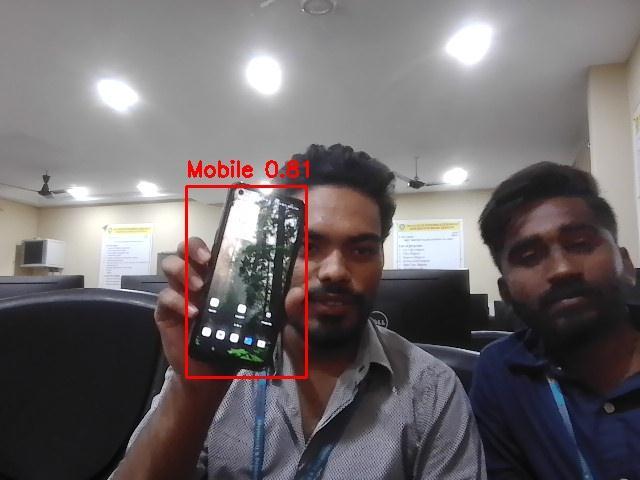
Thefirstexperimentaltestcasewasconductedtoverify theYOLO-basedobjectdetectionmodule.Duringthetest,a mobilephonewasintroducedinfrontofthecamerawhile thestudentwasseated.Thesystemsuccessfullydetectedthe mobilephoneandalsoidentifiedthestudentasaperson.The detected objects were highlighted using bounding boxes alongwithconfidencevalues.Themobilephone detection result confirms that the proposed system can reliably identifyprohibiteddevicesduringexaminationsandcapture theevidenceinstantly.
International Research Journal of Engineering and Technology (IRJET) e-ISSN: 2395-0056
Volume: 13 Issue: 02 | Feb 2026 www.irjet.net p-ISSN: 2395-0072
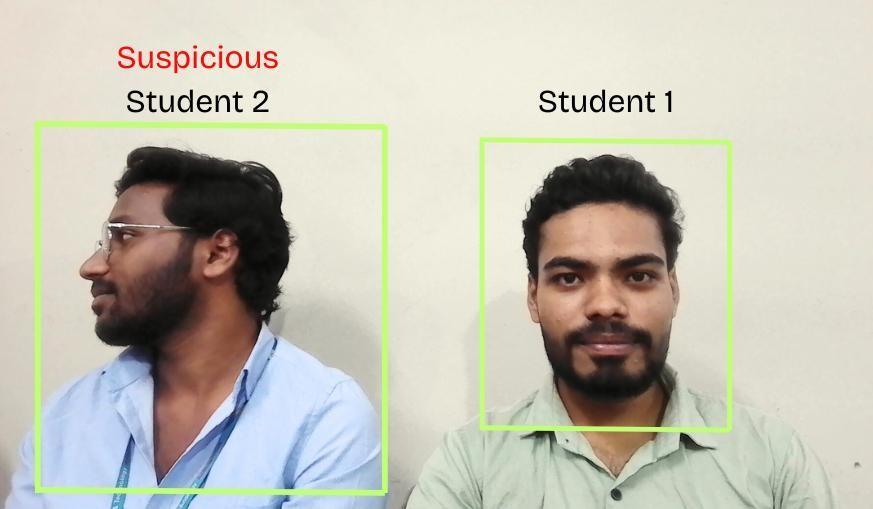
The second experimental test case was conducted to validatetheheadmovementdetectionmodule.Inthistest, the student intentionally rotated the head sideways repeatedlytosimulatesuspiciousbehavioursuchascopying or communication with another candidate. The system successfullytrackedthefaceandidentifiedabnormalhead rotation,andthecandidatewasmarkedassuspicious.This outputdemonstratesthattheproposedsystemcanmonitor candidatebehavioureffectivelyandflagunethicalactionsin realtime.
The experimental results indicate that the system performsefficientlyinreal-timeenvironmentswithoffline processing.YOLO-basedobjectdetectionprovidesaccurate detectionofmobilephoneswithhighconfidencescores.The head movement module successfully identifies abnormal face orientation changes, which are commonly associated withmalpractice.Sinceallprocessingisperformedlocally, the system does not depend on continuous internet
connectivity, making it reliable for rural and low-network examination environments. Evidence capturing and local loggingprovidetransparencyandsupportdecision-making forinvigilators.
ThisprojectsuccessfullydevelopedanOfflineAutomated InvigilationSystemwithGmailAlertIntegrationtoimprove examination security and reduce malpractice. The system effectivelymonitorscandidatesinrealtimeusingawebcam anddetectssuspiciousactivitiessuchasmobilephoneusage, abnormalheadmovement,andunethicaleyegazepatterns using computer vision and machine learning techniques. Since all detection and evidence logging are performed locally,thesystemworksreliablyevenwithoutcontinuous internetconnectivity,makingitsuitableforruralandlownetworkenvironments.
The system also captures and stores evidence with timestamps, ensuring transparency and accountability duringpost-examinationverification.Wheninternetaccess becomes available, automated Gmail alerts with attached evidence are generated, enabling invigilators and administrators to take immediate action. Overall, the proposed solution reduces human dependency, improves monitoring accuracy, supports scalability for large examinationhalls,andprovidesacost-effectiveapproachfor maintainingacademicintegrity.
TheproposedOfflineAutomatedInvigilationSystemwith GmailAlertIntegrationcanbefurtherimprovedbyadding advancedfeaturestoenhanceaccuracy,scalability,andrealtime monitoring capabilities. In future, the system can be extended to support multiple camera inputs for covering largeexaminationhallsmoreeffectively.Additionalcheating detection modules such as voice detection, lip movement analysis, and hand gesture tracking can be integrated to identify collaboration or communication attempts more accurately.Theeyetrackingmodulecanbeenhancedusing deep learning–based gaze estimation models to improve precision under different lighting conditions and camera angles.Thesystemcanalsobeupgradedwithcandidateface recognition for automatic student identification and attendanceverification.Forbetterevidencemanagement,a securelocaldatabasewithencryptioncanbeimplemented alongwithanadmindashboardtoreviewsuspiciousevents and generate detailed examination reports. Furthermore, SMSormobilepushnotificationscanbeaddedalongwith Gmail alerts to ensure faster communication in critical situations.Theseenhancementswillmakethesystemmore robust,intelligent,andsuitableforlarge-scaleinstitutional deployment.
International Research Journal of Engineering and Technology (IRJET) e-ISSN: 2395-0056
Volume: 13 Issue: 02 | Feb 2026 www.irjet.net p-ISSN: 2395-0072
[1] R. S. Saini and S. Dutta, “A Review on Automated ProctoringSystemusingArtificialIntelligence,”International JournalofComputerApplications,vol.182,no.44,pp.1–6, 2019.
[2] A. Gupta, P. Jain, and R. Kumar, “Online Examination Monitoring System using Computer Vision and Machine Learning,” inProc.International ConferenceonIntelligent ComputingandControlSystems(ICICCS),2020,pp.1120–1125.
[3]J.Redmon, S.Divvala,R.Girshick,andA.Farhadi,“You Only Look Once: Unified, Real-Time Object Detection,” in Proc. IEEE Conference on Computer Vision and Pattern Recognition(CVPR),2016,pp.779–788.
[4] J. Redmon and A. Farhadi, “YOLO9000: Better, Faster, Stronger,”inProc.IEEEConferenceonComputerVisionand PatternRecognition(CVPR),2017,pp.7263–7271.
[5] P. Viola and M. Jones, “Rapid Object Detection using a Boosted Cascade of Simple Features,” in Proc. IEEE Conference on Computer Vision and Pattern Recognition (CVPR),2001,pp.511–518.
[6]G.Bradski,“TheOpenCVLibrary,”Dr.Dobb’sJournalof SoftwareTools,2000.
[7] V. Kazemi and J. Sullivan, “One Millisecond Face AlignmentwithanEnsembleofRegressionTrees,”inProc. IEEE Conference on Computer Vision and Pattern Recognition(CVPR),2014,pp.1867–1874.
[8]N.DalalandB.Triggs,“HistogramsofOrientedGradients forHumanDetection,”inProc.IEEEConferenceonComputer VisionandPatternRecognition(CVPR),2005,pp.886–893.
[9] C. Cortes and V. Vapnik, “Support-Vector Networks,” MachineLearning,vol.20,pp.273–297,1995.
[10] A. Rosebrock, “Practical Python and OpenCV: An IntroductiontoComputerVision,”PyImageSearch,2018.