
International Research Journal of Engineering and Technology (IRJET) e-ISSN: 2395-0056
Volume:12Issue:11|Nov2025 www.irjet.net p-ISSN: 2395-0072
International Research Journal of Engineering and Technology (IRJET) e-ISSN: 2395-0056
Volume:12Issue:11|Nov2025 www.irjet.net p-ISSN: 2395-0072
Dr. Shivleela Mudda1 , Chevale Sakshi1 , Wadkar Sneha 3 , Kaloji Kushavarta4
234Students, Electronic Engineering Department
1Associate Professor, EC Department
M .S. Bidve Engineering College Latur, Maharashtra, India
Abstract - The Arduino-powered Obstacle Detection Robot is a mobile, autonomous robot that can traverse its surroundingswithoutrunningintoimpediments.ThecentralcontrolunitofthesystemisanArduinomicrocontroller,which is interfaced with sensors like infrared or ultrasonic modules to identify things in its path. A motor driver that drives the wheelsinresponsetoreal-timesensorfeedbackcontrolstherobot'smovement.Toensuresmoothnavigation,theArduino processes the data and tells the motors to halt, reverse, or change course when an obstruction is detected within a predetermined distance.This project shows how sensors, microcontrollers, and actuators may be combined to create a straightforward yet powerful robotic system with uses in intelligent robotic gadgets, automated cars, and instructional robotics.Thedesignprioritizesaffordability,easeofuse,andscalabilityforfutureimprovements.
Manual supervision of mobile robots can be dangerous, ineffective, and prone to human mistake in a variety of settings, includingplantfloors,warehouses,andhazardousplaces.Anautonomousnavigationsystemthatusesreal-timesensingto identifyimpedimentsanddynamicallymodifyitscourseisdesperatelyneeded.
JeevanM.etal.(2021)presentedthesimplestsysteminapublication[1].ThispaperproposesanArduinoUnothatmay directlycommandthemotordriver toalter the movement oftheDCmotorsifthe ultrasonicsensor'sdistance readingis less than a certain threshold. This demonstrates that basic stop-and-turn obstacle avoidance may be achieved with a straightforwardthreshold.Beyondthefundamentalconfiguration,E.S.S.Aravindaetal.(2022)demonstratedasignificant improvement in the robot's perception by merely adding a servo motor to sweep the ultrasonic sensor left and right.Because the Arduino receives distance readings from a considerably wider field of view, the robot can now choose whethertoturnleftorrightinsteadofjust"seeing"straightahead[2].TheperformancecomparisonbetweentheHC-SR04 andthemoresophisticated LIDAR sensorwascoveredinthestudy byPrasetyo etal.(2023).Ialsoneededtomakesure that, despite its modest cost, the HC-SR04 is the best option for my project. The main conclusion was this research demonstrated the ultimate goal: creating a robot that can employ basic sensor input and highly sophisticated AI to produce incredibly efficient, adaptive, and nearly human-like navigation algorithms, demonstrating the enormous potentialforfurtheradvancementinthissubject.
Autonomous robots frequently struggle to navigate properly in dynamic areas without running into obstacles. Robots cannotalwaysbecontrolledmanually,andcollisionscanharmtherobotoritssurroundings.Theprimarychallengeishow tousestraightforwardandaffordabletechnologytoallowasmall,mobilerobottoidentifyobstructionsinitspathinrealtimeandautonomouslytakeactions(stop,turn,orchangecourse)topreventcollisions. ThegoalofthisprojectistocreateanArduino-basedobstacledetectionrobotthatemploysinfraredorultrasonicsensors to continuously analyze its environment and navigate by avoiding obstacles on its own. The solution will lay the groundworkforcreatingmoreintelligent,self-sufficientroboticsystemsthatcanbeusedinpracticalnavigationandsafety applicationsaswellasinstructionalsettings.
Using Arduino as the central controller, the proposed effort entails designing, constructing, and programming an autonomousobstacle-detectingrobot.Therobot'ssturdy,lightweightframeisoutfittedwithDCmotorsthatarelinkedto a motordriver,givingit exactcontrol overitsforward, backward,androtational motions. Therobotis equippedwithan ultrasonicsensor(liketheHC-SR04)tocontinuouslyscanthewayaheadandprovidereal-timedistancemeasurementsin ordertodetectobstructions.Whenanimpedimentisidentifiedwithinapredeterminedthresholddistance,therobotwill stop, turn, or change course according to the navigation logic implemented by the Arduino microcontroller, which processesthesesensorinputs.
International Research Journal of Engineering and Technology (IRJET) e-ISSN: 2395-0056
Volume:12Issue:11|Nov2025 www.irjet.net p-ISSN: 2395-0072
An adequate battery pack is used to meet the system's power requirements, guaranteeing a steady voltage supply to the Arduinoboard,motors,andsensors.Inordertoimprovesensorlocation,detectionrange,andmovementalgorithms,the robot is tested and optimized in a variety of scenarios and surroundings with obstacles of varied sizes and forms. As a teaching tool for robotics, sensors, and embedded systems, the finished system seeks to exhibit dependable autonomous navigation,obstacleavoidance,andusefulapplicationofmicrocontroller-basedcontrol.
InordertobuildanArduinoobstacledetectionrobot,themechanicalandelectricalpartsmustbeassembledinabalanced and small package. The main components of the robot, including the motors, Arduino board, motor driver, ultrasonic sensor, and power supply, are usually mounted on a two-wheeled chassis. Typically, the chassis contains a small caster wheelatthefrontorreartoprovidestabilitywhileinmotion,aswellastwoDCgearedmotorsmountedoneithersideand attached to a wheel. Screws, standoffs, or double-sided tape are used to firmly install the Arduino Uno and the L293D motordrivermoduleontopofthechassis,makingsurethatallconnectionsaretidyandbrief.
1. Arduino Uno
Microcontroller
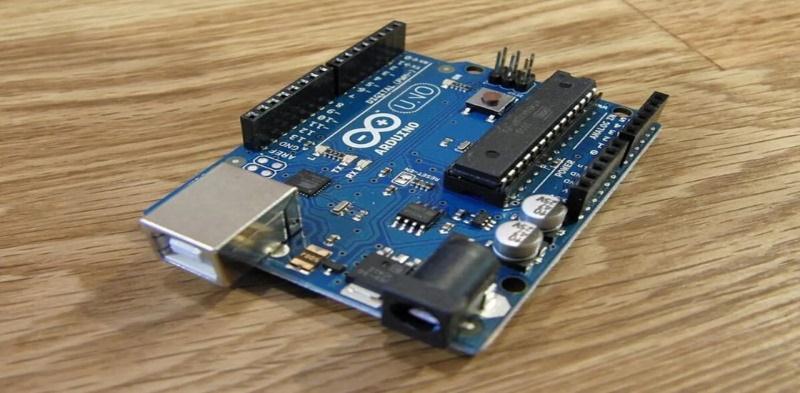
TheArduinoUnoisanopen-sourcemicrocontrollerboardbuiltaroundtheATmega328Pchip,asshowninfigure1.Itcan process data, read sensor inputs, and regulate outputs like motors or LEDs. It runs at 5V with a 16 MHz clock, has 14 digital I/O ports (6 PWM), 6 analog inputs, and 32 KB flash memory. Because of its ease of use and adaptability, it is frequentlyutilizedinrobotics,automation,andelectronicsprojects.ItcanbepoweredbyanexternalbatteryorUSB.
Theultrasonicsensor(HC-SR04)sendssignalstotheArduinoUno.Thesensoroperatesbyemittingultrasonicwavesand timing how long it takes for the echo to return after colliding with an obstruction. The Arduino uses its digital input pin (ECHO) to read this echo time, decides if the way ahead is clear or blocked, and uses the speed of sound to calculate the distancetothebarrier.
The Arduino uses the logic that has been written into it to process the distance measurement. For instance, the Arduino choosestostoptherobotandalteritscourseifthebarrieriswithinapredeterminedthresholddistance(suchas20cm). Therobotcanproceedifitdetectsnoobstacles.TheArduinoisfullyresponsibleforthisdecision-makingprocess.
High-powerDCmotorsarenotdirectlydrivenbytheArduinoUno.Rather,ittransmitscontrolsignals(HIGH/LOW)tothe motor driver (L298N), which subsequently provides the motors with the necessary voltage and current. The motors can rotate left or right or move forward or backward based on the signals from the Arduino. This makes it possible for the robottogoaroundobstaclesonitsown
International Research Journal of Engineering and Technology (IRJET) e-ISSN: 2395-0056
Serial Monitoring:
Additionally,theArduinomayuseaserialmonitortotransmitrobotstatusandsensorinformationtoacomputer.Thisis helpfulfortroubleshootingorexaminingtherobot'sreal-timereactiontoobstacles.
Overall Coordination:
To put it briefly, the Arduino Uno functions as the robot's brain, continuously executing the following loop: sense → process→decide→act.Therobotcanperformautonomousobstacleavoidancethankstoitsintegrationofsensorinputs, executionofprogrammedlogic,andoutputofmotorcontrolcommands.
2.Ultrasonic Sensor
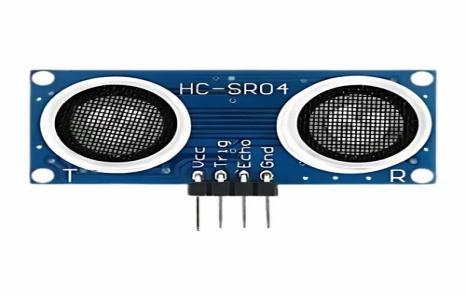
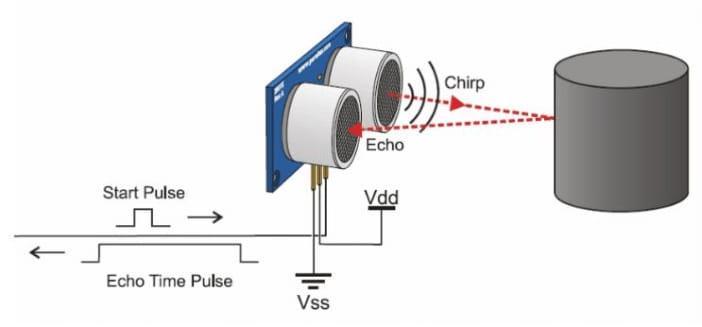
TheultrasonicsensorsforobstacleavoidancearedepictedinFigure2.Therearenumeroussensors thatcanbeutilizedto identify barriers. Among the most widely used sensors are sonar, ultrasonic sensors, cameras that can be employed in computer vision, and infrared sensors (IR). It is capable of measuring thousands to hundreds of points in its range of vision.Ultrasonicsensorsareusedinrobotdesigntoidentifyandavoidobstacles.Whenanobstructionisdiscovered,the frequencysignalsthattheultrasonicsensorscontinuouslytransmitarereflectedbackandusedasinput.
3. Wheels
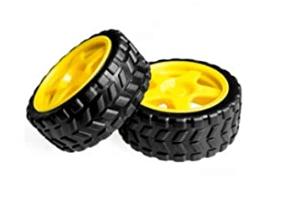
Wheels enabling the robot's locomotion are depicted in Figure 3. Wheels are essential to the mobility and stability of an Arduino-poweredobstacle-detectingrobot.Therobottypicallyemploysatwo-wheeldifferentialdrivesystem,inwhicha casterwheelispositionedatthefrontorreartomaintainbalanceandtwoDCgearedmotorsareconnectedtotwowheels oneithersideofthechassis.Theprimarywheelsareinstalleddirectlyontothemotorshaftsandaretypicallycomposedof rubber or plastic with a diameter of 6 to 7 cm. The robot can move forward, backward, and around obstacles with ease thankstothesewheels,whichtranslatetherotationalmotionofthemotorsintolinearmotion. Becausetheyprovidegood traction on a variety of terrain and guarantee smooth travel, rubber-treaded wheels are favored. In contrast, the caster wheel is a tiny, freely rotating roller or ball that supports the robot's weight and facilitates resistance-free rotation. For
Volume:12Issue:11|Nov2025 www.irjet.net p-ISSN: 2395-0072 © 2025, IRJET | Impact Factor value: 8.315 | ISO 9001:2008 Certified Journal | Page543
International Research Journal of Engineering and Technology (IRJET) e-ISSN: 2395-0056
Volume:12Issue:11|Nov2025 www.irjet.net p-ISSN: 2395-0072
small Arduino-based obstacle avoidance robots, the combination of two driven wheels and one caster wheel offers a straightforward,reliable,andeffectivedesign.
4.DC Motor
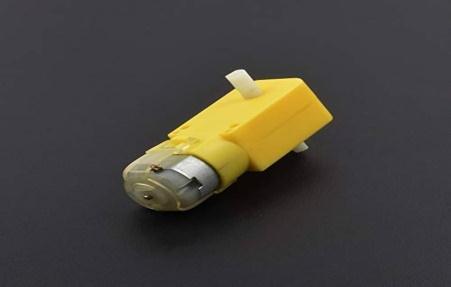
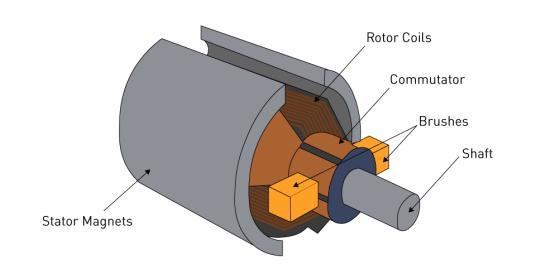
A DC motor is perfect for robotic applications since it has an integrated gearbox that increases torque while decreasing speed,asseeninfigure4.TwoDCgearmotorspowerthewheelsandregulatemovementinanArduinoobstacle-detecting robot.Theytypicallyrunat6–12Vand150–300RPM.Therobotcanmovesmoothlyandwithsufficientpowertosupport itsweightthankstothegearbox.TheArduinocanregulatethespeedanddirectionofthesemotorsforforward,backward, andturningmotionsbyconnectingthemtoamotordrivermodule(suchastheL293DorL298N).
5. Motor Driver(L298N)
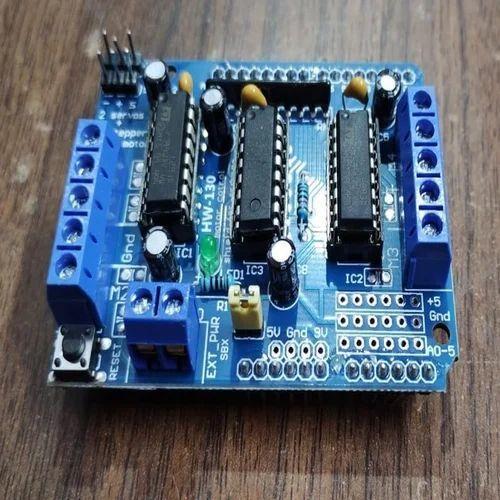
AsillustratedinFigure5,byconvertingthelow-currentcontrolsignalsfromtheArduino intohigher-currentsignalsthat can power the motors safely, the motor driver serves as an interface between the Arduino and the motors. as shown in Figure 5. The majority of motor drivers are built on an H-bridge circuit, which regulates the direction of current flow to enable the motor to rotate in both directions. The L293D and L298N are popular motor driver modules that can simultaneouslyoperatetwoDCmotors.Ithasenablingpins(ENAandENB)forPWMsignal-basedspeedcontrolandinput pins(IN1–IN4)fordirectioncontrol.TheArduinomaysimplyinstructtherobottomoveforward,backward,stop,orturn
International Research Journal of Engineering and Technology (IRJET) e-ISSN: 2395-0056
Volume:12Issue:11|Nov2025 www.irjet.net p-ISSN: 2395-0072
byadjustingthelogiclevelsoftheseinputpinsafterconnectingthemotordrivertotheArduinoandthemotors.Basedon theultrasonicdata,theArduinosendscontrolsignalstothemotordriverinyourobstacledetectionrobot.
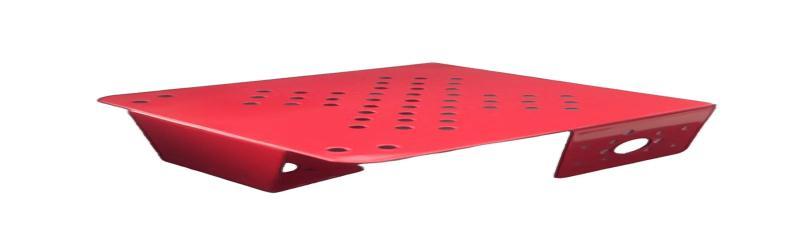
Thebaseorframethathousesallofarobot'sparts,includingmotors,wheels,sensors,anArduino,andabattery,iscalleda robotchassis,asseeninfigure6.Itgivestherobotstability,balance,andstructuralsupport.Typicallycomposedofmetal, plastic, or acrylic, chassis frequently have pre-drilled holes for simple component attachment. The chassis of a mobile robot contains the control boards, sensors for navigation, and motors and wheels for mobility. A well-designed chassis servesastherobot'sskeleton,guaranteessmoothmovement,andsafeguardsparts.
7.Jumper Wires
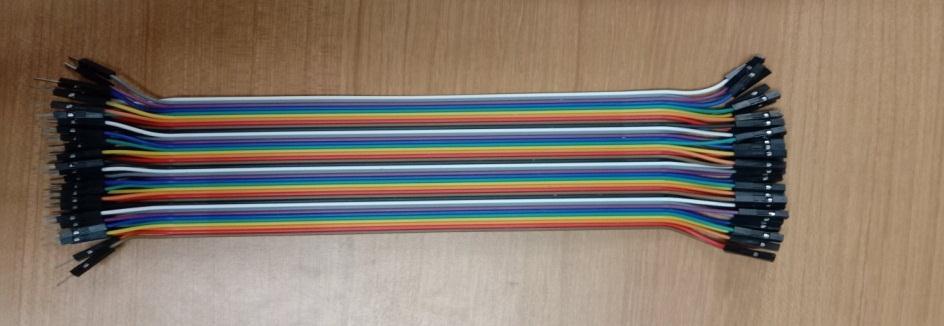
Figure7illustrateshowseveralcomponents,includingtheArduino,ultrasonicsensor,motordriver,andpowersupply,are connectedviajumperwires.Theseflexible,insulatedwireshavepinsonbothends,makingsolderlessconnectionssimple anddependable.JumperwiresconnectthesensorpinstotheArduinofordatareading,transferpowerandgroundsignals tothecomponents,andconnecttheArduinocontrolpinstothemotordriverformotorcontrol.Additionally,theyfacilitate circuit assembly, modification, and troubleshooting. All things considered, jumper wires are essential to the obstacledetectingrobot'scorrectelectricalconnectionsandseamlessoperation.
8 Battery
International Research Journal of Engineering and Technology (IRJET) e-ISSN: 2395-0056
Volume:12Issue:11|Nov2025 www.irjet.net p-ISSN: 2395-0072
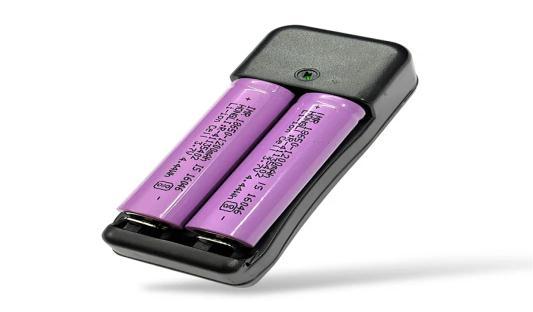
Batteries,aportableelectricalenergysourcethattransformschemicalenergyintoelectricitytopowerelectronicdevices, are depicted in Figure 8. It provides power to parts such as the Arduino, motors, sensors, and motor drivers in robots. RechargeableLi-ion/Li-Pobatteriesor9Vor12Vbatteriesarepopularoptionsforsmallrobots.Typicallyinstalledonthe chassis,thebatteryneedstomeetthecomponents'voltageandcurrentrequirements.Itactsasthemainsourceofenergy, allowingtherobottofunctionindependently.
3. Working
Ultrasonicdetectionandmotorcontrolarethefoundationoftherobot'soperation.Here'sathoroughexplanation:
1.MovementSetup:TwoDCmotorsareattachedtotherobot'swheels.
•Arduinousesamotordriver(L298N)toregulatemotorrotation.
•Bydefault,therobotadvancesuntilitencountersanobstruction.
2.DetectionofObstacles
•Therobothasafront-mountedultrasonicsensor(HC-SR04).
•Thisishowthesensorfunctions:
1.UsestheTrigpintotransmitanultrasonicpulse.
2.Awaitstheechotoreachtheechopinagain.
3.MakingChoices
•TheArduinocontinuouslymeasuresthesensor'sdistance.
•Thedistanceiscomparedtoathreshold,suchas15cm.
Ifthedistanceisgreaterthanthethreshold,therobotadvancessincethepathisclear.
Ifthedistanceislessthanthethreshold:
•Whenanobstacleisspotted,therobotreactstopreventcollisionsbystopping,turningleftorright,orreversing, dependingontheprogramming.
4.MotorControl:TheL298Nmotordriverisusedtocontrolmotors.
•ArduinotransmitsHIGH/LOWsignalstotheL298N'sinputpins:
1.Foreachmotor,onepinshouldbeHIGHandtheothershouldbeLOW.
2.Toreverse,usetheoppositeHIGH/LOWpins.
3.Toturn,onemotortravelsaheadwhiletheotherstopsorreverses.
5.ContinuousLoop:Toenabletherobottomaneuveraroundobstaclesonitsown,thislooprepeatedlyrepeats:•Measure distance→Comparewiththreshold→Decideaction→Movemotors.
4. Result
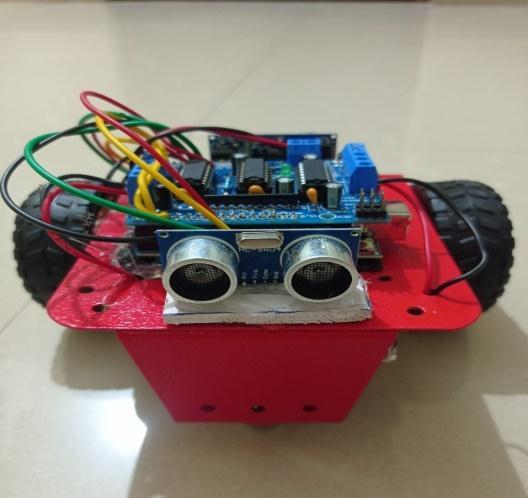
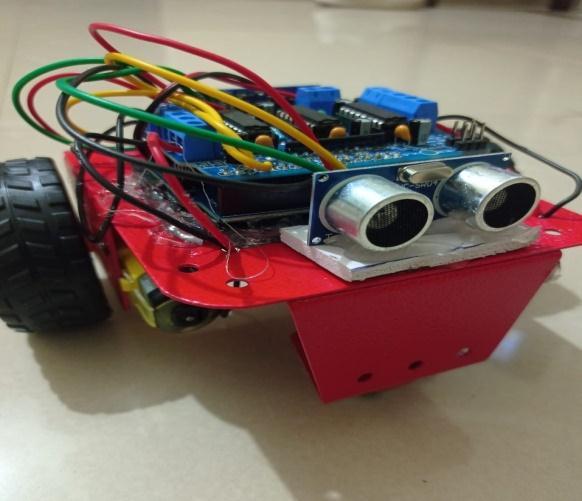
The Obstacle Detection Robot project successfully produced a small autonomous robot that can recognize impedimentsinitspathandpreventcollisions,asseeninfig.9.Duringtesting,therobotadvancesonitsownand stops, rotates, and changes course to avoid obstacles when the ultrasonic sensor detects an object within a
International Research Journal of Engineering and Technology (IRJET) e-ISSN: 2395-0056
Volume:12Issue:11|Nov2025 www.irjet.net p-ISSN: 2395-0072
predeterminedrange.The real-time operation of the systemshowshow well the Arduino, motordriver, motors, andsensorsareintegrated.
Theprojectdisplays:
•Withouthumanassistance,therobotcannavigateabasicenvironment
•Theultrasonicsensorinitiatesmotoroperationsandaccuratelymeasuresdistance.
•Thewheels'directionandmovementareeffectivelymanagedbythemotordriver.
Allthingsconsidered,theprojectaccomplishesitsobjectiveofautonomousobstacledetectionandavoidance,makingita usefulillustrationoffundamentalrobotics,sensorintegration,andmicrocontrollerprogramming.Multiplesensors,speed control,orremotemonitoringcanallbeaddedtomakeitevenbetter.
5. Advantages
•Showsreal-worldautonomousnavigation:Similartohouseholdandindustrialrobots,itillustrateshowrobotsdetect theirsurroundingsandmakedecisionswithouthumaninput.
•Reliableobstacledetection:TherobotissaferandmoredependablethankstotheHC-SR04sensor'sprecisenon-contact distancemeasurement.
•Enhancesproblem-solvingabilities:Studentshonerobotmovementandsensorprecisionwhilelearningtroubleshooting, systemintegration,andcreativedesign.
•Basisforadvancedrobotics:Providestheframeworkformoreintricatesystemssuchasself-drivingcars,indoor mappingrobots,orsmarthomenavigationrobots.
•Real-TimeOperation:Therobotnavigatessmoothlyandeffectivelybyprocessingsensorinputsinstantlyandreacting fasttoobstacles
6. Disadvantages
•LimitedDetectionPrecision:Theultrasonicsensor'soverallreliabilityisdiminishedbyitsinabilitytoidentify translucent,curvy,orsoftobjects.
•LimitedOperationalRange:Therobotcannotplanlong-distanceroutesoranticipatedistantobstaclesduetoitslimited sensingrange.
•EnvironmentalSensitivity:Outdoorfactorssuchasbrightsunshine,unevensurfaces,andnoiseinterferencenegatively impairsensorperformance.
•NoMappingCapability:Itislimitedtobasicnavigationwithoutenvironmentalawarenessbecauseitisunabletocreate orstoremapsofitssurroundings.
•LimitedMechanicalStrength:Therobot'scapacitytomanagelargeloadsorruggedterrainisdiminishedbyits lightweightchassisandbasicDCmotors.
•Battery-DependentOperation:Rechargingorreplacingbatteriesfrequentlyisnecessaryduetotheirshortlifespan.
TheArduino-poweredobstacledetectorrobotisapotentillustrationofhowbasicyetefficientelectronicsmayprovide sophisticated behavior. The robot can sense its environment, make judgments in real time, and move without human help thanks to the integration of the ultrasonic sensor with the Arduino controller. This research not only meets its purpose ofidentifying and avoiding impediments butalsoillustratesthe possibilitiesof embeddedsystemsin modern automation. Weget hands-onexperience withfundamental engineeringideaslikesensorinterface, motorcontrol,and autonomous navigation with this design. All things considered, the initiative is a step toward more sophisticated robotics,demonstratingthatevenmodestadvancementscanresultinsignificanttechnicaladvancement.
The Arduino can easily instruct the robot to move forward, backward, stop, or turn by adjusting the logic levels of these input pins after connecting the motor driver to the Arduino and the motors. Based on the ultrasonic data, the Arduino sendscontrolsignalstothemotordriverofyourobstacledetectionrobot.eco-friendly.Thesedevelopmentscouldopenthe
International Research Journal of Engineering and Technology (IRJET) e-ISSN: 2395-0056
Volume:12Issue:11|Nov2025 www.irjet.net p-ISSN: 2395-0072
door to next-generation robots by making the project appropriate for use in delivery systems, industrial automation, surveillance,andautonomouscars
1. JeevanM., RamakrishnanS., Harsha R.,&LokeshR.(2021).ObstacleAvoidance RoboticVehicleUsingUltrasonic SensorAndArduinoController.JournalofPhysics:ConferenceSeries,1964(6),062125.
2. Aravinda E. S. S., Bandara D. S., & Perera A. G. C. (2022). Implementation of Obstruction Avoiding Robot using UltrasonicSensorandArduinoUNO.InternationalJournalofResearchandEngineering,9(4),169–173.
3. PrasetyoH.,SulaimanN.N.,&FaliqG.A.(2023).PerformanceComparisonofHC-SR04UltrasonicSensorandTFLunaLIDARforObstacleDetection.JurnalElektronikadanTelekomunikasi,23(1),1–9.
4. Ramos L., Arvelo R., & Melián-Batista B. (2016). When Ultrasonic Sensors and Computer Vision Join Forces for EfficientObstacleDetectionandRecognition.RoboticsandAutonomousSystems,85,45–56.
5. Gao J., Sun X., & Zhang Y. (2021). Obstacle Avoidance of Multi-Sensor Intelligent Robot Based on Road Sign Detection.JournalofPhysics:ConferenceSeries,1876(1),012112.
6. MüllerF.,StarkeH.,&TewsM.(2021).ReactiveObstacle–AvoidanceSystemsforWheeledMobileRobotsBasedon ArtificialIntelligence:ALiteratureSurvey.Sensors,21(16),5406.
7. MihăițăS.,IacobG.,&PetrescuF.M.(2023).Evaluatinga HybridLLMQ-Learning/DQNFramework forAdaptive ObstacleAvoidanceinEmbeddedRobotics.JournalofRoboticsandControl(JRC),4(6),575–581.