
International Research Journal of Engineering and Technology (IRJET) e-ISSN: 2395-0056
Volume: 13 Issue: 01 | Jan 2026 www.irjet.net p-ISSN: 2395-0072
International Research Journal of Engineering and Technology (IRJET) e-ISSN: 2395-0056
Volume: 13 Issue: 01 | Jan 2026 www.irjet.net p-ISSN: 2395-0072
Suchitra Sona Gangurde1 , Mitali Vishnu Pawar2 , Sanket Shirish Chaudhary3 , Swetank Vinod Sonawane4, Prof. M. A. Khan5.
1, 2, 3, 4 Final Year Students, Department of Information Technology, Sandip Polytechnic, Nashik, Maharashtra, India 5 Lecturer, Department of Information Technology, Sandip Polytechnic, Nashik, Maharashtra, India
Abstract – Outcome-Based Education (OBE) focuses on achieving predefined learning outcomes through structured teaching, learning, and evaluation practices. However, the manual documentation and tracking of these activities can be inefficient. This paper presents the design and development of a web-based application to automate the implementation of OBE under "Criteria 2: Teaching–Learning and Evaluation" for the Information Technology Department. The developed system facilitates digital curriculum planning, aligns Program Outcomes (POs) and Program Specific Outcomes (PSOs), and systematically documents academic activities. Key features include modules for managing expert lectures, industrial visits, valueadded programs, and final-year projects. By utilizing a full-stack web framework, the system ensures transparency, improved student engagement, and real-time monitoring of educational goals. The outcomes indicate that digitizing these processes leads to better curriculum delivery and more effective attainment of learning outcomes.
Key Words: Outcome-Based Education, OBE, Web Application, Teaching–Learning Process, Curriculum Mapping, Academic Automation, MERN Stack.
Outcome-BasedEducation(OBE)hasbecomeasignificantframeworkintechnicaleducationduetoitsfocuson measurable learning outcomes and student-centered learning. While teaching, learning, and evaluation are crucial for academic effectiveness,manualmethodsoftrackingtheseactivitiesoftenresultindataredundancyandalackoftransparency.
To address these challenges, we have developed a comprehensive software solution designed to digitize the "Criteria 2" standards.Thispaperdiscussesthedevelopmentofthiswebapplication,highlightingitsroleinstreamliningacademicand co-curricular initiatives within the Information Technology Department to enhance learning quality and outcome attainment.
Although various academic and co-curricular activities are conducted in polytechnic institutions, the absence of a structured,centralizeddigitalframeworkfordocumentationlimitstheirvisibilityandeffectiveness.Manualrecord-keeping makesit difficult to map activities to specific Program Outcomes (POs). There is a critical need for a systematic, webbased approach to plan, monitor, and document teaching–learning activities in alignment with OBE principlestoensure continuousacademicimprovement.
3.1 Objectives:
TodesignasoftwareplatformfortheeffectiveimplementationofOutcome-BasedEducationpractices.
TodigitallyaligncurriculumdeliverywithProgramOutcomes(POs)andPSOs.
Toimprovetransparency,accessibility,anddocumentationofacademicactivitiesthroughautomation.
3.2 Scope:
The scope of this project includes the digitization of curriculum planning, teaching–learning processes, expert lectures, industrialvisits,value-addedprograms,industrialtraining,andfinal-yearprojectsundertheumbrellaofCriteria2.
International Research Journal of Engineering and Technology (IRJET) e-ISSN: 2395-0056
Volume: 13 Issue: 01 | Jan 2026 www.irjet.net p-ISSN: 2395-0072
Outcome-Based Education (OBE) has been widely adopted in technical and higher education to improve learning effectiveness and ensure measurable academic outcomes. Academic frameworks and accreditation bodies emphasize aligning curriculum design, teaching–learning activities, and assessment methods with clearly defined Program Outcomes (POs) and Program Specific Outcomes (PSOs). Studies indicate that structured outcome mapping enhances curriculum transparencyandsupportscontinuousqualityimprovementineducationalinstitutions.
However, several researchers have highlighted challenges in the practical implementation of OBE, particularly when academic activities are documented using manual or semi- digital methods. Manual record-keeping increases administrative workload, limits real-time monitoring, and makes it difficult to retrieve evidence during academic audits. Recent literature suggests that integrating information technology solutions into academic management systems can significantlyimprovedataaccuracy,accessibility,anddocumentationefficiency.
Existing studies on academic automation and web-based management systems demonstrate that digital platforms supportcentralizeddatastorage,role-basedaccess,andautomatedreportgeneration.Thesesystemsreduceredundancy andimproveinstitutional readinessforaccreditationandqualityassuranceprocesses.Basedon thesefindings,thisstudy focusesondevelopingaweb-basedsolutiontosupporttheeffectiveandpracticalimplementationofOBEunderCriteria2.
TheproposedsystemisaFull-StackWebApplicationdesigned toorganize,monitor,anddocumentallteaching–learning activities.Thesystemarchitectureenablesthe mappingofcurriculumcontentwithProgramOutcomesandPSOstoensure strictoutcomealignment.
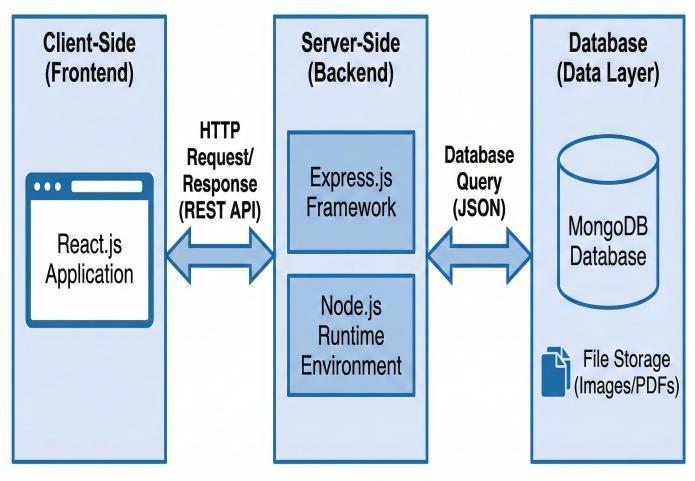
Theproposedwebapplicationisdividedintothreeprimaryfunctionalmodulestoensuresecureandrole-basedaccess:
A. Administrator Module: The administrator has the highest level of privilege. The key responsibilities of this module include:
User Management: Creating and managing accounts for Heads of Departments (HOD), faculty members, and students.
Curriculum Mapping: Defining the Program Outcomes (POs) and Program Specific Outcomes (PSOs) for the academicyear.
System Monitoring: Viewingoverallusagestatisticsandensuringthesystemisrunningcorrectly.
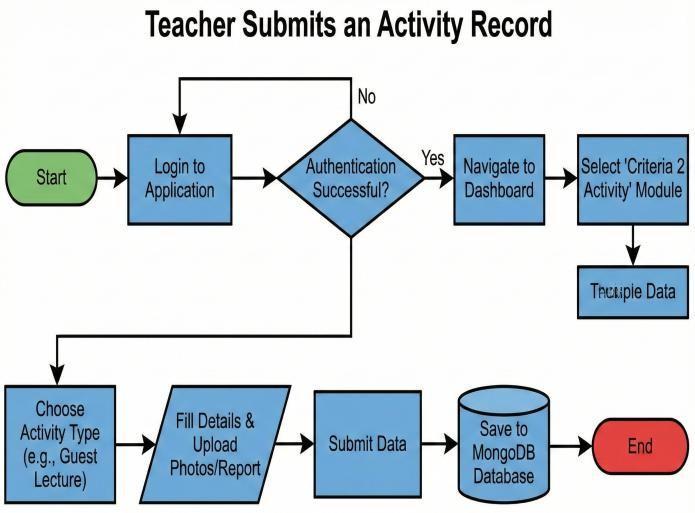
B. Faculty / Staff Module: Thisisthecoremodulewherethemajorityofdataentryoccurs.Facultymemberscan:
Activity Upload: Selectthetypeofactivity(e.g.,"GuestLecture"or"IndustrialVisit")anduploadrelevantdetails suchasdate,resourceperson,andphotographs.
International Research Journal of Engineering and Technology (IRJET) e-ISSN: 2395-0056
Volume: 13 Issue: 01 | Jan 2026 www.irjet.net p-ISSN: 2395-0072
Outcome Mapping: directlymapsaspecificactivitytotherelevantPOs(e.g.,mappingan"IndustrialVisit"to"PO-2: EngineeringKnowledge").
Report Generation: GenerateautomatedPDFreportsfortheirspecificsubjectsorcriteriafiles.
C. Student Module (View Only): Students are providedwithread-onlyaccesstotransparency.Theycan:
View Calendar: Checkthescheduleofupcomingacademicactivities.
Access Resources: Downloadstudymaterialsorreportsuploadedbyfaculty.
Feedback System: Submit feedback regarding specific events or lectures, which is stored in the database for qualityimprovementanalysis.
One of the critical features of the system is the automated generation of documentation. The backend utilizes a specific algorithmtofetchdataandconvertitintoastandardizedformat:
1. Fetch Request: Theuserselectsthe"GenerateReport"buttonforaspecificdaterange.
2. Data Retrieval: TheNode.jsserverqueriestheMongoDBdatabaseforallactivitiesmatchingthefilter.
3. Template Mapping: TheretrievedJSONdataismappedintoapre-definedHTMLtemplate.
4. PDF Conversion: Alibrary(suchasPuppeteerorPDFKit)convertstheHTMLviewintoadownloadablePDFfile.
5. Download: Thefileissenttotheclient'sbrowserfortheusertosavelocally.
The proposed system is developed using the MERN Stack (MongoDB, Express.js, React.js, Node.js), selected for its scalability, efficiency, and full-stack JavaScript capability. To ensure code quality and a modern user interface, the developmentprocessalsointegrated TypeScript fortypesafetyand Tailwind CSS forresponsivestyling.
The client-side of the application is built to be responsive and intuitive, ensuring seamless access for both students and faculty.
React.js: A component-based JavaScript library used for building the user interface. It allows for the creation of reusableUIcomponents,ensuringaconsistentlookandfeelacrosstheapplication.
Tailwind CSS: A utility-first CSS framework used for rapid UI development. It allows for highly customizable designswithoutwritingstandardCSS,ensuringtheapplicationisfullyresponsiveonmobileanddesktopdevices.
TypeScript: UsedasasupersetofJavaScriptto introducestatictyping.Thisreducesruntimeerrorsandimproves codemaintainability,whichiscriticalforhandlingcomplexlogicintheoutcomemappingmodules.
International Research Journal of Engineering and Technology (IRJET) e-ISSN: 2395-0056
Volume: 13 Issue: 01 | Jan 2026 www.irjet.net p-ISSN: 2395-0072
Theserver-sidelogicisdesignedtohandlemultipleconcurrentrequestsandmanagesecuredatatransactions.
Node.js: A JavaScript runtime environment that executes code server-side. Its non-blocking I/O model makes it idealforhandlingreal-timedatafetchinginthisapplication.
Express.js: AminimalwebapplicationframeworkforNode.js.ItisusedtobuildrobustRESTfulAPIsthatfacilitate communicationbetweentheReactfrontendandtheMongoDBdatabase.
MongoDB: A NoSQL database used to store unstructured data such as student records, activity reports, and images.UnliketraditionalSQLdatabases,MongoDBstoresdatainJSON-likedocuments,whichallowsforflexible schemadesign perfectforthevaryingdatastructuresofdifferentacademicactivities.
6.4
Git & GitHub: Used for version control to track changes in the source code and facilitate collaboration among teammembers.
Postman: UtilisedfortestingAPIendpointsduringthedevelopmentphasetoensurethatdatarequests andresponsesarefunctioningcorrectlybeforeconnectingthemtothefrontend.
VS Code: TheprimaryIntegratedDevelopmentEnvironment(IDE)usedforwritinganddebuggingcode.
Theimplementationoftheproposedweb-basedmanagementsystemisexpectedtoyieldsignificantimprovementsinthe administrativeandacademicworkflowsofthedepartment.Thekeyanticipatedoutcomesinclude:
Automated Curriculum Alignment: The system ensures seamless mapping of every academic activity with specificProgramOutcomes(POs)andProgramSpecificOutcomes(PSOs),eliminatingmanualerrorsinattainment calculations.
Enhanced Student Participation: By increasing the visibility of industry-oriented activities through the student portal, the system encourages higher student engagement in workshops, expert lectures, and value-added programs.
Digital Transparency & Accessibility: A centralized cloud-based platform ensures that all academic documentationistransparent,secure,andeasilyretrievablebystakeholdersfromanylocation,resolvingtheissue ofphysicalfiledependency.
Data-Driven Quality Assurance: Thesystemprovidesreal-timeanalyticsandgraphicaldashboards,enablingthe HeadofDepartment(HOD)andfacultytomakedata-drivendecisionstostrengthenacademicqualityandfacilitate continuousimprovement.
Audit Readiness: With automated report generation, the department will remain perpetually ready for external academicaudits(suchasNBAorNAAC)withorganized,standard-compliantdigitalrecordsavailableondemand.
Resource Optimizations: The transition from paper-based logs to a digital database will significantly reduce paper usage and administrative man-hours, allowing faculty to focus more on teaching rather than clerical documentation.
Table -1: Comparison of Manual System and Proposed Web System
Features Manual System Proposed Web System

DataHandling Physicalfiles& registers DigitalDatabase (MongoDB)
Accessibility Restrictedtothe Office Accessible anywhere
Report Generation Manual,Timeconsuming One–clickPDF
International Research Journal of Engineering and Technology (IRJET) e-ISSN: 2395-0056
Volume: 13 Issue: 01 | Jan 2026 www.irjet.net
The proposed web-based Outcome-Based Education management system was successfully implemented at the departmental level to support the documentation and monitoring of Criteria 2: Teaching–Learning and Evaluation. The systemwasdeployedinacontrolledacademicenvironmentandtestedusingactualdepartmentalactivitiesandrecords.
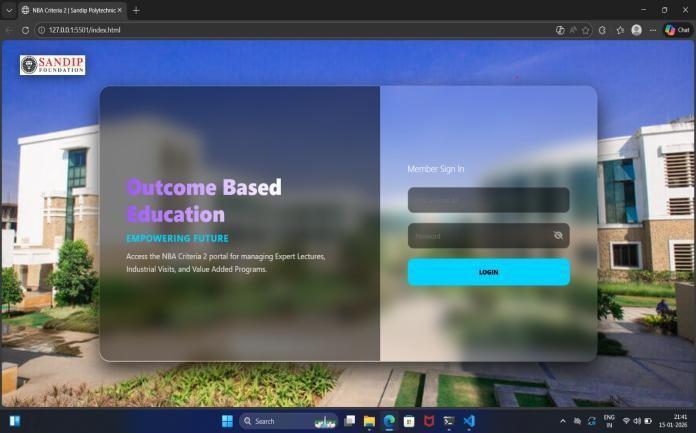
Facultymembersaccessedthesystemthroughrole-basedauthenticationtouploaddetailsofacademicandco- curricular activitiessuchasexpertlectures,industrialvisits,value-addedprograms,andfinal-yearprojects.Eachactivitywasmappedto relevant Program Outcomes (POs) and Program Specific Outcomes (PSOs) using predefined options, ensuring consistent outcomealignment.Supportingdocuments,includingreportsandphotographs,werestoreddigitallyinthedatabase.
Theadministratormoduleenabledcentralisedmanagementofusers,academicparameters,andoutcomedefinitions,while automatedreportgenerationallowedfacultytoproducestandardisedPDFreportsfordocumentationandauditpurposes. Studentswereprovidedwithview-onlyaccesstoschedulesandsharedresources,improvingtransparencyandawareness ofacademicactivities.
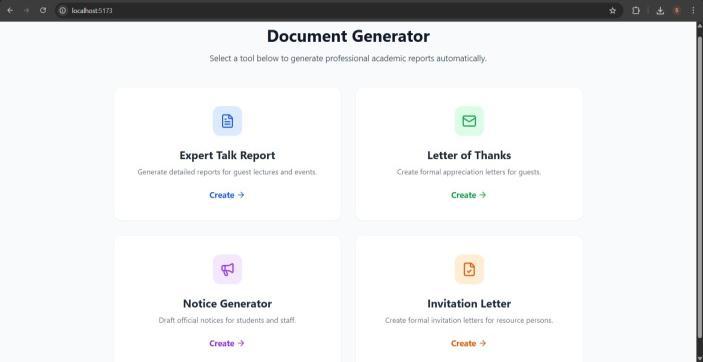
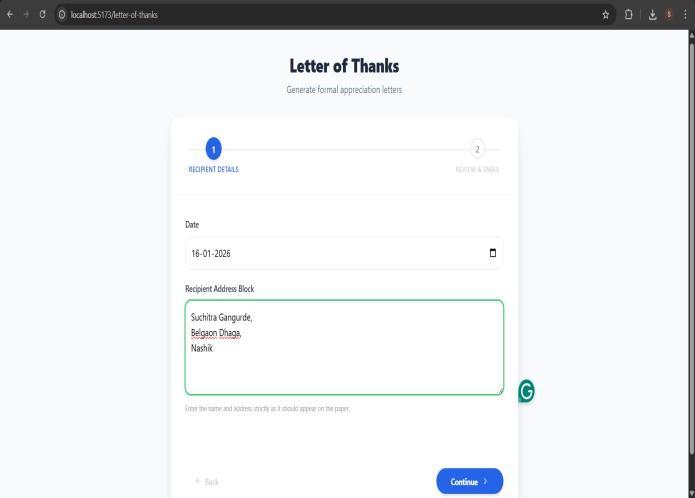
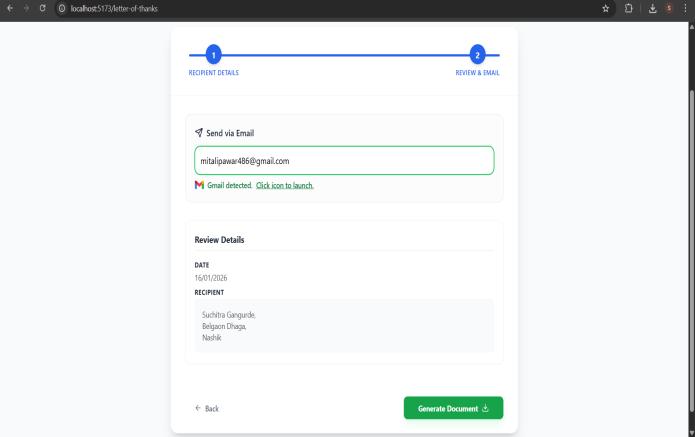
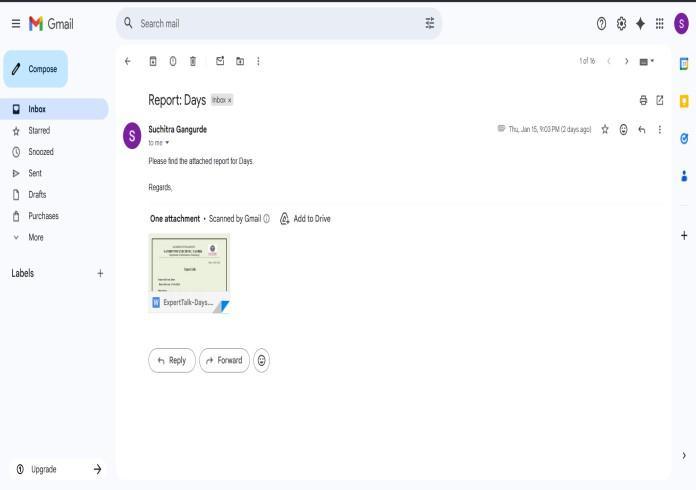
Theimplementationdemonstratedimprovedefficiencyinacademicdocumentation,reducedmanualeffort,andenhanced accessibilityof records. The use of screenshots (Fig -3toFig-7)illustrateskeysysteminterfaces,validating the practical functionalityandusabilityoftheproposedsolution.
International Research Journal of Engineering and Technology (IRJET) e-ISSN: 2395-0056
Volume: 13 Issue: 01 | Jan 2026 www.irjet.net p-ISSN: 2395-0072
9. FUTURE SCOPE:
While the current system effectively digitizes the "Criteria 2" documentation, there is significant potential for future enhancements:
AI-BasedAnalysis:ImplementingMachineLearningalgorithmstopredictstudentperformancetrendsbasedonthe mappedoutcomes.
MobileApplication:DevelopingadedicatedAndroid/iOSappusingReactNativeforeasieraccessbyfacultyonthe go.
International Research Journal of Engineering and Technology (IRJET) e-ISSN: 2395-0056
Volume: 13 Issue: 01 | Jan 2026 www.irjet.net p-ISSN: 2395-0072
Integration with ERP: The system can be integrated with the college’s existing ERP software to fetch student attendancedataautomatically.
Blockchain Security: Using blockchain technology to issue tamper-proof digital certificates for students who completespecificvalue-addedprograms.
The development and implementation of this web-based OBE management system demonstrates a significant improvement in the effectiveness of teaching–learning processes. By shifting from manual to digital documentation, the departmentcanensurebettercurriculumalignmentandcontinuousmonitoring.Thisstudyconfirmsthatintegratingmodern ITsolutionswitheducationalframeworkssupportsqualityassuranceandinstitutionalgrowthintechnicaleducation.
Theauthors expresssinceregratitudetoourprojectguide,Prof.M.A.Khan,andthefacultymembersoftheDepartmentof Information Technology for their continuous guidance and support. Special thanks are extended to Sandip Foundation’s Sandip Polytechnic forprovidingthenecessaryresourcesandinfrastructuretocompletethisresearch.
[1]MSBTEAcademicCalendar,MaharashtraStateBoardofTechnicalEducation.
[2]NationalBoardofAccreditation(NBA),Outcome-BasedEducationGuidelines.
[3] IEEEPublicationsonOutcome-BasedEducationandAcademicQualityAssurance.
[4] DepartmentalReports&COERecords,SandipPolytechnic.
[5]W.G.Spady,"Outcome-BasedEducation:CriticalIssuesandAnswers,"AmericanAssociationofSchoolAdministrators, Arlington,VA,1994.
[6]R.S.Pressman,"SoftwareEngineering:APractitioner’s Approach,"7thed.,McGraw-HillHigherEducation,2010.
[7]V. D. S. Silva, "The MERN Stack: A Review of the Learning Curve and Application in Modern Web Development," InternationalJournalofComputerApplications,vol.176,no.3,pp.25-30,2020.
[8]"React-AJavaScriptlibraryforbuildinguserinterfaces,"FacebookOpenSource.
[9]"MongoDBDocumentation,"MongoDBInc.
[10] S. Gupta and M. Kumar, "Automation of Academic Management Systems in Higher Education," IEEE International ConferenceonAdvancedComputing,2019.
[11] J.Dean,"WebApplicationArchitecture:Principles,ProtocolsandPractices,"WileyPublishing,2009.
[12] "Express.js:Fast,unopinionated,minimalistwebframeworkforNode.js,"OpenJSFoundation.