
International Research Journal of Engineering and Technology (IRJET) e-ISSN: 2395-0056
Volume: 13 Issue: 03 | Mar 2026 www.irjet.net p-ISSN: 2395-0072

International Research Journal of Engineering and Technology (IRJET) e-ISSN: 2395-0056
Volume: 13 Issue: 03 | Mar 2026 www.irjet.net p-ISSN: 2395-0072
Prof. T. Vinay Simha Reddy¹, Dudala Mohana Naga Venkata Sri Lasya2 , D. Sai Kartheek3 , G. Naga Sandeep Reddy4
¹Assistant Professor, Department of Artificial Intelligence and Machine Learning, Malla Reddy University, Maisammaguda, Hyderabad, India
²³´µ Students, Department of Artificial Intelligence and Machine Learning, Malla Reddy University, Maisammaguda, Hyderabad, India
Abstract - Unhealthy dietary habits are one of the leading causes of non-communicable diseases such as obesity, diabetes, and cardiovascular disorders. Monitoring daily food intake remains a major challenge due to the lack of efficient and user-friendly tools. This paper presents NutriVision, an intelligent real-time food recognition and nutrition management system powered by deep learning and computer vision techniques. The proposed system utilizes Convolutional Neural Networks (CNNs), specifically MobileNetV2 and ResNet-50, trained ontheFood-101datasetforaccuratefoodclassification.
In addition to image-based recognition, the system integratesatext-basednutritionallookupusingtheIndian Nutritional Database (INDB), ensuring accurate dietary information for region-specific foods. The architecture combines a React-based frontend, Fast API backend, TensorFlow for model inference, and OpenCV for preprocessing. The system also provides personalised features such as BMI calculation, calorie tracking, meal planning, and health safety checks. NutriVision offers a comprehensive solution for intelligent dietary monitoring andpersonalisednutritionguidance.
Keywords: Food Recognition, Deep Learning, CNN, MobileNetV2, ResNet-50, Nutrition Analysis, Computer Vision,FastAPI,TensorFlow,HealthMonitoring
Inrecentyears,theprevalenceoflifestyle-relateddiseases has increased significantly due to unhealthy eating habits andlackofdietaryawareness.Individualsoftenstruggleto maintainbalancednutritionbecauseexistingtoolsrequire manualinput,whichisbothtime-consumingandproneto humanerror.Traditionalcalorietrackingapplicationsrely heavily on user knowledge and consistency, limiting their effectiveness.
Advancementsinartificialintelligence,particularlyindeep learning and computer vision, have enabled the developmentofautomatedfoodrecognitionsystems.These
systems can analyse food images and provide accurate nutritional information without requiring manual effort. NutriVision leverages these technologies to create an intelligent platform that simplifies dietary tracking and improveshealthawareness.
Thesystemisdesignedtorecognisefooditemsinrealtime using deep convolutional neural networks. It extracts meaningfulvisualfeaturesfromimagesandclassifiesthem into predefined categories. In addition, the platform integratesa text-basedsearchmechanism tohandlefoods thatmaynotbewellrepresentedinimagedatasets.
Food recognition involves identifying food items from imagesusingmachinelearningmodels.CNNsplayacrucial role by learning hierarchical features such as textures, shapes, and colours. These models are trained on large datasets like Food-101 to achieve high classification accuracy.
Nutrition management systems aim to provide users with insightsintotheirdietaryhabits.NutriVisionenhancesthis concept by combining food recognition with personalized recommendations, helping users maintain healthier lifestyles.
International Research Journal of Engineering and Technology (IRJET) e-ISSN: 2395-0056
Volume: 13 Issue: 03 | Mar 2026 www.irjet.net p-ISSN: 2395-0072
The field of automated dietary assessment has evolved significantly with the introduction of machine learning techniques. Early systems relied on handcrafted features such as color histograms and texture descriptors, which were limited in performance and unable to generalize across diverse food categories. With the emergence of deep learning, Convolutional Neural Networks replaced traditional approaches by automatically learning feature representations from raw image data. Studies such as DeepFood demonstrated the effectiveness of transfer learning using pre-trained models like ImageNet. These approaches significantly improved classification accuracy androbustness.
Recent advancements include lightweight architectures like MobileNet, designed for real-time applications with reduced computational cost. Similarly, ResNet introduced residual connections that allow deeper networks to be trainedefficiently,resultinginhigheraccuracy.
Researchhasalsoexploredintegratingnutritiondatabases with recognition systems. Systems combining image recognitionwithnutritionallookupprovidemore
comprehensive solutions compared to standalone models. However, most existing solutions lack personalization features such as health monitoring and dietary recommendations.
NutriVisionaddressestheselimitationsbyintegratingfood recognition, nutrition analysis, and personalized health trackingintoaunifiedplatform.
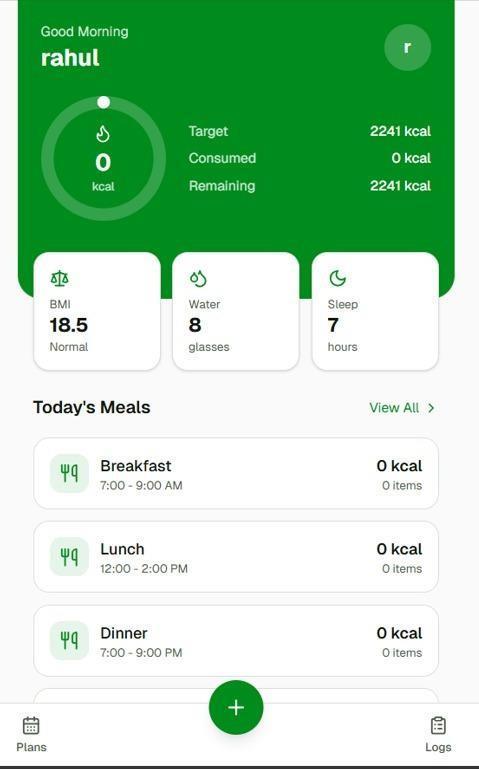
NutriVisionoffersadual-inputpipeline:(a)uploadafood
photograph→CNNclassification,or(b)typeafoodname
→INDBquery.Bothpathsreturnfoodname,kcal,protein, carbohydrates, fat per 100 g, and a personalised Health Safety Check. The image pathway decodes the uploaded image,resizesto224×224pxviaOpenCV,normalisespixel values, runs TensorFlow inference (MobileNetV2 or ResNet-50), and maps the predicted Food-101 label to a nutritiontablefromUSDAFoodDataCentralandINDB.
The text pathway accepts a food name string, performs fuzzy matching against the INDB food-item index, and returns the best-matching nutritional record. This is especially valuable for Indian dishes (biryani, idli, dosa) comprehensively covered in INDB but rare in Food-101 trainingimages.
Figure2showstheProfileSummary.Thisprofiledrivesthe HealthSafetyCheckandthecomputationofcalorictargets. The header card displays computed BMI (18.5 – Normal), dailycalorictarget (2,241 kcal/day),weight(60 kg),body infrmation,andhealthgoal(WeightGain).
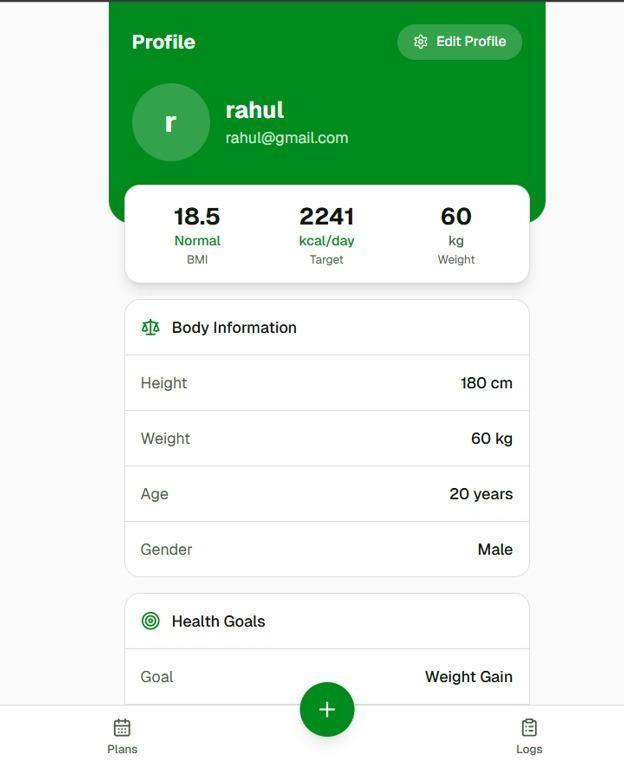
Fig. 2: ProfileSummary–BMI,DailyTarget,HealthGoals
International Research Journal of Engineering and Technology (IRJET) e-ISSN: 2395-0056
Volume: 13 Issue: 03 | Mar 2026 www.irjet.net p-ISSN: 2395-0072
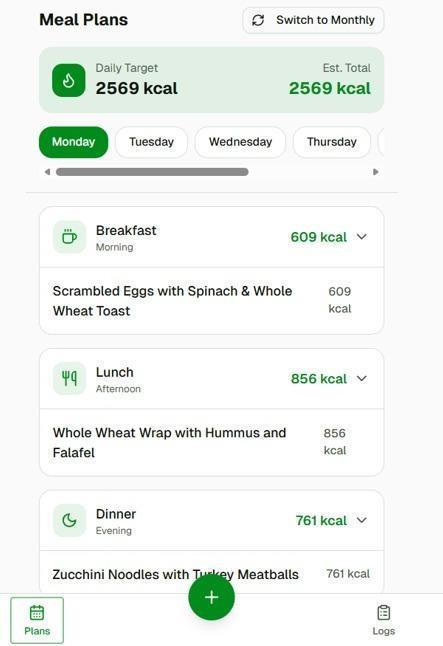
Figure3showstheMealPlansScreenwhereuserscanview andmanagetheirweeklydietplan.Eachmealslotdisplays calorie estimates and food items assigned throughout the day, enabling structured dietary planning aligned with individualcalorictargets.
4. METHODOLOGY
The methodology of NutriVision involves multiple stages, including data preprocessing, model training, and inference.
A. Convolutional Neural Networks
CNNs are used to extract spatial features from images through convolution operations, activation functions, and pooling layers. These networks automatically learn patternsthatdistinguishdifferentfoodcategories.
B. Model Selection
MobileNetV2: Lightweight and efficient for realtimeapplications
ResNet-50: Deeper architecture with higher accuracy
C. Transfer Learning
Pre-trainedmodelsarefine-tunedontheFood-101dataset toimproveperformancewhilereducingtrainingtime.Data augmentationtechniquessuchasrotationandflippingare appliedtoenhancegeneralization.
D. Dataset
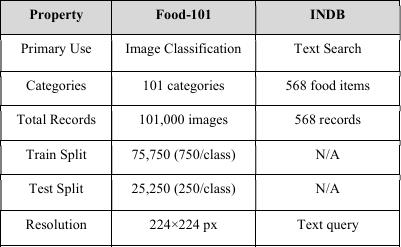
Food-101dataset(101,000images)
INDB (Indian Nutritional Database) for nutrition values
E. Training Configuration
Models are trained using TensorFlow with optimized hyperparameters such as learning rate, batch size, and dropouttopreventoverfitting.
TABLE I: DATASET SUMMARY – FOOD-101 AND INDB
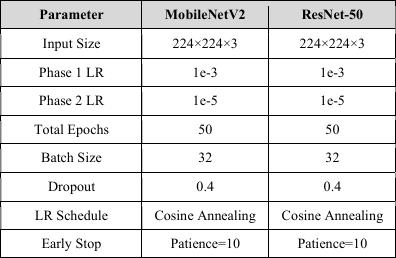
Training was conducted using TensorFlow 2.14/Keras on an NVIDIA RTX 3060 GPU (12 GB VRAM). Classification head: GlobalAvgPool2D → Dropout(0.4) → Dense(512,ReLU)→Dense(101,Softmax).Loss:categorical cross-entropy.Metrics:Top-1andTop-5accuracytracked perepoch.
TABLE II: TRAINING CONFIGURATION
International Research Journal of Engineering and Technology (IRJET) e-ISSN: 2395-0056
Volume: 13 Issue: 03 | Mar 2026 www.irjet.net p-ISSN: 2395-0072
NutriVisionfollowsathree-tierarchitecture:Presentation Layer (Next.js/React), Application Layer (FastAPI + TensorFlow),andDataLayer(PostgreSQL+INDB+Food101 nutrition table). All inter-tier communication uses RESTfulJSONAPIsoverHTTPSwithJWTauthentication.
Figure 4 presents the system architecture. The numbered flow:(1)browsersubmitsimageorfoodname;(2)FastAPI receives request; (3) OpenCV preprocesses image; (4) TF modelclassifiesfood;(5)nutritiontablelookup;(6)Health Safety Check against user profile; (7) JSON response to browser; (8) meal log persisted in PostgreSQL. For text pathway,steps3–4arereplacedbydirectINDBquery.
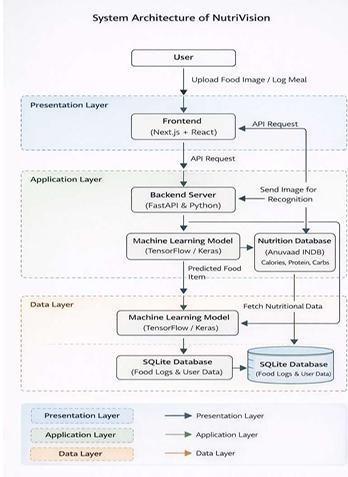
Fig. 4: SystemArchitectureDiagram
A.PresentationLayer(Next.js/React)Next.js14withReact 18providesserver-siderenderingforfastinitialloadsand client-side state for real-time caloric gauge 84.6 88.1 updates. Components include Dashboard, Food Analysis, Meal Plans, and Profile views. Axios handles JWTauthenticatedAPIcalls.
B. Application Layer (FastAPI + TensorFlow) FastAPI provides async Python endpoint handling, automatic OpenAPI documentation, and Pydantic validation. Both TensorFlowmodelsareloadedatserverstartupandcached in memory. The image endpoint accepts multipart/form-
data,preprocessesvia OpenCV,runsTFinference,queries the nutrition table, and returns JSON within one async handler.
C. ImagePreprocessing (OpenCV) The pipeline performs: (1) JPEG/PNG decode and BGR-to RGB conversion; (2) bilinear resize to 224×224 px; (3) normalisation to [0,1]; (4) ImageNet mean subtraction (μ=[0.485,0.456,0.406], σ=[0.229,0.224,0.225]) ensuring input-distribution alignmentwithpre-trainedbackboneweights.
D. Data Layer (INDB + Food-101 + PostgreSQL) The INDB covers 568 Indian food items with per-100 g energy, protein, fat, carbohydrates, and fibre. The Food-101 nutrition table maps 101 class labels to USDA FoodData Central entries. PostgreSQL stores user accounts, profiles, meal logs, and daily records. Indexed full-text search on INDBenablessubmillisecondfuzzymatching.
E. Health Safety Check After nutritional retrieval, a rule engine cross-references caloric density, sugar, and fat content against condition-specific thresholds from the user’s health goal (Weight Gain, Weight Loss, Diabetes Management, etc.) producing a binary safe/caution flag displayedontheFoodAnalysisscreen.
Both models were evaluated on the Food-101 official test split (25,250 images). Table III reports Top-1, Top-5 accuracy, and median inference latency over 500 consecutivecallsonthedeployedFastAPIserver.
TABLE III: FOOD-101CLASSIFICATIONRESULTS
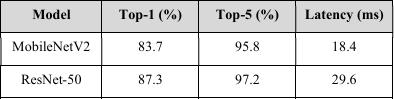
ResNet-50 achieves 87.3% Top-1 and 97.2% Top-5, confirming the advantage of its deeper residual feature hierarchy. MobileNetV2 at 83.7% offers a compelling accuracy-latency trade-off (18.4 ms, 37% faster than ResNet-50)andisthedefaultdeploymentmodel.
End-to-end platform response times averaged 1.23 s (MobileNetV2) and 1.87 s (ResNet-50) across 200 test requests.INDBtext-searchreturnedresultsinunder50ms inallcases.
2026, IRJET | Impact Factor value: 8.315 | ISO 9001:2008
| Page1523
International Research Journal of Engineering and Technology (IRJET) e-ISSN: 2395-0056
Volume: 13 Issue: 03 | Mar 2026 www.irjet.net p-ISSN: 2395-0072
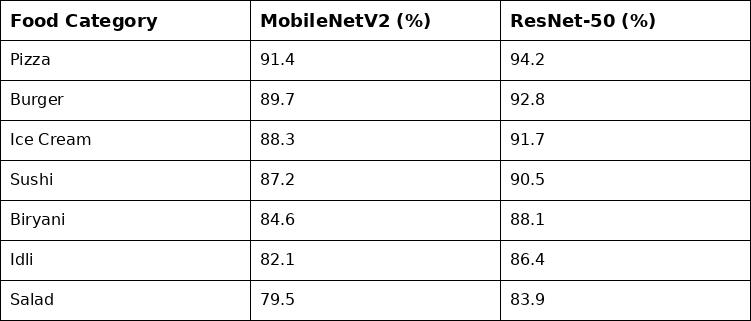
Visually distinctive categories (pizza, burger) consistently score above 89%, while heterogeneous categories (salad, biryani) score lower due to variable ingredient compositions and presentation styles, motivating future ingredient-levelanalysiswork.
Figure 5 shows the Scan Food Screen where users can capture or upload a food photograph for real-time imagebasedrecognition.TheinterfaceinitiatestheCNNinference pipeline, displaying the identified food item and its nutritionalbreakdownwithin2seconds.
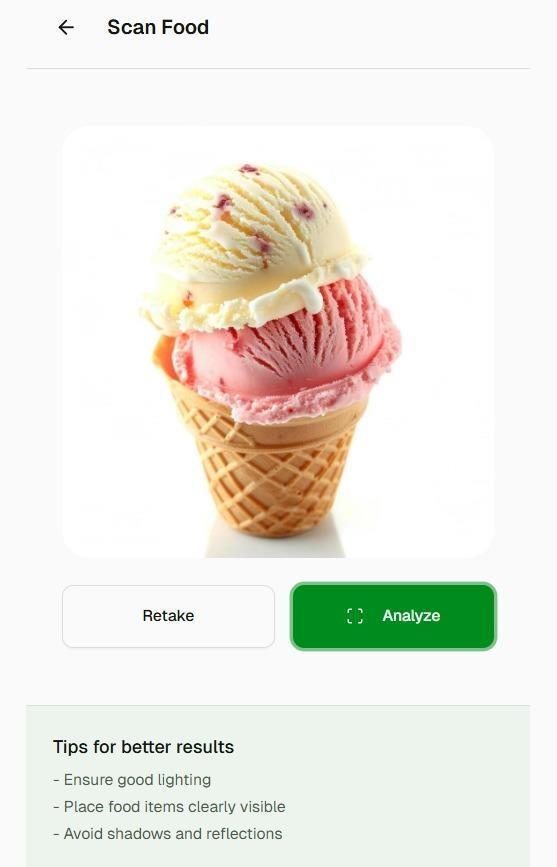
Fig. 5: ScanFoodScreen–ImageCaptureforFood Recognition
Figure 6 shows the food recognition output from the NutriVision platform after image processing. The result displays the identified food item along with its complete nutritional breakdown including calories, protein, carbohydrates, and fat per 100 g, along with the personalisedHealthSafetyCheckstatusfortheuser.
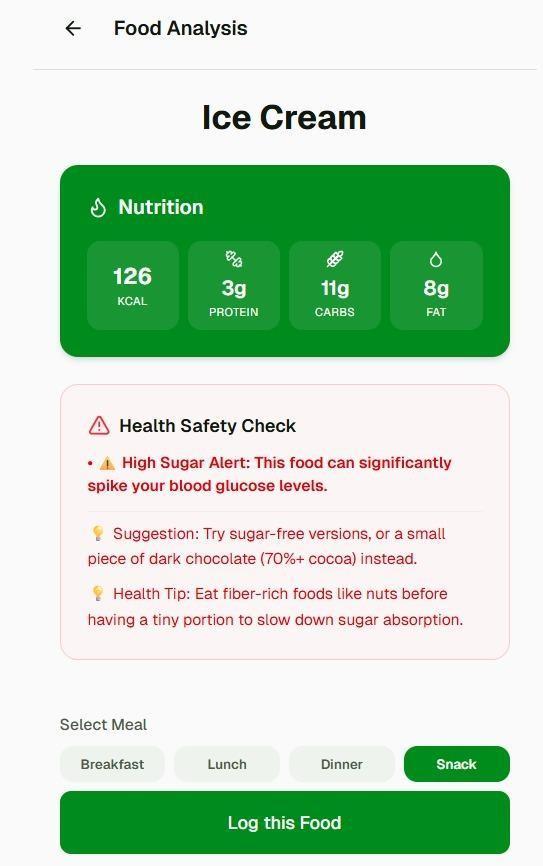
Fig. 6: FoodRecognitionOutput–NutritionalBreakdown andHealthSafetyCheck
NutriVision presents an advanced AI-based solution for food recognition and nutrition management. By combining deep learning models with nutritional databases, the system provides accurate and personalizeddietaryinsights.
The integration of real-time recognition, health monitoring, and user-friendly interfaces makes it a comprehensive platform for improving dietary habits. Future enhancements may include portion size estimation, multi-food detection, and mobile application deployment.
Overall, NutriVision demonstrates the potential of artificial intelligence in transforming healthcare and promotinghealthierlifestyles.
International Research Journal of Engineering and Technology (IRJET) e-ISSN: 2395-0056
Volume: 13 Issue: 03 | Mar 2026 www.irjet.net p-ISSN: 2395-0072
We would like to express our sincere gratitude to our faculty members and mentors for their continuous supportandguidancethroughoutthisproject.Wealso thank Malla Reddy University for providing the resources required for successful completion of this work.
1]N.Sharma,A.Gupta,andR.Singh,“AI-baseddietary assessmentandfoodloggingsystems:Acomprehensive review,” Journal of Nutrition Informatics, vol. 12, no. 3,pp.4562,2024.
[2] P. Kumar and S. Patel, “Personalized nutrition management using machine learning and wearable health data,” IEEE Access, vol. 12, pp. 11423–11439, 2024.
[3] V. Rao and M. Desai, “Indian Nutritional Database (INDB): Structure, coverage and integration with dietary assessment software,” Indian Journal of NutritionandDietetics,vol.61,no.1,pp.12–25,2024.
[4]M.Sandler,A.Howard,M.Zhu,A.Zhmoginov,andL. Chen, “MobileNetV2: Inverted residuals and linear bottlenecks,” in Proc. IEEE/CVF CVPR, pp. 4510–4520, 2018.
[5] K. He, X. Zhang, S. Ren, and J. Sun, “Deep residual learningforimagerecognition,”inProc.IEEECVPR,pp. 770–778,2016.
[6]A.PatelandS.Mehta,“Automateddietarymonitoring for elderly care using computer vision and IoT integration,”IEEEInternetofThingsJournal,vol.11,no. 4,pp.7234–7248,2024.
[7]G.Farinellaetal.,“Retrievalandclassificationoffood images,”ComputersinBiologyandMedicine,vol.77,pp. 2339,2016.
[8]T.RamachandranandV.Narayanan,“Full-stackweb application development for AI-powered health monitoring using FastAPI and React,” Int. J. Web EngineeringandTechnology,vol.19,no.2,pp.112–134, 2024.
[9] C. Liu et al., “DeepFood: Deep learning-based food image recognition for computer-aided dietary assessment,” in Proc. 14th Int. Conf. Computational Science,pp.37–48,2016.
[10]H.Hassannejadetal.,“Foodimagerecognitionusing very deep convolutional networks,” in Proc. 2nd Int.
Workshop Multimedia Assisted Dietary Management, pp.41–49,2016.
[11] G. Ciocca, P. Napoletano, and R. Schettini, “Food recognition: A new dataset, experiments, and results,” IEEEJ.BiomedicalandHealthInformatics,vol.21,no.3, pp.588–598,2017.
[12]S. Mezgec and B. Korousic Seljak, “NutriNet: A deep learning food and drink image recognition system for dietaryassessment,”Nutrients,vol.9,no.7,p.657,2017.
[13] N. Martinel, G. Foresti, and C. Micheloni, “Wide residual network for food recognition,” in Proc. IEEE Int. Conf.BigData,pp.3933–3936,2018.
[14] C. Panagiotakis, G. Tziritas, and P. Fragopoulou, “Multi scale feature fusion for fine-grained food recognition,”PatternRecognitionLetters,vol.168,pp.53–61,2023.
[15] L.Bossard,M.Guillaumin,andL.VanGool,“Food-101 –Miningdiscriminativecomponentswithrandomforests,” inProc.ECCV,pp.446–461,2014.
[16] X.Minetal.,“ISIAFood-500:Adatasetforlarge-scale food recognition via stacked global-local attention network,”inProc.ACMMM,pp.393–401,2023.
[17]A. Galoaa, K. Hamrouni, and S. Foufou, “Hybrid CNN Transformer model for real-time dietary assessment on mobile devices,” IEEE Trans. Neural Systems and Rehabilitation Engineering, vol. 32, pp. 1102–1114, 2024.
2026, IRJET | Impact Factor value: 8.315 | ISO 9001:2008 Certified Journal | Page1525