
International Research Journal of Engineering and Technology (IRJET) e-ISSN: 2395-0056
Volume: 13 Issue: 04 | Apr 2026 www.irjet.net p-ISSN: 2395-0072

International Research Journal of Engineering and Technology (IRJET) e-ISSN: 2395-0056
Volume: 13 Issue: 04 | Apr 2026 www.irjet.net p-ISSN: 2395-0072
P. Abhinav1 , A. Naga Srinivasa Rao2
1Pursuing Computer Science, Andhra Loyola Institute of Engineering and Technology, Vijayawada-12.
2 AssistantProfessor,Department ofAI-ML,Andhra LoyolaInstituteofEngineeringandTechnology,Vijayawada – 12
Abstract - Birdspeciesidentificationisanessentialtaskin biodiversity conservation, ecological monitoring, and environmentalresearch.Traditionalmethodsrelyonmanual observation and expert knowledge, which are timeconsuming,lessscalable,andpronetohumanerror.Withthe advancement of Artificial Intelligence, deep learning techniques have emerged as powerful tools for automating imageclassificationtasks.
This paper presents a novel EliteDenseNet-based deep learning approach for accurate bird species identification. The proposed system utilizes a Convolutional Neural Network (CNN) architecture to automatically extract meaningful features from input bird images and classify them into different species. The EliteDenseNet model enhances feature reuse, improves gradient flow, and increases classification efficiency compared to conventional CNNmodels.
The system is integrated with a Flask-based webapplication that enables users to upload images and receive predictions in real time. The workflow includes image preprocessing, feature extraction, and classification using a softmax-based output layer. The system also provides confidence scores for predictedresults,improvinginterpretability.
Key Words: Bird Species Identification, Deep Learning, Convolutional Neural Network (CNN), EliteDenseNet, Image Classification, Feature Extraction, Computer Vision, Biodiversity Monitoring, Real-Time Prediction
Bird species identification is an important task in biodiversity conservation, ecological monitoring, and environmental research. Birds serve as key indicators of ecological balance, and accurate identification of species helps researchers understand migration patterns, habitat changes, and ecosystem health. Traditionally, bird identification is performed manually by experts based on visual characteristics such as color, size, and shape. However, this process is time-consuming, requires specialized knowledge, and is not scalable for large datasets. With the rapid advancement of Artificial Intelligence (AI), particularly Deep Learning (DL), automated image classification systems have gained significant attention. Convolutional Neural Networks
(CNNs) have shown significant performance in image classification tasks [1] Convolutional Neural Networks (CNNs) have proven to be highly effective in extracting features from images and performing accurate classification. These models can automatically learn patternssuchasedges,textures,andshapes,makingthem suitable for complex image recognition tasks. The motivation of this project is to develop a novel EliteDenseNet-baseddeeplearningsystemforbirdspecies identification that can provide accurate and real-time predictions. Deep learning techniquesare widelyused for automatedvisualrecognitionsystems [10] Byintegrating themodelwithaweb-basedapplication,thesystemaimsto make bird identification accessible to researchers, students,andnatureenthusiasts.
Despite the advancements in deep learning and image classification, bird species identification remains a challengingproblemduetothelargenumberofspeciesand the similarity in their visual features. Traditional manual identification methods are not efficient for large-scale applications and may lead to errors due to human limitations. Existing automated systems either lack sufficientaccuracyorarenotdesignedforreal-timeusage. Additionally, many systems are not integrated with userfriendly interfaces, limiting their practical usability. Therefore,thereisaneedtodevelopareliableandefficient system that can automatically identify bird species from imagesusingdeeplearningtechniques.Thesystemshould becapableofhandlingimagevariations,providingaccurate predictions, and delivering results through a simple and interactiveinterface
The main objective of this project is to design and implement a deep learning-based system for bird species identification using the EliteDenseNet architecture. The specificobjectivesare:
1. To develop a CNN-based model for accurate bird speciesclassification.
2. To apply the EliteDenseNet architecture for improvedfeatureextractionandperformance.
3. To preprocess input images for better model accuracy.
International Research Journal of Engineering and Technology (IRJET) e-ISSN: 2395-0056
Volume: 13 Issue: 04 | Apr 2026 www.irjet.net p-ISSN: 2395-0072
4. To build a web-based application using Flask for real-timeprediction.
5. To evaluate system performance using standard metricssuchasaccuracy,precision,andrecall.
Thisprojectmakesthefollowingcontributions:
1. Development of a deep learning-based bird classificationsystem
2. Implementation of EliteDenseNet architecture for improvedperformance
3. Integration of Flask web application for real-time prediction
4. Designofa user-friendlyinterface forimage upload andresultdisplay
5. Demonstrationofascalableandpracticalsolutionfor birdspeciesidentification.
2.1
In recent years, deep learning has significantly improved the performance of image classification systems. ConvolutionalNeuralNetworks(CNNs)arewidelyusedfor extracting features from images due to their ability to automatically learn hierarchical representations. CNN models can identify patterns such as edges, textures, and shapes,makingthemhighlyeffectiveforvisualrecognition tasks.Severalarchitectureshavebeenproposedtoenhance classification accuracy. VGGNet introduced deeper architecturesforimageclassification[1].Earlymodelslike VGGNet introduced deeper networks with multiple convolutional layers, improving performance but increasing computational complexity. Later, ResNet introduced skip connections to address the vanishing gradient problem, enabling the training of very deep networks. ResNet solved the vanishing gradient problem using skip connections [2]. DenseNet improved feature reuse and model efficiency [3]. Transfer learning techniques help improve performance with limited data [7].
DenseNet (Dense Convolutional Network) is an advanced deep learning architecture [3] that connects each layer to every other layer in a feed-forward manner. This design allows efficient feature reuse, reduces redundancy, and improves gradient flow during training. DenseNet has demonstrated superior performance compared to traditional CNN architectures [3] in various image classification tasks. The concept of feature reuse in DenseNet helps in reducing the number of parameters whilemaintaininghighaccuracy.Thismakesitsuitablefor applications where computational efficiency and performancearebothimportant.
Severalresearchershaveapplieddeeplearningtechniques forbirdspeciesclassification.MostsystemsuseCNN-based models along with transfer learning techniques [7] to improveaccuracy.Transferlearningallowstheuseofpretrained models, reducing training time and improving performance, especially when datasets are limited. However, many existing bird classification [7] systems focus mainly on accuracy and do not provide real-time usability. They often lack user-friendly interfaces and are not integrated into web-based applications, limiting their practicaluse.
Despite the advancements in deep learning, existing systemshaveseverallimitations:
1. Highcomputationalrequirements
2. Lackofreal-timepredictioncapability
3. Limiteddatasetavailability
4. Absenceofuser-friendlyinterfaces
5. Difficulty in handling image variations These limitations highlight the need for an improved system that is both accurate and practically deployable.
To overcome the limitations of existing systems, this project proposes a novel EliteDenseNet-based deep learning approach for bird species identification. The proposed system leverages the advantages of DenseNet architecture [3] for efficient feature extraction and improvedclassificationperformance.
Additionally, the system is integrated with a Flask-based web application to provide real-time predictions and enhance usability. This combination of deep learning and webdeploymentmakesthesystemmorepractical[10]and accessible.
3.1
The proposed system focuses on developing a novel EliteDenseNet-baseddeeplearningmodel [3]foraccurate bird species identification. The system integrates image processing, feature extraction, and classification techniqueswithaweb-basedinterfacetoprovidereal-time predictions. The overall workflow of the system includes imageacquisition,preprocessing,featureextractionusinga CNN model [1], and classification of bird species. The system is designed to be user-friendly and efficient, allowing users to upload images and obtain results instantly.
International Research Journal of Engineering and Technology (IRJET) e-ISSN: 2395-0056
Volume: 13 Issue: 04 | Apr 2026 www.irjet.net p-ISSN: 2395-0072
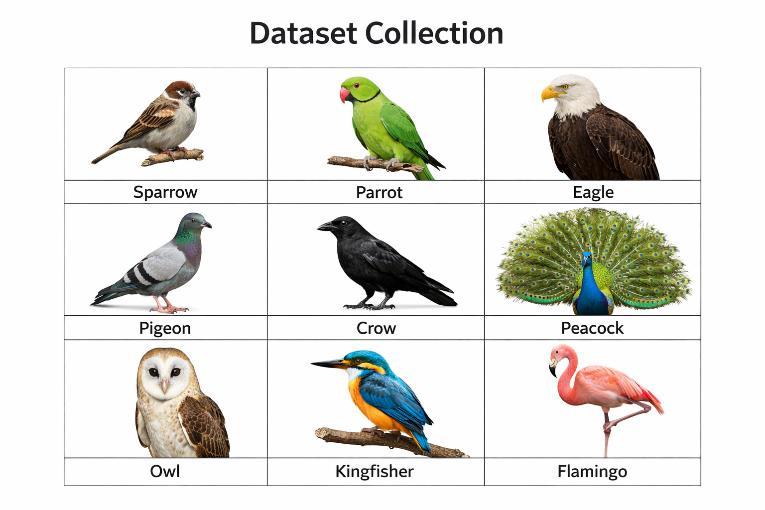
The dataset used in this project consists of images of differentbirdspeciescollectedfromstandarddatasets [8] and online sources. The dataset includes multiple classes such as sparrow, parrot, eagle, pigeon, and crow. Before feedingtheimagesintothemodel,preprocessingstepsare applied to ensure consistency [14] and improve model performance.Thesestepsinclude:
•Resizingimagestoafixedresolution(224×224pixels)
•Normalizingpixelvaluestoastandardrange(0to1)
•Convertingimagesintonumericalarrays
•Applyingbasicaugmentationtechniquessuchasrotation andflipping
Thesepreprocessingtechniqueshelpinreducingnoiseand improvingthegeneralizationcapabilityofthemode
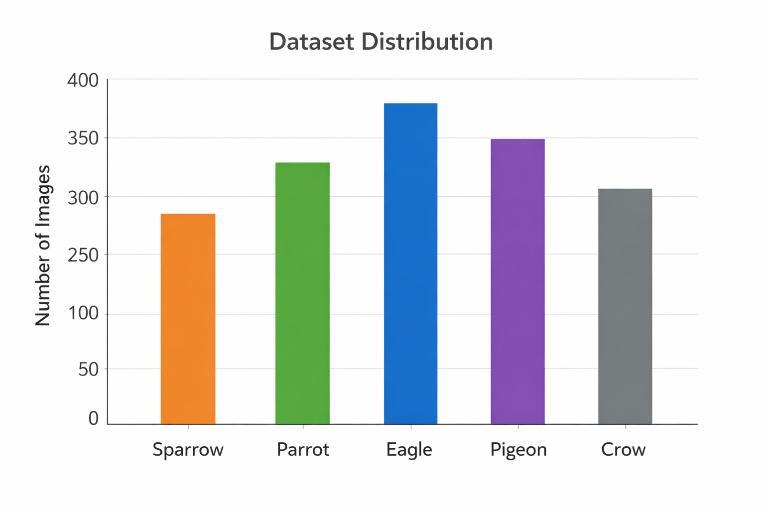
Thisbargraphrepresentsthenumberofimagesavailable foreachbirdspecies.Arelativelybalanceddatasethelpsin improvingclassificationperformanceandreducingbias.
TheproposedsystemusesaConvolutionalNeuralNetwork (CNN) based on the EliteDenseNet architecture.[3] DenseNet connects each layer [3] to every other layer, enabling efficient feature reuse and improving gradient flow.Thearchitectureconsistsof:
•Convolutionallayersforfeatureextraction
•Denseblocksforfeaturereuse
•Poolinglayersfordimensionalityreduction
•Fullyconnectedlayersforclassification
•Softmaxactivationfunctionforprobabilityoutput
This architecture improves classification accuracy while reducingredundancyinfeaturelearning.
The model is trained using labeled bird image data. The trainingprocessinvolves:
•Splittingthedatasetintotrainingandtestingsets
•UsinganoptimizersuchasAdam[7]forweightupdates
•Applyingcategoricalcross-entropyasthelossfunction[7]
•Trainingthemodelovermultipleepochs
Performance metrics such as accuracy, precision, recall, and F1-score [7] are used to evaluate the model's performance.
The system is implemented as a web-based application using the Flask framework. [12] The implementation includes:
•FrontenddevelopedusingHTMLandCSS
•BackenddevelopedusingPythonandFlask
•Integrationofthetrainedmodelwiththebackend
Theuseruploadsanimagethroughthewebinterface,and the backend processes the image and generates predictions.Theresultisdisplayedalongwithaconfidence score.
Thecompleteworkflowofthesystemisasfollows:
•Useruploadsabirdimagethroughthewebinterface
•TheimageissenttotheFlaskbackend
•Preprocessingisappliedtotheinputimage
•TheprocessedimageispassedtotheCNNmodel
•Themodelpredictsthebirdspecies
•Theresultisdisplayedtotheuser
International Research Journal of Engineering and Technology (IRJET) e-ISSN: 2395-0056
Volume: 13 Issue: 04 | Apr 2026 www.irjet.net p-ISSN: 2395-0072
4.1 Overview
Performanceevaluationisanimportantaspectofanydeep learning-based classification system [7]. It helps in analyzing how effectively the model predicts the correct birdspecies.Inthisproject,standardevaluationmetricsare used [7] to measure the performance of the proposed EliteDenseNet-basedmodel.
4.2 Accuracy
Accuracyisthemostcommonlyusedmetricforevaluating classificationmodels.[7]Itrepresentstheratioofcorrectly predicted instances to the total number of instances.
Formula: Accuracy = (Correct Predictions / Total Predictions)×100
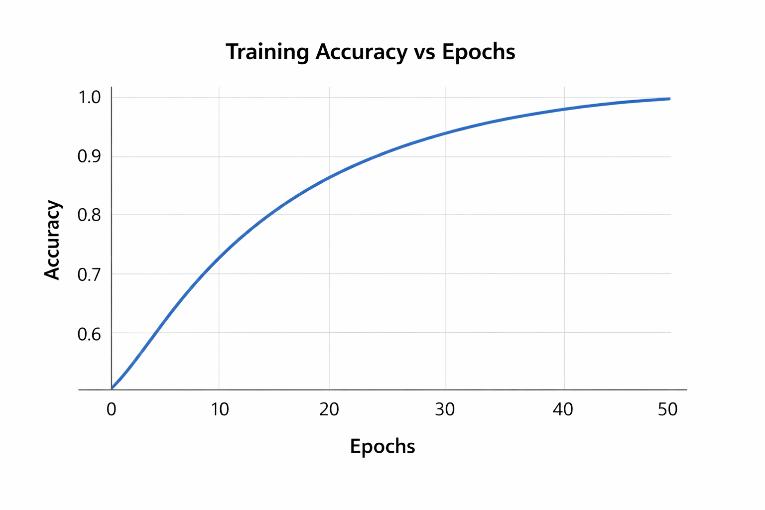
A higher accuracy indicates better model performance. In this system, accuracy improves as the model learns from trainingdata.
4.3 Precision
Precision measures how many of the predicted positive instancesareactuallycorrect.[7]Itisusefulwhenthecost offalsepositivesishigh.
Formula: Precision = TP / (TP + FP) Where: TP = True PositivesFP=FalsePositives
4.4 Recall
Recall measures the ability of the model to identify all relevant instances [7] It is important when a correct predictioniscostly.
Formula: Recall = TP / (TP + FN) Where: FN = False Negatives
4.5 F1-Score
F1-Scoreistheharmonicmeanofprecisionandrecall[7].It providesabalancebetweenbothmetrics.
Formula: F1Score=2×(Precision×Recall)/(Precision+ Recall)
7. Performance Summary Table
7.1 Discussion
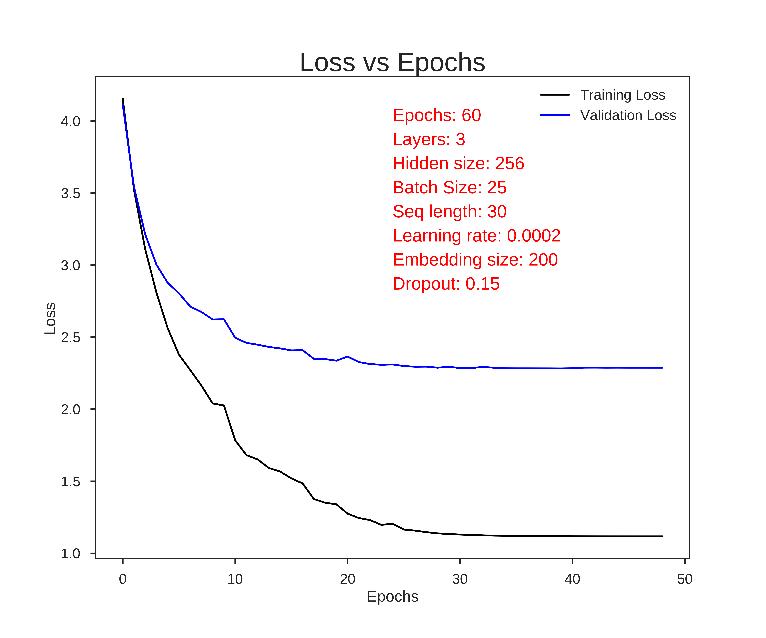
The evaluation results indicate that the proposed EliteDenseNet-based model performs effectively in bird species classification. The increasing accuracy and decreasing loss demonstrate that the model is learning
International Research Journal of Engineering and Technology (IRJET) e-ISSN: 2395-0056
Volume: 13 Issue: 04 | Apr 2026 www.irjet.net p-ISSN: 2395-0072
efficiently.Althoughtheresultsarepreliminary,thesystem shows strong potential for real-time bird identification. Furtherimprovementsindatasetsizeandmodeltuningcan enhanceperformance.
8.1
This research presented the development of a novel EliteDenseNet-baseddeeplearningsystem[3]foraccurate birdspeciesidentification.Theproposedsystemintegrates image preprocessing, feature extraction,andclassification techniques to automate the process of identifying bird species from input images. The system combines deep learning-based feature extraction [10] with a web-based interface to provide real-time predictions. By leveraging theEliteDenseNetarchitecture,themodelefficientlyreuses features and improves classification performance compared to traditional CNN models. The experimental resultsdemonstrate that the proposedapproach provides consistent and reliable classification performance. Performance evaluation using accuracy, precision, recall, and F1-score [7] indicates that the model is capable of learning meaningful features from bird images and producing accurate predictions. Another key contribution of this work is the development of a user-friendly Flaskbased web application [12] that allows users to upload images and obtain predictions instantly. This integration bridgesthegapbetweentheoreticaldeeplearningmodels andpracticalreal-worldapplications.Overall,theproposed system demonstrates the effectiveness of combining deep learning with web technologies to build a scalable and efficientsolutionforautomatedbirdspeciesidentification.
8.2
Although the proposed bird species identification system showspromisingresults,severallimitationsexist.First,the performanceofthesystemdependsheavilyonthequality andsizeofthedataset.Limitedorimbalanceddatasetsmay affect the accuracy of predictions. Second, the model may face difficulty in distinguishing bird species with very similar visual features, such as color and shape. In such cases, the classification accuracy may decrease. Additionally, the current system is based on static image input and does not support real-time video or live detection. Variations in lighting conditions, background noise, and image quality can also impact the model’s performance.Furthermore, the systemcurrentlyprovides preliminarypredictions,andfullmodeloptimizationisstill in progress. Addressing these limitations is essential to improvethereliabilityandrobustnessofthesystem.
8.3
Future work can enhance the proposed system in several ways.Oneimportantimprovementistheexpansionofthe datasetwithalargernumberofbirdspeciesandimagesto improve model accuracy and generalization [7]. Another
potentialenhancementistheintegrationofreal-timevideo processing, enabling the system to identify bird species fromlivecamerainput.Thiswouldmakethesystemmore practical for real-world applications such as wildlife monitoring. Additionally, the system can be extended to supportmobileapplications,allowinguserstoidentifybird species using smartphones. Advanced deep learning architecturessuchasEfficientNet[6]canalsobeexplored to further improve performance. Incorporating cloudbased deployment and API integration can enhance scalabilityandaccessibility.Futureresearchmayalsofocus on improving robustness against variations in lighting, background, and image quality. By exploring these directions, the system can be further developed into a powerful and practical tool for ecological research, environmentalmonitoring,andeducationalpurposes.
• K. Simonyan and A. Zisserman, “Very Deep Convolutional Networks for Large-Scale Image Recognition,” International Conference on LearningRepresentations(ICLR),2015.
• K.He, X.Zhang, S.Ren,and J.Sun,“DeepResidual Learning for Image Recognition,” Proceedings of the IEEE Conference on Computer Vision and PatternRecognition(CVPR),pp.770–778,2016.
• G. Huang, Z. Liu, L. Van Der Maaten, and K. Q. Weinberger, “Densely Connected Convolutional Networks,”ProceedingsoftheIEEEConferenceon ComputerVisionandPatternRecognition(CVPR), pp.4700–4708,2017.
• Krizhevsky,I.Sutskever,andG.Hinton,“ImageNet Classification with Deep Convolutional Neural Networks,” Advances in Neural Information ProcessingSystems(NeurIPS),2012.
• Szegedy et al., “Going Deeper with Convolutions,” Proceedings of the IEEEConference on Computer VisionandPatternRecognition(CVPR),2015.
• M.TanandQ.Le,“EfficientNet:RethinkingModel Scaling for Convolutional Neural Networks,” International Conference on Machine Learning (ICML),2019.
• T. Chen et al., “Deep Learning for Image Classification: A Survey,” IEEE Transactions on NeuralNetworksandLearningSystems,2019.
• J.Dengetal.,“ImageNet:ALarge-ScaleHierarchical Image Database,” IEEE Conference on Computer VisionandPatternRecognition(CVPR),2009.
• F. Chollet, “Deep Learning with Python,” Manning Publications,2017.oGoodfellow,Y.Bengio,andA. Courville,“DeepLearning,”MITPress,2016.