
International Research Journal of Engineering and Technology (IRJET) e-ISSN: 2395-0056
Volume: 12 Issue: 05 | May 2025 www.irjet.net p-ISSN: 2395-0072
International Research Journal of Engineering and Technology (IRJET) e-ISSN: 2395-0056
Volume: 12 Issue: 05 | May 2025 www.irjet.net p-ISSN: 2395-0072
Pushkar Chavan1 , Prof. Vishwajeet Kadlag2
1 P.G. Student, Ajeenkya DY Patil School of Engineering, Lohegaon, Pune, Maharashtra, India
2 Professor, Dept. of Structural Engineering, Ajeenkya DY Patil School of Engineering, Lohegaon, Pune, Maharashtra, India
Abstract - Pushoveranalysis,alsoknownasnonlinearstatic analysis, is a widely used method for assessing the seismic performance of structures. This study applies pushover analysis to evaluate a G+10 multistoried building under different mostseverseismiczoneusing ETABS21.2.0software The results evaluate the behavior of the structure in terms of the maximum displacement corresponding to the base shear. Additionally, the research examines the influence of SoilStructure Interaction (SSI) on the seismic performance of the building, comparing models of various geometry with and without SSI considerations. The symmetric-plan reinforced concrete (RC) building is designed following IS 456:2000 guidelines and analyzed using ETABS21.2.0 software under two boundary conditions: fixed-base and nonlinear static pushover analysis accounting for soil-structure interaction.
Key Words: RC frame, Soil Structure Interaction (SSI), Pushover analysis, Soil type, Support Conditions, Plastic Hinges,PerformancePoint.
1.INTRODUCTION
An effectively engineered structure must exhibit four key qualities:straightforwardandorganicdesign,stronglateral stability,amplestiffness,andsufficientductility.
Buildings with a standard, straightforward configuration tend to sustain less damage in both design and elevation comparedtothosewithirregularconfigurations.According to IS 1893-2016, a construction project is considered irregular when it lacks uniformity in configuration, mass distribution, or capacity-resistant elements. Such irregularities can disrupt the continuity of force flow and stressconcentrations.
This study primarily aims to assess how a structure respondsundervariousexternalinfluences.Theseinfluences includegustorwindpressure,vibrations,trafficmovement, blasts,andseismicactivity.Anydesigncanbesubjectedto unpredictable loads, making structural configuration a critical factor in determining a building’s overall performance.Inthecaseofsevereearthquakes,structural imbalance can result in excessive lateral loading, overwhelming the building’s capacity and leading to significantdamage
Soil-Structure Interaction (SSI) describes how a structure anditsfoundationsoilinfluenceeachotherunderexternal
forces,particularlylateralloadslikeearthquakes.Thesoil’s flexibilityaffectsdisplacement,stability,andinternalforces, making this interaction crucial in soft or layered soil conditions.
PushoverAnalysisisanonlinearstaticapproachofdesigned to find out a structure's behavior under lateral loading conditions. By gradually applying increasing loads, the analysis tracks deformation and the formation of plastic hinges, offering insights into structural behavior during seismicevents.
Soil-StructureInteraction(SSI)referstotheprocessinwhich seismic activity affects both the underground soil and the structureaboveit,creatingamutualinfluence.Astheground moves, the structure’s response alters the soil movement, leadingtoadynamicrelationshipbetweenthetwo.WhileSSI hasanegligibleimpactonrigidsoilandlow-risestructures, itbecomesacrucialfactorindesignsinvolvingsoftsoil,highrise buildings, roadways, heavy structures, nuclear power plants,andhydraulicsystems.
This simplified approach may be suitable for certain structuresandsoiltypes,suchaslightweightbuildingson relativelyfirmground.However,thisassumptiondoesnot always hold. Ignoring SSI in structural analysis can negatively influence stability and lead to unsafe designs, affectingboththesuperstructureandthefoundation.
Jonathan P. Stewart (1) Outlinedapproachestoassessthe influence of inertial soil-structure interaction (SSI) on the seismic behavior of structures. Their approach builds on existingbuildingcodeprovisions,offeringimprovementsby includingtheeffectsoffoundationembedding,flexibility,and shape on site conditions and foundation impedance. Using data from buildings impacted by the 1994 Northridge earthquake,theauthorsdemonstratedtheaccuracyoftheir methodsinpredictingSSIeffects.
Thestudyinvolvedtwoprimaryanalyses:
1. Asimplifieddesignapproachtopredicttheperiod extensionratioandfoundationdampingcoefficients forstructureswithsurface(MV)orembedded(MV orMB)foundations.
2. A system identification method to determine the modalvibrationparametersofstructureswithfixed andflexiblebasesusingstrongseismicmotiondata.
International Research Journal of Engineering and Technology (IRJET) e-ISSN: 2395-0056
Volume: 12 Issue: 05 | May 2025 www.irjet.net p-ISSN: 2395-0072
Uncertainties in applying MV and MB methods arise from factorssuchasimpedancefunctionevaluations,shearwave velocity profiling, and limitations in modeling embedded foundations especially when basement walls are discontinuous. Features like oval-shaped foundations or flexible support for rigid shear walls also require careful consideration. Despite challenges with disturbances in seismic data and numerical inaccuracies, the parametric systemidentificationprocessoffersareliableframeworkfor evaluatingmodalvibrationparameters,providednonlinear structuralresponsesareappropriatelycharacterized. Mathew et al. [2] conducted an analysis of a nine-story reinforcedconcrete(RC)buildingwithanasymmetricalplan, located in seismic zone III, using SAP2000. Author has performednonlinearstaticpushoveranalysistounderstand thebehaviorofbuildingrestingonnon-cohesivesoilsuchas softsoilandrockundertheimpactofSSI.Thepropertiesfor thesesoiltypesweredefinedaccordingtoATC40standards. The study compared three scenarios: a fixed base without considering soil-structure interaction, a flexible base incorporatingSSIintohardsoilconditions,andaflexiblebase incorporatingSSIinsoftsoilconditions.AsperRichartand Lysmer model spring constant and corresponding displacementvaluefordifferentsoilstratawerecompared.
Ghandil and Behnamfar [3] exploredthedirectmethodof soil-structure interaction (SSI) analysis by performing dynamicnon-lineartimehistoryanalysisusingearthquake records.Theyassessedstructuralresponsesunderdifferent soil behavior assumptions, including elasto-plastic, Mohr–Coulomb,equivalentlinear,andanewlyproposedmodified equivalentlinearapproach.Theirstudyexaminedsix3Dsteel buildings,rangingfrom5to30storiesinheight,allmodeled usingSAP2000software. Theyevaluated maximumlateral story displacements and maximum story shear values for eachbuilding,bothwithandwithoutSSI,todetermine the impactofsoilbehavioronstructuralperformance.
1. To prepare the Etabs models and perform Nonlinearstaticpushoveranalysisforvarious geometriesofthebuildingviz.viz.rectangular shape,L-shaped,CShape,IShape.
2. Toevaluatethebaseshearandcorresponding displacementofthestructure.
3. To find out the performance point and correspondingshearforce.
4. To compare seismic performance with and without consideration of the soil structure interactionprocess.
5. Tofindoutthebestshapeofthebuildingwhich shows good seismic performance with and withoutsoilstructureinteractions.
6. To find and state the reason for the structure showsthepoorbehaviorseismicperformance.
Pushover Analysis is a nonlinear static approach used to evaluateastructure’sbehaviorunderlateralforcessuchas earthquakes. By incrementally applying lateral loads, the method identifies yielding points, the formation of plastic hinges, and the structure’s response in the inelastic range, helpingassesspotentialcollapsemechanisms. Thecapacitycurvegeneratedfromthisanalysisplotsbase shearagainstroofdisplacement,illustratinghowstructural componentsyieldandformplastichingeswhiledetermining thestructure’sultimatecapacity.IntegratingthiswithSoilStructureInteraction(SSI)enhancestheaccuracyofseismic evaluations,leadingtosaferdesigns,particularlyforhigh-rise RCCbuildingsinvaryingsoilconditions.Thecoreconceptof PushoverAnalysisisgovernedbythefollowingequation.
[K]⋅{Δ}+{P}NL={F}
Where:
• [K]:Tangentstiffnessmatrix(updatedasstructure yields)
• {Δ}:Displacementvector
• {P}NL: Nonlinear internal force vector (due to plasticity)
• {F}:Appliedexternallateralforcevector
In this study, a seismic analysis is performed on a G+10 reinforcedconcrete moment-resistingbuildingframe.The variousgeometryconsideredforthestudyviz.rectangular shape, L-shaped, C Shape, IShape layout with square grid dimension,thetotalheightconsideredof30mfromground level.Theplinthlevelisconsideredat3mabovethebase, witheachfloormaintainingauniformheightof3m.
Four different support conditions are considered in the study:
1. Building with a infinite rigidity (Restraint against bothrotation&translationinX,Y&Zdirection)
2. Buildingonhardsoilbasecondition.
3. Buildingonmediumsoilbasecondition
4. Buildingonsoftsoilbasecondition.
ETABS21.2.0isusedtocreate&analyzea3Dmodelofa10story reinforced concrete (RC) structure. Beams and columnsarerepresentedasbeamelements,eachhavingsix degreesoffreedomattheirnodes.Theslabfunctionsshellas a rigid diaphragm, distributing horizontal forces to the columns.Steelismodeledusingbarelements,whileconcrete is represented as beam elements, with perfect bonding assumedbetweenmaterials.Thelineelementsincorporate materialgradesofM30forconcreteandFe500forsteel.
Table -1: RCCsectionpropertiesofallstructuralmembers
COLUMNS BEAMS SLABS C:700X700M-30 B:300X600-M30 S:125M-30
International Research Journal of Engineering and Technology (IRJET) e-ISSN: 2395-0056
Volume: 12 Issue: 05 | May 2025 www.irjet.net p-ISSN: 2395-0072
All the structures of various geometries are modeled and analyzedbyconsideringthemostsevereearthquakezonei.e. zone V and zone factors consider Z=0.36. The response reduction factor considered for the analysis as R=5 by consideringallthebeamsandcolumnsasductile.Thesoil type is considered type-I for fixed support condition and hardsoilcondition,soiltype-IIconsideredformediumsoil condition,soiltypeIIIconsideredformediumsoilcondition. The earthquake staticloadcasesviz.EQXin Xdirection & EQYinYdirectionsareassignedinmodeled.ThePushYinY directions are assigned in modeled. The mass source has been defined as factor 1 for dead load and factor of 0.25 taken for the lived load since the live load assigns for the structureas2knpersq.m.Also,thedeadloadconsideredas 1.5knpersq.masfloorfinish.Thestaticnonlineargravity definedforthepushoveranalysiswithfullloadcondition. Thehingesforthecolumnsandbeamsareassignedatboth the ends of the respective columns and beams at 100mm fromachend.
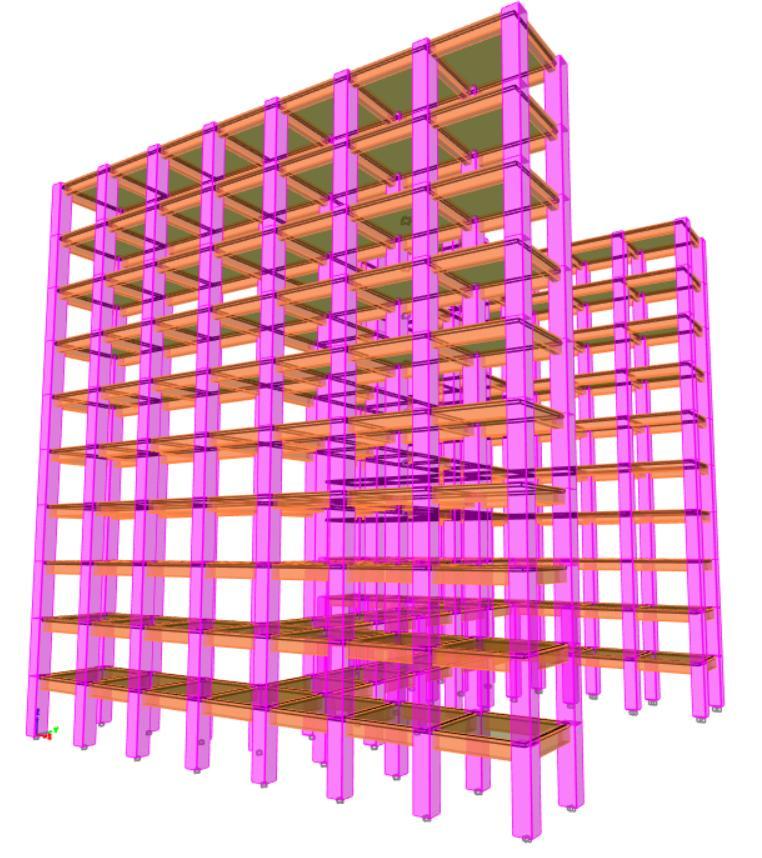
Inafixed-basescenario,thecoordinatepointsindicatethe placement of columns according to the base layout of the structure.Allthesepointsareconstrainedinsixdegreesof freedom:threetranslational(ux,uy,uz)andthreerotational (rx, ry, rz). This ensures that neither linear nor rotational displacementsoccur,maintainingcompletestability.
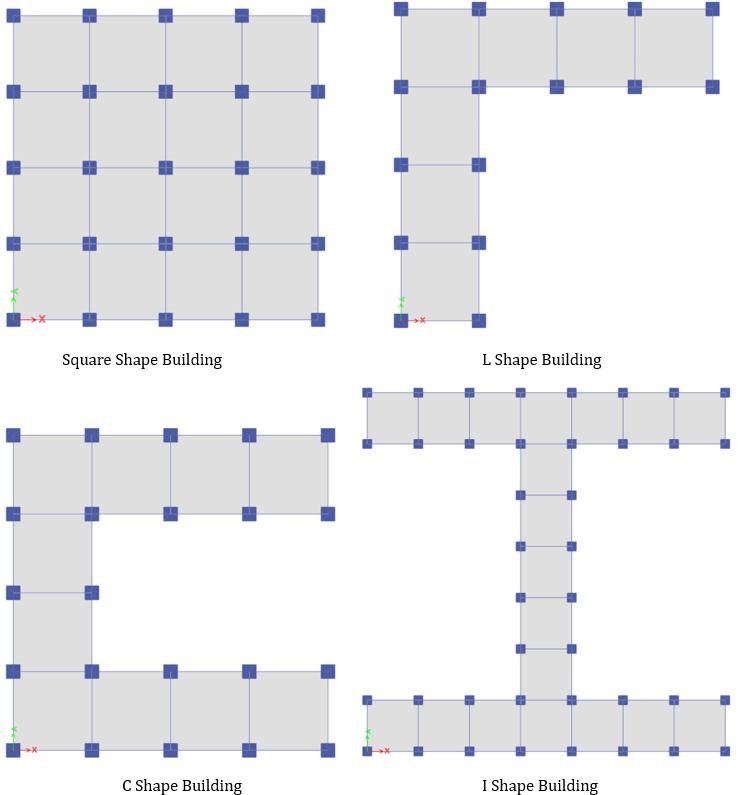
TheabovesnapshowsthedifferenceshapemodeledInthe Etabssoftware.Thesquarebuildingshowssymmetryfrom allfoursidesofthebuildingandtheIshapebuildingshows thesymmetryaboutthehorizontalaswellasverticalaxisof the plan. However, the L and C shape building shows the unsymmetricandshowsonere-entrantcornerintheLshape buildingwhereastheCshapebuildingshowsthe2re-entrant cornerinthesamebuilding.Thecentroidofthebuildingof every shape has different location in the plan which may further cause variation of the load distribution in the structureandprovidethedifferentstructuralbehavior.
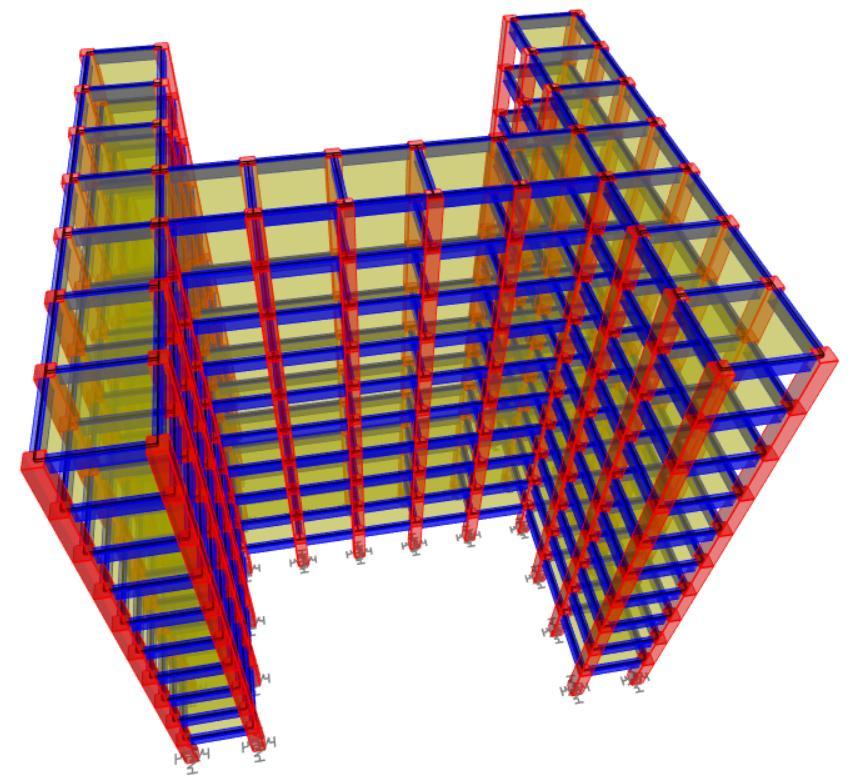
RenderedviewofETABSModelwithDifferent SoilBaseSupportCondition(Hard,Medium&Soft).
This involves modeling a building on a raft foundation to simulate the effects of Soil Structure Interaction (SSI) for
International Research Journal of Engineering and Technology (IRJET) e-ISSN: 2395-0056
Volume: 12 Issue: 05 | May 2025 www.irjet.net p-ISSN: 2395-0072
various soil types-soft, medium, and hard. The process includes:
• Utilizing a building model with its foundation as depictedinFigure3.
• Table2showsthepropertiesofsoilstrata.
• Meshingtheentireareausingquadshellelements andapplyingasoillayertocapturetheinteraction betweenthefoundationandthesoil.
Suchsimulationsareessentialforanalyzinghowdifferent soil conditions influence the stability and behavior of structures.
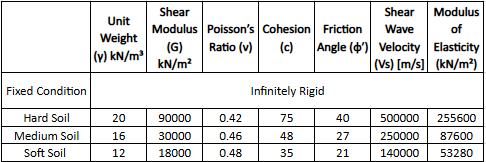
Table -2: SoilLayerProperties
Inthisstudy,LinearstaticandNonlinearStatic(pushover Analysis) is performed to understand the behavior of the structureunderdifferentsoilconditions.Inthisresearchthe hingeformationpatternforthishasbeenstudiedandbased onthatthebehaviorofhingesareasfollows,
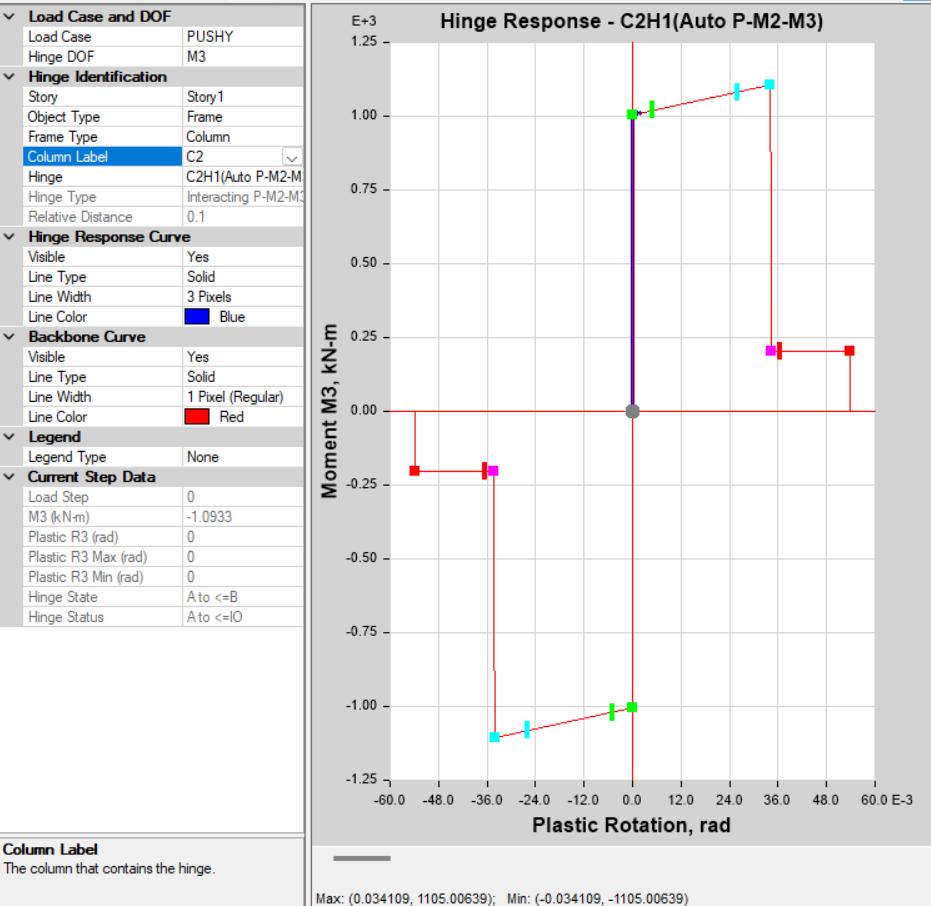
Fig -3:ShowsHingeformationdetails
ThemajorityofhingeshaveformedwithintheIO-LSrange, indicatingminorstructuraldamageandaninsignificantrisk to life. While some structural elements have experienced notabledamage,theyretainresidualstrength,ensuringalow howeverfortheunsymmetricalbuildinghingesinthreatto
occupants.
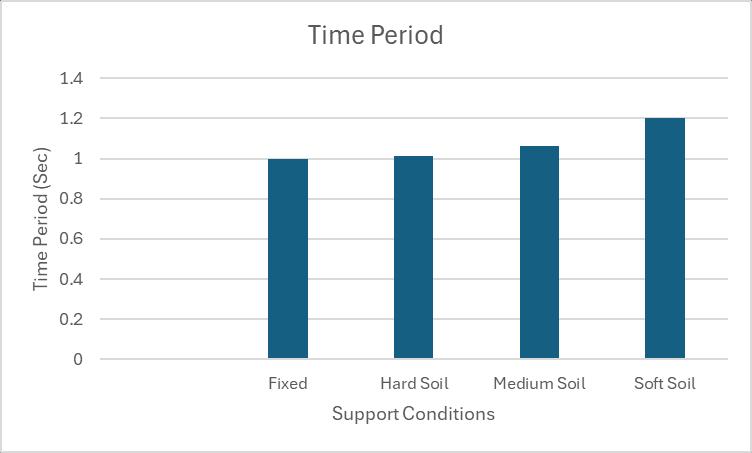
Chart-1:Chartshowscomparisonoftimeforvariousbase supportconditions
Theabovegraphshowstheimpactofsoilconditiononthe timeperiodforstructure,alsoitisnoticedthat,forsoftsoil condition’s structure behaves more flexible compared to othersoilstrata.Thesamebehaviorwasobservedunderthe roofdisplacementcriteria.
Belowgraphshowstherelationbetweenthedisplacement andbaseshearforfixedbasedcondition,hard,mediumand softsoilcondition.Also,itisobservedthatdisplacementis maximumincaseofsoftsoilcomparedtoothersoilstrata, while the base shear is also found maximum in the same case.
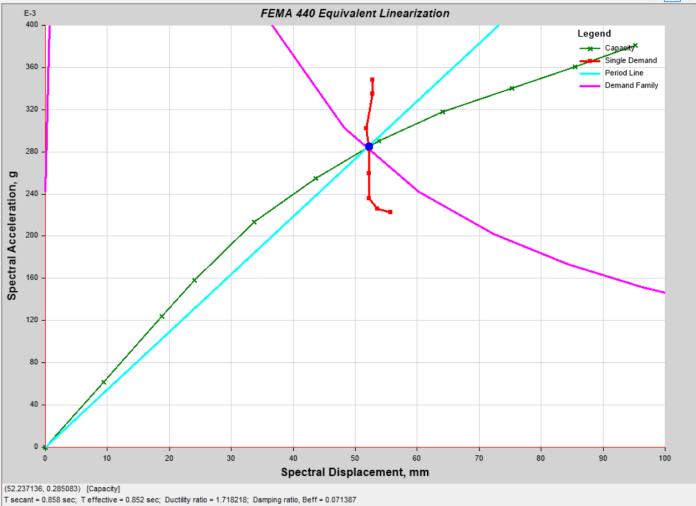
Fig -4:ShowsPerformancepointlocation
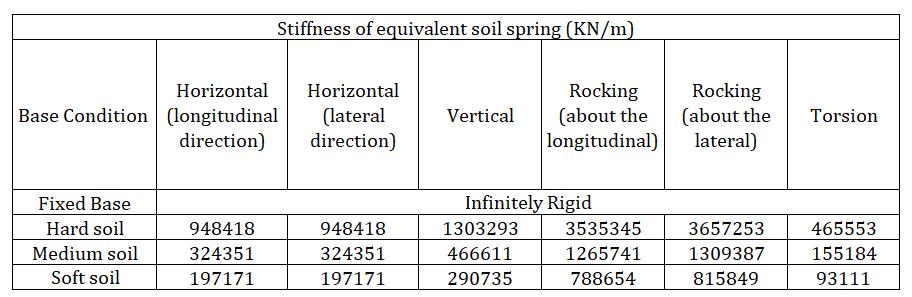
Table -3: ShowsStiffnessequivalentsoilspring.
International Research Journal of Engineering and Technology (IRJET) e-ISSN: 2395-0056
Volume: 12 Issue: 05 | May 2025 www.irjet.net p-ISSN: 2395-0072
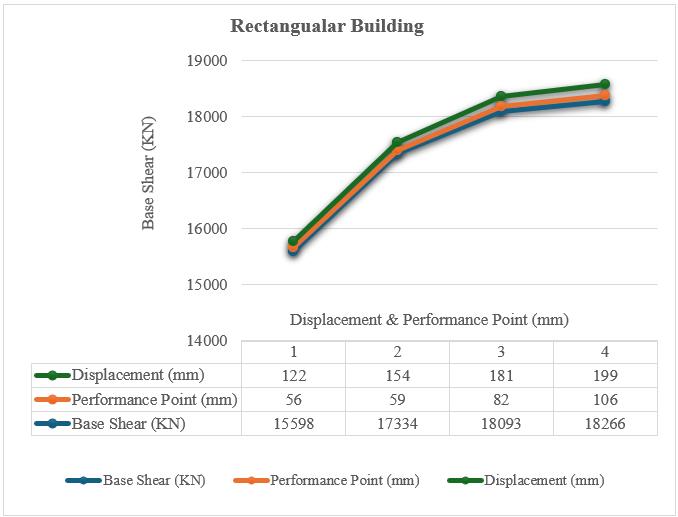
2: Chart shows the relation of base shear vs displacement&performancepointforRectangularBuilding.
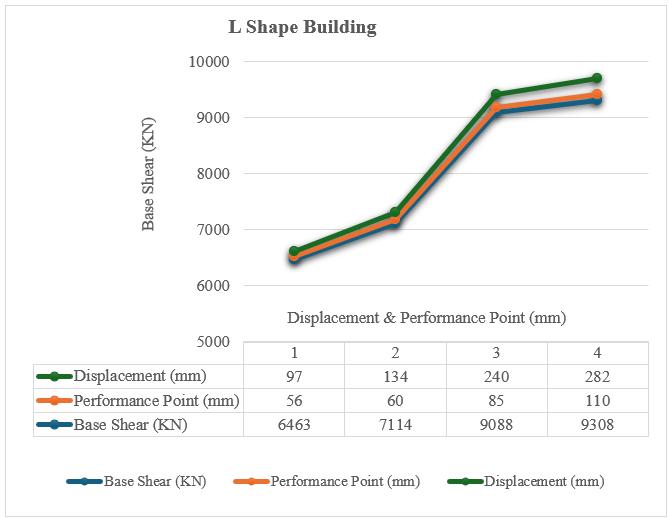
3:Chartshowstherelationofbaseshearvs displacement&performancepointforLShapeBuilding.
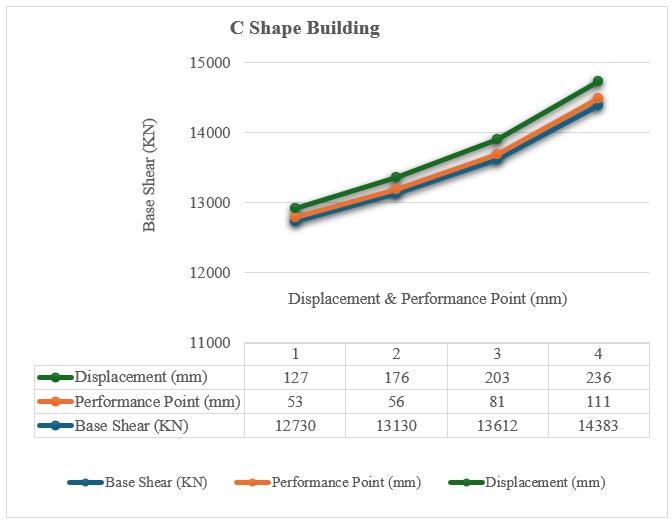
Chart 3: Chart shows the relation of base shear vs displacement&performancepointforCShapeBuilding.
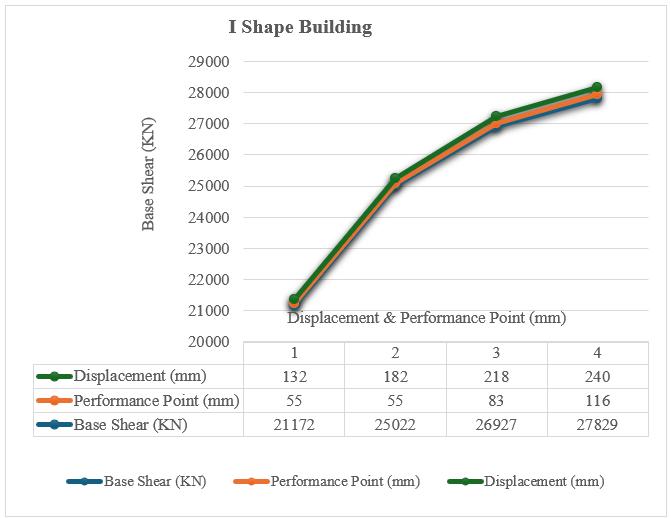
Chart 3: Chart shows the relation of base shear vs displacement&performancepointforIShapeBuilding.
1. Thepercentagedifferenceofdisplacementbetween hardsoilandmediumsoilofsquareshapebuilding &SymmetricalIshapebuildingis15%.Whereasfor Lshapebuildingis44%.
2. Thepercentagedifferenceofdisplacementbetween mediumsoilandsoftsoilofsquareshapebuilding& SymmetricalIshapebuildingis9%.WhereasforL shapebuildingis15%.
3. Hencefromobservationmentionedinpoint-1&2of conclusion, it observes that there is large displacementoccursinunsymmetricalbuildingsas comparedtosymmetricalorsquareshapebuilding.
4. In L Shape Building for Hard soil, Greater the momentofinertialeadsmorewillbethestiffnessof the structure and lesser will be the displacement hence even if the lesser value of base shear for L shape building causing the higher value of displacement is just because of the moment of inertia is lesser of L shape building as compared withothershapebuildingvizRectangular,Cshape,I shapebuilding
5. In L shape building in hard soil, the value of the displacement is less as compare with the l shape buildinginMedium&softsoilevenaftermomentof inertia of the L shape building is same in all conditionofsoilthestiffnessofthestructureisalso dependsontheModulusofelasticityofthematerial sincethevalueofmodulusofelasticityforhardsoil is greater than medium & soft soil hence the stiffnessofthebuildinginHardsoilisconsiderably more as compared with the stiffness of same L shapebuildinginmedium&softsoil.
6. Square shape and Symmetrical I shape building showgoodperformanceinsuchaggressiveseismic zonesascomparedtoCshape&LShapebuildings.
7. Soil-structureinteraction(SSI)maycontributetoan increase in seismic base shear and prolong the
International Research Journal of Engineering and Technology (IRJET) e-ISSN: 2395-0056
Volume: 12 Issue: 05 | May 2025 www.irjet.net p-ISSN: 2395-0072
natural period of building frames. This impact is more pronounced in soft soils due to their lower stiffnesscomparedtohardersoils.
8. Ininteractionanalysis,thesoilmassisassumedto beuniformandisotropic,capableofexhibitingboth linearandnonlinearbehavior.
9. Incorporating SSI results in increased roof displacementandstorydisplacement.
10. Massparticipationinthethirdmodereaches77% forstructureswithfixedbasesacrosshard,medium, andsoftsoilconditions.
11. Story drift is observed on the second floor of the structure in all considered soil conditions (fixed base,hard,medium,andsoft).Themaximumdrift occurs at the second floor when the structure is situatedonsoftsoil.
12. Thehighestbaseshearisrecordedforthestructure positionedonsoftsoil.
[1] Prof.DilipJ.Chaudhari,NikhilN.Chopade“Performance BasedSeismicDesignofRCBuildingwithConsideration ofSoilStructureInteraction”(IRJET)-Volume5,Issue5, (May2018)
[2] JonathanP.Stewart,1GregoryL.Fenves,2andRaymond B.Seed,(2013)“SeismicSoil-StructureInteractionIn Buildings.I:AnalyticalMethods”JournalofGeotechnical AndGeo-environmentalEngineering.
[3] Mathew,Cinitha,Umesha,IyerandSakaria,“Seismic ResponseofRCbuildingbyconsideringsoilstructure interaction”,InternationalJournalofStructural&Civil Engineering,Vol.3,No.1,February2014.
[4] GhandilM.,BehnamfarF.,“Thenear-fieldmethodfor dynamicanalysisofstructuresonsoftsoilsincluding inelasticsoil–structureinteraction”,SoilDynamicsand EarthquakeEngineering,Vol.75,no.4,pp.1–17,2015
[5] ShehataE.AbdelRaheema,MohamedM.Ahmed,Tarek M.A.Alazrak,(2014)“Soil-raftfoundation-structure interaction effects on seismic performance of multistory MRF buildings” Engineering Structures and Technologies.
[6] Jui-Liang Lin, Keh-Chyuan Tsai, Eduardo Miranda, (2014) “Seismic History Analysis of Asymmetric Buildings with Soil–Structure Interaction”, DOI: 10.1061/(ASCE0733-9445)(2009135:2)101Journalof StructuralEngineering©ASCE.
[7] Mohd Ahmed, Mahmoud H. Mohamed, Javed Mallick, Mohd Abul Hasan, (2014) “3D-Analysis of SoilFoundation-StructureInteractioninLayeredSoil”Open JournalofCivilEngineering,2014,4,373-385.
[8] Aditya Parihar, Navjeev Saxena, D. K. Paul, (2010) “Effects of W ects of Wall-Soil-Structure All-SoilStructure Inter e Interaction on Seismic Response of actiononSeismicResponseofRetainingWall”Missouri UniversityofScienceandTechnology.
[9] RakeshYadav,Dr.TrilokGuptaandDr.RaviKr.Sharma “Performance levels of Rc Structures by Non- Linear
pushoverAnalysis”(IJERA)-Volume7,Issue4,(Part-2) April2017.
[10] Prof.MilindV.Mohod“PushoverAnalysisofStructure withplanIrregularity”(IOSRJMCE)-Volume12,Issue4, (july-Aug.2015)
[11] AbhilashD.K,Dr.M.D.Vijayanand“PushoverAnalysis of a Multi-Storied Building in Two Different Zones” (IJIRSET)-Volume8,Issue6,June2019
[12] Prashant Amragol, Dr. Tejas. D. Doshi’ Non-Linear Analysis of RC Building Considering Soil Structure Interaction(IJERT)-Vol.9Issue08,August-2020
[13] VeenaSRavi,SreedeviLekshmi(2016)“EffectofShape and Plan Configuration on Seismic Response of Structure(ZoneII&IV)”InternationalJournalofScience andResearch
[14] Dr. M Keshava Murthy, Harini R, “Performance Based AnalysisofRCStructurewithandwithoutconsidering soil structure Interaction-( Volume: 10 Issue: 07| July 2023)
[15] BowlesJE.,“FoundationAnalysisandDesign”,McGrawHill,Inc.,1982.

PushkarChavanhasover11years ofexperienceincivilandstructural engineering. He specializes in analyzing and designing RCC structures for industries like data centers,healthcare,hospitality,and residential buildings. His role includesreviewingdesigns,tender specifications, and cost estimates, whilecoordinatingwithclients,site teams, and other disciplines to ensuresmoothprojectexecution.

Professor Vishwajeet Kadlag, PG Coordinator at Ajeenkya DY Patil School of Engineering, Pune since 2016, specializes in Earthquake Analysis and IPR. He has filed multiple patents and copyrights, completed interdisciplinary projects, provided shake table consultancy for 7 years, and published 50+ research papers, while also reviewing technical publications.