
International Research Journal of Engineering and Technology (IRJET) e-ISSN:2395-0056
Volume:13Issue:03|Mar 2018 www.irjet.net p-ISSN:2395-0072
International Research Journal of Engineering and Technology (IRJET) e-ISSN:2395-0056
Volume:13Issue:03|Mar 2018 www.irjet.net p-ISSN:2395-0072
Ayushmaan Pandey1, Ms. Chaitali Mhatre2, Devansh Parmar3, Nishant Mishra4, Siddharth Nair5
¹³⁴⁵Student, Department of Computer Engineering, Universal College of Engineering, Kaman, Maharashtra, India
²Assistant Professor, Department of Computer Engineering, Universal College of Engineering, Kaman, Maharashtra, India
Abstract - This paper presents a chat classification system using Natural Language Processing (NLP) and Machine Learning (ML) to detect suspicious conversations related to illegal drug transactions. With the rise of end-toend encrypted messaging apps, cyber drug trafficking has become harder for law enforcement to monitor using traditional methods [3][5]. To address encryption and privacy challenges, the system is deployed in a simulated secure messaging environment. This approach responds to the increasing presence of illicit drug activity on platforms like Telegram and Instagram, which are difficult to analyze inreal-time usingconventionalforensics [1][4][8].
The system replicates a standard chat platform to enable real-time analysis without bypassing encryption protocols. Conversations undergo preprocessing for cleaning and normalization, followed by conversion into numerical vectors using Term Frequency-Inverse Document Frequency (TF-IDF). These vectors are classified using a Logistic Regression model to determine whether a conversation is illicit or benign, similar to modern forensic frameworks [7][9].
If the probability exceeds a set threshold, the system flags the conversation and generates an alert on an admin dashboard. It also includes a feedback loop where admin input helps retrain and improve model accuracy over time. Additionally, an automated module generates forensic-style alerts for authorities [6][10]. Overall, the system offers a scalable and practical solution for early detection of digital drugtrafficking.
Key Words: Natural Language Processing (NLP), Machine Learning (ML), Chat Classification, Drug Trafficking Detection, TF-IDF, Logistic Regression, CybercrimeDetection,Encrypted MessagingAnalysis
1.INTRODUCTION
The digital landscape has significantly transformed modern communication, with instant messaging applications enabling fast and seamless global connectivity. However, the widespread use of these platforms has also created new opportunities for cybercrime and antisocial activities [1][3]. Encrypted messaging services such as Telegram and WhatsApp providestrongprivacyandanonymityfeatures,whichare increasingly being misused for illegal activities, particularlytheonlinetradeofdrugsandnarcotics[4][8]. The largely unregulated nature of these platforms allows
traffickerstooperatehiddenmarketplaces,oftenavoiding traditional law-enforcement monitoring while directly targetingvulnerableindividuals[5].
Monitoring activity on such secure platforms presents a major challenge for law enforcement agencies (LEAs) and platform administrators. The massive volume, speed, and diversityofdigital conversationsmaketraditional manual investigation methods slow and inefficient, leading to massive backlogs in evidence analysis [3][10]. Moreover, individualsinvolvedinillegalactivitiesoftenrelyoncoded language, slang, and evolving conversational patterns to hide their intentions [5]. As a result, manual moderation and basic keyword-based filtering systems frequently fail to detect suspicious content effectively, often suffering from the significant delays inherent in traditional administrative reporting [9]. This delay in detection makes it difficult for authorities to respond quickly, allowing illegal drug-trafficking activities to persist and negativelyaffectcommunitysafety.
To address these challenges, Artificial Intelligence (AI), particularly Natural Language Processing (NLP) and Machine Learning (ML), has become an important tool in digital forensics and automated chat monitoring [3][7]. NLP techniques can analyze unstructured conversational text to identify contextual meaning, linguistic patterns, and semantic relationships, making them more effective thansimplekeywordsearches[1][10].ByintegratingNLP with supervised machine-learning models, systems can process large volumes of chat data, analyze linguistic features, and automatically flag potentially suspicious conversationsforfurtherinvestigation[2][5].
In response to this growing concern, this research proposes Chat Classifier, an automated monitoring system designed to detect potential drug-trafficking activities within digital communications. Because direct monitoring of real messaging platforms is restricted by privacy regulations and end-to-end encryption mechanisms, the system is implemented and evaluated within a simulated secure messaging environment [5][8]. The proposed framework applies NLP techniques to preprocessconversationlogsandconverttextualdatainto numerical representations using the Term Frequency–Inverse Document Frequency (TF-IDF) method. These features are then processed using a Logistic Regression classifier,selectedforitsefficiencyinbinaryclassification anditsabilitytoproduceprobabilisticriskscores[7].The
2026, IRJET | Impact Factor value: 8.315 | ISO 9001:2008 Certified Journal | Page 969
International Research Journal of Engineering and Technology (IRJET) e-ISSN:2395-0056
Volume:13Issue:03|Mar 2018 www.irjet.net p-ISSN:2395-0072
model classifies conversations as illicit or normal. By automatically identifying suspicious messages and notifying administrators through a centralized web-based dashboard,theChatClassifieraimstosignificantlyreduce detectiontimeandsupportproactiveefforts,includingthe generation of automated forensic alerts to combat online drug-traffickingactivities[6][7].
The rapidgrowthofdigital communicationplatformshas created new opportunities for illegal activities such as online drug trafficking. Many traffickers use encrypted messaging services and coded language to conduct transactions, making it difficult for authorities to detect suspicious communications through traditional monitoring methods. As the volume of online conversations increases, manual analysis becomes inefficientandtime-consuming.
TheobjectiveofthisprojectistodevelopaChatClassifier system that uses Natural Language Processing (NLP) and Machine Learning (ML) techniques to automatically analyzechatconversationsandidentifypatternsrelatedto illegaldrugtransactions.ByapplyingaLogisticRegression model along with TF-IDF-based text processing, the system can classify conversations as illicit or benign and generate alerts for administrators to review potentially suspiciousactivities.
Existingsystemsformonitoringillegalactivitiesindigital communications largely depend on manual surveillance and basic keyword filtering techniques. In many cases, human analysts are required to read through large volumes of chat logs or online messages to identify suspicious patterns. This approach is time-consuming, inefficient, and highly dependent on the experience and judgment of the analyst. As the volume of online communication continues to grow rapidly, manual monitoring becomes increasingly difficult to manage effectively.
Some systems also use simple rule-based filtering methods that flag conversations containing predefined keywords related to drugs or illegal activities. However, these systems often fail to understand the context of conversations and may produce a large number of false positivesormissconversationsthatusecodedlanguageor slang. Due to these limitations, existing systems are not always capable of accurately detecting illicit activities in real-time, highlighting the need for more intelligent and automated solutions using machine learning and natural languageprocessingtechniques.
The rapid proliferation of instant messaging applications has transformed digital communication, but has also facilitated a rise in cybercrimes. This has prompted researchers to explore Artificial Intelligence (AI) and Natural Language Processing (NLP) as mechanisms for automatedcontentmoderationanddigitalforensics.
Recent studies extensively document the exploitation of encrypted messaging applications for illicit activities. Nali etal.[4]identifiedathriving,unregulatedmarketplaceon Telegram for the illegal sale of cannabis and nicotine products, noting that the platform's anonymity makes manual monitoring nearly impossible. Building upon this, Sonawane et al. [8] developed an AI pipeline to detect drug-related content, finding that over 90% of flagged messages on Telegram bots were active seller announcements. Sreeram and Bansal [5] emphasized that while end-to-end encryption safeguards user privacy, it simultaneously creates a formidable barrier for law enforcement agencies attempting to intercept illicit communications.
To combat malicious digital communication, researchers rely heavily on NLP and Machine Learning (ML). Naz and Illahi [1] reviewed NLP techniques for detecting harmful User-Generated Content (UGC), concluding that current ML models are highly effective but predominantly reactive. Armoogum et al. [2] and Tuarob et al. [9] demonstrated the efficacy of using the Term FrequencyInverse Document Frequency (TF-IDF) technique alongside traditional machine learning algorithms to classify abusive and crime-related text, proving TF-IDF remains a robust feature extraction method. In the realm ofdigitalforensics,Mogajietal.[7]designedanintelligent chat monitoring system to detect suspicious activities, emphasizing the critical need for real-time analysis. Similarly,BokoloandLiu[3],andXietal.[10]highlighted how NLP can be utilized to identify evidentiary topics in noisy,colloquialforensicdata.
Despite significant advancements in AI-driven forensics, existingsolutionsfacetwomajorlimitations:
1. Encryption and Privacy Barriers: Implementing centralized real-time monitoring on commercial apps like WhatsApp or Telegram is severely restricted by end-to-end encryption and strict data privacy laws, making external data scraping largelyimpractical.
2. Computational Overhead and Reactivity: Many existing frameworks either rely on highly
International Research Journal of Engineering and Technology (IRJET) e-ISSN:2395-0056
Volume:13Issue:03|Mar 2018 www.irjet.net p-ISSN:2395-0072
complex, resource-heavy deep learning models that are difficult to scale, or they remain purely reactive,analyzingcrimesonlyaftertheyoccur.
How the Proposed System Overcomes These Problems: The proposed "Chat Classifier" system isspecificallydesignedtoovercometheseexisting barriersthroughtwostrategicimplementations:
1. Circumventing Encryption via a Simulated Environment: Rather than attempting to penetrate external encrypted networks, the system is purposefully deployed within a simulated "dummy" social media chat environment.Thisallowsthesystemtoingestraw conversation logs directly at the source in real time, entirely bypassing the legal and technical restrictions of commercial end-to-end encryption protocols.
2. Proactive, Lightweight Detection: To avoid the computational drag of heavy deep learning algorithms, the system utilizes TF-IDF for text vectorization paired with a highly efficient Logistic Regression classification model. Instead of reacting post-incident, this lightweight approach proactively calculates a probability score for ongoing conversations. The moment drug-related keywords, slang, or transactional patterns exceed a predefined threshold, the system immediately flags the threat and alerts administrators on a web-based dashboard, enablingrapid,early-stageintervention.
The proposed system is a Chat Classifier designed to automatically detect suspicious conversations related to illegal drug trafficking using Natural Language Processing (NLP)andMachineLearning(ML)techniques.Thesystem analyzes chat messages exchanged within a simulated messaging environment and identifies patterns or keywordsthatmayindicateillicitactivities.Byautomating the monitoring process, the system reduces the dependence on manual analysis and improves the speed andefficiencyofdetectingsuspiciouscommunications.
In this system, conversation logs are first collected and processed using text preprocessing techniques such as cleaning,tokenization,andremovalofunnecessarywords. The processed text is then converted into numerical form using the TF-IDF vectorization method. A Logistic Regressionmodelistrainedonlabeleddatasetscontaining both illicit and normal conversations. When a new message is received, the trained model analyzes the conversation and generates a probability score indicating whetherthemessageisillicitorbenign.
Iftheprobabilityscorecrossesapredefinedthreshold,the system flags the conversation and generates an alert for the administrator. The administrator can review the flagged message through a web-based dashboard and decide whether it represents a genuine threat or a false positive. Feedback from the administrator can later be used to retrain and improve the model’s accuracy. This automated approach allows the system to monitor large volumes of communication efficiently while assisting investigatorsinidentifyingsuspiciousactivitiesatanearly stage.
The proposed system uses Logistic Regression as the primary machine learning algorithm for classifying conversations as illicit or benign. Logistic Regression is a supervised learning algorithm commonly used for binary classificationproblemswheretheoutputbelongstooneof two categories. In this project, the algorithm predicts the probability that a given conversation is related to illegal drugtransactions.
Before applying the algorithm, the conversation text is preprocessed using Natural Language Processing (NLP) techniques. This includes cleaning the text, removing unnecessarycharacters,andconvertingthemessagesinto a structured format. After preprocessing, the text data is converted into numerical vectors using the TF-IDF (Term Frequency–Inverse Document Frequency) method. This technique measures the importance of words within the conversation and allows the machine learning model to analyzetextualdataeffectively.
The Logistic Regression model is then trained using a labeled dataset containing examples of both illicit and normal conversations. During training, the algorithm learns the relationship between textual features and the classificationlabels.Whenanewconversationisreceived, it is transformed into a TF-IDF vector and passed to the trained model, which generates a probability score between 0 and 1. If the probability exceeds a predefined threshold, the system classifies the conversation as illicit andgeneratesanalertforfurtherreview.Thisframework allows the system to automatically analyze conversations andidentifysuspiciouspatternsefficiently.
The design details of the proposed system describe the overall structure and organization of the Chat Classifier application. It explains how different components of the system interact with each other to analyze chat conversationsanddetectsuspiciousactivities.Thesystem is designed in a modular manner to ensure that each componentperformsaspecificfunctionwithintheoverall workflow.
International Research Journal of Engineering and Technology (IRJET) e-ISSN:2395-0056
Volume:13Issue:03|Mar 2018 www.irjet.net p-ISSN:2395-0072
The architecture of the system consists of multiple interconnected modules that handle tasks such as data collection, text preprocessing, conversation analysis, and alert generation. Initially, conversation logs from the simulated chat environment are received by the backend system. The messages are then processed using Natural Language Processing techniques to clean and prepare the textforanalysis.Afterpreprocessing,thedataispassedto the machine learning model, which evaluates the conversation and generates a probability score indicating whetherthemessageisillicitorbenign.
Based on the generated score, the system determines whether the conversation should be flagged. If the score exceeds a predefined threshold, the system generates an alert and stores the information in the database. The administrator can then access the system through a webbased dashboard to review flagged conversations and monitor system performance. This modular design ensures efficient processing, easy maintenance, and scalabilityofthesystemasthevolumeofdataincreases.
The system architecture of the proposed Chat Classifier illustrates how different components interact to analyze and detect suspicious conversations. Initially, conversation messages from the simulated chat platform are sent to the backend system for processing. The backend applies text preprocessingandNatural Language Processing techniques to clean and prepare the data. The processed text is then converted into numerical vectors using the TF-IDF method and analyzed by the trained Logistic Regression model. Based on the generated probability score, the system determines whether the conversation is illicit or benign. If a conversation is identified as suspicious, an alert is generated and displayed to the administrator through the web-based dashboardforfurtherreview.
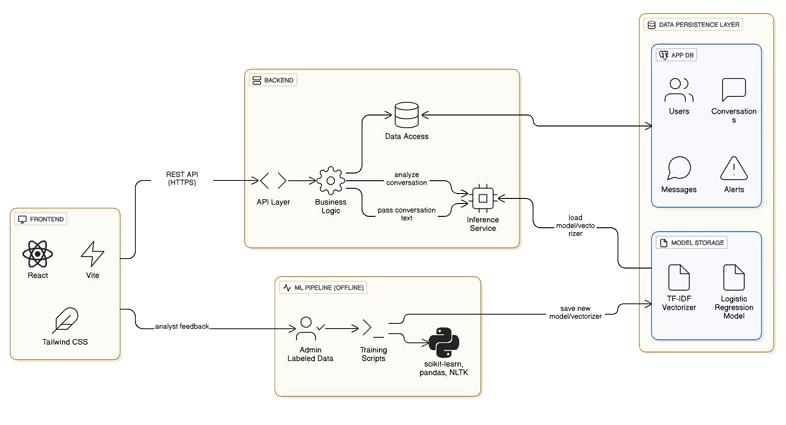
Fig-1:SystemArchitecture
The methodology of the proposed system explains the process used to detect suspicious conversations using
NaturalLanguageProcessing(NLP)andMachineLearning (ML). The system follows several steps, including data collection, preprocessing, feature extraction, model training,andprediction.Thesestepshelpinanalyzingchat messages and identifying patterns related to illegal drug transactions.
First, a labeled dataset containing both illicit and normal conversations is collected. The data is then preprocessed using NLP techniques such as text cleaning, tokenization, and removal of stop words. After preprocessing, the text data isconverted into numerical vectors using theTF-IDF technique so that it can be processed by the machine learningmodel.
The Logistic Regression algorithm is then trained on the processed dataset to learn patterns that distinguish suspicious conversations from normal ones. When a new conversation is received, it goes through the same preprocessing and TF-IDF conversion process before beinganalyzedbythetrainedmodel.Themodelgenerates a probability score, and if it exceeds a predefined threshold, the conversation is flagged, and an alert is generatedfortheadministrator.
The results of the proposed Chat Classifier system demonstrate that the machine learning model is able to analyze and classify chat conversations effectively. After training the Logistic Regression model on the labeled dataset, the system was tested using new conversation samples to evaluate its performance. The model successfully identifies patterns associated with suspicious or illicit drug-related communication and classifies messagesaseitherillicitorbenign.
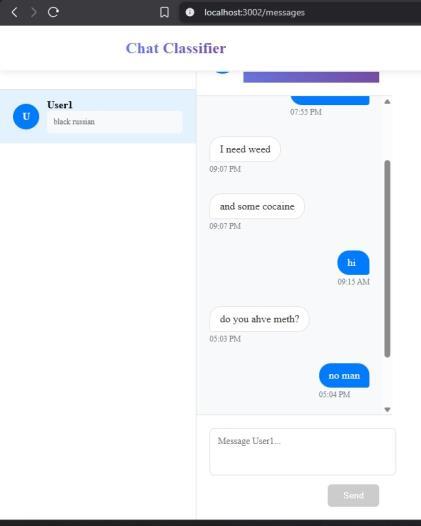
Fig-2: UserChatInterfaceandReal-timeMonitoring
This interface represents the front-end chat environment where users communicate. The system actively monitors
International Research Journal of Engineering and Technology (IRJET) e-ISSN:2395-0056
Volume:13Issue:03|Mar 2018 www.irjet.net p-ISSN:2395-0072
the text stream, identifying high-risk narcotic-related keywordslike"heroine,""weed,""cocaine,"and"meth" as they are typed. This serves as the primary data ingestion point for the classification engine to detect illicit activity duringliveconversations.
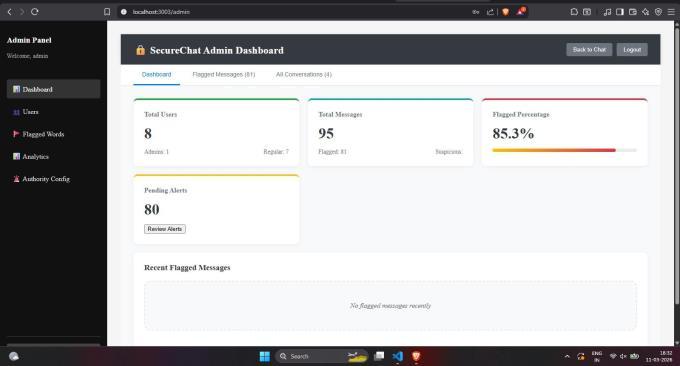
Fig-3:SecureChatAdminDashboardOverview
The main Admin Dashboard provides a high-level summary of system-wide activity, displaying critical metricssuchasthetotalnumberofusersandmessages.It features a prominent "Flagged Percentage" gauge, currently showing a high rate of 85.3%, and a "Pending Alerts"countertonotifyadministratorsofurgentsecurity breaches. This centralized view allows authorities to quicklyassesstheoverallthreatleveloftheplatform.
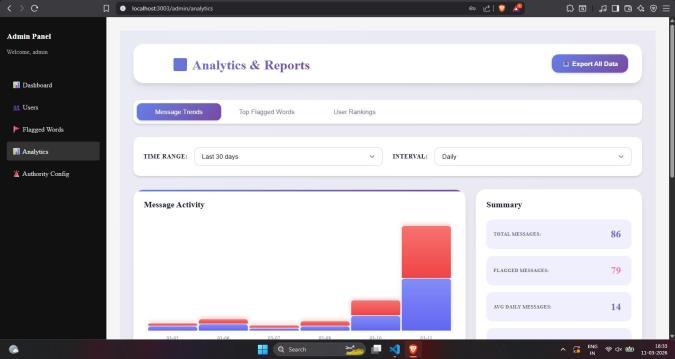
Fig-4: AnalyticsandMessageActivityReports
This section provides deep insights into communication trendsthroughvisualbarcharts,comparingtotalmessage volume against flagged illicit messages. It includes a summary sidebar with statistical data, such as average daily messages and total flagged counts, helping administratorsidentifyperiodsofpeaksuspiciousactivity.
The "Export All Data" feature ensures that these logs can beextractedforformallegaldocumentation.
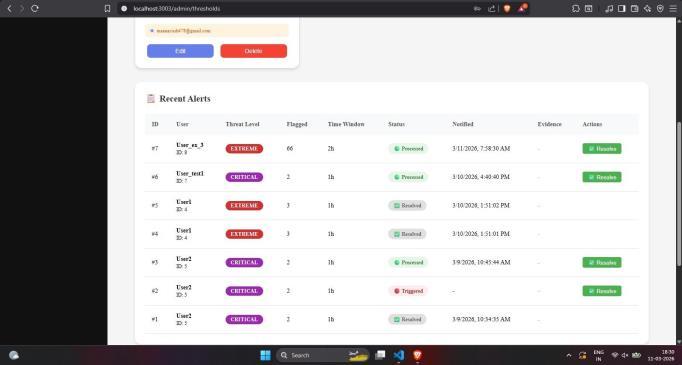
Fig-5: Real-timeAlertMonitoringandEvidenceLog
The Recent Alerts log provides a chronological record of every security trigger generated by the system, categorized by threat levels like "EXTREME" or "CRITICAL." Each entry includes the user ID, the number of flagged messages, and a status indicator showing if the alert has been "Processed," "Triggered," or "Resolved." Thisscreenactsasadigitalevidencelocker,allowing
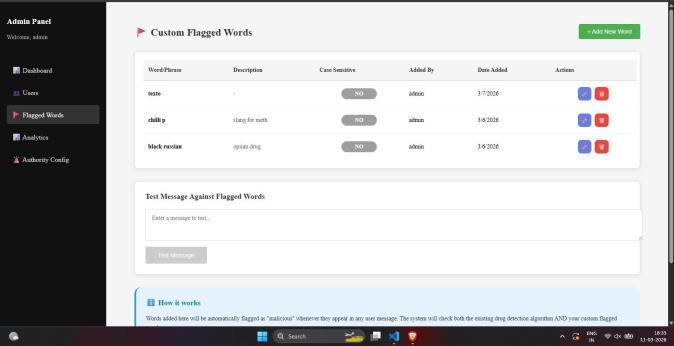
Fig-6:CustomFlaggedWordsandSlangConfiguration
This administrative tool allows for the dynamic updating of the detection engine by adding custom keywords and localized drug slang. It includes a management table showing words like "chilli p" (meth slang) and "black russian" (opium drug), along with their descriptions and case-sensitivitysettings.A"TestMessage" sandboxisalso providedtoverifyifthedetectionalgorithmcorrectlyflags specificphrasesbeforetheyaredeployedlive.
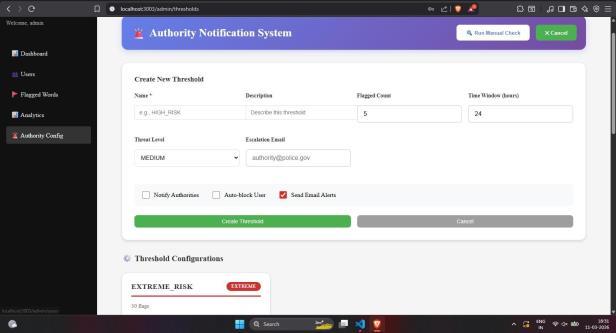
Fig-7:AuthorityNotificationSystemConfiguration
International Research Journal of Engineering and Technology (IRJET) e-ISSN:2395-0056
Volume:13Issue:03|Mar 2018 www.irjet.net
This feature enables the setup of automated escalation protocols by creating risk thresholds, such as "EXTREME_RISK." Administrators can define specific conditions, like a user hitting 50 flags within a 2-hour window, to trigger immediate actions. These actions include notifying external authorities, auto-blocking the user, and sending automated email alerts to official law enforcementaddresses.
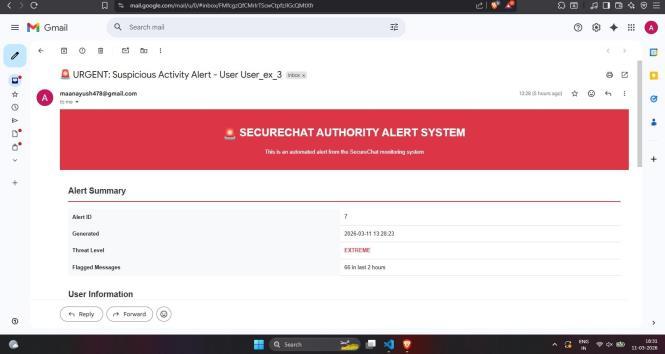
When a high-risk threshold is breached, the system automaticallygeneratesan"URGENT"emailnotificationto the configured law enforcement agency. The email contains a summary of the threat, including an Alert ID, the specific threat level (e.g., EXTREME), and the total count of flagged messages within a timeframe. This ensures that response teams are notified instantly of suspicious activity without requiring manual intervention fromahumanmoderator.
However, the current implementation of the system has certain limitations. The model analyzes only the current message bubble and does not consider the previous context of the conversation. Because of this, the system may fail to detect suspicious intent that becomes clear only when multiple messages are analyzed together. Additionally, individuals involved in illicit communication may use predefined code words or disguised language agreed upon between communicators. Such coded conversations may bypass the detection mechanism since the system primarily relies on known patterns present in the training data. Therefore, while the model demonstrates effective message-level classification,future improvementsshouldfocusonincorporatingconversation context analysis and more advanced language models to betterdetecthiddenorcodedcommunicationpatterns.
The Chat Classifier proposed system illustrates the implementation of Natural Language Processing and Machine Learning for identifying suspicious talks about illegal drugs. Using TF-IDF and Logistic Regression, the system can identify chat messages as illicit or benign to minimize manual checking and improve detection
p-ISSN:2395-0072
efficiency. However, at present, the current system just evaluates the given message and does not take into account the prior conversation context. This method works because it makes it so that communicators can avoidbeingcaughtbyusingcodedlanguageorcodewords thateverybodyagreeson.Futureimprovementscanentail context-basedanalysisandevenmoreadvancedmodelsto enhancetheaccuracyandreliabilityofthesystem.
[1] I. Naz, R. Illahi, “Harmful Content on Social Media DetectionUsingNLP,”Advances,2023,pp.49-59.
[2] S.Armoogum,D.A.Dewi,V.Armoogum,N.Melanie,T. B. Kurniawan, “Unveiling Criminal Activity: a Social Media Mining Approach to Crime Prediction,” Journal ofAppliedDataSciences,2024,pp.1482-1494.
[3] B. G. Bokolo, Q. Liu, “Artificial Intelligence in Social Media Forensics: A Comprehensive Survey and Analysis,”Electronics,2024,pp.1-24.
[4] M. C. Nali, V. Purushothaman, Z. Li, M. Z. Larsen, R. E. Cuomo, J. Yang, T. K. Mackey, “Identification and Characterization of Illegal Sales of Cannabis and Nicotine Delivery Products on Telegram Messaging Platform,” Nicotine and Tobacco Research, 2024, pp. 771-779.
[5] K.Y.Sreeram,K.Bansal,“AlgorithmicChatMonitoring for Mitigating Crime in Telegram: A Multi-Pronged Approach to Prevention and Forensics,” International Journal of Innovative Research in Technology (IJIRT), 2024.
[6] H. C. Aydogan, B. Yıkar, H. Balandız, S. Özsoy, “Assessing ChatGPT-4’s ability to generate forensic reports: a study of artificial intelligence in forensics,” EgyptianJournalofForensicSciences,2025,pp.1-12.
[7] S.A.Mogaji,T.T.Odufuwa, C.A.Afolalu,O.O.Faboya, M. V. Ige, O. D. Idowu, “Development of an Intelligent Chat Monitoring and Suspicious Activity Detection System,”FUOYEJournalofPureandAppliedSciences, 2025,pp.212-224.
[8] M. S. Sonawane, D. P. Patil, A. Kumar, S. Antoniv, “AI Detection of Drug Activity in Telegram Bots and Groups for Security Applications,” 18th International Scientific and Technical Conference on InstrumentationEngineering,2025,pp.452-455.
[9] S. Tuarob, P. Tatiyamaneekul, S. Pongpaichet, T. Tawichsri,T.Noraset,“Beyondadministrativereports: a deep learning framework for classifying and monitoringcrimeandaccidentsleveraginglarge-scale
International Research Journal of Engineering and Technology (IRJET) e-ISSN:2395-0056
Volume:13Issue:03|Mar 2018 www.irjet.net p-ISSN:2395-0072
online news,” Neural Computing and Applications, 2025,pp.7183-7205.
[10] J.Xi,M.Siegel,D.Labudde,M.Spranger,“Towards a joint semantic analysis in mobile forensics environments,” ForensicScienceInternational:Digital Investigation,2025,301846.
© 2026, IRJET | Impact Factor value: 8.315 | ISO 9001:2008 Certified Journal | Page 975