
International Research Journal of Engineering and Technology (IRJET) e-ISSN: 2395-0056
Volume: 13 Issue: 01 | Jan 2026 www.irjet.net p-ISSN: 2395-0072
International Research Journal of Engineering and Technology (IRJET) e-ISSN: 2395-0056
Volume: 13 Issue: 01 | Jan 2026 www.irjet.net p-ISSN: 2395-0072
PROF. M. D. CHOUDHARI1 , YASHODHAN P. THOTE2 , KARAN B. BHAGAT3
1,2,3Artificial Intelligence and Data Science K.D.K. College of Engineering Nagpur, India
Abstract - The rapid advancement of digital technologies has transformed traditional financial markets into highly accessible online ecosystems. Online trading and investment management platforms enable retail investors to participate in stock markets with real-time data, faster transactions, and improved transparency. Despite these advantages, challenges such as insecure transactions, lack of transparency, complex portfolio management, and regulatory compliance continue to hinder user trust and system reliability. This review paper presents a comprehensive analysis of an Online Trading and Portfolio Management System with Advanced Features.
The proposed system is designed using the MERN stack (MongoDB, Express.js, React.js, and Node.js) to ensure scalability, flexibility, and responsiveness. Secure authentication is implemented using JSON Web Tokens (JWT), while real-time market data APIs facilitate live price updates and virtual trade execution. The system also supports portfolio tracking, transaction history management, and administrative monitoring. By integrating modern web technologies with robust security mechanisms, the platform aims to provide a transparent, efficient, and secure trading environment. This paper further discusses research gaps, comparative analysis, system methodology, projected outcomes, and future research directions aligned with emerging Fin Tech trends.
Key Words: Online Trading, Investment Management, Fin Tech, MERN Stack, Secure Transactions, JWT Authentication, Portfolio Management
The financial trading landscape has evolved significantly with the emergence of online trading platforms, reducing dependencyonphysicalbrokeragesandmanualprocesses.Investorscannowaccessreal-timestockprices,executetrades instantly, and monitor portfolio performance through web and mobile applications. This digital shift has democratized marketparticipation,particularlyforretailinvestors.
However, the development of online trading systems introduces several technical and security challenges. These include ensuring secure user authentication, protecting sensitive financial data, managing volatile real-time market feeds, and complying with regulatory standards such as SEBI guidelines. Additionally, many existing platforms lack intuitive user interfacesandadvancedanalyticaltools,makingthemdifficulttouseforbeginners.
The Online Trading and Portfolio Management System with Advanced Features aimstoaddressthesechallengesby integrating secure authentication, real-time data handling, and user-centric design into a unified platform. This review evaluatesexistingresearch,identifiesgaps,andproposesacomprehensivesystemarchitecturesuitableforacademicand prototype-levelimplementation
Recentstudieshighlightthegrowingimportanceofsecure,scalable,anduser-friendlyonlinetradingplatforms.Pateland Mehta (2024) emphasized the use of JSON Web Tokens (JWT) for securing REST ful APIs in Fin Tech applications. Their research demonstrated that JWT-based authentication improves session security and scalability compared to traditional server-sidesessions.
Wang et al. (2021) explored real-time financial data integration using REST ful APIs and Web Socket technologies. Their work highlighted challenges related to API rate limits, latency, and data consistency, which directly impact trading accuracy during high market volatility. Alpha Vantage API documentation further explains practical approaches to accessingreal-timeandhistoricalmarketdatafortradingsimulations.
From a frontend perspective, Kumar and Sharma (2024) analysed the relationship between responsive user interface design and investor engagement. Their findings showed that intuitive dashboards, real-time charts, and simplified
International Research Journal of Engineering and Technology (IRJET) e-ISSN: 2395-0056
Volume: 13 Issue: 01 | Jan 2026 www.irjet.net p-ISSN: 2395-0072
navigation significantly improve user trust and retention. Li and Xu (2019) extended this work by discussing advanced statemanagementtechniquesinReact.jsforhandlingdynamicfinancialdataefficiently.
Onthebackend,Bhattacharya andDas(2023)comparedSQL andNoSQL databases forfinancial applications,concluding that MongoDB offers greater flexibility for storing user portfolios and transaction histories. Zerodha Tech Blog provided industry-levelinsightsintoscalingNode.js-basedsystemstohandlelargevolumesofconcurrentusers.
Security and regulatory compliance remain critical concerns in online trading. Chopra and Singh (2025) discussed lowlatencytradingarchitectures,whileSEBIGuidelines(2022)outlinedmandatorysecurityrequirementssuchasencryption, audit trails, and secure transaction handling. Despite these contributions, existing literature often focuses on isolated components rather than presenting an integrated academic model combining security, real-time trading, portfolio management,andadministrativecontrol.
Study Methodology Key Features Efficiency Improvement Research Gaps
Bhatia(2025) Regulatoryframework analysis SEBBI compliance requirements Invester protection guidelines No technical implementation model
Ricken (2023), Adekoya(2020) JWT authentication in Node.js Stateless API security Scalable authentication Limitedtoauthentication only
Sankaranarayanan &Rajendirane (2022)
ReactJS for trading apps Component-based UI Dynamic data rendering Nobackendintegrationfocus
Bhiseetal.(2019) ReactJSoptimization Performance techniques Improved UI responsiveness Genericoptimizations
Mehtaetal.(2020) MongoDBvsMySQL analysis Database performance NoSQLflexibility benefits Notradingcontext application
Smithetal.(2025) MongoDBdata pipelines Predictive analytics High-throughput processing Limitedsecurity discussion
IV.COMPARATIVE SUMMARY
The comparative analysis of existing literature demonstrates that while significant progress has been made in securing online trading platforms and improving user experience, most studies focus on isolated components rather than holistic system design. Security-focused studies emphasize authentication mechanisms without addressing real-time trading workflows.UI/UXresearchimprovesusabilitybutoftenneglectsbackendsecurityandcompliance.Similarly,databaseand scalabilitystudieslackintegrationwithlivetradingsimulations.
The proposed system distinguishes itself by integrating secure authentication, real-time data processing, portfolio management, and administrative oversight within a single unified framework. This comprehensive approach not only improvesoperational efficiencybut alsoenhancestransparency,security,andusertrust,effectivelybridgingthe research gapidentifiedinexistingstudies
V.METHODOLOGY
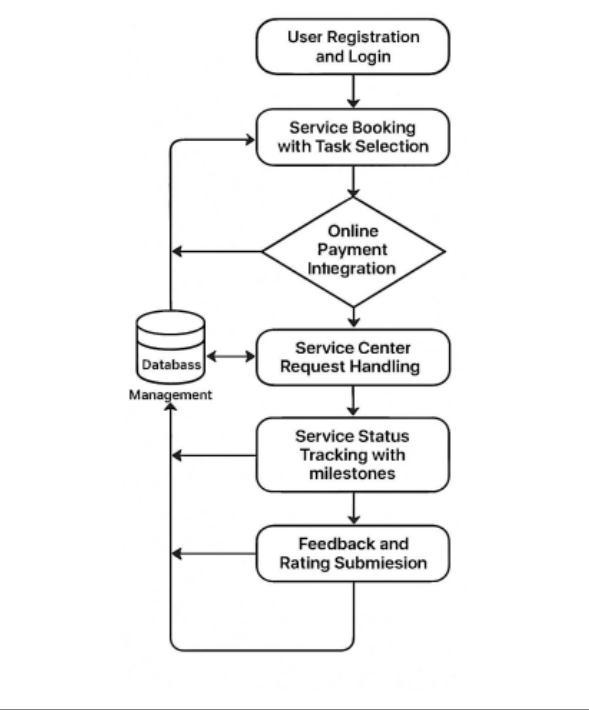
Theproposed Online Trading and Portfolio Management System with Advanced Features isdesignedusingalayered and modular architecture to ensure scalability, security, and maintainability. The methodology integrates frontend technologies, backend services, database management, and external market data APIs to simulate a real-world online tradingenvironment.
International Research Journal of Engineering and Technology (IRJET) e-ISSN: 2395-0056
Volume: 13 Issue: 01 | Jan 2026 www.irjet.net p-ISSN: 2395-0072
1. User Registration and Authentication
Users register using valid credentials, which are securely stored after encryption. Authentication is handled using JSON Web Tokens (JWT), ensuring stateless and secure session management. Token-based validation prevents unauthorized accessandenhancessystemscalability.
2. Frontend Interface and User Interaction
The frontend is developed using React.js, providing a responsive and interactive dashboard. Users can view live stock prices, manage watch lists, execute virtual trades, and analyseportfolio performancethrough charts and tables.Efficient statemanagementensuresreal-timeUIupdateswithoutperformancedegradation.
3. Backend Processing and Business Logic
Node.jswithExpress.jsmanagesserver-sideoperations,includingAPIrouting,authenticationverification,tradeexecution logic, and communication with external market data providers. The backend acts as a secure intermediary between the frontendanddatabase.
4. Real-Time Market Data Integration
The system integrates third-party financial APIs to fetch real-time and historical stock data. This enables accurate price visualization and realistic trade simulation. API rate limits and latency considerations are managed through optimized requesthandling.
5. Virtual Trade Execution
Userscan perform simulated buyandsell operations. Thesystem validates trade requests, updates virtual balances, and recordstransactions.Portfoliovaluesarerecalculateddynamicallybasedonmarketprices.
6. Database Management
MongoDB is used to store user profiles, transaction history, portfolio data, and audit logs. Its flexible schema supports dynamicfinancialrecordsandefficientdataretrieval.
7. Admin Dashboard and Monitoring
An administrative module provides role-based access for monitoring user activity, transaction logs, and system performance.Thismodulesupportsauditingandregulatorycompliance.
International Research Journal of Engineering and Technology (IRJET) e-ISSN: 2395-0056
Volume: 13 Issue: 01 | Jan 2026 www.irjet.net p-ISSN: 2395-0072
The proposed system is expected to deliver a secure, transparent, and efficient online trading environment that closely simulatesreal-worldtradingplatforms.Byintegratingreal-timemarketdata,secureauthentication,anddynamicportfolio management, the system enhances investor awareness and decision-making capabilities. Retail investors can gain practicalexposuretotradingmechanisms withoutfinancialrisk,makingtheplatformsuitableforacademic,training,and prototype-leveldeployment.
Froma technicalperspective,thesystemdemonstrateseffectiveimplementationoffull-stackFinTecharchitectureusing the MERN stack. It ensures low-latency data handling, secure transaction processing, and scalable performance. The inclusionofanadmindashboardfurtherstrengthensoperationaloversightandcompliancemonitoring.
Future enhancements can significantly expand the platform's capabilities. Artificial intelligence and machine learning models can be integrated to provide personalized investment recommendations, risk profiling, and predictive analytics. Block chain technology can be employed to create immutable transaction ledgers, enhancing transparency and trust. Social trading features may allow users to follow or replicate expert trading strategies. Cloud-based deployment can ensure scalability and high availability, while integration with real brokerage APIs and payment gateways can transition thesystemfromsimulationtolivetrading.
This paper concludes that a well-structured online trading and investment management system can effectively address challengesrelatedtosecurity,transparency,andusabilityindigitalfinancialplatforms.TheintegrationoftheMERNstack with JWT-based authentication and real-time market data APIs provides a robust foundation for building secure and scalable trading systems. The proposed architecture demonstrates how modern web technologies can be leveraged to replicatethecorefunctionalitiesofcommercialtradingplatformswithinanacademicframework.
Future research can focus on incorporating advanced machine learning techniques for market trend prediction and automated portfolio optimization. Additional studies may explore high-frequency trading simulations, enhanced cyber security frameworks, and automated regulatory compliance mechanisms. Research into user behaviour analytics and sentiment analysis can further improve decision-support systems. These directions can contribute to the evolution of intelligent,secure,anduser-centricFinTechplatforms.
1. N.Bhatia,"RegulatingOnlineShareTradingandInvestmentPlatformsinIndia:ASEBI-LedFramework,"LegalService India,Oct.2025.
2. M.Ricken,"How/Why:RESTAPIAuthorizationwithJWTinNodeJS,"Medium,Mar.2023.
3. B.Adekoya,"SecuringNodeandExpressRESTfulAPIwithJsonWebToken(JWT),"BuddyWorksTutorials,Sep.2020.
4. M. Sankaranarayanan and N. Rajendirane, "ReactJS For Trading Applications," 2022 IEEE 2nd Mysore Sub Section InternationalConference(MysuruCon),Mysuru,India,2022,pp.1-6,doi:10.1109/MysuruCon55714.2022.9995932.
5. Y. Mehta, D. Damodaran, G. Wang, and S. Khan, "Performance Analysis of NoSQL and Relational Databases with MongoDBandMySQL,"MaterialsToday:Proceedings,vol.24,pp.2036-2043,2020.
6. J. Smith et al., "Data-Driven Predictive Analytics And Decision-Making In FinTech Using MongoDB And HighThroughputDataPipelines,"InternationalJournalofComputerScienceandNetworkSecurity,Feb.2025.
7. SecuritiesandExchangeBoardofIndia,"SEBIGuidelinesonOnlineTradingPlatformsandInvestorProtection,"2025. [Online].Available:https://www.sebi.gov.in
8. V. R. Bhise, S. Gudeti, and S. Sudarshan, "Performance Optimization Techniques for ReactJS," 2019 International Conference on Advances in Computing, Communication and Control (ICAC3), Mumbai, India, 2019, pp. 1-6, doi: 10.1109/ICAC347590.2019.8869134.
9. I.Goodfellow,Y.Bengio,andA.Courville,DeepLearning.Cambridge,MA:MITPress,2016.
International Research Journal of Engineering and Technology (IRJET) e-ISSN: 2395-0056
Volume: 13 Issue: 01 | Jan 2026 www.irjet.net p-ISSN: 2395-0072
10. S.Nakamoto,"Bitcoin:APeer-to-PeerElectronicCashSystem,"2008.
11. P.Gomber,R.J.Kauffman,C.Parker,andB.W.Weber,"OntheFintechRevolution:InterpretingtheForcesofInnovation, Disruption,andTransformationinFinancialServices," JournalofManagementInformationSystems,vol.35,no.1,pp. 220-265,2018.
12. MongoDB Inc., "MongoDB for Financial Services," 2025. [Online]. Available: https://www.mongodb.com/industries/financial-services
13. Alpha Vantage, "API Documentation: Stock Market Data," 2025. [Online]. Available: https://www.alphavantage.co/documentation/
14. R.ElmasriandS.B.Navathe,FundamentalsofDatabaseSystems,7thed.London,U.K.:Pearson,2015.
15. K.S. RaoandD. M.Rao, "SQL andNoSQLDatabase SoftwareArchitecturePerformanceAnalysisandAssessments A SystematicLiteratureReview,"Information,vol.14,no.5,p.97,May2023.
16. S.BrownandJ.Warner,"UsingDailyStockReturns:TheCaseofEventStudies,"JournalofFinancialEconomics,vol.14, no.1,pp.3-31,1985.
17. E. F. Fama, "Efficient Capital Markets: A Review of Theory and Empirical Work," Journal of Finance, vol. 25, no. 2, pp. 383-417,1970.
18. OECD,"DigitalSecurityRiskManagementforEconomicandSocialProsperity,"OECDPublishing,Paris,2021.
19. M. Kleppmann, Designing Data-Intensive Applications: The Big Ideas Behind Reliable, Scalable, and Maintainable Systems.Boston,MA:O'ReillyMedia,2017.
20. S.J.RussellandP.Norvig,ArtificialIntelligence:AModernApproach,4thed.Hoboken,NJ:Pearson,2020.