
International Research Journal of Engineering and Technology (IRJET) e-ISSN: 2395-0056
Volume: 13 Issue: 04 | Apr 2026 www.irjet.net p-ISSN: 2395-0072

International Research Journal of Engineering and Technology (IRJET) e-ISSN: 2395-0056
Volume: 13 Issue: 04 | Apr 2026 www.irjet.net p-ISSN: 2395-0072
G Sainath1, G Sriram2, K Harshavardhan3, K Sudharshan4 , MD Abdul Aleem5
1,2,3,4UG Students, Department of Computer Science and Engineering, JBREC, Hyderabad, India
5Assistant Professor, Department of Computer Science and Engineering, JBREC, Hyderabad, India
Abstract - NEXUS AI is a Multimodal AI Content Studio that integrates multiple AI-powered generation capabilities into a single unified platform. Built on a Flask backend with a dynamic JavaScript frontend, it leverages the Groq API to deliver rapid, high-quality outputs across seven distinct modes: Text Generation, Vision Analysis, Code Generation, Social Media content, Image Prompts, Image Generation, and Translate & Adapt. The system follows a clean layered architecture where user requests flow through a browser UI, an API abstraction layer, a Flask processing backend, and finally the Groq AI service. This paper presents the complete system design, architectural overview, workflow sequence, implementation details, and validated output results demonstrating NEXUS AI's effectiveness as a versatile AI content studio for researchers, developers, and creative professionals.
Key Words: Multimodal AI, Content Generation, Groq API, Flask Backend, Natural Language Processing, Vision Analysis, Code Generation, REST API, Large Language Models, Web Application
NEXUS AI is a comprehensive Multimodal AI Content Studio designed to democratize access to powerful AI capabilities through an intuitive web interface. In today's rapidly evolving AI landscape, users require a unified platform capable of handling diverse content generation tasks from natural language text and code to image analysisandmultilingualtranslation.
Thesystemisbuiltuponamodularthree-tierarchitecture: a responsive browser-based frontend, a RESTful API middleware layer (api.js), and a Python Flask backend (app.py) that interfaces directly with the Groq AI service. This design ensures clean separation of concerns, high maintainability,andscalability.
NEXUSAIaddressessevenkeycontentdomainsinasingle studio environment, making it suitable for individual developers, academic researchers, marketing professionals, and content creators alike. The platform's
multimodal capability spanning text, vision, and code represents a significant step toward fully integrated AIassistedworkflows.
Adaptintoonecohesiveinterfacepoweredbystate-of-theartLLMcapabilities
1.2
•Designascalable,modularmultimodalAIplatform.
•IntegrateGroqAPIforhigh-speedLLMinference.
• Implement a clean REST API abstraction layer between frontendandbackend.
• Deliver an intuitive, dark-themed UI with real-time generationfeedback.
• Validate system outputs across all seven generation modes.
Table 2 summarises the key components and their technologies. The Frontend (Browser) layer comprises index.html, style.css, and script.js. The API Layer (api.js) acts as the communication bridge, sending POST /generate requests to the Flask Backend (app.py). The backend processes the prompts, builds context-aware requests, and forwards them to the external Groq API, returningstructuredJSONresponses
Table - 1: NEXUS AI System Components & Technologies
International Research Journal of Engineering and Technology (IRJET) e-ISSN: 2395-0056
Volume: 13 Issue: 04 | Apr 2026 www.irjet.net p-ISSN: 2395-0072
AIService GroqAPI LLM Inference
Model llama3-8b8192 Language Generation
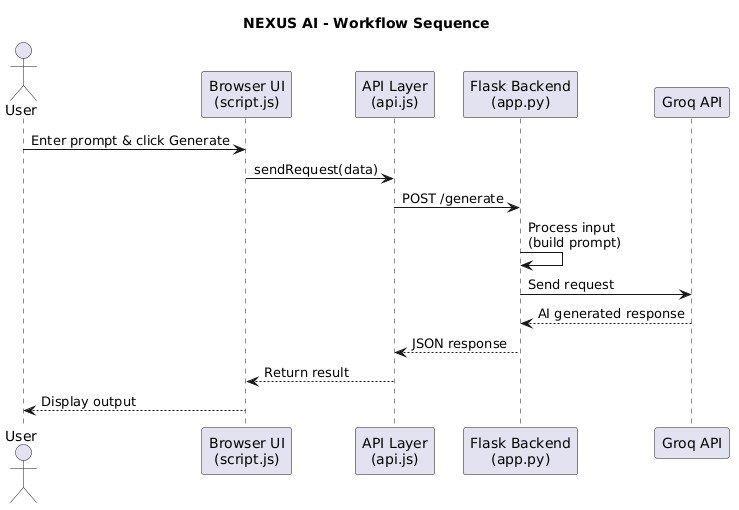
The NEXUS AI system follows a three-tier client-server architecture, as illustrated in Fig. 1. The architecture ensures loose coupling between the presentation and business logic layers. Each component can be independently scaled or replaced for instance, the Groq APIcanbeswappedwithanotherLLMproviderwithout
The frontend is a single-page application (SPA) rendered in the browser. It consists of a navigation sidebar listing theseven generationmodes,a dynamiccontentarea with mode-specificinputcontrols(prompttextarea,maxtokens slider, temperature control), and an output panel with Copy, Clear, and Save actions. The UI uses a dark theme with purple accent colors for improved focus during extendeduse.
api.js implements the sendRequest(data) function that serialises user input into a structured JSON payload and dispatches it via HTTP POST to the Flask /generate endpoint.Ithandlesasynchronousresponses,errorstates, and response parsing, insulating script.js from direct backendconcerns.
The Flask backend receives the POST /generate request, extracts the mode and prompt parameters, constructs mode-specific system prompts, and calls the Groq API using the llama3-8b-8192 model. The response is parsed and returned as a JSON object to the API layer. CORS is enabledtosupportbrowser-basedclients.
Groq provides ultra-fast LLM inference, significantly reducing response latency compared to traditional inference endpoints. The backend uses the groq Python SDKwithstructuredmessagearrayscontainingsystem
Fig.2presentsthecompleteUMLsequencediagramofthe NEXUS AI request-response workflow. The interaction beginswhentheUserentersapromptandclicksGenerate intheBrowserUI(script.js).
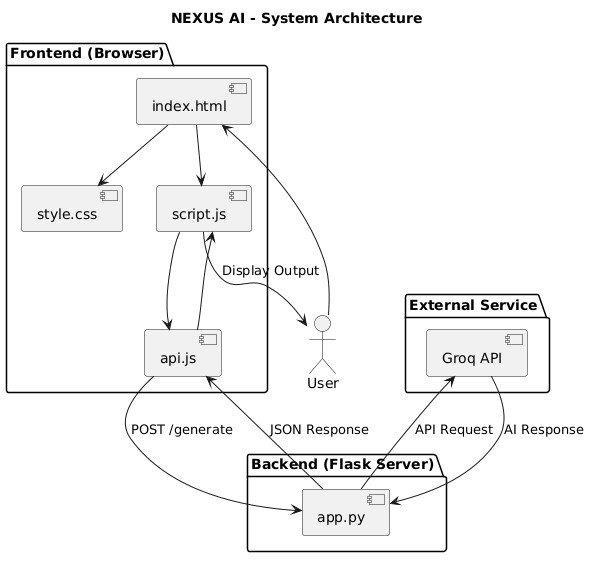
Step 1 User Input: The user selects a generation mode, enters a prompt, and optionally configures max tokens andtemperatureparameters.
Step 2 API Call: script.js invokes sendRequest(data) in api.js,serialisingtheinputtoJSONanddispatchingaPOST /generaterequesttoFlask.
International Research Journal of Engineering and Technology (IRJET) e-ISSN: 2395-0056
Volume: 13 Issue: 04 | Apr 2026 www.irjet.net p-ISSN: 2395-0072
Step 3
Backend Processing: app.py validates the input andconstructsamode-specificsystempromptthatguides theLLM’sresponsestyle.
Step4 GroqAPIRequest:Flasksendstheprompttothe Groq API using the llama3-8b-8192 model and awaits the AI-generatedcompletion.
Step5 ResponseChain:GroqAPI→FlaskJSON→api.js →script.jsrendersoutputintheoutputpanel.
Step 6 User Display: Generated content appears with Copy, Clear, and Save controls for post-generation management.
4.1 Generation Modes
Table 2 summarises all seven generation modes provided by NEXUS AI, each backed by a dedicated mode-specific systempromptengineeredwithintheFlaskbackend. anduserroles,enablingcontext-awareresponsestunedto eachgenerationmode.
whentheUserentersa promptand clicksGenerateinthe BrowserUI(script.js).
Table - 2: NEXUS AI Generation Modes
Mode Description
TextGeneration Articles,stories,essays,marketing copy
VisionAnalysis Image understanding & multimodalreasoning
CodeGeneration Write, explain, debug code (all languages)
SocialMedia Posts, captions, threads (Twitter, Instagram)
ImagePrompts Prompts for DALL-E, Midjourney, StableDiffusion
ImageGeneration
Translate&Adapt
AI-generated visuals from text descriptions
Multilingual translation with culturaladaptation
Text Generation produces articles, essays, stories, and marketing copy using prompt-guided LLM completions. Vision Analysis accepts uploaded images (JPG, PNG, GIF, WebP) alongside a user question for multimodal visual reasoning. Code Generation generates, explains, debugs, and optimises code across all major programming languages.
Table 3 presents the key configuration parameters and security settings enforced by the NEXUS AI backend. API keys are stored as environment variables and never exposed to the frontend. CORS headers are restricted to approvedoriginsinproductiondeployments.Inputlength is validated server-side to prevent prompt injection and excessivetokenconsumption
Table - 3: Configuration Parameters & Security Settings
1024 256–8192
Model
llama3-8b8192 Groqhosted
APIAuth EnvVar
Never sent to client
NEXUS AI was tested across all seven generation modes. Below we present three representative outputs demonstratingtheplatform'scapabilities.
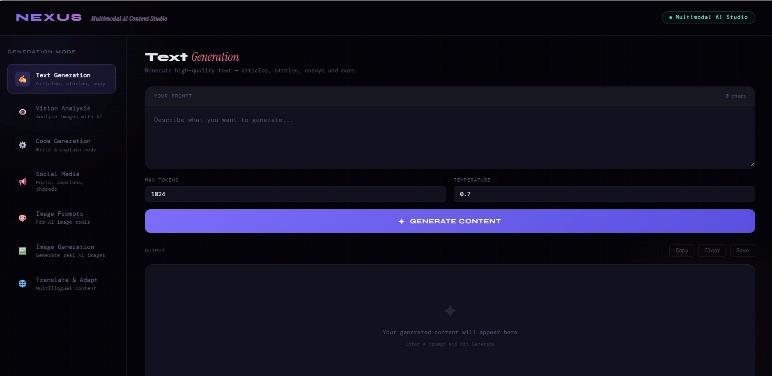
Output 1 Text Generation Interface
International Research Journal of Engineering and Technology (IRJET) e-ISSN: 2395-0056
Volume: 13 Issue: 04 | Apr 2026 www.irjet.net p-ISSN: 2395-0072
Fig. 3 shows the Text Generation mode of the NEXUS AI studio. The user enters a natural language prompt in the YOUR PROMPT field and configures Max Tokens (default 1024) and Temperature (default 0.7) to control output lengthandcreativity.UponclickingGENERATECONTENT, the LLM produces high-quality articles, stories, or essays in the output panel below, with Copy, Clear, and Save controlsforpost-generationmanagement.
2 Code Generation
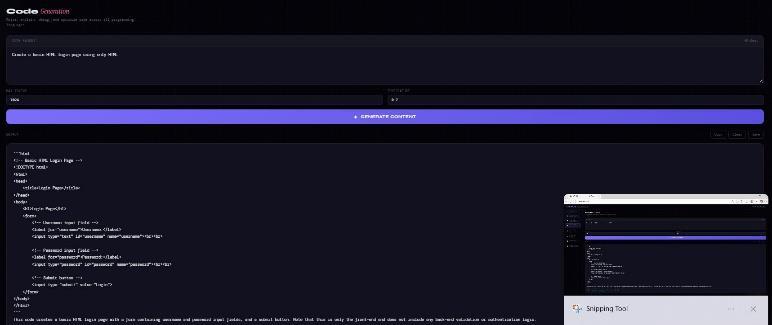
Fig - 4: Code Generation Mode HTML Login Page
Fig. 4 demonstrates Code Generation responding to “Create a basic HTML login page using only HTML.” The system produced a well-structured, commented HTML document with username/password fields and a submit button,includinganexplanatorysummary,confirmingthe model’s ability to generate functional, production-ready code.
Output 3 Vision Analysis
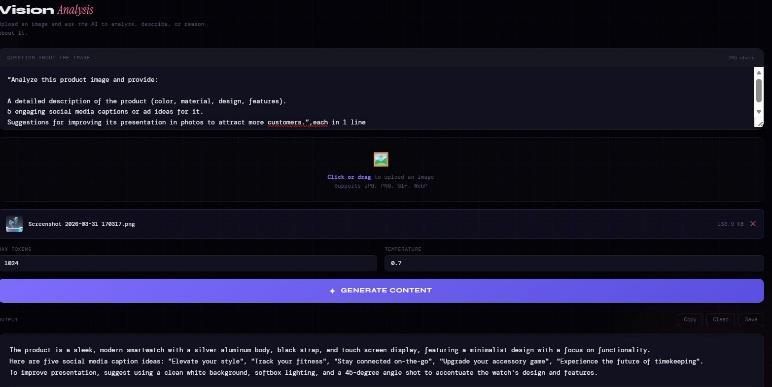
Fig - 5: Vision Analysis Mode Product Image Analysis
Fig. 5 illustrates Vision Analysis with a smartwatch product image. The AI correctly identified the product, generated five social media caption ideas, and recommended professional photography techniques (white background, softbox lighting, 45-degree angle) to enhancee-commerceproductpresentation.
NEXUS AI successfully demonstrates the viability of a unified, multimodal AI content studio built on a lightweight Flask-Groq architecture. The system's clean three-tier design, rapid response times enabled by Groq's inference engine, and intuitive dark-themed interface collectively deliver a professional-grade tool for diverse AI-poweredcontentworkflows.
The platform's modular design allows straightforward extension to additional generation modes, model providers, or authentication layers. Future work includes adding user session management, prompt history, streaming response output, and support for additional multimodalinputsincludingaudioandvideoanalysis.
The validated outputs across Text Generation, Code Generation, and Vision Analysis confirm NEXUS AI's reliabilityandpracticalutilityforresearchers,developers, and creative professionals seeking a single integrated AI studio.
The author would like to thank the Groq team for providing accessible LPU-accelerated API infrastructure and the Pollinations AI team for their open image generationAPI,bothofwhichmadethisprojectfeasibleas anindividualdevelopmenteffort.
[1] OpenAI, "GPT-4 Technical Report," arXiv:2303.08774, 2023.
[2] Meta AI, "The LLaMA 3 Herd of Models," arXiv:2407.21783,2024.
[3] A. Q. Jiang et al., "Mixtral of Experts," arXiv:2401.04088,2024.
[4]A.Vaswanietal.,"AttentionIsAllYouNeed,"Advances in Neural Information Processing Systems (NeurIPS), vol. 30,2017
[5] R. Rombach et al., "High-Resolution Image Synthesis with Latent Diffusion Models," IEEE/CVF Conference on Computer Vision and Pattern Recognition (CVPR), pp. 10684–10695,2022.
[6] Pollinations AI, "Open-source generative media API," [Online].Available:https://pollinations.ai
[7] A. Grinsztajn, E. Oyallon, and G. Varoquaux, "Flask: A micro web framework for Python," Python Software Foundation,2010.