
Volume:13Issue:04|Apr2026 www.irjet.net



Volume:13Issue:04|Apr2026 www.irjet.net
Ayush Wankhede, Sameer Jadhav, Pankaj Damale
Department of Artificial Intelligence and Data Science
Dr. D. Y. Patil Institute of Engineering, Management and Research, Pune, India
Abstract - Themodernfinanciallandscape ischaracterized by an overwhelming volume of unstructured news data, making it difficult for investors to extract relevant insights. This paper presents an AI-driven system that automates the collection, filtering, and summarization of financial news using Large Language Models (LLMs). The system integrates web scraping techniques, natural language processing, and cloud-based serverless architecture to process large volumes of data efficiently. News articles are collected from online sources and analyzed using GPT-based models to identify investor-relevant information. Relevant articles are then summarized into concise and professional insights.The use of AWS Lambda enables scalable and parallel processing, while Amazon S3 ensures secure data storage. The proposed system significantly reduces manual effort and improves decisionmaking speed. However, challenges such as model accuracy and dependency on external APIs remain.
Key Words: Large Language Models, Financial NLP, Web Scraping, AWS Lambda, News Streaming, InvestmentAnalysis
Thisdocumentpresentsanautomatedsystemdesignedto assist investors in analyzing financial news efficiently. In today’s digital world, thousands of news articles are publisheddaily,makingitdifficulttoidentifyrelevantand actionable information. Traditional approaches rely on manual analysis or keyword-based filtering, which lack scalabilityandcontextualunderstanding.
The proposed system leverages Large Language Models (LLMs) to process financial news and identify relevant informationforinvestors.Byintegratingwebscraping,cloud computing, and AI-based summarization, the system providesascalablesolutionforreal-timenewsanalysis.
In today’s digital financial environment, investors face significantchallengesintrackingandanalyzingrelevantnews duetothemassivevolume ofinformationgenerateddaily acrossmultipleplatforms.Manuallyfilteringandinterpreting thisdata istime-consuming, inefficient,and oftenleads to missingcriticalinsightsthatcanimpactinvestmentdecisions. Traditional keyword-based approaches lack contextual

Understanding and fail to identify truly meaningful information. Therefore, there is a strong need for an automatedandintelligentsystemthatcanefficientlyfilter, analyze,andsummarizefinancialnews,enablingfasterand moreinformeddecision-makingforinvestors.
ProblemStatement:
Therapidgrowthofonlinefinancialnewsmakesitdifficult forinvestorstoidentifyrelevantandimpactfulinformation. Manual analysis is time-consuming, unscalable, and often leadstomissingcriticalinsights.Traditionalkeyword-based approachesfailtocapturecontextualmeaning,makingthem ineffectiveforaccuratedecision-making.Therefore,thereis aneedforanautomatedsystemthatcanefficientlyfilterand summarizeinvestor-relevantnews.
Toautomatethecollectionoffinancialnewsfrom onlinesources
To classify news articles based on investor relevanceusingLargeLanguageModels
Togenerateconciseandmeaningfulsummariesfor betterdecision-making
Toimplementascalablesystemcapableofhandling largevolumesofdataefficiently
Recent advancements in artificial intelligence have significantly improved financial news analysis. Various studieshaveexploredtheuseofmachinelearninganddeep learningmodelsforsentimentanalysisandprediction. Papasotiriouetal.(2024)demonstratedtheeffectivenessof GPTmodelsingeneratingstockratings.Jiang&Zeng(2025) utilized FinBERT for financial sentiment analysis and improved prediction accuracy. Ardekani et al. (2024) introducedFinSentGPTformultilingualsentimentanalysis. Additionally, serverless architectures have been used to improvescalabilityandcostefficiencyinreal-timefinancial systems.
These studies highlight the transition from traditional methods to AI-driven approaches, emphasizing the importanceofcontextualunderstandingandscalability.

Volume:13Issue:04|Apr2026 www.irjet.net
International Research Journal of Engineering and Technology (IRJET) e-ISSN:2395-0056 p-ISSN:2395-0072
In addition to the previously discussed studies, several researchershaveexploreddifferentapproachesforfinancial textanalysisandnews-basedpredictionsystems.Traditional machinelearningmodelssuchasSupportVectorMachines (SVM), Random Forest, and Naïve Bayes have been widely usedforsentimentclassificationoffinancialnews.However, thesemodelsrelyheavilyonmanualfeatureengineeringand oftenfailtocapturecontextualmeaningincomplexfinancial language.
Deep learning techniques, including Recurrent Neural Networks (RNN) and Long Short-Term Memory (LSTM) networks, improved performance by capturing sequential dependencies in textual data. These models have been successfullyappliedtopredictstockmarkettrendsbasedon historical newsandsocialmediasentiment. However,they still facelimitations inunderstandinglong-rangecontextand domain-specificnuances.
With the introduction of transformer-based architectures, such as BERT and GPT, there has been a significant improvementinnaturallanguageunderstanding.Modelslike FinBERT are specifically fine-tuned for financial text and providebettersentimentclassificationcomparedtogeneralpurposemodels.Ontheotherhand,LargeLanguageModels (LLMs) such as GPT-4 offer advanced capabilities like contextual understanding, text generation, and summarization, making them highly suitable for financial newsanalysis.
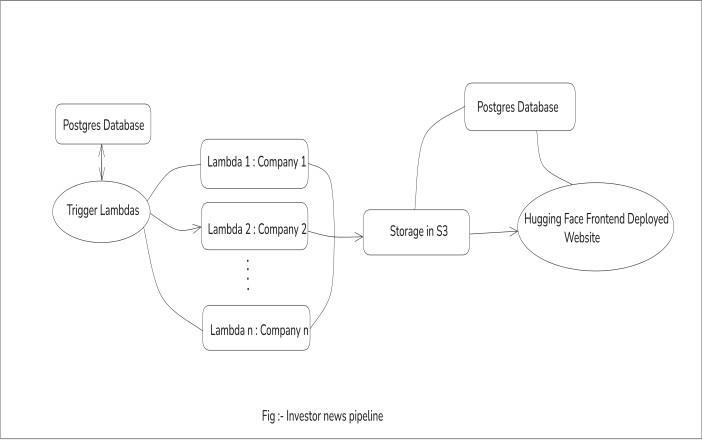
Fromasystemarchitectureperspective,cloudcomputingand serverlesstechnologieshaveplayedacrucialroleinenabling real-time data processing. AWS Lambda allows parallel execution of tasks, making it possible to process news for multiple companies simultaneously with reduced cost and latency.Similarly,cloudstoragesolutionssuchasAmazonS3 providescalableandsecuredatastorage.
Overall,theliteratureindicatesaclearshifttowardAI-driven, scalable,andautomatedsystemsforfinancialnewsanalysis. However,thereisstillaneedforimprovedaccuracy,better
Evaluation metrics, and more robust real-world implementations.
ThispaperpresentedanAI-drivensystemforfinancialnews streamingandanalysisusingLargeLanguageModels. The systemsuccessfullyautomatesthecollection,classification, andsummarizationofnewsarticlesrelevanttoinvestors.By leveragingcloud-basedserverlessarchitecture,thesystem ensuresscalabilityandefficiency.
Theproposedapproachreducesmanualeffortandenhances decision-makingbyprovidingconciseandrelevantinsights. Future work may focus on improving model accuracy, handlingmulti-sourcedata,andenhancingsystemreliability.
Theauthorswouldliketoexpresstheirsinceregratitudeto their project guide for continuous support and guidance throughoutthedevelopmentofthisproject.Theauthorsalso thank the department and institution for providing the necessaryresources.
[1]Papasotiriouetal.,“AIinInvestmentAnalysis:LLMsfor EquityStockRatings,”2024.
[2] Jiang & Zeng, “Financial Sentiment Analysis using FinBERT,”2025.
[3]Ardekanietal.,“FinSentGPT,”2024.
[4] Al-Amin et al., “Serverless Architecture for Real-Time StockAnalysis,”2025.
[5] Khan et al., “Stock Market Prediction using Machine Learning,”2022.