
International Research Journal of Engineering and Technology (IRJET) e-ISSN: 2395-0056
Volume: 13 Issue: 01 | Jan 2026 www.irjet.net p-ISSN: 2395-0072
International Research Journal of Engineering and Technology (IRJET) e-ISSN: 2395-0056
Volume: 13 Issue: 01 | Jan 2026 www.irjet.net p-ISSN: 2395-0072
1,2,3,4
Sneha Bhargava¹, Shubhranshu Das², Rajguru Singh³, Rohit Soni´
Department of Artificial Intelligence & Machine Learning, Oriental Institute of Science and Technology, Bhopal, India ***
Abstract – Neuro Pulse is an AI-based multimodal emotion detection system designed to analyze human emotions using text, speech audio and facial expressions to support emotion-aware human–computer interaction. Traditional emotion recognition systems often rely on unimodal inputs, limiting theirability to interpret complex emotional behavior. The proposed system independently processes textual, audio, and visual inputs using transformer-based Natural Language Processing models for text emotion detection, pretrained deep learning models for speech emotion recognition, and convolutional neural networkswithcomputervisiontechniquesforfacial emotion analysis. Neuro Pulse follows modular client–server architecture with a React-based frontend and a Flask-based backend communicating through RESTful APIs. Experimental evaluation under controlled conditions demonstratesreliable qualitativeemotion detectionacross all modalities, highlighting the system’s effectiveness and suitabilityforacademicandexperimentalapplications.
Key Words: Multimodal Emotion Detection, Affective Computing, Natural Language Processing, Speech Emotion Recognition, Facial Emotion Analysis, ArtificialIntelligence.
Oneofthekeyfactorscontributingtosuccessfulhuman–computerinteractionistheabilitytorecognizeemotions, as human emotions significantly influence decisionmaking, communication, and behavior. Considering the rapidgrowthofdigital platformssuchasonlinelearning systems, virtual assistants,andremote communication tools, there is a greater demand for smart systems that are capable of understandingandresponding to human emotions.
Most traditional emotionrecognitionsystems are based on unimodal approaches like text sentiment analysis or facialexpressionrecognition.Theseapproachescertainly have their advantages; however, they tend to overlook the fact that people's emotional expressions in real life are multimodal, thus multifaceted.Hence people usually mixtheirlanguagewithvoicetoneandfacialexpressions toconveytheiremotions.
Neuro Pulse addresses these limitations by combining the three major sources of emotional information, namely text, speech,andfacial expressions, into one integrated and coherent emotion model.The system
consists of several modules or components where each of the emotion detection uses a separate mode thus one can, for example, experiment with the facial detection partorextenditeasilyinthefuture.
A. Text-Based Emotion Detection
Text-basedemotiondetectionhasbeenwidelystudiedin the field of affective computing and Natural Language Processing. Early approaches relied on rule-based and keyword-driven sentiment analysis techniques, which were limited in handling semantic and contextual variations in language. Recentadvancementsintroduced machine learning and transformer-based models that significantly improved emotion classification by capturingcontextualrelationshipswithintextualdata.
Speech emotion recognition focuses on identifying emotionalstatesfromvocalcharacteristicssuchaspitch, tone, and intensity. Traditional methods used handcrafted acoustic features, which required extensive feature engineering. Modern approaches utilize pretraineddeeplearningmodelsthatautomaticallylearn emotional patterns from speech signals, resulting in improved robustness and performance under controlled conditions.
Facial emotion detection employs computer vision techniques to analyze facial expressions and identify emotional states. Convolutional neural networks have become the dominant approach due to their ability to automatically extract facial features and classify basic emotions such as happiness, sadness, anger, and surprise.
Recent studies highlight that multimodal emotion detection systems outperform unimodal approaches by combining emotional cues from multiple sources. By integrating text, speech, and facial modalities, multimodal systems provide a more comprehensive understanding of emotional states. The Neuro Pulse systemadoptsthismultimodalapproachwithamodular architecturesuitableforacademicapplications.
International Research Journal of Engineering and Technology (IRJET) e-ISSN: 2395-0056
Volume: 13 Issue: 01 | Jan 2026 www.irjet.net p-ISSN: 2395-0072
A. Dataset Description
The proposed system utilizes publicly available pretrained models for text, speech, and facial emotion detection. No custom dataset was created for training purposes. The system focuses on real-time emotion inference using existing deep learning models to ensure simplicityandacademicfeasibility.
B. Data Processing
Text input is preprocessed using tokenization and normalization before being passed to the NLP model. Audioinputisprocessedtomaintainconsistentsampling rates and reduce noise. Facial images are resized and normalized before facial emotion analysis. These preprocessingstepsensure consistentandreliableinput forallemotiondetectionmodules.
C. Emotion Detection Model
Transformer-based models are used for text emotion detection due to their strong contextual understanding capabilities. Speech emotion recognition is performed usingpretraineddeeplearningmodelsthatanalyzevocal features directly from audio signals. Facial emotion detection is implemented using convolutional neural networks combined with computer vision techniques to analyzefacialexpressions.
D. System Interface
ThesysteminterfaceisdevelopedusingReact,providing an intuitive and user-friendly environment for interaction. Users can select the desired input modality, submit text, audio, or images, and view the detected emotional state. The frontend communicates with the Flask-basedbackendthroughRESTfulAPIs.
A. Experimental Setup
The system was evaluated under controlled conditions using sample text inputs, recorded speech audio, and facial images. The evaluation focused on qualitative analysis of emotion prediction accuracy and system responsivenessacrossdifferentmodalities.
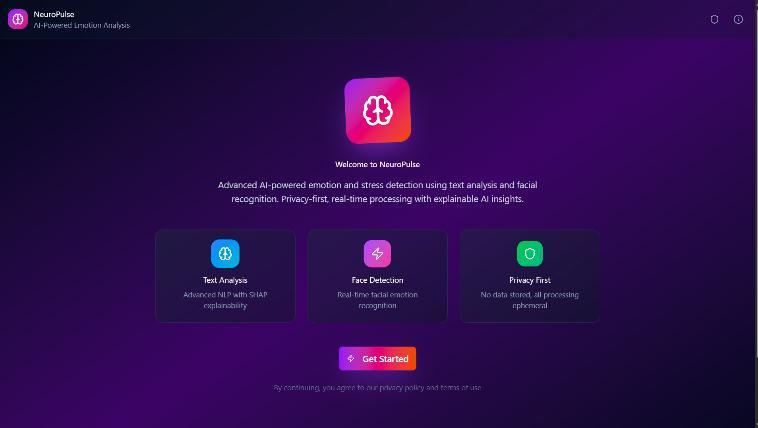
Fig - 1 presents the main interface of the Neuro Pulse system, highlighting the available emotion detection featuressuchastextanalysis,facialemotionrecognition, andprivacy-firstprocessing.
The text emotion analysis module enables users to submit natural language text for emotion detection, as illustrated in Fig - 2. The system processes the input using transformer-based Natural Language Processing models to capture semantic and contextual emotional cues.Experimentalobservationsindicatethatthesystem producesconsistentemotionpredictionsforemotionally expressive text, demonstrating effective contextual understanding.
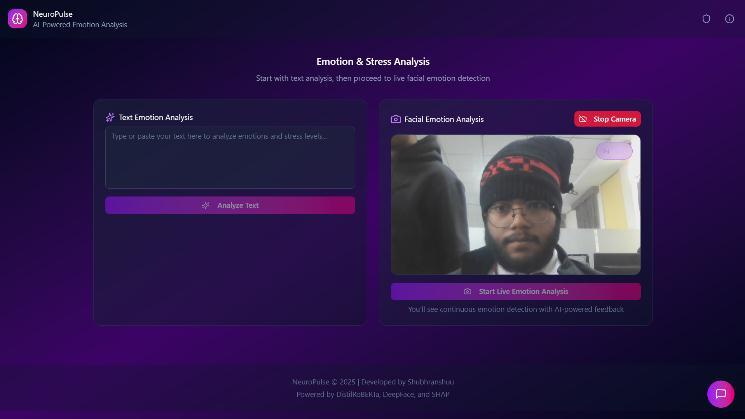
Live facial emotion detection is performed using realtimecamerainput,asshowninFig-3.Facialexpressions captured through the live video feed are analyzed using computer vision techniques combined with convolutional neural networks. The system accurately identifies basic facial emotions such as happiness and
International Research Journal of Engineering and Technology (IRJET) e-ISSN: 2395-0056
Volume: 13 Issue: 01 | Jan 2026 www.irjet.net p-ISSN: 2395-0072
neutrality along with corresponding confidence scores. Detection performance is influenced by factors such as lightingconditionsandfacialvisibility.
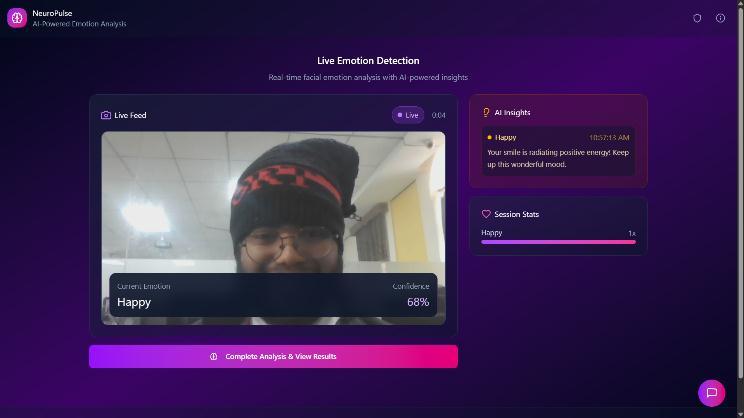
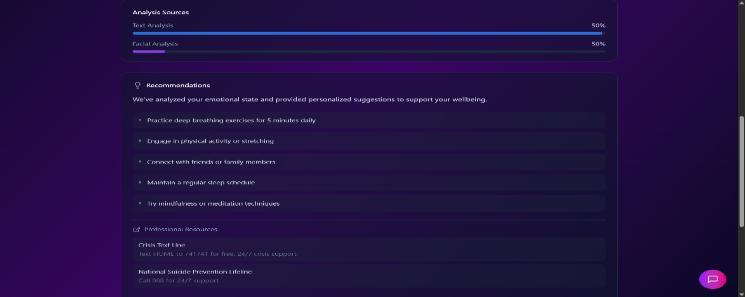
Fig-5:PersonalizedRecommendationsandUser FeedbackInterface
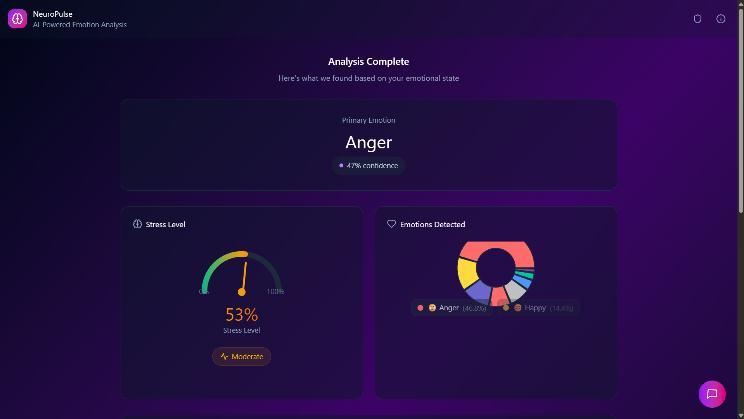
3) Emotion and Stress Analysis Results
Theemotionandstressanalysisdashboard,presentedin Fig - 4, provides a consolidated view of the detected emotionalstate.Thesystemidentifiesaprimaryemotion with anassociatedconfidencelevel and estimatesstress intensity based on emotional patterns observed during analysis. This visualization allows users to easily interpret emotional trends and stress indicators generatedbythesystem.
4) Personalized Recommendations and Feedback
Based on the detected emotional and stress levels, the system generates personalized recommendations to support emotional well-being, as shown in Fig - 5. Suggested activities include relaxation exercises, mindfulness practices, and social engagement. Additionally,a feedback mechanismis provided to allow userstoevaluatetheaccuracyoftheanalysis,supporting systemevaluationandfutureimprovements.
This paper presented Neuro Pulse, an AI-based multimodal emotion detection system capable of analyzing human emotions from text, speech, and facial expressions. The system successfully demonstrates the application of Artificial Intelligence techniques in multimodal emotion analysis using a modular and scalable architecture. Experimental results indicate reliableemotiondetectionundercontrolledconditions.
Future enhancements include implementing multimodal emotion fusion techniques for improved accuracy, optimizing the system for real-time processing, and incorporating ethicalandprivacy-awaremechanismsfor emotion-awareapplications.
Theauthorswouldliketoexpresstheirsinceregratitude to their project guide for continuous guidance and support throughout the development of this project. They also thank the faculty members of the Department of Artificial Intelligence and Machine Learning, Oriental Institute of Science and Technology, Bhopal, for providing the necessary academic environment and resources.
[1]R.W.Picard,AffectiveComputing,MITPress,1997.
[2]Z.Zengetal.,“ASurveyofAffectiveComputing,”IEEE Transactions on Pattern Analysis and Machine Intelligence,2009.
[3] J. Devlin et al., “BERT: Pre-training of Deep Bidirectional Transformers for Language Understanding,”NAACL,2019.
[4]I.Goodfellowetal.,DeepLearning,MITPress,2016.
[5]A.Krizhevskyetal.,“ImageNetClassificationwith DeepConvolutionalNeuralNetworks,”2012.