
International Research Journal of Engineering and Technology (IRJET) e-ISSN: 2395-0056
Volume: 12 Issue: 02 | Feb 2025 www.irjet.net p-ISSN: 2395-0072
International Research Journal of Engineering and Technology (IRJET) e-ISSN: 2395-0056
Volume: 12 Issue: 02 | Feb 2025 www.irjet.net p-ISSN: 2395-0072
Manju J1 , Sumalatha M S2
1Professor, Mahaguru Institute of Technology, Kayamkulam
2Associate Professor, Department of computer science and engineering, Mahaguru Institute of Technology, Kayamkulam
Abstract - Road traffic forecasting is the process of predicting future traffic conditions and patterns using data analysis. It is crucial for the better traffic management, safety enhancement, congestion reduction, and urban mobility. Current road transport forecasting approaches are limited by inaccuracies in real-time data, poor handling of complex traffic dynamics and unpredictable human behavior. In order to forecast traffic flows using radar and meteorological sensor data, this study evaluates the efficacy of three advanced deep learning approaches: convolutional neural networks (CNN), long short-term memory (LSTM) and autoregressive LSTM (AR-LSTM). The system demonstrated that they accurately predict traffic patterns by including weather as an essential element. The study shows how weather has a big influence on traffic flow, which makes it crucial for predictive modeling. In terms of computational efficiency and prediction accuracy, the CNN model performed better than both LSTM and AR LSTM. CNN demonstrated its suitability for real-time applications by achieving the lowest mean absolute error and require a small amount of execution time to create predictions. The study demonstrates the potential of these models to assist traffic management, which shows that it is feasible to estimate traffic flows with a high degree of accuracy across one-hour intervals. The importance of implementing advanced deep learning techniques for more intelligent and responsive traffic systems is highlighted by these findings.
Key Words Road traffic forecasting, convolutional neural networks, mean absolute error, deep learning.
Road traffic forecasting can optimize route planning, enhance decision-making, and improve overall transportationefficiency.Theriseintrafficcongestionisone ofthemainproblemsthatdrivers,highwayoperators,and municipalmanagersarecurrentlydealingwith.Itworsens thetravellerexperiencebyaddingcomplexitytoeveryday travelandhavingharmfuleffectsontheenvironment,users' time,andfinancialexpenses.Roadandcityoperatorsmay alsofinditusefultousetrafficflowforecastswhenputting trafficplanningandmanagementtechniquesintopractice. Trafficstateestimation(TSE)isthetechniqueofusingnoisy and partially observed traffic data to infer traffic state parametersuchasspeed,flow,andothersimilarfactors,on
road parts. Because the TSE topic is useful to public authorities,roadworkers,andthegeneralpeople,thereisa lotofinterestininvestigatingitintheITSfield[1].
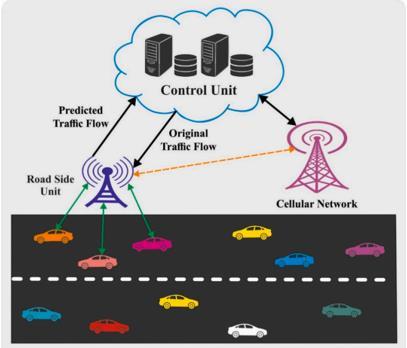
Roadtrafficsituationproblemsareatypicaloccurrenceinall majorcitiesglobally.Formorethan50years,governmental andprivateorganizationshaveworkedtoreducethesocial, economic, and environmental issues caused by traffic congestion. Three methods used to lessen the effects of traffic congestion: controlling traffic flows, promoting transportation alternatives, and building more infrastructure. The second is primarily a subject of public policies, while the first is constrained by topographical, financial,andsocialfactors.Thelatterhasbeenimproving steadily over the past few years due to the data growth provided by sensors in vehicles and roads, as well as the technology requiredforusingthatdata.Inordertocreate advanced traveller information systems (ATIS) and advancedtrafficmanagementsystems(ATMS),itishelpful tobeabletomonitor,analyze,andunderstandtrafficfactors likeflow,occupancy,ortraveltimes.Earlyinvestigationsof Kalman filtering techniques and time-series approaches using various approaches comprised the majority of the initial efforts to predict traffic flows. Figure 1 depicts the roadtrafficforecastingmodel.
Short-term prediction horizons have been used in many methods to forecast traffic features. The research community'sinterestinthisareahasgrownconsiderably,as have the availability of data, analysis techniques, and processing power. Predicting traffic details is one of the
International Research Journal of Engineering and Technology (IRJET) e-ISSN: 2395-0056
Volume: 12 Issue: 02 | Feb 2025 www.irjet.net p-ISSN: 2395-0072
pillarsofthedynamicfieldofresearch,policymaking,and technological development known as Intelligent TransportationSystems(ITS)nowadays.Inadditiontobeing storedinfrequentlyupdatedpublicrepositories,roadsensor dataisalsomadeavailablewithfine-grainedresolutionin the form of floating automobile data, people’s mobility traces,trafficcountsofbicycle,andtrafficsignaloperation conditions. Forecasting methods have developed at a comparablerate;whiletime-seriesanalysiscontinuestobea majorcomponentofthemostrecentresearchcontributions, machine learning approaches are also receiving a lot of interest. The use of simulation tools has increased. The proposed study evaluated the utilization of several DL approaches and data characteristics to predict traffic patterns.
Theaimsofthestudyareasfollows:
Toutilizedeeplearning(DL)methodssuchasLSTM, CNNandARLSTMfortheroadtransportforecasting effectively.
To access the system performance in terms of executiontimeandmeanabsoluteerror.
AhybridmultimodalDLframework(HMDLF)wasproposed byDuetal.[2]forpredictingshort-termtrafficflow.Within anauxiliaryattentionmechanism,themodelemployedgated recurrentunits(GRU)with1DCNN.WhiletheGRUmodelled longtemporalrelationships,theCNNextractedlocaltrend aspects.Inordertolearndeepnonlinearrelationsbetween trafficmodalities,includingspeed,flow,weather,andpass time, a multimodal representation and fusion learning frameworkwerecreatedusingseveralCNN-GRU-Attention modules.Thefindingsconfirmedthatthemodelperformed well in a range of traffic scenarios, including weekdays, weekends,andanomalies.Whenlearningspatial-temporal interdependenceandallowingforerrorsatpeakandtrough points, the method achieved good performance. However, limitations included reliance on large datasets and challengesincollectingdiversetrafficdata.
Essienetal.[3]developedaDLmodelusingabi-directional LSTM stacked autoencoder (SAE) for urban traffic prediction. It integrates tweets from traffic officials with weather and traffic data to enhance accuracy. Tested on Chester Road, Greater Manchester, UK, the model outperformed traditional machine learning methods. However, scalability remains a challenge due to high processing costs and uneven traffic sensor distribution, limitingitsapplicationtoasinglearterialroadratherthana broaderurbantrafficnetwork.Formosaetal.[4]introduced a DL approach with a centralized digital architecture to predicttrafficconflicts.Theycollecteddisaggregatedtraffic dataandin-vehiclesensordatafromtheUKM1motorway. Using an R-CNN model, they analyzed video data to track
vehicles and identify lane markers relative to the egovehicle.ADeepNeuralNetwork(DNN)wasthendeveloped by combining traffic factors like density and speed with surrogatesafetymeasures(SSMs)suchastime-to-collision (TTC).TheDNNachievedreal-timepredictionsat15Hzwith 94% accuracy, making it suitable for Advanced Driver AssistanceSystems(ADAS).Italsodemonstratedlowfalse alarm rates, with sensitivity ranging from 71% to 78%. However,themodel'srelianceonhigh-qualitysensordata andchallengesinmanagingvarioustrafficscenariosposed limitations.
Boukercheetal.[5]analyzedmachinelearning(ML)models for traffic prediction by categorizing them based on their theoreticalfoundationsandmodifications.RecurrentNeural Networks(RNNs),CNNs,andConv-RNNwerewidelyused, whileseq2seqandattention-basedarchitecturesimproved efficiency.CombiningGraph-ConvolutionalNetworks(GCNs) with attention-based seq2seq models effectively captured spatial and temporal correlations. However, predicting traffic on extensive road networks remained computationally expensive. Ahmed et al. [6] proposed a graph neural network-based on information fusion. By integrating temporal and geographical data into a graph structure, the model identified complex patterns in traffic flow. GNNs effectively captured spatial relationships, improving prediction accuracy. However, challenges includedtheneedforsubstantialdatasetsanddifficultyin preciselymodelingdynamictrafficconditions.
Ma et al. [7] proposed a neural network autoregressive integrated moving average (NN-ARIMA) model for traffic state prediction. By combining the ARIMA method with a neuralnetworkmultilayerperceptron,themodelextracted location-specific features and nonlinear traffic patterns while capturing network-wide co-movement trends. Validated on a six-month highway dataset, NN-ARIMA reducedmeansquarederror(MSE)by8.9–13.4%compared to standalone MLP and ARIMA models. However, it faced challengesinhandlinglargenetworksandlongtime-series datasets. Zhang et al. [8] proposed a Hybrid Graph Convolutional Network (HGCN) to forecast traffic flow at highwaytollstations,integratingdate-type,meteorological, spatial, and temporal factors. Using GCN, the model effectively captured the non-Euclidean nature of road networks.Resultsshowedimprovedaccuracyoverbaseline ML models. However, its static graph structure limited adaptabilitytodynamictrafficchanges.
Hu et al. [9] introduced the Spatial-Temporal Prediction Model Network (SPTMN) for traffic forecasting. By leveragingaTemporalConvolutionNetwork(2DTCN)and GCN, the model captured both global spatial relationships andtemporaldependencies.Itdemonstratedhighstability andadaptabilitytosuddentrafficspeedchanges.Baoetal. [10]developedaDeepBeliefNetwork(DBN)forprediction in adverse weather. Integrated with Support Vector
International Research Journal of Engineering and Technology (IRJET) e-ISSN: 2395-0056
Volume: 12 Issue: 02 | Feb 2025 www.irjet.net p-ISSN: 2395-0072
Regression, the model accurately mapped complex traffic relationships, maintaining a prediction error below 9%. However,itscomputationaldemandswerehigh.Panetal. [11]introducedtheFD-Markov-LSTMmethod,combininga fundamental diagram (FD), Markov chain, and LSTM for traffic state estimation (TSE) and prediction in congested anduncongestedconditions.Themethodlackedreal-world validation for nonrecurring delays and was unsuitable for long-termforecasting.
Currentroadtransportforecastingmodelsfacesignificant limitations.Theyrelyheavilyonlarge,high-qualitydatasets, which are challenging to collect due to the uneven distributionoftrafficsensorsandthehighcostsassociated withprocessingsuchdata[7].Mostmodelsarerestrictedto singlearterialroads,makingscalabilitytolargernetworks difficult. Furthermore, these systems struggle with computational expenses [5], especially when managing diverse traffic scenarios and simulating dynamic traffic patterns. While information fusion has enhanced spatial relationship modeling, it remains limited by insufficient datasetsanddifficultiesinhandlinglong-seriestrafficdata. Additionally, static graph structures hinder the models’ abilitytoadapttodynamictrafficchanges,underscoringthe needforscalable,data-efficient,andadaptiveapproachesto improveforecastingaccuracy[8].
Thedataareselectedfromthesurroundingareasofthetwo beachesthatwerechosentocustomizethemodeltoforecast thetrafficflowforPortugal'scoastalbeaches.Thedatasets from an ITS network created in the Portuguese city were usedforthispurpose,makinguseoffield-installedroadside infrastructuresensors.TSEmodelsweretrainedusingML methods,especiallyLSTM,AR-LSTM,andaCNN,topredict thetrafficflowonPortugal'stwodistinctcoastlinebeaches suchasBarraandCostaNova.
Therelevanceoftheprovideddatatosupporttheinduction ofthepredictionmodelswasthenassessed.Thedatasetsare fromtwodistinctsources.Figure2(a)and(b)visualizethe radarandmeteorologicalstationlocations.Thelocationsof the radars are shown in Figure 2 (a). The first one takes placebeforecrossingthebridge,themiddleonetakesplace in the interconnected segment between Costa Nova and Barraandthelastonetakesplacenearthesouthernedgeof theCostaNova.Thetwometeorologicalstationsgathering environmental information areshowninFigure2(b).For every hour of the day, each record corresponds to one observationeverytenminutes.Twomainobjectivesinthe processing of the meteorological data: correcting the stations'missingmeasurements,andconvertingthevalues ofwinddirectionfromdegreestocardinals.
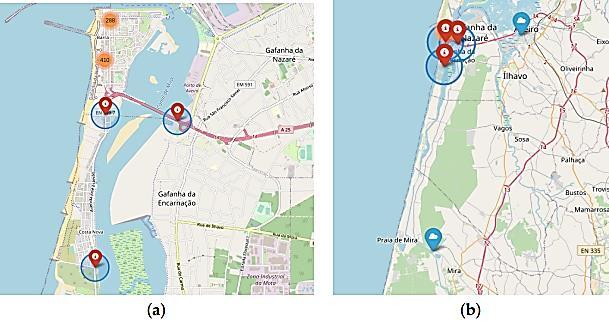
Fig - 2: PASMOradarandmeteorologicalstationlocations (a)radarand(b)meteorologicalstationsandradars
Figure 3 depicts the process for handling the traffic flow predictiononPortugalbeaches.Parkingandradarsarethe twodatasetstakenfromtelemetrydataset,whichcontains therecordingsfromradarsandparkingsensors.Afterthat data preprocessing is done to obtain the radar and meteorological data for the mining process. The preprocessed data are combined into a single dataset for the miningtask. Thedataminingapproachesprocessedthedata inthemodeltrainingphaseacrosstheCNNandLSTM.
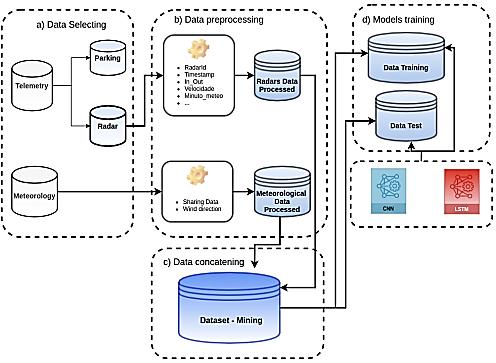
Fig - 3: Datapreparationandmodeltrainingmethod
3.1 Dataset
Over 170 million recordings (170,158,409) from parking sensors and radars make up the original Telemetry collection,whichconsidertheyears2019,2020,and2021. Onlyradardatawerechosenforthisstudyandthefeatures oftheoriginaldataareillustratedinTable1.Inthisstudy, thePortugueseInstituteofSeaandAtmospheresuppliedthe weatherdataset[12].
Table – 1: Originaldataattributes
Attribute Content timestamp Recordtimestamp id ObjectID radar_id Radaridentification radar_lon Longituderadarcoordinate radar-lat Latituderadarcoordinate yspeed Speedcomponent:Y-axis xspeed Speedcomponent:X-axis
International Research Journal of Engineering and Technology (IRJET) e-ISSN: 2395-0056
Volume: 12 Issue: 02 | Feb 2025 www.irjet.net p-ISSN: 2395-0072
The meteorological data is produced at a frequency of 10 minutes, while the radar data is created at a frequency of 100 milliseconds. Other derived radars data such as day, month, year, hour, and minute attributes, were generated prior to modifying the granularity. The speed measure is generated by the and features. Positive valuesforspeedindicateanobjectmovingaway,whereas negativevaluesindicatethespeedofanobjectsimilartothe radar.Foreachradar,thequantityandspeedatthelevelof radararedeterminedusingthespeedandmovingobject’s direction.


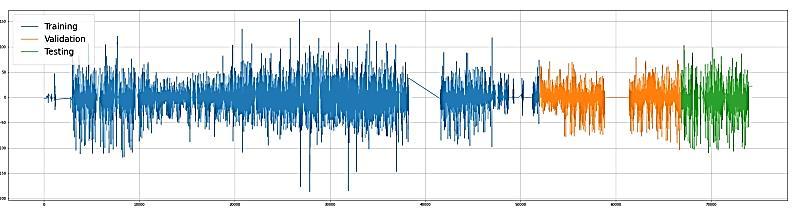
includes contextual information including weekday, temperature, solar radiation, wind direction and speed. Figure 4 represents the splitting of entire dataset into subsets,timeinx-axisandtrafficflowvaluesiny-axis.
Inordertogenerateasingleset,thetwodatasetsmustbe combined, as depicted in Figure 3. The following characteristics were taken into account as indexes while concatenating: year, month, day, hour, and minute. As a result, every record in the final dataset is made up of attributes that represent the radar and weather measurementsaswellasindexcolumns.


Theaimofthisstudyistomakeanapproachthatcanpredict trafficflowinbothregionstakingintoaccounttheweather andspeedofthevehicle.Thetrafficflowisrepresentedby two measures such as and expressedinEquation(1)to(4).

where isthenumberoftheobjectsapproximatingthe radar and isthenumberofdetachingobjects.





Where = radar identification, = interval minute ranges from 1 to 50, = value of the attribute where =1, = value of the attribute where =0.

If value is positive, then it represents the traffic flow increaseinthatregion,andifitisnegative,thenregionhas lesstrafficflow.
Training,validation,andtestingsetswerecreatedfromthe finaldatasetthatwaspre-processedintheearlierstagesand aredividedintheratio70:20:10respectively.Thedataset
For predicting the traffic flow, three DL regression techniquessuchastermmemoryLSTM,ARLSTM,andCNN, andMAEwasutilizedasanevaluationmetric.Theoptimal configuration, which was determined by an optimisation phaseutilisingthehyperparameteroptions,wastakeninto accountwhenbuildingeachmodel.Sixdistincttimeintervals weretakenintoconsiderationforeachmethod:(1,1),(2,2), (3,3),(4,4),(5,5),and(6,6).In(1,1),therewasonehistorical record (ten minutes) and one forecasted traffic flow (ten minutes).Asaresult,thisstudyusesamulti-stepmodelto estimatetrafficflowbetween10and60-minutes.Singleand multi-modelsareillustratedinFigure5
A layer with 64 filter maps, a ReLU function, and a kernel sizeequaltothetimeintervalvaluewereusedtobuildthe CNN model. The number of nodes was calculated by multiplying the number of features with the time interval value. The format was finally altered by the final layer to showtheexpectedtrafficflowstatistics. (a) (b)
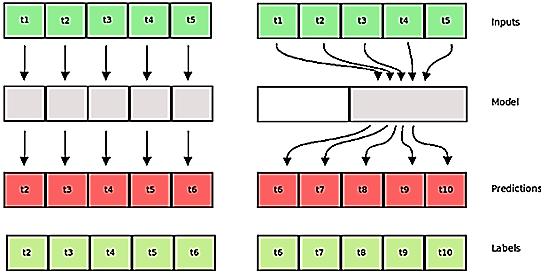
Fig - 5: (a)Singlestep(b)multistep
Time-series datasets have been analysed using the LSTM method,whichsuggeststocalculatethepredictionforthe subsequent time gap after accumulating the internal state throughoutthetimeinterval.32neuronsmadeupthefirst layeroftheLSTMmodelusedinthisstudy.Inthesequence, therewasadenselayerthathadthesamesetupastheCNN. Todisplaytheanticipatedtrafficflowvalues,thelastlayer transformstheformat.InAR-LSTMapproach,theprediction
International Research Journal of Engineering and Technology (IRJET) e-ISSN: 2395-0056
Volume: 12 Issue: 02 | Feb 2025 www.irjet.net p-ISSN: 2395-0072
was decomposed into individual time steps. The method useseachmodeloutputtofeedbackintoitself.
An Intel(R) Xeon(R) CPU E5-2620 v4, a CPU frequency of 2100 MHz, and a RAM having a capacity of 16GB running Ubuntu20.04.4 (LTS),wasusedtotestthedatarelatedto both beaches. The tests were conducted in a server of an operatingsystem,remotelyscheduledviaSSH.Additionally, equivalentintervalswereutilized,rangingfromasingletenminuteblocktosix10-minuteblocksandpredictedthenext 10-minutesduringa10-minutebreakandthenexttwenty minutesduringatwenty-minutebreak,untilreachedsixty minutes.
CNN, LSTM, and AR-LSTM were the techniques employed andthetestswereruntentimesforeachinterval,evaluate theexecutiontimeandMAE.Eachoftheseparameters'mean and standard deviation were determined. The CNN technique test results for both beaches are displayed in Table2.
ForBarraBeach,thetestwithaten-minuteinputandoutput gives the best performance with the lowest MAE and executiontime.ForCostaNovaBeach,thelowestMAEisalso achievedwithaten-minuteinputandoutput,butthebest execution time is observed with a sixty-minute input and output.
Table - 2:CNNresults
Table3representstheoutcomesofthetestobtainedwith the LSTM model to both beaches. Although tests with identicalinputandoutputequivalentto60-minuteshavea reducedstandarddeviation,themethodobtainedthelowest MAEforthirty-minuteperiodsusingtheLSTMapproachfor Barra traffic. Ten-minute intervals yielded the lowest average execution time. The best outcomes for MAE and execution time were obtained using Costa Nova testing at ten-minuteintervals.Withexecutiontimesvariesfrom15to
32 minutes, LSTM experiments enabled to acquire MAE values between 13% and 15%. The interval increases maintain MAE values within the same range even when executiontimesincrease,considertheincreaseaspointless.
Table4representstheresultsofARLSTMapproachonboth beaches.InthecaseofBarrabeach,thetestswithinputand outputtimesof30and40minuteshadtheminimumMAE. The tests with the smallest standard deviation have input andoutputtimesoffortyminutes.InthecaseofCostaNova beach,wheninputandoutputareequalto30minuteshad the best MAE average result. It is noteworthy that the periodswiththegreatestresultsforaverageexecutiontime andMAEaveragearethesameforbothbeaches.
Table - 4:ResultsofARLSTM
BasedonmeteorologyandthedataproducedbytheIPMA andPASMOproject,aTSEwasconstructedtoforecastthe accesstraffictoboththebeaches.Severalapproacheswere
International Research Journal of Engineering and Technology (IRJET) e-ISSN: 2395-0056
Volume: 12 Issue: 02 | Feb 2025 www.irjet.net p-ISSN: 2395-0072
attempted during the learning process to see which produced the best outcomes in terms of complexity and error. In order to maximize the total learning outcomes, several forecasting and learning periods were also employed.
TestsoftrafficpredictionutilizingCNN,LSTM,andAR-LSTM techniques showed the best execution times and interval
6:
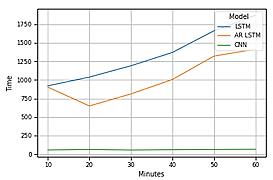
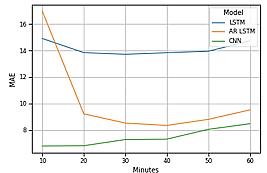
lengthsforaccuracy(MAE).WhileCostaNovahadthebest MAEwith10-minuteintervalsbutfasterexecutionwith60minuteintervals,Barra trafficexhibitedthe bestMAEand executiontimeforCNN.Figure6depictstheMAEevolution ofCostaNovaandBarrabeachesandFigure7visualizethe execution time of Costa Nova and Barra beaches.
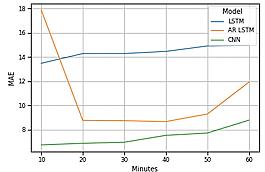
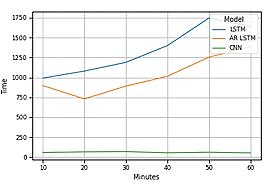
Fig – 7: ExecutiontimeevolutionofBarra(a)andCostaNova(b)prevision
ThegraphsinFigures7aand7billustratethebenefitsof usingaCNNapproachfortrafficforecastingbyanalyzing dataonaglobalscale.
Road traffic forecasting is the process of predicting traffic conditionsusingvehicleflow,historicaldata,weatherand different models to progress the traffic flow and management. Using weather data to increase forecast accuracy,thisstudydemonstratesthepromiseofDLmethod forroadtrafficforecasting.WiththelowestMAEandfastest execution times, CNN surpassed the other three methods such as LSTM, AR-LSTM, and CNN, during learning and predicting intervals of ten minutes. These intervals are appropriateforreal-timeapplicationssincetheyobtaineda balancebetweencomputationalefficiencyandprecision.The
resultshighlighthowimportantitistoselectthebesttime windows for various methods. CNN's accuracy and speed performance highlight how well-suited it is for dynamic traffic conditions when timely updates are essential. In conclusion, a robust framework for real-time traffic forecasting is provided by DL techniques, especially CNN. Withminimalcomputingeffort,theycanbeusedtosupport smartcityprojectsandregulatetrafficflow.
1. Xu, D., Wei,C., Peng, P., Xuan,Q., &Guo,H. (2020). GE-GAN:Anoveldeeplearningframeworkforroad trafficstateestimation.TransportationResearchPart C:EmergingTechnologies,117,102635.
2. Du,S.,Li,T.,Gong,X.,&Horng,S.J.(2020).Ahybrid methodfortrafficflowforecastingusingmultimodal
© 2025, IRJET | Impact Factor value: 8.315 | ISO 9001:2008 Certified Journal | Page362
International Research Journal of Engineering and Technology (IRJET) e-ISSN: 2395-0056
Volume: 12 Issue: 02 | Feb 2025 www.irjet.net p-ISSN: 2395-0072
deeplearning.Internationaljournalofcomputational intelligencesystems,13(1),85-97.
3. Essien,A.,Petrounias,I.,Sampaio,P.,&Sampaio,S. (2021).Adeep-learningmodelforurbantrafficflow prediction with traffic events mined from twitter.WorldWideWeb,24(4),1345-1368.
4. Formosa, N., Quddus, M., Ison, S., Abdel-Aty, M., & Yuan,J.(2020).Predictingreal-timetrafficconflicts using deep learning.Accident Analysis & Prevention,136,105429.
5. Boukerche,A.,&Wang,J.(2020).Machinelearningbased traffic prediction models for intelligent transportation systems.Computer Networks,181, 107530.
6. Ahmed,S.F.,Kuldeep,S.A.,Rafa,S.J.,Fazal,J.,Hoque, M.,Liu,G.,&Gandomi,A.H.(2024).Enhancementof traffic forecasting through graph neural networkbased information fusion techniques.Ma, T., Antoniou, C., & Toledo, T. (2020). Hybrid machine learningalgorithmandstatisticaltimeseriesmodel for network-wide traffic forecast.Transportation ResearchPartC:EmergingTechnologies,111,352372.
7. Ma, T., Antoniou, C., & Toledo, T. (2020). Hybrid machine learning algorithm and statistical time series model for network-wide traffic forecast.TransportationResearchPartC:Emerging Technologies,111,352-372.
8. Zhang, T.; Ding, W.; Chen, T.; Wang, Z.; Chen, J. A Graph Convolutional Method for Traffic Flow Prediction in Highway Network. Wirel. Commun. Mob.Comput.2021,2021,1997212.
9. Hu,Z.;Sun,R.;Shao,F.;Sui,Y.Anefficientshort-term traffic speed prediction model based on improved TCNandGCN.Sensors2021,21,6735.
10. Bao, X., Jiang, D., Yang, X., & Wang, H. (2021). An improveddeepbeliefnetworkfortrafficprediction consideringweatherfactors.AlexandriaEngineering Journal,60(1),413-420.
11. Pan,Y.A.,Guo,J.,Chen,Y.,Cheng,Q.,Li,W.,&Liu,Y. (2024). A fundamental diagram-based hybrid frameworkfortrafficflowestimationandprediction by combining a Markovian model with deep learning.Expert Systems with Applications,238, 122219.
12. https://www.ipma.pt/en/produtoseservicos/index.j sp
2025, IRJET | Impact Factor value: 8.315 |