
International Research Journal of Engineering and Technology (IRJET) e-ISSN: 2395-0056
International Research Journal of Engineering and Technology (IRJET) e-ISSN: 2395-0056
M. Rabinath1 , P. Navenkumar2, T. Navenkumar3 , Dr. P. Selvakumar4 , Dr. K. Mareesan5
1,2&3
Final year Mechanical Engineering Students, Kongu Engineering College, Erode, Tamilnadu, India.
4Head&Professor/Mechanical Engineering, Kongu Engineering College, Erode, Tamilnadu, India.
5Lecturer(SG-II)/EEE, VSVN Polytechnic College, Virudhunagar, Tamilnadu, India.
Abstract - In the face of climate change, it has become increasingly important for all sectors to take action to reduce their carbon emissions. One sector that plays a crucial role in this effort is education. We have conducted a case study for analyzing the presence of carbon emissions in our college. In this article, we will explore various strategies that our college can implement to reduce their carbon footprintandfosteragreenereducationalenvironment.This case study investigates the CO₂ emissions at Kongu Engineering College, identifying the primary sources and proposing measures for reduction. The energy consumption, transportation, and garbage generation of educational institutions, owing to their expansive campuses and elevated activity levels, greatly contribute to the contamination of CO₂. The purpose of this study is to estimate the institution's carbon footprint by examining waste management procedures, staff and student travel habits, and energy use in buildings. According to the research, the two biggest sources of emissions are power generated by fossil fuels and extensive car usage. The findings suggest a number of mitigating techniques, such as switching to renewable energy sources like solar power, encouraging the use of electric vehicles and public transportation, putting energy-efficient technology into practice, and enhancing garbagerecyclinginitiatives.Byadoptingthesemeasures, Kongu Engineering College can reduce its carbon footprint, promote a more sustainable campus environment, and serve as a model for other educational institutionsaimingtoachievecarbonneutrality.
Key Words: Carbon emissions, CO2, Renewable energy sources.
There have been numerous studies focused on trends and challenges in reducing these emissions in almost all sectors, from global industrial activities to more localized initiatives, such as college campuses. The authors identified key regions contributing to emissions and analysed how these factors influenced global climate change, emphasizing the urgency of international climate agreements to mitigate the growing emissions problem[1]. A detailed analysis of global CO₂ emissions trends, highlighting the major emittingcountriesandregionsispresented. The report
covered both historical and contemporary data, revealingsignificantincreasesinemissions,particularly from developing countries[2}. The relationship between culture, income, and CO₂ emissions, investigating how societal values and economic development influenced environmental impact was explored. The study analysed data across various countries, showing that higher income levels often correlated with increased emissions[3]. A review was done for CO₂ measurement procedures used in ventilation research, assessing the reliability and effectiveness of different methodologies. The authors compared techniques such as direct and indirect CO₂ measurement, discussing their implications for indoor air quality studies. They emphasized the importance of accurate CO₂ measurements in ensuring proper ventilation, particularly in indoor environments, to maintain healthy air quality standards[4]. A new instrumental concept was proposed for measuring CO₂ concentration in the atmosphere, utilizing space-based technology. The paper discussed the technical aspects of sensors and satellite systems designed for highprecisionatmosphericCO₂ measurement[5&6]. Astudy reviewed the sources and health impacts of pollutants suchasparticulatematter,nitrogenoxides,andsulphur dioxide, with a focus on their interaction with CO₂ emissions[7&9]. The authors analysed various energyefficientpracticesandtechnologiesimplementedonthe campus, such as renewable energy adoption and efficient energy management systems[8]. A study exploredhowvariousecosystems,includingforestsand grasslands, responded to increasing CO₂, temperature, and other environmental changes. The authors emphasized that ecosystem responses were complex[10]. Investigation have been made for indoor and outdoor air quality in schools across HongKong, focusing on pollutants like CO₂, particulate matter, and volatile organic compounds[11]. Analysis is carried out for the impact of CO₂ concentrations on indoor air quality in Serbianschoolbuildingsandexploredcorrelationswith relativehumidityandtemperature[12] Anassessement isdonerecentadvancesinmeasurementtechniques for atmospheric CO₂ and methane observations[13] A study revealed seasonal and yearly variations in CO₂ fluxes, withtheforestactingasacarbonsinkmostofthetime. Itdiscussedtheimportanceoflong-termmeasurements to understand forest carbon dynamics and their role in
Volume: 12 Issue: 01 | Jan 2024 www.irjet.net p-ISSN: 2395-0072 © 2025, IRJET | Impact Factor value: 8.315 | ISO 9001:2008 Certified Journal | Page95
International Research Journal of Engineering and Technology (IRJET) e-ISSN: 2395-0056
Volume: 12 Issue: 01 | Jan 2024 www.irjet.net p-ISSN: 2395-0072
mitigating global CO₂ emissions[14]. A study analyzed energy consumption patterns and corresponding emissions,linkinghighlevelsofCO₂andotherpollutant to adverse health effects on workers[15]. A study explored the potential risks of CO₂ toxicity on human health in the context of climate change. The study highlighted that while CO₂’s role in climate change was well known, its direct effects on human health at elevated concentrations were often over looked[16]. A study explored various renewable energy technologies and their feasibility in replacing fossil fuels to enhance energy sustainability. The authors concluded that integrating multiple renewable sources could significantly reduce CO₂ emissions while ensuring a stable and sustainable energy supply[17]. A study found that countries with higher economic and environmental sustainability tended to have lower emissions, emphasizing the role of policy-driven approaches to achieving emission reductions[18]. A study explored political, economic, and environmental factors influencing emissions reduction efforts, highlighting differences in policy approaches and cooperation among these countries[19]. A case study evaluated energy- efficient technologies and sustainable practices implemented on the campus to reduce CO₂ emissions. The study demonstrated how educational institutions could serve as models for sustainability, showing that net-zero development was achievable through renewable energy integration, energy-efficient buildings, and effective resource management[20].
2.1 Problem Identification
Likemanyothersizableeducationalestablishments, Kongu Engineering College contributes significantly to the community by offering high-quality instruction and encouragingtechnologicalinnovation.Butthecampus's environmental effect increases along with its size and activity level, especially in terms of CO₂ emissions. The energy used by campus buildings for lighting, air conditioning, and electronic equipment; the emissions from everyday staff, professor, and student commutes andwastemanagementproceduresarethemaincauses of the institution's carbon footprint. The college contributes significantly to global climate change by its reliance on conventional electricity derived from nonrenewable sources, wasteful resource use, and conventional transportation patterns. To determine their scope and create workable mitigation plans, it is essentialtoidentifyandmeasuretheseemissions.
2.2 Objective
This study's main goal is to evaluate and examine the CO₂ emissions at Kongu Engineering College's(Fig3.1) various operational activities produce. The research will point out inefficiencies in the organization's current processes and suggest workable solutions to lower emissions overall. Measuring CO₂ levels in various campus facilities and evaluating building energy use and pin pointing high-demand locations are some of the specific goals. The study will identify inefficiencies in current systems and propose actionable measures to reduce the institution's over all emissions.
Specificobjectivesinclude:
MeasuringindoorCO₂levelsacrossvarious campusfacilities.
Analysingemissionsfromstudentandstaff transportation.
Makingremarksfortheanalyseddata
3. METHODOLOGY
Thestudyfollowsamulti-stepmethodologyto gatherdata,calculateemissions,andperformadetailed analysis.
3.1 Process Flow
The process of identifying the problem is starts form determining the sources of occurrence, for the progressinitialisationthelocationisfirstchosenwisely and started the reading. The process flow is mentioned intheflowchart(Fig.1.):
Study about the location
Get reading of CO2 concentration
Data Analysis
Finding causes for air contamination
Suggest Measures to reduce CO2
Fig. 1. Methodology of Case Study
International Research Journal of Engineering and Technology (IRJET) e-ISSN: 2395-0056
Volume: 12 Issue: 01 | Jan 2024 www.irjet.net p-ISSN: 2395-0072
To keep an eye on air quality, sensors are positioned strategically throughout buildings such as offices, labs, dorms, and classrooms. Data is gathered over a predetermined time period in order to identify patternsrelatedtooccupancyandventilationefficiency inthedevice(Fig.2).

The measurement of CO₂ emissions at Kongu Engineering College was carried out by gathering data on energy consumption, transportation activities, and waste management. Energy consumption data was collected from monthly utility bills, focusing on electricityusageinacademicbuildings,laboratories,and residential facilities. To convert this data into CO₂ equivalents, emission factors provided by national authorities were used, based on the type of energy consumed (e.g., coal based electricity or renewable sources). Transportation emissions were estimated through a survey of students, faculty, and staff, which assessed commuting distances, vehicle types, and fuel used. Waste management data, including the volume of wastesenttolandfills,recycled,orincinerated,wasalso analysed. Emission factors were applied to waste generation data to calculate the Carbon foot print associatedwithwastedisposal.Thisholisticapproachto data collection enabled an accurate estimation of the institution’stotalCO₂emissions.
Energy use, transportation patterns, and waste managementanalysesoftheinstitutionwereconducted to determine its major sources of CO₂ emissions. The major source of carbon was the fossil fuel-based electricity dependence by the university in powering buildings and laboratory equipment. There existed a weakusageofrenewableresourcesforenergyandalso
inefficient usage, thereby resulting in a higher level of emissions. Transportation is another main emission source that was indeed the case as a significant percentage of the campus population commutes using private vehicles running on gasoline or diesel. The absence of extensive recycling programs and reliance on landfills as the primary mode of waste disposal added further to increasing the CO₂ emissions. The factors mentioned were pointed out as main sources of CO₂contaminationwithintheinstitution.
The collected data revealed Kongu Engineering College has an enormous carbon footprint majorly caused by the energy consumption and transportation sectors. This study showed urgency on the grounds of energy management and transportable as well. Although there are quite many systems in place for waste management, lack of proper recycling infrastructure and mishandled segregation of wastes were great problems noticed. Dependence on conventional energy sources along with the growing populace on campus calls for animmediate shift in this institution towards cleaner energy solutions. It would suggest that, as of now, present practices are not alignedtothepurposesofsustainabledevelopment.
In light of the above findings, the following are some measures that would reduce the contribution of KonguEngineeringCollegetoCO₂emissions.Renewable sources of energy such as installation of solar panels and wind energy would substantially reduce the presence of fossil fuel use. Better Energy Efficiency Improvement in energy consumption can be achieved by using LED lights, intelligent building systems, and upgradinginsulationforoldbuildingswouldreducethe absolute level of energy use. These improvements will begin to show with environmentally conscious policies for transport, like heightened awareness and increase of public transport, carpooling, and electric automobile vehicles. Bike-friendly infrastructure development is also encouraged to encourage non- motorized commuting. Waste management gets improved due to the expanded recycling programs, introducing composting for organic wastes, and trying to reduce it to a minimal usage of landfills. All the measures, when enacted, will reduce the carbon footprint of the institution to a significantly lower degree and ensure sustainabilitywithinthecampusenvironment.
Volume: 12 Issue: 01 | Jan 2024 www.irjet.net
The quality of air is measured in the atmosphere of various location within the campus and register as carbon dioxide contamination in parts per million (ppm). The greencoverareasarenotedandtakenintoaccountforthe causeanalysis.
The final result table 4.1 lists the carbon dioxide readingforeachmeasuredlocations.
Table4.1:MeasurementofCarbonDioxideinKongu EngineeringCollege
Location
International Research Journal of Engineering and Technology (IRJET) e-ISSN: 2395-0056
Volume: 12 Issue: 01 | Jan 2024 www.irjet.net p-ISSN: 2395-0072
Hostel4 (Illango& Kamban)
Hostel6 (Ponnar& Sankar)
GasStove, Idly Steamer, RiceBoiler
GasStove, Idly Steamer, RiceBoiler
The quality of the air is finally analysed by auditing the contamination of carbon dioxide in the atmospheric air around the campus. The concentration of CO₂in air iscompared with anaccepted standardsofCO₂ contamination in ppm after limiting some levels of concentrationofCO₂inair.
The acceptable level of CO₂ concentration varies depending on the purpose of each location in an engineering institution, particularly with regard to indoorairqualityandoccupantcomfort.Whileoutdoor atmospheric CO₂ concentrations generally over around 400-450 parts per million(ppm),indoor spaces often have higher concentrations due to human activities, equipmentuse,andventilationsystems.
4.4.1 Class rooms and Lecture Halls
Acceptable CO₂ Levels: 600 –1,000ppm
CO₂ concentrations above 1,000 ppm may indicate inadequate ventilation and can lead to drowsinessandreducedcognitive performance.Proper ventilation systems, such as natural airflow or mechanical HVAC, should maintain levels under 1,000 ppm.
4.4.2 Laboratories
Acceptable CO₂ Levels: 600 –1,000ppm
Due to the high usage of equipment and varying occupancy, lab scan have fluctuating CO₂ levels Effective ventilation is crucial to prevent the accumulation of harmful gases, including CO₂, especiallyinchemicalorbiologicallabs.
4.4.3 Computer
Acceptable CO₂ Levels: 600 –1,000ppm
These spaces often have high energy use from computingequipmentandservers.CO₂levelsshouldbe maintained within the range to avoid discomfort and ensurethatthesystemdonotcompromiseairquality.
4.4.4
Acceptable CO₂ Levels: 500 –1,000ppm
In residential spaces, higher CO₂ levels can be common at night due to poor ventilation when windows are closed, Levels over 1,000 ppm may indicate inadequate air exchange and should be addressedbyimprovingairflow.
4.4.5 Administrative Offices
Acceptable CO₂ Levels: 500 – 800 ppm
Offices are typically smaller spaces with fewer occupants, so CO₂ levels tend to be lower. However, withpoorventilationorhighoccupancy,levelsmayrise above800ppm,affectingproductivity.
4.4.6 Libraries
Acceptable CO₂ Levels: 500 – 800 ppm
In spaces designed for concentration CO₂ levels should ideally be kept low. Prolonged exposure to concentrations above 800 ppm can reduce focus and cognitivefunction.
4.4.7 Cafeterias and Dining Areas
Acceptable CO₂ Levels: 600 – 1000 ppm
These spaces see high traffic during meal times, so ventilation should be adequate to maintain CO₂ levels below1,000ppmtoavoiddiscomfort.
4.4.8 Conference Halls and Seminar Halls
Acceptable CO₂ Levels: 600 – 1000 ppm
Similar to class rooms, these areas often host large groups of people, which can rapidly increase CO₂ levels. Effective ventilation is crucial to keep CO₂ levels within acceptable limits, asconcentrations above1,000 ppmcancausediscomfortandreduceattention.
4.4.9 Server Rooms and Data Centers
Acceptable CO₂ Levels: 400 – 600 ppm
Server rooms typically need to maintain low CO₂ levels to ensure equipment functions properly. These rooms are generally well- ventilated with cooling systemsthathelpmaintainlowCO₂concentrations.
4.5 Graphical Data Representation
The comparison of CO₂ concentration in various locationswithinthecampusisshownasbargraphinFig 3
International Research Journal of Engineering and Technology (IRJET) e-ISSN: 2395-0056
Volume: 12 Issue: 01 | Jan 2024 www.irjet.net p-ISSN: 2395-0072
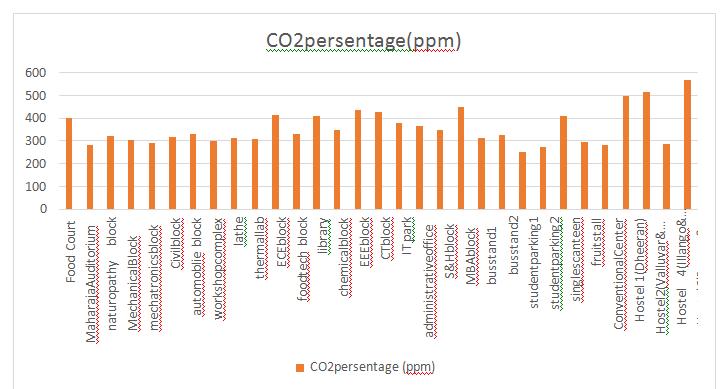
Fig.3:OveralldataofCO2 reading
Identificationofmeasures needtobeidentified for treating the elevated concentration of carbon dioxideintheairovertheperiodoftime.
With the same activities which involves high carbon dioxide emission taking place the concentration remain increasing and a controlled usageofthoseactivitiesareneedtobeempathised.
Identification of different ways to achieve less carbondioxideemissionforthenecessaryevents.
Waysforclearingthesourceofproducinghuge quantityofcarbondioxideintotheatmosphere.
Creating awareness against extra polating the usage of activities which tends to produce huge amount of carbon dioxide into the atmosphere, and letting them to know about the limitations of the utility.
This case study highlights the significant role educational institutions, such as Kongu Engineering College, play in contributing to CO₂ emissions through their various operations, including energy consumption, transportation and waste management. As centres of learning and innovation, engineering collegeshaveboththeresponsibilityandopportunityto lead by example in the fight against climate change. By transitioning to renewable energy sources, enhancing energy efficiency, promoting sustainable transportation and improving waste management practices, institutions can significantly reduce their carbon footprint. Implementing these changes not only mitigates the environmental impact but also fosters a culture of sustainability within the campus community, preparing future engineers and leaders to prioritize environmental stewardship. The implementation of these measures not only benefits the environment but also fosters a culture of sustainability, setting an example for students, faculty, and staff to adopt eco-
friendly practices in their daily lives. On the final report the analysation of the data from the table is further remarked on the bases of the carbon dioxide contamination and then listed the sources of the possibleCO₂emissionactivities.
[1] Friedlingstein, P., Houghton, R. A., Marland, G., Hackler, J., Boden, T. A., Conway, T. J.,& Le Quéré, C. (2010). Update on CO₂ emissions. Naturegeoscience, 3(12),811-812.
[2] Olivier, J. G., Peters, J. A.,& Janssens-Maenhout, G.(2012).TrendsinglobalCO₂emissions.2012 report.
[3] Disli, M., Ng, A., & Askari, H.(2016). Culture, income, and CO₂ emission. Renewable and SustainableEnergyReview ,62,418-428.
[4] Mahyuddin,N.,&Awbi,H.(2012).AreviewofCO₂ measurement procedures in ventilation research. International Journal of Ventilation, 10(4),353-370.
[5] Ekwurzel, Brenda, et al. "The rise in global atmospheric CO₂, surface temperature, and sea level from emissions traced to major carbon producers." Climatic Change 144.4(2017):579590.
[6] Buil,C.,Pascal,V.,Loesel,J.,Pierangelo,C.,Roucayrl, L.,&Tauziede,L. (2011,October). A new space instrumental concept for the measurement of CO₂ concentration in the atmosphere. In Sensors, Systems, and Next- Generation Satellites XV (Vol.8176,pp.535-545).SPIE.
[7] Saxena,P., & Sonwani,S. (2019). Criteria air pollutants and their impact on environmental health (Vol. 1, No. 1). Singapore: Springer Singapore.,
[8] Abdul-Azeez,I.A., & Ho,C.S.(2015).Realizing low carbon emission in the university campus towards energy sustainability. Open Journal of EnergyEfficiency, 4(2),15-27.
[9] Rosa, L. P.,& Ribeiro, S. K. (2001). The present, past, and future contributions to global warming of CO₂ emissions from fuels. Climatic Change, 48(2),289-307.
[10] Norby, R. J.,& Luo, Y. (2004). Evaluating ecosystem responses to rising atmospheric CO₂ and global warming in a multi‐factor world. New phytologist, 162(2),281-293.
International Research Journal of Engineering and Technology (IRJET) e-ISSN: 2395-0056
Volume: 12 Issue: 01 | Jan 2024 www.irjet.net p-ISSN: 2395-0072
[11] Lee, S. C., & Chang, M.(2000). Indoor and outdoor air quality investigation at schools in HongKong. Chemosphere, 41(1-2),109-113.
[12] Lazović, I. M., Stevanović, Ž. M., JovaševićStojanović,M.V.,Živković,M. M., & Banjac, M.J. (2016). Impact of CO₂ concentration on indoorairqualityand correlation with relative humidity and indoor air Temperature inschoolbuildingsinSerbia. Thermal Science, 20(suppl.1),297-307.
[13] Zellweger, C., Emmenegger, L., Firdaus, M., Hatakka, J., Heimann, M., Kozlova, E., ... & Buchmann, B. (2016). Assessment of recent advances in measurement techniques for atmospheric carbon dioxide and methane observations. Atmospheric Measurement Techniques, 9(9),4737-4757.
[14] Carrara, A., Kowalski, A. S., Neirynck, J., Janssens,I. A., Yuste, J. C.,& Ceulemans, R. (2003). Net ecosystem CO₂ exchange of mixed forestin Belgiumover5 years. Agricultural and Forest Meteorology,119(3-4),209-227
[15] Mitra,N., Shahriar,S.A., Lovely,N., Khan,M.S., Rak,A.E., Kar,S.P.,...& Salam, M. A. (2020). Assessing energy-based CO₂ emission and workers’ health risks at the ship breaking industries in Bangladesh. Environments, 7(5), 35
[16] Bierwirth,P.N.(2018).Carbon dioxide toxicity and climate change: a major unapprehended risk for human health. Web Published: Research Gate, 10
[17] Razmjoo,A., Kaigutha, L.G., Rad, M.V.,Marzband, M., Davarpanah,A., & Denai, M.J. R.E. (2021). A Technical analysis investigating energy sustainability utilizing reliable renewable energy sources to reduce CO₂ emissions in a high potential area. Renewable Energy, 164, 4657.
[18] Khan,I., & Hou, F.(2021). The impact of socioeconomic and environmental sustainability on CO₂ emissions: a novel framework for thirty IEA countries. Social Indicators Research, 155(3),1045-1076.
[19] Chapman, A., Fujii, H.,& Managi, S. (2018). Key drivers for cooperation toward sustainable development and the management of CO₂ emissions: Comparative analysis of six North eastAsiancountries. Sustainability,10(1),244.
[20] Sinha,S.,&Sudarsan,J.S.(2023,February).NetZeroDevelopmentinEducationalCampuses A Case Study of Nalanda University Campus at Rajgir. In International Conference on Sustainable Built Environment(pp. 261-274). Singapore:SpringerNatureSingapore.

Author 1: Mr. M. RABINATH, Final Year Mechanical Engineering student of Kongu Engineering College,Erode,Tamilnadu,India.

Author 5: Dr. K. MAREESAN, Lecturer(SG-II)/EEE Department of VSVN Polytechnic College, Virudhunagar,Tamilnadu,India.

2025, IRJET | Impact Factor value: 8.315 | ISO 9001:2008