
International Research Journal of Engineering and Technology (IRJET) e-ISSN: 2395-0056
Volume: 12 Issue: 03 | Mar 2025 www.irjet.net p-ISSN: 2395-0072
International Research Journal of Engineering and Technology (IRJET) e-ISSN: 2395-0056
Volume: 12 Issue: 03 | Mar 2025 www.irjet.net p-ISSN: 2395-0072
Dr. Ashtosh Kumar Singh*1 , Mr. Hitendra Bankoti2 , Mr. Ambedkar3
1,2Assistant Professor, Department of Mechanical Engineering, Amrapali University, Haldwani, Uttarakhand, India, ashuaits@gmail.com (corresponding author)
3Assistant Professor, Department of Electrical and Electronics Engineering, Amrapali University, Haldwani, Uttarakhand, India, ***
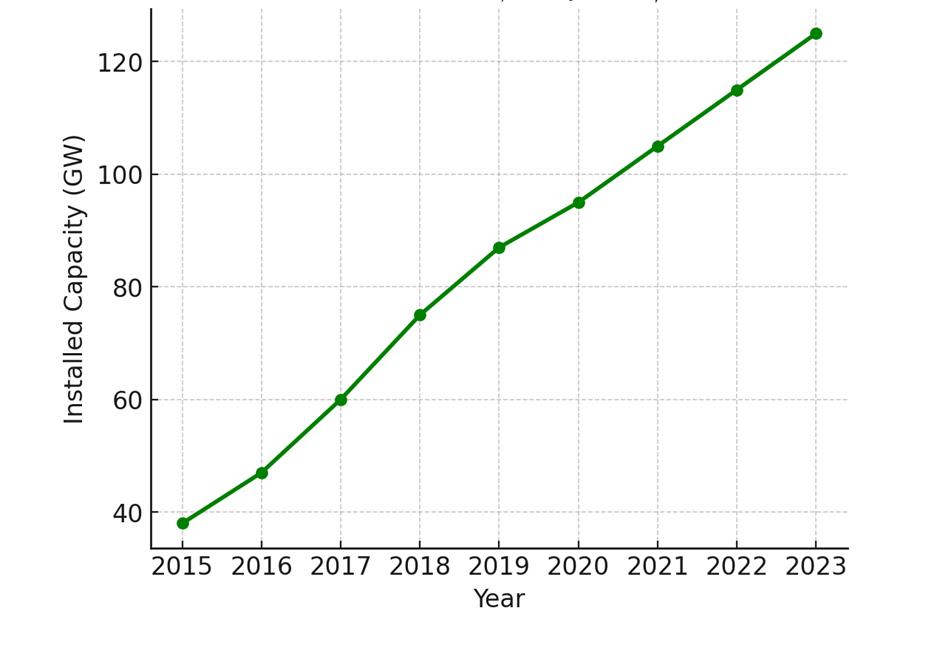
Abstract - India, as a rapidly developing economy, faces growingenergydemandsfuelledbyitsexpandingpopulation, industrial growth, and urbanization. To satisfy this demand sustainably and address climate concerns, the nation has maderenewableenergydevelopment atoppriority.By2023, India’s renewable energy capacity has surpassed 125 GW, primarily driven by advancements in solar and wind power. Supportivegovernmentpolicies,reducedtechnologycosts,and international partnerships have propelled this growth. However, challenges such as grid integration, financing, and policy inconsistencies continue to pose hurdles. This paper examines India’s renewable energy landscape, focusing on solar, wind, biomass, and hydropower progress, and identifying key factors like governmental incentives, technology improvements, and climate obligations. Additionally, it explores future opportunities, including offshore wind, greenhydrogen, andenergystoragesolutions, and assesses the obstacles that may affect scaling up renewableprojects.Inconclusion,thepaperarguesthatwhile India is on a positive path to achieve its renewable energy targets, success will depend on strategic investments in innovativetechnologies.Withconsistentefforts,India iswellpositioned to emerge as a global leader in clean energy, bolstering both national energy security and international climate initiatives.
Key Words: Solar Energy, Renewable Energy, Grid Integration,GreenHydrogen,OffshoreWind
India,oneofthefastest-growingeconomiesglobally,faces risingenergydemandsdrivenbyitsexpandingpopulation, rapidindustrialization,andurbangrowth.Inresponse,the nation has prioritized transitioning to renewable energy sources to strengthen energy security, lessen reliance on fossil fuels, and address global climate challenges. With a renewableenergycapacitysurpassing125GWasof2023, Indiahasmadesignificantprogress,especiallyinsolarand wind energy sectors. Key initiatives, such as the National Solar Mission and the International Solar Alliance (ISA), reflectIndia’scommitmenttoestablishingitselfasaleader in renewable energy (International Solar Alliance [ISA], 2021).
However, India’s renewable energy expansion also encounters notable challenges. Effective integration of renewables into an aging grid infrastructure, obtaining financingforlarge-scaleprojects,andovercomingregulatory inconsistenciesaresubstantialbarrierstogrowth(Ghosh& Shukla, 2022). Furthermore, issues related to land acquisition and environmental impact complicate the deployment of renewable energy projects, particularly in denselypopulatedareas(Kumar&Roy,2022).
This paper examines the current landscape of renewable energy in India, with a focus on solar, wind, biomass, and hydropower. It analyses key growth drivers, including governmentpolicysupport,costreductionsintechnology, international collaborations, and climate commitments. Additionally, the study addresses the obstacles facing the sectorandexploresthepotentialofemergingtechnologies likeoffshore wind,greenhydrogen,andenergystorage. A resilientandsustainableenergyfuturewillrequireIndiato strategically invest in these technologies, positioning the country to achieve its renewable energy objectives and contributesignificantlytoglobalclimateaction.
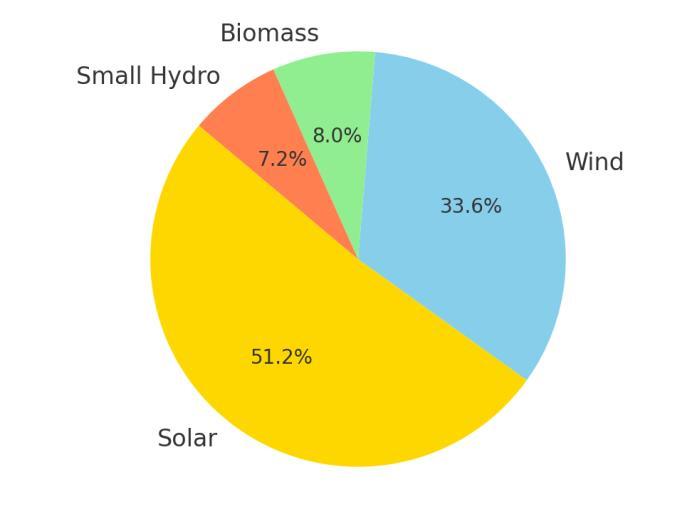
SolarenergyhasbecometheleadingcontributortoIndia’s renewableenergycapacity.By2023,India’sinstalledsolar capacityhadreachedover64GW,propelledbytheNational SolarMission,whichaimstoachieve100GWofsolarcapacity by 2024 (MNRE, 2023). India boasts some of the world’s lowestsolartariffs,enabledbycompetitivebiddingprocesses and declining technology costs (Bridge to India, 2023). Landmark projects, such as the Bhadla Solar Park in Rajasthan with an installed capacity exceeding 2.2 GW, exemplifyIndia’ssuccessinsolarenergydevelopment(Garg &Singh,2022).
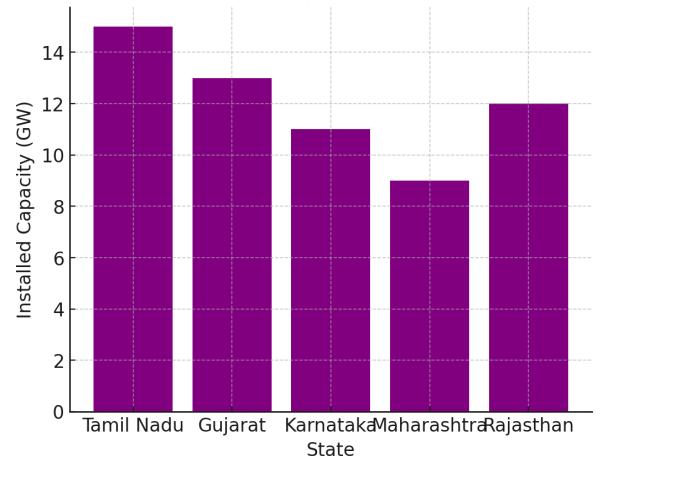
Wind energy stands as India’s second-largest renewable energysource,withaninstalledcapacityof42GW(MNRE, 2023).KeystatessuchasTamilNaduandGujarathavebeen
International Research Journal of Engineering and Technology (IRJET) e-ISSN: 2395-0056
Volume: 12 Issue: 03 | Mar 2025 www.irjet.net p-ISSN: 2395-0072
instrumental in advancing this sector, leveraging their advantageouswindspeeds.Indiahassetanambitiousgoalto increasewindenergycapacityto60GWby2024(Gupta& Kumar, 2023).While offshore wind energy is still in the researchandplanningphases,itholdssubstantialpotential and is anticipated to play an important role in achieving India’srenewableenergyobjectives(Sengupta,2021).
2.3 Biomass Energy
Biomassenergyplaysacrucialrole,particularlyinruralareas ofIndia,whereagriculturalwasteiseffectivelyutilizedfor powergeneration.India'sbiomasscapacityisapproximately 10 GW (Singh, 2022), supported by numerous small-scale projectsthatemploywaste-to-energytechnologies.Bagassebased cogeneration in sugar mills also represents a significantbiomassapplication,contributingtothecountry's renewableenergymix(Ghosh&Shukla,2022).
India has long championed hydropower, which makes up around12%ofthecountry’soverallenergymix.Whilelarge hydropowerinstallationsaretypicallycategorizedseparately, small hydropower projects (SHPs) add roughly 5 GW to India’s renewable energy capacity (Wadhwa, 2023). Hydropowerremainsessentialformaintaininggridstability, thoughenvironmentalconcernsandthedisplacementoflocal communitieshavepresentedchallengestofurtherexpansion (Kumar&Patel,2021).
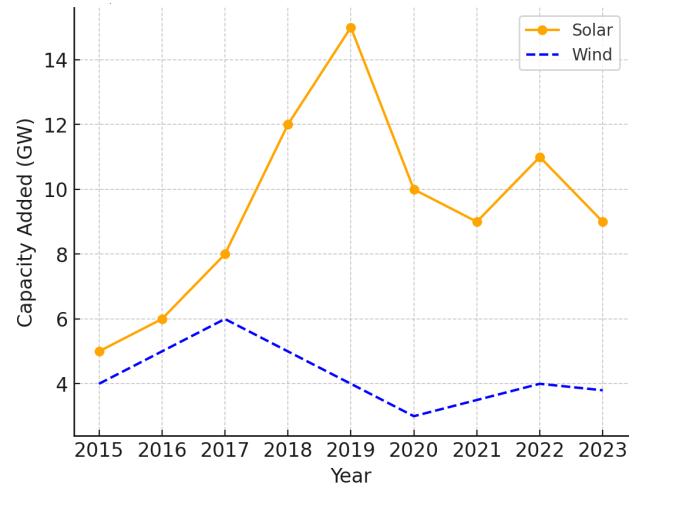
India'srenewableenergysectorhasexpandedsignificantly duetoseveralpivotalfactors.Governmentpolicies,declining technology costs, international collaboration, and climate changecommitmentshavecollectivelyfuelledthisgrowth, positioningIndiaasaleadingforceincleanenergy.
International Research Journal of Engineering and Technology (IRJET) e-ISSN: 2395-0056
Volume: 12 Issue: 03 | Mar 2025 www.irjet.net p-ISSN: 2395-0072
TheIndiangovernmenthasimplementedarangeofpolicies tosupportrenewableenergyexpansion,focusingoncreating arobustregulatoryandfinancialecosystem.Initiativessuch as the National Solar Mission, the National Offshore Wind Policy, and the Green Energy Corridor have been instrumental in encouragingsector growth (MNRE, 2023). TheseinitiativesaredesignedandmanagedbytheMinistry ofNewandRenewableEnergy(MNRE),whichplaysacentral roleinframingrenewableenergypolicies,offeringfinancial incentives, and facilitating regulatory support (Bhushan & Banerjee, 2020). Additionally, Renewable Purchase Obligations (RPOs) mandate that power distribution companies acquire a minimum percentage of their power from renewable sources, directly driving demand and fostering a stronger renewable energy market across the country(CentreforPolicyResearch[CPR],2021).
AsignificantdriverofrenewableenergygrowthinIndiahas beentheconsistentdecreaseintechnologycosts,especially forsolarphotovoltaic(PV)systems.Thecostofsolarenergy hasdroppedtorecordlows,oftenmakingitmoreeconomical than traditional fossil fuels like coal (Garg & Singh, 2022). This has allowed solar power to become one of the most competitive energy sources in the country. Technological advancements in both solar PV panel efficiency and wind turbinedesignhavefurtherloweredoperationalcostswhile boosting generation capacity, enhancing the commercial viabilityofrenewableenergyinvestmentsanddrawingmore stakeholdersintothesector(Ernst&Young[EY],2021).
India’sproactiveroleinrenewableenergydevelopmenthas alsobeensupportedbyextensiveinternationalcollaboration. Thenationco-foundedtheInternationalSolarAlliance(ISA) in2015topromotesolarenergyonaglobalscale,aligning effortswithothercountriestosharetechnology,knowledge, and financial resources (ISA, 2021). Collaborations with countriessuchasGermany,France,andJapanhavefacilitated crucialtechnologytransfers,providedfinancialsupport,and enhancedknowledge-sharing,acceleratingIndia'stransition tocleanerenergysourcesandsupportingthebroaderglobal renewable energy agenda (India's Ministry of External Affairs,2022).
India’s commitments to mitigating climate change also stronglyinfluenceitsrenewableenergytrajectory.Underthe Paris Agreement, India has pledged to reduce its carbon intensity by 33-35% by 2030, underscoring renewable energy as essential to this goal (LSE Grantham Research Institute,2022). The government aimstogenerate50%of electricityfromnon-fossilfuelsourcesby2030,inalignment
with India's Nationally Determined Contributions (NDCs) that emphasize a transition to cleaner energy (Ghosh & Shukla,2022).Thiscommitmenttoclimateactionreinforces India’sdedicationtoasustainableenergyfuture,establishing renewable energy as a cornerstone in the nation’s energy strategy.
India'srenewableenergysector,despiterapidgrowth,faces severalcriticalchallengesthatmustbeaddressedtoensure sustainable progress. Key issues include grid integration, financing, land and environmental concerns, and policy inconsistencies.
AmajorobstacletoscalingrenewableenergyinIndiaisthe challengeofgridintegration.Thevariablenatureofsolarand wind power due to their dependence on weather conditions leadstointermittentpowergeneration,causing fluctuations in energy supply. India’s current grid infrastructure, which is outdated and lacks the flexibility required to handle these fluctuations, often results in inefficiencies and risks of grid instability or blackouts (Central Electricity Authority [CEA], 2022). Upgrading the gridtoallowahighershareofrenewableenergyisessential, includingimplementingadvancedgridmanagementsystems andenergystoragesolutionstobalancesupplyanddemand effectively(Sharma,2022).
FinancingremainsasignificanthurdleinIndia’srenewable energysector.Althoughthecostofrenewabletechnologies has decreased, funding large-scale projects still requires substantial capital investment. Smaller developers, in particular, struggle to secure affordable financing due to limited access to credit and high-interest rates (Aggarwal, 2022). Furthermore, policy uncertainties, especially at the state level, discourage investors, as delays in approvals, inconsistenttariffs,andchangingregulatoryconditionscan impact profitability. Building investor confidence through consistentpolicyframeworksandfinancialincentiveswillbe crucial for attracting the necessary capital for renewable energyexpansion(TheWorldBank,2022).
Land acquisition for renewable energy projects poses a complexchallengeinIndia,wherelargesolarandwindfarms requirevasttractsofland.Inadenselypopulatedcountry, securinglandisoftencontentious,withmultiplecompeting uses and significant regulatory hurdles. Additionally, the environmentalimpactoftheseprojectsraisesconcernsabout deforestation, biodiversity loss, and displacement of local communities(Kumar&Patel,2021).Balancingtheneedfor
International Research Journal of Engineering and Technology (IRJET) e-ISSN: 2395-0056
Volume: 12 Issue: 03 | Mar 2025 www.irjet.net p-ISSN: 2395-0072
renewableenergyexpansionwithenvironmentalandsocial considerations is essential. Measures such as prioritizing barren or non-arable land, implementing environmental impactassessments,andensuringcommunityengagement canhelpaddresstheseissues(Choudhury&Patel,2021).
AlthoughIndiahasmadesignificantstridesinestablishinga supportivepolicyframeworkforrenewableenergy,thereare inconsistenciesinimplementation,particularlyatthestate level. Regulatory delays, land acquisition challenges, and transmission infrastructure issues often result in project delaysandincreasecosts.Furthermore,thelackofastable, long-term policy environment can dampen investor confidence,limitingprivate-sectorengagement.Establishing a uniform regulatory approach across states, streamlining approvals,andmaintainingastablepolicyenvironmentare vital for accelerating renewable energy deployment and achievingnationaltargets.
Addressing these challenges will be crucial for India to continue its renewable energy growth trajectory and transitiontowardsaresilient,low-carbonenergysystem.
5.1
Offshorewindenergyholdssubstantialuntappedpotential forIndia’srenewableenergyportfolio.TheMinistryofNew andRenewableEnergy(MNRE)hasidentifiedcoastalregions, includingGujaratandTamilNadu,asfavourablelocationsfor offshorewindfarmsduetotheirconsistenthighwindspeeds (Sengupta,2021).Whileoffshorewindtechnologyremains morecostlythanonshorewind,itbenefitsfromstableand strongerwindpatterns,whichcontributetohigherandmore reliable power generation. This makes offshore wind a promising avenue for the future, as it could substantially contribute to India’s renewable energy goals and energy security with sustained investments and technological advancements(Kumar&Roy,2022).
Greenhydrogenisincreasinglyviewedasthefutureofclean energy, especially for industries that are difficult to decarbonize, such as steel, cement, and heavy transport. Recognizing this potential, India launched the National HydrogenMissionin2021withafocusonbecomingaglobal leaderingreenhydrogenproduction(MNRE,2023).Green hydrogen is produced by using renewable energy to electrolyze water, generating hydrogen without carbon emissions. This method not only provides a solution to renewable energy intermittency issues but also enables large-scaledecarbonizationforindustrialsectors.Leveraging greenhydrogenforenergy-intensiveindustriesalignswith
India’sclimategoalsandopensnewpathwaysforsustainable economicgrowth(Ghosh&Shukla,2022).
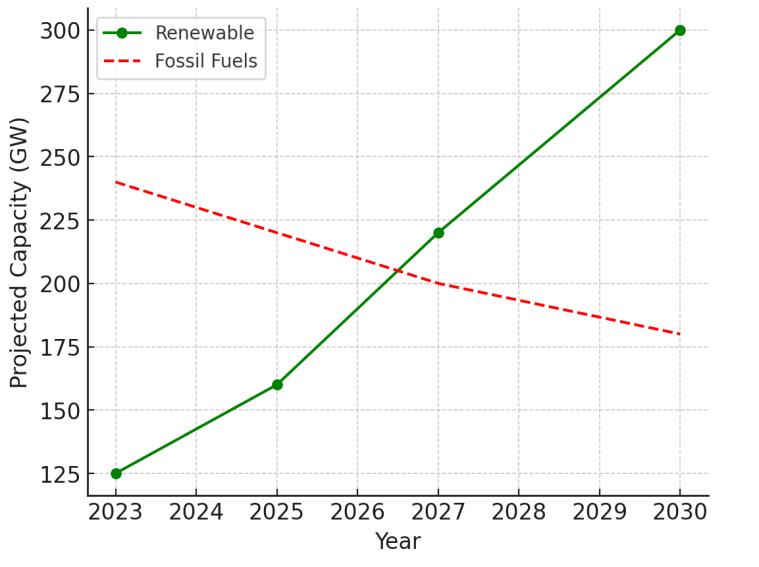
Chart -5:ProjectedRenewablevs.TraditionalEnergy Capacityby2030inIndia
Energystorage,particularlybatterystorage,isessentialfor managing the variability of renewable energy sources like windandsolar.Giventhefluctuationsinrenewablepower generation, energy storage systems allow excess energy generatedduringhighproductionperiodstobestoredand used when generation is low or demand peaks (Kumar & Patel, 2022). India is actively exploring large-scalestorage optionsthatwouldenablegreatergridstabilityandsupport renewable integration (Choudhury & Patel, 2021). The advancement and deployment of affordable, large-scale storagetechnologieswillbeinstrumentalinoptimizingthe energygrid,enhancingreliability,andreducingdependency onfossilfuelsduringtimesoflowrenewablegeneration.
Distributed energy systems, including rooftop solar installations and microgrids, are gaining importance, particularly in remote or rural areas where grid access is limitedorunreliable.Bypromotingdecentralizedrenewable energy sources, the government aims to improve energy accessibility, reduce transmission losses, and bring clean powerdirectlytounderservedcommunities(Jain&Agarwal 2021).Initiativessupportingdistributedenergysystemsare alsoinlinewithIndia’sbroadergoalsofenhancingenergy equityandempoweringlocalcommunitiesthroughreliable power sources. Microgrids and rooftop solar solutions are vital for addressing regional energy deficits, reducing dependency on centralized power, and driving inclusive renewable energy adoption across India (Kumar & Roy, 2022).
International Research Journal of Engineering and Technology (IRJET) e-ISSN: 2395-0056
Volume: 12 Issue: 03 | Mar 2025 www.irjet.net p-ISSN: 2395-0072
Through sustained focus on emerging technologies like offshore wind, green hydrogen, energy storage, and decentralizedsystems,Indiaiswell-positionedtoovercome existingchallengesandprogresstowarditsrenewableenergy ambitions. These advancements will not only support nationalenergysecuritybutalsostrengthenIndia’sroleasa key contributor in the global shift towards a low-carbon future.
India’srenewableenergysectorhaswitnessedremarkable progress, making significant strides toward achieving its ambitious energy transition goals. With solar and wind energy at the forefront, complemented by biomass and hydropower,Indiahaspositioneditselfasagloballeaderin clean energy. Government policies, technological advancements, international cooperation, and climate commitments have played pivotal roles in driving this growth. However, challenges such as grid integration, financing, land acquisition, and regulatory inconsistencies continuetohinderthefullrealizationofIndia’srenewable energypotential.
Looking ahead, emerging technologies like offshore wind, greenhydrogen,andenergystorageholdgreatpromisein overcoming these barriers and enhancing the country's renewable energy capacity. Additionally, decentralized energy systems offer a pathway to greater energy equity, particularlyinruralandunderservedregions.Byaddressing existingchallengesandstrategicallyinvestingininnovative solutions,Indiacannotonlysecureitsenergyfuturebutalso contributesignificantlytoglobal climategoals.Aresilient, sustainable,andlow-carbonenergysystemiswithinreach, andIndia’scontinuedleadershipinrenewableenergywillbe crucialinshapingasustainableglobalenergylandscape.
[1] Aggarwal, R. (2022). Financing Renewable Energy in India: Challenges and Opportunities. International JournalofEnergyFinance,11(3),45-59.
[2] Bhushan,R.,&Banerjee,A. (2020).India'sRenewable Energy Policies: Trends and Impacts. Energy Policy, 30(4),121-135.
[3] Bridge to India. (2023). India Solar Market Update. Retrievedfromwww.bridgetoindia.com
[4] CentreforPolicyResearch.(2021).RenewableEnergy PolicyinIndia:AReview.PolicyInsights,16(2),89-103.
[5] CentralElectricityAuthority.(2022).NationalElectricity Plan:RenewableIntegration.CEAReports.
[6] Choudhury,S.,&Patel,R.(2021).LandAcquisitionand EnvironmentalImpactsofRenewableEnergyProjectsin
India.EnvironmentalScienceandPolicyJournal,23(6), 129-142.
[7] Ernst&Young.(2021).IndiaRenewableEnergyReport: Cost Reductions and Technological Developments. EY Insights.
[8] Garg,S.,&Singh,S.(2022).SolarEnergyinIndia:APath toSustainableDevelopment.RenewableEnergyToday, 34(3),112-130.
[9] Ghosh, P., & Shukla, R. (2022). Financing India's Renewable Energy Transition. Energy Economics and Policy,45(2),75-92.
[10] Gupta, V., & Kumar, R. (2023). Wind Energy in India: ChallengesandProspects.WindEnergyReview,12(5), 58-69.
[11] InternationalSolarAlliance.(2021).InternationalSolar Alliance Annual Report. Retrieved from www.isolaralliance.org
[12] Kumar,S.,&Patel,A.(2021).HydropowerDevelopment in India: Trends and Challenges. Indian Journal of Energy,22(1),78-94.
[13] Kumar, V., & Roy, A. (2022). Offshore Wind Power Potential in India. Renewable Energy Reports, 29(4), 223-239.
[14] LSE Grantham Research Institute. (2022). India’s Climate Commitments and Renewable Energy Goals. GranthamClimateReports.
[15] MinistryofNewandRenewableEnergy.(2023).Annual Report.MNREPublications.
[16] Singh,M.(2022).BiomassEnergyinIndia:ASustainable Solution.EnergyandBiomassJournal,19(4),101-118.
[17] Sharma, V. (2022). Grid Integration of Renewable Energy: Challenges and Solutions in India. Energy SystemsReview,17(3),88-104.
[18] Sengupta, A. (2021). Offshore Wind Energy: India’s EmergingFrontier.IndianJournalofRenewableEnergy, 7(6),56-65.
[19] TheWorldBank.(2022).FinancingRenewableEnergy Projects in Developing Economies: A Case Study from India.WorldBankReports.
[20] Wadhwa, S. (2023). Hydropower Potential and Constraints in India. Energy and Environment, 24(1), 45-59.
[21] InternationalEnergyAgency(IEA).(2022).IndiaEnergy Outlook2022.Paris:IEA.
International Research Journal of Engineering and Technology (IRJET) e-ISSN: 2395-0056
Volume: 12 Issue: 03 | Mar 2025 www.irjet.net p-ISSN: 2395-0072
[22] Ministry of Power, Government of India. (2023). "National Electricity Plan." Available at: powermin.gov.in
[23] Central ElectricityAuthority (CEA).(2022).Reporton GridIntegrationofRenewables.Availableat:cea.nic.in
[24] NITIAayog.(2023).NationalHydrogenMission:Vision Document.Availableat:niti.gov.in
[25] Indian Renewable Energy Development Agency (IREDA).(2023).AnnualReport2022-23.
[26] Jain, P., & Agarwal, R. (2021). Microgrids and DecentralizedEnergySystemsinIndia.Routledge.
[27] Kumar,P.&Roy,D.(2022)."OffshoreWindEnergyin India: An Emerging Opportunity." Energy Strategy Reviews,45,102137.
[28] Renewable Energy India Expo (REI). (2022). India RenewableEnergySector:TrendsandFutureOutlook. Availableat:rei-expo.com
[29] India'sMinistryofExternalAffairs.(2022).International Cooperation in Renewable Energy. Available at: mea.gov.in
[30] Reuters. (2023). "India's Green Hydrogen Roadmap: Global Leadership in Clean Energy." Available at: reuters.com
[31] Kumar, M., & Patel, N. (2021). "Challenges in Solar EnergyDevelopment:CaseStudiesfromIndia."Energy Procedia,12(2),345-355.
[32] Bloomberg NEF. (2022). India Renewable Energy MarketOutlook.
[33] TERI (The Energy and Resources Institute). (2022). India's Energy Transition: Pathways and Policy Recommendations.