
International Research Journal of Engineering and Technology (IRJET) e-ISSN: 2395-0056
Volume: 13 Issue: 05 | May 2026 www.irjet.net p-ISSN: 2395-0072

International Research Journal of Engineering and Technology (IRJET) e-ISSN: 2395-0056
Volume: 13 Issue: 05 | May 2026 www.irjet.net p-ISSN: 2395-0072
SARITA MISHRA, PL. ARUNDHATEE MISHRA
(MURP,
FOAP, AKTU, Lucknow, India.), Assistant Professor at faculty of architecture and planning, Aktu , Lucknow
ABSTRACT
Development projects such as dams, highways, industrial corridors, mining projects, smart cities, metro systems, and urban infrastructure frequently require large-scale land acquisition. Such projects often result in displacement of communities, loss of livelihood, socio-cultural disruption, and environmental stress. In India, weak compensation systems and inadequate rehabilitation mechanisms historically created conflicts between development agencies and affected communities. Marginalized groups including tribal populations, farmers, fishermen, and informal workers were often the most affected.
To address these concerns, the Government of India introduced the National Rehabilitation and Resettlement Policy (NRRP), 2007 as a comprehensive policy framework for the rehabilitation and resettlement of project-affected families. The policy aimed to integrate social justice, participatory governance, livelihood restoration, and sustainable development principles into the development planning process.
This paper critically examines the conceptual framework, objectives, provisions, implementation mechanisms, planning significance, and limitations of NRRP 2007. The study also analyzes the policy’s contribution toward socially inclusive development planning and its role in shaping the Right to Fair Compensation and Transparency in Land Acquisition, Rehabilitation and Resettlement Act, 2013. Through the analysis of the Narmada Valley Project case study, the paper highlights the practical challenges associated with displacement management andrehabilitation planning in India.
KEY WORDS: RehabilitationandResettlement(R&R),NRRP2007,Development-InducedDisplacement, LivelihoodRestoration,InclusiveDevelopment,UrbanPlanning
Development is essential for economic growth, industrialization, modernization, and infrastructure expansion. In India, large-scale projects such as dams, industrial corridors, highways, metro systems, urban redevelopment projects, and mining operations have significantly contributed to national
© 2026, IRJET | Impact Factor value: 8.315 | ISO 9001:2008 Certified Journal | Page1117
International Research Journal of Engineering and Technology (IRJET) e-ISSN: 2395-0056
Volume: 13 Issue: 05 | May 2026 www.irjet.net p-ISSN: 2395-0072
development. However, these projects often require acquisition of agricultural land, forest areas, and residentialsettlements,leadingtodisplacementoflocalcommunities.
Development-induced displacement has emerged as a major socio-economic and planning challenge in India.Displacedpopulationsfrequentlyfacelossofland,livelihood,housing,socialidentity,andaccessto natural resources. In many cases, inadequate compensation and poor rehabilitation planning result in long-termeconomicvulnerabilityandsocialexclusion.
Before NRRP 2007, rehabilitation and resettlement practices in India lacked a comprehensive national framework. Different states followed varying rehabilitation policies, resulting in inconsistency and inequality in compensation and rehabilitation measures. Public protests and social movements against displacementhighlightedtheurgentneedforamoreinclusiveandpeople-centricpolicyframework.
TheNationalRehabilitationandResettlementPolicy(NRRP),2007wasintroducedbytheGovernmentof India to ensure fair compensation, minimize displacement, restore livelihoods, and improve the living standardsofproject-affectedfamilies.Thepolicymarkedasignificantshiftfromcompensation-oriented approachestocomprehensiverehabilitation-basedplanning.
This study is based on secondary data collected from government reports, policy documents, journal articles, books, and case studies related to rehabilitation and resettlement in India. The methodology includes a review of Government of India policy documents, analysis of NRRP 2007 provisions, comparativereviewofrehabilitationframeworks,casestudyanalysisoftheNarmadaValleyProject,and planning-based interpretation of rehabilitation strategies. The study adopts a qualitative and analytical researchapproach.
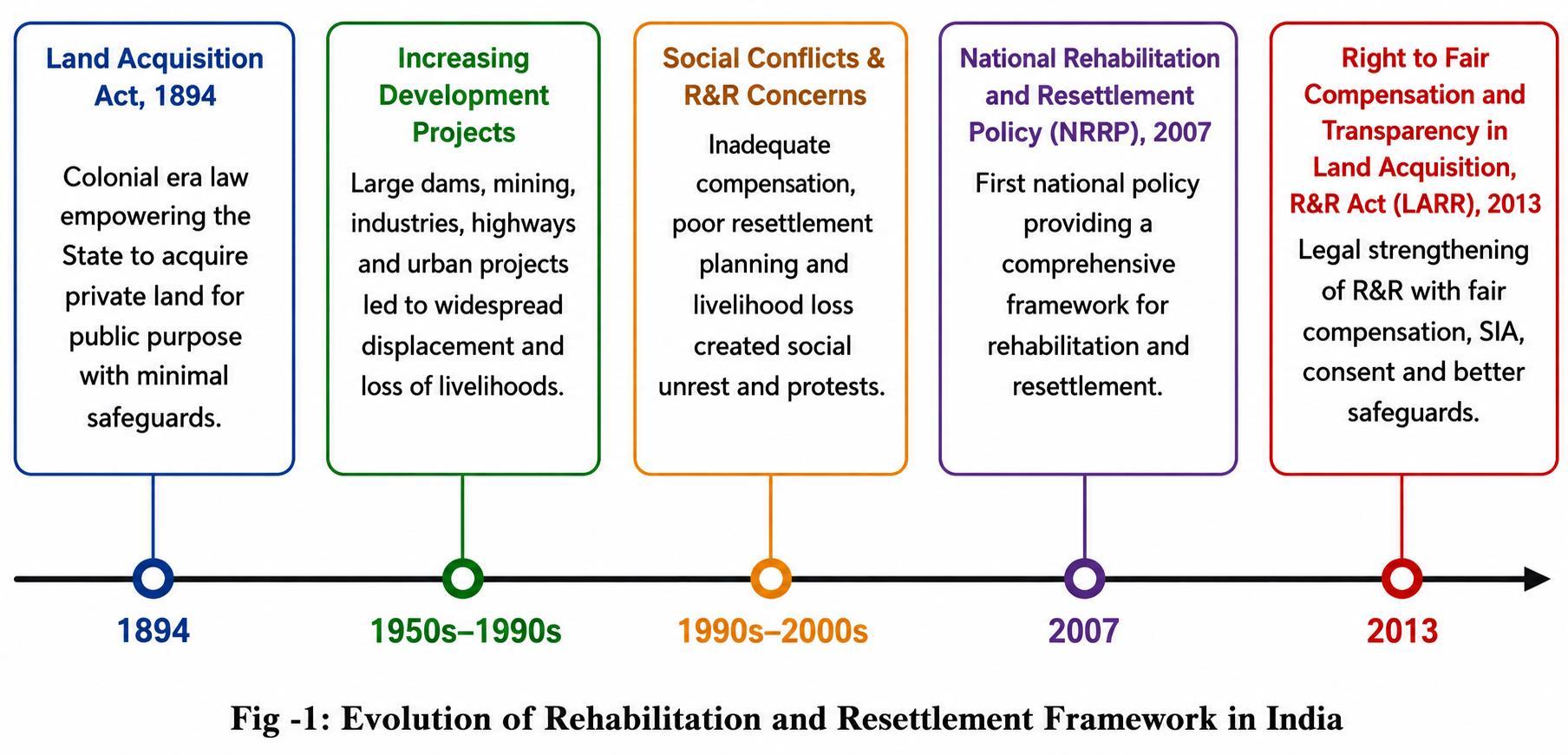
The evolution of rehabilitation policies in India can be linked with increasing development-induced displacementafterindependence.EarlyinfrastructureprojectssuchasBhakraNangalDamandHirakud Damdisplacedthousandsoffamilieswithoutproperrehabilitation.Importantmilestonesintheevolution ofrehabilitationpoliciesincludetheLandAcquisitionAct,1894,initialR&Rdiscussionsduringthe1980s, the National Policy on Resettlement and Rehabilitation, 2003, the National Rehabilitation and Resettlement Policy, 2007, and the LARR Act, 2013. These policies reflected a gradual shift from compensation-focusedapproachestowardsociallyinclusiverehabilitationframeworks.
International Research Journal of Engineering and Technology (IRJET) e-ISSN: 2395-0056
Volume: 13 Issue: 05 | May 2026 www.irjet.net p-ISSN: 2395-0072
Rehabilitation and Resettlement (R&R) refers to the process of relocating displaced populations and restoring their socio-economic conditions after displacement caused by development projects or disasters. Resettlement refers to the physical relocation of affected families from their original place of residence to alternative settlement areas equipped with basic infrastructure and services, while rehabilitation focuses on restoring livelihoods, ensuring economic security, rebuilding social networks, and improving the overall quality of life of displaced populations. The conceptual framework of NRRP 2007 was based on the principles of social justice and equity, participatory planning and consultation, sustainable livelihood restoration, protection of vulnerable communities, human-centered development planning,andminimizationofinvoluntarydisplacement.Thepolicyrecognizedthatcompensationalone was insufficient and emphasized long-term socio-economic rehabilitation as an essential component of developmentplanning.
The need for NRRP 2007 emerged due to increasing conflicts and dissatisfaction associated with land acquisition and displacement in India. Several development projects faced strong opposition because affected communities experienced inadequate compensation, poor rehabilitation, and lack of livelihood support. Major issues before NRRP 2007 included inadequate and delayed compensation, loss of agricultural land and livelihoods, weak rehabilitation planning, lack of participation of affected communities,socialdisintegrationandculturalloss,tribaldisplacementandenvironmentalinjustice,and administrative inefficiencies with weak monitoring systems. The absence of a uniform national policy
International Research Journal of Engineering and Technology (IRJET) e-ISSN: 2395-0056
Volume: 13 Issue: 05 | May 2026 www.irjet.net p-ISSN: 2395-0072
created inconsistencies across states and projects. Therefore, NRRP 2007 aimed to establish a standardizedandsociallyinclusiveframeworkforrehabilitationandresettlementmanagement.
The major objectives of the National Rehabilitation and Resettlement Policy, 2007 were to minimize involuntary displacement caused by development projects, ensure fair and transparent rehabilitation practices, provide compensation and livelihood restoration measures, improve the socio-economic conditions of project-affected families, protect vulnerable groups such as Scheduled Tribes, Scheduled Castes, women, and marginal farmers, encourage participatory planning and community consultation, establishmonitoringandgrievanceredressalmechanisms,andintegraterehabilitationplanningintothe overalldevelopmentprocess.
The policy emphasized that development should not occur at the cost of social exclusion or economic marginalization.
The policy introduced several important rehabilitation provisions, including Social Impact Assessment (SIA), compensation mechanisms for affected families, land-forland provisions, housing and infrastructure development, livelihood restoration and employment support, safeguards for tribal and vulnerable communities, grievance redressal systems, and participatory governance mechanisms. These provisions aimed to create a more balanced and humane approach toward development-induced displacement.Overall,thepolicyemphasizedthat rehabilitation and resettlement should focus not only on compensation but also on restoring the dignity,livelihoods,andwell-beingofaffectedcommunities.
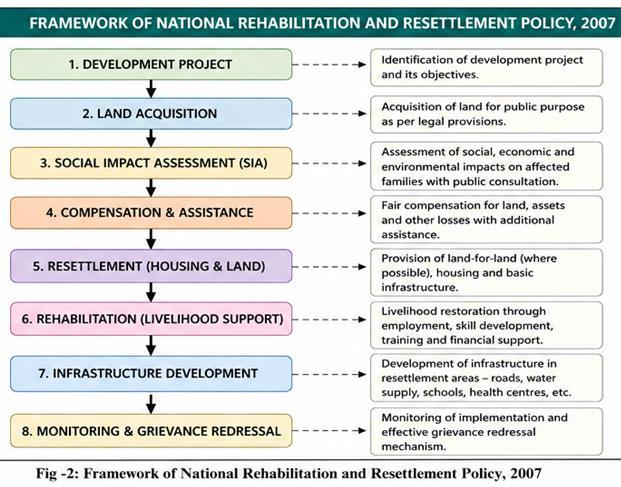
SocialImpactAssessmentisoneofthemostimportantcomponentsofrehabilitationplanning.Ithelpsidentifythe social,economic,environmental,andculturalimpactsofdevelopmentprojects.
International Research Journal of Engineering and Technology (IRJET) e-ISSN: 2395-0056
Volume: 13 Issue: 05 | May 2026 www.irjet.net p-ISSN: 2395-0072
SIAincludes:
•Populationanddemographicanalysis
•Livelihoodassessment
•Environmentalimpactanalysis
•Identificationofvulnerablegroups
•Communityconsultationandparticipation
•Riskandmitigationassessment
TheinclusionofSIAinNRRP2007strengthenedtheplanningprocessbyintegratingsocialequityinto developmentprojects
2. Compensation Mechanisms:
Thepolicyproposedcompensationforlossofland,housing,livelihoods,andotherassets.Compensation wasintendedtosupporteconomicrehabilitationandresettlement.
3. Land-for-Land Provision:
In specific cases, particularly involving tribal populations and agricultural communities, the policy recommendedland-for-landcompensation.
4. Housing and Infrastructure:
Resettlement areas were required to provide basic infrastructure such as roads, drinking water, sanitation,schools,electricity,andhealthcarefacilities.
5. Livelihood Restoration:
The policy promoted employment opportunities, vocational training, and income generation programs fordisplacedfamilies.
6. Special Provisions for Vulnerable Groups:
SpecialsafeguardswereintroducedforScheduledTribes, women-headedhouseholds, andeconomically weakersections.
7. Grievance Redressal Mechanisms:
Thepolicyproposedinstitutionalarrangementsforaddressingcomplaintsandmonitoringrehabilitation processes.
International Research Journal of Engineering and Technology (IRJET) e-ISSN: 2395-0056
Volume: 13 Issue: 05 | May 2026 www.irjet.net p-ISSN: 2395-0072
8. Participatory Planning:
Affectedcommunitieswereencouragedtoparticipateinplanning,implementation,andmonitoring processes.
Fromanurbanandregionalplanningperspective,NRRP2007representedamajorshifttowardsocially inclusiveandsustainabledevelopmentplanning.Thepolicyrecognizedthatinfrastructureandeconomic development must be balanced with social equity and environmental sustainability. The planning significanceofNRRP2007includestheintegration ofsocialimpactassessmentintoplanningprocesses, promotion of participatory governance and stakeholder consultation, inclusion of livelihood restoration in development planning, emphasis on sustainable rehabilitation infrastructure, reduction of social conflictsassociatedwithdisplacement,andimprovementinlong-termsocio-economicsustainability.The policyhighlightedtheimportanceofbalancingdevelopmentobjectiveswiththewelfareandparticipation ofaffectedcommunitiestoensuremoreequitableandsustainableplanningoutcomes.
Forplanners,thepolicyhighlightedtheimportanceofcommunity-centeredplanningapproachesand equitabledistributionofdevelopmentbenefits.
Despiteitsprogressiveprovisions,NRRP2007facedseveralimplementationchallengesandlimitations.
Major limitations of NRRP 2007 included weak legal enforceability, delays in compensation and rehabilitation, inadequate institutional coordination, poor monitoring and evaluation systems, limited participationofaffectedcommunitiesinpractice,lackoftransparencyinlandacquisitionprocesses,and inconsistent implementation across states. These challenges reduced the overall effectiveness of the policyandcreatedgapsbetweenpolicyprovisionsandactualimplementationontheground.
Inmanycases,rehabilitationpackagesfailedtorestorelivelihoodsfully,especiallyforinformalworkers and tribal communities dependent on natural resources. Administrative inefficiencies and corruption furtheraffectedimplementationeffectiveness.
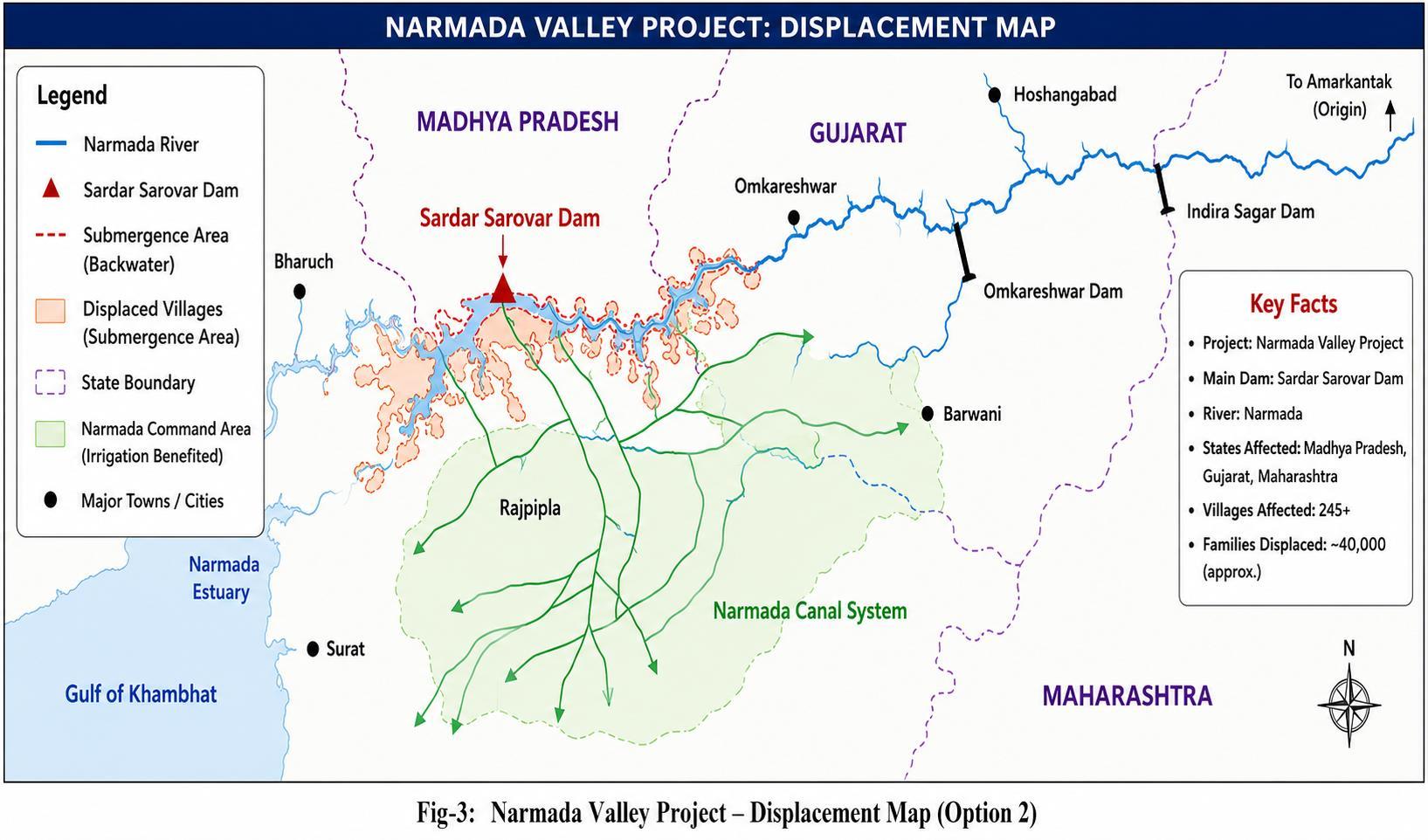
The Sardar Sarovar Dam Project in the Narmada Valley is one of the most significant examples of development-induceddisplacementinIndia.Theprojectaimedtoprovideirrigation,drinkingwater,and hydroelectric power to several states. However, the construction of the dam displaced thousands of families,particularlytribalcommunitieslivingintheaffectedareas.
International Research Journal of Engineering and Technology (IRJET) e-ISSN: 2395-0056
Volume: 13 Issue: 05 | May 2026 www.irjet.net p-ISSN: 2395-0072
The project became internationally recognized due to protests led by social movements such as the Narmada Bachao Andolan. Activists highlighted issues related to inadequate rehabilitation, environmentaldegradation,andlackofparticipationofaffectedcommunities.
The Narmada case demonstrated the importance of comprehensive rehabilitation planning, community participationandconsultation,transparentcompensationmechanisms,livelihoodrestorationstrategies, and long-term monitoring and evaluation. The case highlighted the need for a more inclusive and accountableapproachtorehabilitationandresettlementindevelopmentprojects.
The case also influenced national discussions on rehabilitation policies and contributed to the developmentofstrongerrehabilitationframeworkssuchasNRRP2007.
Although NRRP 2007 introduced progressive rehabilitation principles, several implementation challenges remained. Major limitations included weak legal enforceability, delayed implementation, administrative inefficiencies, poor institutional coordination, compensation disputes, inadequate monitoringsystems,andlimitedparticipationinpractice.
International Research Journal of Engineering and Technology (IRJET) e-ISSN: 2395-0056
Volume: 13 Issue: 05 | May 2026 www.irjet.net p-ISSN: 2395-0072
These challenges reduced the effectiveness of rehabilitation measures and created significant gaps between policy objectives and ground-level implementation. In many cases, affected communities continued to face difficulties in receiving fair compensation, livelihood restoration, and proper rehabilitationsupport.
The gap between policy provisions and ground-level implementation reduced the effectiveness of rehabilitationoutcomes.
NRRP2007laidthefoundationfortheRighttoFairCompensationandTransparencyinLandAcquisition, RehabilitationandResettlementAct,2013.TheLARRActstrengthenedseveralprovisionsofNRRP2007, includingmandatorySocialImpactAssessment,improvedcompensationmechanisms,rehabilitationasa legal right, transparency in land acquisition, and enhanced safeguards for vulnerable communities. The Act represented a significant step toward a more accountable, transparent, and socially inclusive land acquisitionandrehabilitationframeworkinIndia.
The National Rehabilitation and Resettlement Policy, 2007 laid the foundation for the Right to Fair Compensation and Transparency in Land Acquisition, Rehabilitationand Resettlement Act, 2013 (LARR Act). The LARR Act significantly strengthened several provisions introduced under NRRP 2007 by making Social Impact Assessment mandatory, improving compensation mechanisms, enhancing transparency in land acquisition processes, and recognizing rehabilitation and resettlement as legal rights. The Act also introduced consent requirements for certain development projects and provided stronger safeguards for vulnerable groups, including Scheduled Tribes and marginalized communities. Thus, NRRP2007playedacrucialrolein shapingmodernlandacquisition andrehabilitationpoliciesin Indiabypromotingamoretransparent,equitable,andsociallyinclusivedevelopmentframework.
The following measures can improve rehabilitation and resettlement practices in India, including GISbased rehabilitation planning, digital monitoring systems, transparent compensation mechanisms, women-inclusive rehabilitation policies, long-term livelihood restoration programs, community participation platforms, sustainable settlement infrastructure, and strong institutional coordination mechanisms. The adoption of these measures can strengthen the effectiveness, transparency, and sustainabilityofrehabilitationprocesseswhileensuringgreatersocialinclusionandimprovedqualityof lifeforaffectedcommunities.
International Research Journal of Engineering and Technology (IRJET) e-ISSN: 2395-0056
Volume: 13 Issue: 05 | May 2026 www.irjet.net p-ISSN: 2395-0072
The National Rehabilitation and Resettlement Policy, 2007 represented a significant shift toward a socially inclusive and people-centric rehabilitation framework in India. The policy attempted to balance economicdevelopmentwithsocialjusticebyemphasizinglivelihoodrestoration,participatoryplanning, andprotectionofvulnerablecommunities.
Although implementation challenges remained in areas such as institutional coordination, monitoring systems, and compensation delivery, NRRP 2007 contributed significantly toward improving rehabilitationpracticesandpolicyawarenessinIndia.
From a planning perspective, the policy highlighted the importance of integrating social equity, environmental sustainability, and participatory governance into development planning. The lessons learned from NRRP 2007 continue to influence contemporary rehabilitation and land acquisition frameworksinIndia.
1.GovernmentofIndia.NationalRehabilitationandResettlementPolicy,2007.
2.GovernmentofIndia.LARRAct,2013.
3.Cernea,M.M.Risks,SafeguardsandReconstruction.
4.Mathur,H.M.DisplacementandResettlementinIndia.
5.Fernandes,Walter.Development-InducedDisplacementStudies.
6.WorldBank.InvoluntaryResettlementSourcebook.
7.PlanningCommissionofIndiaReports.
8.MinistryofRuralDevelopmentReports.