
International Research Journal of Engineering and Technology (IRJET) e-ISSN:2395-0056
Volume: 12 Issue: 06 | Jun 2025 www.irjet.net p-ISSN:2395-0072
NANO-ADMIXTURE AND FIBRE-BASED STABILIZATION FOR SLOPE
STABILITY IMPROVEMENT IN LOW-STRENGTH SILTY SOILS: A CASE STUDY FROM KANDRA KOTA
PALLI SRIDHARAN KARTHIKEYA1, KONDALA RAMU2
1Post graduation Student, Department of Civil Engineering, University College of Engineering Kakinada(A), JNTUK, Kakinada, Andhra Pradesh, India
2Professor of Civil Engineering Department, University College of Engineering Kakinada(A), JNTUK, Kakinada, Andhra Pradesh, India
Abstract - This research focuses on improving the slope stability of an irrigation canal embankment at Kandra Kota, Andhra Pradesh, through soil stabilization techniques. The earlier untreated slope analysis revealed failure potential due to poor shear strength and high silt content. This extended study investigates the effect of nano-lime, nano-alumina, and polypropylene fibre on enhancing the shear strength parameters and factor of safety(FOS)ofthesamecanalslope.
Two stabilization mixes were prepared using varying percentages of nano additives and fibre. Laboratory tests such as Atterberg limits and direct shear were conducted toevaluate improvementsin cohesionand internalfriction angle. Slope stability analysis using HYRCAN software revealed that the stabilized soil showed significant FOS improvement under dry, submerged, and sudden drawdown conditions. Mix 2, with higher additive content, achievedthehighestFOSacrossallcases.
The results demonstrate that nano-material-based soil stabilization is an effective, eco-friendly, and practical approach for improving the stability of irrigation canal embankments, especially in silt-dominant soils prone to seepageanderosion.
Key Words: Slope Stability, Nano Additives, Soil Stabilization, HYRCAN, Factor of Safety, Canal Embankment,PolypropyleneFiber,Cohesion
1.INTRODUCTION
Irrigation canal embankments are frequently constructed on soft or silty soils, which are highly susceptibletofailureduetoseepage,rainfallinfiltration, fluctuating water levels, and erosion. The safety and performance of such slopes depend significantly on the soil’s shear strength and the effectiveness of drainage and protection systems. In many canal projects across India, slope instability arises due to high silt content, expansive clay behaviour, and lack of adequate stabilizationmeasures.
These failures can lead to canal bed erosion, side slope collapse, and damage to adjacent infrastructure such as roads or pipelines. In recent years, there has been growing interest in adopting modern soil improvement techniquestoaddressthesechallengeseffectively.
1.1 Case Site: Kandra Kota
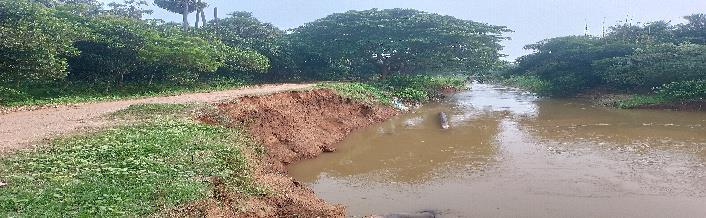
The case study area is located at Kandra Kota, Andhra Pradesh, where a road embankment adjacent to an irrigation canal experienced visible signs of instability. The embankment, with a height of 18 meters and side slope of 1V:1.5H, had previously shown distress due to poor soil strength, rainfall-induced erosion, and unprotected slopes. Earlier slope stability analysis conducted on the untreated soil revealed critically low FOS values, especially under submerged and sudden drawdownconditions.
This preliminary analysis and failure behaviour were documented and presented at the IYGEC 2025 conference. Based on the findings, it was evident that remedial measures were necessary to prevent further degradation and to restorethestructural stability ofthe embankment
1.2 Objective of the Present Study
The current study focuses on the stabilization of the problematic embankment soil using a combination of nano-lime, nano-alumina, and polypropylene fibre. The primaryobjectiveistoevaluatetheeffectivenessofthese additivesinimprovingtheshearstrengthcharacteristics ofthesoilandenhancingtheoverallstabilityofthecanal slope.Thisresearchincludes:
Laboratory testing of stabilized soil for Atterberglimitsandshearstrength
Application of HYRCAN software to analyse slopestabilitybeforeandaftertreatment
International Research Journal of Engineering and Technology (IRJET) e-ISSN:2395-0056
Comparison of FOS values under dry, submerged,andsuddendrawdownconditions
Byfocusingonpost-treatmentperformance,thisstudy aims to provide a sustainable and field-applicable solution to slope failures in similar geotechnical conditions.
2. LITERATURE STUDY
2.1 Holister et al (2003) presented the effect of nano
particles on strength behavior of materials. It was found that, the strength of the material increases due to the occurrenceofinteractionsbetweenintermixedmaterials.
2.2 Daniele et al (2008) investigated enhancement of unconfinedcompressivestrengthofsoillimemixturesby adding various percentages of nano- lime. An optimum nano- lime at four different curing periods is recommendedforthestudiedsoil-limemixtures.
2.3 Taha (2009) conducted laboratory experiments to understand the geotechnical properties of natural soils mixedwithnanomaterial.Theresultsfromexperimental investigation indicate that addition of nano material reducesplasticityindexofnaturalsoil.
2.4 Zaid Hameed Majeed and Mohd Raihan Taha, (2010), investigated the effect of various nano materials on the geotechnical properties of soft soil sample from Peneng state. It was concluded that the unconfined compressive strength of soil increases by adding nano materialtothesoftsoil.
2.5 Abd-Elaty et al. (2019) conducted a comprehensive slope stability analysis for El-Salam Canal in Egypt, emphasizing the impacts of climate change-induced sea level rise (SLR) and seismic activities. Their study used coupled finite difference and finite element methods Visual MODFLOW for groundwater simulation and Phase2 software for mechanical slope stability under dynamicandhydrogeologicalstressors.
2.6 Aruna Lakshmi et al. (2018) conducted a slope stabilityinvestigationoftheerosion-proneNadukaniHills in Kerala, India, to evaluate the effectiveness of slope reinforcement measures in controlling soil erosion. The studyhighlightsthattheregionisparticularlyvulnerable duetoitssteeptopography,acidicandfine-texturedsoils, heavyrainfall,andtheproximityofhighwaystounstable hillslopes.
2.7 Gunawan et al. (2023) conducted a slope stability assessment of sandstone mining slopes in Sedau Village, West Lombok Regency, to determine whether the steep cut slopes remain within acceptable safety limits. The study highlights how mining-induced slopes— particularly in rock formations like sandstone—require careful evaluationduetotheincreasedriskoflandslides, especially when slope heights and inclinations are considerable. The site examined had a 41 meter-high slopewithasteepinclinationof67°,promptingtheneed forthoroughanalysis.
Volume: 12 Issue: 06 | Jun 2025 www.irjet.net p-ISSN:2395-0072 © 2025, IRJET | Impact Factor value: 8.315 | ISO 9001:2008
2.8 Anjana Babu et al. (2016) examined the effect of polypropylene fiber (PPF) on the shear strength parameters of sandy soil using a series of direct shear tests.ThestudyfocusedonvaryingthePPFcontentfrom 0% to 1.75% by dry weight to determine the optimal dosage for shear strength improvement. The soil used wascollectedfromThrissur,Kerala,andwasclassifiedas sandy soil with an initial angle of internal friction (φ) of 19.83° and negligible cohesion. The test results demonstratedaconsistentincreaseinbothcohesionand friction angle with increasing PPF content up to 0.75%, beyondwhichthevaluesdeclined.
2.9 Panbarasi Govindasamy et al (2017) explored usage of nano- lime as a stabilizing agent for expansive claybyaddingdifferentpercentagesofnano-limeinsoillime mixtures. The - 20 - unconfined compressive strength of treated soil increased considerably over curingtimewithincreasingpercentageofnano-lime.The optimum strength is attained at 0.5% nano- lime admixtures.
2.10 Reze Ziaie Moayed and Hamidreza Rahmani (2017), studied the effect of nano-Sio2 solution on the strength characteristics of kaolinite. The measured resultsindicatethattheunconfinedcompressivestrength ofpuresoilincreasesby40%byaddingnanosolution.
3. METHODOLOGY
3.1 Stabilization Materials Used
Thesoilstabilizationprocessemployedinthisstudyuses acombinationofnano-scaleadditivesandsyntheticfibre to improve the mechanical behaviour of the native embankmentsoil.Thematerialsselectedinclude:
Nano-lime (CaO): Reacts pozzolanically with silica in clay minerals to increase cohesion and reduceplasticity.
Nano-alumina (Al₂O₃): Enhances the soil structure through improved particle bonding andcontributestostiffnessandstrength.
Polypropylene Fibre (PPF): A synthetic reinforcing agent that improves the frictional
International Research Journal of Engineering and Technology (IRJET) e-ISSN:2395-0056
Volume: 12 Issue: 06 | Jun 2025 www.irjet.net p-ISSN:2395-0072
resistanceofthesoil matrixbyprovidingtensile reinforcement.
Twomixproportionswereprepared:
Mix 1: 0.5% nano-alumina + 1% nano-lime + 0.25%PPF
Mix 2:1%nano-alumina+2%nano-lime+0.5% PPF
These proportions were selected based on preliminary trials and relevant literature to achieve optimal improvementsatminimaldosage.
3.2 Soil Mixing and Sample Preparation
The native soil wascollected from the site of the Kandra Kota canal embankment. The soil was first oven-dried and then pulverized to pass through a 4.75 mm IS sieve. Stabilizerswereaddedindryformandthoroughlymixed toensureuniformdistribution.
After mixing, distilled water was added to bring the sample to optimum moisture content. The prepared mixes were compacted using the Standard Proctor methodincylindricalmouldsfordirectsheartesting.The specimens were stored and cured appropriately before testing,althoughspecificcuringdurationsareexcludedas peracademicrequirements.
3.3 Laboratory Testing Program
A comprehensive laboratory testing program was conductedonbothuntreatedandstabilizedsoil samples to evaluate the changes in geotechnical properties after the addition of nano-lime, nano-alumina, and polypropylene fibre. All tests were performed as per IndianStandard(IS)codes.
Thefollowingtestswereconducted:
NaturalMoistureContent–IS2720(Part2)
SpecificGravityTest–IS2720(Part3)
Grain Size Distribution (Sieve + Hydrometer) –IS2720(Part4)
Atterberg Limits (Liquid & Plastic Limits)– IS 2720(Part5)
FreeSwellIndex–IS2720(Part40)
Compaction Test (Standard Proctor) – IS 2720 (Part7)
Permeability Test (Variable Head)– IS 2720 (Part17)
Unconfined Compression Test– IS 2720 (Part 10)
DirectShearTest–IS2720(Part13)
DifferentialFreeSwellTest –Basedonstandard practice
The results of these tests were compiled and compared foruntreatedandtreatedsoil.Thesevalues,particularly the shear strength parameters obtained from the direct shear test, were used as inputs in the HYRCAN software for slope stability analysis under dry, submerged, and suddendrawdownconditions.
3.4 Stability Analysis Using HYRCAN Software
Slope stability analysis was carried out using HYRCAN software, a dedicated program for analyzing earth embankments and canal slopes under various hydraulic and loading conditions. The software implements Bishop’s Simplified Method, a widely accepted limit equilibrium approach for circular slip surfaces in homogeneousandlayeredsoils.
The strength parameters (cohesion and internal friction angle) obtained from the direct shear test for untreated and stabilized soil mixes were input into the software. Threehydraulicconditionsweresimulatedforeachcase:
Drycondition
Submergedcondition
Suddendrawdowncondition
The geometry of the slope was modeled based on field datafromtheKandraKotacanalembankment,whichhas a height of 18 m, slope inclination of 1 vertical to 1.5 horizontal (1V:1.5H), and bottom width of 30 m. The canal bed width was considered as 6 m. The groundwater and phreatic levels were set according to actual site observations during peak irrigation and rainfallconditions.
The Factor of Safety (FOS) for each condition was determined for theuntreatedsoil,Mix 1 andMix 2. This enabled a comparative analysis to understand the effect of stabilization on the overall slope stability under variousenvironmentalexposures.
4. EXPERIMENTAL RESULTS AND ANALYSIS
4.1
Laboratory Test Results of Untreated and Stabilized Soil
Laboratorytestingwasconductedonbothuntreatedand stabilized soils using standard procedures to determine the engineering properties. The results of various tests suchasAtterberglimits,specificgravity,anddirectshear strengthparametersarepresentedinTable1
International Research Journal of Engineering and Technology (IRJET) e-ISSN:2395-0056
Volume: 12 Issue: 06 | Jun 2025 www.irjet.net p-ISSN:2395-0072
Table - 1: AtterbergLimitsofUntreatedandStabilized SoilSamples
Property
LiquidLimit(%) 342 305 28
PlasticLimit(%) 1874 202 1982
PlasticityIndex (%) 1546 103 818
SoilClassification
DifferentialFree Swell(%) 40 22 13
Coefficientof permeability (cm/min)
Cohesionof bottomclay (kN/m2)
LIQUIDLIMIT
Chart -1:WLValuesofSoilfordifferenttrials
Mohr's Circle SPECIMEN3 SPECIMEN2
Chart -2:Mohr’scirclefromtriaxialtestbefore treatment
SPECIMEN1 y=07942x+05109
DirectShearTest
Chart -3: shearstrengthparametersfromdirectshear testafterstabilization
The stabilized soils exhibited increased cohesion and friction angle, which are critical for improving slope resistanceunderexternal loads.Thesevalues werelater usedforslopestabilityanalysis.
4.2 Slope Stability Analysis Using HYRCAN Software
HYRCAN software was used to perform slope stability analysis under three exposure conditions: dry, submerged, and sudden drawdown. The slope geometry wasmodelledaccordingtoactualsiteconditions,andthe strength parameters from the direct shear test were inputforeachsoiltype.
The software applied Bishop’s Simplified Method to calculate the Factor of Safety (FOS). Stability analysis was performed for all three cases: untreated results representedinFig2,Fig3,Fig4.
International Research Journal of Engineering and Technology (IRJET)
Volume: 12 Issue: 06 | Jun 2025 www.irjet.net p-ISSN:2395-0072
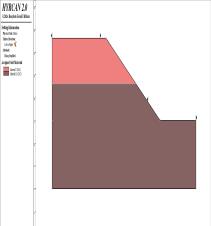
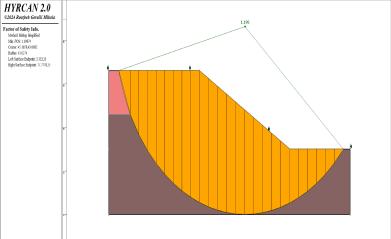
Fig -2:FactorofSafetyunderdrycondition
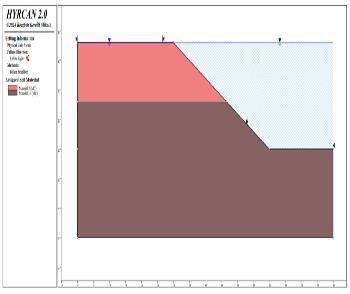
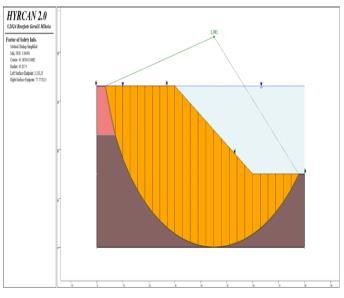
Fig -3:FactorofSafetyunderSubmergedcondition
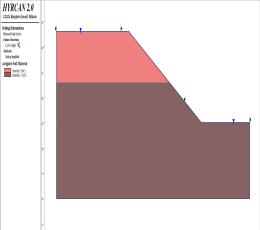
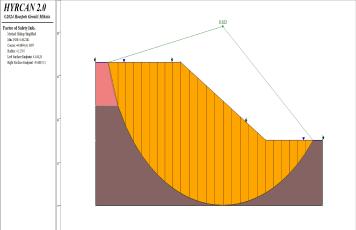
Fig -4:FactorofSafetyunderDrawdowncondition
The Factor of Safety (FOS) for each condition after
stabilizationisrepresentedintheFig5,Fig6,Fig7andit wasdeterminedfortheMix1andMix.
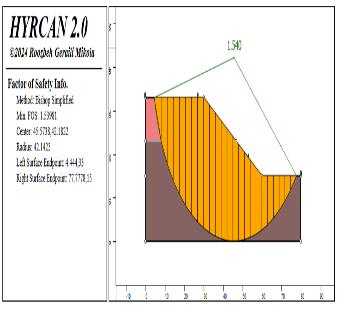
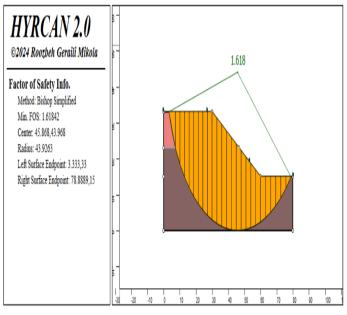
Fig -5:FactorofSafetyunderDryconditionafter stabilizationforthetwotrials
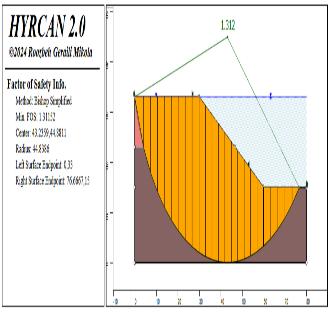
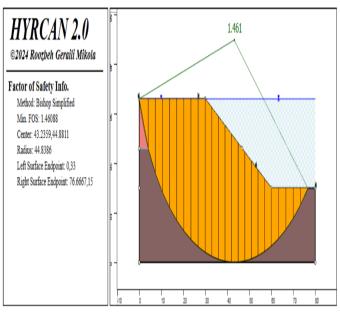
Fig -6:FactorofSafetyunderSubmergedconditionafter stabilizationforthetwotrials
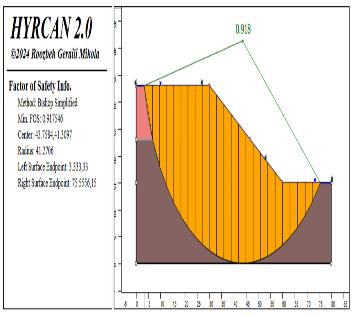
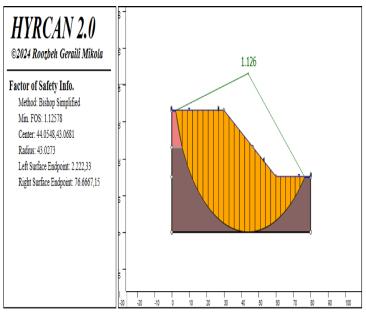
Fig -7:FactorofSafetyunderDrawdownconditionafter stabilizationforthetwotrials
Table -3: FactorofSafetyofEmbankmentAfter Treatment
trail2stabilized soil
5. CONCLUSIONS
1. The study aimed to enhance the slope stability of an irrigation canal embankment at Kandra Kota using nano-lime, nano-alumina, and polypropylenefibreasstabilizingagents.
2. Twostabilizedmixeswere preparedandtested. Mix2(1%NA+2%NL+0.5%PPF)consistently showedsuperiorperformanceoverMix1.
3. Laboratorytestsconfirmed: A reduction in plasticity index from 15.46% (untreated) to 8.18% (Mix 2), indicating reduced swelling and improvedworkability.
International Research Journal of Engineering and Technology (IRJET) e-ISSN:2395-0056
Volume: 12 Issue: 06 | Jun 2025 www.irjet.net p-ISSN:2395-0072
A shift in soil classification from CI to CL, representing improved behavior for embankmentstability.
DFS value dropped from 40% to 13% in Mix 2, reflectinglowersoilexpansiveness.
Cohesion increased from 49.033 kN/m² (untreated)to68.65kN/m²(Mix2).
Angle of internal friction improved drastically from7.6°to38.45°,enhancingshearresistance.
Permeability reduced significantly, improving drainageandminimizingseepagerisk.
HYRCANsoftwareanalysisshowed:
Underdryconditions,FOSimproved from1.199 to1.618(Mix2).
Under submerged conditions, FOS improved from1.041to1.416.
Under sudden drawdown conditions, the most critical, FOS increased from 0.632 to 1.126, exceedingthesafelimit.
4. The stabilization was successful under all exposure conditions, confirming the efficacy of nano-based additives in improving both soil strengthandslopereliability.
5. Overall, Mix 2 is recommended for field applications due to its balanced performance, sustainability, and cost-effectiveness for embankmentstabilization.
6. SCOPE FOR FURTHER STUDIES
The following few points are listed for further investigation.
i. Field-scale implementation of the proposed stabilization technique is needed to validate laboratory results under real conditions, including environmental and construction factors.
ii. Long-term behavior of stabilized soil should be investigated, considering effects of seasonal changes,aging,andrepeatedloading.
iii. The performance of nano-stabilized soils under dynamic or seismic loads requires further evaluation, especially in earthquake-prone zones.
iv. The role of curing time, temperature, and humidity on strength gain should be optimized forpracticalfieldapplications.
v. Futurestudiescanexploretheuseofalternative nano-materials or industrial by-products (e.g., fly ash, GGBS) for improved performance and sustainability.
vi. A detailed cost–benefit analysis comparing nano-stabilization with conventional methods (lime, cement) can support decision-making for large-scaleadoption.
vii. Integration of chemical stabilization with physical protection measures (e.g., geotextiles, drainage systems, vegetation) should be consideredforholisticslopesafety.
REFERENCE
1 Abd-Elaty. (2019, 05). Stability of Irrigation CanalSlopesConsideringtheSeaLevelRiseand Dynamic Changes: Case Study El-Salam Canal, Egypt. water, 11, 1046. doi:10.3390/w11051046
2 Agbelele,K.J.(2023,01).StudyofSlopeStability Using the Bishop Slice Method: An Approach Combining Analytical and Numerical Analyse. Open Journal of Applied Sciences, 13, 1446 1456.doi:10.4236/ojapps.2023.138115
3 Basheer,AmjethandPrashant,Amit.(2021,11). Case Study of Slope Failures in Canal. 109 115. doi:10.1061/9780784483688.011
4 Bishop,A.(1955).Theuseoftheslipcircleinthe stabilityanalysisofslopes.InGéotechnique(Vol. 5(1,pp.7-17).
5 Gunawan, M and Hidayati, and Adam, R. (2023, 05). Slope Stability Analysis Using Bishop Method and Slide 2D Software at Sand Stone Mining in Sedau Village, Narmada District, Lombok Barat Regency. IOP Conference Series: Earth and Environmental Science, 1175, 012010. doi:10.1088/17551315/1175/1/012010
6 J.M. Duncan and S.G. Wright. (1980). The accuracy of equilibrium methods of slope stabilityanalysis.EngineeringGeology,16,5-17. doi.org/10.1016/0013-7952(80)90003-4
7 Jebelli, J. Meguid, M. (2013, 01) Soil Stability Analysis in Irrigation Canals: A Case Study. J. Egypt.Geotech.Soc.2013,18,4153–4168
8 K.,ArunaandT.,MohammedandT.,RagilandK., Reshma and V., Salma and K., Neethu. (2018, 05). Slope Stability Analysis for Soil Erosion - A Case Study on Nadukani Hills. International Journal of Civil Engineering, 5, 25-29. doi:10.14445/23488352/IJCE-V5I5P105.
9 Liu, C. a. (2018, 01). Analysis of Road Embankment Slope Stability. Open Journal of Civil Engineering, 121-128. doi:10.4236/ojce.2018.82010
2025, IRJET | Impact Factor value: 8.315 | ISO 9001:2008 Certified Journal | Page1206
International Research Journal of Engineering and Technology (IRJET) e-ISSN:2395-0056
Volume: 12 Issue: 06 | Jun 2025 www.irjet.net p-ISSN:2395-0072
10 Mikola, Roozbeh. (2023, 02). HYRCAN: A Comprehensive Limit Equilibrium Software Package for 2D Slope Stability Analysis. doi:10.22541/au.167533016.65709246/v1.
11 Salunkhe, Mr and Chvan, Assist and Bartakke, Ms and Kothavale, Ms. (2017, 03). An Overview on Methods for Slope Stability Analysis. International Journal ofEngineeringResearch& Technology (IJERT), 06. doi:10.17577/IJERTV6IS030496
12 Shkdorani,N.a.(2014,08).Stabilityassessment of a failed artificial embankment slope, Pollack Periodica. An International Journal for EngineeringandInformationSciences,9,4558.
13 Sreelakshmi, G. a. (2022). Stability Analysis of Non-homogeneous Slopes and Assessment of Failure Characteristics Using HYRCAN. In LECTURE NOTES OF CIVIL ENGINEERING (Vol. 274, pp. 455-465). doi:10.1007/978-981-194055-2_36.
14 N. Rajagopal and N. Arunachalam. (2014). “Identification of Soil Erosion Prone Zones in Parts of Palani hills Tamilnadu India- Using Remote Sensing and GIS”, Int. Journal for RemoteSensingandGeoScience,vol.3(1).
15 P. Vincent, T. Subash and N. Nalanth. (2016). “Geotechnical assessment of soil in erosion prone zone”, Int. Journal for Civil Engineering Technology,vol.7(6),pp-227-240,2016.
16 Houehanou, E.C., Ahlinhan, M.F. and Ali, A.W. (2023) Assessment of Slope Stability by the Fellenius Slice Method: Analytical and NumericalApproach.WorldJournalofAdvanced Research and Reviews, 18, 1205-1214. https://doi.org/10.30574/wjarr.2023.18.2.0874
17 Greenwood, J.R. (2006) SLIP4EX A Program for Routine Slope Stability Analysis to Include the Effects of Vegetation, Reinforcement and HydrologicalChanges.Geotechnical&Geological Engineering, 24, 449-465. https://doi.org/10.1007/s10706-005-4156-5
18 Zolkepli,M.F.,Ishak,M.F.andZaini,M.S.I.(2019) Slope Stability Analysis Using Modified Fellenius’sandBishop’sMethod.IOPConference Series: Materials Science and Engineering, 527, Article ID: 012004. https://doi.org/10.1088/1757899X/527/1/012004
19 Dr. K. R. Arora “Soil mechanics and foundation engineering”, (1987) Standard publishers distributers,(2015)ISBN:81-8014-112-8
20 Dr.B.C.Punmia,Er.AshokKumarJain,Dr.Arun Kumar Jain (2005). “Soil mechanics and foundations” Laxmi Publications (P) LTD, 1994,2005.
21 Bishop, A.W. (1955). The Use of Slip Circles in the Stability Analysis of Earth Slopes. Geotechnique,5,7-17.
22 Janbu,N.(1954).Stabilityanalysisofslopeswith dimensionless parameters. Harvard Soil MechanicsSeries,46,811.
23 Morgenstern, N.R. and Price, V.E. (1965) The Analysis of the Stability of Generalised Slip Surfaces. Géotechnique, 15, 79-93. https://doi.org/10.1680/geot.1965.15.1.79
24 Spencer,E.(1967). AMethodforAnalysisofthe Stability of Embankments Assum ing Parallel Interslice Forces. Géotechnique, 17, 11-26. https://doi.org/10.1680/geot.1967.17.1.11
25 Cheng, Y.M. and Lau, C.K. (2014) Slope Stability Analysis and Stabilization. New Methods and Insight, 2nd Edition, London. https://doi.org/10.1201/b17015
26 Balasubramaniam, A.S., Cai, H., Zhu, D., Surarak, C. and Oh, E.Y.N. (2010). Settlements of Embankments in Soft Soils. Geotechnical EngineeringJournaloftheSEAGS&AGSSEA,41, No.2.
27 IS 2720(Part 12) 1987. “Indian Standard Code for Methods of Test for Soil, (Part 12), Determination of shear strength parameters of soil from consolidated undrained test with measurementofporewaterpressure”.
28 IS 2720 (Part 3/sec 1) 1980. Indian Standard CodeforMethodsofTestforSoil,(Part3/sec1) “DeterminationofSpecificGravity”.
29 IS 2720 (Part 4) – 1985. “Indian Standard Code forMethodsofTestforSoils(Part4),GrainSize Analysis.”
30 IS 2720 (Part 2) – 1973. “Indian Standard Code for Methods of Test for Soils (Part 2) –DeterminationofMoistureContent”
31 IS2720(Part3/Sec1)–1980.“MethodsofTest for Soils – Part 3: Determination of Specific Gravity,Section1–Fine-GrainedSoils.
32 IS 2720 (Part 5) – 1985. “Methods of Test for Soils – Part 5: Determination of Liquid and PlasticLimits.”
33 IS 2720 (Part 17) – 1986. “Methods of Test for Soils – Part 17: Laboratory Determination of Permeability.”
34 IS 2720 (Part 11) – 1993. “Methods of Test for Soils–Part11:DeterminationofShearStrength ParametersusingTriaxialApparatus.”
35 IS 2720 (Part 40) – 1977. “Methods of Test for Soils – Part 40: Determination of Free Swell IndexofSoils.”
36 IS2720(Part15)–1986.“MethodsofTestfor Soils – Part 15: Determination of Consolidation Properties”.