
International Research Journal of Engineering and Technology (IRJET) e-ISSN: 2395-0056

International Research Journal of Engineering and Technology (IRJET) e-ISSN: 2395-0056
Samruddhi Gadadare1 , Prof. P. N. Kadam2 , Priti Kharat3 , Prathamesh Nalawade4 , Devika Nimbalkar5
1,3,4,5 Student, Department of Computer Engineering, SVPM’s College of Engineering, Malegaon BK, Maharashtra, India
2 Assistant Professor, Department of Computer Engineering, SVPM’S College of Engineering Malegaon BK, Baramati, Maharashtra, India
Abstract - Women today face many health problems like irregular periods, PCOS (Polycystic Ovary Syndrome), menopause, and a lack of awareness about hygiene and healthcare. Most existing apps focus only on one issue such as period tracking without offering complete and personalized support. To address this gap, we developed NaariCare, an intelligent web-based platform that helps women manage their overall health using Artificial Intelligence (AI) and Machine Learning (ML). The system includes features such as menstrual cycle tracking, PCOS prediction, menopause awareness, personalized diet and fitness recommendations, and a 24/7 AI chatbot for health queries. Italsoconnectsusers with nearby doctors, NGOs, andgovernmenthealthschemesto make healthcare more accessible. By analyzing user data through ML models, NaariCare predicts health risks early and offers preventive guidance.This approach empowers women with accurate insights, continuous awareness, andconvenient access to healthcare support all in one smart and easy-to-use platform
Key Words: Menopause, PCOS, Menstrual Tracking, AI Chatbot,MachineLearning.
Women’s health is an important part of society’s overall well-being,butitisoftennotgivenenoughattention.Many womentodayfacehealthproblemssuchasirregularperiods, PolycysticOvarySyndrome(PCOS),menopauseissues,anda lack of awareness about hygiene and preventive care. Because of busy lifestyles, limited access to doctors, and social hesitation, these problems are often ignored or diagnosed very late. Although there are many mobile and webapplicationsthathelptrackmenstrualcycles,mostof them focus only on period tracking or fertility windows. They do not provide complete health support, such as predictingpossiblehealthrisks,givinglifestylesuggestions, orconnectinguserswithmedicalhelp.
Asaresult,womenstillfinditdifficulttogetaccurate,timely, and reliable health guidance. To solve this problem, we developed NaariCare, an AI-based women’s health and wellnessplatform.NaariCareusesArtificialIntelligence(AI) andMachineLearning(ML)tounderstandawoman’shealth data and give personalized advice. It helps in tracking menstrual cycles, predicting PCOS and menopause, and
providingcustomdietandexerciserecommendations.The platform also includes an AI chatbot that answers healthrelated questions instantly and connects users to doctors, NGOs, and government health schemes when needed. NaariCare aims to make healthcare simpler, smarter, and moreaccessibleforeverywoman.Itnotonlypromotesearly detectionofhealthproblemsbutalsospreadsawarenessand encourageswomentotakebettercareoftheirphysicaland mental well-being. In short, NaariCare is a step toward empowering women through intelligent and easy-to-use digitalhealthcare.
Development of an integrated women’s healthcare system that enables accurate menstrual cycle tracking, PCOS and menopausepredictionusingML-basedanalytics.Thesystem willprovidepersonalizeddietandhygienerecommendations, AIchatbotassistance,nearbygynecologistsuggestion,NGOs, andgovernmenthealthschemestoimprovewomen’shealth managementandawareness.
In recent years, the integration of machine learning techniquesforPCOSdetectionandmenstrualhealthsupport has gained significant attention. Jyoti Choudhary and Madhuri Thakur [1] proposed an integrated system combiningXGBoostforPCOSpredictionwithanNLP-based chatbot to assist women with menstrual health queries. Theirapproachenhancesaccessibilitytohealthcaresupport throughautomation.However,themodelfaceslimitationsin generalizabilityandreal-worldapplicabilityduetodataset constraints.
Md Mahbubur Rahman et al. [2] developed a web-based machinelearningsystemaimedatearlydetectionofPCOS using multiple classification algorithms. Their model demonstrated high accuracy and efficiency in predicting PCOS at an early stage, making it suitable for preventive healthcare. Despite its effectiveness, the study relies on limited datasets and lacks extensive clinical validation, whichmayreduceitsapplicabilityinreal-worldscenarios.
Vasu Avashti, Ashish Kumar, and Aditya Bhardwaj [3] presented a machine learning-based approach using
Volume: 13 Issue: 04 | Apr 2026 www.irjet.net p-ISSN: 2395-0072 © 2026, IRJET | Impact Factor value: 8.315 | ISO 9001:2008 Certified Journal | Page1779
International Research Journal of Engineering and Technology (IRJET) e-ISSN: 2395-0056
Volume: 13 Issue: 04 | Apr 2026 www.irjet.net p-ISSN: 2395-0072
XGBoosttodetectPCOSwithanaccuracyofapproximately 96%.Theirmodelutilizedclinicalandmetabolicfeaturesto improve prediction performance. While the results are promising, the study does not fully capture diverse symptomatic variations of PCOS, which may affect its generalizationacrossdifferentpopulations.
Aliaksandra Shauchuk [4] explored personalization techniques in mobile period tracker applications, emphasizing user-centered design for improving user engagement and accuracy. The study highlighted how tailoredrecommendationscanenhanceuserexperienceand health awareness. However, the research is limited by a small and homogeneous sample size within a narrow age group,restrictingbroaderapplicability.
DaltonC.G.ValadaresandAngeloPerkusich[5]proposeda FlaskandMySQL-basedwebapplicationthatincorporates machinelearningformenstrualtrackingandgynecological query handling. The system also provides doctor recommendations, improving user interaction with healthcare services. However, the application primarily focuses on menstrual tracking and does not comprehensivelyaddressotherwomen’shealthconditions.
Therapidadvancementofdigitalhealthcaretechnologieshas created new opportunities to improve women’s health management. However, existing systems often focus on isolated functionalities such as period tracking or general fitness,lackingacomprehensiveandintelligentapproach..
A. Bridging the Healthcare Gap
Asignificantchallengeinwomen’shealthcareisthelackof accessibilitytoreliablemedicalsupport,particularlyinrural and underserved regions. Many women face difficulties in connectingwithqualifiedhealthcareprofessionals,NGOs,and governmenthealthschemesduetofragmentedsystemsand lack of awareness. Naaricare aims to address this issue by providing a unified platform that integrates healthcare services, enabling seamless communication and access to support.
Early diagnosis plays a crucial role in preventing severe health complications. Conditions such as Polycystic Ovary Syndrome(PCOS),menstrualirregularities,andmenopauserelated disorders are often detected late due to lack of monitoringandawareness.ThemotivationbehindNaaricare istoleveragemachinelearninganddeeplearningmodelsto analyze user data andidentify early warningsigns ofsuch conditions
C. Personalized Wellness
Traditional healthcare solutions often provide generalized recommendations that may not be suitable for every
individual. Women’s health is highly personalized and influencedbyfactorssuchasage,hormonalchanges,lifestyle, and medical history. Naaricare is designed to deliver customized health recommendations, including diet plans, exercise routines, hygiene practices, and mental wellness strategies. This personalized approach enhances user engagementandensuresmoreeffectivehealthmanagement.
D. Promoting Awareness and Education
Lackofawarenessregardingreproductivehealth,menstrual hygiene,andpreventivecareremainsamajorconcern.Many women do not have access to accurate and reliable information, leading to misconceptions and poor health practices. Naaricare addresses this gap by providing educationalcontentsuchasarticles,videos,andinteractive chatbot support. The platform empowers women with knowledge,enablingthemtomakeinformeddecisionsabout theirhealthandwell-being.
E. Ensuring Privacy and Trust
Privacyanddatasecurityarecriticalfactorsintheadoption ofdigitalhealthapplications.Womenoftenhesitatetoshare personal health information due to concerns about data misuseandlackofconfidentiality.Naaricareismotivatedto build a secure and trustworthy environment by implementing robust security measures, including data encryption, secure authentication, and role-based access control.
5 SYSTEM ARCHITECTURE
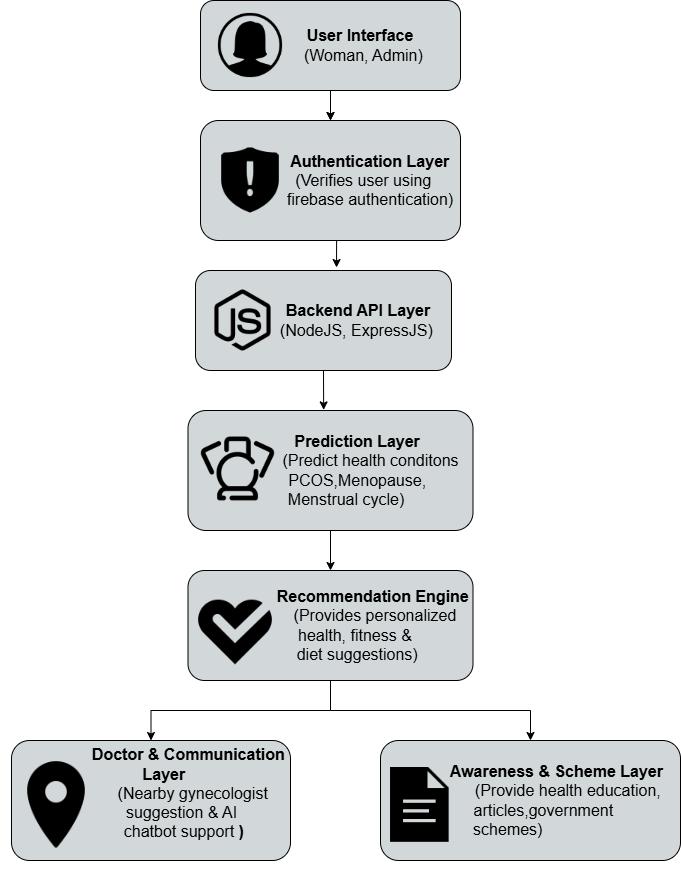
1: SystemArchitecture
International Research Journal of Engineering and Technology (IRJET) e-ISSN: 2395-0056
Volume: 13 Issue: 04 | Apr 2026 www.irjet.net p-ISSN: 2395-0072
1.UserRegistration&Authentication:Userssecurelyregister andlogintoaccesspersonalizedhealthcareservices.
2.AddSymptomsandHealthRecords: Usersinputmedical data such as symptoms, menstrual history, and hormonal detailsforanalysis.
3.DiseasePrediction:Machinelearningmodelsanalyzeinput datatopredictconditionslikePCOSandmenopausestages.
4. Recommendation to User: The system provides personalizeddiet,exercise,andhygienesuggestionsbasedon predictionresults.
5. Access to Other Health Systems: Usersareconnectedto doctors,NGOs,andgovernmenthealthschemesforfurther supportandtreatment.
Algorithm 1: Random Forest
Random Forest is an ensemble machine learning algorithm that uses multiple decision trees to improve prediction accuracy and reduce overfitting. It works by creating several trees using random subsets of data and features,andeachtreemakesitsownprediction.Thefinal output is determined by majority voting in classification problems.IntheNaariCaresystem,RandomForestisusedto analyze user health data such as symptoms, menstrual history,andhormonaldetailstopredictconditionslikePCOS andmenopausestages.
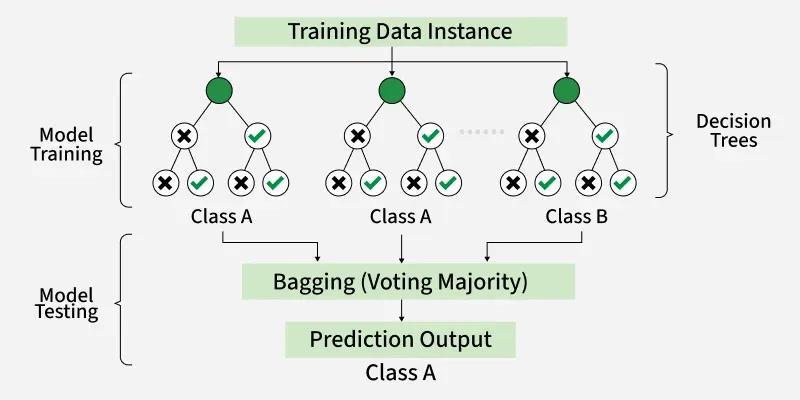
Explanation of Random forest:
1. Input: User enters health data such as age, symptoms, menstrual cycle details, and hormonal information into NaariCare
2.Dataset and preprocessing: The system uses existing labeledpatientdata andprocessesitbycleaning,handling missingvalues,andconvertingitintonumericalform
3.Modelbuilding:Multipledecisiontreesarecreatedusing randomsubsetsofdataandfeatures.
4.Predictionprocess:Theuser’sdataispassedthroughall decisiontreesandeachtreegivesitsownprediction
5.Output decision: Final result is obtained using majority votingamongalltreepredictions
6.Result and recommendation: Based on the prediction, NaariCare provides disease risk analysis and personalized suggestionslikediet,exercise,andmedicalconsultation.
Algorithm 2: K-Nearest Neighbors (KNN)
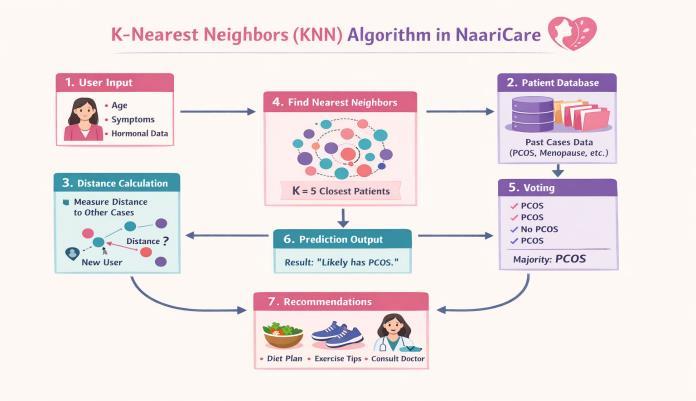
Fig-3:K-NearestNeighbors(KNN)
Explanation of KNN:
1.Input: User enters health data such as age, symptoms, menstrual cycle details, and hormonal information into NaariCare.
2.Dataset and preprocessing: The system uses existing labeledpatientdataandprocessesitbycleaning,handling missing values, converting it into numerical form, and normalizingthevalues
Modelbuilding:Thesystemstoresallprocesseddatapoints and selects a value of K to determine how many nearest neighborstoconsider
Prediction process: The user’s data is compared with all existing data points by calculating distances to find the K closestneighbors.
Output decision: The most common class among the K nearestneighborsisselectedasthefinalprediction.
Result and recommendation: Based on the prediction, NaariCareprovidesdiseaseriskanalysisandpersonalized suggestionslikediet,exercise,andmedicalconsultation
International Research Journal of Engineering and Technology (IRJET) e-ISSN: 2395-0056
Volume: 13 Issue: 04 | Apr 2026 www.irjet.net p-ISSN: 2395-0072
Algorithm 3: XGBOOST
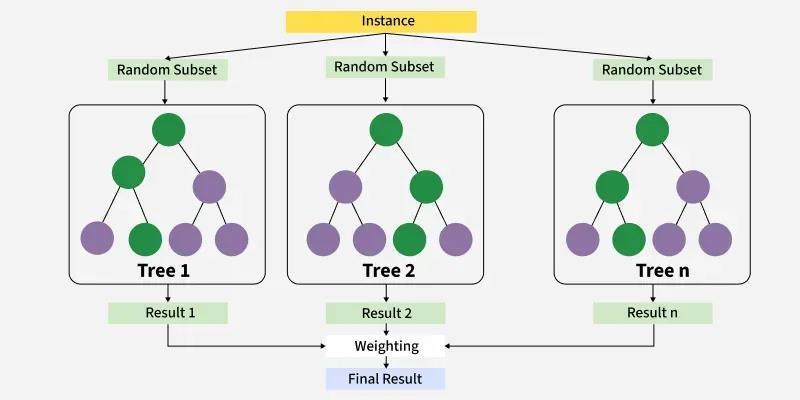
Fig4.XGBoostAlgorithm
Explanation of XGBOOST:
1.Input: User enters health data such as age, symptoms, menstrual cycle details, and hormonal information into NaariCare
2.Dataset and preprocessing: The system uses existing labeledpatientdataandprocessesitbycleaning,handling missing values, converting it into numerical form, and normalizingfeatures.
3. Model building: Multiple decision trees are built sequentiallywhereeachnewtreecorrectstheerrorsofthe previousonesusinggradientboosting
4.Predictionprocess:Theuser’sdataispassedthroughall boosted trees and each tree contributes to improving the prediction
5. Output decision: Final result is obtained by combining outputs of all trees to produce a strong and accurate prediction.
6. Result and recommendation: Based on the prediction, NaariCareprovidesdiseaseriskanalysisandpersonalized suggestionslikediet,exercise,andmedicalconsultation.
Algorithm 4: LSTM
1. Input: User enters sequential health data such as menstrualcyclehistory,symptomsovertime,andhormonal changesintoNaariCare
2.Datasetandpreprocessing:Thesystemusestime-series healthdata,cleansit,handlesmissingvalues,convertsitinto numericalformat,andstructuresitassequences.
3. Model building: An LSTM (Long Short-Term Memory) neuralnetworkiscreatedtolearnpatternsfromsequential andtime-dependentdata
4. Predictionprocess:Theuser’ssequentialdataispassed throughLSTMlayerswhichcapturelong-termdependencies andtemporalpatterns
5.Outputdecision:Themodelpredictsthehealthcondition basedonlearnedsequencepatterns(e.g.,cycleirregularities orhormonaltrends)
6. Result and recommendation: Based on the prediction, NaariCareprovidesdiseaseriskanalysisandpersonalized suggestionslikediet,exercise,andmedicalconsultation.
I.Accuracy
•RandomForestAlgorithm:RandomForestprovideshigh accuracy by combining multiple decision trees, reducing overfittingandcapturingcomplex patterns inhealthdata, makingiteffectiveforpredictingconditionslikePCOS.
•KNNAlgorithm:KNNoffersgoodaccuracydependingon thechoiceof Kanddata quality,butit may beaffected by noisyorirrelevantfeaturesinthedataset.
•XGBoostAlgorithm:XGBoostprovidesveryhighaccuracy by sequentially correcting errors of previous trees and capturing complex relationships in structured healthcare data.
•LSTMAlgorithm:LSTMoffershighaccuracyfortime-series databylearninglong-termdependenciesinmenstrualcycles andhormonalpatterns.
II. Computational complexity
• Random Forest Algorithm: Random Forest has high computational complexity due to the construction and evaluation of multiple decision trees, especially during training.
• KNN Algorithm: KNN has low training cost but high computationalcomplexityduringprediction,asitcalculates distancewithalldatapoints.
• XGBoost Algorithm: XGBoost has high computational complexityduetosequentialtreebuildingandoptimization, butitisefficientcomparedtootherboostingmethods.
• LSTM Algorithm: LSTM has very high computational complexity as it involves deep neural network layers and requiresmoretrainingtimeandresources.
• Random Forest Algorithm: Random Forest provides moderate real-time performance, as predictions are relativelyfastoncethemodelistrained,buttrainingitselfis time-consuming.
• KNN Algorithm: KNN has poor real-time performance because it requires distance calculations with the entire datasetforeverynewinput.
International Research Journal of Engineering and Technology (IRJET) e-ISSN: 2395-0056
Volume: 13 Issue: 04 | Apr 2026 www.irjet.net p-ISSN: 2395-0072
•XGBoostAlgorithm:XGBoostprovidesmoderatereal-time performancewithrelativelyfastpredictionsaftertraining, makingitsuitableforpracticalapplications.
•LSTMAlgorithm:LSTMhaslowerreal-timeperformance duetocomplexcomputations,especiallywhenhandlinglong sequences.
IV. Generalization to New Data
• Random Forest Algorithm: Random Forest generalizes welltonewdataandhandlesunseencaseseffectivelydueto itsensemblenature.
•KNNAlgorithm:KNNhasmoderategeneralizationability andmaystrugglewithnewdataifthedatasetisnoisyornot well-distributed.
•XGBoostAlgorithm:XGBoostgeneralizesverywelltonew dataduetoregularizationtechniques,reducingoverfitting andimprovingrobustness.
•LSTMAlgorithm:LSTMgeneralizeswellforsequentialdata but may require large datasets and retraining if data patternschangesignificantly.
In conclusion, Random Forest and XGBoost provide high accuracyandstrongperformanceforstructuredhealthcare data in NaariCare. KNN is simple and useful for basic predictionsbutislessefficientforlargedatasetsandrealtime use. LSTM is best suited for time-series data like menstrualcycles,capturinglong-termpatternseffectively. Combining these algorithms improves overall prediction accuracyandsystemreliability.
7. METHODOLOGY
The proposed NaariCare system is designed to predict women’s health conditions such as PCOS and menopause stages using machine learning techniques like Random Forest and K-Nearest Neighbors (KNN). The system processes user health data and provides personalized healthcare recommendations. The architecture is divided intoseveralstagesasdescribedbelow:
I. Data collection and Input
UserhealthdataiscollectedthroughtheNaariCareinterface:
• Users enter details such as age, menstrual cycle history, symptoms (acne, weight gain, irregular periods).
•Dataisstoredsecurelyforfurtherprocessingandanalysis
II. Data Preprocessing
The collected data undergoes preprocessing to ensure quality
• Data Cleaning: Handling missing or inconsistent values
• Encoding: Converting categorical data into numerical format
•Normalization:Scalingvaluestoauniformrangeforbetter modelperformance
III. Feature Selection and Dataset Preparation
Relevant features are selected to improve prediction accuracy:
• Important attributes like cycle regularity, BMI, and symptoms
• Dataset is divided into training and testing sets
•Helpsinreducingnoiseandimprovingmodelefficiency
IV. Model Training Using Random Forest and KNN
Machine learning models are trained using prepared datasets:
• Random Forest: Multiple decision trees are built using random subsets of data and features
• KNN: Stores all data points and classifies based on similarity
•Modelslearnpatternsbetweensymptomsanddiseases
V.Prediction & Classification
The trained models are used to predict user health conditions:
•New user input is passed into the models
•RandomForestusesmajorityvotingfrommultipletrees
• KNN identifies nearest neighbors and assigns the most common class
•Outputisgeneratedaspredictedcondition(e.g.,PCOSrisk level)
VI. Result Generation and Recommendation
Basedonpredictionresults,thesystemprovidesactionable insights:
•Displays disease risk analysis to the user
• Suggests personalized diet plans, exercise routines, and hygiene
•Recommendsmedicalconsultationifnecessary
VII. System Integration and Continuous Learning
The complete model is integrated into the NaariCare platform:
• Enables real-time prediction and user interaction
•Newuserdata canbeaddedtoimprove model accuracy overtime
•Ensuresscalabilityandcontinuoussystemenhancement
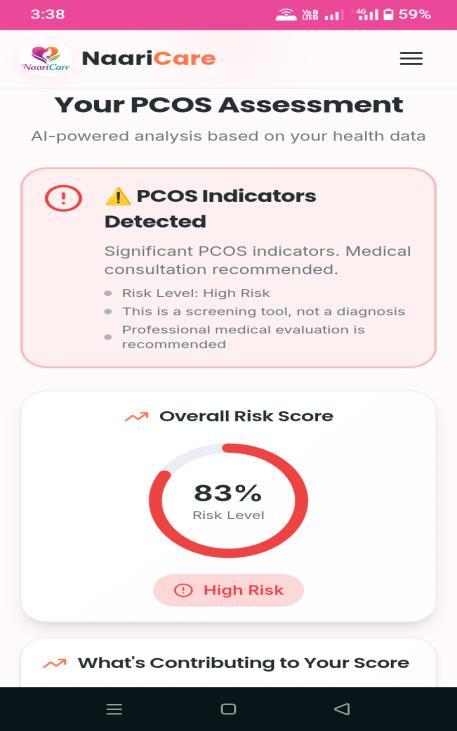
a.PCOS
Model
Random Forest Ensemble Learning 92 Medium Handles complex symptom well
XGBoost Gradient 93 Medium Efficient
International Research Journal of Engineering and Technology (IRJET) e-ISSN: 2395-0056
Volume: 13 Issue: 04 | Apr 2026 www.irjet.net p-ISSN: 2395-0072
Boosting Model butslightly complex
KNN InstanceBased Learning 90 Low Slower in real-time
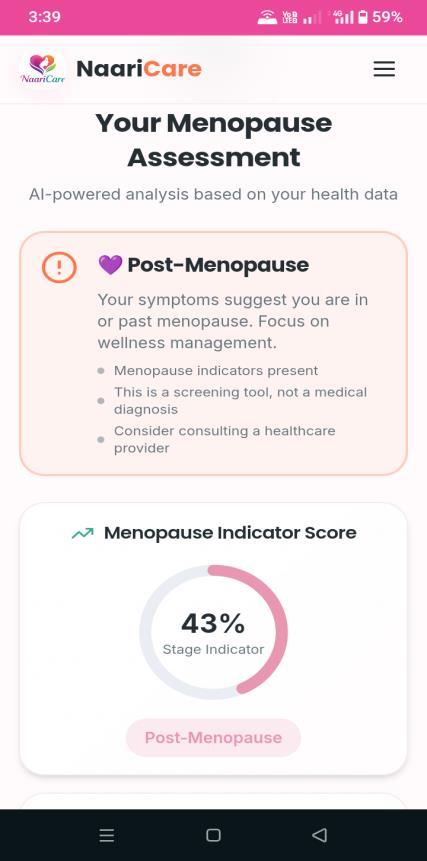
b.Menopause
Model Type Accuracy (%) Real time capability Comments
Random Forest Ensemble Learning 98 Medium Handles complex symptom patterns well
XGBoost Gradient Boosting Model 99 Medium Efficient, robust but slightly complex
KNN InstanceBased Learning 90 Low Slower in real-time
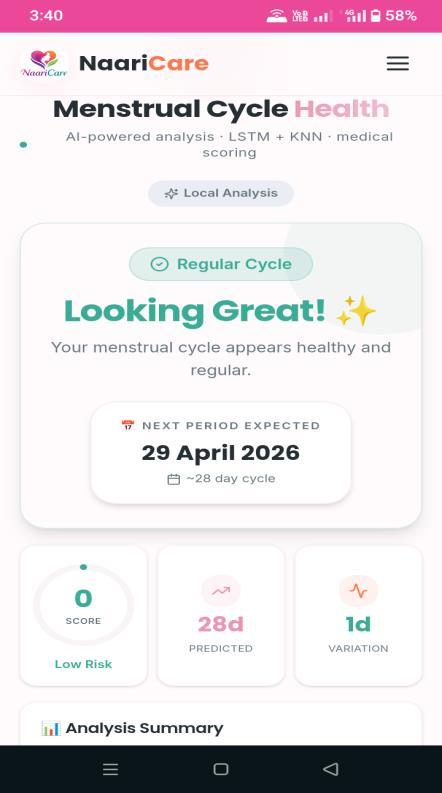
c.Menstrual Cycle
Model Type Accuracy (%) Real time capability Comments
LSTM Recurrent Neural Network 91 High tracking cycle irregularities
KNN InstanceBased Learning 80 Low Slower in real-time due to distance
International Research Journal of Engineering and Technology (IRJET) e-ISSN: 2395-0056
Volume: 13 Issue: 04 | Apr 2026 www.irjet.net p-ISSN: 2395-0072
The proposed NaariCare system represents a significant steptowardtransformingwomen’shealthcarethroughthe integration of modern technologies such as Machine Learning(ML)andArtificialIntelligence(AI).Bycombining predictiveanalyticswithuser-friendlydesign,thesystemnot onlyenablesearlydetectionofcriticalhealthconditionslike PCOS, menstrual disorders, and menopause-related complications,butalsoempowerswomentotakeproactive controloftheirhealth.Inconclusion,NaariCareisnotjusta technological solution but a comprehensive healthcare support system aimed at improving the quality of life for women. It combines accuracy, accessibility, and personalizationtocreateareliableandefficientplatformfor women’shealthmanagement.Withfurtherdevelopmentand widespread adoption, NaariCare has the potential to contribute significantly to preventive healthcare, early diagnosis,andoverallempowermentofwomeninmanaging theirhealtheffectively.
[1]J. ChoudharyandM. Thakur,"IntegratingML for PCOS DetectionandfemBot:ANovelNLP-BasedMenstrualHealth Chatbot for Women’s Health Support," 2025.
[2] M. M. Rahman, A. Islam,and M. Z., "Empowering Early Detection: A Web-Based Machine Learning Approach for PCOS”,2024.
[3] V. Avashti, A. Kumar, and A. Bhardwaj, "Empowering Women’sHealth:MachineLearningforPCOSDetectionand Prediction,"2024.
[4] A. Shauchuk, "Mobile Period Tracker Apps and Personalisation,"2023.
[5] D. C. G. Valadares and A. Perkusich, "Application using Machine Learning to Promote Women’s Personal Health," 2023.