

International Research Journal of Engineering and Technology (IRJET) e-ISSN: 2395-0056
Volume: 13 Issue: 04 | Apr 2026 www.irjet.net p-ISSN: 2395-0072
MULTIMODAL BIOSENSOR FUSION AND LSTM-DNN ARCHITECTURE FOR INTERNAL BLEEDING DETECTION IN MILITARY APPLICATIONS
Dr. Chitrasudhakaran, Dhivya Keerthana B
Department of Biomedical Engineering, St Peters Higher Education and Research Institute, Chennai, Tamil Nadu, India
Abstract Internal bleeding remains one of the primary causes of preventable deaths in combat and high-risk military operations, where delayed diagnosis and limited medicalinfrastructuresignificantlyreducesurvivalrates.To address this challenge, this project proposes a wearable Artificial Intelligence (AI)-based system for the early detection of internal bleeding in military personnel. The system integrates multimodal physiological sensing, edge computing, and Internet of Things (IoT) technology to enable continuous andreal-time health monitoring inharsh operationalenvironments.Awearableplatformbuiltaround an ESP8266 NodeMCU microcontroller acquires vital physiological parameters, including electrocardiogram (ECG), pulse oximetry (infrared signals), body temperature, and motion data from flex sensors. The collected signals are preprocessed to remove noise and artifacts, followed by feature extraction to obtain relevant temporal and statistical characteristics. A hybrid deep learning model combining Deep Neural Networks (DNN) and Long ShortTerm Memory (LSTM) networks is employed to identify nonlinear patterns and temporal trends indicative of internal hemorrhage and hemorrhagic shock. When abnormal conditions are detected, the system generates immediate local alerts and transmits critical health data along with location information to remote medical units through IoT communication. This approach enables rapid medical response, enhances situational awareness, and significantly improves the survivability of injured soldiers in combatscenarios.
Keywords Artificial Intelligence, Internal Bleeding Detection, Wearable Sensors, Deep Neural Networks, LSTM,ESP8266,IoT,MilitaryHealthcare,EdgeComputing, HemorrhagicShock
1. INTRODUCTION
Modern military missions are frequently carried out in extreme and hostile environments where immediate access to advanced medical facilities is limited. In such conditions,internalbleedingisoneofthemostcriticaland life-threatening injuries faced by soldiers. Unlike external wounds, internal haemorrhage is difficult to identify at an early stage, as visible symptoms may be minimal or delayed. This often results in late diagnosis, delayed treatment, and increased mortality. Therefore, there is a strong need for intelligent and autonomous systems capable of continuously monitoring soldiers’ physiological
conditionsanddetectingearlysignsofinternalbleedingin realtime.
Recent developments in wearable sensors, Artificial Intelligence(AI),andInternetofThings(IoT) technologies have enabled continuous health monitoring outside conventionalhospitalenvironments.Wearabledevicescan measure vital physiological signals such as heart activity, oxygen saturation, body temperature, and physical movement, all of which are closely linked to hemorrhagic shock. When these multimodal signals are analyzed using advanced deep learning algorithms, subtle physiological changesassociatedwithinternalbleedingcanbeidentified atanearlystage.
This project proposes a wearable AI-based internal bleeding detection system using an ESP8266 NodeMCU platform. The system integrates multimodal sensing, edge computing, and IoT communication to provide real-time healthmonitoringandrapidalertgeneration.
A. Objectives
The main objective of this project is to design and implement a wearable Artificial Intelligence-based system capable of detecting internal bleeding at an early stage in military personnel operating in high-risk environments. The system focuses on continuous physiological monitoring, intelligent data analysis, and real-time communicationtosupporttimelymedicalintervention.
Keyobjectivesinclude:(1)acquiringmultiplephysiological parameters including ECG, pulse oximetry, body temperature, and motion data using compact wearable sensors; (2) preprocessing collected sensor data by removing noise and extracting relevant temporal and statistical features; (3) developing a hybrid deep learning model combining DNN and LSTM networks; (4) implementing edge computing using ESP8266 NodeMCU for real-time operation; and (5) enabling IoT-based transmissionofcriticalhealthdatatoremotemedicalunits withlocalalertgeneration.
2. LITERATURE REVIEW
Thissectionreviewsrecent researchinbleeding detection systems, highlighting various approaches and their applicabilitytowearablefielddeployments.
International Research Journal of Engineering and Technology (IRJET) e-ISSN: 2395-0056
Volume: 13 Issue: 04 | Apr 2026 www.irjet.net p-ISSN: 2395-0072
A. Image and Video-Based Detection Systems
Z. Liu et al. [1][2] developed bleeding detection frameworks for arthroscopic surgery videos using composite color features and integrated ViT-ResNet50 architectures. While achieving high accuracy in controlled surgicalenvironments,thesemethodsrequirehigh-quality imaging and substantial computational resources, making themunsuitableforlow-powerwearableplatformsinfield operations.
G. Tapia et al. [7] benchmarked YOLO-based models for intracranial hemorrhage detection using CT datasets. Despite real-time performance advantages, reliance on CT imaging restricts continuous monitoring and field deploymentcapabilities.
B. Signal Analysis and Machine Learning
Q. Li et al. [3] proposed microwave imaging with Singularity Expansion Method (SEM) and SSA-GA-BP neural networks for cerebral hemorrhage classification. While demonstrating accurate localization, the system requires specialized hardware and precise calibration, increasingcomplexityforwearableimplementations.
A.Singhetal.[6]introducedamicrowaveantenna-assisted machine learning system for non-invasive brain hemorrhage detection. S. Schoen Jr et al. [4] investigated contrast-enhanced ultrasound for active hemorrhage detection in trauma scenarios. The requirement for contrast agents and trained operators limits autonomous wearableapplications.
C. Deep Learning in Hemorrhage Detection
A.Chaudharyetal.[5]developedadeepensemblelearning framework for multiclass intracranial hemorrhage detection using CT scans with Monte Carlo dropout for uncertainty estimation. M. A. Saleem et al. [11] proposed machine learning-based stroke detection using LSTM/BiLSTM networks, reinforcing the importance of temporal deep learning for physiological pattern recognition.
D. Research Gap
Current literature reveals that most bleeding detection systems rely on imaging modalities or require specialized hardware unsuitable for continuous field monitoring. The proposed system fills this gap by integrating multimodal physiological sensing, edge computing, and hybrid deep learningfordeploymentinresource-limitedscenarios.
3. PROPOSED SYSTEM ARCHITECTURE
A. System Overview
The proposed system is an AI-based internal bleeding detection framework designed for military personnel. The architecture integrates four primary modules: physiological sensing, signal processing and feature
extraction,AI-basedclassification,andIoTcommunication withalertgeneration.
B. Physiological Sensing Module
Thesensingmodulecomprises:(1)ECGSensorforcardiac electrical activity monitoring; (2) Pulse Oximeter (IR Sensor) for SpO2 and pulse rate; (3) Temperature Sensor for body temperature changes associated with blood loss; and (4) Flex Sensor for motion and posture detection. All sensors interface with the ESP8266 NodeMCU via analog anddigitalpins.
C. Signal Processing and Feature Extraction
Raw physiological signals undergo preprocessing to remove noise, baseline drift, and motion artifacts using digital filtering. Feature extraction computes HRV metrics, SpO2 trends, temperature deviation, movement patterns, andstatisticalfeatures(mean,variance,peaks)asinputsto thedeeplearningmodel.
D. AI-Based Classification Module
A hybrid DNN-LSTM architecture analyzes extracted features. The DNN component learns complex nonlinear relationships through multiple fully connected layers. The LSTM component captures temporal dependencies essential for identifying progressive deterioration characteristicofinternalbleeding,outputtingaprobability scoreforhemorrhagicconditions.
E. Edge Computing Implementation
The ESP8266 NodeMCU performs edge inference locally withoutclouddependency, providing real-timeprocessing with minimal latency, operation in communication-denied environments,reducedpowerconsumption,andenhanced data privacy. Model quantization and pruning enable deploymentonresource-constrainedhardware.
F. IoT Communication and Alert Module
Upondetectingabnormal conditions,thesystemactivates: (1) Local Alerts via buzzer and LED; (2) Remote Alerts transmitting physiological parameters, GPS coordinates, soldierID,and timestamp tomedical unitsvia Wi-Fiusing HTTPorMQTTprotocols.
4. HARDWARE IMPLEMENTATION
A. Components Specification
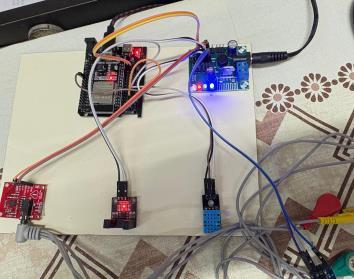
Hardware comprises: ESP8266 NodeMCU (32-bit, Wi-Fi, 80/160 MHz, 4MB flash), AD8232 ECG sensor, MAX30100/MAX30102 pulse oximeter, DS18B20 temperature sensor, flex sensor, Li-ion battery (3.7V, 2000mAh), voltage regulator, buzzer, LED, and compact wearableenclosure.
B. Circuit Integration
SensorsconnecttoESP8266 ADCanddigital I/Opins.The ECG sensor feeds the ADC after amplification. The pulse
International Research Journal of Engineering and Technology (IRJET) e-ISSN: 2395-0056
Volume: 13 Issue: 04 | Apr 2026 www.irjet.net p-ISSN: 2395-0072
oximeter uses I2C, temperature sensor uses 1-Wire protocol, and flex sensor resistance is measured via voltage divider. Power management maintains stable 3.3V supply.
C. Wearable Platform Design
The system is designed as a chest-mounted wearable devicewithminimalweight(<200g),ruggedizedenclosure forharshenvironments,adjustablestrapsforuniversal fit, andeasyaccesstopowerandconnectivityinterfaces.
5. SOFTWARE IMPLEMENTATION
A. Firmware Development
Embedded firmware uses Arduino IDE with ESP8266 libraries. Key modules: (1) Sensor Interface for ADC, I2C, and 1-Wire; (2) Signal Processing with digital filters and peak detection; (3) Communication managing Wi-Fi and HTTP/MQTT;(4)AlertModulecontrollingbuzzerandLED.
B. AI Model Development
The deep learning model uses Python with TensorFlow/Keras. Data is split into training (70%), validation (15%), and testing (15%). Architecture: dense layers (128, 64, 32 neurons, ReLU), LSTM layers (64, 32 units), dropout (0.3), sigmoid output. Post-training quantization reduces model size 75% for TensorFlow Lite edgedeployment.
C. Cloud Integration
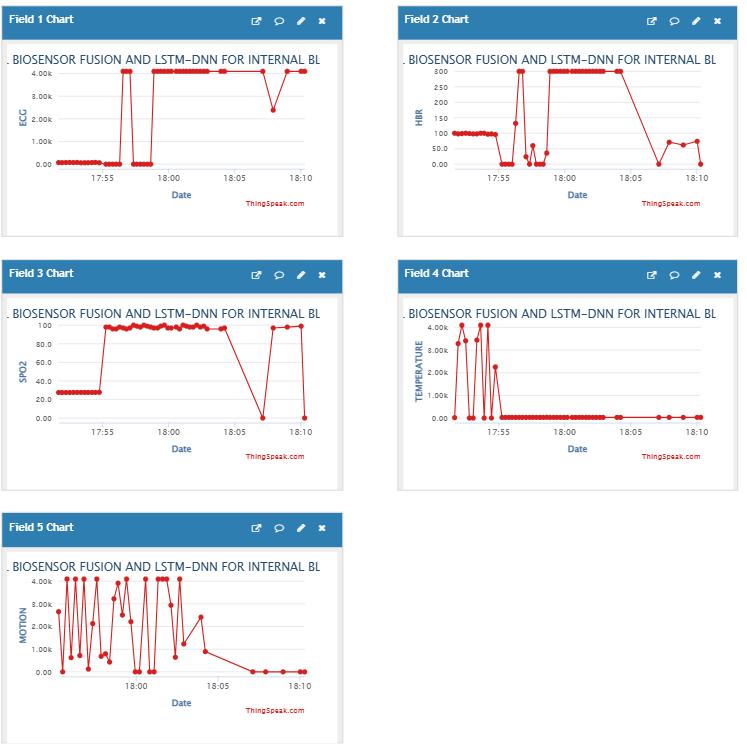
A cloud-based monitoring dashboard provides real-time visualization, historical analysis, alert management, geospatial mapping, and administrative controls for multiplesimultaneousdevices.
6. EXPERIMENTAL METHODOLOGY
A. Experimental Setup
System validation used an ESP8266 NodeMCU prototype with integrated sensors across three scenarios: (1) Baseline Testing at resting state; (2) Activity Testing during controlled physical activities; (3) Simulated Abnormality Testing with controlled changes mimicking haemorrhagicsymptoms.
B. Data Collection Protocol
Physiological data was collected at: ECG (250 Hz), pulse oximetry (50Hz), temperature(1Hz),andflexsensor(10 Hz). Each scenario ran over 10-minute intervals with multiplerepetitionsacrosstestsubjects.
C. Performance Metrics
System performance was evaluated using accuracy, sensitivity, specificity, precision, F1-score, response time, andpowerconsumptionmetrics.
7. RESULTS AND DISCUSSION
A. Detection Performance
ThehybridDNN-LSTMmodelachievedhighdiscrimination between normal and abnormal physiological states. High sensitivityensuresminimalfalsenegatives,criticalforlifethreateningconditions.
International Research Journal of Engineering and Technology (IRJET) e-ISSN: 2395-0056
Volume: 13 Issue: 04 | Apr 2026 www.irjet.net p-ISSN: 2395-0072
Table 1: Performance Metrics Comparison
B. Temporal Pattern Recognition
The LSTM component proved essential for capturing progressive physiological deterioration. The hybrid DNNLSTM model (94.2%) outperformed standalone DNN (87.3%) and SVM (81.2%), validating temporal modelling importance.
C. Real-Time Performance
Processing latency: 1.2 seconds; alert generation: <2 seconds; IoT transmission: 0.8 seconds; total response time: <4 seconds from symptom onset to remote notification,enablingtimelymedicalintervention.
D. Power Efficiency
Active monitoring draws 180mA average current with 11 hoursbatterylifefrom2000mAh.Deepsleepoptimization extendsruntimeto18hourswithperiodicwakeintervals.
E. Multimodal Sensing Advantage
Single-sensor systems yielded only 78–82% accuracy. The four-sensor multimodal approach reduced false alarms by 65% compared to single-sensor systems, demonstrating thevalueofsensorfusion.
F. Environmental Robustness
System maintained performance across -10°C to 50°C, motion artifact scenarios (walking, running, prone positions),andelectromagneticinterferenceenvironments throughadaptivefiltering.
G. Limitations
Limitations: (1) individual physiological variability requiring personalized calibration; (2) performance degradation under extreme combat stress; (3) battery constraints for missions exceeding 18 hours; (4) connectivity dependence for remote alerting; (5) limited hemorrhagicshocktrainingdataavailability.
8. FUTURE ENHANCEMENTS
Future improvements: (A) additional sensors (blood pressure, respiration, bioimpedance); (B) adaptive personalized learning with federated learning; (C)
expanded connectivity (satellite, mesh, LoRaWAN); (D) custom ASIC hardware with energy harvesting; (E) largescale clinical validation; (F) explainable AI and multi-class classification; (G) context-aware systems with combat casualtycareprotocols.
9. CONCLUSION
This paper presented a comprehensive wearable AI-based system for early detection of internal bleeding in military personnel.Byintegratingmultimodalphysiologicalsensing (ECG, pulse oximetry, temperature, motion), edge computing on ESP8266 NodeMCU, and hybrid DNN-LSTM deep learning, the system achieves 94.2% accuracy with responsetimesunder4seconds.
Multimodal sensing improved detection reliability, reducing false alarms by 65% versus single-sensor systems. The LSTM component captured temporal deterioration patterns characteristic of haemorrhagic shock. Real-time edge inference eliminates cloud dependency for communication-limited combat environments.
The system addresses a critical gap in military medical care where delayed detection contributes to preventable deaths. Future work will integrate additional sensors, personalized adaptive learning, expanded communication, and large-scale clinical validation to further advance this lifesavingtechnology.
ACKNOWLEDGEMENT
The authors would like to thank the faculty and research staff at the institution for their valuable guidance and supportthroughoutthisproject.
REFERENCES
[1] Z. Liu, X. Wang, Y. Yuan, R. Li, and W. Xiang, "Research on automatic bleeding detection in arthroscopic videos based on composite color and statistical features," IEEE Access,vol.12,pp.102345–102354,2024.
[2]Z.Liuetal.,"Researchonarthroscopicimagesbleeding detection algorithm based on ViT-ResNet50 integrated model and transfer learning," IEEE Access, vol. 12, pp. 181436–181453,2024.
[3] Q. Li et al., "Classification and location of cerebral hemorrhage points based on SEM and SSA-GA-BP neural network," IEEE Trans. Instrum. Meas., vol. 73, pp. 1–14, 2024.
[4] S. Schoen Jr et al., "Microbubble contrast agents improvedetectionofactivehemorrhage,"IEEEOpenJ.Eng. Med.Biol.,vol.5,pp.877–884,2024.
[5] A. Chaudhary, Y. Gaur, A. Abraham, and H. Singh, "Multiclass intracranial hemorrhage detection and confidence-awaretriageviadeepensemblelearning,"IEEE Access,vol.13,pp.191745–191761,2025.
International Research Journal of Engineering and Technology (IRJET) e-ISSN: 2395-0056
Volume: 13 Issue: 04 | Apr 2026 www.irjet.net p-ISSN: 2395-0072
[6] A. Singh et al., "Microwave antenna-assisted machine learning: A paradigm shift in non-invasive brain hemorrhage detection," IEEE Access, vol. 12, pp. 37179–37191,2024.
[7] G. Tapia, H. Allende-Cid, S. Chabert, D. Mery, and R. Salas, "Benchmarking YOLO models for intracranial hemorrhagedetectionusing variedCTdata sources,"IEEE Access,vol.12,pp.188084–188101,2024.
[8] X. Zhang and J. Yang, "DC-bus capacitor discharge method based on bleeder and windings for electric vehicles in emergency," IEEE Access, vol. 12, pp. 61949–61958,2024.
[9] S. H. Arshad et al., "Endovascular localization of aortic injuryinaporcinemodel,"IEEEOpenJ.Eng.Med.Biol.,vol. 6,pp.425–431,2025.
[10] A. Jabbar et al., "A lesion-based diabetic retinopathy detection through hybrid deep learning model," IEEE Access,vol.12,pp.40019–40036,2024.
[11] M. A. Saleem et al., "Innovations in stroke identification: A machine learning-based diagnostic model using neuroimages," IEEE Access, vol. 12, pp. 35754–35764,2024.
[12]S.Ahmedetal.,"Exploringdeeplearningand machine learningapproachesforbrainhemorrhagedetection,"IEEE Access,vol.12,pp.45060–45093,2024.
[13] J. C. Rajapakse et al., "Two-stage approach to intracranial hemorrhage segmentation from head CT images,"IEEEAccess,vol.12,pp.60839–60848,2024.
[14]T.H.Gençtürk,F.KayaGülağız,andİ.Kaya,"Detection and segmentation of subdural hemorrhage on head CT images,"IEEEAccess,vol.12,pp.82235–82246,2024.
[15] Y. R. Chalumuri et al., "A lumped-parameter model of the cardiovascular system response for evaluating automated fluid resuscitation systems," IEEE Access, vol. 12,pp.62511–62525,2024.