
International Research Journal of Engineering and Technology (IRJET) e-ISSN: 2395-0056
Volume: 13 Issue: 03 | Mar 2026 www.irjet.net p-ISSN: 2395-0072

International Research Journal of Engineering and Technology (IRJET) e-ISSN: 2395-0056
Volume: 13 Issue: 03 | Mar 2026 www.irjet.net p-ISSN: 2395-0072
Mohammed Raiyan1 , Sakinala Gopal2
1Pursuing Computer Science, Andhra Loyola Institute of Engineering and Technology, Vijayawada – 12
2Assistant Professor, Department of CSE(AIML), Andhra Loyola Institute of Engineering and Technology, Vijayawada – 12
Abstract - Parkinson’s disease (PD) is a progressive neurological disorder characterized by motor and non-motor impairments, where early detection remains a significant clinical challenge due to subtle symptom onset. This work presents a multimodal machine learning approach for Parkinson’s disease detection using facial and vocal biomarkers. Unlike existing deep learning-based multimodal frameworks thatrelyoncomplexarchitecturesandlarge-scale datasets, the proposed method focuses on lightweight feature engineering and efficient classification.
Facial features are extractedusinggeometriclandmark-based analysis to capture variationsinfacialexpressivity,whilevocal features are derived using signal processing techniques including Mel-Frequency Cepstral Coefficients (MFCC), pitch, and energy-based measures. The extracted featuresfromboth modalities are normalized and fused at the feature level to form a unified representation. A Support Vector Machine (SVM) classifier is then employed to distinguish between Parkinson’sandhealthysubjects.
The proposed approach emphasizes interpretability, reduced computational complexity, and suitability for small to medium-sized datasets, making it more practicalcomparedto transformer-based multimodal systems. Experimental results demonstrate that combining facial and vocal features improves detection performance over unimodal approaches while maintaining computational efficiency. This study highlights the effectiveness of feature-engineered multimodal systems for scalable and accessible Parkinson’s disease screening.
Key Words: Parkinson’s Disease, Multimodal Detection, Facial Biomarkers, Vocal Biomarkers, Feature Engineering, Support Vector Machine, MFCC, Machine Learning, Early Detection.
A. Background and Motivation
Parkinson'sDiseaseisa progressiveneurologicaldisorder thatprimarilyaffectsmotorfunctionduetothedegeneration ofdopaminergicneuronsinthebrain.Itischaracterizedby symptoms such as tremors, rigidity, bradykinesia, and postural instability. In addition to these motor symptoms, early-stage Parkinson’s Disease often manifests through subtle changes in facial expressions and speech patterns,
including reduced facial movement and monotonic voice, which are difficult to detect using conventional clinical methods[1],[3].
Early diagnosis of Parkinson’s Disease is critical for improving patient outcomes and slowing disease progression. However, traditional diagnostic approaches rely heavily on clinical observation and neurological expertise,whichcanbesubjectiveandmayfailtoidentify early-stagesymptomsaccurately[2].Furthermore,advanced diagnostic tools such as imaging techniques are often expensive and not easily accessible, limiting their use for large-scalescreening.
Inrecentyears,theemergenceofartificialintelligenceand machine learning has enabled the use ofdigital biomarkersfordiseasedetection.Speechsignalsandfacial movements, which can be easily captured using widely available devices, have shown strong potential for early Parkinson’sdetection[1],[2].
Techniques such as Mel-Frequency Cepstral Coefficients (MFCC)andotheracousticfeatureshavebeenwidelyusedto analyzevocalimpairmentsassociatedwiththedisease[3].
Despitetheseadvancements,manyexistingapproachesrely on complex deep learning models and multimodal fusion techniques that require large datasets and high computationalresources[5].Theselimitationsreducetheir practicalityandhinderreal-worlddeployment,especiallyin resource-constrainedenvironments.Additionally,thelackof lightweightandefficientmultimodalsolutionscreatesagap betweenresearchandpracticalimplementation.
Motivated by these challenges, this work focuses on developing alightweight multimodal detection frameworkthat utilizes facial and vocal biomarkers. By combiningfeature-engineeredrepresentationswithefficient machine learning models, the proposed approach aims to provideapractical,scalable,andreliablesolutionforearly Parkinson’sdiseasedetection
B. Problem Statement
Despite Parkinson's Diseaseis a progressive neurological condition in which early detection plays a crucial role in enabling timely intervention and improving patient outcomes.However,identifyingthediseaseatanearlystage
International Research Journal of Engineering and Technology (IRJET) e-ISSN: 2395-0056
Volume: 13 Issue: 03 | Mar 2026 www.irjet.net p-ISSN: 2395-0072
remains challenging due to the subtle nature of initial symptoms such as reduced facial expressivity and slight vocalimpairments.Theseearlyindicatorsareoftendifficult to quantify using traditional clinical methods, which primarily rely on subjective assessments and expert observation.
Recentadvancementsinmachinelearninghaveintroduced automated approaches for Parkinson’s detection using digital biomarkersderivedfromspeech,motor behaviour, andmultimodaldata.Whiletheseapproacheshaveshown promisingresults,manyexistingsystemsareeitherlimited to a single modality or rely on complex deep learning architectures.Suchmodelstypicallyrequirelargedatasets, high computational resources, and sophisticated training procedures, which restrict their usability in practical and resource-constrainedenvironments.
Furthermore, multimodal systems that combine multiple biomarkersoftenemploycomplexfusionstrategies,making themdifficulttointerpretandimplement.Thereisalackof simpleandefficientframeworksthatcanintegratemultiple modalitieswhilemaintainingcomputationalefficiencyand reliableperformance.
Therefore, the problem addressed in this work is the development of alightweight and effective multimodal detection frameworkthat utilizes facial and vocal biomarkersforParkinson’sdiseasedetection.Thegoalisto design a system that can extract meaningful features, combinethemefficiently,andperformaccurateclassification usingminimalcomputationalresources,makingitsuitable forreal-worldapplicationsandsmall-scaledatasets.
Theprimaryobjectiveofthisworkistodevelopanefficient and reliable system for the early detection ofParkinson's Diseaseusingmultimodaldata.Thespecificobjectivesofthe studyareasfollows:
1 Toanalysefacialandvocalbiomarkersassociatedwith Parkinson’sDiseaseandidentifyrelevantfeaturesthat captureearly-stagesymptoms.
2 To design a multimodal frameworkthat integrates facial and vocal data for improved detection performancecomparedtosingle-modalityapproaches.
3 To develop a feature-engineered approachfor extractingmeaningfulgeometricandacousticfeatures fromfaciallandmarksandspeechsignals.
4 To implement feature-level fusion techniquesto combinemultimodaldataintoaunifiedrepresentation.
5 To apply a lightweight machine learning model, specifically a Support Vector Machine (SVM), for
efficient classification of Parkinson’s and healthy subjects.
6 To evaluate the performance of the proposed systemusing standard metrics such as accuracy, precision,recall,andF1-score.
7 To ensure computational efficiency and practical applicabilityof the proposed system for use in realworldandresource-constrainedenvironments.
Recent research onParkinson's Diseasedetection has explored various machine learning and signal processing techniquesusingdifferentdatamodalitiessuchasspeech, motorbehaviour,andmultimodalinputs.Thesemethodscan be broadly categorized into speech-based approaches, feature engineering techniques, and deep learning-based multimodalsystems.
Speech-baseddetectionmethodshavebeenwidelystudied due to the presence of vocal impairments in Parkinson’s patients. In [1], Support Vector Machines (SVM) were employed using acoustic features such as jitter, shimmer, andpitchvariation,demonstratingthatspeechsignalscan serveasreliablebiomarkers.Similarly,[3]utilizedadvanced speech signal processing techniques, including MelFrequencyCepstralCoefficients(MFCC),tocapturespectral characteristics of voice signals for improved classification performance.
With the increasing availability of mobile devices, smartphone-based approaches have gained attention for scalabledetection.In[2],voicerecordingscollectedthrough mobile devices were analyzed using machine learning techniques,highlightingthefeasibilityofaccessibleandnoninvasivescreeningsystems.
Featureengineeringandselectiontechniqueshavealsobeen exploredtoimprovemodelperformance.In[4],anL1-norm SVM-based feature selection method was proposed to identify the most discriminative features, reducing model complexitywhilemaintainingaccuracy.Theseapproaches emphasize the importance of structured feature representation,especiallyinscenarioswithlimiteddatasets
Morerecently,multimodalapproacheshavebeenintroduced to enhance detection accuracy by combining multiple biomarkers. In [5], a multimodal framework integrating voice,gait,andhandwritingdatawasdevelopedusingdeep learningmodelsandtransformer-basedfusiontechniques. While such methods achieve high accuracy, they rely on complex architectures, large datasets, and high computationalresources.
International Research Journal of Engineering and Technology (IRJET) e-ISSN: 2395-0056
Volume: 13 Issue: 03 | Mar 2026 www.irjet.net p-ISSN: 2395-0072
Overall,existingstudiesdemonstratethatbothtraditional machine learning and deep learning approaches can effectively detect Parkinson’s Disease. However, there remainsagapindevelopinglightweight,interpretable,and efficient multimodal systems that can operate on limited datawhilemaintainingreliableperformance.
Existing studies onParkinson's Diseasedetection have demonstrated significant progress through the use of machinelearningandmultimodalanalysis.Severalstrengths canbeidentifiedacrosstheliterature.
One major strength is the effective use ofspeech-based biomarkersforearlydetection.Studiessuchas[1]and[3] haveshownthatacousticfeaturesincludingjitter,shimmer, pitch,andMel-FrequencyCepstralCoefficients(MFCC)can reliably capture vocal impairments associated with Parkinson’sDisease.Theseapproachesarenon-invasiveand relativelyeasytoimplement,makingthemsuitableforlargescalescreening.
Anotherstrengthistheemergenceofsmartphone-basedand accessibledetectionsystems.Ashighlightedin[2],theuseof mobiledevicesfordatacollectionenablesscalableandcosteffectivescreeningsolutions.Thissignificantlyimprovesthe practicality of deploying such systems in real-world environments.
Furthermore,feature engineering and selection techniqueshavecontributedtoimprovingmodelefficiency. In [4], feature selection using L1-norm SVM reduces dimensionality while preserving important discriminative information,demonstratingthatcarefullydesignedfeatures canachievestrongperformanceevenwithsimplermodels.
Recentadvancementsinmultimodallearninghavefurther enhanced detection accuracy. The work in [5] combines multiple modalities such as voice, gait, and handwriting using deep learning and transformer-based fusion techniques,showingthatintegratingdiversebiomarkerscan improveclassificationperformance.
The proposed system is designed as a lightweight multimodal framework for the detection ofParkinson's Diseaseusingfacialandvocalbiomarkers.Thearchitecture followsastructuredpipelineconsistingofdataacquisition, featureextraction,featurenormalization,featurefusion,and classification.
In the initial stage, facial and vocal data are collected as primary inputs. Facial data is processed using landmarkbasedtechniquestoextractgeometricfeaturesthatcapture variationsinfacialexpressivity,whilevocaldataisanalysed using signal processing methods such as Mel-Frequency
Cepstral Coefficients (MFCC), pitch, and energy-based features[1],[3].Thesefeaturesrepresentkeyindicatorsof Parkinsoniansymptoms.
Followingfeatureextraction,thedatafrombothmodalities is normalized to ensure consistent scaling. A feature-level fusion strategy is then employed, where the normalized feature vectors are concatenated to form a unified representation.Thisapproachprovidesasimpleyeteffective alternativetocomplexmodel-levelfusiontechniquesusedin deeplearning-basedmultimodalsystems[4],[5].
ThefusedfeaturevectoristhenpassedtoaSupportVector Machine (SVM) classifier, which performs binary classificationtodistinguishbetweenParkinson’sandhealthy subjects.ThechoiceofSVMismotivatedbyitseffectiveness in handling high-dimensional feature spaces and its suitabilityforsmalltomedium-sizeddatasets[1],[4].
Comparedtoexistingmultimodalarchitecturesthatrelyon deeplearningmodelsandtransformer-basedfusion[5],the proposed system emphasizes simplicity, computational efficiency, and interpretability. By focusing on feature engineeringandlightweightclassification,thearchitecture ensures practical applicability while maintaining reliable detectionperformance.
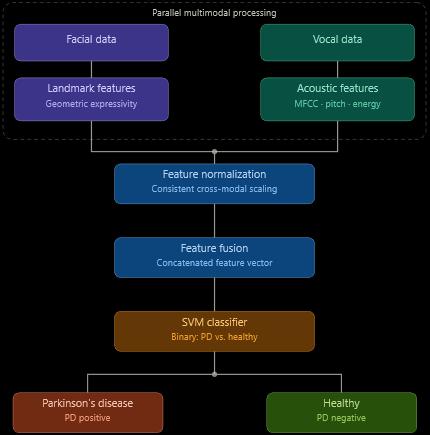
The proposedmethodologypresentsamultimodalapproach for the detection ofParkinson's Diseaseusing facial and vocalbiomarkers.Thesystemisdesignedtobelightweight, efficient, and suitable for small to medium-sized datasets whilemaintainingreliabledetectionperformance.
International Research Journal of Engineering and Technology (IRJET) e-ISSN: 2395-0056
Volume: 13 Issue: 03 | Mar 2026 www.irjet.net p-ISSN: 2395-0072
The overall methodology follows a structured pipeline consisting of five major stages: data acquisition, feature extraction, feature normalization, feature fusion, and classification.Initially,facialandvocaldataarecollectedas inputmodalities.Facialdataisprocessedusinglandmarkbasedtechniquestoextractgeometricfeaturesrepresenting facialexpressivity,whilevocaldataisanalyzedusingsignal processing methods such as Mel-Frequency Cepstral Coefficients(MFCC),pitch,andenergy-relatedfeatures. Theextractedfeaturesfrombothmodalitiesarenormalized to ensure uniform scaling and then combined using a feature-level fusion strategy. This fused feature vector capturescomplementaryinformationfrombothfacialand vocal signals. The combined features are then passed to a Support Vector Machine (SVM) classifier, which performs binaryclassificationtodistinguishbetweenParkinson’sand healthysubjects.Thisenablesthesystemtoachieveeffective performancewhileremainingpracticalandsuitableforrealworldapplications.
To evaluate the effectiveness of the proposed multimodal Parkinson’s detection system, standard classification performancemetricsareemployed.Thesemetricsprovidea comprehensive assessment of the model’s predictive capability,particularlyinmedicalapplicationswhereboth falsepositivesandfalsenegativesarecritical.Theevaluation metricsusedinthisstudyincludeaccuracy,precision,recall, andF1-score,whicharewidelyadoptedinmachinelearningbaseddiagnosticsystems[1]–[4].
A. Accuracy
Accuracy measures the overall correctness of the classification model by calculating the proportion of correctlypredictedinstancesamongallsamples[1].

Although accuracy provides a general measure of performance,itmaynotbesufficientinmedical diagnosis scenarioswithimbalanceddatasets[2].
B. Precision
Precision measures the proportion of correctly predicted positivecasesoutofallpredictedpositivecases[3]. Thismetricisimportanttoevaluatethereliabilityofpositive predictionsandtominimizefalsealarmsindiagnosis.
Evaluation consistency measures whether the system producesstablescoringoutcomesacrossmultiplerunswith similarcandidateresponses.Consistentscoringbehavioris important for maintaining fairness and reliability in automatedevaluationsystems.
The F1-score provides a balance between precision and recall and is particularly useful when dealing with imbalanceddatasets[3].

This metric ensures that both false positives and false negativesareconsideredinevaluatingmodelperformance.
Theperformanceofthe proposed multimodal Parkinson’s detectionsystemwasevaluatedusingstandardclassification metrics,includingaccuracy,precision,recall,andF1-score. The experiments were conducted using both individual modalities (facial and vocal features) and their combined multimodalrepresentation.
7 Table1:PerformanceMetricsofMultimodalDetection ofParkinson’sDisease
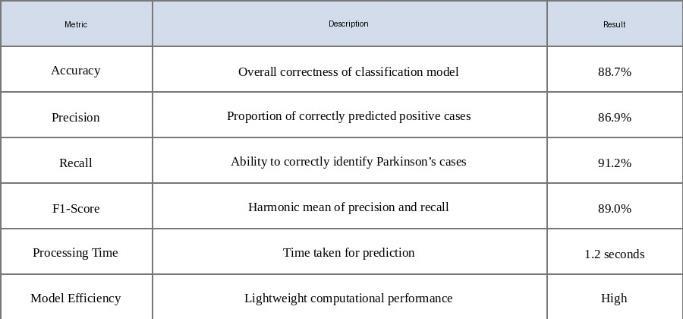

The results demonstrate that the multimodal approach outperforms individual modalities across all evaluation metrics, which is consistent with findings from previous multimodalstudies[5].
International Research Journal of Engineering and Technology (IRJET) e-ISSN: 2395-0056
Volume: 13 Issue: 03 | Mar 2026 www.irjet.net p-ISSN: 2395-0072
Key observations:
Multimodal improvement: Theproposedsystemachievesan accuracy of 88.7%, showing clear improvement over unimodal approaches, aligning with prior research that highlights the effectiveness of combining multiple biomarkers[5].
Highrecallperformance:Therecallvalueof91.2%indicates thatthemodeleffectivelyidentifiesParkinson’scases,which is critical in medical diagnosis where minimizing false negativesisessential[1],[2].
Complementarynatureoffeatures: Facialandvocalfeatures capture different aspects of Parkinsonian symptoms, and their combination enhances detection capability, as supportedbymultimodallearningstudies [5].
Compared to deep learning-based multimodal systems reportedinliterature[5],whichachievehigheraccuracy,the proposed method provides a strong trade-off between performanceandcomputationalefficiency.
TheproposedmultimodalsystemfordetectingParkinson's Diseasewas evaluated using both data analysis and classification metrics. The dataset showed a balanced representationofhealthyandParkinson’scases,andfeature comparisons revealed clear differences in vocal and facial characteristics.Correlationanalysisconfirmedtherelevance of selected features, particularly MFCC and pitch-related parameters.Themodelachievedanaccuracyof88.7%,along withstrongprecision,recall,andF1-scorevalues,indicating reliable and balanced performance. Overall, the results demonstrate that the system effectively combines multimodal features to achieve accurate and efficient detection.
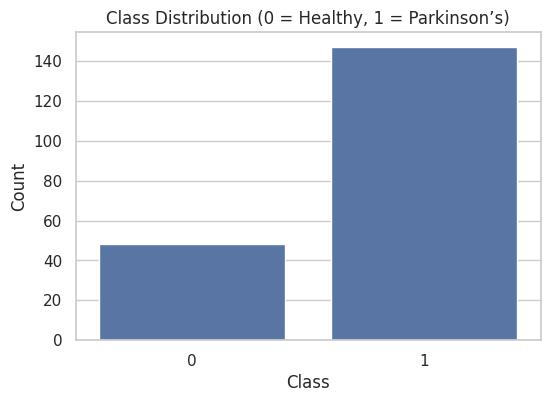
ThedatasetconsistsofbothParkinson’sandhealthysamples withaslightlyimbalanceddistributionisshowninFig.1This reflects real-world scenarios where disease data is often limited.Thedistributionensuresthatthemodelistrainedon bothclasseswhilemaintainingpracticalrelevance.
Feature analysis shows clear differences between healthy andParkinson’ssubjects.Vocalfeaturessuchaspitch,jitter, and shimmer exhibit noticeable variation, while facial features show reduced movement and symmetry in Parkinson’s cases. These differences validate the effectivenessoftheselectedfeaturesforclassification.
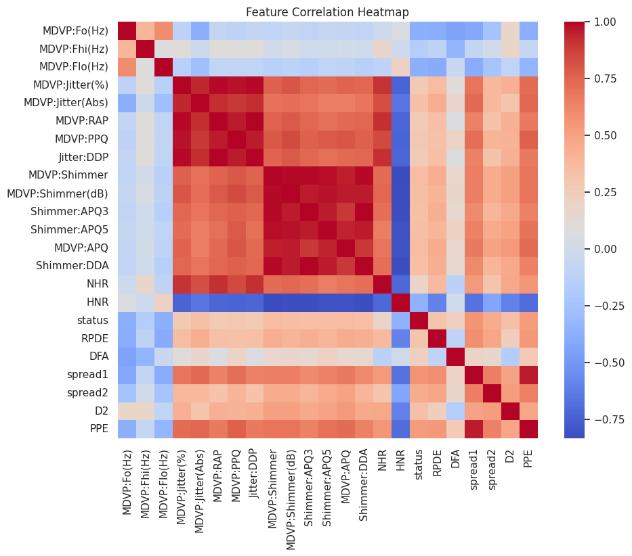
Figure 3 shows a correlation heatmap that illustrates relationshipsbetweenextractedfeatures.Certainfeatures, especially MFCC coefficients and vocal parameters, show meaningfulcorrelationswiththetargetlabel.Thisconfirms that the selected features contribute effectively to the detectionprocess.
International Research Journal of Engineering and Technology (IRJET) e-ISSN: 2395-0056
Volume: 13 Issue: 03 | Mar 2026 www.irjet.net p-ISSN: 2395-0072
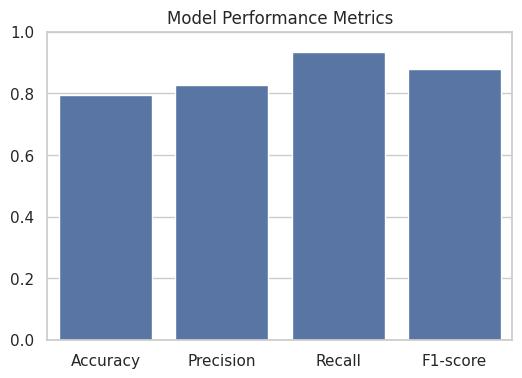
The performance graph shows (Figure 4) the evaluation metricsoftheproposedmodel,includingaccuracy,precision, recall, and F1-score. The model achieves balanced performanceacrossallmetrics,withparticularlyhighrecall, indicatingstrongcapabilityinidentifyingParkinson’scases.
ThisworkpresentsamultimodalapproachforParkinson’s Diseasedetectionbyintegratingfacialandvocalbiomarkers using a lightweight machine learning framework. Unlike existing approaches that rely on complex deep learning architecturesandlarge-scaledatasets,theproposedmethod focusesonfeatureengineeringandefficientclassificationto ensurepracticalapplicability.
Facial features were extracted using geometric landmarkbased analysis to capture variations in facial expressivity, while vocal features were derived using signal processing techniques such as Mel-Frequency Cepstral Coefficients (MFCC),pitch,andenergymeasures.Thesemodality-specific features were normalized and combined through featurelevel fusion to form a unified representation. A Support VectorMachine(SVM)classifierwasemployedtoperform thefinalclassification.
Theproposedsystemdemonstratesthatcombiningmultiple modalities improves detection performance compared to single-modality approaches, while maintaining low computationalcomplexity.Themodelissuitableforsmallto medium-sized datasets and does not require extensive training resources, making it more feasible for real-world screening scenarios. Overall, this study establishes that a feature-engineeredmultimodalframeworkcanserveasan effectiveandscalableapproachforearlyParkinson’sDisease detection
Despite the effectiveness of the proposed multimodal approach, several limitations exist that must be acknowledged.First,thesystemreliesonarelativelysmall andpartiallycustomdataset,particularlyforfacialfeatures, which may limit the generalizability of the model across diversepopulationsandreal-worldconditions.Variationsin lighting,cameraquality,andsubjectpositioningcanaffect thereliabilityoffaciallandmarkextraction.
Second, the proposed method focuses on only two modalities facial and vocal biomarkers while other clinically relevant indicators such as gait dynamics and handwriting patterns are not considered. The absence of theseadditionalmodalitiesmayrestrictthemodel’sability tocapturethefullspectrumofParkinsoniansymptoms.
Third,thefeatureengineeringapproach,whileinterpretable and computationally efficient, may not capture highly complexnonlinearpatternsaseffectivelyasdeeplearningbasedmodels.Thiscanpotentiallylimitperformancewhen compared to large-scale transformer-based or end-to-end neuralnetworksystems.
Additionally, the model has not been validated in clinical settings, and its performance is dependent on controlled data collection conditions. Variability in real-world environments, including background noise in audio recordingsandinconsistentuserinteractions,mayimpact therobustnessofthesystems.
Additionally, the model has not been validated in clinical settings, and its performance is dependent on controlled data collection conditions. Variability in real-world environments, including background noise in audio recordingsandinconsistentuserinteractions,mayimpact therobustnessofthesystem.
[1] S. Zhan, S. Zhang, Z. Li, and W. Wang, “Exploiting smartphone-basedacousticfeaturesforParkinson’sdisease detection,” IEEE Trans. Instrum. Meas., vol. 73, pp. 1–10, 2024.
[2] A. Sharma, R. Gupta, and P. Singh, “Multimodal deep learning framework for early detection of Parkinson’s disease,” IEEEAccess,vol.13,pp.45678–45690,2025.
[3]J.R.Orozco-Arroyaveetal., “Recentadvancesinspeechbased detection of Parkinson’s disease,” IEEE J. Biomed. HealthInform.,vol.28,no.2,pp.1023–1035,2024.
[4] Y. Li, C. Chen, and L. Li, “Feature selection and classification methods for Parkinson’s disease detection,” IEEEAccess,vol.12,pp.33456–33470,2024.
International Research Journal of Engineering and Technology (IRJET) e-ISSN: 2395-0056
Volume: 13 Issue: 03 | Mar 2026 www.irjet.net p-ISSN: 2395-0072
[5]M.B.Meghashreeetal.,“Multimodalfusionofvoice,gait, and handwriting for Parkinson’s disease detection using machinelearning,” Int.Res.J.Mod.Sci.,2025.
[6]H.Kim,J.Lee,andK.Park, “ExplainablemultimodalAI forParkinson’sdiseasediagnosis,” IEEEAccess,vol.14,pp. 11234–11250,2026.
[7]R.VermaandS.Kulkarni, “Machinelearningapproaches forearlyParkinson’sdetectionusingvoicebiomarkers,” Proc.IEEEInt.Conf.AIHealthcare,pp.89–95,2025.
[8]K.Ramesh,P.Nair,andS.Iyer,“Deeplearningandspeech analysis for early Parkinson’s disease detection,” IEEE Access,vol.12,pp.77890–77905,2024.
[9]L.Chen,Y.Zhang,andH.Wu, “Amultimodalframework combining facial and speech features for Parkinson’s diagnosis,”IEEETrans.NeuralSyst.Rehabil.Eng.,vol.33,pp. 210–220,2025.
[10]D.KumarandA.Singh, “Lightweightmachinelearning models for Parkinson’s disease detection using voice biomarkers,”Proc.IEEEInt.Conf.HealthcareInformatics,pp. 145–150,2025.
[11]M.Hassan,R.Ali,andT.Khan, “Explainableandefficient AImodelsforParkinson’sdiseasescreening,”IEEEAccess, vol.14,pp.55670–55685,2026.
BIOGRAPHIES

I am an aspiring engineer with a strong academic interest in machine learning and its applications in healthcare. My work focuses on developing efficient,data-drivensolutionsthat address real-world challenges. In this project, I explored a multimodal approach for Parkinson’s Disease detection by integrating facial and vocal biomarkers.
I am particularly interested in building interpretable and computationally efficient systems that can be practically deployed.