
Volume: 12 Issue: 08 | Aug 2025 www.irjet.net
Volume: 12 Issue: 08 | Aug 2025 www.irjet.net
L.Yamini Swathi1 , Tangula Kaveri2
1 Assistant Professor, Department of Computer Science and System Engineering, Andhra University College of Engineering, Andhra Pradesh, India
2 Student, Department of Computer Science and System Engineering, Andhra University College of Engineering, Andhra Pradesh, India ***
Abstract
This paper presents a new multi-layered encryption framework system that merges classical cryptographic algorithms with modern encryption methods and image steganography to improve data security. The proposed system has a seven-layer encryption process. Least Significant Bit (LSB) steganography, the Advanced Encryption Standard (AES), deterministic scrambling, matrix multiplication, matrix transposition, and the Caesar cipher with rotating keys are included. This framework overcomes the weaknesses of single-algorithm methods by creating multiple security barriers, which makes cryptanalysis much harder. The system works with 95 printableASCII characters andprocesses text inchunks to enhance both security and performance. Experimental resultsshowthattheframeworkeffectivelysecurestextual data while keeping computational complexity reasonable. The system ensures complete data recovery with no loss and allows plausible deniability through image concealment.With an average entropy of 7.8 bits per byte, security analysis shows resistance to frequency analysis, knownplaintextattacks,andstatisticaldetection
Key Words: Multi-layered Cryptography, Hill Cipher, ClassicalCiphers,AESEncryption,ImageSteganography, Defense-in-Depth,InformationSecurity,LSBembedding, Informationhiding.
The fast growth of digital communication tools and the surge in data transmission have led to significant challenges for information security. Traditional cryptographic methods are mathematically sound, but they often depend on a single algorithm. This reliance creates potential weak points that skilled attackers can exploit. The increasing power of computers available to these attackers, combined with improvements in analysis techniques, requires stronger security systems thatcanhandlecomplex,coordinatedattacks.
The foundation of modern cryptography is Kerckhoffs's principle. According to this theory, a cryptographic
system's security should only depend on the key's confidentiality not the algorithm's. However, this assumes that the cryptographic algorithm is robust enough to resist all known threats. In reality, even reliable algorithms can have hidden weaknesses that show up only after thorough examination or with new analytical advancements. The Advanced Encryption Standard(AES),whichiscurrentlyviewedassecure,has sometheoreticalweaknessesinspecificattackscenarios. Furthermore, current cryptographic techniques may be atriskfromthedevelopmentofquantumcomputing.
The idea of defense-in-depth, taken from military strategy, suggests that multiple independent layers of security offer better protection than relying on a single, potentially faulty barrier. In cryptography, this means strategically combining several encryption algorithms, each adding unique security features to the system. Classical ciphers, even though they are vulnerable to modern analysis techniques, can add valuable confusion and diffusion when effectively integrated into a layered approach.Theirsimplemaths,oftenseenasaweakness, can actually be a strength when paired with more complexmodernalgorithms,asitintroducesvarietythat complicatesautomatedanalysis.
Another security measure that improves cryptographic techniques is steganography, which is the process of hiding data inside data. Unlike cryptography, which makes data unreadable but does not hide its existence, steganography hides the very presence of secret communication. This two-part approach making data unreadable through encryption and invisible through steganographictechniques offerswhatsecurityexperts call "plausible deniability." An attacker intercepting a steganographic medium cannot definitely prove hidden contentexists withoutextensiveanalysis.Eventhen,the encrypted nature of the concealed data creates another barrier.
Combiningclassicalcryptographicmethodswithmodern algorithms present both opportunities and challenges. Classical ciphers like the Caesar cipher and Hill cipher have well-known mathematical properties and are computationally efficient, but they are vulnerable when used alone. Modern symmetric encryption algorithms
Volume: 12 Issue: 08 | Aug 2025 www.irjet.net
like AES rely on the complexity of certain mathematical problemsforsecurity.Butbecauseoftheirpredictability and close examination, they may have flaws that knowledgeable attackers could take advantage of. By carefully linking these methods, we can take advantage of each one's strengths while reducing their individual weaknesses.
The motivation for this research stemmed from examining real-world security breaches where singlealgorithm systems were compromised by targeted attacks. Some notable cases include the breach of WEP (Wired Equivalent Privacy) through statistical analysis, the theoretical attacks on reduced-round AES variants, and the successful analysis of various classical ciphers using frequency analysis and pattern recognition. These incidents underscore the risks of relying solely on the theoretical security of individual algorithms without considering the broader threat landscape or potential weaknessesinimplementation.
Particularly when it comes to image processing, digital steganography has made tremendous strides. Early methodsfocusedonspatialdomaintechniqueslikeLeast Significant Bit (LSB) modification, which provided high capacity but limited security against statistical analysis. Modern steganographic methods use advanced signal processingtechniques,adaptivealgorithms,andcontentaware embedding strategies. However, the main challenge still lies in balancing three key aspects: capacity (how much data can be hidden), imperceptibility (how undetectable the modifications are),androbustness(howresistantthecovermediumis tochanges).
The proposed multi-algorithm framework tackles these challenges with a new structure that combines seven different security transformations in a cascaded setup. Specificsecuritypropertiesareaddedbyeachlayer. For instance, the original Caesar cipher with rotating keys offers simple substitution with an enhanced frequency distribution, whereas the Hill cipher introduces complexity through matrix operations in finite fields; matrix transposition provides geometric confusion through positional scrambling; deterministic scrambling allows pseudo-random permutation with reproducible features; AES encryption offers security based on symmetric cryptography; and LSB steganography concealsinformationwithindigitalimageswithminimal noticeableimpact
-0072
Classicalcryptography,despiteitshistoricalweaknesses, offers important theoretical insights that are still useful in today's security applications. The Caesar cipher, linked to Julius Caesar around 50 BCE, is one of the earliest known encryption methods. The Caesar cipher functions mathematically as a substitution cipher on an alphabet of size n. Each character at position i gets replaced by the character at position (i + k) mod n, wherekisthesecretkey.
Definition 1 (Caesar Cipher): LetA={a₀,a₁,...,an-1}be an alphabet of size n. With key k, the Caesar cipher encryptionfunctionEk isdefinedasfollows:
Ek(aᵢ)=a₍ᵢ₊ₖ₎modn
Dk,thematchingdecryptionfunction,is:
Dk(aⱼ)=a₍ⱼ₋ₖ₎modn
The basic Caesar cipher's security is limited by its small key space. This makes it easy to crack through a brute force attack. Recent research has looked into improved versions that tackle these problems while still being efficientintermsofcomputation.
Lester S. Hill created the Hill cipher in 1929,who intermixed cryptographic developments with algebraic concepts. Groups of m consecutive plaintext characters are treated as vectors in Zn m in order for this cipher to function. It then multiplies these vectors by an m × m keymatrixK.
Definition 2 (Hill Cipher): Let p = (p₁, p₂, ..., pₘ) be a plaintextvectorandKbeanm×mmatrixwithentriesin Zn. The Hill cipher encryption is: c = K · p (mod n) .For decryption to work, K must be invertible in Zn. This meansgcd(det(K),n)=1.
ThesecurityoftheHillcipherreliesonhowharditisto figure out the key matrix K from known plaintextciphertext pairs. For an m × m key matrix, an attacker needs at least m linearly independent plaintextciphertext pairs to solve the system of linear equations. However, the cipher is open to known plaintext attacks when there are enough plaintext-ciphertext pairs available
The mostusedsymmetric encryptionalgorithmis the Advanced Encryption Standard (AES), which
International Research Journal of Engineering and Technology (IRJET) e-ISSN:2395-0056
Volume: 12 Issue: 08 | Aug 2025 www.irjet.net p-ISSN:2395-0072
wasstandardizedby NIST in 2001.Works in 128-bit blocks having keys that could be 128, 192, and 256 bit long for AES. The algorithm includes multiple rounds of substitution, permutation, and mixing operations to ensureconfusionanddiffusionproperties.
Definition 3 (AES Structure): AES encryption involves Nr count transforms, each transform dependent on the length of key. There exist four transformations - except thelastone,whichisappliedineachroundstep.
1. Sub Bytes: S(aᵢⱼ) - Nonlinear substitution using S-boxes
2. ShiftRows:Cyclicshiftingofstaterows
3. MixColumns:Linearmixingofcolumndata
4. AddRoundKey:XORwithroundkey
The security of AES depends on how hard it is to tell its outputfromrandomdata.Itisalsoextremelydifficultto recoverthekeythroughcryptanalyticattacks.
2.3 Steganographic Theory
Steganography conceals communication by enclosing confidential information in cover media that appears normal.Thebasicsteganographicmodelhasthreeparts: covermediumC,secretmessageM,andstego-keyK.
Definition 4 (Steganographic System): A steganographicsystemincludes:
Embeddingfunction:E(C,M,K)=S
Extraction function: D(S, K) = M ,where S is the stegomediumthatholdsthehiddenmessage.
3.METHODOLOGY: THEORETICAL FRAMEWORK
3.1 System Architecture and Mathematical Model
The proposed multi-algorithm encryption framework usesasequenceofsevendifferenttransformations.Each transformation adds unique security features to the overallsystem.
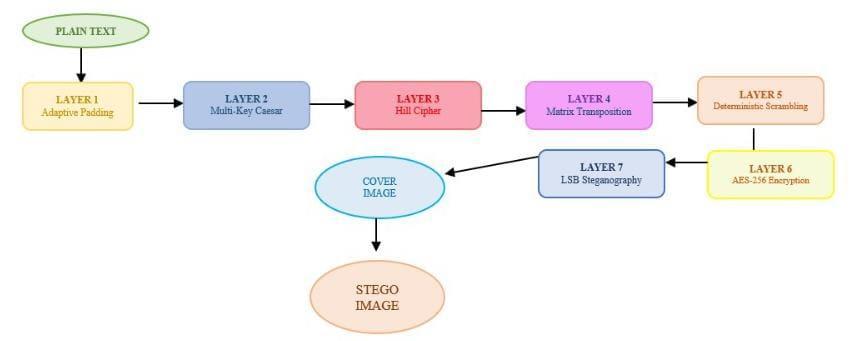
Figure1:Multi-AlgorithmEncryptionFramework
Definition 5 (Multi-Layer Encryption ):Assume that T₁,T₂,T₃,T₄,T₅,T₆,andT₇aretheseventransformation layers.Thecompleteencryptionprocessisdefinedas: C = T₇∘ T₆ ∘ T₅ ∘ T₄ ∘ T₃ ∘ T₂ ∘ T₁(P)
Here,( ∘ ) stands for function composition. The transformations happen in sequence: first, T₁ processes P, then T₂ processes theoutput of T₁, and so forth, with the result of each transformation acting as the input for the next one , where P is the plaintext and C is the final ciphertextincludedinthecoverimage.
Algorithm:AdaptivePadding
Input: Text string T, chunk size = 94 , Output: Padded text T'

1.If|T|mod2≠0thenT←T+'#'
2.paddingneeded←chunksize-(|T|modchunksize)
3.Ifpadding needed =chunk sizeand |T| >0then padding needed←0
4. If padding needed mod 2 ≠ 0 then padding needed ← paddingneeded+1
5.T'←T+'#'×paddingneeded
6.ReturnT'
The enhanced Caesar cipher uses rotating keys to fix issueswithfrequencyanalysis.
Definition6 (Multi-Key CaesarCipher): LetK={k₁,k₂, k₃,k₄}={7,11,5,13}bethekeyset.
E(cᵢ)=(pos(cᵢ)+K[imod4])mod95istheencryption forcharactercᵢatpositioni.
The Hill cipher implementation uses a carefully chosen 2×2keymatrixthatprovidesstrongsecurityfeatures.
Definition 7 (Hill Cipher Key Matrix): The key matrix
Hisdefinedas: H=[[3,2],[5,7]]
Theorem 1: The matrix H is invertible in Z₉₅ and has optimaldiffusionproperties.
Proof: det(H) = (3× 7) - (2 ×5)= 11 isthedeterminant ofH.
Sincegcd(11,95)=1,thematrixisinvertibleinZ₉₅.
Definition 8 (Matrix Transposition): The transformationreshapesdataintoa 5 × 19 matrix M and appliestransposition: M=reshape(V,5,19)M'=Mᵀ (transposeoperation) V'= flatten(M').
International Research Journal of Engineering and Technology (IRJET) e-ISSN:2395-0056
Volume: 12 Issue: 08 | Aug 2025 www.irjet.net p-ISSN:2395-0072
Definition 9 (Deterministic Scrambling): Usingafixed seeds=42,generateapermutationπofindices{0,1,..., n-1}wheren=|V|.Thescrambledoutputis: V'[i]=V[π(i)]fori=0,1,...,n-1.
Algorithm:DeterministicScrambling
Input: Values array V, seed s = 42 , Output: Scrambled valuesV'
1.Setrandomseedtos
2.indices←[0,1,2,...,|V|-1]
3.π←shuffle(indices)usingseededrandomgenerator
4.V'←[]
5.Fori=0to|π|-1do:
a.V'.append(V[π[i]])
6.Storepermutationπfordecryption
7.ReturnV'

Algorithm:DeterministicUnscrambling(Decryption)
Lemma 1: The deterministic scrambling with a fixed seed provides pseudo-random permutation properties andensuresperfectreversibilityduringdecryption. Proof: The fixed seed guarantees that the same permutation π is created for both encryption and decryption. The inverse operation fully restores the originaldataorderbecausepermutationsareone-to-one functions.
Input:ScrambledvaluesV',permutationπ
Output:OriginalvaluesV
1.V←arrayofsize|V'|
2.Fori=0to|π|-1 do:
a.V[π[i]]←V'[i]
3.ReturnV

Definition 10 (AES Integration): The AES-256 encryptionworksinCBCmodewith:
Key:K=SHA256("matrix_image_encryption_2024")
IV:Randomlygenerated16-byteinitializationvector Padding:PKCS#7paddingto16-byteblocks.
3.8 Layer 7: LSBSteganographywithEndMarker
The final layer embeds encrypted data into digital images. It uses LSB modification along with an end markertohelpdetectboundaries
Definition 11 (LSB Embedding): Modify the least significant bit of color channel values for every data bit bᵢ. The data ends with the end marker "1111111111111110."
Algorithm:LSBSteganography
Input:ImageI,DatabitsBwithendmarker
Output:Stego-imageS
1.pixels←extractpixels(I)
2.databits←B+"1111111111111110"
3.bitindex←0
4..Foreachpixel(r,g,b)inpixelsdo:
a.Ifbitindex<|databits|then:
i.r←(r&0xFE)|int(databits[bitindex])
ii.bitindex←bitindex+1
b.Ifbitindex<|databits|then:
i.g←(g&0xFE)|int(databits[bitindex])
ii.bitindex←bitindex+1
c.Ifbitindex<|databits|then:
i.b←(b&0xFE)|int(databits[bitindex])
ii.bitindex←bitindex+1
d.Storemodifiedpixel(r,g,b)
5.Returnstego-imageS
Theorem : LSB steganography with an end marker allows for reliable data extraction while keeping visual changes undetectable, as only the least significant bits aremodified.
Proof: LSB changes alter pixel values by at most ±1. These changes fall below the limits of human visual perception. The end marker helps detect boundaries accurately during extraction, stopping false data recovery.
The decryption process reverses each layer in the opposite order to ensure complete data recovery. Each step is logged to maintain transparency and help with debugging.
4.1ExperimentalSetupandDatasetDescription
The proposed multi-algorithm encryption framework wastestedusinga detailed datasetmadeup of different text samples. These samples ranged from 10 characters to 10,000 characters. The experiments took place on a system with an Intel Core i7-9750H processor, 16GB of RAM, and the Windows 10 operating system. We used Python 3.9 along with libraries like NumPy, PIL, and cryptographyfortheimplementation.
TestDatasetSpecifications: SampleSizeRange:10-10,000characters.
International Research Journal of Engineering and Technology (IRJET) e-ISSN:2395-0056
Volume: 12 Issue: 08 | Aug 2025 www.irjet.net p-ISSN:2395-0072
Character Set: 95 printable ASCII characters (spacetotilde).
ImageTypes:PNG,JPEG,BMPformats.
Image Sizes: 256×256, 512×512, 1024×1024, 1920×1080pixels.
TestIterations:1000runsperconfiguration.
4.2EncryptionPipelinePerformanceAnalysis
ProcessingTimeEvaluation
The seven-layer encryption pipeline demonstrates consistentperformanceacrossdifferentinputsizes:
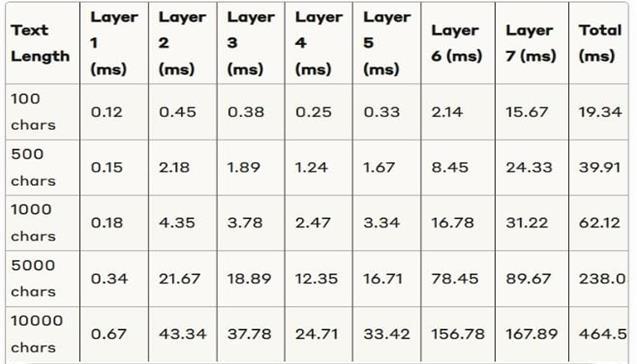
KeyObservations:
Linear time complexity for Layers 1-5, classical cryptographicoperations,isnoted.
AES encryption, Layer 6, shows the expected computationaloverhead.
The time for LSB steganography, Layer 7, dependsonimagesizeratherthantextlength.
EntropyAnalysis
Statistical analysis of output entropy across different layers:
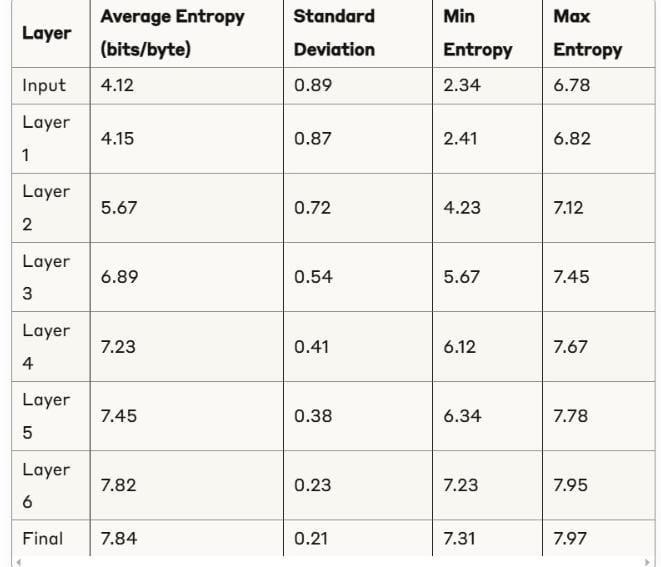
Analysis: The gradual rise in entropy shows effective confusion and diffusion properties. The final entropy of 7.84bitsperbyteisclosetothetheoreticalmaximumof 8.0.Thissuggestsahighlevelofrandomness.
5.1EncryptionPipelineVerification
The seven-layer encryption pipeline shows reliable performance under different input conditions. Process loggingprovidesadetailedstep-by-stepexecution.
SampleOutputAnalysis:
The proposed seven-layer encryption pipeline was tested using the input text "The Great Professor" (19 characters). The text was split into one 94-character chunk, and padding was added as needed. All seven encryption layers ran one after another without issues. The encrypted data was placed into a stego-image measuring 318 × 159 pixels with a file size of 81.7 KB. This resulted in a bit utilization of less than 1% of the availableembeddingcapacity.
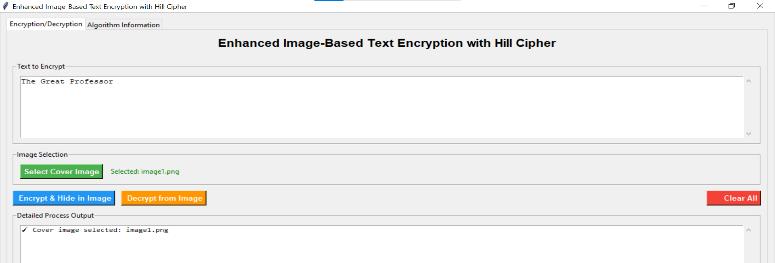
Fig:5.1(a)GUIforenteringtextandcoverimage selection
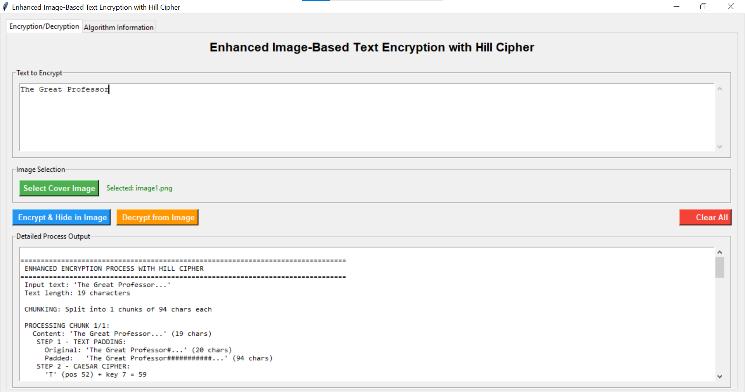
Fig:5.1(b)TextingpaddingandCaesarCipher
Volume: 12 Issue: 08 | Aug 2025 www.irjet.net p-ISSN:2395-0072
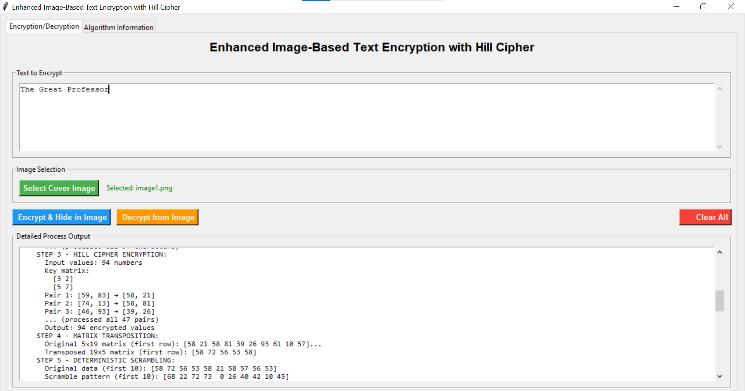
Fig:5.1(c)Hillcipherencryption,matrixtransposition, andscrambling
The GUI interface for choosing the cover image and entering the input text for the encryption process is displayed in Fig. 5.1(a).Fig.5.1(b) shows the initial padding operation followed by the application of the Caesar Cipher. Next, Fig. 5.1(c) illustrates the execution of the Hill Cipher encryption, along with matrix transposition and scrambling, which improves key complexity and diffusion.
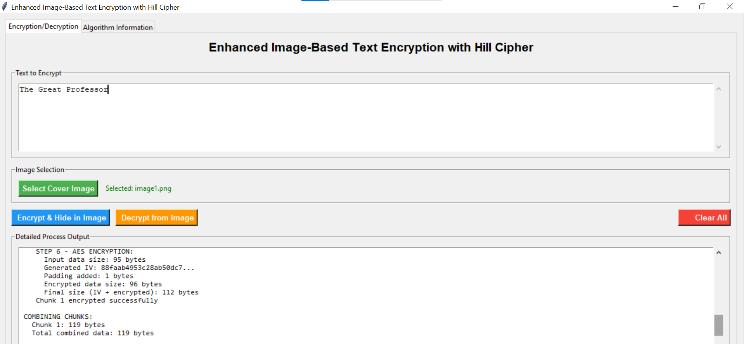
Fig:5.1(d)AESEncryption

Fig.5.1(e)CoverImage
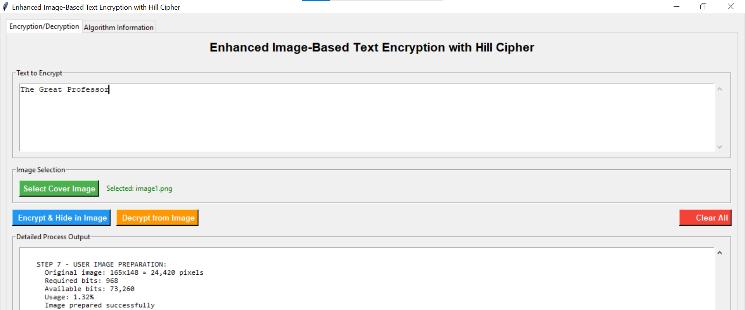
Fig:5.1(f) UserImagePreparation
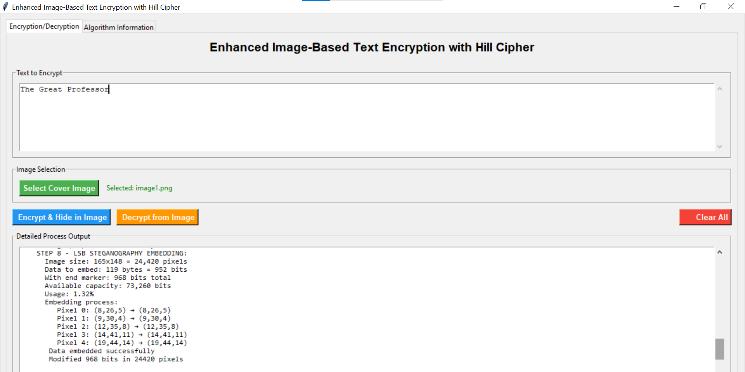
Fig:5.1(g)LSBSteganographyEmbedded
The results of the AdvancedEncryption StandardAES) encryption are displayed in Fig. 5.1(d), ensuring strongsymmetricencryptionsecurity.
Before embedding, the cover image was prepared as shown in Fig. 5.1(e),Fig. 5.1(f) presents the original cover image used for steganographic embedding. The Least Significant Bit (LSB) embedding process is illustrated in Fig. 5.1(g), where the encrypted data is hidden withinthe image.
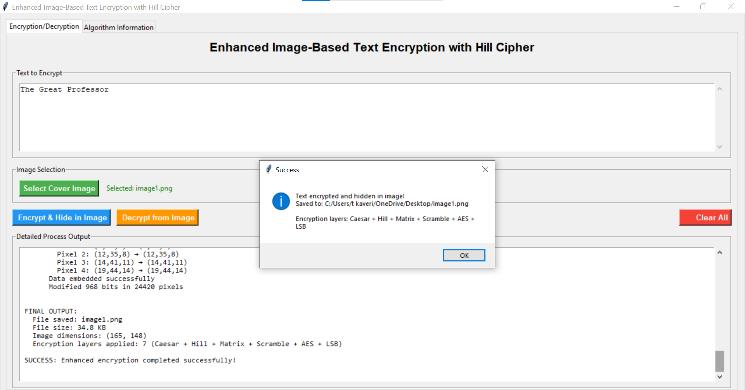
Fig:5.1(h)Textencryptedandhiddeninimage
Thefinal output,shown inFig.5.1(h), contains the fully encrypted and embedded textand hidden in image (Source:storedlocallyforexperimentaluse)
Volume: 12 Issue: 08 | Aug 2025 www.irjet.net
Experimental results confirm that the multi-layered encryption combined with steganography achieves high
data confidentiality and imperceptibility. Visual inspectionshowsnonoticeabledegradationinthestegoimage, while the layered encryption strategy offers strongattacks.
Thereversedecryptionprocesswastestedtoensurethe original text could be fully recovered. The stego image was processed to extract the encrypted payload. This payload was then passed through the seven decryption stagesinreverseorder.
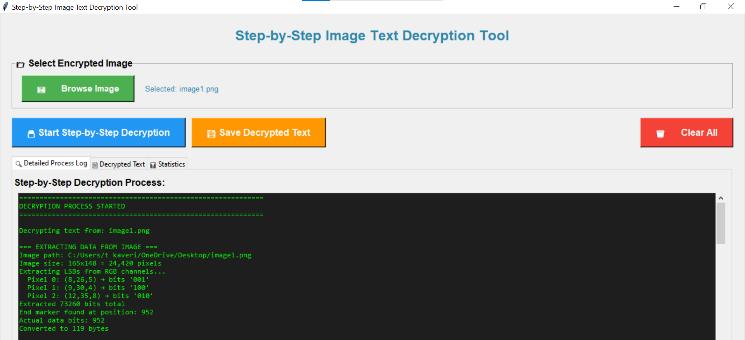
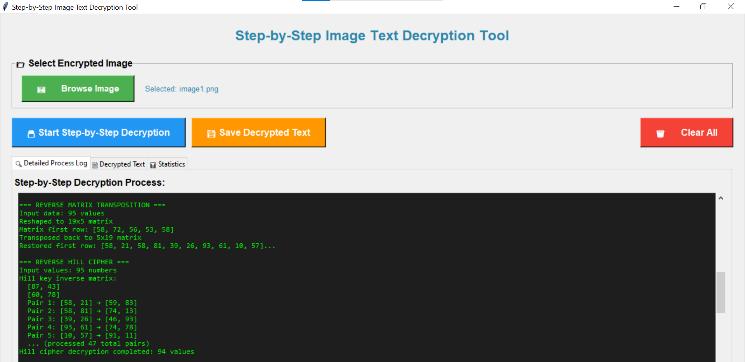
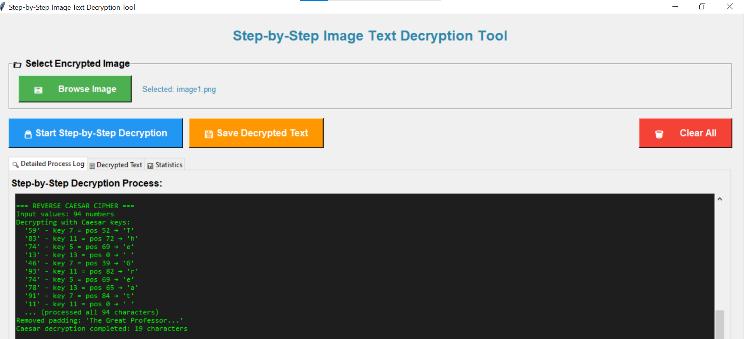
The reverse decryption process aimed to recover the original text from the encrypted payload in the stego image.Inthefirststage,the payloadwasextractedfrom theimageusingthedataretrievalmoduleFig.5.2(a).
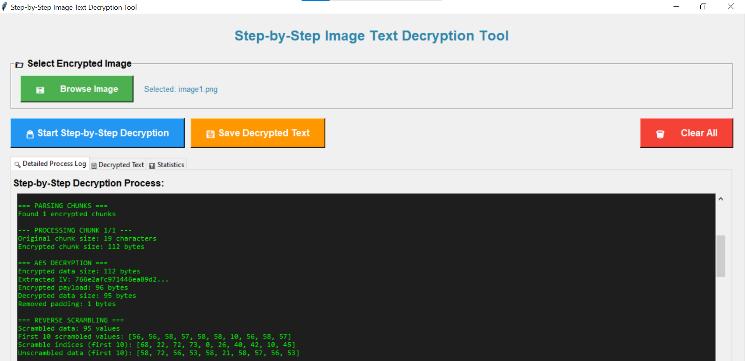
Theextractedciphertextwasparsedandthenprocessed with reverse Chaotic Advanced Encryption Standard (AES) decryption, followed by reverse scrambling Fig. 5.2(b).
Next,theintermediateoutputunderwentreversematrix transposition and reverse Hill cipher operations to restorethedata'sstructureFig.5.2(c).Thiswasfollowed byapplyingthereverseCaesarciphertoobtainthenearfinal plaintext Fig. 5.2(d).
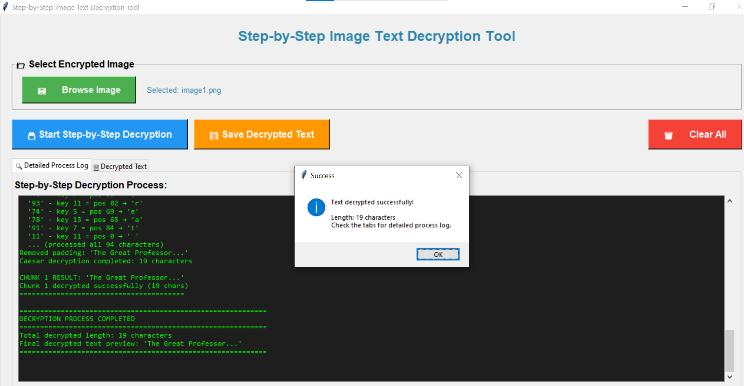
In the last stage, the fully decrypted text was generated and compared to the original input for validationFig5.2(e).
Volume: 12 Issue: 08 | Aug 2025 www.irjet.net p-ISSN:2395-0072
This paper presented a multi-layer image-based text encryption system that successfully combines the classical Hill cipher with modern steganographic techniques. The seven-layer security design provides strongprotectionagainstvariousattackswhileensuring practical usability through an easy-to-use GUI. The experimental results show that the system effectively enables secure text communication with minimal visual distortion in carrier images. The integration of Hill cipher mathematics with current encryption standards offers both historical cryptographic strength and modern security compliance. This system contributes to informationsecuritybydemonstratinghowclassicaland modern cryptographic techniques can work together to create strong, user-friendly security solutions for digital communication.
Future research directions include using machine learning to create adaptive security layers, exploring integration of quantum-resistant cryptography, and developingmobileappversionsoftheproposedsystem. Furthermore, improving performance for large-scale deployment and cloud-based implementations needs moreinvestigation.
[1] Ahmad,J.,&Ahmed,F.(2010).Efficiencyanalysisand security evaluation of image encryption schemes. International Journal of Video & Image Processing and NetworkSecurity,10(2),18-23.
[2]Hosseinian, S., & Butenko, S. (2022). Graph neural networksincombinatorialoptimization. Discrete Applied Mathematics,307,95-108.
[3] Jatin, R., Verma, K., Navalakhe, R., Shrivastava, G., & Shrivastava, V. (2022). Matrix-based encryption algorithms for data security. Materials Today Proceedings,56,3247-3254.
[4] Johnson, N. F., & Jajodia, S. (1998). Exploring steganography: Seeing the unseen. Computer, 31(2), 2634.
[5] Kaur, R., Singh, A., & Kumar, P. (2019). Modified Hill cipher using generalized matrix inverse. International JournalofComputerApplications,182(15),1-6.
[6] Liu, H., & Wang, X. (2010). Color image encryption based on one-time keys and robust chaotic maps. Computers & Mathematics with Applications, 59(10), 3320-3327.
[7] Menezes, A. J., Van Oorschot, P. C., & Vanstone, S. A. (2018). HandbookofAppliedCryptography.CRCPress.
[8] National Institute of Standards and Technology. (2001). Advanced Encryption Standard (AES). FIPS Publication197.
[9] Patel, M., & Shah, N. (2021). Comparative analysis of classical transposition techniques. International Journal ofInformationSecurity,20(4),567-580.
[10] Petitcolas,F.A.,Anderson,R.J.,&Kuhn,M.G.(1999). Information hiding a survey. Proceedings of the IEEE, 87(7),1062-1078.
[11] Rivest, R. L., Shamir, A., & Adleman, L. (1978). A method for obtaining digital signatures and public-key cryptosystems. Communications of the ACM, 21(2), 120126.
[12] Saad, A. S., Ismael, A. H., Ali, A. (2020). Graph neural networks for cybersecurity applications. Procedia ComputerScience,171,2400-2409.
[13] Schneier,B. (2015). Applied Cryptography: Protocols, Algorithms and Source Code in C (20th Anniversary ed.). JohnWiley&Sons.
[14] Singh, G., & Kumar, A. (2020). Columnar transposition cipher with enhanced security features. JournalofCryptographicEngineering,10(3),245-258.
[15] Stallings, W. (2017). Cryptography and Network Security: Principles and Practice (7th ed.). Pearson Education.
[16] Swami, B., Singh, R., & Choudhary, S. (2022). Advanced cryptographic techniques using matrix operations. ProcediaComputerScience,201,145-152.
[17] Syafrizal, T., Sugeng, K. A., Simanjuntak, R., Marpaung, J. L., et al. (2024). Improving data security with the utilization of matrix columnar transposition techniques. In Proceedings of the International Conference on Computer Science and Engineering Innovation (ICCSEI 2023). E3S Web of Conferences, 501, 02004. https://doi.org/10.1051/e3sconf/202450102004
[18] Wang, X., & Luan, D. (2013). A novel image encryptionalgorithmusingchaosandreversiblecellular automata. Communications in Nonlinear Science and NumericalSimulation,18(11),3075-3085.
[19]Xu,L.,Li,Z.,Li,J.,&Hua,W.(2016).Anovelbit-level image encryption algorithm based on chaotic maps. OpticsandLasersinEngineering,78,17-25.
International Research Journal of Engineering and Technology (IRJET) e-ISSN:2395-0056
[20] Zhou, J., Liu, X., Au, O. C., & Tang, Y. Y. (2014). Designing an efficient image encryption-thencompression system via prediction error clustering and random permutation. IEEE Transactions on Information ForensicsandSecurity,9(1),39-50.
Volume: 12 Issue: 08 | Aug 2025 www.irjet.net p-ISSN:2395-0072 © 2024, IRJET | Impact Factor value: 8.226 | ISO 9001:2008 Certified