
International Research Journal of Engineering and Technology (IRJET) e-ISSN: 2395-0056
Volume: 12 Issue: 10 | Oct 2025 www.irjet.net p-ISSN: 2395-0072
International Research Journal of Engineering and Technology (IRJET) e-ISSN: 2395-0056
Volume: 12 Issue: 10 | Oct 2025 www.irjet.net p-ISSN: 2395-0072
SOUMYA PM1 , Dr. H.N. ASHOKA 2
1M. Tech student, Power System Analysis, Dept. of Electrical and Electronics Engineering, University BDT Collage of Engineering, Davangere, Karnataka, India
2Professor, Department of Electrical and Electronics Engineering, University BDT Collage of Engineering, Davangere, Karnataka, India.
Abstract - This study presents a non-electricalinput-based method of tracking maximum power points (MPPT) in a solar-powered water pumping mechanism that uses a Brushless DC (BLDC) motor. The main goal is to design an MPPT method that is independent of step size, specifically for water pumping applications. A DC–DC boost converter, regulated by MPPT, is used to draw the maximum available power from the solar photovoltaic (SPV) array while also ensuring a smooth start for the BLDC motor. The BLDCmotor is to be examined by the curves of rotor speed, stator current, electromagnetic torque, and back EMF with respect to time. The efficiency of the BLDC motor-driven pumping system is assessed under various solar irradiation circumstances, and its overall performance is examined and simulated in MATLAB/Simulink.
Key Words: Maximum power point tracking (MPPT), Artificial Neural Network (ANN), Solar Photovoltaic Array (SPV), Brushless DC Motor (BLDC) ,MATLAB/Simulink etc.
1.INTRODUCTION
Energy extraction under temperature, irradiance fluctuationsisoptimizedutilizingmethodsfromMaximum PowerPointTracking(MPPT).OscillationsattheMPPTand dependency on preset step sizes are two drawbacks of traditionalMPPTsystems,suchasIncrementalConductance (INC)andPerturbandObserve(P&O),whichreduceoverall efficiency. An MPPT technique based on Artificial Neural Networks (ANN) for solar-powered water pumping applicationsusingBrushlessDC(BLDC)motordrives[1]. Among irrigation methods, micro-irrigation is highly efficient,reducingwaterwastagecomparedtotraditional flood irrigation. designing solar-powered water pumping systems for a 14.7-hectare grape farm. It evaluates three system configurations: without storage, with battery storage, and with water tank storage [2]. Solar energy providesasustainablealternativeforpoweringirrigation pumps,reducingdependenceonfossilfuelsandlowering operationalexpenses.Whichfocusesondevelopingasolarpowered water pumping system with an automatic switchingmechanism[3].
Photovoltaic (PV) systems are becoming a more appealing option for water pumping applications due to rising need for energy. For such systems, brushless DC (BLDC) motors are recommended because to their low maintenance requirements, small design, and great efficiency. However, standalone solar pumps face issues duringlowsunlightornighthours, leadingtointerrupted water supply. suggests a BLDC motor drive-based gridinterfacedsolarPVsystemthatisbackedbyapowerfactorcorrectedboostconvertertoenablesmoothpowersharing betweenthegridandPV[4].
The system ensures continuous water delivery, improved power quality, and reliable motor operation under varying solar conditions. Although standalone photovoltaic (PV) systems are inexpensive, particularly when battery-free, they must function well to optimize energyuse.TomakesurethePVarrayrunsatitshighest power point, MPPT approaches are used, such as the PerturbObserve(P&O)algorithm[5]. PV-basedpumping systemwithaninductionmotordriveandvectorcontrolto achieveefficientoperationundervaryingsolarirradiance [5]. Simulation results demonstrate that the proposed control method maintains stable motor performance and consistentwaterdischarge.
The two MPPT algorithms that are most commonly used when taking the water pumping system into account are incremental conductance (INC) and perturb and observe (P&O). However, in a standalone SPVWPS, the MPPT method's step size is a crucial component that governs control attributes [6]. In order to circumvent the detrimental impact of step size, the ANN-based MPPT techniqueischosen. Usingsolarphotovoltaic(PV)energy forpumpingisacost-effectiveandeco-friendlyalternative to diesel or grid-powered pumps [7]. A model of a solarpoweredcentrifugalpumpsystemdrivenbyaBLDCmotor, designedandsimulatedin MATLAB/Simulink.Themodel helps analysed system performance and optimize design parameters for efficient water pumping under different conditions.
The design and simulation of a solar-powered pumpingsystemusingasingle-phaseinductionmotor,DC-
International Research Journal of Engineering and Technology (IRJET) e-ISSN: 2395-0056
Volume: 12 Issue: 10 | Oct 2025 www.irjet.net p-ISSN: 2395-0072
DCboostconverter,andSPWMinverter[8].Theproposed modelimprovesefficiency,reducesharmonicsthroughLC filtering,andprovidesareliablesolutionforirrigationand rural water supply applications. Maximum Power Point Tracking(MPPT)iscrucialforeffectiveenergyconsumption [9].TraditionalMPPTmethodslikePerturb&Observeand Incremental Conductance often struggle under partial shading,leadingtopowerloss.MPPTtechniquecombininga scanningalgorithmwithanArtificialNeuralNetwork(ANN) to accurately track the global maximum power point (GMPP).
The modeling and also simulation of a solarpoweredwaterpumpingsystemthatdrivesahydraulicload usingaseparatelyexcitedDCmotorandcentrifugalpump. ThePVvoltageisincreasedusingaDC-DCboostconverter toensuresmoothmotorrunning[10].Theperformanceof thesuggestedsystemisassessedinseveralenvironmental scenariosusingMATLAB/Simulinksimulation.
1.1 Objective
To utilize Maximum Power Point Tracking (MPPT) to modelasystemusessolarenergytopowerabrushless DC(BLDC)motorforwaterpumping.
To create a boost converter that will control and increase the solar photovoltaic (PV) array's voltage in ordertosatisfythemotor'sneeds.
Evaluation of results in MATLAB / Simulink for its effectivenessinreal-lifescenarios.
1.2 Proposed Methodology
ThesystemalsohasPVarray,anANNbasedMPPTdriving DC-DCBoostconverter,DCcapacitorlinkwhichisregulated by PWM signal generated by electronics commutation to controlVSIandpumpsystem.SPVarrayisselectedcarefully to ensure optimal and CCM operation of the DC-DC boost converter
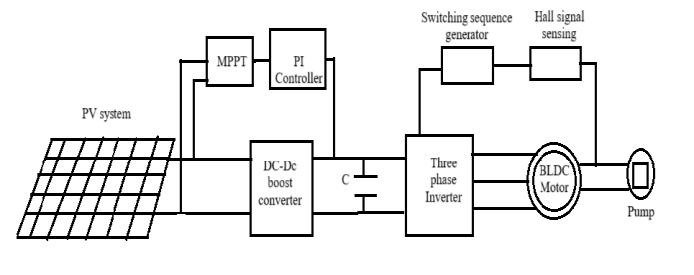
The diagram shows the block representation of a solar-poweredBLDCmotor-drivenwaterpumpingsystem. ThePVarraygeneratesDCpower,whichisfedtoaDC-DC boostconverter.Thisconverterstepsupthevoltagetothe requiredlevelandmaintainsastableDClinkvoltage. The PVarray'smaximumpowerextractionisguaranteedbyan MPPTcontroller.,andaPIcontrollerregulatestheconverter
output.Thethree-phaseinverterconvertstheboostedDC voltageintoathree-phaseACsupplydrivetheBLDCmotor. Hall sensors provide rotor position feedback to the switchingsequencedeveloped,whichcontrolstheinverter to ensure appropriate motor commutation, switch. The BLDCmotordrivesthepump,enablingwaterflow,making the entire setup efficient for irrigation or water supply applications.
1)PV array produces DC; the MPPT algorithm measures conditionsandsetsthetargetdutyformaximumpower.
2)TheDC–DCboostraisesandstabilizesthePVvoltageto theDC-linklevelunderPIcontrol.
3)The inverter converts the DC-link to three-phase waveforms;Hallsensorsfeedrotorpositiontotheswitching logic.
4)Correctly timed commutation drives the BLDC motor, whichturnsthecentrifugalpumptodeliverwater.
FromsolarPVarrayblockparametersTrinaSolar TSM-200DA01A.05 SPV module is selected which is available in the module section of PV array block in MATLAB/Simulink.
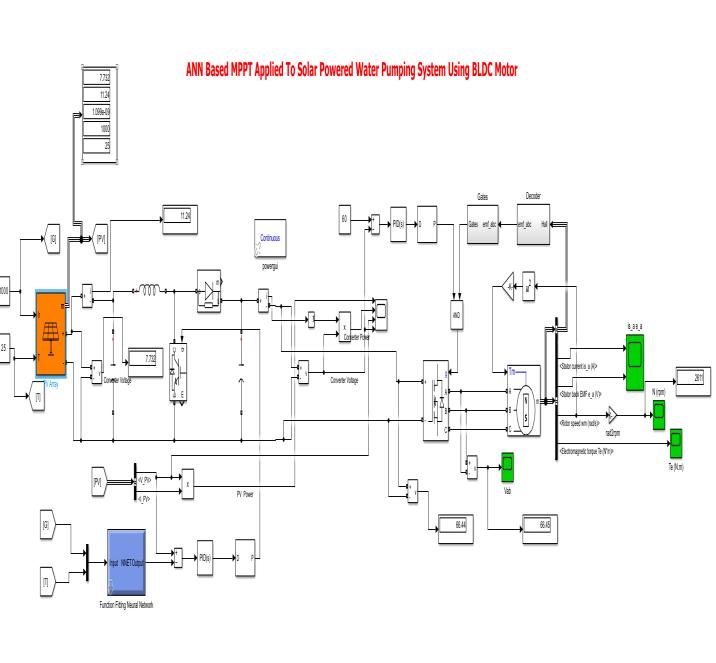
Fig 2: PVarraymodelinMATLAB/Simulink
The simulation shows a solar PV-powered BLDC motor waterpumpingsystemwithANN-basedMPPTcontrol.The PVarraygeneratesDCpowerdependingonsolarirradiance and temperature. This power is fed to a DC-DC boost converter,whichstepsupthevoltageandmaintainsastable DC-linkvoltage.TheANN-basedMPPTblockcalculatesthe reference voltage and adjusts the duty cycle of the boost converterformaximumpowerextraction.TheboostedDC is converted into three-phase AC by the inverter, which drivestheBLDCmotor.Hallsensorsproviderotorposition feedbacktocontroltheswitchingsequenceoftheinverter, ensuring smooth motor operation. The motor runs the pump, delivering water, and the model monitors
International Research Journal of Engineering and Technology (IRJET) e-ISSN: 2395-0056
Volume: 12 Issue: 10 | Oct 2025 www.irjet.net p-ISSN: 2395-0072
parameters like speed, torque, and current to analyze performance.
2.1 PV Array Module: SPVarrayofrating2.81kWfeeding 2.38 kW motor is selected. Excess power is required to overcomeallthelossesoccurduringvariousstagesofthe SPVWPS system. To generate 2.81 kW. maximum voltage (Vmpp)selectedas267.4,MaximumCurrent(Impp)which is required to get 2.81 kW is to be verified by using this belowformula Modulemaximumpower(w)=200.93(per module)Totalnumberofmodules=14
Pmpp = 200.93 x 14 = 2813 w
Impp= Pmpp/ Vmpp = 2813/267.4 = 10.52 A
So,togeneratemaximumpowerof2.81kWatstandardtest condition (STC) 7 module are connected in series and 2 modules are connected in parallel. Formula is given as below
Numberofmodulesconnectedinseries Ns= Vmpp/ Vm = 267.4/38.2 = 7
Numberofmodulesconnectedinparallel Np= Impp/ Im =10.52/5.26 =2
Idealboostoutputpower Pout = Vout x Iout max = 48x11.4 =547.2W
Idealinputcurrent Iin = Pout = 547.2=17.82A Vin 30.7
Restricting the voltage ripple, ΔVdc in Vdc, C is estimatedas ω = 2×П×��r×�� 120
For simulation, capacitor C is taken a higher value. A highervalueofCreducesrippleatDCbus.
2.3 SELECTION OF CENTRIFUGAL PUMP: In terms of designing,acentrifugalpumpisselectedbyestimatingthe proportionality constant, K utilizing the accompanyingrelationshipas
K = P = 2813 = 1.37x10^4W/(rad/sec) 2 ��3 27333
WherePismotorpower,��risratedspeedofBLDCmotor in rad/sec and pump rated torque (T rated) of the BLDC motorundersteadystatecondition.
2.4 Brushless DC Motor (BLDC): BLDCmotorsoperateon the basis of the interaction between the rotor and stator magnetic fields. When the rotor's permanent magnets interactwiththestator'srevolvingmagneticfield,atorqueis created that rotates the rotor. It is the BLDC motor that powers the water pump. The DC-DC boost converter provides the motor with a DC voltage that regulates its speed. In a three-phase BLDC motor, the rotor position determinesthebackelectromotiveforce(EMF),andtheback EMFofeachphasevariesby120°electricaldegreesbetween phases.
ω = 2×П×��r×�� = 2xП(2611x4) = 273.3rad/s 120 120
2.2 Design Boost Converter: At standard test condition arraymaximumoutputvoltageisVmppandoutputofboost convertermaintainedtobeatDClink(Vdc)whichisrated voltageofBLDCmotor.So,toverifieddutycycle(D).
Vout = 48 V; Iout max = 11.4A; Vin = 30.7V
Switchingfrequency(Fs)fortheboostconverterisselected tobe10,000Hz.Themotive behindselectingsucha high valueistoreduceripplesintheinductorcurrent(iL)andto improvethetransientperformanceoftheboostconverter. At maximum power point, Impp calculated. Limiting the currentripple,ΔILiniListobecalculate. Δ IL = 0.01x Iout max x Vout =0.1782A Vin
ΔVout = 0.01 x Vout = 0.48V
Inductance L= (Vin - Vin) = 30.7 (48-30.7) =6.21mH
Fs × ΔIL x Vout 0.178x10000x48
Capacitor C = Iout max (1- Vin/ Vout) =8.5599x10^-4F
Fsx Vout
ImpliedDutytoBoost(30.7Vto48V)
D = 1- Vin =1–30.7=0.36 Vout 48
2.5PositionSensors: PositionsensorsinstalledintheBLDC motor detect the rotor’s position and convert it into an electricalsignal,whichprovidesthecorrectcommutation informationtothelogicswitchingcircuit.Commutationina BLDCmotorfollowsasix-stepsequence.Duringeachstep, the six switches in the Voltage Source Inverter (VSI) are turned ON and OFF in a specific pattern to generate six currentflowvectors.Thesevectorsadvancetherotorby60° eachtime.Toperformthiscommutation,Hall-effectposition sensors are used. These sensorsdetect the rotor position over every 60° span and generate three Hall signals. The signals are then decoded to produce the appropriate switchingpulsesfortheVSIswitches.Figure3.2.6illustrates the electronic commutator switching states. The Hall sensors are positioned so that they detect rotor magnet changes slightly before the rotor reaches the exact commutationpoint.Thisensuresthatcommutationoccurs justintime,preventingtherotorfromstoppingorgetting lockedinoneposition.
International Research Journal of Engineering and Technology (IRJET) e-ISSN: 2395-0056
Volume: 12 Issue: 10 | Oct 2025 www.irjet.net p-ISSN: 2395-0072
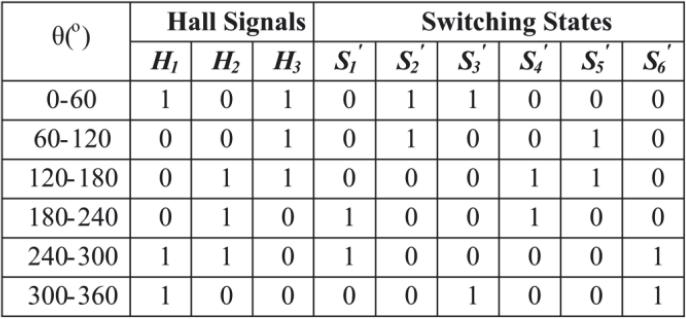
Table 2.5: Controlstructureofwaterpumpingsystem
3.RESULTS
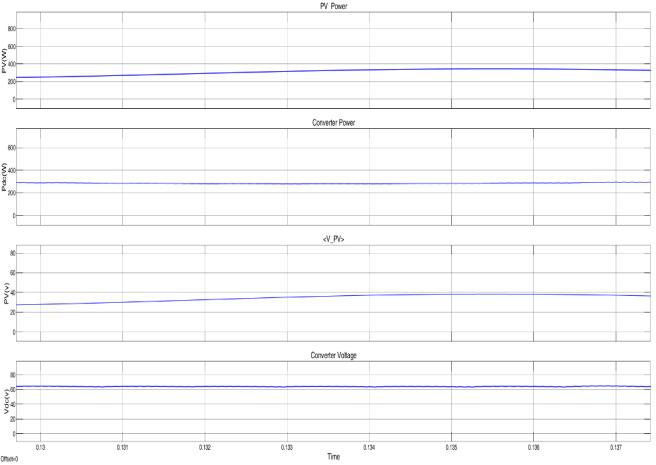
3.1: PerformanceofSPVarrayandBoostconverter (powerandvoltage).
Figure3.1showstheoperationoftheboostconverter,where the inductor current (iL) was measured at approximately 10.50A.Theoutputvoltage(Vdc)wassuccessfullyregulated andmaintainedat300V,whichistherequiredDClinkvoltage todrivetheBLDCmotor.
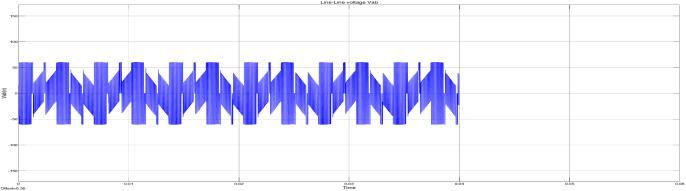
3.2: Performancecurveofline-to-linevoltage.
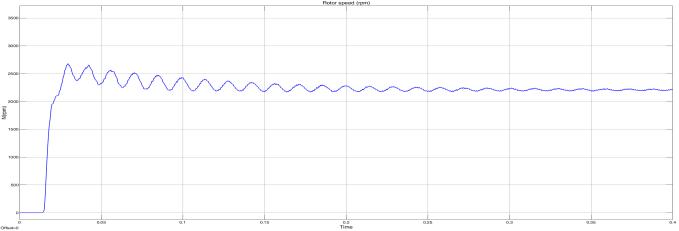
3.3: performanceofrotorspeed(rpm)
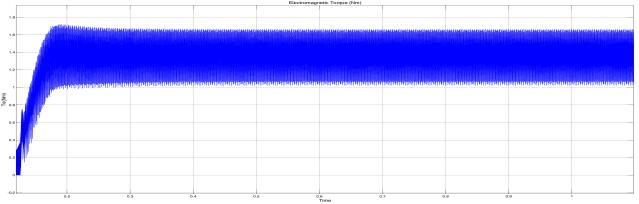
3.4: PerformanceofElectromagneticTorque(Nm).
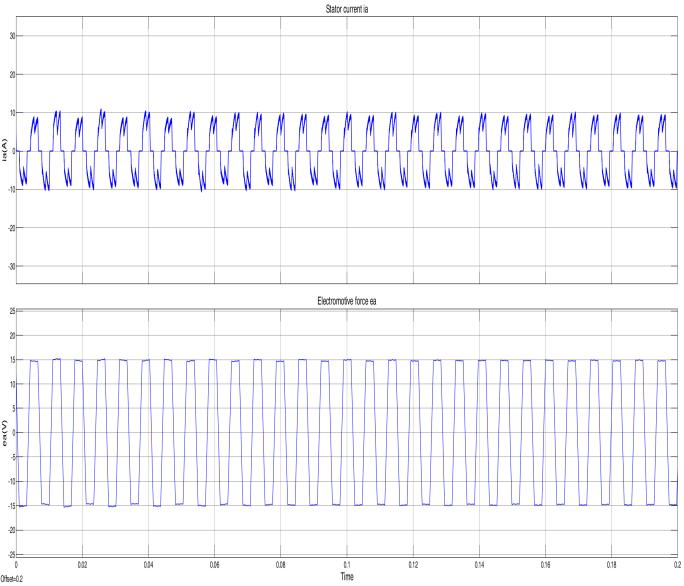
3.5: PerformanceofStatorcurrent(I)andEMF(v)with respecttotime
3.2The Efficiency of the overall system at various irradiance.
For different irradiance from solar panel is boosted and converted to AC signals by inverter generates the mechanicaloutputasmotorspeed.
Table 3.2: Efficiencyoftheoverallsystematvarious irradiance
International Research Journal of Engineering and Technology (IRJET) e-ISSN: 2395-0056
Volume: 12 Issue: 10 | Oct 2025 www.irjet.net p-ISSN: 2395-0072
Table3.2showsthepercentageefficiencyinvarious irradianceso,withtheuseofMPPTtracingtechnology.The overallsystemgives92.81%efficiencyat1000irradiance.
Thestudysuccessfullydevelopedasolar-powered BLDCmotor-drivenwaterpumpingsystemusinganMPPT strategy based on non-electrical inputs. The proposed algorithm operates independently of step size, addressing thelimitationsofconventionaltrackingmethods.Simulation results confirmed reliable performance of the PV array, boost converter, and BLDC drive, maintaining smooth operationunderchangingirradiance.Thesystemachieveda peak efficiency of 92.81% at standard conditions and sustained 67.34% efficiency even at low sunlight. Additionally,theMPPTcontrolenabledsoftstartingofthe BLDC motor, reducing current surges and enhancing the durabilityofthepumpsystem.
[1]D.KoPriyatoshJena,RajenPuduret.al.,(2019).“ANN based MPPT applied to solar powered water pumping systemusingBLDCmotor”IEEEICSETS2019.
[2]MohammadZamanlouandM.TariqIqbalet.al.,(2020). “Designandanalysisofsolarwaterpumpingwithstorage for irrigation in Iran.” 2020 IEEE 17th International ConferenceonSmartCommunities.
[3]KhamalDharmesh,ChauhanKuldeepsinhet.al.,(2018)
“Effective Irrigation Using Solar Based Water Pump with Automatic Switching.”2nd International Conference on CurrentResearchTrendsinEngineeringandTechnology.
[4]RajanKumar,Bhim Singhet,al.,(2018).BrushlessDC motor-drivengrid-interfacedsolarwaterpumpingsystem.” ResearchArticle,InternationalEngineeringTechnology.
[5] S.G. Malla, C.N. Bhende and S. Mishra et.al., (2013). “Photovoltaic based water pumping system.” 2013 IEEE SchoolofElectricalSciences,IndianInstituteofTechnology Bhubaneswar,India.
[6]MJayakumarandVRajiniet.al,(2022).“Investigationof photovoltaic water pumping system.” 2013 IEEE, Internation conference on circuit, power and computing technology.
[7] Levon Gevorkov, Irina Kirpichnikova et.al., (2021). “Model of Solar Photovoltaic Water Pumping System for DomesticApplication.”202128thInternationalWorkshop onElectricDrives:ImprovingReliabilityofElectricDrives (IWED).
[8] R. Kameswara Rao, P. Srinivas, S. Kranthikumar et.al., (2014). “Simulation and Analysis of Electrical Water PumpingSystemUsingSolarEnergy.”2014IEEE.
[9]L.Bouselham,M.Hajj,B.Hajjet.al.,(2016).“AMPPTBased ANN Controller Applied to PV Pumping System.”2016IEEE.
[10] Jagabandhu Majhi, S. Nema and Deepak Verma et.al., (2019). Simulations and analysis of solar based water pumping system for hydraulic actuated load.”2019IEEE.