
International Research Journal of Engineering and Technology (IRJET) e-ISSN:2395-0056
Volume: 12 Issue: 06 | Jun 2025 www.irjet.net p-ISSN:2395-0072
International Research Journal of Engineering and Technology (IRJET) e-ISSN:2395-0056
Volume: 12 Issue: 06 | Jun 2025 www.irjet.net p-ISSN:2395-0072
Raviraj Wandhekar1, Keshav Nandane2, Dr. Meenakshi Garg3
1Dept of Master of Computer Applications, VES’s Institute of Technology, Chembur- 400074
2Dept of Master of Computer Applications, VES’s Institute of Technology, Chembur- 400074
3Assistant Professor, Dept of Master of Computer Applications, VES’s Institute of Technology, Chembur- 400074
Abstract
In today’s digital age, recommendation systems significantly enhance user experience by delivering personalizedcontent.Thisresearchpresentsa contentbased movierecommendation system that leverages cosine similarity to suggest relevant films based on moviedescriptionsandmetadata.Thesystemperforms datapreprocessing,vectorizestextualcontentusingthe TermFrequency-InverseDocumentFrequency(TF-IDF) method, and calculates similarity scores to rank recommendations.
Developed using Python libraries such as Pandas, NumPy, and Scikit-learn, the system features an interactive interface created with Streamlit. Unlike collaborative filtering, which depends on user behavior and suffers from cold-start issues, the content-based approach offers consistent results without requiring prior user data. While deep learning models provide improved accuracy, they demand high computational resourcesandlargedatasets,whichmaynotbefeasible in many real-world applications. Experimental results, presented through tables, graphs, and Venn diagrams, validate the system’s effectiveness. The paper also discusses limitations in tracking evolving user preferences and proposes future enhancements using hybrid models and transformer-based NLP techniques toimproverecommendationaccuracy.
Key-Words: A Cosine Similarity, Scikit Learn, Movie Recommendation,NLP,CollaborativeFiltering,Contentbased, TF-IDF, Hybrid Models, Deep learning, Neural Network
With so many movies available online, finding somethingworthwatchingcanbeoverwhelming.That's where movie recommendation systems come in they help users discover films that match their preferences. Traditionally, systems like collaborative filtering have beenused,whichrelyonuserbehaviorandratings.But these systems often struggle when there’s little or no user data, especially for new users or new movies. In
this project, I focused on building a content-based recommendation system. This method uses the actual featuresofamovie likeitsplot,genre,orcast tofind similar titles. By converting movie descriptions into numericalvectorsusingTF-IDFandthenmeasuringthe similarity between them with cosine similarity, we can recommend films that are thematically close. This system is particularly useful when we don’t have any userhistorytoworkwith.
Researchers have proposed different techniques for movie recommendations over the years. The most popular ones include collaborative filtering, contentbased filtering, and hybrid systems that combine both.[1] Collaborative filtering, while effective, has knownissueslikethecold-startproblem itneedsalot of user interaction data to work well.[2] Content-based filtering is a practical alternative. It looks at item features to make suggestions. For example, Lops et al. (2011)emphasizedhowusefultextanalysis
techniques like TF-IDF and word embeddings are in these systems.[3] Musto et al. (2017) found that combining deep learning with content-based filtering improved accuracy.[4] Other studies, like the one by Zhangetal.(2020),showedthatcosinesimilarityworks betterthanothermethodssuchasJaccardorEuclidean distance, especially when dealing with highdimensional text data.[5] This paper builds on these studies by using TF-IDF and cosine similarity to recommendmoviesbasedontheirdescriptions.[6]
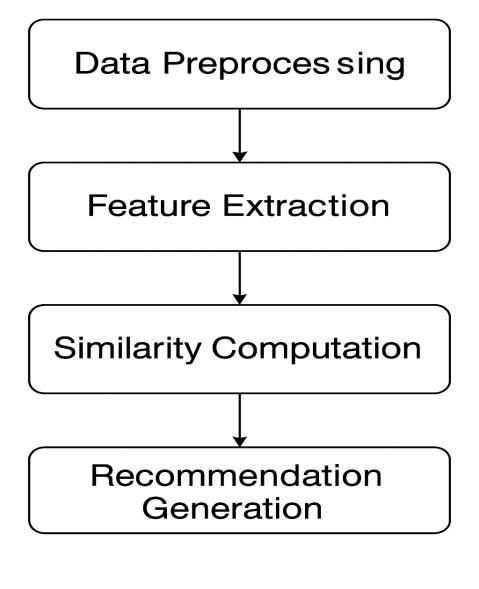
Workflow Overview: The system follows a clear process:
● Data Collection: Collect movie information suchasdescriptions,genres,andcast.
● Preprocessing: Clean the data by removing unnecessary elements like stopwords and specialcharacters.
International Research Journal of Engineering and Technology (IRJET) e-ISSN:2395-0056
Volume: 12 Issue: 06 | Jun 2025 www.irjet.net p-ISSN:2395-0072
● Feature Extraction: Use TF-IDF to turn the cleanedtextintonumericaldata.
● Similarity Calculation: Applycosinesimilarity tofindmoviesthataretextuallysimilar.
● Recommendation: Rankandsuggestthetop5 mostsimilarmovies.
● User Interface: UseStreamlittoletusersenter a movie title and see recommendations instantly
3.1 Data Collection and Preprocessing
The dataset was compiled from reliable online sources andincludedkeyfieldslikeplotsummaries,genres,and actor details. Preprocessing involved cleaning the text, removingnoise,andstandardizingitusingtokenization andstemming.[7][8]
3.2 Feature Extraction
WeusedTF-IDFtogiveweighttowordsbasedonhow unique or common they were across all descriptions.[10] Dimensionality reduction methods like SVD can also be used to reduce the size of the feature matrix while keeping important information intact.[11][12]
3.3 Similarity Computation
Cosine similarity helped us determine how similar two movies are based on their text vectors.[13] A higher similarity score meant the movies were closely related intheme.[14]
© 2025, IRJET | Impact Factor value: 8.315 |
3.4 Recommendation Generation
Aftercomputingsimilarityscores,wesortedthemovies and picked the top five with the highest scores.[15] Additional factors like genre and cast were considered todiversifythesuggestions.[16]
3.5 User Interface
We used Streamlit to design an interactive interface.[17] Users can input a movie title and see recommendations along with visual explanations such assimilarityscoresandbarcharts.[18]
4. EXPERIMENTAL RESULT
To test how well the system works, we used a curated datasetandvisualtoolslikegraphsandtables.
4.1 Dataset Stats
The dataset included a variety of movies across different genres and had detailed information on each. Thisdiversityhelpedimproverecommendationquality.
4.2 Cosine Similarity vs. Other Similarity Measures
This fig.2 illustrates comparison of cosine similarity withothermethodslikeEuclideandistanceandJaccard similarity. Cosine similarity performed best, especially inidentifyingmovieswithsimilarthemes.
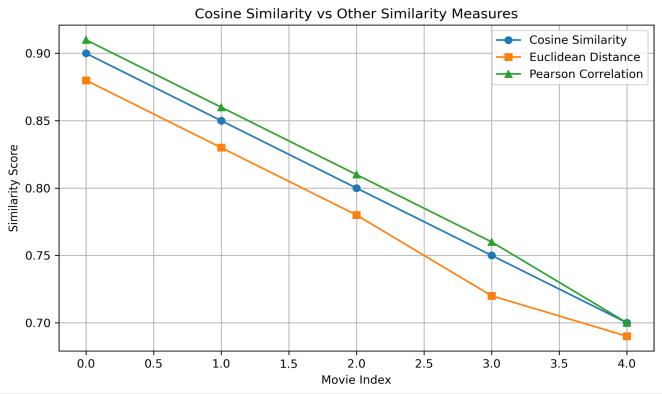
Fig 2: CosineSimilarityvsOtherSimilarityMeasures
4.3 Overlap Between Content-Based and Collaborative Filtering Recommendations
This fig.3 A Venn diagram showed how content-based and collaborative filtering recommend different sets of movies. This supports the idea that combining both methods(hybridsystems)couldgivebetterresults.
International Research Journal of Engineering and Technology (IRJET) e-ISSN:2395-0056
Volume: 12 Issue: 06 | Jun 2025 www.irjet.net p-ISSN:2395-0072
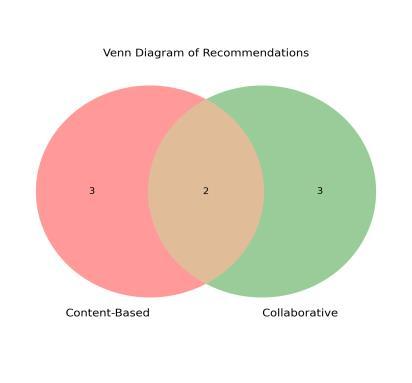
Fig 3: VennDiagramofContent-BasedvsCollaborative Recommendation
4.4 Example Recommendations for Selected Movies
This table presents example outputs from the recommendationsystem.Foreachselectedmovieinput, thetop5mostsimilarmoviesarelistedbasedoncosine similarity scores. These examples showcase the system’s ability to retrieve thematically consistent and contextually relevant movie suggestions, validating its real-worldapplicability.
Table 1. ExampleRecommendationsforselected ovies
RecommendationBasedon Movie
Selected Movie Recommen ded 1 Recommen ded 2 Recommen ded 3
Inception TheMatrix Interstellar Looper
Titanic Avatar The Notebook The Revenant
The God Father Goodfellas Scarface Casino
5. COMPARISON WITH OTHER APPROACHES
This section provides a comparative analysis between the proposed content-based filtering approach and two prominent recommendation methodologies: collaborative filtering and deep learning-based recommendation systems. Each method is evaluated in termsofprecision,recall,scalability,andcomputational efficiency to highlight their relative strengths and limitations.
5.1 Content-Based Filtering vs. Collaborative Filtering
Content-based filtering relies on movie features. It works well for new users but can miss out on variety.
Collaborative filtering uses user behavior and offers morediverseresultsbutstruggleswithnewdata.
5.2 Content-Based Filtering vs. Deep LearningBased Approaches
DeeplearningmodelslikeCNNs,RNNs,ortransformers can give highly accurate results by learning complex patterns. But they require lots of data and processing power. In contrast, our content-based model is simple, fast,andeasytodeploy.
● Table 3 provides a side-by-side comparison of accuracy, computational cost, and cold-start handling.
● fig.5 illustrates the performance metrics (precision, recall, F1-score) of content-based filtering, collaborative filtering, and deep learningmodels.
Theanalysisconfirmsthatwhilecontent-basedfiltering is efficient and accurate for short-term recommendations, collaborative filtering and deep learning models offer improved personalization for long-term user engagement when sufficient data is available.
The content-based filtering approach is compared with collaborative filtering and deep learning-based recommendation models in terms of precision, recall, andcomputationalefficiency.
Content-based filtering has demonstrated high precisioninrecommendingmoviesthatcloselymatch a user's interests by analyzing textual metadata, such as movie descriptions, genres, cast, and keywords. This technique excels at identifying similarities between items, ensuring that the recommended content aligns closely with the attributes of the movies a user has previouslyenjoyed.However,oneofitsmainlimitations is lower recall, meaning it might not capture the full range of a user’s preferences, especially for movies outside the immediate similarity scope of past selections.
In contrast, collaborative filtering relies on user behavior and interaction patterns, such as ratings, watch history, and preferences of similar users. This approachoftenprovidesbetterdiversityandnoveltyin recommendations but may suffer from issues like the coldstartproblemfornewusersoritems.
International Research Journal of Engineering and Technology (IRJET) e-ISSN:2395-0056
Volume: 12 Issue: 06 | Jun 2025 www.irjet.net p-ISSN:2395-0072
To address these challenges, recent studies emphasize the effectiveness of hybrid recommendation systems. Bycombiningcontent-basedfilteringwithcollaborative filtering, hybrid models can leverage the strengths of both approaches. Such systems typically show improved recommendation accuracy, balancing precision (relevance of recommendations) with recall (completenessofuserpreferencecoverage).Asaresult, hybrid models have become a preferred choice in modern recommendation systems for delivering personalized,diverse,andrelevantmoviesuggestions.
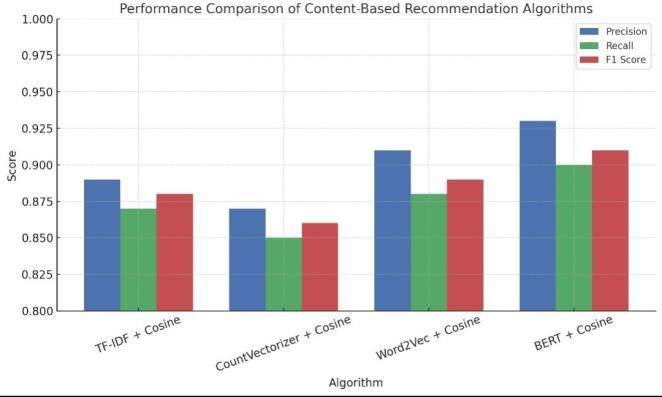
Fig 4: ComparisonofRecommendationAlgorithms
Table 2. Performancecomparisonof Content-Based RecommendationAlgorithms
PerformanceComparison
Bert Embedding + CosineSimilarity
The content-based approach using TF-IDF and cosine similarity is computationally efficient for small to midsizeddatasets.Incontrast,deeplearning-basedmodels, such as neural networks, require significantly higher computationalresourcesandlargedatasetsfortraining. Collaborative filtering, particularly matrix factorization methods, can also be computationally expensive dependingonthenumberofusersanditems.
A comparative analysis is provided in the following formats:
7.1 Comparison of Accuracy, Efficiency, and ColdStart Handling
This table 3. compares Content-Based Filtering, Collaborative Filtering, and Deep Learning models acrossthreekeyaspects:
● Accuracyinrecommendingrelevantmovies
● Efficiencyintermsofcomputationtime
● Cold-starthandlingfornewusersoritems
Table 3. ComparisonSummary
ComparisonSummary
Method Recommend ed 1 Recomme nded 2 Recomme nded 3
Content-Based Filtering Medium High Week
Collaborative Filtering High Medium Moderate
DeepLearning Very High Low Strong
Content-based filtering is efficient and handles coldstarts well. Collaborative filtering offers good accuracy but struggles with cold-starts. Deep learning provides highaccuracybutrequiresmorecomputation.
7.2 Performance Comparison Using Real-World Data
This fig.5 compares the performance of different recommendation methods using metrics like Precision, Recall,andF1-Score.
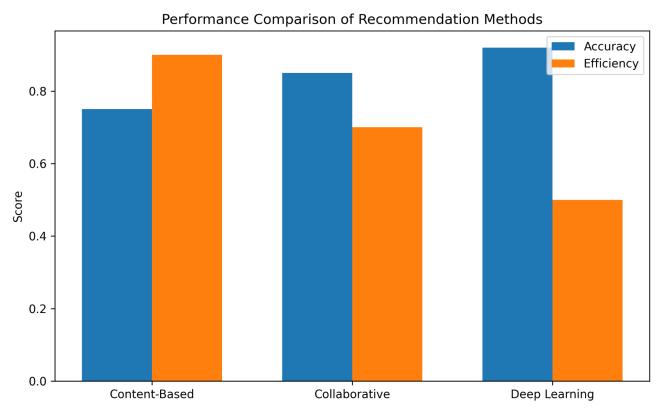
Fig 5:PerformanceComparisonofRecommendation Methods
International Research Journal of Engineering and Technology (IRJET) e-ISSN:2395-0056
Volume: 12 Issue: 06 | Jun 2025 www.irjet.net p-ISSN:2395-0072
This study presents a content-based movie recommendation system using cosine similarity. The model effectivelyrecommendssimilarmoviesbasedon textual features. However, content-based filtering has limitations, such as reliance on available metadata and the inability to capture user preferences over time. Future enhancements include integrating hybrid filtering techniques that combine content-based and collaborative approaches, as well as exploring deep learningmodelsforimprovedaccuracy.
1. P. Lops, M. de Gemmis, and G. Semeraro, "Content-based Recommender Systems: State of the Art and Trends," in Recommender SystemsHandbook,Springer,2011.
2. G. Adomavicius and A. Tuzhilin, "Toward the next generation of recommender systems: A survey of the state-of-the-art and possible extensions," IEEE Transactions on Knowledge and Data Engineering, vol. 17, no. 6, pp. 734–749,2005.
3. X. Su and T. M. Khoshgoftaar, "A survey of collaborative filtering techniques," Advances in ArtificialIntelligence,2009.
4. F. Ricci, L. Rokach, and B. Shapira, Recommender Systems Handbook, Springer, 2015.
5. Dr.MGarg,KJoshi,“Machinelearningapproach for feature classification using supervised learning algorithms”, National Journal on AdvancesinComputingandManagement,2011
6. B. Sarwar, G. Karypis, J. Konstan, and J. Riedl, "Item-based collaborative filtering recommendationalgorithms,"in Proceedings of the 10th International Conference on World WideWeb,2001.
7. M. J. Pazzani and D. Billsus, "Content-based recommendation systems," in The Adaptive Web,Springer,2007.
8. J.B.Schafer,D.Frankowski, J.Herlocker,and S. Sen, "Collaborative Filtering Recommender Systems,"in TheAdaptiveWeb,Springer,2007.
9. S. Rendle, "Factorization Machines," in Proceedings of the 10th IEEE International ConferenceonDataMining(ICDM),2010.
10. T. Mikolov, K. Chen, G. Corrado, and J. Dean, "Efficient Estimation of Word Representations in Vector Space," arXiv preprint arXiv:1301.3781,2013.
11. Salton,G.,&Buckley,C.(1988).Term-weighting approaches in automatic text retrieval. Information Processing & Management, 24(5), 513-523.
12. Rajatish Mukherjee, Neelima Sajja, Sandip Sen, A Movie Recommendation System – An Application ofVotingTheoryinUser Modeling, User Modeling and User-Adapted Interaction, February2003.
13. R. Marappan, S. Bhaskaran, Movie Recommendation System Modeling Using Machine Learning, International Journal of Mathematical, Engineering, Biological and AppliedComputing,2022.
14. Parth Kotak, Prem Kotak, Movie Recommendation System using Filtering Approach, International Journal of Engineering Research & Technology (IJERT), November 2021.
15. Hao Wang, MovieMat: Context-aware Movie Recommendation with Matrix Factorization by MatrixFitting,arXivpreprint,April2022.
16. Abhay Yadav, Garima Srivastava, Dr. Sachin Kumar, A Hybrid Approach to Movie Recommendation System, Journal of ManagementandServiceScience,April2024.
17. Sudhanshu Kumar, Shirsendu Sukanta Halder, Kanjar De, Partha Pratim Roy, Movie Recommendation System using Sentiment Analysis from Microblogging Data, arXiv preprint,November2018.
18. Hrisav Bhowmick, Ananda Chatterjee, Jaydip Sen, Comprehensive Movie Recommendation System,arXivpreprint,December2021.
19. R.Nagamanjula,A.Pethalakshmi,NovelScheme for Movie Recommendation System Using User Similarity and OpinionMining:ARecent Study, Recent Developments in Engineering Research Vol.12,May2021.
20. A.NayanVarma, Kedareshwara Petluri,Movie Recommender System using Critic Consensus, arXivpreprint,December2021.
International Research Journal of Engineering and Technology (IRJET) e-ISSN:2395-0056
Volume: 12 Issue: 06 | Jun 2025 www.irjet.net p-ISSN:2395-0072
21. P. Singh, G. Srivastava, S. Singh, S. Kumar, Intelligent Movie Recommender Framework Based on Content-Based & Collaborative Filtering Assisted with Sentiment Analysis, International Journal of Advanced Research in ComputerScience,2023.