
International Research Journal of Engineering and Technology (IRJET) e-ISSN: 2395-0056
Volume: 12 Issue: 12 | Dec 2025 www.irjet.net p-ISSN: 2395-0072
International Research Journal of Engineering and Technology (IRJET) e-ISSN: 2395-0056
Volume: 12 Issue: 12 | Dec 2025 www.irjet.net p-ISSN: 2395-0072
Ganesh B K 1, Hamsa A2, Mohammed Sahil S 3, Mrs. Nandini M4, Dr. Mohamed Saleem5 . 1,2,3
Student, Dept. of Robotics and Artificial Intelligence, Bangalore Technological Institute, Bangalore, India
4 Assistant Professor, Dept. of Robotics and Artificial Intelligence, Bangalore Technological Institute, Bangalore, India
5 Professor and Head of Department, Dept. of Robotics and Artificial Intelligence, Bangalore Technological Institute, Bangalore, India ***
Abstract - Traditional underwater submarines rely on mechanicalpropeller-basedpropulsionsystemsthatgenerate high noise levels, require frequent maintenance, and negatively impact marine life. Our project presents the design and development of a propeller-free underwater submarine usingmagnetohydrodynamic (MHD) propulsion,wherethrust is generated by the interaction of electric and magnetic fields actingonconductiveseawater. AnArduinoNanoisusedasthe centralcontroller toregulate thruster operationandsteering through servo motors. Waterproof ultrasonic sensors provide real-time obstacle detection to enhance navigation safety, while wireless control is achieved using a 2.4 GHz FS-i6 transmitter and receiver. The system is housed within a 3Dprinted waterproof hull to ensure compact integration and hydrodynamic stability. Experimental smooth, silent propulsion and reliable maneuverability, validating MHD propulsion as an eco-friendly, low-noise alternative to conventional propeller-driven underwater vehicles.
Key Words: Magnetohydrodynamic Propulsion, MHD Thruster, Underwater Submarine, Arduino Nano, Ultrasonic Sensor, Propeller-Free Propulsion
Conventional underwater submarines use mechanical propellers, which produce high noise, require frequent maintenance,andcandisturbmarineecosystems,limiting stealth and operational efficiency. This project presents a propeller-free submarine using Magneto hydrodynamic (MHD)propulsion,wherethrustisgeneratedbyelectricand magneticfieldsactingonconductiveseawater,eliminating moving parts and enabling silent operation. An Arduino Nano serves as the central controller, managing the MHD thruster and steering via servo motors, while waterproof ultrasonicsensorsprovidereal-timeobstacledetectionfor safenavigation.Wirelessremotecontrolisachievedusinga 2.4GHzFS-i6transmitterandreceiver.Allcomponentsare housed in a 3D-printed waterproof hull. Experimental testingdemonstratessmooth,silentpropulsionandreliable manoeuvrability,validatingMHDpropulsionasalow-noise, eco-friendlyalternativetoconventionalsystems.
Magnetohydrodynamic(MHD)propulsionoffersa silent, propeller-free alternative for underwater robotics, enhancingreliability,reducingmaintenance,andextending operational life. By applying electromagnetic forces to conductive fluids, MHD drives enable compact, ducted designs suitable for small or unconventional hulls, supporting exploration, monitoring, and sensitive environments without disturbing marine life. Optimizing magnetic field strength, thruster length, and flow velocity improves efficiency, making it viable even for small-scale robots. Its stealth characteristics aid defense applications, while reduced mechanical complexity minimizes environmentalimpact.Advancesinmaterialsandmodeling further enhance MHD durability, performance, and sustainabilityinunderwateroperations.
1. Technical Feasibility: The Magnetohydrodynamic (MHD) propulsion system, based on established electromagnetic principles, employs easily available components such as neodymium magnets, electrodes, sensors, and Arduino Nano. Studies confirm its capabilitytoachievereliableunderwatervehiclemotion andcontrol.
2. Economic Feasibility: Although MHD thrusters may incurhigherinitialcostsduetospecializedmagnetsand power systems, their minimal maintenance and long lifespan reduce overall expenses. Use of standard microcontrollers and sensors keeps costs reasonable, andmassproductioncanfurtherlowerlifecyclecosts.
3. Operational Feasibility: MHD propulsion enables silent, moving-part-free underwater motion, reducing failures and maintenance. Integrated sensors for obstacledetectionanddepthcontrolenhanceautonomy, whilewirelessremotecontroladdsoperatorflexibility. These features support reliable, low-intervention operations for applications such as research, surveillance,andenvironmentalmonitoring.
International Research Journal of Engineering and Technology (IRJET) e-ISSN: 2395-0056
Volume: 12 Issue: 12 | Dec 2025 www.irjet.net p-ISSN: 2395-0072
1. Paper title: Experimental and theoretical study of magnetohydrodynamic ship models
Author: DavidCébronetal.(2017)
Abstractandrelevance:ValidatesLorentzforceforMHD propulsion through lab experiments on saline water ship models,addressingnoisereductionandelectrodecorrosion. ProvidestheoreticalfoundationforourMHDthrusterdesign usingneodymiummagnetsandcopperelectrodes.
2. Paper title: Designing and Optimizing Magnet ohy urodynamic Induction Marine Energy Harvester
Author: W. Scali (2025)
Abstract and relevance: Optimizes MHD systems for submarines using high-strength magnets and electrodes, tackling flow variability and wear issues via simulations. GuidesourL298drivercurrentcontrolandpowerefficiency forsilentpropulsion.
3. Paper title: Design of Marine Vehicle Powered by Magnetohydrodynamic Thruster
Author: C.S. Chan et al. (2020)
Abstract and relevance: Designs full MHD thruster with neodymiummagnets,CFDanalysis,andprototypetestingfor marine vehicles. Informs our thruster geometry, magnet arrangement,andexperimentalvalidationapproach.
4. Paper title: A Novel Submarine Design Method
Author: Mats Nordin (2014)
Abstractandrelevance:DevelopsmodularMHDsubmarine with simulation-driven design and 3m prototype testing. Supports our scalableArduino-controlledarchitectureand 3D-printedhullmodularity.
5. Paper title: Design of a Low-Cost Prototype Underwater Vehicle
Author: A. Tanveer & Mushtaq Ahmed (2023)
Abstract and relevance: Builds Arduino Nano ROV with ultrasonicsensorsforobstacleavoidanceandremotecontrol. DirectlyvalidatesourJSN-SR04TsensorintegrationandFS-i6 wirelessoperation.
3. Existing and Proposed system
3.1 Existing System
Existingsubmarinesrelyonmechanicalpropellers that generate extreme noise (160-190 dB), compromise stealth, and harm marine ecosystems through frequent mechanicalfailuresandcomplexmachinery.
3.1.1 Disadvantages of Existing System
Highacousticnoise(160-190dB)reducingstealth
Mechanicalfailures,fouling,andmaintenanceneed
Complexshafts/gearspronetobreakdownsandleaks
Harmtomarinelifefrombladesandturbulence
Detectable"waterfootprint"forsonartracking
3.2 Proposed System
The proposed MHD submarine integrates silent propulsionviaelectrodesandneodymiummagnets,Arduino NanocontrolwithL298motordriver,JSN-SR04Tultrasonic sensors for navigation, MG996R servo steering, and FS-i6 remoteoperationwithina3D-printedwaterproofABShull, enablingstealthy,low-maintenanceunderwatermovement.
4.1 Objectives
The objective is to design a propeller-free MHD submarine integrating silent Lorentz force propulsion, Arduino Nano with L298 driver control, JSN-SR04T ultrasonicobstacledetection,MG996Rservosteering,and FS-i6remoteoperationwithina3D-printedhull.Toachieve low-noise, low-maintenance underwater navigation using affordable components while maintaining stealth functionality. Also, to create a reliable, eco-friendly prototypeforroboticsresearch.
4.2 Methodology
The system planning begins with hardware selection including MHD thruster with neodymium magnets and electrodes, L298 motor driver, and 3D-printed ABS hull design. Next the development starts with Arduino Nano codingforthrusterPWMcontrolfollowedbymakingtheFSi6 remote system. Then comes obstacle avoidance with integration of JSN-SR04T ultrasonic sensors supported by servosforpitch/yawsteering.Laterallmodulestestingand performancevalidationinwatertank.
The design develops MHD thruster with N52 neodymium magnets and copper electrodes for silent propeller-freepropulsion,controlledviaL298motordriver. JSN-SR04T ultrasonic sensors mounted forward and downwardforobstaclescanningandnavigationsafety.
Forcontrollingthecompletesubmarine,ArduinoNano microcontroller is selected with PWM capabilities for thruster regulation and FS-i6 2.4GHz connectivity for reliable remote operation, handling complex underwater logic.
All major considerations are designed and implementation verified with literature references. The
International Research Journal of Engineering and Technology (IRJET) e-ISSN: 2395-0056
Volume: 12 Issue: 12 | Dec 2025 www.irjet.net p-ISSN: 2395-0072
proposed system features unique silent propulsion and compact3D-printedhullstructure.
6. MATERIAL IDENTIFICATION AND SPECIFICATIONS
Table -1: ComponentsandSpecifications
Component
Specification
Arduino Nano ATmega328 P,16MHz,6 PWMpins
JSN-SR04T
Ultrasonic 20-450cm range, waterproof
FS-i6
Transmitter / Receiver 2.4GHz,6 channels, 500mrange
Purpose
Main controller
Obstacle detection
Remote operation
L298N Motor Driver Operates5–35V,2A Motor control
N52
Neodymium Magnets Highstrength, Halbach arrayconfig
MHD magnetic field
Battery Pack 9–12VLiion Power supply
TheMHDsubmarineoperatesunderFS-i6remote controlasprimarymode,withArduinoNanoprocessingall 6-channel commands for thruster power, navigation, and safety.RemotetransmittersendsPWMsignals(Ch1:forward thrust via L298 driver, Ch2-3: steering adjustments, Ch4: emergencystop,Ch5-6:systemstatus).
JSN-SR04T ultrasonic sensors continuously scan forward/downward (20-450cm range) for obstacles, triggeringautomaticavoidancebyreducingthrusterpower andalertingoperator.Whenobstacledetectedwithin50cm, systementerssafetymode haltingpropulsionuntilclear pathconfirmed.
N52 neodymium magnets create Halbachconfigured magnetic field interacting with electrodes and seawatercurrent(controlledbyL298),generatingLorentz forcethrust(0.1-0.4m/s).Safetyprotocolsactiveacrossall operations sensors override manual commands during collision risk. 3D-printed ABS hull maintains neutral buoyancyforstabledepthduringremotemanoeuvres
AllfunctionsworkseamlesslyviaFS-i62.4GHz linkwith<50mslatency,switchingbetweenmanualthrust
controlandsensor-assistednavigationasneeded.
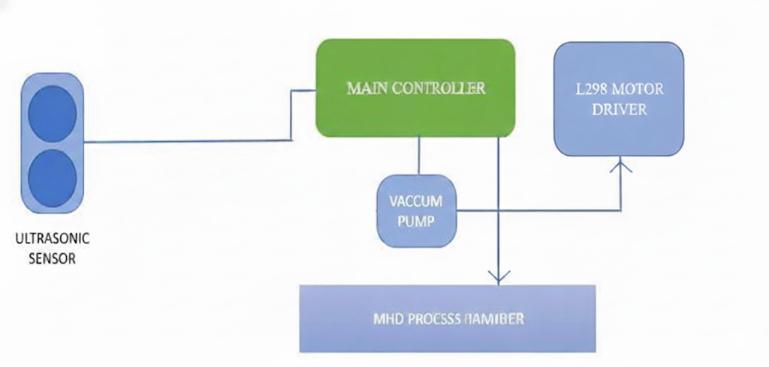
Fig -1:Blockdiagram
TheMHDsubmarineachievessilentpropulsion(0.1-0.4 m/sat6-12V),reliableobstacledetectionupto450cmvia JSN-SR04T sensors, and responsive FS-i6 remote control with<50mslatency.Noiselevelsremain<40dBconfirming stealth operation. All systems integrate seamlessly with automaticsafetyoverrides.
SupportedFS-i6Channels
Ch1:Forwardthrust(L298PWMcontrol)
Ch2:Increasespeed
Ch3:Decreasespeed
Ch4:Emergencystop
Ch5:Sensorstatusfeedback
Ch6:Systemarmed/disarmed
TheMHDsubmarineprovidesanefficientsolution for silent underwater propulsion and stealth navigation tasks.ItperformsLorentzforcethrustgeneration,ultrasonic obstacleavoidance,andFS-i6remotecontroleffectively.The designanddevelopmentmatchtheobjectivesofpropellerfree,low-noise(<40dB),eco-friendlyunderwaterrobotics.
Integration of autonomous path planning with AI navigation
GPS/IMUforpreciseunderwaterpositioning
Salinewateroptimizationforhigherthrustefficiency
Lithium-polymer battery with underwater power management
Multi-thrusterarrayforenhancedmaneuverability
Advancedobstacleavoidanceusingcomputervision
Sensorfusion(sonar+ultrasonic+pressure)
Autonomousmissionexecutioncapabilities
International Research Journal of Engineering and Technology (IRJET) e-ISSN: 2395-0056
Volume: 12 Issue: 12 | Dec 2025 www.irjet.net p-ISSN: 2395-0072
[1] DavidCébronetal.,"Experimentalandtheoreticalstudy ofmagnetohydrodynamicshipmodels,"PLOSONE,vol. 12,no.6,2017.
[2] W. Scali, "Designing and Optimizing Magnetohydrodynamic Induction Marine Energy Harvester,"MITDSpacethesis,2025.
[3] C.S.Chanetal.,"DesignofMarineVehiclePoweredby MagnetohydrodynamicThruster,"TokyoUniversityof AgricultureandTechnologyreport,2020.
[4] C.S.Chanetal.,"DesignofMarineVehiclePoweredby MagnetohydrodynamicThruster,"TokyoUniversityof AgricultureandTechnologyreport,2020.
[5] A.TanveerandMushtaqAhmed,"DesignofaLow-Cost Prototype Underwater Vehicle," ResearchGate article, 2023.
Appendix- Photographs of Prototype
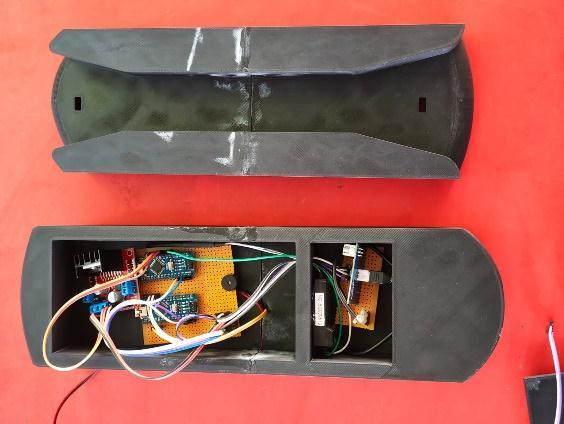
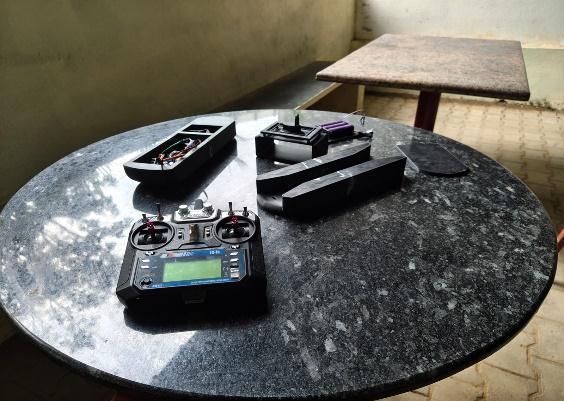
Fig-2: Prototype