
International Research Journal of Engineering and Technology (IRJET) e-ISSN: 2395-0056
Volume: 12 Issue: 06 | Jun 2025 www.irjet.net p-ISSN: 2395-0072
International Research Journal of Engineering and Technology (IRJET) e-ISSN: 2395-0056
Volume: 12 Issue: 06 | Jun 2025 www.irjet.net p-ISSN: 2395-0072
Manoj Kumar Shukla
Lecturer (TPO), Kalaniketan Polytechnic College, Jabalpur (MP), India
Abstract - Optimal costing of turbine generator is very important in deciding the overall costing of power plant. Effect of various parameters on the generator cost is studied in the paper, mainly effect of these parameters on inertia effect of turbine are covered. Though this is generally applicable to all power plant turbine, however in the current work major emphases is given to hydro power plant turbine. Starting from selection of site, design-simulation to selection of various components has a direct or indirect impact on the generator cost which are elaborated in current study.
Key Words: Hydroturbine,Generator,Cavitation,Runner, PowerPlant,Tailrace.
1.INTRODUCTION
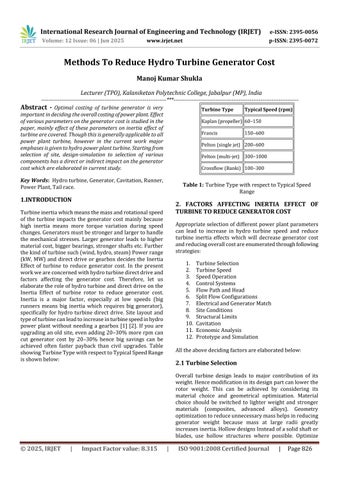
Turbineinertiawhichmeansthemassandrotationalspeed of the turbine impacts the generator cost mainly because high inertia means more torque variation during speed changes.Generatorsmustbestrongerandlargertohandle the mechanical stresses. Larger generator leads to higher materialcost,biggerbearings,strongershaftsetc.Further thekindofturbinesuch(wind,hydro,steam)Powerrange (kW, MW) and direct drive or gearbox decides the Inertia Effect of turbine to reduce generator cost. In the present workweareconcernedwithhydroturbinedirectdriveand factors affecting the generator cost. Therefore, let us elaboratetheroleofhydroturbineanddirectdriveonthe Inertia Effect of turbine rotor to reduce generator cost. Inertia is a major factor, especially at low speeds (big runners means big inertia which requires big generator), specifically for hydro turbine direct drive. Site layout and typeofturbinecanleadtoincreaseinturbinespeedinhydro power plant without needing a gearbox [1] [2]. If you are upgradinganoldsite,evenadding20–30%morerpmcan cut generator cost by 20–30% hence big savings can be achieved often faster payback than civil upgrades. Table showingTurbineTypewithrespecttoTypicalSpeedRange isshownbelow:
Turbine Type Typical Speed (rpm)
Kaplan(propeller) 60–150
Francis 150–600
Pelton(singlejet) 200–600
Pelton(multi-jet) 300–1000
Crossflow(Banki) 100–300
Table 1: TurbineTypewithrespecttoTypicalSpeed Range
INERTIA EFFECT OF TURBINE TO REDUCE GENERATOR COST
Appropriateselectionofdifferentpowerplantparameters can lead to increase in hydro turbine speed and reduce turbine inertia effects which will decrease generator cost andreducingoverallcostareenumeratedthroughfollowing strategies:
1. TurbineSelection
2. TurbineSpeed
3. SpeedOperation
4. ControlSystems
5. FlowPathandHead
6. SplitFlowConfigurations
7. ElectricalandGeneratorMatch
8. SiteConditions
9. StructuralLimits
10. Cavitation
11. EconomicAnalysis
12. PrototypeandSimulation
Alltheabovedecidingfactorsareelaboratedbelow:
Overall turbine design leads to major contribution of its weight.Hencemodificationinitsdesignpartcanlowerthe rotor weight. This can be achieved by considering its material choice and geometrical optimization. Material choice should be switched to lighter weight and stronger materials (composites, advanced alloys). Geometry optimizationtoreduceunnecessarymasshelpsinreducing generator weight because mass at large radii greatly increasesinertia.HollowdesignsInsteadofasolidshaftor blades, use hollow structures where possible. Optimize
International Research Journal of Engineering and Technology (IRJET) e-ISSN: 2395-0056
Volume: 12 Issue: 06 | Jun 2025 www.irjet.net p-ISSN: 2395-0072
TurbineRunnerDesignsuchasLighterrunner,Bladedesign andReducediameter.Usinglighteralloys(aluminum-bronze insteadofpuresteelifstrengthallows).Slimblades,hollow structures, optimized for strength-to-weight. If possible, slightlyhigherspeedrunners(smallerdiameter)havemuch lessinertiascaleswithradiussquared[1][2].
Use Faster-Type Turbines such as Francis turbine and Diagonalflowturbines.Francisturbinesgenerallyrunfaster than Kaplan or Pelton at the same head and flow. (e.g.,typicalFrancis:150–600rpm,vsKaplan:60–150rpm). Similarly Diagonal flow turbines (like Deriaz turbine) can combineflowflexibilitywithhigherspeeds.Ifturbinetype selection is appropriately done it can often jump from 60 rpm to 120–150 rpm just by using a Francis instead of a Kaplan, if site allows. A smaller runner diameter allows higher rotational speed. If runner size and tweak blade profilesareslightlyreduced,itcanincreaserpmby20–50% whilekeepingefficiencyreasonable[3].
CheckCurrentturbinetypewhetheritisaKaplan,Francis, Pelton, or other turbine. Whether switching to a faster runner still meet efficiency requirements or not. Blade profileisalsochecked,whetherprevailingconditionallow bladestobemodifiedforslightlyhigherspeedsornot.
2.2
If turbine is designed to run faster, the generator can be smaller for the same power output. Higher speed lowers torqueatsamepowersincePowerisproductofTorqueand AngularSpeed.IncreaseRotationalSpeedwithHigherRPM lowerstorqueatsamepowerandhencesmallergenerator canbeemployed.Forexample,insteadofrunningturbineat 100rpm,designittorunat150–200rpmifthesiteheadand flow allows. May be a small boost in head like civil modifications could allow this. Gearbox can help but adds complexity and increase cost sometimes direct drive at higherturbinespeedisbetter[3].
Allowing the turbine and generator to operate at variable speedsespeciallyinwindorhydroturbineletstoavoidbig mechanicalshocks.Italsoallowsthegeneratordesigntobe lighter because it doesn't have to handle big fixed-speed torquespikes.
2.4
Use active control to smooth out mechanical loads (pitch control in wind turbines, flow control in hydro turbines). Reduces peak torques on the generator. Hydraulic flow control such as guide vanes, wicket gates can smooth the flowandreducetorquefluctuations.Lesssuddentorquecan beachievedbylightergeneratordesign.UsingSemi-Flexible Coupling Not rigidly hard-coupling between turbine and generatorwithtorsionalflexiblecouplingcanabsorbshocks
andsmoothoutpeakloads.Designthegeneratortohavea slightly higher internal rotor inertia to "buffer" torque fluctuations from the turbine. Use permanent magnet generators (PMG), they can be lighter than wound-field machines.Designgeneratorwithhigherpolecounttokeepit compactevenatlowspeed[4].
Abovefactorscanbeanalyzedbyconsideringcasestudyof Kaplan turbine running at 60 rpm with direct drive connection. Traditional generator would be very large to handle the slow speed and high torque. Hence, we can redesigntherunnertooperateat90rpm(even50%more speed), so that generator size could dropped by approximately 33% easily. Also, using PMG instead of a wound rotor could shave 10–20% weight. In this way turbinerpmcouldvarythegeneratorsizeanditscost.
A brief of above parameters is given below considering a caseofdirectdrivehydroturbine.Thebestcostreductions usuallycomefrommakingtheturbinelighterandfasterand usinggeneratordesignsbettersuitedforlowspeed.Atypical Quickcomparisonplotofgeneratorsizevs.turbinespeed.
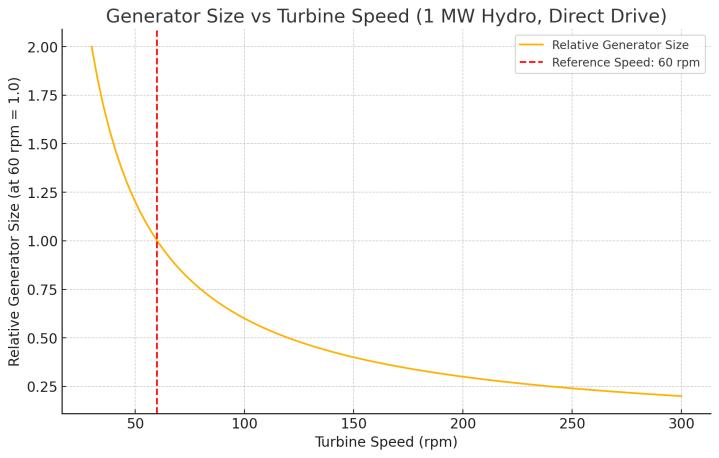
Accordingtotheaboveshownplotwhentheturbinespeed increases, the relative generator size drops sharply. At 60 rpm(reddashedline),wetakegeneratorsizeas1.0(100% baseline).At120rpm,thegeneratorcanbeabouthalfthe size.At180–200rpm,thegeneratorcanbearoundone-third theoriginalsize.Thisshowswhyincreasingturbinespeed, evenalittle,hasahugeimpactongeneratorcostandweight. Ifturbinespeedisdoubledfrom60rpmto120rpm,halve thegeneratorsizeandcostishalved.Evenamodestincrease (sayfrom60rpmto90rpm)cutscostbyaboutone-third. Following table (rpm vs. generator cost estimate) is enumeratedbelow.Numericalvaluesofaboveparameters aregivenbelowintabularform.
International Research Journal of Engineering and Technology (IRJET) e-ISSN: 2395-0056
Volume: 12 Issue: 06 | Jun 2025 www.irjet.net p-ISSN: 2395-0072
Evaluationofsiteconditionisnecessaryinordertoputhigh rotationturbine.SomeofthesiteconditionsuchasNethead (gross head minus losses) if it is high enough to allow a faster turbine without cavitation risks, Flow rate Is it relativelystableorhighlyvariable,Waterquality:(sediment load,debris),fastrunnersaremoresensitivetoerosion[3].
2.9
Runner stress is analysed using Finite Element Analysis (FEA). Faster spinning means higher centrifugal forces. Analysing the runner blades and hub handle to bear the extraforces.ShaftstrengthischeckedbyFEAwhichshows willtheshaftsurvivehighertorsionalloads[3].
2.5 Flow Path and Head
Increase net head by civil modifications raises the intake elevation a bit. Lowering the tailrace which is water exit levelalsoaidsinthis.Evenasmallincreaseinheadmaybe 10 to 20% allows higher optimal turbine speeds. Some projects dig a "draft tube depression" lowering the exit watertogetmoreheadforfree.
In Pelton or Turgo turbines, it can split flow into multiple smallerjets,eachdrivingasmallerrunnerathigherspeed.If usingKaplantypepropellerturbineshavingavariable-pitch blade system allows operation at higher speeds under variableflowswithoutlosingefficiency.
2.7
If using a partial converter like a Doubly Fed Induction Generator (DFIG) allows small variable speed operation withoutfullconversion.Thenturbinecanbedesignedfora slightlyfasternominalspeedandletsmallvariationswithout mechanicalstress[5].
Generator RPM match with high pole count generator is easilydesignedforthenewspeed.Gridconnectionimpacts speed variation synchronization especially important for directgrid-tiedsetups[5].Thus,ifhydrositeallowsit,even switchingfromaKaplanrunnertoasmallerFrancisturbine could double your rpm and halve generator cost without adding a gearbox. A step-by-step checklist for evaluating speed increase at specific site is as enumerated to safely evaluateincreaseinturbinespeedatsite.
Topreventcavitation,theNetPositiveSuctionHead(NPSH) mustbehigherthanrequired.Higherspeedleadstolower pressure at blade surfaces. To Perform cavitation check Thoma's cavitation number (sigma) is used to ensure submergenceisenough.Smallincreaseintailracepressure canavoidcavitationifneeded.ModificationinDrafttubeCan improve the flow and pressure recovery of flowing water current. Similarly, feasibility in tailrace modifications deepenstheoutlettoincreasenethead.Headallowsfaster turbineassociatedwithcavitationriskandifCavitationrisk is high then alternate methods are analyzed like Increase submergence,stayatlowerrpm,proceedtoredesignrunner andgenerator[6].
Financial constraints decide the Cost to modify turbine runnerredesign,shaft,etc.alsoCosttoredesigngenerator becausesmallersizemeanslowermaterialcost.ReturnOn InvestmentIsthepaybacktimereasonableoftenlessthan3 yearsforbigreductions[7].
Finally, before actual turbine assembly set up at the site, simulationofprototypeisperformed.Usingcomputational models,thensmallprototypeisbuiltandtestrigismadeto validatethenewspeedrangesafelybeforestartingtobuild actualturbineassembly[3].
3. Conclusion
Generator and turbine cost are two components which contribute major portion of overall power plant costing. Therefore,inordertooptimizeoverallpowerplantcostingit isdesirabletoverifyallnecessaryparameterswhichhelpin decreasing the costing. These parameters have been discussed in the paper. Further decreasing turbine inertia willhelpinreducinggeneratorcost.Othermeasureswhich
International Research Journal of Engineering and Technology (IRJET) e-ISSN: 2395-0056
Volume: 12 Issue: 06 | Jun 2025 www.irjet.net p-ISSN: 2395-0072
help in decreasing generator cost is increasing turbine rotationalspeed,suitableturbineselection,adjustflowpath, verify cavitation risk and finally verifying the prototype simulation.
Reference
[1]H.D.Piriz,“InertiaofHydroGenerators.Influenceonthe Dimensioning,Cost,Efficiency11andPerformanceofthe Units”,CIGRE2012,A1-102,http://www.cigre.org
[2]ZhouL,WangH,WangY,ZhangH,LiWandLiR(2023), “Evaluationoftheimpactofinertiaonsystemoperation cost” Front. Energy Res. 11:1118349. doi: 10.3389/fenrg.2023.1118349
[3]ManojKumarShukla(2011)“CFDanalysisof3-Dflowfor Francisturbine”MITInternationalJournalofMechanical EngineeringVol.1No.2Aug2011,pp93-100
[4] Zaiyu Chen (2025), “Inertia Support Capability Evaluation for Wind Turbine Generators Based on SymmetricalOperation”Symmetry/AsymmetryStudies in Modern Power Systems Symmetry2025,17(1), 31;https://doi.org/10.3390/sym17010031
[5] Rizwan Rafique Syed (2015) “Doubly-Fed Induction MachineforuseinMini-HydroPowerPlants”Technical Assessment, Norwegian University of Science and Technology.
[6]TanishKashyapetal(2024)“Silterosionandcavitation impactonhydraulicturbinesperformance:Anin-depth analysis and preventative strategies” Volume 10, Issue 8,30 April 2024, e28998, https://doi.org/10.1016/j.heliyon.2024.e28998
[7] Carmen M.Puertas-Frías et al (2022) “Design and economic analysis of a hydrokinetic turbine for household applications” Volume 199,November 2022, Pages 587-598 Renewable Energy https://doi.org/10.1016/j.renene.2022.08.155
2025, IRJET | Impact Factor value: 8.315 | ISO