
International Research Journal of Engineering and Technology (IRJET) e-ISSN: 2395-0056
Volume: 13 Issue: 01 | Jan 2026 www.irjet.net p-ISSN: 2395-0072
International Research Journal of Engineering and Technology (IRJET) e-ISSN: 2395-0056
Volume: 13 Issue: 01 | Jan 2026 www.irjet.net p-ISSN: 2395-0072
Ujwal Kant1, Ankit Goyal1, Priyavrat Kumar1, Vikas Gupta1
1Department of Mechanical Engineering, Technocrats Institute of Technology and Science Anand Nagar, BHEL Oppo site Hathaikheda Dam,Bhopal, Madhya Pradesh 462021
Abstract - This review paper provides a comparative analysis of methane and air micro-combustors, emphasizing their design, working principles, performance efficiency, and thermal management strategies. Due to their compact size and high energy density, micro-combustors are emerging as pivotal components inportable power generationand microelectromechanical systems (MEMS). The methane microcombustor operates through sequential stages fuel-air mixing, combustion in micro-channels, heat generation, and exhaust management with effective heat recirculation enhancingenergyretention.Itsperformancegraphshowsthat combustion efficiency rapidly approaches 100% at moderate power outputs (~10 W), indicating high thermodynamic efficiency. In contrast, the air micro-combustor employs a similar principle but with enhanced focus on symmetric heat recirculation, leading to sustained high-temperature zones (~700°C) as evident from the temperature-distance profile. Both configurations underscore the importance of precise thermal control, efficient mixing, and flame stability at the microscale. This paper highlights the significance of microcombustor development for miniaturizedenergy systems and sets the stage for future advancements in clean and decentralized power technologies.
Key word: Methane micro-combustor, micro-combustion, portablepowergeneration
Introduction
Micro-combustionistheprocessoffuel–aircombustionin devices with sub-millimeter to millimeter characteristic dimensions. These micro-combustors have attracted significantinterestduetotheirabilitytoprovidecompact, high-energy-density power sources for microelectromechanical systems (MEMS), micro aerial vehicles, micro-robots, and thermophotovoltaic systems [1,2]. Hydrocarbon fuels such as methane are particularly appealingbecauseoftheirhighvolumetricandgravimetric energydensity approximately50timeshigherthanthatof conventional batteries making them ideal for portable energygeneration[3].Methaneisalsoabundant,relatively easy to store, and has well-understood combustion characteristics, making it a prime candidate for microcombustionresearch[4-9].
Methane/air micro-combustors have been widely studied because they balance fuel availability, safety, and performance.Comparedtohydrogen,methaneiseasierto
store and safer to handle while still achieving high combustionefficiencies[10].Airmicro-combustors,where airservesastheoxidizer,arecriticalinbothpremixedand diffusion-controlled configurations. They are often integratedintomicro-turbines,thermophotovoltaicpower generators,andmicro-heaters,enablingdeviceswithpower outputsrangingfromafewwattstotensofwatts[11,12].
Theoperationofmicro-combustorsisgovernedbyclassical combustionprinciples,butwithnotablemodificationsdueto miniaturization.Thequenchingdistance,whichdetermines the smallest dimension that can sustain a stable flame, becomes comparable to the device size. For methane-air mixtures,thisdistanceistypicallyaround0.5–1.0 mm[13]. Indevicesapproachingthislimit,flamestabilityisachieved only through preheating of the reactants or catalytic wall interactions.
In many designs, premixed methane-air mixtures enter narrow channels where they ignite and stabilize at high temperatures(600–700 °C).Porousmedia suchassilicon carbide or ceramic foams are often employed inside the combustion chamber to enhance surface area and enable distributed combustion, which reduces heat loss and increasesreactionzonestability[7].Thesematerialsalsoact asflameholdersbypreventingflashbackorblow-off.
Flame stability in micro-combustors is determined by the interplayofflowvelocity,equivalenceratio(Φ),wallthermal conductivity,andgeometry[14].Unstableflamebehaviors suchasFREI(FlameRepetitiveExtinctionandIgnition) are commonly observed in micro-scale devices. FREI occurs when the flame cannot remain stationary and oscillates between extinction and reignition due to heat loss and varyingresidencetime[15].
Introducingbluffbodiesorbackward-facingstepsintheflow pathhasbeenshowntocreaterecirculationzonesthatactas flame anchors, thereby extending the blow-off limits and stabilizingleanflames(Φ < 0.8)[16].Numericalstudiesof methane-air micro-combustors with bluff bodies have confirmedenhancedperformance,particularlyforportable thermophotovoltaicsystems[17].
Heat recirculation is a cornerstone of micro-combustor design. By transferring heat from hot exhaust gases to incoming reactants, the system effectively preheats the mixture and offsets wall losses [9]. Common geometries
International Research Journal of Engineering and Technology (IRJET) e-ISSN: 2395-0056
Volume: 13 Issue: 01 | Jan 2026 www.irjet.net p-ISSN: 2395-0072
include the Swiss-roll combustor, where parallel channels for reactants and exhaust gases are arranged in a spiral configurationtomaximizeheattransfer[18].
Recent studies show that coupling heat recirculation with porous media significantly improves flame stability and combustion efficiency. For example, a U-shaped microcombustorwithembeddedporousmaterialsachievedstable operationwithmethane-airmixturesatpowerlevelsaslow as 2 W [7]. This combination also reduces the minimum ignition temperature and broadens the operating equivalenceratiowindow.
Key performance parameters for methane-air microcombustors include thermal efficiency, combustion efficiency, power output, and temperature distribution. Laboratory-scale devices typically achieve combustion efficienciesexceeding90%underoptimizedconditions[19].
Walltemperaturesof600–900 °Carecommon,particularly in devices designed for thermophotovoltaic power generation[20].
The power output of micro-combustors depends on flow rate,equivalenceratio,andgeometry.Studiesreportstable operation at power levels from 2 to 20 W, with higher powersachievedthroughadvancedinsulation,externalcups, and optimized flow paths [21]. The relationship between combustion efficiency and power output shows a steep increase at low power, which then plateaus near unity efficiency at higher operating ranges [19]. Methane-air micro-combustors have been integrated into several advancedapplications,including:
Micro-thermophotovoltaic (MTPV) generators, where the hotwallsofthecombustoremitradiationthatisconverted toelectricityviaphotovoltaiccells[22].Micro-gasturbines and micro heat engines, which use combustor output to drivesmall-scaleturbinesorpistons[23].Micro-propulsion systemsforUAVsandsatellites,wherecompactcombustion chambers generate thrust or provide thermal power [24]. Despitesignificantprogress,thereareseveralkeychallenges inmethane-airmicro-combustordevelopment:
Thermoacousticinstabilitiesariseduetocouplingbetween heat release and acoustic modes within the small combustionchamber,leadingtopressureoscillations[25]. Emissionscontrol,particularlyforNOₓ,isdifficultbecause high wall temperatures favor NO formation. Lean combustion (Φ < 1) and distributed flames are being exploredassolutions[26].Miniaturizationlimitsexistdueto quenchingdiameters;whenchanneldimensionsapproach thequenchinglimit,theflamecannotsustainitselfwithout preheating or catalytic walls [13]. Modeling complexity: Accurate simulation of fluid dynamics, heat transfer, and chemical kinetics requires advanced CFD techniques, including LES (Large Eddy Simulation) and DNS (Direct NumericalSimulation),whicharecomputationallyexpensive [27]
Futureresearchfocusesonadditivemanufacturingofmicrocombustorgeometries,hybridcatalytic-combustionsystems, andtheintegrationofAI-basedoptimizationalgorithmsfor designandcontrol.
Micro Power Generation refers to the production of electricity on a small scale, typically ranging from a few wattstoseveralkilowatts.Itisdesignedtoservelocalized energy needs such as homes, portable electronics, remote sensors,militaryequipment,oroff-gridapplications.Thekey advantage of micro power systems lies in their ability to providereliableanddecentralizedenergywithoutrelyingon largeinfrastructure.
There are various technologies employed in micro power generation, including thermoelectric generators (TEGs), microgasturbines,fuelcells,photovoltaics(solarpanels), and micro-combustors. Among them, combustion-based systems, like methane micro-combustors, are notable for offeringahighenergydensity,makingthemidealforlongdurationapplicationswherebatteriesarenotviable.
In such systems, chemical energy (from methane or other fuels)isconvertedintothermalenergythroughcombustion. This heat can then be transformed into electricity using thermoelectricmaterialsorsmallturbines.Thecompactsize of these devices enables their integration into portable or embeddedsystems,andwithproperthermalinsulationand waste heat recovery, their efficiency can be significantly improved.
Applications of micro power generation include powering wearabledevices,unmannedaerialvehicles(UAVs),space rovers, biomedical implants, and remote monitoring stations.Theyalsoplayacriticalroleinemergencybackup systemsandinregionslackinggridconnectivity.
As renewable energy and distributed generation gain importance, micro power generation is becoming a vital solutionforsustainable,off-grid,andmobileenergyneeds, offering a bridge between reliability and environmental responsibility.
International Research Journal of Engineering and Technology (IRJET) e-ISSN: 2395-0056
Volume: 13 Issue: 01 | Jan 2026 www.irjet.net p-ISSN: 2395-0072
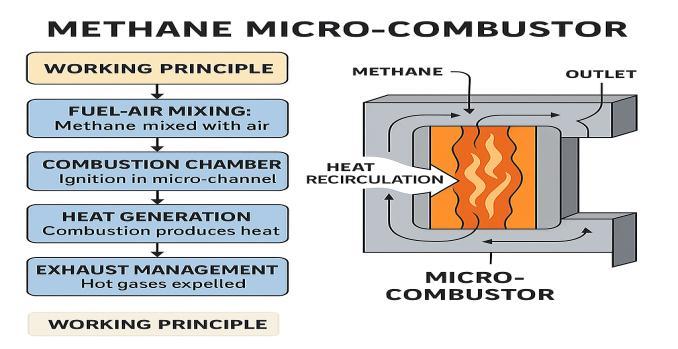
Figure1 shows Methane Micro-Combustor is a compact combustiondevicedesignedtoefficientlyburnmethanefuel at the microscale. These devices are critical in developing portable energy systems, offering high energy density in small volumes ideal for micro power generators, MEMS (Micro-Electro-Mechanical Systems), UAVs, and spacelimitedthermalapplications.
Theworkingprinciplebeginswiththefuel-airmixingstage, where methaneis blended withairtoform a combustible mixture. This mixture enters the combustion chamber, typically a micro-channel or cavity lined with hightemperature-resistantmaterials.Ignitionisachievedusing electricsparks,catalyticsurfaces,orpreheatingtechniques. Atthisscale,flamequenchingisachallengeduetoheatloss tochamberwalls,whichisminimizedbyadvancedthermal insulationandheatrecirculationstrategies.
Once ignition occurs, heat generation follows through exothermic reactions, releasing thermal energy. This heat can be harnessed directly for propulsion or indirectly via thermoelectric or micro-turbine systems to produce electricity.Anessentialdesignfeatureistheheatexchanger, whichrecyclespartoftheexhaustheattopreheatincoming gases,maintainingthermalefficiencyandflamestability.
Finally,exhaustgasesareexpelledthroughanoutlet.These gases can be utilized for secondary heating or expelled directly into the environment. The small scale of these devices necessitates precise control of flow rates, temperature,andfuel-airratios.
Materialsusedincludeceramics,silicon,andstainlesssteel duetotheirthermalresistance.Methanemicro-combustors offer an efficient, compact, and clean energy alternative, especiallyinapplicationswherebatteriesareinsufficientor impractical.
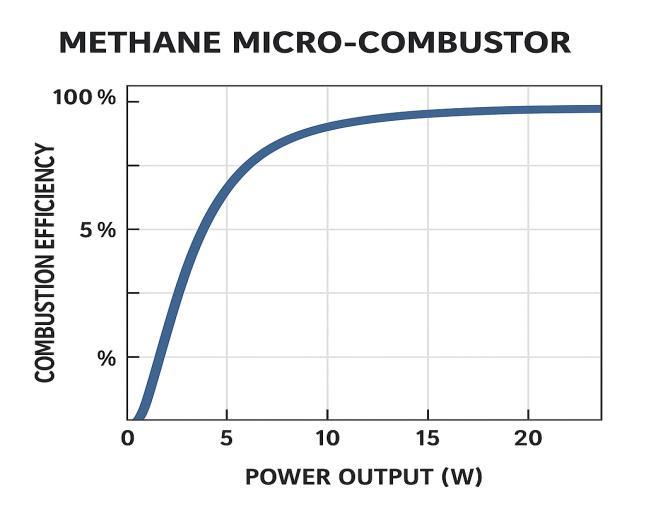
Figure2MethaneMicro-Combustorisacompactdevicethat burnsmethanetoproduceheatandpoweratamicroscale level. It operates by mixing methane with air, igniting the mixture in a micro combustion chamber, and converting chemical energy into thermal energy. This heat can then drive thermoelectric generators or micro-turbines for electricitygeneration.
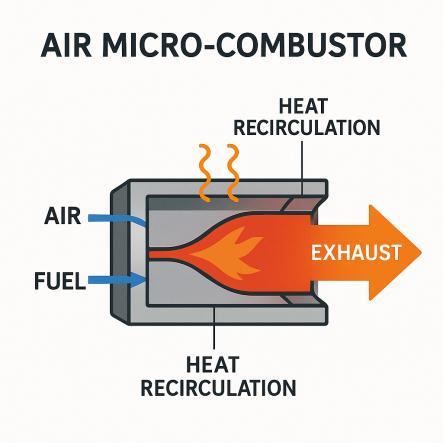
Figure 3 An Air Micro-Combustor is a compact thermal energyconversiondevicethatutilizesthecombustionofa fuel–air mixture to produce heat at a microscale. The provided diagram illustrates the fundamental working principle of this system. Air and fuel (such as methane, hydrogen, or propane) are introduced into the combustor throughseparateinlets.Thesetwocomponentsaremixed withinthecombustionchamber,whereignitioninitiatesthe combustionprocess.
The combustion chamber is carefully designed to support stableflamepropagationwhileminimizingheatloss,which is a major concern at small scales due to high surface-tovolumeratios.Heatrecirculationplaysacriticalrolehere: partoftheheatfromtheexhaustgasesisrecycledbackto preheattheincomingfuel–airmixture.Thisnotonlysustains combustion at lower temperatures but also significantly improves thermal efficiency and reduces the likelihood of flamequenching.
Thediagramclearlyshowstheflowdirectionfromleft(air andfuel input)toright(exhaustoutput),withexothermic reactiongeneratingheatinthecenter.Thehotcombustion gases are then expelled through the exhaust outlet, completingtheenergyconversioncycle.
Airmicro-combustorsareusedinmicropowergeneration systems,portableelectronics,drones,remotesensors,and military equipment, offering a lightweight and efficient energysolution.Theirabilitytooperateinremoteoroff-grid locations makes them highly valuable for modern, mobile
International Research Journal of Engineering and Technology (IRJET) e-ISSN: 2395-0056
Volume: 13 Issue: 01 | Jan 2026 www.irjet.net p-ISSN: 2395-0072
technologies.Additionally,advancedmaterialcoatingsand ceramic linings are often used to improve durability and performanceathightemperatures.
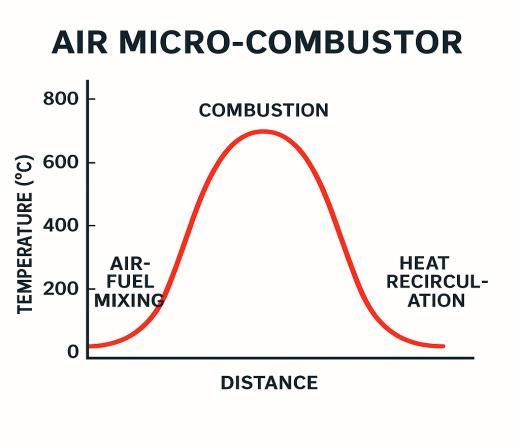
Figure4Thegraphillustratesthetemperatureprofilewithin anairmicro-combustoralongitslength.Onthex-axisisthe distance, while the y-axis represents temperature (°C). Initially,duringtheair-fuelmixingphase,thetemperatureis low. As the mixture enters the combustion zone, temperaturerapidlyincreases,peakingaround700°Cdueto theexothermicreaction.Beyondthecombustionzone,the temperature drops steadily as the heat is partially recirculatedandsomeislostthroughtheexhaust.Thisgraph highlightstheimportanceofthermalmanagementandheat recirculation in ensuring flame stability and improving overallefficiencyinmicro-scalecombustionsystems.
Methane micro-combustors represent a promising advancement in compact energy generation technology, offeringvariousfutureapplicationsacross industries.One significant area of development is in portable power systems, where these combustors can be paired with thermoelectric generators or micro-turbines to provide lightweight,long-lastingpowerformilitary,aerospace,and remotefieldoperations.
Theanalysisofmethaneandairmicro-combustorsreveals their efficiencyandpotential forcompactenergysystems. The methane micro-combustor demonstrates a wellstructuredworkingprinciple,beginningwithfuel-airmixing and leading to efficient combustion in micro-channels. Its performance graph shows that combustion efficiency increasessharplywithpoweroutput,reachingnear-optimal efficiency(~100%)ataround10–15W,makingitidealfor micro-powergeneration.Similarly,theairmicro-combustor designemphasizesheatrecirculation,stabilizingcombustion andenhancingthermalefficiency.Thetemperature-distance graph highlights a peak combustion temperature of over 700°C,indicatingeffectiveenergyreleaseduringoperation.
Both systems rely heavily on heat recirculation to sustain ignitionandminimizethermallosses.Thesefindingssupport micro-combustors' viability in portable devices, microturbines,andlow-powerenergyconversionsystems.Their compactness,thermalefficiency,andscalabilitypointtoward theirgrowingimportanceinfuturecleanenergyandmicroelectromechanical system(MEMS)applications,especially wherespaceandefficiencyarecritical.
1) C.Fernandez-Pello,“Micropowergenerationusing combustion: Issues and approaches,” Proc. Combust. Inst., vol. 29, no. 1, pp. 883–899, 2002.
2) Maruta, “Micro and mesoscale combustion,” Proc. Combust. Inst., vol. 33, no. 1, pp. 125–150,2011.
3) K. Maruta et al., “Development of micro-scale combustionformicropowergeneration,”Energy& Fuels,vol.19,no.5,pp.2104–2108,2005.
4)
5)
6)
7)
8)
9)
J. M. Turns, An Introduction to Combustion: Concepts and Applications, 3rd ed. McGraw-Hill, 2012.
H. Nakamura et al., “Flame quenching in narrow channels,”Combust.Flame,vol.152,no.3,pp.447–460,2008.
D.Dunn-Rankin,E.A.Walther,“Microcombustion: Technologies and applications,” Proc. Combust. Inst.,vol.30,no.2,pp.2005–2020,2005.
M. Yang et al., “Thermal performance of a micro combustorwithheatrecirculation,”Int.J.Hydrogen Energy,vol.37,pp.17072–17079,2012.
Z. Huang et al., “Heat recirculating microcombustorsforportablepower,”Appl.Energy,vol. 230,pp.996–1008,2018.
H.Lee,S.K.Choi,“Swiss-rollmicrocombustorsfor heatrecirculation,”Combust.Sci.Technol.,vol.185, no.5,pp.783–803,2013.
10)
Y. Ju, K. Maruta, “Microscale combustion: Technology development and fundamental research,”Prog.EnergyCombust.Sci.,vol.37,no.6, pp.669–715,2011.
11)
L. Sitzki, Y. Tang, F. Carleton, S. M. Gordon, F. A. Williams,“Combustioninmesoscaleburners,”Proc. Combust.Inst.,vol.29,pp.887–894,2002.
12)
S. Kaisare, D. G. Vlachos, “A review on microcombustion: Fundamentals, devices, and
International Research Journal of Engineering and Technology (IRJET) e-ISSN: 2395-0056
Volume: 13 Issue: 01 | Jan 2026 www.irjet.net p-ISSN: 2395-0072
applications,”Prog.EnergyCombust.Sci.,vol.38,no. 3,pp.321–359,2012.
13)
S. Tien, P. Ronney, “Quenching and flame stabilization in micro channels,” Combust. Flame, vol.156,no.6,pp.1192–1200,2009.
14)
Z.Li,M.Yang,“Flamestabilizationinmicroplanar combustors,”Energy,vol.95,pp.131–140,2016. 15)
N. Borer et al., “Flame repetitive extinction and ignitioninmicro-combustion,”Combust.Flame,vol. 158,pp.391–400,2011. 16)
P. Dong, X. Yao, “Effects of bluff body on lean premixed methane-air micro-combustion,” AIP Conf.Proc.,vol.2100,no.1,210001,2019.
17)
S.Ren,X.Li,“Numericalstudyofmicrocombustor withbluffbody,”Fuel,vol.288,p.119639,2021.
18)
G. M. Chigier, “Swiss-roll micro burner design,” Combust.Flame,vol.158,no.2,pp.467–475,2011. 19)
R.Miesseetal.,“Performanceanalysisofmethane microcombustors,”J.Micromech.Microeng.,vol.14, no.12,pp.1532–1540,2004.
20)
M. Fikri, “Wall temperature and efficiency in thermophotovoltaic micro-combustors,” Energy ConversionandManagement,vol.145,pp.45–52, 2017.
21)
H. Wei, J. Wang, “High power density micro combustor design,” Energy, vol. 196, p. 117066, 2020.
22)
D. Seo, Y. Ju, “Thermophotovoltaic micro power generation,”Appl.Phys.Lett.,vol.86,2005.
23)
A.H.Epstein,“Micro-gasturbineengines,”ASMEJ. Turbomach.,vol.124,no.1,pp.11–21,2002.
24)
J. S. Hsu, “Micro propulsion systems for small satellites,”AIAAJ.PropulsionPower,vol.20,no.5, pp.886–893,2004.
25)
T. Lieuwen, Unsteady Combustor Physics, CambridgeUniversityPress,2012.
26)
K. E. Niemeyer, “NOx emissions in micro-scale combustion,” Combust. Flame, vol. 159, pp. 275–290,2012.
27)
X.Zhang,D.G.Vlachos,“Largeeddysimulationof methanemicrocombustors,”Combust.Flame,vol. 160,pp.2336–2349,2013.
© 2025, IRJET | Impact Factor value: 8.315 | ISO