
International Research Journal of Engineering and Technology (IRJET) e-ISSN: 2395-0056
Volume: 12 Issue: 12 | Dec 2025 www.irjet.net p-ISSN: 2395-0072
International Research Journal of Engineering and Technology (IRJET) e-ISSN: 2395-0056
Volume: 12 Issue: 12 | Dec 2025 www.irjet.net p-ISSN: 2395-0072
Yash Kumar Patle¹, Yogesh Pawar², Vinay Patel³, Raj Patel´
¹Department of Artificial Intelligence & Machine Learning, Oriental Institute of Science And Technology, Bhopal, India
²Department of Artificial Intelligence & Machine Learning, Oriental Institute of Science And Technology, Bhopal, India
³Department of Artificial Intelligence & Machine Learning, Oriental Institute of Science And Technology, Bhopal, India
⁴Department of Artificial Intelligence & Machine Learning, Oriental Institute of Science And Technology, Bhopal, India
Guide: Prof. Akansha Meshram , Department of AIML, Oriental Institute of Science And Technology
Abstract - This paper presents a Meta Job Recommendation System that provides intelligent job recommendationsusingArtificialIntelligenceandsemantic similaritytechniques.Thesystemoperatesonpre-collected job datasets obtained from platforms such as LinkedIn, Indeed, Naukri, and Kaggle. Job descriptions and user preferencesarerepresentedusingsemantictextembeddings to capture contextual relationships beyond traditional keywordmatching.FacebookAISimilaritySearch(FAISS)is employed to efficiently perform similarity-based retrieval between user profiles and job embeddings. The proposed approachimprovesrecommendationrelevance,scalability, and personalization while maintaining computational efficiency.Thesystemissuitableforacademicandpractical applications, with future work focusing on real-time data integrationandadaptivelearningmechanisms.
Therapidexpansionofonlinerecruitmentplatformshasled to an exponential increase in the number of job opportunities available to job seekers. Popular platforms such as LinkedIn, Indeed, and Naukri host millions of job postingsacrossvariousindustriesanddomains.Whilethis growthhasimprovedaccesstoemploymentopportunities,it has also made the job search process complex and timeconsuming. Job seekers often face difficulty in identifying suitable roles that align with their skills, experience, and career preferences due to the overwhelming volume of availablelistings.
Traditional job search and recommendation systems primarilyrelyonkeyword-basedfilteringtechniques.These approaches are limited in their ability to understand the semanticmeaningofjobdescriptionsandcandidateprofiles. Small variations in terminology, synonyms, or contextual differences can result in relevant job opportunities being missed or irrelevant jobs being recommended. Consequently,keyword-basedsystemsoftenfailtoprovide
accurate and personalized recommendations, leading to reducedusersatisfaction.
Toovercometheselimitations,thispaperproposesaMeta JobRecommendationSystembasedonArtificialIntelligence andsemanticsimilaritytechniques.Thesystemoperateson pre-collectedjobdatasetsobtainedfromplatformssuchas LinkedIn, Indeed, Naukri, and Kaggle. Semantic text embeddingsaregeneratedtorepresentjobdescriptionsand user preferences in a high-dimensional vector space, enabling contextual understanding of skills and requirements. Facebook AI Similarity Search (FAISS) is utilizedtoefficientlyperformsimilaritymatchingbetween job embeddings and user profiles. The proposed system enhances recommendation accuracy, scalability, and personalization while remaining suitable for academic evaluation.Futureworkincludesintegratingreal-timejob dataextractionandadaptivelearningmechanismstofurther improvesystemperformance.
Withtheincreasingdigitizationofrecruitmentprocesses, online job portals have become the primary medium for connecting job seekers and employers. Platforms such as LinkedIn, Indeed, and Naukri continuously generate vast amountsofjob-relateddataintheformofjobdescriptions, skill requirements, and role specifications. While this abundance of data provides opportunities, it also creates challenges in efficiently matching suitable candidates with relevantjobopenings.
Most existing job recommendation systems rely on traditionalinformationretrievaltechniques,suchaskeyword matchingandrule-basedfiltering.Thesesystemsoftenfailto understandthecontextualmeaningofjobdescriptionsand user skills, resulting in inaccurate or irrelevant recommendations.Forexample,candidateswithsimilarskill setsbutdifferentterminologymaynotreceiveappropriate jobsuggestionsduetorigidkeywordconstraints.
International Research Journal of Engineering and Technology (IRJET) e-ISSN: 2395-0056
Volume: 12 Issue: 12 | Dec 2025 www.irjet.net p-ISSN: 2395-0072
The motivation behind this work is to address these limitations by applying Artificial Intelligenceand semantic similaritytechniquestojobrecommendation.Byleveraging semanticembeddings,textualjobdatacanberepresentedin a meaningful numerical form that captures contextual relationships.Thisallowsthesystemtoidentifyrelevantjob opportunities even when exact keyword matches are not present.TheuseofFAISSfurtherenablesefficientsimilarity search over large datasets, making the recommendation process scalable and practical. This approach aims to improve recommendation accuracy, enhance user experience,andprovidearobustfoundationforintelligent jobmatchingsystems.
Despite the availability of large volumes of job data on onlinerecruitmentplatforms,existingjobrecommendation systems often fail to deliver accurate and personalized results. Most systems rely on keyword-based matching techniques,whicharelimitedintheirabilitytounderstand the semantic relationship between job requirements and candidate skills. This results in irrelevant job recommendationsandincreasestheeffortrequiredbyusers to manually filter suitable opportunities. Additionally, job dataistypicallyscatteredacrossmultipleplatformssuchas LinkedIn,Indeed,andNaukri,makingitdifficulttoanalyze and utilize effectively. Therefore, there is a need for an intelligentjobrecommendationsystemthatcanoperateon aggregated datasets and leverage semantic similarity techniques to provide relevant, accurate, and scalable job recommendationsbasedonuserskillsandpreferences.
Jobrecommendationsystemshavebeenwidelystudiedinthe fields of information retrieval and machinelearning. Early approaches primarily relied on rule-based and keywordmatching techniques, where job recommendations were generatedbasedonexactmatchesbetweenuserqueriesand job descriptions. Although simple to implement, these methodsoftenfailedtocapturecontextualsimilaritiesand resultedinirrelevantrecommendations.
RecentresearchhasfocusedonapplyingNaturalLanguage Processing (NLP) and machine learning techniques to improverecommendationaccuracy.TechniquessuchasTFIDF, Word2Vec, and other embedding-based models have beenusedtorepresenttextual jobdatainnumerical form. These methods allow systems to capture semantic relationshipsbetweenjobdescriptionsandcandidateskills, leadingtomorerelevantrecommendations.
Several studies have also explored similarity-based recommendation methods using vector space models and distancemetrics.FacebookAISimilaritySearch(FAISS)has beenwidelyadoptedforefficientnearest-neighborsearchin large-scale datasets due to its high performance and
scalability.However,manyexistingsystemsfocusonsingleplatformdataandlackeffectiveaggregationmechanisms.
Theliteratureindicatesthatcombiningjobaggregationwith semanticsimilarity-basedrecommendationcansignificantly enhancesystemeffectiveness.Thisworkbuildsuponexisting research by integrating pre-collected job datasets from multipleplatformsandapplyingsemanticembeddingswith FAISStoprovidescalableandaccuratejobrecommendations suitableforacademicandpracticalapplications.
The proposed Meta Job Recommendation System was implemented using Python-based machine learning techniques and a web-based architecture. Multiple job datasetswerecollectedfrompubliclyavailablesourcessuch asKaggle,includingjoblistingsfromplatformslikeLinkedIn, Indeed,andUpwork.
Thedatasetconsistsofjobtitles,jobdescriptions,required skills,andotherrelevantattributes.MultipleCSVfileswere merged and processed to create a unified dataset for experimentation.
[2]
Thecollecteddatawaspreprocessedtoremovemissingand duplicate entries. Text preprocessing techniques such as lowercasing,removalofstopwords,andtokenizationwere applied to job descriptions and skill sets to ensure consistency.
TF-IDF vectorization and precomputed embeddings were usedtoconverttextualjobdescriptionsanduserskillsinto numericalrepresentations.Cosinesimilaritywasappliedto measure semantic similarity between user skills and job descriptions. A FAISS index was used to improve retrieval efficiencyforlargedatasets.
The backend of the system was developed using FastAPI, which exposes RESTful APIs for job recommendation. The backendloadstheprecomputedembeddingsandsimilarity indextogeneraterankedjobrecommendations.Thefrontend was developed using Next.js, providing a user-friendly interfaceforskillinputandresultvisualization.Thebackend servicewasexecutedusingthe Uvicorn server.
International Research Journal of Engineering and Technology (IRJET) e-ISSN: 2395-0056
Volume: 12 Issue: 12 | Dec 2025 www.irjet.net p-ISSN: 2395-0072
5.1
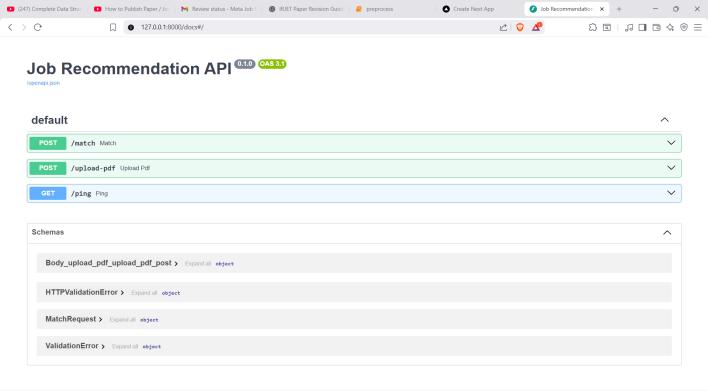
The system was tested by providing a set of user skills as inputthroughthebackendAPIandfrontendinterface.The APIexecutionwasverifiedusingFastAPI’sbuilt-inSwagger UI.
For an input such as “Python, Machine Learning, Data Analysis”, the system generated the following top job recommendations:
3. This is Processing phase of the text where model extract the key features like what are thir skills to recommend the job.
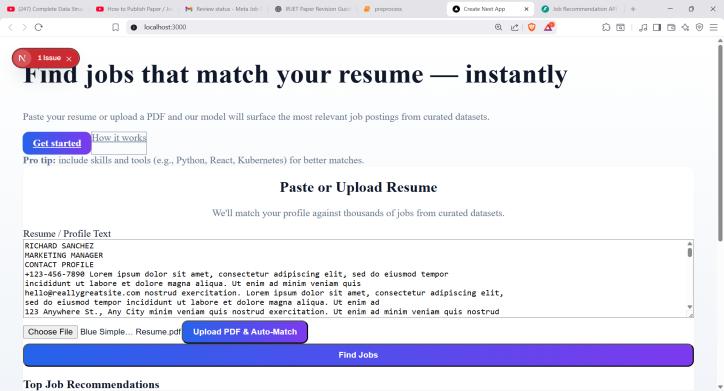
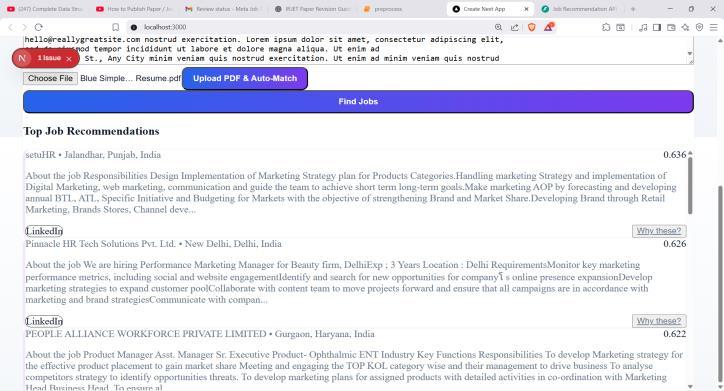
4. This is the Main Output Phase Where you see the best fit jobs and platform as well as why its best for you and how much compatable you are .
1. This is my UI which Help to interact with the users and connected with backend to recommend the job and platform.
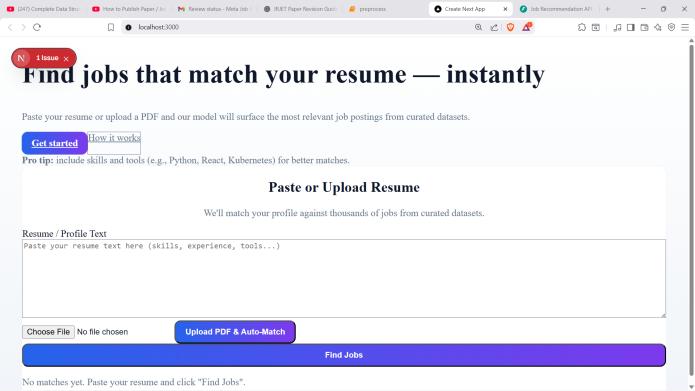
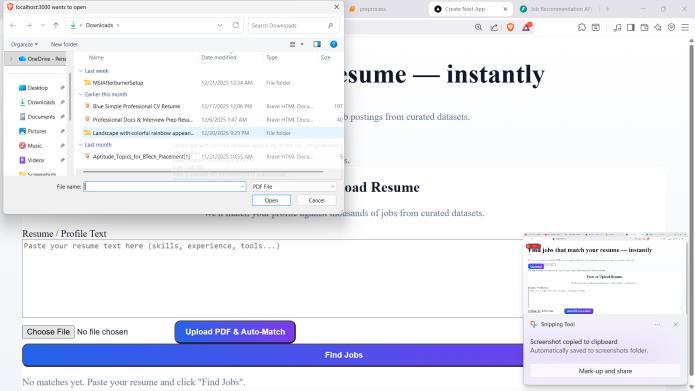
2. This is Input Phase where you can select the resume for job recommendations .
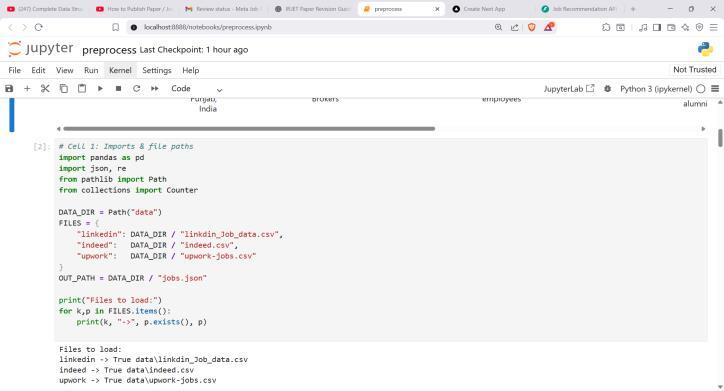
5. This is the model training phase where I preprocess the datasets in jupyter notebook.
International Research Journal of Engineering and Technology (IRJET) e-ISSN: 2395-0056
Volume: 12 Issue: 12 | Dec 2025 www.irjet.net p-ISSN: 2395-0072
6. This screenshot showing that backend is running perfectly without any Errors.
ThispaperpresentedaMetaJobRecommendationSystem thatleveragesArtificialIntelligenceandsemanticsimilarity techniques to provide accurate and personalized job recommendations. By utilizing pre-collected job datasets fromplatformssuchasLinkedIn,Indeed,Naukri,andKaggle, the system effectively aggregates job information and overcomesthelimitationsoftraditionalkeyword-basedjob search methods. Semantic embeddings were used to representjobdescriptionsanduserpreferences,whileFAISS enabledefficientandscalablesimilarity-basedretrieval.The proposed approach improves recommendation relevance, scalability,andoverall user experience, makingitsuitable foracademicandpracticalapplications.
Althoughthecurrentimplementationoperatesonstructured andpre-collecteddatasets,itdemonstratestheeffectiveness of semantic similarity in job recommendation systems. Future work includes integrating real-time job data extraction from online platforms, incorporating advanced transformer-based embedding models, and implementing userfeedbackmechanismstoenableadaptiveanddynamic learning. These enhancements can further improve recommendationaccuracyandsystemperformanceinrealworlddeploymentscenarios.
Wewouldliketoexpressoursinceregratitudetoourproject guidefortheirvaluableguidance,continuoussupport,and constructivefeedbackthroughoutthedevelopmentofthis projectandthepreparationofthisresearchpaper.Wealso extendourthankstothefacultymembersoftheDepartment of Artificial Intelligence and Machine Learning, Oriental InstituteofScienceAndTechnology,Bhopal,forproviding thenecessaryresourcesandencouragement.Finally,weare thankfultoourpeersandallthosewhodirectlyorindirectly contributedtothesuccessfulcompletionofthiswork.
[1] R. Burke, “Hybrid Recommender Systems: Survey and Experiments,”UserModelingandUser-AdaptedInteraction, 2002.
[2]J.Devlin,M.Chang,K.Lee,andK.Toutanova,“BERT:Pretraining of Deep Bidirectional Transformers for Language Understanding,”arXivpreprintarXiv:1810.04805,2018.
[3]J.Johnson,M.Douze,andH.Jégou,“Billion-scalesimilarity searchwithFAISS,”IEEETransactionsonBigData,2019
[4] T. Mikolov, K. Chen, G. Corrado, and J. Dean, “Efficient EstimationofWordRepresentationsinVectorSpace,”arXiv preprintarXiv:1301.3781,2013.
[5]X.AmatriainandJ.Basilico,“RecommenderSystemsin Industry: A Netflix Case Study,” ACM Conference on RecommenderSystems,2012.
[6] Kaggle, “Public Job Listings Datasets,” Available: https://www.kaggle.com
[7] LinkedIn, “Job Listings and Skills Data,” Available: https://www.linkedin.com
[8] Indeed, “Job Search and Recruitment Platform,” Available:https://www.indeed.com