
International Research Journal of Engineering and Technology (IRJET) e-ISSN: 2395-0056
Volume: 13 Issue: 04 | Apr 2026 www.irjet.net p-ISSN: 2395-0072

International Research Journal of Engineering and Technology (IRJET) e-ISSN: 2395-0056
Volume: 13 Issue: 04 | Apr 2026 www.irjet.net p-ISSN: 2395-0072
1G Swapna Rani, Sr Assistant Professor, Computer Science and Engineering,Geethanjali College of Engineering and Technology Hyderabad, Telangana, India
2Sharanya Chakrabarti, UG Student, Computer Science and Engineering, Geethanjali College of Engineering and Technology Hyderabad, Telangana, India
3D Harika, UG Student, Computer Science and Engineering, Geethanjali College of Engineering and Technology Hyderabad, Telangana, India
4N Abhishek, UG Student, Computer Science and Engineering, Geethanjali College of Engineering and Technology Hyderabad, Telangana, India ***
Abstract—Healthcare systems require intelligent tools for early detection of patient deterioration and effective clinical decision-making. This paper presents MediScope, a web-based AI-assisted health monitoring and disease risk prediction platform. The system integrates patient and doctor management, electronic health record storage, machine learning-based prediction, and interactive dashboards. MediScope is developed using Flask, SQLite, SQLAlchemy, and frontend technologies such as HTML and JavaScript. A Random Forest model is trained to predict patient progression toward critical conditions based on vital signs and symptoms. The platform provides secure rolebased access, real-time prediction, and user-friendly dashboards. MediScope is lightweight, scalable, and designed for accessibility, making it suitable for nontechnical users and clinical environments.
Keywords Health Monitoring, Disease Risk Prediction, Flask, SQLite, Random Forest, Clinical Dashboard, PatientDoctorSystem,ExplainableAI.
Global Healthcare systems face increasing challenges due to the rising burden of chronic diseases and limited availability of clinical resources. Early identification of patient deterioration is critical to improving treatment outcomes and reducing mortality rates. Traditional healthcare dashboards often lack integration with predictiveanalyticsandfailtoprovidereal-timeinsights.
Recent advancements in Artificial Intelligence (AI) and Machine Learning (ML) have enabled predictive modeling using patient health records. However, many existing systems are either complex to deploy or limited to research purposes. There is a need for an accessible, integrated platform that combines patient data managementandpredictiveanalytics.
To address these challenges, this paper introduces MediScope, an AI-based health monitoring system that
integrates secure authentication, patient record storage, and machine learning prediction within a single web application. The system enables doctors and patients to interact with clinical data efficiently and supports early riskdetection.
Several Early healthcare analytics systems relied on statisticalmethodsandmanualclinicalscoringtechniques. These approachesoftenlackedscalabilityandadaptability to large datasets. With the evolution of machine learning, models such as Random Forest, Support Vector Machines, and Neural Networks have demonstrated improved predictionaccuracyinhealthcareapplications.
Recent research also highlights the importance of interactive dashboards for visualizing patient data and enabling decision-making. Explainable AI techniques such asSHAPhavebeenintroducedtoimprovetransparencyin predictivemodels.
Despitetheseadvancements,manyexistingsystemseither focus only on prediction or only on visualization. MediScope bridges this gap by integrating data management, prediction, and visualization into a unified platformthatiseasytodeployanduse.
A.
MediScope is a complete AI-driven web platform designed for smart health monitoring and disease risk prediction through automated data processing, predictive modeling,andinteractivevisualization.Thesystemfollows a modulararchitectureconsistingoffrontend, backend, AI analyticsengine,anddatabaselayers.
MediScope enables efficient healthcare analysis by integratingpatientdatacollection,machinelearning-based prediction, and real-time dashboard visualization. The platform is structured to provide seamless interaction
International Research Journal of Engineering and Technology (IRJET) e-ISSN: 2395-0056
Volume: 13 Issue: 04 | Apr 2026 www.irjet.net p-ISSN: 2395-0072
betweenusersandthesystemwhileensuringaccessibility andeaseofuseforbothdoctorsandpatients.
B. System Architecture
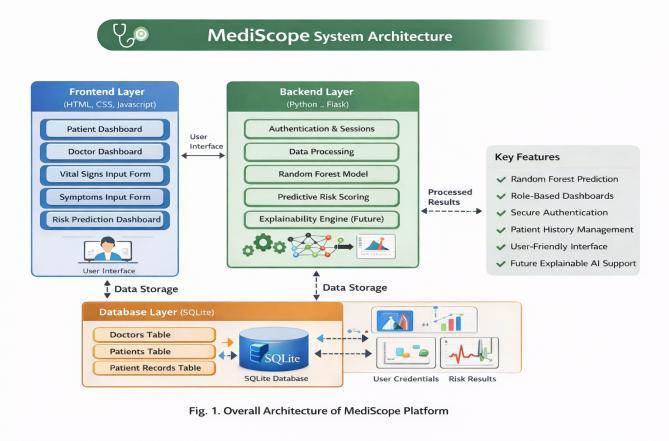
As shown in Fig. 1, the overall architecture of the MediScope platform integrates patient data input, preprocessing, Random Forest-based disease risk prediction,andfutureexplainabilitysupportintoaunified AI-drivenpipeline.
The backend manages data processing, model execution, prediction generation, and API communication. The frontend provides interactive dashboards, patient forms, and visualization panels for users. The SQLite database stores patient records, user credentials, and prediction results, ensuring efficient data retrieval and management.
A. Data Collectionand Datasets
The system uses an electronic health record dataset (ehr_data.csv)containing:
• Bloodpressure
• Heartrate
• Respiratoryrate
• Temperature
• Oxygensaturation
• Medicationadherence
• Symptomseverity
• Criticalconditionlabels
B. Data Preprocessing
Thepreprocessingpipelineincludes:
• DataloadingfromCSV
• Featureselection
• DatascalingusingStandardScaler
• Train-testsplitting
This Pipeline helps the platform use different datasets withoutneedingmanualsetup.
C. Machine Learning Model (INFO + Optimized ELM)
The main prediction engine in MediScope uses a Random Forest classifier for disease risk prediction. The model is trained on patient health data, including vital signs and symptom-related features. Random Forest is chosen for its high accuracy, robustness, and ability to handlecomplexhealthcaredatasets.
The model processes input features such as heart rate, blood pressure, oxygen levels, and symptom severity to predict whether a patient is likely to progress toward a critical condition. The trained model is stored and loaded duringruntimeusingjoblibforefficientinference.
Model performance is evaluated using standard metrics such as accuracy, precision, recall, and F1-score, ensuringreliableandconsistentpredictionresults.
D. Explainable AI using SHAP
To improve transparency and trust in predictions, MediScope supports Explainable AI using SHAP (SHapley Additive Explanations). SHAP helps interpret how each inputfeaturecontributestothepredictionoutcome.
SHAP visualizations such as feature importance plots and contribution graphs enable users and doctors to understand how vital parameters like heart rate, oxygen saturation,andsymptomseverityinfluenceriskprediction. This enhances decision-making and increases system reliability.
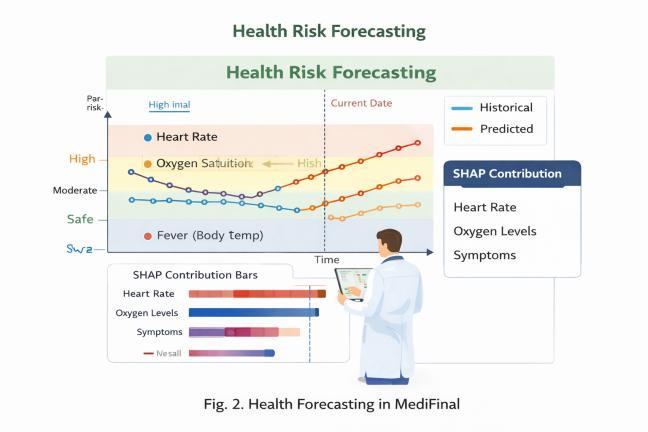
TheforecastingmoduleinMediScopeanalyzeshistorical patient health data to identify trends and predict future health risks. Using time-series learning techniques, the systemcanestimate howa patient’s conditionmay evolve overtime.
Themoduleenablestrackingofpatienthealthprogression and supports early intervention by predicting potential deterioration. This feature is especially useful for continuousmonitoringandpreventivehealthcare.
As shown in Fig. 2, the forecasting engine analyzes past patient records and generates future risk trends, helping doctors make proactive clinical decisions and improving patientoutcomes
International Research Journal of Engineering and Technology (IRJET) e-ISSN: 2395-0056
Volume: 13 Issue: 04 | Apr 2026 www.irjet.net p-ISSN: 2395-0072
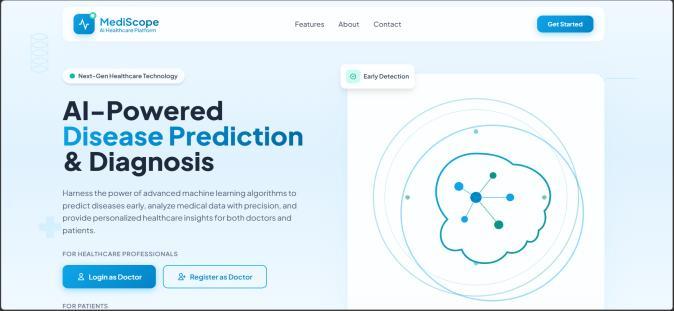
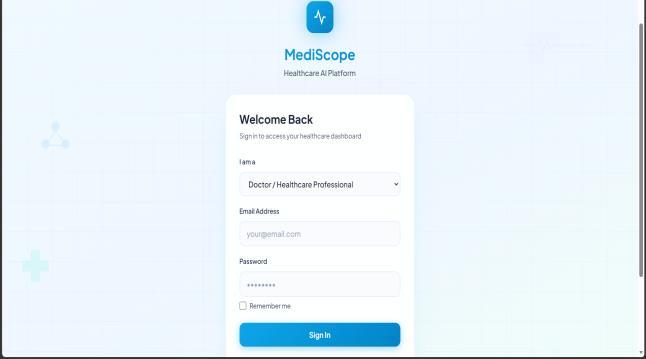
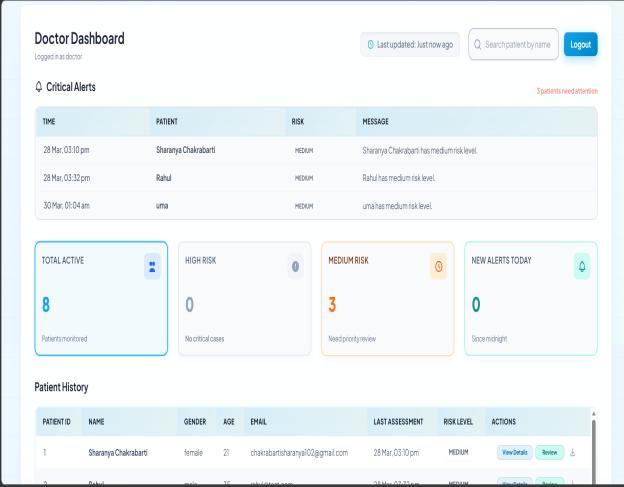
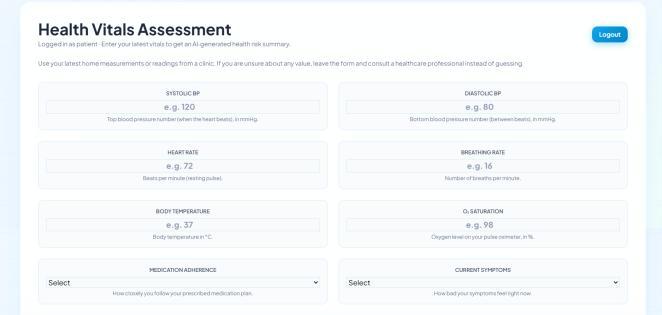
ThefrontendinterfaceofMediScopeisbuiltusingHTML, CSS, and JavaScript. It provides an interactive and userfriendly environment for both patients and doctors. The system includes multiple interfaces such as the main dashboard, login pages, and dedicated dashboards for users.
The interface allows users to register, log in, and interact with the system by entering health data and viewing prediction results. The design focuses on simplicity, accessibility,andsmoothnavigation.
As shown in Fig. 3, the MediScope user interface includes the main dashboard, doctor and patient login pages, and their respective dashboards, providing a complete and seamlessuserexperience.
B. Backend Processing Module
The backend of MediScope is developed using Flask. It handles user authentication, session management, data preprocessing, and communication between frontend and database. It also manages model execution and ensures efficientsystemperformance.
C. AI Analytics Module
The AI analytics module integrates the Random Forest model for disease risk prediction. It processes patient health data, performs preprocessing, and generates prediction results. This module forms the core intelligence of the system and supports future enhancements like explainableAI.
D. Database Module
SQLitedatabaseisusedtostoreusercredentials,patient records, prediction results, and session data. This ensures lightweight, secure, and efficient storage of all system information.
A. Dashboard Analysis
The MediScope provides an interactive dashboard that displays patienthealthinformationandpredictionresults. The dashboard updates dynamically based on user inputs andstoreddata.
International Research Journal of Engineering and Technology (IRJET) e-ISSN: 2395-0056
Volume: 13 Issue: 04 | Apr 2026 www.irjet.net p-ISSN: 2395-0072
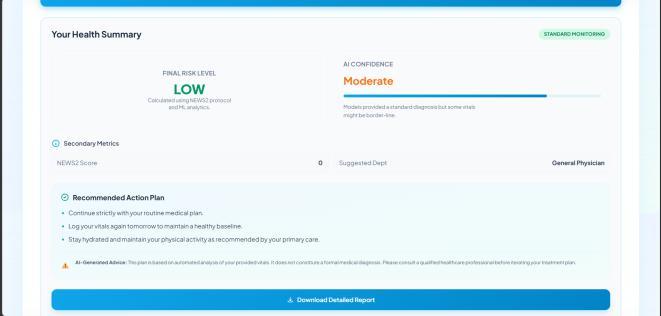
As shown in Fig. 4, the patient results dashboard presents disease risk prediction clearly, helping users understandhealthconditionseffectively.
B. Predictionand Model Performance
The Random Forest model used in MediScope provides accurate and reliable predictions. The model is evaluated using metrics such as accuracy, precision, recall, and F1score.
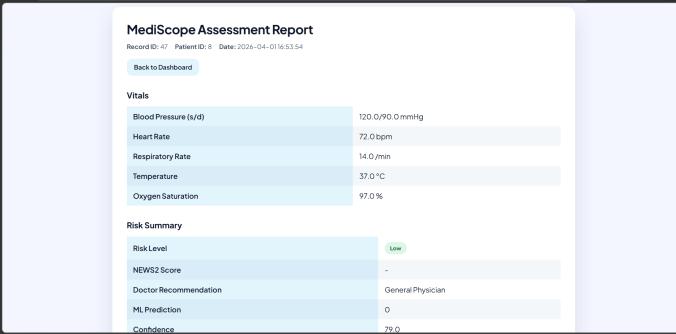
5. Predicted Disease RiskUsing Random Forest Model
C. Visualizationand Explainability
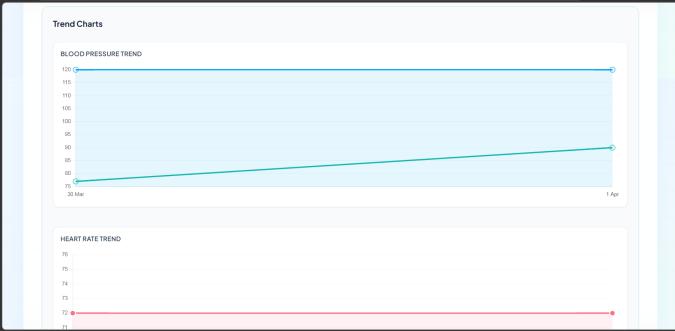
The system generates visual outputs such as prediction graphs, health trends, and feature analysis. These visualizations improve understanding and support better decision-making.
D. System Efficiency and Usability
and PredictionAnalysis
MediScope is lightweight and efficient, capable of running on standard systems. The web-based interface ensures easy accessibility and usability for both patients andhealthcareprofessionals.
This paper introduced MediScope, a web-based AIdriven healthcare platform for disease risk prediction and health monitoring. The system integrates data preprocessing, machine learning, and interactive dashboards into a single unified application. By utilizing a Random Forest model, MediScope effectively predicts the likelihood of patients progressing toward critical health conditionsbasedonvitalsignsandsymptomdata.
Experimental results demonstrate that the system provides reliable prediction performance and meaningful health insights. The platform is lightweight, scalable, and user-friendly, making it suitable for both patients and healthcare professionals. MediScope highlights the potential of AI in improving clinical decision-making and enablingproactivehealthcaremonitoring.
Future enhancements of MediScope may include the integration of real-time health monitoring using wearable IoT devices, advanced deep learning models for improved prediction accuracy, and cloud-based deployment for large-scalehealthcareapplications.
Additional features such as real-time alerts, personalized health recommendations, multilingual support, and explainable AI (SHAP) for better interpretation of predictionscanfurtherenhancethesystem’susabilityand effectivenessinmodernhealthcareenvironments.
TABLE I. PROJECT MODULES AND DESCRIPTION
Project Module Description
UserInterface Handlesdashboards,login,anduser interaction
Preprocessing Module Datacleaning,normalizationand featureselection
AIPrediction Module RandomForest-baseddiseaserisk prediction
Explainability Module SHAP-basedinterpretation
Forecasting Module Futurehealthtrendprediction
DatabaseModule SQLitestorageforusersandpatients records
TABLE II. TECHNOLOGY STACK
Component Technology
Frontend HTML,CSS,JavaScript
Backend FastAPI(Python)
Database SQLite
DataProcessing Pandas,NumPy
Visualization Matplotlib
ExplainableAI SHAP
MachineLearning RandomForest(Scikit-learn)
International Research Journal of Engineering and Technology (IRJET) e-ISSN: 2395-0056
Volume: 13 Issue: 04 | Apr 2026 www.irjet.net p-ISSN: 2395-0072
TABLE III. TEAM CONTRIBUTION
Team
Member Contribution
MemberI AI Model Development, Data Preprocessing, and Prediction Module Implementation
MemberII Frontend Development and Documentation
MemberIII Backend Support, Database Management,Testing
The authors would like to thank Geethanjali College of Engineering and Technology for providing the academic environment and resources that supported this research work.
Theauthorsexpresstheirsincereappreciationto M for her valuable guidance, constructive feedback, and continuous support throughout the development of the Project.
The authors also acknowledge the support of the Department of Computer Science and Engineering for facilitatingthesuccessfulcompletionofthiswork.
[1] J. Smith et al., “Machine learning-based clinical risk prediction using electronic health records,” Journal of Medical Systems,2024.
[2] A. Kumar and S. Reddy, “AI-driven health monitoring systems for early disease detection,” IEEE Access, 2024.
[3] L. Chen et al., “Random Forest-based predictive analytics for patient health monitoring,” Healthcare Analytics,2025.
[4] P. Sharma and R. Gupta, “Predictive modeling in healthcare using machine learning techniques,” International Journal of Health Informatics,2024.
[5] M. Rahman et al., “Explainable AI for clinical decision support using SHAP,” Applied Artificial Intelligence in Healthcare,2025.
[6] S. Patel and K. Verma, “Efficient disease prediction using ensemble learning methods,” IEEE Transactions onBiomedical Engineering,2024.
[7] D. Lee et al., “Web-based healthcare dashboards for real-time patient monitoring,” Journal of Healthcare Engineering,2025.
[8] R. Singh et al., “Integration of AI and electronic health records for predictive healthcare systems,” Computers in Biology and Medicine,2024.
[9] H.ZhangandY.Liu,“Time-seriesforecastingofpatient healthdatausingmachinelearning,” Biomedical Signal Processing and Control,2025.
[10] K.Nairetal.,“Scalablehealthcareanalyticsusingcloud and AI technologies,” Future Generation Computer Systems,2024.
[11] V. Rao and P. Mehta, “Intelligent clinical decision support systems using machine learning,” Health Informatics Journal,2025.
[12] S. Das et al., “Explainable artificial intelligence in healthcare monitoring systems,” IEEE Reviews in Biomedical Engineering,2024.
[13] M. Ali et al., “Data-driven healthcare prediction using AI and big data analytics,” Journal of Biomedical Informatics,2025.
[14] World Health Organization (WHO), “Artificial Intelligence in Healthcare: Policy and Implementation,”2024.