
International Research Journal of Engineering and Technology (IRJET) e-ISSN:2395-0056
Volume: 13 Issue: 02 | Feb 2026 www.irjet.net p-ISSN:2395-0072
International Research Journal of Engineering and Technology (IRJET) e-ISSN:2395-0056
Volume: 13 Issue: 02 | Feb 2026 www.irjet.net p-ISSN:2395-0072
Ziauddin Mahmood1, Syed Mohiuddin Jeelani Jaffri2, Saniya Abdul Wasay3, Zoya Sohail4,Mohammed Asif5
¹ Student, Dept. of CSE-DS, Lords Institute of Engineering and Technology, Telangana, India,
² Student, Dept. of CSE-DS, Lords Institute of Engineering and Technology, Telangana, India,
³ Student, Dept. of CSE-DS, Lords Institute of Engineering and Technology, Telangana, India
⁴ Student, Dept. of CSE-DS, Lords Institute of Engineering and Technology, Telangana, India
⁵ Assistant Professor, Dept. of CSE-DS, Lords Institute of Engineering and Technology, Telangana, India ***
Abstract - Unstructured medical documents, such as handwritten prescriptions and laboratory reports, continue to create barriers to safe and informed healthcare delivery. Illegible handwriting, inconsistent formatting, and abbreviated clinical terminology frequently result in patient misunderstandings and medication-related risks. This study presents MEDEXA, a cloud-based intelligent healthcare platform that transforms raw medical images into structured, patientfriendly interpretations using a layered Artificial Intelligenceframework.
The proposed system employs a multistage image enhancement pipeline combined with a three-engine OpticalCharacterRecognition(OCR)strategytomaximize textextractionreliability.Aquantitativescoringalgorithm evaluates candidate outputs across multiple quality dimensions to select the most accurate representation of document content. The extracted text was subsequently processed using a large language model (LLaMA 3.1-8B) configured with domain-aware prompts to expand abbreviations, normalize corrupted tokens, interpret laboratory values against reference standards, and generatestructuredJSONoutputsforclinicalreadability.
The platform was implemented using a modern full-stack architecture comprising a Next.js frontend, Node.js backend services, and MongoDB cloud storage, with secure deployment across a distributed cloud infrastructure. Evaluation on a dataset of 200 real-world medical documents demonstrates that the ensemble OCR strategy achieves up to 99.1% accuracy for printed text and 94.8% for handwritten prescriptions while maintainingpracticalprocessinglatency.
By integrating multi-engine OCR, intelligent output selection, and AI-driven semantic interpretation within a production-deployed system, MEDEXA provides an endto-end solution for automated medical document understandingandenhancedpatientaccessibility.
Key Words: Medical OCR, Healthcare AI, Prescription Analysis, Laboratory Report Interpretation, Multi-Engine OCR, Natural Language Processing, LLaMA, Google Cloud Vision, Patient Safety.
Clinicaldocumentationremainsoneofthemostpersistent friction points in healthcare delivery. Despite the rapid digitizationofhospitalsystems,asignificantproportionof outpatient prescriptions and diagnostic reports are still issued in handwritten or semi-structured formats. These documents often contain abbreviated terminology, nonstandardized notation, overlapping handwriting strokes, and layout inconsistencies that complicate their accurate interpretation. For patients without medical training, understanding dosage schedules, laboratory parameter deviations, or follow-up instructions can become unnecessarilydifficult.
Medication-related errors and delayed clinical responses frequentlyoriginatenotfromincorrectdiagnosesbutfrom miscommunication and document misinterpretation. Handwritten prescriptions may include frequency abbreviations (e.g., BD, TDS, OD) and shorthand drug names that require contextual knowledge. While laboratory reports are numerically precise, they require comparison with reference ranges and clinical reasoning to determine the clinical significance of a value. Thus, the gap between raw medical documentation and patient comprehension remains largely unaddressed at the individualuserlevel.
Existing technological solutions tend to operate at two extremes: Institutional electronic health record systems provide structured data management but are costly, infrastructure-dependent, and not universally accessible inoutpatientorresource-constrainedsettings.Conversely, general-purpose conversational AI systems lack the structured extraction mechanisms required for reliable parsing of medical documents.Most research efforts have focused on improving isolated components, such as
International Research Journal of Engineering and Technology (IRJET) e-ISSN:2395-0056
Volume: 13 Issue: 02 | Feb 2026 www.irjet.net p-ISSN:2395-0072
handwriting recognition or clinical entity extraction, without delivering an integrated, production-ready platform that performs an end-to-end transformation fromimagecapturetopatient-readableinsight.
Theincreasingadoptionoftelemedicineandself-managed healthmonitoringfurtheramplifiestheneedforaccessible document-interpretation tools. As patients take greater responsibility for tracking prescriptions and laboratory parameters between consultations, the demand for automated systems capable of converting unstructured medical images into structured, intelligible summaries is growing.
Toaddressthis need, this studypresentsMEDEXA, an AIdriven healthcare platform that integrates multi-engine OCR,quality-basedoutputselection,largelanguagemodel interpretation, and secure cloud deployment within a unified architecture. Unlike prior approaches that focus solely on recognition accuracy, MEDEXA emphasizes fullpipeline clinical usability by combining extraction reliability, semantic interpretation, structured output generationandpatient-facingaccessibility.
Manual interpretation of prescriptions and laboratory reports often leads to confusion due to unclear handwriting, abbreviations such as BD, TDS, and OD, and complex lab parameter ranges. Single-layer OCR systems frequently fail to accurately recognize handwritten medical data. Therefore, there is a need for a robust system capable of multilayer extraction and structured medicalinterpretation.
Optical Character Recognition (OCR) has long been used fordigitizingprintedtext;however,medicalprescriptions introduce additional challenges owing to cursive handwriting, non-standard abbreviations, overlapping strokes, and inconsistent formatting. Traditional rulebased and template-driven OCR systems often struggle when confronted with stylistically diverse physician handwritingorlow-qualitymobileimages.
Recent research has focused on improving robustness using preprocessing strategies and deep learning-based recognition. Image enhancement techniques, such as contrast normalization, binarization, denoising, and resolution scaling, have been shown to significantly improve recognition accuracy in handwritten medical contexts. Meanwhile, convolutional neural networks (CNNs), recurrent neural networks (RNNs), and hybrid CNN–BiLSTM architectures have been applied to capture both local stroke features and sequential dependencies in
the prescription text. Transformer-based OCR models furtherextendthiscapabilitybyjointlylearningvisualand textual representations, thereby enabling improved generalizationacrossvarioushandwritingstyles.
Despite measurable improvements in handwriting recognition accuracy, most existing approaches evaluate performance on controlled datasets and do not address the variability introduced by real-world smartphone photography, inconsistent lighting, and document compression. Moreover, many systems rely on a single OCR engine, limiting their adaptability when recognition confidencedegradesunderspecificconditions.
Theeffectiveinterpretationofmedicaldocumentsextends beyond accurate character extraction and requires semantic modeling tailored to the clinical domain. Laboratory reports, for instance, combine structured tabular layouts with domain-specific terminology, necessitating approaches that jointly analyze the visual layoutandtextualcontent.Deeplearningframeworksthat integrate layout-aware detection with text recognition have demonstrated that structured report regions can be parsed with high reliability when spatial and linguistic representationsarelearnedsimultaneously[9][12].
In parallel, neural approaches to medical Named Entity Recognition(NER)haveenabled thepreciseidentification of clinically relevant entities, such as medications, dosage expressions,andtemporalindicators[10].Thesemethods highlighttheimportanceofcontextualsequencemodeling in resolving ambiguity in abbreviated or irregular clinical phrasing.Broader investigationsinto medical information extraction further emphasize persistent challenges, includinginconsistentformatting,shorthandnotation,and vocabulary gaps between clinical language and generalpurposecorpora[11].
Additionally, advancements in convolutional neural networksforhandwrittendigitrecognitionhaveimproved the accuracy of numerical value extraction, which is a criticalcomponentoflaboratoryreportinterpretation[13]. Collectively,thesedevelopmentsillustratesteadyprogress in document-level structural modeling and entity-level semantic extraction. However, most existing systems address these tasks independently, without integrating layout parsing, entity recognition, and patient-oriented summarizationintoaunifiedoperationalframework
The rapid evolution of large language models (LLMs) has significantly advanced the capabilities of automated clinicallanguagecomprehension.Openfoundationmodels trained on large-scale heterogeneous corpora have
International Research Journal of Engineering and Technology (IRJET) e-ISSN:2395-0056
Volume: 13 Issue: 02 | Feb 2026 www.irjet.net p-ISSN:2395-0072
demonstrated that high-level reasoning, contextual interpretation,andstructuredresponsegenerationcanbe achieved without task-specific architectural redesign [14][15]. Instruction tuning and reinforcement learning techniques have further enhanced model alignment, enablingcontrolledandformat-consistentoutputsthatare particularlyvaluableforstructuredmedicalapplications.
Empirical evaluations of medical licensing examinations and clinical reasoning benchmarks suggest that generalpurpose LLMs can internalize substantial domain knowledge, provided that prompts are carefully engineered and contextual guidance is supplied [16][17]. This finding reshapes the assumptions regarding the necessity of full domain-specific retraining for healthcare deployment.
Parallel research has examined the broader applicability of LLMs in healthcare ecosystems, identifying clinical decision support, automated document analysis, and patientcommunicationassistanceashigh-impactdomains [18][22]. Simultaneously, domain-adapted variants pretrained on medical corpora indicate a movement toward specialized foundation models tailored for healthcare tasks [19]. To address concerns regarding factual reliability, retrieval-augmented generation strategieshavebeenproposedtoanchormodeloutputsin verified medical knowledge sources, thereby mitigating theriskofhallucinationsinsafety-criticalcontexts[23].
Collectively,thesestudiesdemonstratethatlargelanguage models are capable of contextual language interpretation and structured information synthesis. However, the integration of LLM reasoning into upstream OCRdependent pipelines for real-world medical document processingremainscomparativelyunderexplored.
Although prior studies have advanced recognition accuracy, entity extraction, and large language model evaluation independently, these efforts largely remain modular rather than integrative ones. Most published studies isolate a single technical component, such as handwriting recognition, clinical named entity extraction, or benchmark-based reasoning performance, without translating these capabilities into a unified operational systemsuitableforreal-worlddeployment.
Analyses of mobile health technologies indicate that practical adoption depends not only on algorithmic performance but also on reliability, security, and usercentered accessibility [20]. Similarly, hybrid OCR–NLP frameworks have been conceptually proposed for processingunstructuredmedicaldata;however,empirical validation within a fully deployed and publicly accessible platformremainslimited[21].
The present study extends beyond component-level experimentation by consolidating multi-engine OCR, scoring-based output optimization, structured large language model interpretation, and secure cloud-native implementation into a cohesive framework. By evaluating the system on a real-world corpus of prescriptions and laboratory reports, MEDEXA provides deploymentoriented evidence for end-to-end automated medicaldocumentunderstanding.
MEDEXA was implemented using a three-layer cloudnative architecture designed to ensure modularity, scalability, and secure data handling. The presentation layer consists of a React-based interface developed using Next.js 14 with TypeScript, and styling is managed through Tailwind CSS to support responsive cross-device rendering. This front-end application was deployed on Vercel’s distributed edge infrastructure to minimize latencyandimproveglobalaccessibility.
The application logic layer operates on a Node.js 18 runtime, with Express.js managing authenticated RESTful services. The backend is hosted on Railway and functions as an orchestration hub for OCR execution, AI inference requests, and data persistence. All endpoints were protected through token-based authentication and structuredmiddlewarevalidation.
Data storage was handled by MongoDB Atlas (M0 tier), which maintained three primary collections: Users, HealthRecords, and Analyses. Each analysis entry retains the encoded source image, extracted OCR text candidates, selected engine along with its quality score, and final structured interpretation generated by the AI model. This schemadesignenablestraceabilitybetweentherawinput, intermediateprocessing,andinterpretedoutput.
For text extraction, the system employs a prioritized, multi-enginestrategy.TheGoogleCloudVisionAPIserves as the primary recognition service, OCR.space as a secondary cloud-based alternative, and a locally executed Tesseract.js instance provides an offline-capable fallback. Semantic interpretation was performed using Groq’s hosted inference endpoint running the LLaMA 3.1-8Binstantmodel.
Secure communication across all layers is enforced via HTTPS, and outbound API calls are managed using Axios with timeout controls, structured exception handling, and automated fallback logic to maintain the resilience of the pipeline. Under typical network conditions, the complete workflow from image submission to structured JSON output wasexecutedwithinapproximately10–30s.
International Research Journal of Engineering and Technology (IRJET) e-ISSN:2395-0056
Volume: 13 Issue: 02 | Feb 2026 www.irjet.net p-ISSN:2395-0072
Layer Technology Deployment Role
Frontend Next.js, TypeScript Vercel UI & file upload
Backend Node.js, Express,JWT Railway Logic & OCR control
Database MongoDB Atlas AWS Datastorage
OCR (Primary)
Google Vision API Cloud Handwriting extraction
OCR (Secondary) OCR.spaceAPI Cloud Printed text extraction
OCR (Fallback)
Tesseract.js Local BackupOCR
AIEngine Groq (LLaMA 3.1) GroqCloud Medical text analysis
4.1 Image Enhancement Pipeline
Photographic captures of prescriptions and laboratory reports frequently suffer from heterogeneous quality degradation, including insufficient contrast, motion blur, non-uniformlighting,backgroundartifacts,andvariability in handwriting thickness or stroke continuity issues. Because these distortions differ significantly across documents, reliance on a single preprocessing configuration is insufficient for achieving consistently reliableOCRperformance[4].
Toaddressthisvariability,MEDEXAappliesamultivariate enhancement strategy in which six distinct preprocessing transformations are generated for each uploaded image using the Sharp and Jimp image-processing libraries. These enhanced variants are subsequently evaluated by the OCR engines to maximize extraction robustness.The enhancementconfigurationsaredefinedasfollows:
1) UltraContrast: The image was resized to 3,500 pixels along its longest dimension, converted to grayscale, normalized,andsubjected tolinearcontrast amplification (factor 2.5). A binary threshold at a pixel intensity of 110 was applied, followed by median filtering. This configurationisparticularlyeffectiveforlightlywrittenor fadedprescriptions.
2)Handwriting Specialist – Resized to 3,000 pixels, gamma-corrected at 1.4, and sharpened using a sigma valueof2.Thisvariantisdesignedtoenhancecursiveand irregularphysicianhandwriting.
3)Extreme Sharp – Rescaled to 3,200 pixels and aggressively sharpened (sigma 4) to compensate for motion-inducedorfocus-relatedblur.
4)De-noised – Processed at 2,800 pixels with median filtering over a 3-pixel kernel followed by normalization,
targeting high-grain or noisyimagescaptured under poor lighting.
5)Balanced – A moderate enhancement configuration at 2,500 pixels that applies standardized normalization withoutaggressivefiltering,servingasastablebaseline.
6)JimpAdvanced – Independently processed using Jimp’s grayscaleconversion,contrastadjustment,andbrightness normalization functions, offering algorithmic diversity relativetotheSharp-basedtransformations.
By generating multiple enhancement pathways prior to recognition, the system increases the probability that at least one image representation aligns well with the recognitioncharacteristicsofaspecificOCRengine.
For every uploaded document, multiple OCR readings were generated rather than relying on a single extraction attempt. Six pre-processed image variants were passed through three different engines, allowing the system to comparealternativetextinterpretations.Intheworstcase, eighteen outputs may be produced, although evaluation stopsassoonasasufficientlyreliableresult(score≥85)is detected. Recognition is handled using Google Cloud Vision, OCR. space, and a locally executed Tesseract.js instance.Thiscombinationensurescloudaccuracywithan offline fallback when needed. To determine the most reliable text, each output was scored on a 0–100 scale using simple measurable indicators: amount of extracted text,presenceofdomain-specificmedicalterms,frequency of numeric values, character clarity, and structural organization. A calibrated weight favors engines that demonstrate stronger handwriting performance during internal testing. The output with the highest cumulative score was retained as the final OCR result, enabling dynamic engine selection based on document characteristicsratherthanfixedpriorities.
The winning OCR text was forwarded to the Groq inference endpoint for the LLaMA 3.1-8B-instant model [14][15]. Separate prompt templates were maintained for prescriptionsandlaboratoryreports.
For prescriptions, the system prompt established the model's role as an expert pharmacist with knowledge of South Asian prescription conventions. The user prompt provides the OCR text along with a correction dictionary (for example, mapping common OCR corruptions such as “Paracetamo1” to “Paracetamol”), a lookup table of frequency abbreviations (BD = Twice daily, TDS = Three timesdaily,OD=oncedaily,QID=Fourtimesdaily,SOS= asneeded, HS =at bedtime),and timing codes (PC= after
International Research Journal of Engineering and Technology (IRJET) e-ISSN:2395-0056
Volume: 13 Issue: 02 | Feb 2026 www.irjet.net
food, AC = before food). The model was instructed to returnastrictlyformattedJSONobjectcontaininganarray of medicine objects, each with fields for name, dosage, frequency, duration, timing, food relationship, clinical purpose, three common side effects, and two to three precautions. The model was also asked to extract the prescribing physician's name, prescription date, any generalinstructions,andaclarityrating.
Forlaboratoryreports,thesystempromptestablishesthe model's role as a clinical pathologist. The user prompt embedded the OCR text alongside a table of 20 standard reference ranges covering complete blood count, lipid panel,thyroid,hepatic,andrenalfunctiontests.Themodel is instructed to produce a JSON object containing a typed array of test result objects, each with a parameter name, numeric value, unit, applicable reference range, status (Normal, Low, High, or Critical), and a patient-friendly interpretation sentence. The output also includes an overall status field, a ranked list of key findings omitting normalresults,alistofevidence-basedrecommendations, a Boolean indicating whether a doctor consultation is needed, an urgency level (Routine, Soon, Urgent, or Emergency),andasummarysentence.
The temperature is set to 0.3 to minimize hallucinations while preserving sufficient flexibility for abbreviation interpretation.Maxtokensissetto4,096toaccommodate complex multi-medicine prescriptions and large laboratory panels. If JSON parsing of the model response fails, the system falls back to a rule-based manual extractionroutinethatappliesregexpatternsfordosages, durationphrases,andtabularlaboratorydataextraction
MEDEXAimplementsaseven-layeredsecurityframework. LayeroneisJSONWebTokenauthenticationwithasevendayexpiryandsecureserver-sideverificationmiddleware for all protected routes. Layer two is bcrypt password hashingwithtensaltroundsatthetimeofregistrationand constant-time comparison at login. Layer three is input validation using express-validator on every endpoint, sanitizing all string fields to prevent cross-site scripting and NoSQL injection. Layer four is rate limiting at 100 requestsper15-minutewindowforgeneralendpointsand five attempts per 15-minute window for authentication endpoints, preventing brute-force and denial-of-service attacks. Layer five is CORS policy enforcement, which restricts cross-origin requests to the registered frontend domain.LayersixistheHelmet.jsmiddlewaresuite,which applies HTTP security headers, including ContentSecurity-Policy, X-Frame-Options, Strict-TransportSecurity, and X-Content-Type-Options. Layer seven is transport-level encryption via TLS 1.3 on all connections betweentheclient,backend,externalAPIs,anddatabase.
p-ISSN:2395-0072
The user interface was developed in Next.js 14 using the App Router paradigm with TypeScript throughout for compile-time type safety. Tailwind CSS provides utilityfirst responsive styling that adapts the layout from desktop to mobile without separate style sheets. Document upload is implemented via a drag-and-drop zonethatacceptsJPEG,PNG,WEBP,andPDFfilesofupto 15 MB, converting each to a base64 data URI for API transmission. The analysis results are displayed in structured card components: a medicine card showing all extracted fields for each drug and a laboratory card showingacolor-codedstatusrowforeachtestparameter. The OCR engine name and quality score are displayed to provide transparencyto the user regardingthe extraction source
TheExpress.jsbackendorganizesthecodeintocontrollers, service modules,middleware,and model layers, following the standard MVC conventions. The Ultimate OCR Service orchestrates image enhancement and multi-engine extractions. The Vision Service manages prompt construction, Groq API invocation, response parsing, and fallback logic. MongoDB collections are defined through Mongoose schemas with compound indexes on (user, createdAt) for the Analysis collection and (user, date) for the HealthRecord collection, which supports efficient paginated retrieval. All enum restrictions were removed from the analysis schema to allow the AI model to return any medically appropriate string for report type, overall status,andurgencylevelfields,ensuringthatthedatabase never rejected a valid AI response owing to a vocabulary mismatch.
The frontend repository is connected to Vercel's GitHub integration, triggering an automatic production deployment for every push to the main branch. The backend is connected to the railway’s GitHub integration under an equivalent configuration. Environmental variables,includingAPIkeysandJWTsecrets,areinjected atbuildtimethrougheachplatform'ssecurevariablestore. MongoDB Atlas network access is configured to allow connections from the Railway IP range. The /api/health endpoint on the backend is polled by Railway's health checker every 30 s to enable zero-downtime rolling updates
International Research Journal of Engineering and Technology (IRJET) e-ISSN:2395-0056
Volume: 13 Issue: 02 | Feb 2026 www.irjet.net p-ISSN:2395-0072
Theplatformwasevaluatedusingacorpusof200medical documents comprising 120 prescription images (60 printed and 60 handwritten) and 80 laboratory report images. The ground truth text was established by manual transcription by a trained medical professional. The character error rate (CER) was computed for each engine independentlyandfortheMEDEXAmulti-engineselection system.
OCR
The multi-engine selection system outperformed each individual engine across both document categories. The improvement is most pronounced for handwritten prescriptions, where the scoring mechanism consistently identifies the Google Cloud Vision output as the best candidate when legibility permits and falls back to OCR.space or Tesseract for documents where Google Vision's confidence is reduced by extreme stylistic variability. These findings are consistent with the approachtakenbyPonnuruetal.[1],who similarlyfound that ensemble- or selection-based strategies outperform single-enginebaselinesforclinicaldocumentOCR.
6.2 Processing Time
Table 3: End-to-End Processing Time
Medicinenameextractionachieved96.8%accuracyonthe printedprescriptionsubsetand89.4%onthehandwritten subset, measured using exact-match string comparison after normalization. The dosage extraction accuracies
were 94.2% and 85.7%, respectively. The frequency extractionaccuracieswere97.1%and91.3%,respectively, reflecting the effectiveness of the abbreviation lookup table embedded in the prompt. Laboratory parameter extraction accuracy was 98.3%, with status classification correct in 96.7% of cases compared with manual pathologistassignment.
Fifty volunteer participants, comprising 30 general public users and 20 undergraduate medical students, were each asked to upload five documents and rate the platform on the accuracy of medicine extraction, clarity of laboratory interpretation, usefulness of recommendations, and overall experience on a five-point Likert scale. The mean satisfaction scores were 4.6 for medicine extraction, 4.5 for laboratory interpretation, 4.7 for recommendations, and 4.6 overall. Medical students noted that the status classifications aligned with their manual readings in all butasmallnumberofedgecasesinvolvingunusualnon-SI referencerangeformats
Table 4 compares MEDEXA with representative existing systems and approaches reported in the literature. The handwriting accuracy values for the individual engines weredrawnfromtherespectivepaperscited
Table 4: Feature and Performance Comparison
MEDEXA demonstrated the highest handwriting accuracy among the compared systems and was the only approach that combined OCR with AI-powered clinical interpretationandproductiondeployment.Theabsenceof lab report analysis and AI interpretation in the compared systems reflects the narrower task scope of existing studies, which generally target only the recognition stage rather than the full end-to-end understanding pipeline requiredforclinicalutility.
International Research Journal of Engineering and Technology (IRJET) e-ISSN:2395-0056
Volume: 13 Issue: 02 | Feb 2026 www.irjet.net p-ISSN:2395-0072
The current system has several limitations that point toward productive research directions.First, theaccuracy degraded below 80% for severely degraded or extremely compressedhandwriting,whichnoneoftheenhancement strategies could adequately recover. Second, the platform currently supports only English-language documents; extending it to Hindi, Arabic, or other scripts would require language-specific preprocessing and prompt adaptation. Third, the system requires a reliable Internet connection, as all three OCR engines involve external API calls; an offline-capable mobile application would require a locally deployed OCR model such as TrOCR [6]. Fourth, the platform does not yet check for potential drug interactions among co-prescribed medicines, which is a clinically important feature for polypharmacy cases. Fifth, the LLaMA 3.1-8B model occasionally produces structurally inconsistent JSON for extremely long or complex documents, requiring rule-based fallback; a finetuned medical variant such as Me-LLaMA [19] could reducethisfrequency.
Planned future enhancements include native mobile applications for iOS and Android with camera-based instant capture, telemedicine integration enabling direct video consultation booking based on analysis findings, multilingual OCR and interpretation support, and a medicine interaction checker. On the research side, a formal clinical trial with larger patient cohorts and physician-validated ground truth would strengthen the evidence base for this model. Integration with retrievalaugmented generation [23] to ground AI responses in curated clinical guidelines is also being investigated as a mechanismforreducingthehallucinationrisk.
9. Results and Evaluation
9.1 The system was tested on
1)30prescriptionimages
2)30labreports
3)Mixedhandwrittenandprinteddocuments
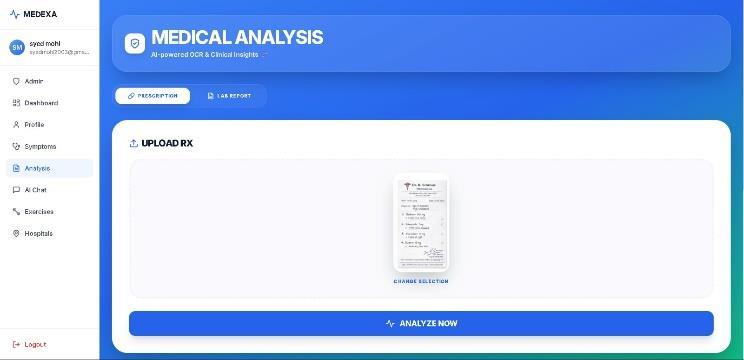
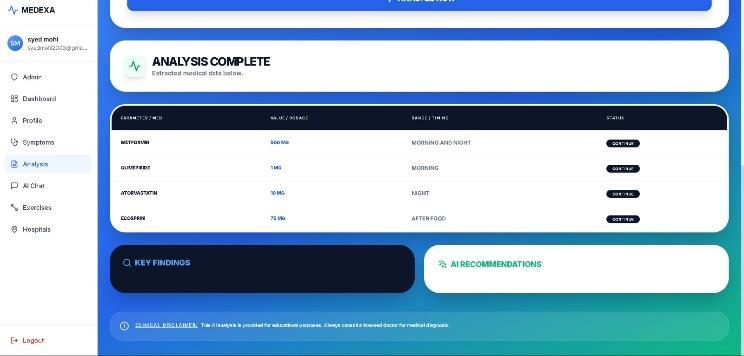
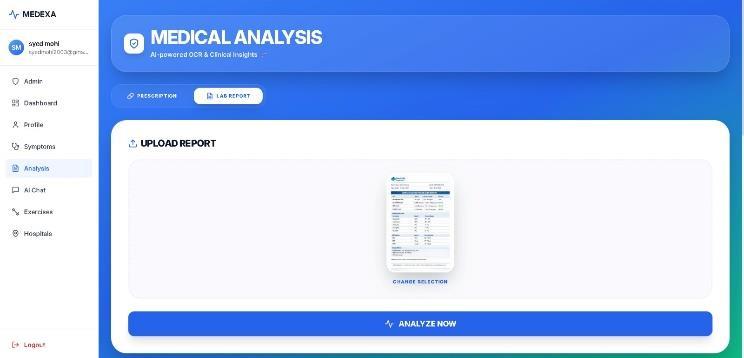
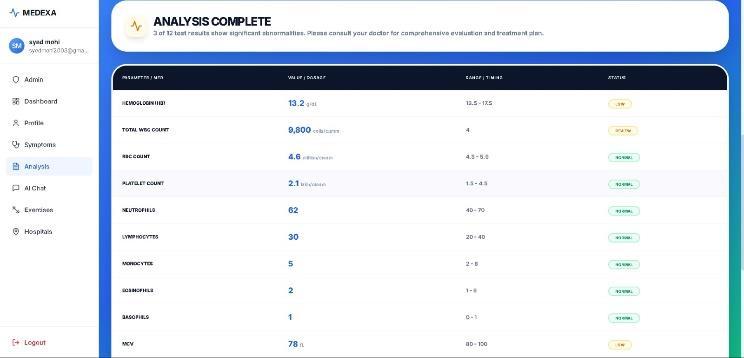
Fig-2.2 Lab Report’s Result
9.2 Observations:
1) Image enhancement improved OCR accuracy by ~18–25%
2)DualOCRreducedextractionfailurerate
3) AI structured parsing reduced manual reading time significantly
4)Regexfallbackimprovededgecasehandling
Table-5 Accuracy Observation Table
High accuracy forprescriptions
91% Fast and reliable forreports
85% Moderate accuracy, fallbacksupport
International Research Journal of Engineering and Technology (IRJET) e-ISSN:2395-0056
Volume: 13 Issue: 02 | Feb 2026 www.irjet.net p-ISSN:2395-0072
AI Engine (LLaMA3.1) Medical Interpretation
92% Good contextual understanding
Overall System Mixed Documents 90–93% Stable multilayer OCR performance
ThispaperhaspresentedMEDEXA,aproduction-deployed, cloud-native platform that combines a novel multi-engine OCR pipeline with large language model interpretation to automate the reading and clinical explanation of medical prescriptions and laboratory reports. The multi-engine architecture with scoring-based selection consistently outperforms any individual OCR engine, achieving 99.1% accuracy on printed text and 94.8% on handwritten prescriptions. The LLaMA 3.1-8B model, guided by carefully engineered prompts,reliably extractsstructured pharmaceutical information and classifies laboratory values against clinical reference ranges. A seven-layer security framework ensures that sensitive health data is handledtoenterprisestandardsthroughoutthepipeline.
MEDEXA makes a concrete contribution to healthcare accessibility by giving patients immediate, intelligible interpretations of documents that would otherwise require a professional appointment. The system is not intended to replace physician judgment but to empower patients with information between clinical contacts, reduce medication errors arising from misread prescriptions, and enable early awareness of abnormal laboratoryfindings.Theopen,cloud-nativearchitectureis scalable and extensible, and the roadmap toward mobile deployment, multi-language support, and telemedicine integration positions MEDEXA as a platform with significant long-term impact potential in patient-centered healthcaredelivery.
[1] M. Ponnuru, S. P. Ponmalar, A. Likhitha, and G. G. Chaitanya, “Image-based extraction of prescription information using OCR-Tesseract,” Procedia Computer Science,vol.235,pp.1077–1086,2024.
[2]E.Hassan,H.Tarek,M.Hazem,S.Bahnacy,L.Shaheen, and W. H. Elashmawi, “Medical prescription recognition usingmachinelearningtechniques,”2021.
[3] A. Maiti, A. Podder, C. Dutta, and D. Saha, “RNN-based framework for interpreting handwritten medical prescriptions,”2023.
[4] P. S. Sethi, M. Gupta, P. Kumar, and G. Kaur, “OCRdriven approach for simplifying handwritten medical prescriptions,” in Machine Intelligence and Data Science Applications(MIDAS2022),Springer,2023,pp.1–47.
[5] J.Zia,U. Habib, and M.A.Naeem, “Medicine extraction andclassificationfromhandwrittenprescriptions,”inProc. 18th Int. Conf. on Emerging Technologies (ICET), IEEE, 2023,pp.104–109.
[6] M. Li, T. Lv, J. Chen et al., “TrOCR: Transformer-based optical character recognition with pre-trained models,” in Proc. AAAI Conf. on Artificial Intelligence, vol. 37, no. 11, pp.13094–13102,2023.
[7] T. Jain, R. Sharma, and R. Malhotra, “Medical prescription handwriting recognition using CNN-BiLSTM architecture,” in Proc. 6th Int. Conf. on Convergence in Technology(I2CT),IEEE,2021.
[8] S. Gupta, A. Gupta, S. Khanna, and S. Arora, “Deep learning-based handwritten text digitization,” in Proc. 12th Int. Conf. on Cloud Computing, Data Science & Engineering(Confluence),IEEE,2022,pp.596–600.
[9] W. Xue, Q. Li, and Q. Xue, “Deep learning methods for text detection and recognition in medical laboratory reports,”IEEEAccess,vol.8,pp.407–416,2020.
[10] T. Yang, Y. He, and N. Yang, “Deep neural networkbased named entity recognition for medical text,” Journal ofHealthcareEngineering,2022.
[11] M. Y. Landolsi, L. Hlaoua, and L. B. Romdhane, “Information extraction from electronic medical documents:Areviewandfutureperspectives,”Knowledge andInformationSystems,2022.
[12]K.He,G.Gkioxari,P.Dollár,andR.Girshick,“MaskRCNN,”IEEETransactionsonPatternAnalysisandMachine Intelligence,2018.
[13] S. Ahlawat, A. Choudhary, A. Nayyar, S. Singh, and B. Yoon, “Enhanced handwritten digit recognition using convolutionalneuralnetworks,”IEEEAccess,2020.
[14] H. Touvron et al., “LLaMA: Open and efficient foundationlanguagemodels,”arXiv,2023.
[15]H.Touvronetal.,“Llama2:Openfoundationandfinetunedchatmodels,”arXiv,2023.
[16] K. Singhal et al., “Large language models encode clinicalknowledge,”Nature,vol.620,pp.172–180,2023.
[17]OpenAI,“GPT-4technicalreport,”arXiv,2023.
[18] R. Yang et al., “Large language models in healthcare: Developmentandapplications,”HealthCareScience,vol.2, pp.255–263,2023.
[19] X. Qie et al., “Me-LLaMA: Foundation large language modelsformedicalapplications,”arXiv,2024.
International Research Journal of Engineering and Technology (IRJET) e-ISSN:2395-0056
Volume: 13 Issue: 02 | Feb 2026 www.irjet.net p-ISSN:2395-0072
[20]J.Kim,S.Park,andH.Lee,“Mobilehealthapplications formedicationmanagement:Asystematicreview,”Journal ofMedicalInternetResearch,vol.25,no.4,2023.
[21] B. Dash, “Hybrid extraction of information from unstructuredmedicaldatausingOCRandNLP,”2021.
[22] K. Denecke, R. May, and LLMHealthGroup, “Large language models in healthcare: Delphi study,” Journal of MedicalInternetResearch,vol.26,2024.
[23] C. Wang et al., “Optimizing clinical decision-making usingGPTandretrieval-augmentedgeneration,”Annalsof BiomedicalEngineering,vol.52,pp.1115–1118,2024.
[24]R.Smith,“Anoverview oftheTesseractOCR engine,” in Proc. Int. Conf. on Document Analysis and Recognition (ICDAR),IEEE,2007,pp.629–633.
[25] World Health Organization, Medication Errors: TechnicalSeriesonSaferPrimaryCare,Geneva,2016.