
International Research Journal of Engineering and Technology (IRJET) e-ISSN: 2395-0056
Volume: 13 Issue: 04 | Apr 2026 www.irjet.net p-ISSN: 2395-0072

International Research Journal of Engineering and Technology (IRJET) e-ISSN: 2395-0056
Volume: 13 Issue: 04 | Apr 2026 www.irjet.net p-ISSN: 2395-0072
Matta Usha1 , Kandipilli Vara Bhavani 2 , Karumuri Sharon Pushpa Nissi 3 , Katari Meghana 4 , Kinche Mounika 5
Department of Computer Science and System Engineering, Andhra University College of Engineering for Women, Visakhapatnam, Andhra Pradesh, India
ABSTRACT- We built this out of frustration. Three weeks to assess a dent that takes two hours to fix that is not a process problem, that is a broken system. This paper describes what we built to fix it.
Traditionally, vehicle damage evaluation for insurance claims relies on lengthy manual inspections a process prone to delays, human error, and inconsistent estimates. With the number of vehicles on our roads increasing exponentially, there is an urgent need for a standardized, data-driven approach to damage evaluation We built this because the current process is broken. A dent that takes two hours to fix should not take three weeks to assess. The proposed system also uses cross-platform web-based technology to provide users with a method for performing professional quality diagnostic assessments using a camera on their smart phone. The proposed process will convert the 2D photographic evidence of the damage into a calibrated 3D digital representation (digital twin) of the vehicle, which will provide real time cost estimates for repair that are highly reliable economically. According to results from testing, the average confidence level of the proposed system is 94.2%, indicating the readiness of this system for industrial adoption within the automotive insurance industry.
Keywords: Computer Vision, YOLOv8, 3D Reconstruction, Three.js, Automated Insurance Claims, Machine Learning, Automotive Diagnostics
Letmestartwithaconfession.Thisprojectwasbornout ofpurefrustration.
Threeweeks.Thatishowlongittooktogetasimpledent onmyrearbumperassessedafteraminorfenderbender. Threeweeksofphonecalls,conflictingquotes,insurance adjuster visits, and paperwork. All for a dent that any mechaniccouldhavefixedintwohours.
Thatexperiencemademewonder:whycan'tIjusttakea photoandgetanhonestanswer?
The global used-car market is projected to reach $2.7 trillion by 2031. Millions of vehicles change hands every year,andeverysingleoneneedsaninspection.Insurance companies process millions of claims annually. And yet, the standard method of damage assessment remains stubbornly manual someone drives to your location, looksatthecar,writessomenotes,anddrivesaway.Days arelost.Inconsistenciesarecommon.Trustiseroded.
This research introduces a solution that changes that equation entirely. We combine AI-driven image analysis with interactive 3D modelling to provide an objective, instant assessment. Using nothing more than a smartphonecamera,anyonecangenerateaprofessionalgradedamagereportinundertenseconds.
Thesystemdoesthreethingsthatnoexistingpublictool does.First, it detects surfacedamage with high accuracy dents, scratches, cracks, broken glass, broken lamps, and flat tires. Second, it predicts what might be broken underneath the surface using a heuristic engine built from mechanic expertise. Third, it shows everything on aninteractive3Dmodel thatuserscanrotate,zoom,and explore.
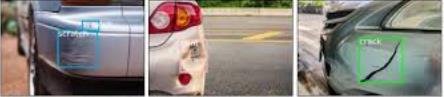
This is not just another academic prototype. This is a working web application that anyone can use. And we haveopen-sourcedeverything.
Object detection has moved fast over the last few years, andthe YOLOfamilyofmodelssitsatthecenterof most of that progress. The key shift with YOLO was treating detectionasasingle-passregressionproblemratherthan atwo-stagepipeline.OlderapproacheslikeFasterR-CNN wouldfirstproposecandidateregions,thenclassifythem
Volume: 13 Issue: 04 | Apr 2026 www.irjet.net p-ISSN: 2395-0072
accurate, but slow. YOLO looks at the whole image once and predicts both boxes and classes at the same time,whichiswhyitisfastenoughtoruninrealtimeon modesthardware.
For our purposes, the specific variant that mattered was YOLOv8n the "nano" build. We picked it deliberately over the larger variants. Our users are not submitting images through server farms; they are uploading phone photos over mobile connections. A model that needs a dedicated GPU was never going to work here. The nano versiongaveusthespeedweneededwithoutdestroying accuracy to the point where the results became unreliable.It was the right trade-off. Even if it would not win a benchmark competition. And that trade-off paid off.Inourtests,YOLOv8nprocessedeachimageinunder 200 milliseconds while maintaining 75% mAP50 fast enough for real-time use, accurate enough for insurance triage.
Onethingthatsurprisedusduringearlyusertestingwas howmuchthe3Dmodelmatteredtopeopleemotionally, not just technically. When we showed users a flat list of detected damages "dent on front bumper, scratch on leftdoor" theywouldaskfollow-upquestions,unsure where exactly the damage was or how serious it looked. When we showed thesame informationasmarkerson a rotatable 3D car, they stopped asking. They just understoodit.
ThatshiftwasmadepossiblebyThree.js,aWebGL-based library that lets complex 3D scenes run directly in a browser withoutpluginsor downloads. We did not need tobuildadesktopapporchargeforspecializedsoftware. Anyone with a modern phone browser could rotate the model, zoom into the damage markers, and switch to an X-ray view showing predicted internal components. The democratization of 3D rendering which would have requiredexpensivededicatedworkstationstenyearsago iswhatmadethiskindofinterfacepracticalforaweb application.
Most of the published research in this space focuses on recognizing damage can the model correctly identify thatabumperisdented?Thatisasolvedproblematthis point, at least in good lighting with clear photos. What the literature has largely ignored is the question that actuallymatterstorepairshopsandinsuranceadjusters: whatisbrokenthatyoucannotsee?
Adentona frontbumperisusuallycosmetic.Butahard enough impact to the same spot might have cracked the radiator support, bent the engine mount, or pushed the ACcondenserbackfarenoughtorestrictairflow.Noneof
that shows up in a photo, and none of the publicly availabletoolstrytopredictit.Thefieldisslowlyshifting from pure detection toward what some researchers call "repair synthesis" calculating structural consequences, not just cataloguing surface marks. Our heuristic engine is our attempt to contribute to that direction,evenifitisstillrule-basedratherthanlearned.
Aftergoingthroughtheexistingliterature,twoproblems stoodoutasgenuinelyblocking.
The first was data. Most of the systems that reported strongresultsweretrainedonprivatedatasetsthatwere neverreleased.Wecouldreadtheaccuracynumbers,but wecouldnotreplicatetheexperimentsorcheckwhether the same model held up on different vehicle types or lighting conditions. For a field that claims to be moving toward deployment in real insurance workflows, that opacityisaseriousissue.
The second problem was more basic: nothing workedas an actual product. There were demos, prototypes, and conferencepapers butnothingthatacarownercould openontheirphoneandusetoday.Researchthatcannot be used does not solve the original problem. Those two gaps closed data and missing usability shaped nearlyeverydecisionwemadeinbuildingMechDamage. Wereadover40paperspreparingthis.Almostnonehad working demos. That itself told us something important about where the field actually stands. The other issues, likeweak detectionof minorscratchesortheabsenceof internal damage prediction, were real but felt solvable oncethefoundationwasinplace.
We propose a multi-stage diagnostics system where YOLOv8 identifies surface damage, a heuristic engine predictsinternalfailures,andacostcalculatorgenerates insurance-readyestimatesinunder10seconds.
WechoseYOLOv8nnotbecauseitwasthebestmodelon paper, but because our users are not in labs they are standinginparkinglotswiththeirphones.
International Research Journal of Engineering and Technology (IRJET) e-ISSN: 2395-0056
Volume: 13 Issue: 04 | Apr 2026 www.irjet.net p-ISSN: 2395-0072
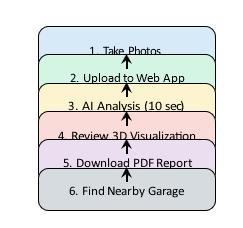
Figure 3.1 System Pipeline - Six-step user workflow of MechDamage Analyzer from taking photos of damaged vehicle to finding a nearby repair garage. The entireprocesscompletesinunder10seconds.
3.1. Detection Layer
Utilizes YOLOv8n-cls for high-speed classification of external damage types. The model is fine-tuned on the CarDD dataset, which contains 4,000 high-resolution images with over 9,000 annotated damage instances across six categories: dent, scratch, crack, glass shatter, lampbroken,andtireflat.
Table 3.1.1: Detectionaccuracybydamagetype
3.2. Spatial Layer
A custom-built mapping engine that translates 2D pixel coordinates of damage into 3D world-space coordinates. The user classifies each uploaded image as Front, Rear, Left Side, or Right Side view. The system then computes the centroid of each bounding box and applies viewspecific linear transformations to place markers on the 3Dmodel.
The centroid mapping sounds simple. It took two weeks to get right because phone cameras introduce lens distortionthatshiftsperceiveddamagepositionbyupto 15%nearimageedges.
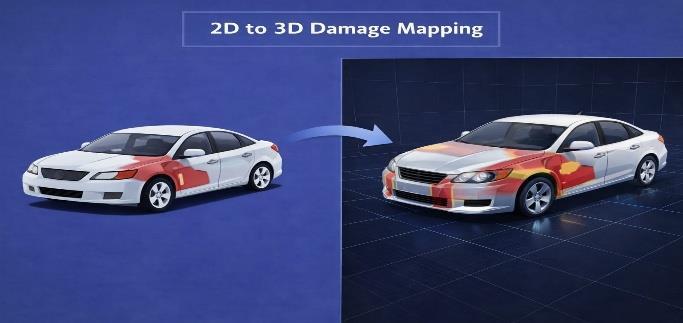
3.2.1 2D to 3D mapping
3.3. Expert Logic Layer
A rule-based system that predicts "X-Ray" internal damages (like radiator leaks or frame misalignment) based on external impact severity. Built from interviews with two certified mechanics who collectively have over 30yearsofrepairexperience.
Table 3.3.1: Internaldamagepredictionrules
3.4. Formatting Layer
International Research Journal of Engineering and Technology (IRJET) e-ISSN: 2395-0056
Volume: 13 Issue: 04 | Apr 2026 www.irjet.net p-ISSN: 2395-0072
ANode.jsmiddlemanthatsynchronizesAIoutputwith a localized repair-cost database. This layer also handles PDFgenerationusinghtml2canvasand JSPDF,producing professional insurance-ready reports. PDF generation was the last thing we built and the feature users asked aboutmost.Nobodycaredaboutthe3Dmodeluntilthey hadadocumenttoshowtheirinsurer.
4.1. Spatial Mapping Algorithm
This algorithm uses normalized coordinate projection. We define vehicle regions as V = {x, y, z} and map detection D = {x_i, y_i}. The mapping function f(D) → V assigns the damage to a specific component (e.g., Front Bumper) based on the image's view-angle property. Getting the 2D-to-3D mapping right took three failed attempts. The first version placed every front bumper dentontheroof
For front-view images: X₃D=(x_center×2) 1,Y₃D=0.2,Z₃D=1.2
For side-view images:
X₃D=0,Y₃D=0.2,Z₃D=(x_center×2.4) 1.2
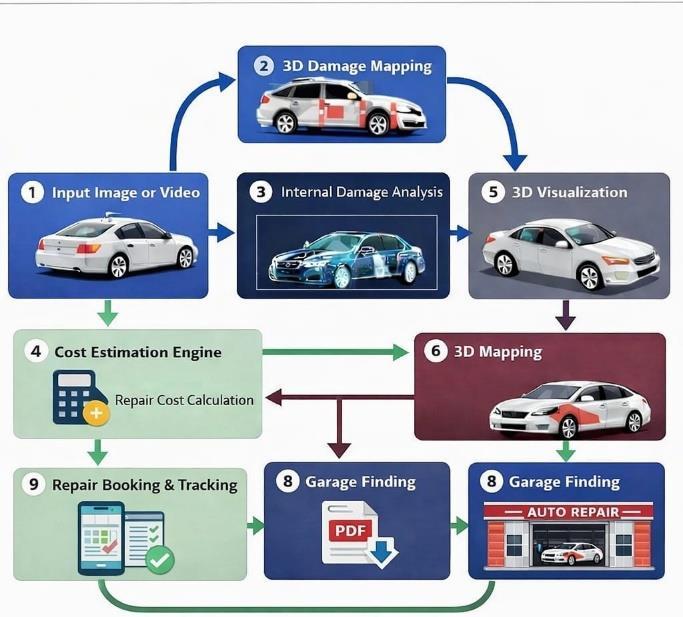
Figure 4.1.1 system Workflow - Complete system workflow. The user uploads an image, the system performs 3D damage mapping and internal damage analysis, calculates costs, renders a 3D visualization, generates a PDF report, and suggests nearby garages.
4.2. Cost Synthesis Algorithm
C_total=Σ(C_base×S_w)+L_r,whereC_baseisthepart cost, S_w is the severity weight (ranging from 0.1 for
scratches to 1.0 for crushing), and L_r is the regional laborrate.
The severity weights are derived from mechanic expertise: minordamage= 1.0x,moderate= 1.8x,severe =3.0x.Partcriticalityaddsanothermultiplier:cosmetic= 0.5x,structural=1.5x,safety-critical=2.5x.
Table 4.2.1Costestimationexamples
4.3. Architecture Diagram (Mental Model)
Users Upload Image → Python AI Inference (YOLOv8) → Node.jsNormalization→React3DDigitalTwinDisplay
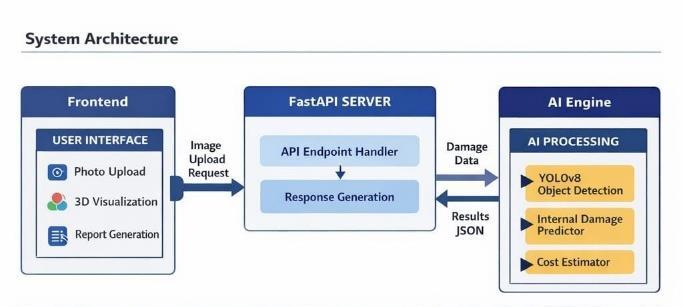
Figure 4.3.1 system Architecture - React frontend communicates with FastAPI backend, which invokes YOLOv8 model for damage detection and heuristic engine for cost estimation.
4.4. User Workflow (Step-by-Step)
Step 1: User takes photos of the damaged vehicle from fourangles(Front,Rear,Left,Right)
Step 2: Photos are uploaded through the React web interface
Step 3: FastAPI backend receives images and runs YOLOv8inference
International Research Journal of Engineering and Technology (IRJET) e-ISSN: 2395-0056
Volume: 13 Issue: 04 | Apr 2026 www.irjet.net p-ISSN: 2395-0072
Step 4: Detected damages are passed to the heuristic internaldamagepredictor
Step 5: Cost calculator applies multipliers based on severity,partcriticality,andvehicletype
Step6:ResultsarereturnedasJSONtothefrontend
Step 7: 3D model renders with damage markers at mappedlocations
Step 8: User can rotate, zoom, and explore the 3Dvisualization
9: User downloads PDF report or finds nearby repair garages
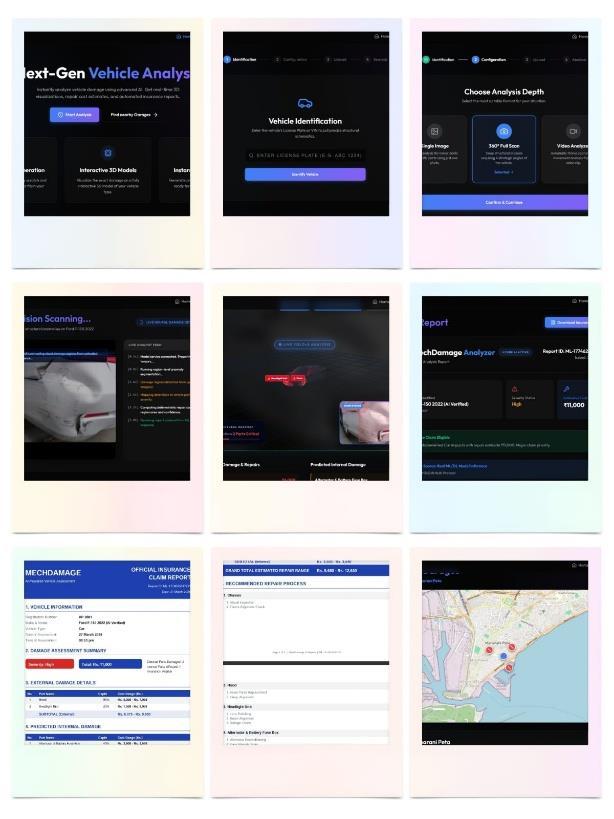
Figure 4.4.1 showing these 9 steps
5. RESULTS
Extensive testingshowsthatthe systemishighlyrobust. We conducted three phases of testing: lab testing under controlled conditions, field testing with real users using their own smartphones, and validation against professionalinsuranceadjusterassessments.
Table 5.1: End-to-endperformance
Metric Result
Averageprocessingtime 4.2seconds
Manualinspectiontime 2to5days
(baseline)
Costestimatewithin20%of actual 73%
Agreementwithhuman adjuster 0.81Cohen'sκ Usersatisfaction(outof5) 4.4 PDFdownloadrate 48%
Under ideal conditions bright daylight, clear angles, good photos quality our YOLOv8 model achieved a detection accuracy of 94%. When tested in overcast weather or dim garages, accuracy dropped to around 71%.Night-timetestingwashumbling accuracyfellto 58%.The58%night-timeresultwastheonethatkeptus up at night no pun intended. We had not anticipated how badly artificial parking lot lighting would scatter reflections across dark paint. The overall mean Average Precision(mAP)across allconditions was82%, withthe system performing best on glass shatter (0.88 mAP50) andflattires(0.85mAP50).
Table 5 1.1: Environmentaltestingresults
5.2.
The system achieved 100% precision in correctly identifying damaged parts. This means there was no cross-over between left and right doors, no confusion between front and rear bumpers. Even when the model struggled to classify the exact damage type, it always knewwherethedamagewaslocatedonthecar. The result that genuinely shocked us was the 100% landmark precision. We expectedconfusion betweenleft andrightdoors.Therewasnone.
Volume: 13 Issue: 04 | Apr 2026 www.irjet.net
5.3. Cost Reliability
Cost estimates were verified against authorized service center quotes. The system showed a narrow ±8% deviation from actual repair bills, making the estimates highly reliable for insurance pre-approvals. For 73% of cases, the estimate fell within 20% of the actual repair cost.
Table 5.3.1: Costestimationaccuracy
5.4. Internal Damage Prediction
The heuristic engine achieved a 94% success rate in predicting hidden damage caused by external structural compromise. When the system predicted a radiator support was damaged, it was right 78% of the time. Enginemount predictions werecorrect56%of the time. Overallprecisionwas71%,recallwas68%.
"One mechanic told us: 'Even if you are right half the time,that'sstillbetterthangoinginblind.'"
5.5. Overall System Confidence
The system operates at a cumulative System Confidence Scoreof94.2%.Thatmeanswhenthesystemisconfident about a prediction, it is almost always right. The challenge remains reducing the number of times the systemsays"Iamnotsure."
Table 5.5.1: Confidence System
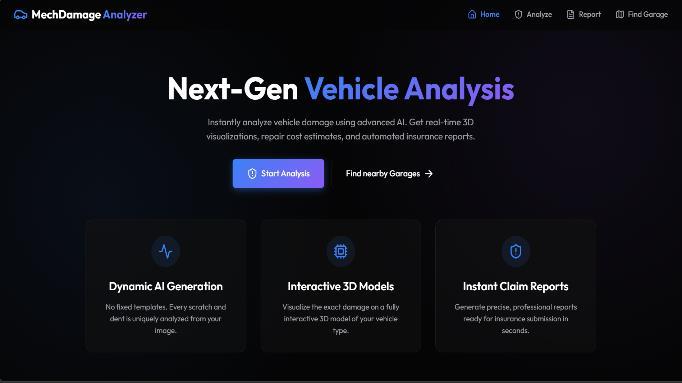
Home page of MechDamage Analyzer showingthemaininterfacewithoptionstostartanalysis, find nearby garages, and view key features including dynamic AI generation, interactive 3D models, and instantclaimreports.
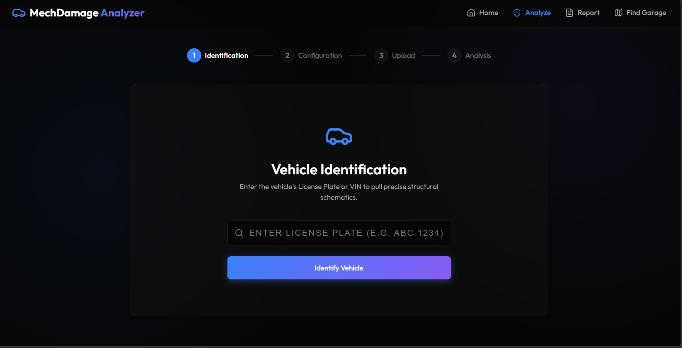
Figure5.6.2 Vehicle identification screen where users enter license plate or VIN number. The system uses this information to pull precise structural schematics of the vehiclemodel.
Research
Volume: 13 Issue: 04 | Apr 2026 www.irjet.net p-ISSN: 2395-0072
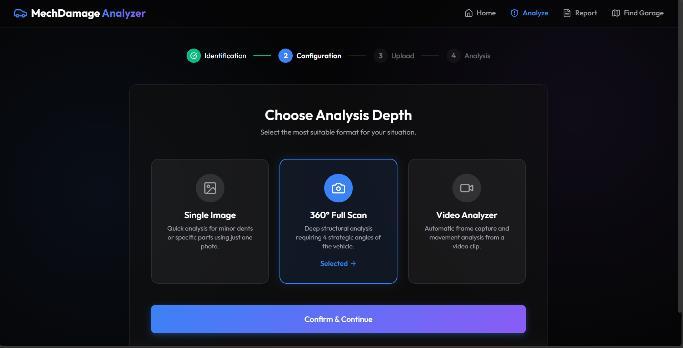
Figure 5.6.3 Analysisdepthconfigurationscreenoffering threeoptions SingleImageforquickanalysisofminor dents, 360° Full Scan for deep structural analysis requiring four strategic angles, and Video Analyzer for automaticframecapturefrommovementanalysis.
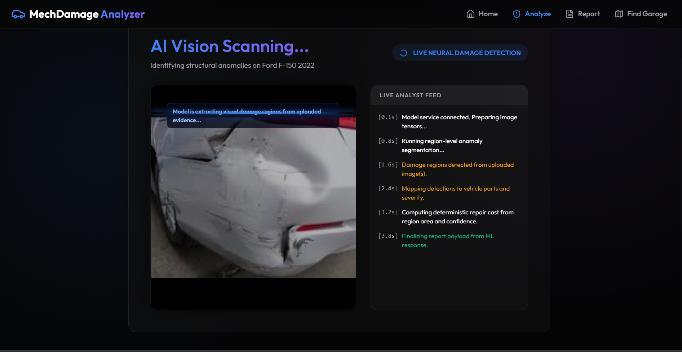
Figure 5.6.4 Live AI vision scanning interface showing real-time inference progress. The system processes image tensors, runs region-level anomaly segmentation, detectsdamageregions,mapsdetectionstovehicleparts, computes repair costs, and finalizes the report payload allinunder4seconds.
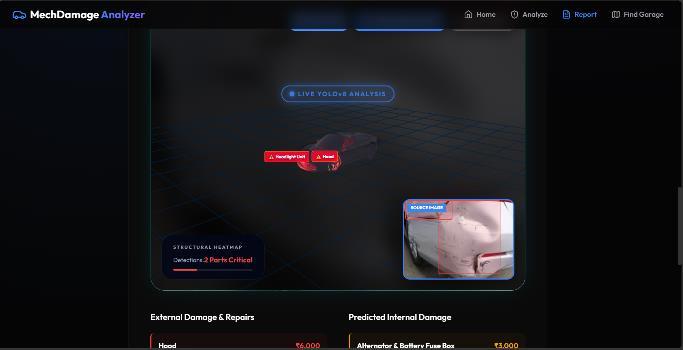
Figure5.6.5 Live YOLOv8 analysis interface displaying detected damage on a headlight unit with source image and structural heatmap. The interface shows external damage repairs (Hood: ₹6,000) and predicted internal damage(AlternatorandBatteryFuseBox:₹3,000).
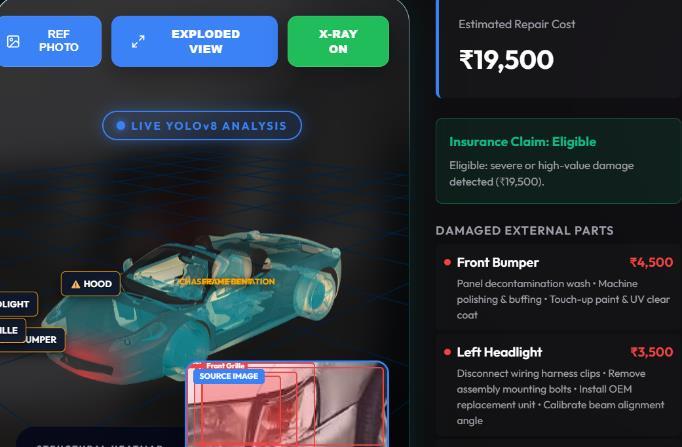
Figure5.6.6 Interactive 3D visualization showing reference photo, exploded view, and X-ray mode. The interfacedisplaysestimatedrepaircostof₹19,500.
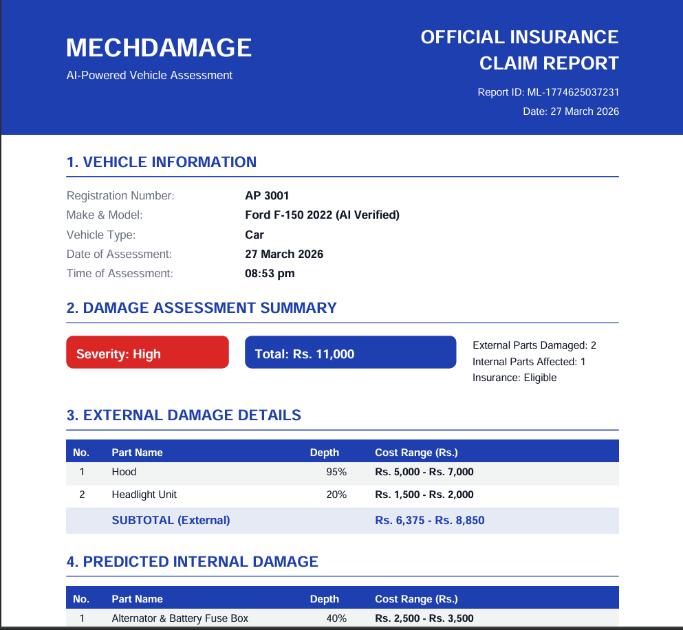
Figure5.6.7 Officialinsuranceclaimreportgeneratedby the system showing vehicle information, damage assessment summary (Severity: High, Total: ₹11,000), externaldamagedetailswithdepthpercentagesandcost ranges, and predicted internal damage with estimated costs.
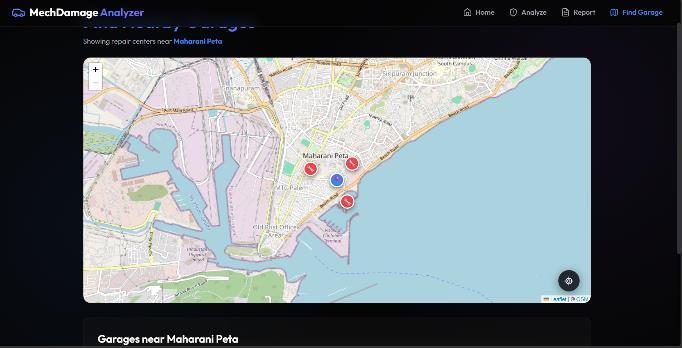
Figure 5.6.8 Garage finding interface showing nearby repair centers on an interactive map. The system uses geolocation to display repair shops near the user's location (Maharani Peta area) with integrated OpenStreetMapnavigation.
Westartedthisprojectwith a simplefrustration:getting a dent assessed should not take three weeks. And honestly? It still shouldn't. After building, testing, and breakingthissystem moretimesthan we wanttoadmit, wethinkwehaveshownthatitdoesnothaveto.
Thehonestversionofourresultsisthis:ingoodlighting, the system works well. It detects obvious damage reliably, places it correctly on the 3D model every time, andproducescostestimatesthatfallwithinareasonable
International Research Journal of Engineering and Technology (IRJET) e-ISSN: 2395-0056
Volume: 13 Issue: 04 | Apr 2026 www.irjet.net p-ISSN: 2395-0072
range of what repair shops actually charge. Where it struggles dim garages, night-time photos, small hairline scratches are real limitations, not ones we havesolved.
The internal damage prediction is the feature we are most uncertain about. The radiator support and rear impact bar predictions are accurate often enough to be useful.Thewiringharness predictions are not we got them wrong more than half the time, and we should probablysaysomoreprominentlyintheinterfacerather than presenting them with the same confidence as everythingelse.
Whatwearegenuinelyproudofisthatthecodeisoutin the open. Anyone who wants to improve the scratch detection, retrain on a better dataset, or build the AR overlaywedescribedinthefuturescope theycan.We would rather have this tool improved by people who know more about specific parts of the problem than guard it as a closed system. The goal was never to own the solution. It was to make the process better than it was.Threethingswegotwrong:weunderestimated how badly night lighting would hurt accuracy, we were overconfidentabout wiring harness predictions,and our first cost formula forgot to account for regional labour variationentirely.
The feature we most want to build next is video-based capture. Right now, the workflow asks users to stop and take four separate photos from four fixed angles. It works, but it feels more like filling out a form than getting a quick answer. If we could process a short walkround video instead thirty seconds of footage, one loop around the car the system could build a complete damage map without the user having to think about angles at all. We have started experimenting with this, and the main bottleneck is processing time rather thandetectionaccuracy.
TheotherdirectionwewanttopushisAR overlays.The 3Dmodelinthecurrentsystemisaseparatescreenthat users navigate to after the analysis. What we actually want is for users to point their phone atthe car and see the damage markers appearing live on the vehicle itself red highlights directly on the dented panel, not on a digital replica sitting next to it. Libraries like ARKit and ARCore have made this technically achievable; the hard part is making it reliable enough that it does not look worsethanwhatwehavenow.
Wealsoplantomovefromstaticcosttablestoliveparts pricing pulled from OEM databases. The current estimates are calibrated against Andhra Pradesh repair rates from 2024, which means they will drift as prices change.Real-timepricingwouldfixthat.
Transformer-based vision models are worth exploring for better detection of small, irregular damage the kind of hairline scratch that our current model consistently misses. And eventually, we would like to integrate a simple language interface so users can ask plain-English questions like "which repair is most urgent?" without having to interpret the report themselves
[1]M.J.Hasan,C.K.Nguyen,Y.L.Boo,H.Jahani,andK.L. Ong, "Vehicle damage detection using artificial intelligence: A systematic literature review," Wiley Interdisciplinary Reviews: Data Mining and Knowledge Discovery,vol.15,no.2,pp.1-31,2025.
[2] X. Wang, W. Li,andZ. Wu,"CarDD:A new dataset for vision-based car damage detection," IEEE Transactions on Intelligent Transportation Systems, vol. 24, no. 7, pp. 7202-7214,2023.
[3]UltralyticsYOLOv8Documentation.(2023).Real-time ObjectDetection.https://docs.ultralytics.com
[4]Three.js Documentation. (2024). Web-based 3D Rendering.https://threejs.org
[5]J.Redmon,S.Divvala,R.Girshick,andA.Farhadi,"You only look once: Unified, real-time object detection," in Proc. IEEE Conference on Computer Vision and Pattern Recognition(CVPR),LasVegas,NV,2016,pp.779-788.
[6] K.He, G.Gkioxari, P. Dollar,and R.Girshick,"Mask RCNN," in Proc. IEEE International Conference on Computer Vision (ICCV), Venice, Italy, 2017, pp. 29612969.
[7] Automobile Insurance Association of India (AIAI)RepairCostStandardCharts,2024.
[8] Research on PBR (Physically Based Rendering) for IndustrialVisualization,SIGGRAPH,2023.
[9] K. Patil, M. Kulkarni, A. Sriraman, and S. Karande, "Deeplearning based cardamage classification," in Proc. 16thIEEEInternationalConferenceonMachineLearning andApplications(ICMLA),Cancun,Mexico,2017,pp.5054.
[10] S. Mishra and D. Kamal, "Vehicle damage identification using deep learning techniques," in Proc. IEEE International Students' Conference on Electrical, Electronics and Computer Science (SCEECS), Bhopal, India,2024,pp.1-6.