
International Research Journal of Engineering and Technology (IRJET) e-ISSN:2395-0056 p-ISSN: 2395-0072

Volume: 12 Issue: 02 | Feb 2025 www.irjet.net

International Research Journal of Engineering and Technology (IRJET) e-ISSN:2395-0056 p-ISSN: 2395-0072
Volume: 12 Issue: 02 | Feb 2025 www.irjet.net
Pratiksha Raut1 , Sakshi Borse2 , Riya Chavan3 , Khushi Chavan4 , Gayatri Tidke5
1 Assistant Professor, Dept. of Computer Engineering, GES’s R. H. Sapat College of Engineering, Nashik, Maharashtra, India
2,3,,4,5Student, Dept. of Computer Engineering, GES’s R. H. Sapat College of Engineering, Nashik, Maharashtra, India *** -
Abstract - Mentalillnesses,suchasanxiety,depression,and stress,areofsignificantconcernallovertheworld.Thisstudy serves an advanced online system called "Mental Health Analysis Using Machine Learning, which predicts mental healthconditionsbystructuredquestionnairesandmachine learning techniques. It makes use of the algorithms of Decision Trees as well as NLP in order to analyze the user inputs and provide suitable personal feedback while also suggesting professional consultation. Predictive analytics, a recommendationengine,progressivetracking,andreal-time monitoring of mood would be the system's key features. All informationregardingusersisencryptedandproperlystored forcompletedatasecurityandprivacy.Currently,noonehas created anything like Wysa or Woebot. Such a system provides long-term tracking, real-time insights, and personalized recommendations-bridging gaps between selfassessment tools and professional mental health support. Developed using Python, ReactJS, TensorFlow, and MySQL/PostgreSQL, the platform uses Decision Tree algorithms for prediction, collaborative filtering for recommendations, and linear regression for tracking progress.Thesystemisdesignedtobescalable,user-friendly, and secure. These would include accurate psychometric assessments, early detection of mental health problems, customized recommendations, long-term progress tracking, and professional integration. Other features like gamificationandreminderskeeptheusermoreengagedand hold onto the user, making this system a full-fledged, accessiblementalhealthsupportsolution.
Key Words: User Progress Tracking, Professional Consultation Integration, Recommendation System, DecisionTreeAlgorithm,NaturalLanguageProcessing (NLP).
Mental health is an important component of well-being, influencing emotions, cognitive functions, and social interactions.Anxiety,depression,andstressaresomeofthe mentalillnessesthathavesevereeffectsonindividualsand society as a whole, making it essential to develop new methods for early detection and intervention. Traditional diagnosisofmentalhealthdependsmainlyonself-reported assessments using structured questionnaires, which may besubjectiveandpronetoinconsistencies[1].Advancesin technologyhavebroughtforwardpowerfultoolstoanalyze

complex mental health data that are now able to identify cases in early stages and tailor treatments based on patients,whichresultsinbetteroutcomesforthepatients. ML techniques like NLP, Decision Trees, and Neural Networks can be applied to a massive amount of data coming from diverse sources like self-reported surveys, wearable devices, and online interactions to look for patternsrelatedtomentalhealth.Thesetechniquesenable researchersandhealthproviderstoautomateassessments, provide real-time insights, and deliver tailored interventionstopeopleinneed[2].
Mental health issues had been part of human life for thousands of years, even with some historical references that go as far back as the 5th century BC. But in the contemporary world, mental health disorders are now widespread with millions affected globally. Statistics from the Indian government reveal that approximately 130 millionpeoplemaybesufferingfromsomeformofmental illness. Despite these alarming statistics, mental health remains a taboo subject, preventing people from seeking timelymedicalintervention.Accordingtoresearch,only8–10%oftheaffected populationreceivesproper treatment, whilethemajorityremainundiagnosedanduntreated.This lack of awareness and support has led to an increase in suicideratesandincreasedpsychologicaldistressamongall sections of society. Primarily, underdeveloped mental healthcareinIndia alongwithotherissuessuchasscarce funding and a lack of mental health professionals is contributing to this crisis. Data by the World Health Organization stipulates that India has only 0.75 psychologists and psychiatrists per 100,000 people whilst countries like Argentina have 106 psychologists per 100,000 people. Another economic constraint prevents millionsfromaccessingmentalhealthcareservices.Ahuge portionofthepopulationinIndiaresidesbelowthepoverty lineandthusdoesnotevenhavethemeanstofulfillsimple needs like food, shelter, and medical attention, let alone mentalhealthservices.Eveniftheycanaffordhealthcare, thecostofpsychiatrictreatmentremainsahugechallenge. Amongst the most prevalent mental health conditions are depression, anxiety, PTSD, and insomnia. Depression breaksaperson'semotionsandrendersthemintoconstant sadness and despair, while anxiety is described by excessiveworryingandnervousnessoftenaccompaniedby symptoms such as tachycardia and difficulty in breathing. PTSDoccursbecauseoftheeffectsoftraumaresultingin

International Research Journal of Engineering and Technology (IRJET) e-ISSN:2395-0056
Volume: 12 Issue: 02 | Feb 2025 www.irjet.net
emotionalupsetandproblemsofrecovery.Oneofthesleep disordersmostencounteredisinsomniawherepeoplefail togettheamountofrestthattheyrequireinordertobetter theirmentaldisorder.
To diagnose these conditions, mental health professionals often rely on questionnaire-based assessments that evaluate patients based on situational and objective questions. However, with the rapid advancement of artificial intelligence (AI) and machine learning (ML), automated mental health prediction systems can play a transformative role in early detection and intervention. This study explores the potential of machine learning algorithms to analyze mental health data, predict various psychological disorders, and offer data-driven insights for improvedhealthcaredecision-making[5].
Chung and Teo. [1], conducted a systematic review of the application of the use of the ML techniques in predicting mental health problems like schizophrenia, depression, bipolar disorder, PTSD, and children's mental health issues. The authors divided the different categories of ML approaches, including supervised learning, ensemble methods, and deep learning, analyzing their performance across30researcharticles.
Konda Vaishnavi et al. [2], proposed a predictive model based on machine learning to detect mental issues. In this paper, five machine learning techniques, namely, Logistic Regression, K-Nearest Neighbor, Decision Tree, Random Forest, and Stacking, were used. The study concluded that Stacking was the best one of them and produced an accuracy of 81.75%. It was also explained by the authors that feature selection was required as well as ROC curve analysis while testing the performance of models. This study, therefore, calls for a much larger dataset for more accuratepredictionandenlargesthescopeofthespacefor morerobustapplicationsindiagnosingmentaldisorders.
Roger Garriga et al. [3], proposed a machine learning model using EHRs to predict mental health crises in the following 28 days: using XGBoost, the AUROC yielded a value of 0.797 and proved clinically useful in a 6-month pilot, thereby contributing to help clinicians manage their caseload andprevent crises in 64% ofcases. Theresearch demonstrated challenges in data availability, and continued prediction was advocated as an important component in optimizing mental health healthcare resources, and also changing from a reactive to a preventativeapproach.
Renugadevi R et al. [4], proposed a predictive model for workplace mental health issues in the workforce using machinelearning.Witharangeofalgorithmsincluding
p-ISSN: 2395-0072
DecisionTrees,RandomForests,LogisticRegression,and Adaboost the model could be made up to 92.14% accurate, however, the best performance was by Adaboost. It highlighted that the data needs to be preprocessed and there are issues like privacy of data. Thispointed out all those possibleareasofintervention where the model might be able to intervene at an early stage in improving mental health support and reducing the cost of health care while addressing concerns involvingdataintegrityandthepreventionofbias.
Satvik Gurjar et al. [5], presented the machine learning model to predict mental health-related problems like depression,anxiety,PTSD,andinsomnia.Asurveybased on the self-reported data was carried out by gathering data from diverse demographics. The algorithms used herewereRandomForest,SVM,LogisticRegression,and NaiveBayes,whichhadhighaccuracyinthepredictionof anxietyatupto97.27%.Thesystemintegratesintoaweb application to predict the severity of mental health conditions and gives results based on the input from users. The study was able to learn the lessons for overcoming the mental health epidemic-such as improving mental health consciousness, availability of data,andashiftfromreactivecaretowardprevention.
Ashley E. Tate et al. [6], developed machine learning models to predict mental health issues in adolescents using data from 7,638 twins in Sweden. Using 474 predictors from parental reports and registry data, models such as Random Forest, SVM, XGBoost, and Neural Networks achieved AUC values of up to 0.739, withRandomForestperformingslightlybetter.Thestudy highlighted variables like impulsivity, neighbourhood quality, and parental mental health as important predictors.Whilethemodelsshowedpotential,theywere not clinically reliable, emphasizing the need for further refinement and the potential utility of simpler logistic regression techniques for similar datasets. The research underscored the importance of early prediction to improvementalhealthinterventionsandoutcomes.
Anna van Oosterzee. [7], reviewed the applications of supervised machine learning models for mental health diagnosis-auxiliary applications for the purpose of criticizing reliance upon DSM classifications. She argued thatthesemodelsinheritthevalidityproblemsofDSM's heterogeneous and low predictive categories to make them powerless in improving patient outcomes. Though modelsmayachieveahighlevelofaccuracy,thismeasure is deceptive as it does not translate to genuine clinical utility. Van Oosterzee also suggested directing the focus towards the models that can enhance prognosis, treatment selection, and prevention instead of towards suchanapplication.Theapplicationitselfcanfurtheraid inprovidingpersonalizedtreatmentstrategiesinsteadof usinggroundtruthdatabasedonDSM.
International Research Journal of Engineering and Technology (IRJET) e-ISSN:2395-0056
Volume: 12 Issue: 02 | Feb 2025 www.irjet.net
Miryam Elizabeth Villa-Pérez et al. [8], developed machinelearningmodelsfortheanalysisofEnglish and SpanishTwitterdatasetsforthedetectionofninemental health conditions, including ADHD, anxiety, and depression. With the use of n-grams, q-grams, POS tags, topicmodeling,LIWC,andwordembeddings,thebinary classificationachievedAUCscoresof0.846(English)and 0.835(Spanish).Formulticlassclassification,AUCscores were 0.697 (English) and 0.712 (Spanish). The XGBoost and CNN models were the best performing models. Overall, this research pointed out challenges like overbalanced datasets while emphasizing the potential for using data from social media to allow for the possibilityof earlydetection,hencehelpingshiftmental health care from reactive toward more preventative approaches.
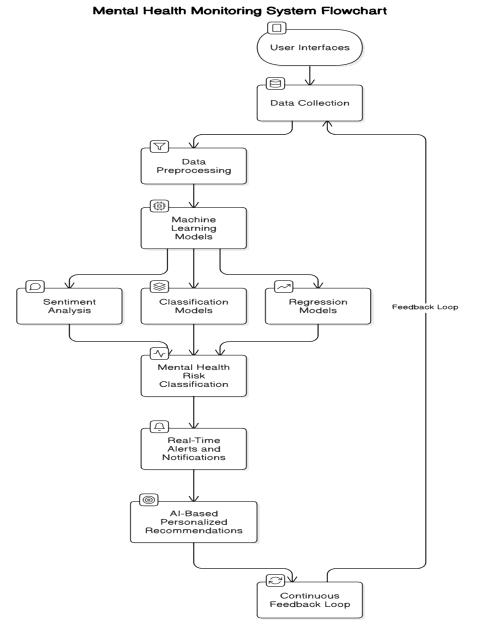
Fig1.Proposedsystemarchitecture
Mental health became a critical issue that needed to be problematized regarding this global challenge, as at the sametime,manyarefindingrefugeindealingandhelping to cope with emotional wellbeing. This technology advanced digital solutions, such as mental health application, opened windows towards accessible and scalablemethodsforaddressingdifficulties.
Fig.1 describes the architecture framework for a mental health application meant to promote users to maximize their levels of well-being based on personalized recommendations and professional advice plus analytics meanttobepredictiveinnature.Theproposedapplication
p-ISSN: 2395-0072
architecture should define the layers that ensure the functional,secure,aswell asscalablenatureofthesystem and implementing the user privacy in ethical considerations.
ThefivelayersconstitutedintheproposalincludetheUser Interface Layer, the Application Logic Layer, the Data ManagementLayer,theIntegrationLayer,andtheSecurity Layer. Each layer is designed with particular components working in tandem with one another towards delivering a smoothyetimpactfuluserexperience.Itisasystembased on modern technologies such as NLP, ML, and secure managementofadatabase,handlingthecomplexneedsofa mentalhealthmanagementsystemwithintegrityandtrust indata.
The rest of the sections outline architecture, starting from the base User Interface Layer, and progressing to sophisticated logic, data, integration, and security mechanisms.
TheUILayer,thefront-endlayerofanapplication,letsthe users of the system have a direct relationship with the application. The primary elements are comprised of the followingmajorcomponents.
Profile&ProgressDashboard:Theuserinterface,therefore, brings in a particular view related to the trend in mood, a progress report, and activity log, thus making the users knowabouttheirtimescalementalcondition.
Main Research Focus: Concentrated on UX design, data visualization techniques, and accessibility features of intuitivenessandinclusiveness.
QuestionnaireModule:Itacquiresuserinputthroughaset ofquestionsorassessmentsofmentalhealthconditions.
Main Research Focus: Adaptive questionnaire design, integration of psychometric models, and real-time validation of enhancements in the accuracy and responsivenessofassessments.
User Authentication: Ensures secure access to the application by giving personalized experiences for each of theusers.
The focus of the study is implementation of secure authentication methods such as biometric login and twofactorauthenticationsandefficientsessionmanagement.
TheApplicationLogicLayerservesastheactualcoreofthe system where data processingand functionalitiesoccur. It comprises: HappinessMeter:Thisfeatureisresponsibleforcalculating userhappinessbasedoninputdatafromtheQuestionnaire Moduleandotherfeatures.
Volume: 12 Issue: 02 | Feb 2025 www.irjet.net
International Research Journal of Engineering and Technology (IRJET) e-ISSN:2395-0056 p-ISSN: 2395-0072
Research Focus: Here, a focus is given to development of algorithms related to sentiment analysis, wearable integration,andotherreal-timefeedbackmechanisms.
Recommendations Engine: Displays personalized recommendations made based on the assessment of the user'smentalhealthconditions.
Research Focus: Machine learning models for personalization, collaborative filtering techniques, and ethicalconsiderationsinrecommendationsystems.
PredictiveAnalyticsModule: Thismoduleanalyzesdatato predict the potential risks of mental health or emerging trends.
Research Focus: Predictive modeling, time-series analysis, and anomaly detection for proactive mental health management.
3. DataManagementLayer
This layer is involved in the storage, processing, and analysisoflargevolumesofdata.Thekeycomponentsare: NLPModule:Thishelpanalyzeuser-generatedtexttosense emotions,stress,andanxiety.
Research Focus: Training NLP models, managing multilingual inputs, and improving model accuracy for mentalhealthapplications.
DatabaseManagement:Thisdealswithbothstructuredand unstructured data and has good scalability and security features.
Research Focus: Database architecture design, data normalization, and compliance with data protection regulationssuchasHIPAAandGDPR.
4. IntegrationLayer
The integration layer facilitates collaborations with external and extends the system's functionalities. It includes
ProfessionalConsultationModule:Thiswilllinkuserswith professionalcertifiedmentalhealthprofessionals.
Research Focus: Telemedicine platforms, WebRTC-based real-timecommunicationprotocols.
5. SecurityLayer
E The safety and privacy of a user's information are important.TheSecurityLayerfocuseson
Data Encryption & Privacy: Protects sensitive user data during storage and transmission through advanced encryptionmethods.
ResearchFocus:Studyingthesecurityofrobustencryption techniques like AES and RSA, which will secure user data frombreachesandunauthorizedaccess.
The mental health application makes use of the modular architecture, advanced machine learning algorithms, NLP, secure data management techniques to provide personalized and secure user experience. The system is designed into multiple modules: Profile and Progress Tracking, Mental Health Recommendations, Predictive Analytics, Natural Language Processing for Emotional Analysis, and Professional Consultation Integration. These moduleswork togetherseamlesslytoprovidetotal mental healthmanagement.
Data Collection: Users are queried on a daily basis with questionnaires,self-reportingofemotions,and,ifavailable, wearabletechnologyintegrationtoenhancedataaccuracy anddepth.
Preprocessing: Collected data is standardized and normalized for uniform analysis and visualization. For instance, timestamps are transformed into a common formatforaligningwiththegenerationandcomparisonof trends.
ModelTraining:Thepreprocesseddataisfedintomachine learning models like Random Forest and Support Vector Machines (SVM) to learn patterns in mood trends, user activities,andemotionalstates.
Visualization: Interactive charts, graphs, and dashboards are used to represent mood fluctuations over time, completedactivities,andprogresstowardmentalwellness goals.
UserFeedbackLoop:Userscanadjusttheirpreferencesand confirm the correctness of trends visualized. This user feedback is recorded to further improve the visualization cycleandmaintainaproperstandardofoverallsatisfaction withinsightfulness.
Sentiment Analysis: Summarizes the text inputs, questionnaires, and other user interactions. NLP models extractsentimentfromtext,highlightingstatesofemotion. Algorithm Design: Using weighted averages of sentiment scores, questionnaire responses, and other metrics to delivera"happinessindex."
Visualization: Presentation as a simple, intuitive meter, providingactionableinsightsforimprovement. Research Focus: Improves sentiment analysis models through continuous revision based on user feedback for accuracy.
Volume: 12 Issue: 02 | Feb 2025 www.irjet.net
DataInput:ItintegratesdatafromHappinessMeter,mood trends, and questionnaires to provide personalized recommendations.
Recommendation Generation: It combines collaborative filteringandcontent-basedfilteringalgorithmstoproduce anindividual-specificmodelofrecommendations.Thisuser may require mindfulness practices or exercise and sportrelatedresourcesorprofessionalhelp.
Feedback Loop: The user's ratings on the suggestions developfeedback forfuture interactionsby improvingthe algorithmusedinsuggestion.
Tools Used: Python libraries Scikit-learn and TensorFlow are primarily developed using and fine-tuned to build modelsofrecommendation.
Data Collection: The module performs analysis on the historical data consisting of users' responses, emotional trends,andbehavioralpatterns.
Model Training: The system can train LSTM (Long ShortTerm Memory networks) or even ARIMA (AutoRegressive Integrated Moving Average) as the time-series models in order to predict the potential risks towards the mental healthrisksorfutureemotionalstates.
Risk Detection: It alerts the user depending on the prediction,identifyingtheirrisksbasedonpredictionsand suggestingmeasuresofprevention.
FeedbackandValidation:Itprovidesinputfromusersand experts to continuously validate the predictions of the model.
InputParsing:Thismodulereadsthroughtextinputsfrom the users based on journals or a chatbot interaction to determineemotionalstates.
SentimentClassification:Inthisstage,itutilizespre-trained modelsfromNLP,suchasBERTorGPT,toclassifythetext inputsincategoriesofhappiness,stress,oranxiety.
Custom Training: Trains NLP models on anonymised datasetstoenhanceperformanceforspecificmentalhealth language.
Output: Offer detailed emotional insights, and these are passed onto the other modules such as Happiness Meter andRecommendationsEngine.
User Matching: This module matches the users with licensed mental healthprofessionalsfromthe appropriate regionsandaccordingtoneed,preference,andlocation. It has a calendar system for users and professionals to schedulesessionseasily.
p-ISSN: 2395-0072
DataEncryption:AES-256encryptionandSSL/TLSarealso implementedforsecuredatastorageanddatainmotion. Privacy preservation techniques like differential privacy andfederatedlearningareusedtoprotecttheinformation ofusers.
Compliance: Adhere to global data protection laws, which encompassHIPAA,GDPR,andotherlocalprivacylaws.
Authentication: Multi-factor authentication for log-in, that itselfputsinanextralayerofsecurityfortheuser.
The mental health analysis system is designed to provide accurate insights across all its modules, ensuring user satisfaction through ease of use and effectiveness. It uses machine learning models such as Random Forest and SupportVectorMachines(SVM)toidentifymoodpatterns, detect emotional trends, and offer personalized recommendations. It will improve self-awareness and mental well-being because the system gives users actionable insights based on their daily responses and behavioral data. Interactive visualizations will enhance user engagement, making mental health tracking more intuitive and insightful with an adaptive feedback mechanism, the system can refine its analysis over time, increasingtheaccuracyofmoodpredictionsandenhancing recommendation quality. This personalized approach is likely to contribute to improved mental health outcomes, including reduced stress levels, better emotional regulation, and higher overall happiness. The system is designed to be scalable, so more data sources, such as wearabledevicesandexternal mental healthassessments, can be integrated to make the analysis more comprehensive. It is also projected to be cost-effective, making it a valuable tool for individuals, therapists, and mental health professionals without requiring expensive resources.Overall,theseresultssuggestthatthesystemhas thepotentialtoenhancementalhealthawareness,improve well-being,andprovideanaccessibleAI-drivenapproachto mentalhealthmanagement.
In this paper we introduced mental health analysis applicationtoimprovementalhealthcarewiththehelpof advanced technologies. Modules of emotional tracking, personalized recommendations, predictive analytics, and professional consultation integrate in the technology to provideholisticandefficientmanagementofmentalhealth.
Its higher accuracy with results, user satisfaction, and costeffectiveness makes it practical and scalable among diverse user groups. Mental well-being improvement is supported through the ability of the application in order to decrease management time, improve wellness plans adherence, and
Volume: 12 Issue: 02 | Feb 2025 www.irjet.net
International Research Journal of Engineering and Technology (IRJET) e-ISSN:2395-0056 p-ISSN: 2395-0072
boostself-awareness.Therefore,itisaninnovativesolution thatisagiantleaptowardsthefacilitationofmakingmental health support accessible, personalized, and effective for theusers.
[1] Jetli Chung and Jason Teo “Mental Health Prediction UsingMachineLearning:Taxonomy,Applications,and Challenges”, Hindawi, Applied Computational IntelligenceandSoftwareComputing(2022),pp.1-19 DOI:https://doi.org/10.1155/2022/9970363.
[2] Konda Vaishnavi,UNikhitha Kamath,BAshwathRao andNVSubbaReddy“PredictingMentalHealthIllness using Machine Learning Algorithms”, Journal of Physics:ConferenceSeries,(2022),pp:2-8. DOI:10.1088/17426596/2161/1/012021.
[3] RogerGarriga,JavierMas,SemharAbraha,JonNolan, OliverHarrison,GeorgeTadrosandAleksandarMatic, “Machine learning model to predict mental health crises from electronic health records”, nature medicine(2022)pp:01-29.
DOI: https://doi.org/10.1038/s41591-022-01811-5
[4] Renugadevi R, Sivabalan S, Sajida Sultana.Sk, Shanmukha Sai Priya, Yogyatha Sree, Ganta Revathi Naidu, “Predicting Mental Health through Machine LearningAlgorithms”,ConferenceIEEE,(2023), pp:26. DOI:10.1109/ICSSS58085.2023.10407160
[5] Satvik Gurjar, Chetna Patil, Ritesh Suryawanshi, Madhura Adadande, Ashwin Khore, Noshir Tarapore, “Mental Health Prediction Using Machine Learning”, IRJET,(2022),pp:1-5.
[6] Ashley E. Tate, Ryan C. McCabe, Henrik Larsson, Sebastian Lundstro, Paul Lichtenstein, Ralf KujaHalkola1 “Predicting mental health problems in adolescence using machine learning techniques”, PLOS,(2020)pp:1-13
DOI:https://doi.org/10.1371/journal.pone.0230389.
[7] AnnavanOosterzee,“AIandmentalhealth:evaluating supervised machine learning models trained ondiagnosticclassifications”, Springer,(2024),pp:1-10.
DOI: https://doi.org/10.1007/s00146-024-02012-z
[8] Miryam Elizabeth Villa-Perez, Luis A. Trejo, Maisha Binte Moin, and Eleni Stroulia, “Extracting Mental Health Indicators From English and Spanish Social Media: A Machine Learning Approach” IEEE, (2023), pp:1-18.
DOI:10.1109/ACCESS.2023.3332289
© 2025, IRJET | Impact Factor value: 8.315 |