
International Research Journal of Engineering and Technology (IRJET) e-ISSN: 2395-0056
Volume: 13 Issue: 04 | Apr 2026 www.irjet.net p-ISSN: 2395-0072
International Research Journal of Engineering and Technology (IRJET) e-ISSN: 2395-0056
Volume: 13 Issue: 04 | Apr 2026 www.irjet.net p-ISSN: 2395-0072
B. Goutham Sai1 , P. Nikhil2 , M. Sai Teja3 , P. Nandu Yadav4 , Assistant professor Mrs. Nomula Mounika5
1,2,3,4B Tech final year Students of Electronics & Communication Engineering, 5Assistant Professor, Department of Electronics & Communication Engineering, JB Institute of Engineering and Technology (UGC Autonomous), Yenkepelly, Hyderabad, 500075, Telangana.
Abstract- The use of LPG in homes and Commercial places is increasing, the safety gas and continuous gas availabilityareveryimportant, thispaperpresentsan IOT – based gas level and leakage monitoring system using an ESP32 microcontroller, MQ-2, and load sensor. The system continuously checks for gas leakage and monitors the level of gas in the cylinder. When a gas leak is detected, it immediately alerts the user through a buzzer, LED indicators, notifications to. The load sensor measures the weight of the cylinder, and when the gas level drops below a predefined threshold, the system automatically sends a refill booking request througha cloud-based services. This reduces manual effort and prevents unexpected gas shortages. The system uses WI-FI connectivity to provide real time data access through a mobile application, allowing users to monitor the system from anywhere. Testing results show that the system provides accurate readings, responds quickly to leakage, and works reliably over time. This solution improves safety, automation, and user convenience, making it suitable for homes, restaurants and small-scale industries.
Key Words: Smart LPG System, IoT Gas Safety, RealTime Leakage Detection, ESP32 Automatic, Load Sensor,AutomaticGasBooking.
Liquefied Petroleum Gas (LPG) is widely used in domestic and industrial applications due to its high efficiency, clean combustion, and ease of handling. However, the use of LPG cylinder involves significant risks such as gas leakage and unexpected depletion of gas. Gas leakage can lead to serious hazards including fireaccidents.Therefore,continuousmonitoringofLPG cylinders is essential to ensure safety and uninterruptedusage.
Severalsystemshavebeendevelopedtoaddressthese challenges.Traditionalgasmonitoringmethodsrelyon manual checking, in accurate and unreliable. With the advancement of Internet of Things (IoT) technology, smart systems have been introduced to provide realtime monitoring and remote access to gas-related data [1], [4]. Gas sensors such as MQ-series sensors are widely used for detecting LPG leakage due to their sensitivityandreliability[3],[7].
In addition to leakage detection, monitoring the gas levelisequallyimportant.Loadsensor-basedsystems are commonly used to measure the weight of LPG cylinders and estimate the remaining gas level accurately [6]. Some existing systems also integrate automatic booking features using GSM or IoT technologiestoensuretimelycylinderreplacement[2], [5].
In this paper, an IoT- based Gas Level and Leakage Indicator withAutomaticBookingSystemisproposed. Thesystemusesaloadsensortomeasurethegaslevel and anMQ-6gas sensor to detect leakage. An ESP32microcontrollerisused for data processing and wireless communication. The system provides realtime updates through a mobile application and generatesalertsusingabuzzerandnotificationsincase ofleakage.Additionally,whenthegaslevelfallsbelowa predefinedthreshold,thesystemautomaticallyinitiates agasrefillbookingrequestusingacloud-basedservice orAPI.
International Research Journal of Engineering and Technology (IRJET) e-ISSN: 2395-0056
Volume: 13 Issue: 04 | Apr 2026 www.irjet.net p-ISSN: 2395-0072
Theproposedsystemenhancessafety,reducesmanual effort, and improves user convenience. It provides an efficient and reliable solution for LPG monitoring in bothresidentialandindustrialenvironments.
The system offers several important features that improve safety, efficiency, and user convenience. It provides continuous monitoring of LPG cylinders, ensuringthatusersarealwaysawareofthegasleveland leakage status. The use of a load sensor improves accuracy in measuring the remaining gas compared to traditionalmethods.
Another key feature is automatic gas booking, which eliminates the need for manual checking and booking. This ensures that the cylinder is replaced on time without any delay. The integration of IoT technology allowsremotemonitoringthroughamobileapplication, makingthesystemuser-friendlyandefficient.
Overall,thesystemenhancessafety,reduceseffort,and provides a reliable smart solution for LPG usage in homesandindustrialenvironmenttoalltheLPGusers.
LiquefiedPetroleumGas (LPG)is commonly used in homes, restaurants, and industries because of its efficiencyandeaseofuse.However,safetyissuessuch asgasleakageanddifficultyinknowingthe remaining gas level are still major concerns. To solve these problems, many researchers have developed system using sensors, microcontrollers, and communication technologies.
Earlierworksmainlyfocusedondetectiongasleakage using MQ-series sensors and providing alerts through buzzers [3],[7]. These systems were useful in identifying leakage but did not provide additional features like gas level monitoring or remote access. Later, researchers introduced IoT-based systems that aloe users to monitor gas conditions through mobile applicationsinrealtime[1],[4].
To measure the gas level, some studies used weightbased methods with load sensors, which provides better accuracy compared to traditional estimation techniques[6].Otherworksalsoincludeautomaticgas booking features using GSM or internet–based communication to reduce manual effort on getting the gasbookings[2],[5].
Even though these developments improved and monitoring, most system focused only on individual featuresanddidnotprovideacompletesolution.This createsaneedforanintegratedsystemthatcombines gas level, monitoring leakage detection real-time alertsandautomaticbookingfor(LPG)cylinders.
In most homes and commercial places, LPG cylinders are still used without any smart monitoring system. Users depend on manual methods to check gas levels anddetectleakage,whichhasseveraldrawbacks.
Gas level is usually estimated by lifting the cylinder, observing flame quality, or guessing based on usage. These methods are not accurate and often lead to sudden gas depletion. Leakage detection is also done manuallyusingsmell or soapsolutiontests, whichare unsafeandunreliable.
Some basic gas detectors are available, but they only producealocalalarmanddonotprovidemobilealerts or remote monitoring. They also do not measure gas levelsorperformanyautomatedactions.
Another major limitation is that gas booking is done manually.Usersmustremembertobookarefillthrough phonecallsormobileapps,whichcanbeinconvenient andmayleadtodelays.
Toovercometheselimitations,thisprojectproposesan IoT-based LPG monitoring system that integrates multiple features into a single platform. The system users a load sensor to measures the weigh to cylinder andestimatethegaslevel,whileanMQ-6gassensoris usedtodetectleakage.
An ESP32 microcontroller processes the sensor data and sends to a mobile applications using Wi- Fi. Users can monitor gas, leakage status, and system update in real time. When leakage is detected, the system providesimmediatealertsthroughabuzzerandsends notificationstothemobiles.
When the gas level fall below a predefined threshold, thesystemautomaticallysendsabookingrequestonly through clod based. This ensures that the cylinder is replacedontimewithoutuserintervention. Theproposedsystemimprovessafety,providesreal timemonitoringandintroducesautomation,tomake it more efficient and user friendly compared to existing methods.
This section describes the implementation of the proposed system by combining sensing, processing and communication components in to a single working model. The system is designed to monitor LPG cylinder conditionscontinuouslyandrespondautomaticallywhen required.Aloadsensorisusedtodeterminethecylinder weight,whichhelpsinidentifyingtheavailablegaslevel, whichanMQ-6gassensorisusedtosenseanyleakagein the surrounding environment. Both sensors are
International
Volume: 13 Issue: 04 | Apr 2026 www.irjet.net p-ISSN: 2395-0072
connectedtothe ESP32microcontroller,whichactsas sending it to a cloud platform using Wi-Fi. A mobile applicationisusedtodisplaytheinformationtotheuser in real time. The system is tested under different conditions to ensure proper function, accuracy and reliability.
The operation of the system is based on continuous sensing and intelligent decision making. The load sensor measures the cylinder weight at regular intervals and this value issued to calculated the remaininggaslevel.Atthesametime,TheMQ-6sensor monitorsthesurroundingsairtodetectanypresenceof LPG gas The ESP32 receives both inputs and analyses them using predefined conditions. When the gas level falls below a certain limit, the system identifies it as a low-levelconditionandsendsanotificationtotheuser. If gas leakage is detected, the system immediately activatesabuzzerandsendsmessageforthemobilesto ensurequickresponse.
Themobileapplicationretrievesthisdataandpresents itina simple format, allowingusers to check gaslevel andleakageitdisplaysinthemobile, andalertsatany time. When the gas level reaches through a critical point, the system automatically initiates a booking requestthroughanonlineservice,reducingtheneedfor manual action. The overall system ensures smooth communication between hardware and software components, providing real-time monitoring, fast alert response,andautomatedgasmanagementinaefficient andreliablemanner.
The implementation phase focuses on developing a working model of the system by integrating hardware components and programming the microcontroller. In this project, a load sensor and MQ-6sensor are used along with the ESP32 to monitor the LPG cylinder. The sensor is connected to the ESP32, which collects and processes the data continuously. The system is programmed using Arduino IDE, where the sensor values are read and sends the informationtomobile.Whenthelevelandleakage islowitwilldisplayandthesystemgeneratesalerts and performs automatic gas booking through predefinedcommunicationmethodsareincludedto improvesafetyandusability.Papercalibrationand carriedouttoensurethesystemworksaccurately andreliably.
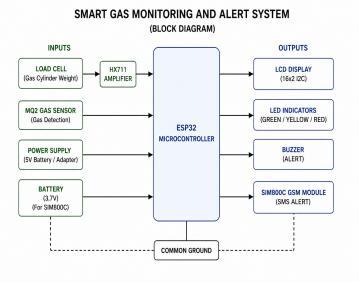
TheESP32processesthedatareceivedfromthesensors and compares it with predefined limits to decide the required action. When a gas leakage is detected, the system immediately activates the buzzer and LED indicatorstoprovidealocalwarning.Atthesametime, notifications present through Wi-Fi for remote monitoring.Foradditionalsafety,anoptionalrelaywith a solenoid valve can be used to automatically stop the gassupplyduringemergencyconditions.Astablepower supply ensures smooth operation of all components. Whenthegaslevelfallsbelowthesetlimit,thesystem automatically initiates a booking request. Overall, the system shows effective coordination between sensing, processing,alerting,andautomationtoensuresafeand reliableLPGmonitoring.
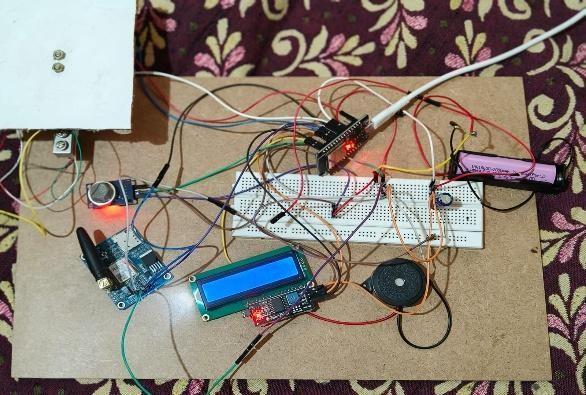
The hardware setup includes the ESP32 microcontroller,loadsensorwithHX711module,MQ-6 gas sensor, buzzer, LED indicators and a regulated powersupply.Theloadsensorisplacedbelowthe LPG cylindertomeasuretheweightofthegascylinderand displaysonmobile.TheMQ-2sensorispositionednear thecylindervalvetodetectanyleakageeffectively.Both sensors areconnected to the ESP32, which acts as the central controller of the system. The buzzer and LED provideimmediatealertswhenleakageorlowgaslevel isdetected.
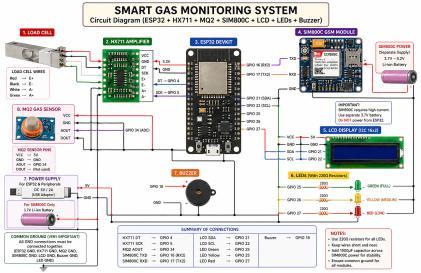
Fig2: CircuitDiagram
International Research Journal of Engineering and Technology (IRJET) e-ISSN: 2395-0056
Volume: 13 Issue: 04 | Apr 2026 www.irjet.net p-ISSN: 2395-0072
The software is developed using Arduino IDE and written in embedded c/c+. The ESP32 continuously reads data from the sensor and processes it to determine the gas level and leakage condition. The programcomparessensorvalueswithpredefinedlimits toidentifyabnormalsituation.Ifleakageisdetected,the system activates the buzzer and LED to alert the user. When the gas level becomes slow, a warning is generated, and the system initiates an automatic booking action using predefined logic. The software is designed to run continuously and provide stable performance.
System integration ensures that all components work together smoothly. The sensors provide input to the ESP32, which processes the data and makes decisions based on sets conditions. When abnormal conditions occur, the system generates alert through the buzzer and Led indicator. The automatic booking function is also triggered when the gas level becomes low. This coordination between sensing, processing and alert mechanisms ensures that the system operates efficientlyandmoresafety.
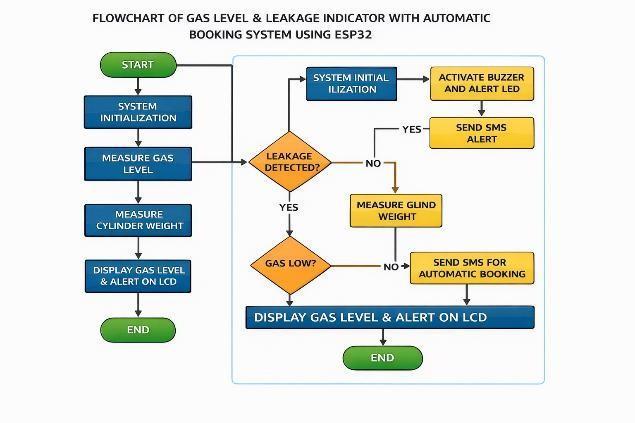
The developed system was tested under different conditions to evaluate its performance in gas level monitoring, leakage detection and alert generation. Theloadsensorwasabletomeasuretheweightofthe gascylinderaccuratelyandthesuccessfullyconverted thedataintoanestimatedgaslevel.Duringtestingthe readingchangedinaccordingtotheweightofthegas cylinder when the weight of the gas cylinder goes downitautomaticallybooksthecylinder.
The system is tested under different conditions to verifyitsaccuracyandperformance.TheMQ-6sensor istestedbyexposingittogastoconfirmquickleakage detection. The load sensor is tested with different weighttoensurecorrectgaslevelestimationESP32is
checkedforproperdataprocessingandstableoperation. ThealertsystemistestedtoensurethebuzzerandLED respondcorrectlyduringleakageandlowgascondition. The result show that the system works effectively, providingreliablemonitoringandtimelyalerts,making itsuitableforreal-worlduse.
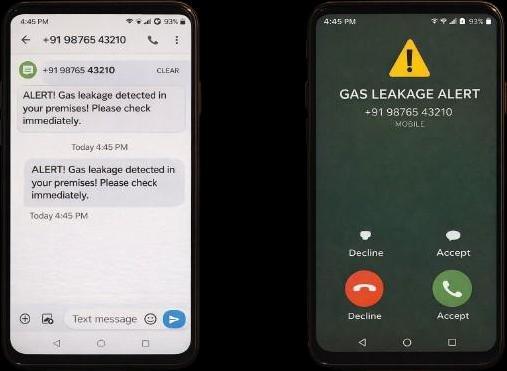
The alert system worked properly in both situations, including low gas level and gas leakage. When the gas level dropped below the predefined limit, the system generated a warning to inform the user. Similarly, during leakage conductions, the system provided instant alerts through the buzzer and LED. These featuresensurethattheuserisalwaysawareofcylinder conduction.
Thesystemperformancewasstableduringcontinuous operations. ESP32 microcontroller processed sensor dataefficiently and handled alltheoperationswithout any errors and works smoothly, providing accurate monitoringandquickresponse.
The developed system effectively monitors LPG cylinder conditions with high reliability. The load sensoraccuratelyestimatesthegaslevel,whiletheMQ6sensorquicklydetectsleakageandtriggersimmediate alerts. The system responds without delay, ensuring timelywarningtotheuser.Therefore,itenhancessafety andreducestheriskofaccidentsaswellasunexpected gas depletion. Overall, the system proves to be a practical and efficient solution for real-time LPG monitoring.
The overall the system performance of the developed system shows that it effectively monitors the gas level and reliably detects leakage conduction. Therefore, it reducestheneedofmanualcheckingandhelpsuserstake timely action to avoid hazardous situations and unexpected gas shortage. Hence, the project provides a practical and efficient solution suitable for real-life applicationssuchashomesandallindustriesworkings.
International Research Journal of Engineering and Technology (IRJET) e-ISSN: 2395-0056
Volume: 13 Issue: 04 | Apr 2026 www.irjet.net p-ISSN: 2395-0072
The developed LPG Gas Level and Leakage Indicator with Automatic Booking System successfully demonstrates a practical and efficient solution for improving safety and convenience in LPG usage. The system is capable of continuously monitoring the gas level using a load sensor and detecting leakage of gas using MQ-6 sensor. The ESP32 microcontroller effectively processes the data and generates timely alertsthroughabuzzerandLEDindicatorsitthebooking statusinmobileandsendsnotificationtomobile.
Therefore, the system reduces the need of manual checkingandhelpsinpreventingdangeroussituations caused by gas leakage or sudden gas depletion. The automaticbookingwhenthegascylinderiscompleted. Theoverallperformanceofthesystemisreliable,stable andsuitableforrealtimeapplications.
Hence,theproposedsystemprovidesasmartandcosteffective solution that can be used in households and commercialenvironmentstoimprovesafety,efficiency andeasetouse.
The proposed system can be further enhanced by incorporating additional features to improve its performance,safetyanduserexperience.Inthefuture, anautomaticgasshut-offmechanismusingasolenoid valve can be integrated to stop the gas supply. The systemcanalsobeextendedtosupportmultipleLPG cylinder,makingitsuitableforlargeapplicationssuch as apartments, restaurants and commercial setups wherecontinuousmonitoringisrequired.
Further improvements can include the development of a dedicated mobile applications that provides detailsinformationsuchasgasusageinall,alertlogs and system status in more user-friendly manner. Advantage data processing techniques can also be appliedtopredicttheremaininggasusagetimemore accurately,helpingusersplanrefillsinadvance.
In addition, the system can be integrated with smart home technologies to enable remote control and automation.Voice-basedcontrolandnotificationscan alsobeaddedtoenhanceuserconvenience.Therefore, withtheseimprovements,thesystemcanevolveinto a more advance, intelligent and fully automated LPG monitoringsolutionformodernsmartenvironments.
[1] S. Kumar and R. Sharma, “LPG gas leakage detection and prevention system,” International JournalofEngineeringResearch,vol.5,no.3,pp.145–150,2019.
[2]A.Patil,S. Deshmukh, andP. Pawar, “IoT basedLPG gas monitoring and automatic cylinder booking system,”InternationalJournalofAdvancedResearchin Electrical, Electronics and Instrumentation Engineering,vol.7,no.4,pp.1890–1896,2018.
[3] V. Ramya and B. Palaniappan, “Embedded system forhazardousgasdetectionandalerting,”International JournalofDistributedandParallelSystems,vol.3,no.3, pp.287–300,2012.
[4] M. A. Rahman, M. S. Hossain, and M. M. Rahman, “SmartgasmonitoringsystemusingIoT,”International Journal of Computer Applications, vol. 180, no. 32, pp. 20–25,2018.
[5] K.R.NatarajandP.S.Kumar,“LPGleakagedetection and automatic booking system using GSM,” InternationalJournalofScientificResearchEngineering &Technology,vol.6,no.5,pp.456–460,2017.
[6] P. S. Pandey and N. Kumar, “Loadcell based LPG gas level monitoring system,” International Journal of Innovative Research in Science, Engineering and Technology,vol.6,no.6,pp.11234–11239,2017.
[7]R.MishraandS.Agrawal,“IoTbasedsmartgasleakage detection system with real time alert,” International Journal of Engineering and Advanced Technology, vol.9, no.2,pp.2245–2249,2020.
[8] D. Singh and R. Singh, “Design and implementation of LPG gas leakage detection system using Arduino,” International Journal of Engineering Trends and Technology,vol.67,no.1,pp.45–49,2019.
[9]S. R. Prabhu and K. R. Ramesh, “Wireless LPG gas monitoringandleakagedetectionsystem,”International JournalofEngineeringResearch&Technology,vol.8,no. 6,pp.512–516,2019.
[10] N. Gupta and A. Sharma, “IoT based smart gas leakage detection and alert system,” International JournalofRecentTechnologyandEngineering,vol.8,no. 3,pp.2341–2345,2019.
[11]P. Verma and S. Singh, “Design of LPG leakage detection and automatic alert system using microcontroller,”InternationalJournalofScientificand ResearchPublications,vol.6,no.5, pp.123–127,2016.
[12] M.K.SharmaandR.Gupta,“SmartLPGmonitoring andbookingsystemusingIoT,”InternationalJournalof Engineering Science and Computing, vol.7, no.4, pp.10234–10238,2017.
[13] T. K. Reddy and V. S. Rao, “Gas leakage detection and control system using Arduino and GSM,” International Journal of Engineering Development and
International Research Journal of Engineering and Technology (IRJET) e-ISSN: 2395-0056
Volume: 13 Issue: 04 | Apr 2026 www.irjet.net p-ISSN: 2395-0072 © 2026, IRJET | Impact Factor value: 8.315 | ISO 9001:2008
Research,vol.5,no.2,pp.876–880,2017.
[14] A.K.SinghandP.Mishra,“IoTbasedgasleakage monitoringandalertingsystem,”InternationalJournal of Computer Science and InformationTechnologies, vol.9,no.2,pp.150–154,2018.
[15] R. K. Jain and S. Mehta, “Design and implementation of smart LPG monitoring system usingloadsensor,”InternationalJournalofAdvanced EngineeringResearchandScience,vol.5,no.3,pp.89–93,2018.