
International Research Journal of Engineering and Technology (IRJET) e-ISSN: 2395-0056
Volume: 13 Issue: 04 | Apr 2026 www.irjet.net p-ISSN: 2395-0072
International Research Journal of Engineering and Technology (IRJET) e-ISSN: 2395-0056
Volume: 13 Issue: 04 | Apr 2026 www.irjet.net p-ISSN: 2395-0072
Yuvika Appaiah1 , Atithya Narayanan 2 , Syed Usaid3
1Student, Dept. of Mechanical Engineering, BMSCE, Bangalore, India
2Student, Dept. of Mechanical Engineering, BMSCE, Bangalore, India
3Student, Dept. of Mechanical Engineering, BMSCE, Bangalore, India
Abstract - This report introduces an affordable ROV concept engineered for subsurface observation and environmentaldatacollection.Thecentralgoalofthiseffortis to produce an underwater platform that remains accessible whileperformingtaskstypicallyhandledbymoreadvanced or prohibitively costly autonomous systems[1]. By significantly lowering materialand manufacturing expenses, thisdesignseekstoremovethefinancialobstaclesoftenfaced by smaller academic teams and institutions in need of practicalunderwaterresearchtools[1]. Alow-budgetMarine Autonomous Robotic Vehicle Explorer offers an economical pathway for conducting underwater monitoring and surveillance within shallow aquatic regions, built at roughly ₹20,000 using a modular assembly and inexpensive hardware [2].Beyond affordability, such designs support quicker prototyperefinementcyclesthatareespeciallyvaluablewhen addressingevolvingmarineresearchneeds.Thesesystemsalso provide the flexibility to integrate customized scientific payloads, enabling the collection of targeted environmental data that would otherwise require costly equipment [3],[4]
By lowering economic and technical barriers, this approach widens participation in underwater science by enabling diverseresearchteams includingthosewithlimitedfunding toperformsustainedenvironmentalobservations.Thereport outlines the structural layout, component choices, and essential low-cost engineering strategies used to develop this accessible ROV platform. It further elaborates on the structural design and low-cost equipment crucial for developing such an accessible underwater vehicle. [5]
Key Words: Remotely Operated Vehicle (ROV), Underwater inspection, Low-cost marine technology, Environmental monitoring, Modular payload architecture
The growing demand for comprehensive underwater research and monitoring has amplified the significance of unmannedunderwatervehicles,includingbothAutonomous Underwater Vehicles and Remotely Operated Vehicle[6] These robotic systems are indispensable across a wide spectrum of critical applications, including military operations and scientific research. Furthermore, they contribute significantly to sustainable development goals
through the sustained monitoring of the physical and chemical parameters that define the state of aquatic environments [7].The broad implementation of sophisticated commercial ROVs is often constrained by significant capital investment requirements. The considerable financial outlay required for purchasing, operating, and maintaining these sophisticated systems often creates significant barriers for smaller research groups, educational institutions, and regions with limited resources.Suchfinancialobstacleshavedirectlyresultedin majorgapsinourknowledgeconcerningoceanexploration andcharacterization,aproblemthatisparticularlyacutein marineenvironments[8]
Inresponsetothesechallenges,thereisaclearneedforthe development of low-cost ROV. Recent advancements in technology, coupled with the increasing availability of affordable off-the-shelf components and modern manufacturing techniques have made it feasible to design and construct capable ROVs at a fraction of the cost of traditional system [9]. This new way of working makes it easytoquicklytestandimprovedesigns.Thisencourages new ideas and allows for important underwater research andexplorationthatwouldbetooexpensiveotherwise[10].
For the past three decades, Remotely Operated Vehicles (ROVs) have been deployed globally by various organizations to access underwater locations otherwise inaccessibletohumandiversorotherconventionalmethods. Recently, ROVs have expanded their roles, now executing tasks traditionally performed by divers, such as hull cleaning,primarilydrivenbyeconomicnecessityandsafety concerns. While the performance and reliability of commercial ROV equipment have continuously improved overthisthirty-yearspan,thesetechnologicaladvancements haveunfortunatelyresultedinsubstantiallyincreasedcosts thus making it our primary objective to minimize these operationalcosts[11].
Thisreportdetailsasystematicapproachtodesigningalowcost,RemotelyOperatedVehicleforsubsurfacesurveillance and environmental monitoring. By emphasizing the integration of readily available components which are inexpensive, this report aims to bridge the gap between expensivecommercialsystemsandcost-effectiveROVs[12]
The proposed design here intends to create an affordable platformcapableofperformance,therebyprovidingaccess to essential underwater exploration and data acquisition
International Research Journal of Engineering and Technology (IRJET) e-ISSN: 2395-0056
Volume: 13 Issue: 04 | Apr 2026 www.irjet.net p-ISSN: 2395-0072
necessities for a broader community of researchers and educators[3][8]
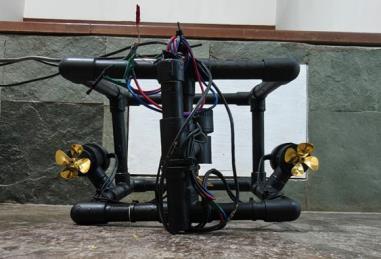
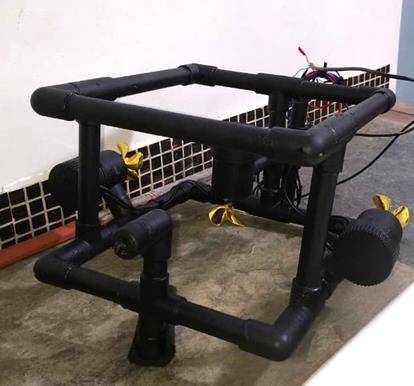
TheRemotelyOperatedVehicle(ROV)showninFigures1(a) and 1(b) is specifically designed for exploring lake beds, prioritizing cost-effectiveness, portability, and straightforwardcontrol.Acrucialelementofthisdesignis enabling real-time data transmission between the vehicle and the human operator. The presence of an operator is considered essential for successful expeditions, as human judgmentallowsforimmediateadaptationtotheunexpected and often unpredictable changes inherent to the lake environment [13]. In the broader industry, contemporary ROV platforms are systematically classified based on key specifications, including their physical size, operational depth rating, power source, horsepower, and overall functionalcapability.
The current landscape of underwater surveillance and monitoringisfundamentallyconstrainedbytherelianceon complex, and prohibitively expensive Remotely Operated Vehicles(ROVs).Theseplatformsoftenrequirespecialized equipment,extensivelogisticalsupport,andhighlytrained personnel, making routine checks and ease of access unattainable for many organizations and individuals. This limitationhinderscriticalactivitieslikerapidenvironmental assessments, small-scale infrastructure inspections, and academictrainingprograms.
WeareintroducingaprototypeshiftwithourLow-Cost Underwater ROV. This solution is purpose-built to be compact,modular,andexceptionallycost-effectivewithout sacrificingessentialperformance.OurROVprovidesanagile, easily deployable, and accessible platform that brings the capability of underwater observation out of the highly specialized domain and into the hands of a much broader userbase.Thisapproachdirectlyaddressesthefinancialand logisticalbarriersthathavehistoricallylimitedunderwater exploration and data collection, thereby democratizing accesstocrucialaquaticinsights[14].
The global demand for underwater exploration, data acquisition, and robotics training is accelerating across multiplesectors.Ourprimarygoalistoaddressthisneedby providing a cost-effective and readily accessible platform. Thissystemisidealfor:
EducationalInstitutions:Allowingstudentstogain hands-on experience in marine robotics, control systems,andoceanography.
SmallBusinesses&NGOs:Enablingaffordabledata collection for local environmental projects or inspectionservices.
Hobbyists & Researchers: Providing a tool for independentdiscoveryandpreliminaryfieldwork.
Rapid Deployment Operations: Offering quick and efficient surveillance capabilities for immediate responsescenarios,suchasdisasterassessmentor localizedpollutiontracking[15]
The long-term impact of this low-cost solution is the democratization of access to subsurface monitoring for a diversearrayofessentialapplications:
EnvironmentalMonitoring:Facilitatingfrequent,widespread monitoringofcoralreefs,aquaticecosystems,andpollution levels, enabling prompt conservation efforts and dataintensiveresearch.[15],[16]
InfrastructureInspection:Providinganaffordablemeansfor routine checks of submerged assets such as bridge piers, damwalls,andmunicipalwaterpipes,significantlylowering maintenancecostsandincreasingsafety.[15],[17]
ThetotalexpenditureformanufacturingtheprototypeROV wasmeticulouslydocumented,amountingtoabudgetunder rupeestwentythousandwhichisnotablycompetitivewhen benchmarkedagainstcommerciallyavailableROVsthatare typicallymoreexpensive.Thiscost-effectivenessisprimarily attributedtothestrategicselectionofreadilyavailable,offthe-shelf components and the adoption of simplified manufacturingtechniques,whichsignificantlyreduceboth material and labour costs without compromising fundamental operational capabilities [18]. This cost reductiondirectlyaddressestheprevalentissueofexpensive underwater equipment, making advanced surveillance accessible to a wider range of users including smaller research groups, educational institutions, and even hobbyists [3], [10], [19]. Moreover, the utilization of commercial-off-the-shelfcomponents,asopposedtocustomfabricatedparts,drasticallylowersmanufacturingexpenses [20]. This strategy not only reduces the initial investment
International Research Journal of Engineering and Technology (IRJET) e-ISSN: 2395-0056
Volume: 13 Issue: 04 | Apr 2026 www.irjet.net p-ISSN: 2395-0072
but also simplifies maintenance and part replacement, as these components are widely available and often interchangeable[20][21]
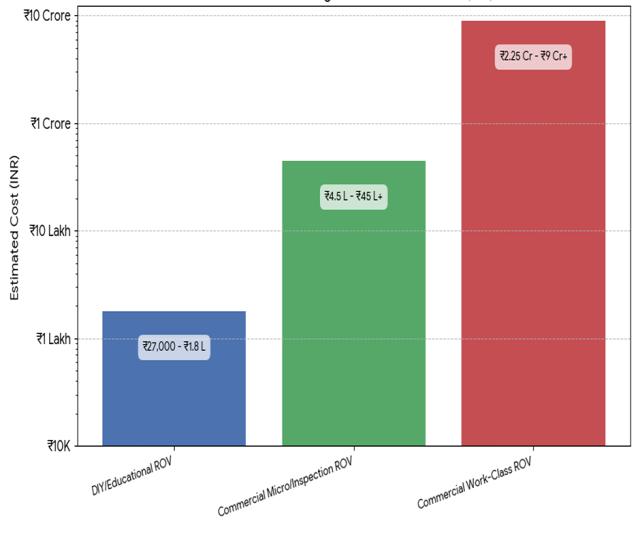
The bar chart shown above illustrates the estimated cost rangesfordifferentclassesofRemotelyOperatedVehicles (ROVs), with values in Indian Rupees (INR). The cost categoriesare:
• DIY/EducationalROV:(Likeourproject)
• Commercial Micro/Inspection ROV: (Entry-level professionaltools)
• Commercial Work-Class ROV: (Heavy-duty industrialmachines)
TheY-axisemploysalogarithmicscaletoclearlyillustrate thesubstantialvariationsincostmagnitudes. Akeyinsightisthestriking,non-linearcorrelationbetween ROV classification and financial outlay, where expenses increaseexponentiallywithgreaterdepthratings,reliability, andadvancedfeaturerequirements.
• DIY/EducationalROVspresentanexceptionallylow barrier to entry, making this technology accessibletohobbyistsandacademicinstitutions withaninitial investmentunderrupees2lakh. This price point is transformative for practical learning and small-scale, shallow-water investigations.
• The transition from an educational unit to a Commercial Micro/Inspection ROV signifies an approximate 25-fold increase in cost at the higher end. This jump reflects the inclusion of professional, pressure-rated components and sealedbrushlessthrusters.
• Themostsignificantfinancialescalationoccurswith the move to a Commercial Work-Class ROV, demanding investments in the tens of crores. Thisimmensecapitalexpenditureisreservedfor highlyspecialized,mission-criticaloperationsin extreme conditions, necessitating robust,
certified components such as titanium frames andpowerfulhydraulicsystems[22][23]
Ultimately,thegraphsupportsthestrategicchoicetopursue a DIY design: while our ROV compromises on deep-water capabilities,itdeliversunparalleledvalueandaccessibility for fundamental inspection and educational purposes, effectively separating functional underwater access from multi-crorebudgets.Thiseconomicalapproachencourages wideradoptionandexperimentation,fosteringinnovation and broadening the practical applications of underwater roboticsbeyondtraditionalhigh-costendeavours[20][3].
Table -1: Componentandcostanalysis(inINR).
Component
Our ROV (DIY/Educational)
ROV
PriceRange (Initial Cost) ₹27,000 –₹1,80,000 ₹4.5
Frame Material
PVC pipe, Acrylic, 3D-PrintedPlastic
Aluminum, Reinforced Composites
Depth Rating
Thrusters
Shallowwater (≈10–30m)
Mediumdepth (≈100–300m)
ModifiedhobbyDC motors, small COTSthrusters
High-efficiency, sealed brushless thrusters
ROV
Sensors
Tether
Basic camera, depth sensor, simpleIMU
4K/HD Camera, Sonar (optional), DVL, advanced IMU
Titanium, High-Grade Aluminum Alloys
Extreme depth (600m to 3,000m+)
Powerful hydraulic or high-voltage electric thrusters
Advanced multi-beam Sonar, Manipulator Arm(s),NDT probes
Simple CAT5/Ethernet or thinnercable
High-strength, armored, neutrallybuoyant cable Reinforced umbilical with Fiber Optics
Theanalysis,visuallysupported by the accompanying bar graph, clearly demonstrates that the financial outlay for underwaterroboticstechnologyescalatessignificantlywith increased depth ratings and industrial certifications. Our
International Research Journal of Engineering and Technology (IRJET) e-ISSN: 2395-0056
Volume: 13 Issue: 04 | Apr 2026 www.irjet.net p-ISSN: 2395-0072
projecteffectivelynavigatesthiscapital-intensivedomainby achieving remarkable cost-effectiveness, thereby making underwater exploration functionally accessible at an educationallevel[18]
OurROV,constructedforapproximately₹20,000,represents a transformative platform. In stark contrast to entry-level Commercial Micro/Inspection ROVs, which typically commence at ₹4.5 Lakh, our design fulfills its primary objectives visual inspection and basic shallow-water maneuverability at a cost less than 5% of the cheapest professionalalternatives.
This favourable cost-to-capability ratio offers three key advantages:
1. Democratization of Technology: It removes the significantfinancialhurdlestypicallyassociated withunderwaterrobotics,makingitavailableto students, researchers operating with limited funding, and small-scale environmental monitoringinitiatives,particularlywithinIndian waterways[3],[10],[19]
2. Learning and Development Platform: The minimalinitialinvestmentencourageshands-on experimentation, risk-taking, and rapid design iteration,whicharecrucialelementsforpractical engineering education and the development of roboticsskills.
3. LocalApplicability:TheROVisideallysuitedfor common regional applications, such as the inspectionofponds,lakes,andtanks,orcoastal ecosystem studies. In these contexts, extreme depth capabilities and industrial certifications arelesscriticalthanaccessibility,easeofrepair, and the utilization of readily available, commercial-off-the-shelfcomponents[20],[21]. In essence, the affordability of our ₹20,000 ROV unequivocally demonstrates that sophisticated, missionrelevant underwater robotics can be achieved without requiring multi-lakh expenditures. This positions our solutionasahighlyefficientandsociallyresponsibleoption forbotheducationalandlocalizedscientificapplications.
Table -2: Ourlow-costROVcostpercentagebreakdown
Component
Thrusters/Motors (x3) ₹6,000 30% Costreduced by dropping motors, lowering the total percentage.
Controller/Electronic s ₹8,000 40% Reflects investment in quality ESCs or advanced sensors.
Camera&Lights ₹3,000 15%
Tether&Connectors ₹2,000 10%
Dedicated budget for a basic visual feedback system.
Essential costs for power and communicati onlines.
Frame(PVC)&Foam ₹1,000 5%
Total ₹20,000 100%
Negligible cost due to simple PVC material choice.
1. OurROV:Moneygoesmainlyintofunctionality (thrusters/electronics).
2. Commercial ROV: Money is heavily spent on reliability (pressure hull) and advanced data (sensors).
This section systematically outlines the engineering approach used to create our low-cost submarine for underwatermonitoring.Itdetailstheiterativedesigncycle, covering everything from initial concepts and the careful selectionofcomponentstothepracticalstepsoffabrication and comprehensive testing. This rigorous process was undertakentoensurethevehicleisbothfullyfunctionaland trulycost-effective.
The selection of a box-like, open-frame structure for the RemotelyOperatedVehicle(ROV)asshowninFigure2isa deliberate engineering trade-off that prioritizes ease of fabrication and adaptability. This design choice, characterized by its inherently simple and rectangular geometry, offers several key advantages that make it particularlywell-suitedforsubsurfacesurveillance[24]
International Research Journal of Engineering and Technology (IRJET) e-ISSN: 2395-0056
Volume: 13 Issue: 04 | Apr 2026 www.irjet.net p-ISSN: 2395-0072
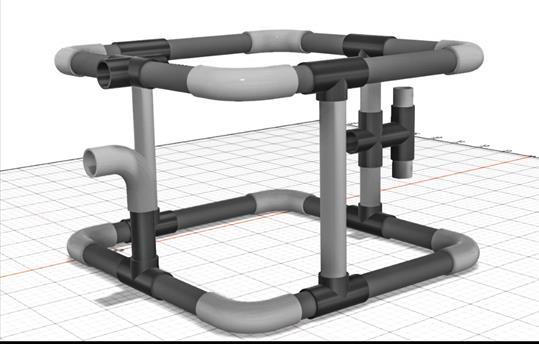
StructuralandModularBenefits
• SimplicityandCost-Effectiveness:Thisrectangular shapeallowsforstraightforward,low-complexity manufacturing and assembly, minimizing fabricationcostsandtime.
• AdaptabilityandExpansion:Theopen,multi-sided frame provides an extensive surface area with numerous accessible points for component attachment[24]
• Thisfacilitatesthemodularintegrationofcameras, motors, lights and additional instrumentation, cateringtodiversemissionrequirementswithout extensiveredesign[25][16]
ManeuverabilityandControl
• Zero Steady Turning Radius: The symmetry and rigidity of the box-frame, coupled with strategicallyplacedthrusters,enabledecoupled translationalandrotationalcontrol.Thisallows the ROV to achieve a zero steady-state turning radius itcanrotatepurelyaboutitsverticalaxis withoutanyforwardorlateralmotion(yawingin place),whichiscriticalforprecisepositioningin confined environments or close-quarters inspection. This enhanced maneuverability is crucial for navigating complex underwater topographies and performing detailed inspectionsofstructures[26].Furthermore,the wide structure of the frame facilitates optimal thruster placement, maximizing torque generationforagilemovementssuchasspinning [27]
• OptimizedStabilityProfile:Thegreaterthedistance between center of gravity and the center of buoyancy, greater is the static and dynamic stability of the ROV, making it resistant to roll and pitch when operating in unpredictable underwater environments. This stability enhances overall operational reliability and minimizes the power required to maintain a
desired orientation, particularly during precise inspectiontasks[17]
Theselectionofmaterialsforthelow-costROVprioritizesa balancebetweenstructuralintegrity,corrosionresistance, weight,andmanufacturabilitytoensurebothperformance andeconomicviability.Polyvinyl Chloridepipe(PVC)was chosen for the construction due to its optimal balance of characteristics, specifically its contribution to weight reduction, inherentcorrosionresistance, neutral chemical behaviour, and acceptable stiffness and shock absorption [13].ThewidespreadavailabilityofPVCpipesandfittings allowsforstraightforward,low-complexitymanufacturing andassembly,minimizingfabricationcostsandtimeasthey canbeeasilycut,drilled,andjoinedusingreadilyavailable toolsandepoxyglue.Thiseaseoffabricationiscrucialfor rapidprototypingandrepair[28]
Fromastructuralperspective,PVC'sinherentrigidityinpipe formprovidessufficientsupportfortheROV'scomponents andpayloadunderexpectedoperationalloads,contributing significantlytoitsoverallstructuralintegrity.Unlikemany metals,PVCisentirelyinerttowatercorrosion,eliminating theneedforprotectivecoatingsandsignificantlyextending theROV'slifespaninharshmarineenvironments.Thisalso mitigates the risk of galvanic corrosion when the frame interactswithothermetalliccomponents[28]
Furthermore,PVC'srelativelylowdensitycontributestothe overall weight reduction of the ROV, which simplifies buoyancy control and reduces the power demands on the thrusters,therebyimpactingbatterylife.Itsneutralchemical behaviourensuresitdoesnotleachharmfulsubstancesinto the water and remains stable across varying water chemistries. While rigid, PVC also possesses a degree of flexibility that allows it to absorb minor impacts and vibrations, protecting sensitive internal components from shock damage during operation or handling. The design approach consciously minimized the use of metal in the frame to reduce both cost and weight, simultaneously mitigating the risk of galvanic corrosion in water. The suitabilityofPVCwasfurtherconfirmedbyitscapabilityto withstand the operational pressure requirements while remainingcost-effective,therebyvalidatingitsroleasakey structuralcomponentfortypicalshallowtomoderatedepth ROVoperations[28].
The selection of an endoscopic camera for the ROV was drivenbyitsoptimalbalanceofcharacteristicsessentialfor low-cost,effectiveunderwatersurveillance.Itscompactsize minimizes hydrodynamic impact, contributing to the vehicle'smaneuverabilityandreducingpowerconsumption [29],[30].Therobustandoftenwaterproofconstructionof endoscopic cameras makes them inherently suitable for challengingaquaticenvironments,ensuringdurabilityand
International Research Journal of Engineering and Technology (IRJET) e-ISSN: 2395-0056
Volume: 13 Issue: 04 | Apr 2026 www.irjet.net p-ISSN: 2395-0072
reliable performancewithoutrequiring extensivecustombuilt pressure housings [31]. Furthermore, the ability of thesecamerastodeliverclearvideofeedsfacilitatesdetailed observation and inspection tasks crucial for scientific research and environmental monitoring [32], [33] Economically,thesecamerasareacompellingchoicedueto theiraffordabilityandwidespreadavailability,makingthem accessible to a broader community of researchers and educators and helping to overcome the financial barriers typically associated with advanced underwater imaging systems [8], [34], [35], [36]. This approach allows for the developmentofcapableunderwatervehiclesatafractionof the cost of traditional systems, democratizing access to crucialaquaticinsights[4],[18].Theintegrationissimplified throughversatileconnectivitylikeType-CUSBcables,which providebothpoweranddatatransmission,andtheirsmall formfactorallowsforsecureencasementwithinprotective PVC piping and affixation with simple cable ties, thereby safeguarding the sensitive imaging device from physical impacts and water pressure while maintaining a stable viewingplatform[28]
5.1
TheROV'spropulsionsystemisengineeredforbothprecise depth control and versatile horizontal movement. The verticalthruster,crucialforcontrollingascentanddescent, employs a readily available and cost-effective modified 1100-gallon-per-hour bilge pump [37]. These pumps are favoredfortheirsimplicity,durability,andlowacquisition cost,makingthemidealforbudget-consciousdesigns.This pump is meticulously mounted vertically and structurally integratedusingarobustPVCthree-wayconnector,which providesasecureandstablehousing,minimizingvibration andensuringefficientpowertransfertotheimpeller. For horizontal locomotion, the ROV is equipped with two modified1100-gallon-per-hourbilgepumps.Thesespecific pumpswereselectedfortheirinherentpowerandpotential for adaptation, providing sufficient thrust for effective maneuverability [38]. To achieve enhanced thrust and propulsive efficiency, a significant modification was undertaken:theoriginalbottomhousingofeachbilgepump was carefully removed, and the factory-standard impeller was replaced with a custom-designed propeller. This alteration significantly improves the hydrodynamic characteristics by optimizing blade shape and pitch for underwater propulsion, allowing for greater thrust generation and more agile maneuverability through the watercolumncomparedtothelessefficientstockimpellers [39]. The strategic placement of these thrusters one verticalandtwohorizontal enableseffectivecontrolover theROV'stranslationalmovements(forward,backward,up, down)androtationalmovements(yaw),facilitatingprecise navigation and positioning in various underwater environments[40].
ThetetherservesastheindispensablelifelinefortheROV, actingastheprimaryconduitforbothcriticalcontrolsignals andelectricalpowertransmissiontothepropulsionsystems. This dual functionality is efficiently managed through a durableCat5eEthernetcable,whichoffersmultipletwisted pairs suitable for reliable data and low-voltage power transfer, benefiting from its widespread availability and robustness in outdoor applications [41]. Crucially, the onboard camera, responsible for capturing real-time underwater video, operates independently, relying on its own dedicated video/power cable. This separation minimizes potential electromagnetic interference with sensitivecontrolsignals,ensuringstableROVoperation,and alsoguaranteesoptimalvideoqualitywithoutdegradation frompowerfluctuationsordatacrosstalk[42].Forenhanced operationalstability,improvedhydrodynamicefficiencyby reducing drag, and to prevent entanglement with underwaterobstaclesortheROVitself,allpowercables,data lines,andthepolypropyleneropearemeticulouslybundled together using industrial-grade cable ties and weatherresistant electrical tape, creating a streamlined and organizedumbilicalcable[28].
Acomprehensivepowermanagementsystemisintegrated to ensure efficient distribution and regulation of the 12V supply to various components, including the thrusters, tether,andthecamerasurveillancesystem[43].Thissystem iscriticalforpreventingovercurrent’s,protectingsensitive electronics,andoptimizingbatterylife.Directionalcontrol fortheROV'sthreethrustermotorsisachievedthroughthe use of three momentary Double-Pole, Double-Throw switcheslocatedinitscontrolbox.Eachswitchfunctionsasa mechanicalH-bridge,acommoncircuitconfigurationusedto controlmotordirection,enablingthereversalofthemotor's electricalpolarity.Thispolarityreversalisaccomplishedby a criss-cross wiring pattern on the four outer terminals, where a dedicated positive wire and a negative wire are connected diagonally across the switch contacts. The switch's two centre terminals act as the output poles, directlylinkingtothethrustermotorleads[13],[25].Power forallthreeswitchesissuppliedinparallelfromthemain 12Vbatterybus,ensuringconsistentvoltagedeliverytoeach thruster.Themomentarynatureoftheseswitchesiscrucial forsafetyandprecisecontrol,asitensuresimmediatepower cutofftothethrusteruponrelease,preventingunintended continuousoperation[44]
The ROV's entire electronic system, encompassing all thrusters and the camera, is powered by a robust 12V lithium-ion battery. This specific battery chemistry was selected for its high energy density, providing significant
International Research Journal of Engineering and Technology (IRJET) e-ISSN: 2395-0056
Volume: 13 Issue: 04 | Apr 2026 www.irjet.net p-ISSN: 2395-0072
powerrelativetoitsvolumeandweight;anditsconsistent poweroutputthroughoutitsdischargecycle,ensuringstable performance [45]. With an approximate capacity of 2000mAh, this power source is engineered to provide an operationaldurationofabout4to5hours,dependingonthe intensityofthrusterusageandotherelectricalloads,offering ampletimefortypicalinspectionormonitoringmissions.As a rechargeable unit, this battery is central to the ROV's operational autonomy, serving as the sole and primary power source [28]. For missions requiring extended operational periods, an external power supply can be integrated, delivering continuous power via the tether to circumvent battery life limitations [46]. This approach allowsforprolongedsubsurfacedeploymentnecessaryfor extensive surveillance and data collection efforts, thereby expandingtheROV'sutilitybeyondtheinherentconstraints ofonboardbatterycapacity[47].Thisdesignconsideration highlights a crucial trade-off between untethered operationalflexibilityandprolongedmissionendurance,a commonchallengeinautonomousunderwatervehicleand remotelyoperatedvehicledesigns[48]
Forcomprehensiveunderwatervisualization,anadvanced endoscopic camera,equippedwitha versatileType-CUSB cable,ispreciselyintegratedintotheROV'sframework.To ensureitslongevityandreliableperformance,thesensitive imagingdeviceissecurelyencasedwithinaprotectivePVC pipe. This enclosure not only shields the camera from potentialphysicalimpactsandtheincreasingwaterpressure atdepthbutalsoprovidesastablehousingthatallowsfor effortlessadjustmentofitsviewingangleandfocalposition through simple mechanical means, offering flexibility in surveillancetasks[49].Thiscameraisspecificallychosenfor its compact size, which allows for minimal hydrodynamic impact;its robust, often waterproof,construction suitable for challenging aquatic environments; and its ability to deliver clear video feeds, facilitating detailed observation and inspection tasks [50]. The entire camera assembly is thenfirmlyaffixedtotheROV'sbasegridusingdurablecable ties, preventing any unwanted movement or vibration during operation that could degrade video quality. The camera comes pre-equipped with in builtlightsas well as supporting lights attached to the front face of the ROV to increase visibility. The Type-C USB cable is thoughtfully routed through the internal structure of the ROV frame, connecting directly to the control system to provide both continuous electrical power, leveraging its capacity for higher power delivery, and facilitate the real-time transmission of high-quality video footage to the surface operator[28]
BuoyancyControl:Themainpurposeofthefoamtubesisto counteracttheweightofthe ROV'scomponents,including
the PVC frame, motors, and wiring, to achieve neutral buoyancy [51]. Without these flotation elements, the ROV wouldbenegativelybuoyantandwouldsimplysink[51].By strategically adding foam, an upward buoyant force is introducedthateffectivelybalancestheROV'soverallweight in water, allowing it to "hover" at a desired depth with minimalrelianceontheverticalthrusterforstation-keeping [48], [52]. This precise buoyancy management is a fundamentalaspectofunderwatervehicledesign,crucialfor operationalefficiencyandstability[23],[53]
Stability:Thestrategicplacementoffoamtubesiscriticalfor maintaining the ROV's stability, helping to keep it upright and preventing it from flipping unexpectedly [54]. This is achievedbypositioningthefoamtubeshighontheframe, whichraisesthevehicle'scenterofbuoyancy[54].Ensuring thecenterofbuoyancyisabovethecenterofgravity where heavier components like motors are typically situated providestheROVwithinherentstabilityandaself-righting tendency[48],[51]
Modifiability: Foam tubes offer a practical solution for adaptingtheROV'sbuoyancyduetotheireaseofadditionor removal.Thisallowsforquickadjustmentstoaccommodate different payloads, such as additional cameras or tools, ensuringtheROVremainsneutrallybuoyantdespitechanges in its overall weight [55]. Furthermore, this modifiability facilitatesadjustmentsforvaryingwaterdensities,whether operatinginfreshwaterorsaltwater,asthebuoyantforce requiredwilldiffer[56],[57].Theuseoffoam,particularlyin low-costdesigns,alsopresentsaneconomicalalternativeto more complex and expensive buoyancy compensation systems, enabling greater accessibility and flexibility for researchers[4],[10],[58]
The forces acting on a Remotely Operated Vehicle (ROV) changedrasticallyuponsubmersionduetotherapid,linear increase in hydrostatic pressure with depth ,i.e, the magnitude of the normal force exerted on the ROV's pressurevesselescalatessignificantlyasthewatercolumn's weightabovethevehicleincreases[55]
P = γ x (Eq.1)
Where:
Pisthepressure[Pa]
γisthespecificweightofthefluid[N/m3]
histhedepth[m]
International Research Journal of Engineering and Technology (IRJET) e-ISSN: 2395-0056
Volume: 13 Issue: 04 | Apr 2026 www.irjet.net p-ISSN: 2395-0072
Table -3: Specificweightofwateratstandard atmosphericpressure(metricunits).
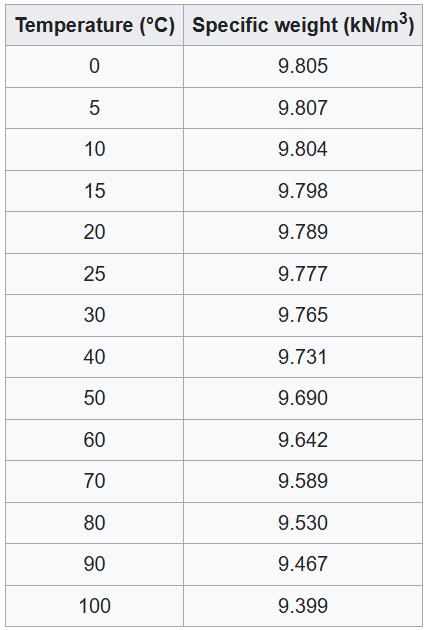
Consideringanaverageofthespecificweightsfrom15–30 °C.
Whenanobjectisimmersedinaliquid,theliquidgenerates a force that tends to push the object towards the surface, knownasthebuoyantforceB,givenbytheequation, B = ρgV (Eq.3) where:
ρisthedensityofthefluid gistheaccelerationduetogravity Visthevolumeofthedisplacedfluid.
1. RequiredVolume(V)forNeutralBuoyancy:

. (Eq. 4) (Thisassumesthewaterisfreshwaterat4°Cwithadensity (ρ)of1000kg/m3).
2. BuoyantForce(B)atNeutralBuoyancy:

Averagespecificweightoffluid= =9772
P=9772x10m=97720=0.0977MPa
This calculation confirms that at a depth of 10 meters the wateritselfexertsapressureofapproximately 0.0977MPa
The critical pressure of a material is the absolute, maximumamountofforceperareaitcanhandlebeforeits structuralintegrityispermanentlycompromised.Exceeding this ultimate pressure limit guarantees the material will undergofailure[55].
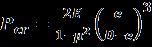

=Criticalpressure(failurecondition)[Pa]
E=Modulusofelasticityofthematerial[GPa]
e=Pipethickness[m]
D=Externaldiameterofthepipe[m]
μ=Poisson'sratio
(Eq.2)
Theimmersionsystemfacilitatestheverticalmotionofthe ROVinthewater.Theexistingwaysforimplementingthe immersionsystemare:
a) Mechanical method by using propellers to achieve the displacement,and
b) Hydraulic method by using ballast tanks which can be filledwithwaterorairinordertosubmergeoremerge.For thesakeofsimplicity,wehaveusedthemechanicalmeansof immersion.Bysimplifyingtheequationcancellingg,wecan find the volume required to displace water equal to the ROV'smass:
Fromourprototype,wehaveassumedtheweightoftheROV to be 4kgs. TheconclusionthattheROVisneutrallybuoyantwhenfully submerged and displacing 0.004m3 The shape being cuboidaldoesnotaffectthecalculationforbuoyancy.
Substituting the values, elasticity for PVC as 2.89 GPa, the Poisson’sratioas0.41thethicknessofthepipeby3.15x103, and the outside diameter of the pipe as 22.2 x 10⁻³m, a criticalpressureof 0.314 MPa wasobtained[55]
Since the maximum pressure the ROV can withstand is 0.314MPawhichisgreaterthanthepressureitwillactually experience0.0977MPa,thestructurehasa factor of safety and is deemed safe for operation at the depth of 10m indicating that the ROV would be safe under the working conditions[55].
The core objective is tocalculate the drag force, which represents the specific amount of physical resistance the water exerts on the ROV as it moves at maximum speed. Once this is precisely known, we use it to determine the powerthatthethrustermotorsmustcontinuouslygenerate, ensuring the ROV can consistently overcome the water's opposition.
Thedragforceisdeterminedbyamodifieddragequation thatsumsuptheresistancefromboththeROV'smainbody anditsattachedumbilicalcable.
International Research Journal of Engineering and Technology (IRJET) e-ISSN: 2395-0056
Volume: 13 Issue: 04 | Apr 2026 www.irjet.net p-ISSN: 2395-0072
Wehave3motorsof8.5Wcapacityeach=3x8.5W= 25.5 (Eq.7)
(Eq.5)
Density(ρ)1000kg/m3
Velocity(V)=0.25722m/s
TheconclusionthattheROV'smaximumspeedis0.5knotis typicallynotadirectmeasurement,butadesignassumption basedonseveralpracticalandengineeringconstraintsfora small,observation-classROV.Limitingthespeedto0.5knot reduces the required motor power and overall energy consumption. This is crucial as it increases their run time [13]
DragCoefficient(Cd)ofROV1.5-2(Thisvalueisanestimate basedonthebluffshapeoftheROV)
FrontalArea(A)0.09m2(thisisthecross-sectionalareathat faces the water flow. The dimensions are 30cm×30 cm.
Convertingtometers:0.30m×0.30m=0.09m2)
Drag Coefficient of the chord – 1.2 since diameter of the chordis1.5cm
Maximumavailablethrust: Usingthetotalavailablepower andthehighesttheoreticalpropellerspeedfrom ouranemometermeasurement5m/s–
Drag coefficient = 5.54N
The sum of the two drag components is 5.54N. Drag equations often don't account for the fact that a moving objectalsoacceleratesthewateraroundit(theaddedmass effect). To account for this, an extra 10% is added to the result[13].
Correction=10%x5.54N=0.554N
Final Drag Force (Fd): 5.54N+0.554N= 6.094N
Thepowerrequiredistheamountofenergypersecond neededtopushtheROVagainstthedragforce.
Power = Force × Velocity (Eq.6)
⒈ Force(Fd):6.094N(Thefinalcorrecteddragforce).
⒉ Velocity(V):0.25722m/s(Themaximumspeedof1 knot).
⒊ Calculation:

=6.094N×0.25722m/s= 1.57Watts
This means the ROV thrusters must supply at least 1.57 Wattsofmechanicalpowertoovercomethedragandmove at its top speed so that the ROV can maintain a speed of 0.5knotsunderreal-worldoperatingconditions[13].
Based on the final drag force calculation, the continuous mechanical power required by the thrusters to move the ROVatitstargetspeedof0.5Knots:1.57WattsThismeans that0.5Knotsthrustersonlyneedtoconvert1.57Wattsof energyintothrust.
Thrust= (Eq.8)
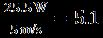
Themotorsystemprovidesamaximumof25.5W,whichis sufficienttomeetthe1.57Wrequirementfor0.5knotswith a massive safety margin. This confirms the motors are appropriatelysizedforthe0.5knottargetspeedbutcannot reachthehigherspeeds
6.5 Electrical Connections of the ROV
1. Total power and current
Poweroutput=Numberofmotorsxpowerpermotor =3x8.5= 25.5 (Eq.9)
Maximumcurrentdrawn= power/voltage = 25.5/12 = 2.13 A (Eq.10)
2. Battery run time (estimate) = Q/I =2000mAh/1000 = 2Ah (Eq.11)
Maxruntime–Q/I=2/2.13=0.94hrs = 56 minutes (Eq.12)
Thisisthetheoreticalruntimeatfullthrottle.SincetheROV istypicallymovingslowly,theactualcurrentdrawismuch lowerandtheactualruntimewillbesignificantlylonger.
Table -4: Componentsafetycheck
. Component System Requirement Component Rating Safety Status
Current 2.13A 15A Safe (Theswitchcan easilyhandlethe currentload.)
Voltage 12V 250V Safe (Theswitchis ratedformuchhigher voltagethan12V
Table -5: SummaryoftheROVElectrical
Parameter
Total Mechanical Power 3x8.5 25.5 Watts Maxphysicalpower availableforthrust.
International Research Journal of Engineering and Technology (IRJET) e-ISSN: 2395-0056
Volume: 13 Issue: 04 | Apr 2026 www.irjet.net p-ISSN: 2395-0072

Max Current Draw 2.13A Maxcurrentpulledfrom thebattery.

Theoretical Run Time 56 Minutes Runtimeatfull, continuousthrottle.
Switch Safety 15Arating vs2.13A draw 12.87A margin Componentsaresafely ratedforthesystem's demands.
ThissectioncomprehensivelyassessestheROV'soperational capabilities, focusing on its maneuverability, propulsion efficiencyforsubsurfacesurveillanceandmonitoring[60]
7.1
Computationalfluiddynamicssimulationsareessentialfor accuratelypredictingthehydrodynamicperformanceofthe submarine, particularly to analyse drag coefficients and propulsionefficiencyundervariousoperationalconditions [55]. These simulations allow for the optimization of hull forms and propeller designs, minimizing energy consumption and maximizing speed and maneuverability [61].Furthermore,numericalmodelscanpreciselyquantify complex fluid phenomena, such as turbulent flow and cavitation,whicharecriticalforrobustdesigndecisions[62]
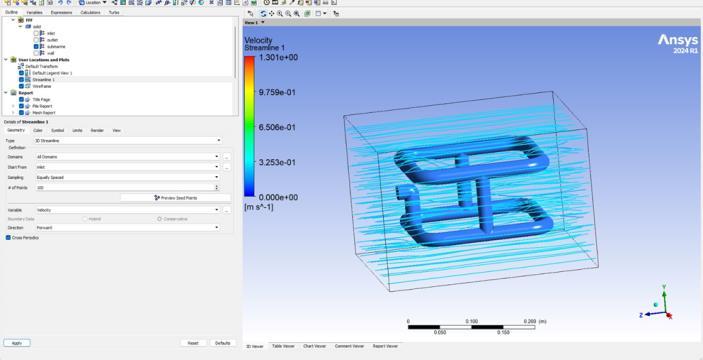
WehaverunanAnsysFluidFlowanalysistocalculatethe approximatedragthatourmodelwouldproducefortheboxlikestructure.Thisanalysishelpsindeterminingtheviscous dragthemodelexperiencesinwaterandsubsequentlyaids indecidingthepowerrequirementsfortheROV,assistingin itsoveralldesign[63].
The theoretical value calculated for the drag was 5.54N (excludingtether),whichalignswiththeexperimentaldrag forceof5.54Nobtainedfromthesimulation,thusvalidating theanalyticalpredictionsasshowninFigure3[64]
The primary validation of the Remotely Operated Vehicle wasexecutedwithinastabilizedlaboratoryenvironmentspecifically, a swimming pool. This controlled setting was imperativeforisolatingmechanicalvariablesandensuring thefundamentalintegrityoftheplatform’sarchitecture.Key engineering benchmarks achieved during this phase included:
Structural and Buoyancy Assessment: Confirming theframe'sresilienceagainsthydrostaticpressure andverifyingthatthedesiredneutralbuoyancywas maintained.
PropulsionSystemCalibration:Rigoroustestingof the thruster array to quantify thrust-to-weight ratios and ensure the vehicle could achieve the designatedvelocity.
Dynamic Stability Analysis: Evaluating the ROV’s centreofgravityandcentreofbuoyancytoprevent uncontrolledpitchingorrollingduringhigh-torque maneuvers.
Transitioning from laboratory conditions to a lake environmentprovidedacritical"real-world"stresstestfor thesystem.Operatinginanaturalbodyofwaterintroduced unpredictablevariablesthatcannotbereplicatedinapool, allowingforacomprehensiveevaluationof:
1. Environmental Resilience: Determining the system'sabilitytomaintainstation-keepingwhile subjectedtonaturalcurrentsandvaryingthermal layers.
2. Telemetry and Signal Fidelity: Validating the reliability of the communication tether and realtimedatatransmissionthroughwater.
3. Visual Navigational Clarity: Analysing how the onboard camera systems performed when navigating complex, unmapped lake-bed topography compared to the clear, geometric confinesofapool.
Withthesuccessfultransitionfromprototypetofield-tested system, the project’s roadmap focuses on expanding the ROV’s utility for broader scientific and industrial sectors. Futureiterationswillprioritize:
1. Essential Data Collection: To move beyond basic functional checksandcommencethecollectionof mission-criticalenvironmentaldataunderauthentic operationalstresses.
2. Performance Optimization: To conduct a comprehensiveseriesoftestrunsaimedatrefining the operational smoothness and minimizing potential failure points. This iterative testing and refinementprocessisnecessarytoensuretheROV operates robustly and reliably in its intended
International Research Journal of Engineering and Technology (IRJET) e-ISSN: 2395-0056
Volume: 13 Issue: 04 | Apr 2026 www.irjet.net p-ISSN: 2395-0072
application setting. This structured approach ensures that the vehicle moves logically from a verified prototype stage to a fully reliable system readyfordiversefielddeployment.
Despite these limitations, the successful fabrication and operational validation of the prototype underscore the considerablepotentialfordeployingsuchlow-costROVsin diverseapplications,particularlyforeducationalpurposes andpreliminaryenvironmentalmonitoring[26]
8.1
• Affordability and Accessibility: Theutilizationof readilyavailableandeconomicalcomponents,such asPVCpipingforthestructuralframe,bilgepump motorsforpropulsion,andstandardDouble-Pole, Double-Throw switches, significantly reduces the financial and technical barriers to constructing a RemotelyOperatedVehicle.
• Modular Design and Ease of Repair: The ROV's PVCframeisassembledusingfittingsandadhesive, which facilitates straightforward modification, disassembly,andreplacementofdamagedsections. This design choice simplifies troubleshooting and repair processes, this modularity also allows for easyupgradesandcustomization,enablingusersto adapt the ROV for specific mission requirements withouttheneedforextensiveredesign[54]
• Streamlined Control System: The reliance on DPDT switches provides a mechanically uncomplicated,robust,anddependablemethodfor reversingmotorpolarity.Thiseliminatestheneed for complex electronic speed controllers or microcontrollers. Furthermore, the momentary nature of these switches acts as a crucial safety feature,instantlycuttingpoweruponrelease.This design choice enhances operational safety by mitigatinguncontrolledmovementsandsimplifying user interaction, making it suitable for novice operators[65].
• Optimized Power-to-Weight Ratio: The incorporation of 12V bilge pump motors offers a high thrust-to-volume ratio. This provides ample power for fundamental maneuvering, especially consideringthelightweightnatureofthePVCframe structure. This careful selection of components ensuresefficientpowerutilization,acriticalfactor for extending operational endurance in batterypoweredunderwatervehicles[66].
8.2
• Limited Depth and Durability: Low-cost ROVs oftenfacesignificantlimitationsintheiroperational
depthandoveralldurabilityduetotheuseofmore economicalmaterialsandcomponents,suchasPVC hullsandlessrobustmotors[1].Whilesomelowcost designs can reach shallow depths, this is far more limited than the capabilities of commercial, higher-costsystems,whicharedesignedformuch greaterdepths[4],[18],[67].Generallimitationsin structure and durability, such as withstanding immense crush force or functioning in aggressive high-pressure environments,areinherent in such cost-consciousdesigns[5],[32],[67].
• Reduced Power and Propulsion Efficiency: Economical motors commonly used in low-cost ROVs typically lack the power and durability of more expensive thrusters, which directly impacts the vehicle's thrust capabilities and overall propulsive efficiency [1], [68]. There is often a trade-offinefficiencyorhigherpowerconsumption, leading to lower energy efficiency compared to more advanced systems [69], [70]. For instance, whileasystemmightprovidesufficientpowerfora targetspeed(e.g.,0.5knots),itmaynotbeableto achieve higher speeds due to insufficient thrust generated by the motors, often making them inherentlypower-inefficient[71].
• Restricted Sensor and Processing Capabilities: LowLow-costROVsoftencomewithlimitationsin the sophistication and quality of their integrated sensors and the available onboard processing power, which can significantly affect mission effectiveness[4],[32],[72].Thiscanrestricttheir ability to execute advanced data processing algorithms or complex navigation tasks, and may introduce challenges related to thermal managementforelectroniccomponents[4],[73]
• Constrained Operational Range and Potential forCommunicationIssues: Theoperationalrange oflow-costROVsistypicallylimitedbythelengthof their tether, with common ranges up to a few hundred meters [31]. Furthermore, achieving reliable underwater positioning and navigation, alongwithstablecommunicationforcontrolsignals and video feedback, presents inherent challenges for underwater robots, as communication dependencies introduce exploitable weaknesses andglitches[74],[75],[76],[77]
• Challenges in Handling and Overall Reliability: The structural design and component choices in low-costROVscansometimesleadtolimitationsin theireaseofhandlingandoverallreliability,making them more prone to accidents [32], [74]. The inherent trade-offs made to achieve affordability may mean these vehicles are more susceptible to wear and tear or require more careful operation compared to their more robust, high-end counterparts.
Volume: 13 Issue: 04 | Apr 2026 www.irjet.net p-ISSN: 2395-0072
Despite certain technical limitations, the low-cost design philosophy allows for widespread adoption in areas like educational outreach, where students can assemble and experiment with ROVs without significant financial investment [78], [79], [80]. Furthermore, this approach provides an environmental monitoring where it is cost effective despite the reduced durability and power compared to more expensive alternatives [1]. Remotely OperatedVehiclesoperatingatdepthsof10-15metersare indispensabletoolsacrossarangeofapplications,primarily leveragingtheirabilitytoconductnon-intrusiveobservation anddatacollection.Theselow-costROVsbroadenaccessto underwater inspection and survey technologies, making themviableforbotheducationalinitiativesandpreliminary environmentalmonitoring[1],[18],[26].Theycanbeused for detailed habitat mapping and aquatic life surveys, capturing high-definition video for monitoring purposes, aiding in ecological studies, and supporting educational outreachprogramsbyallowingstudentstoengagedirectly withmarineenvironments[1]. Forinfrastructuremanagement,theseROVsarecriticalfor thesafeandefficientinspectionofsubmergedassets.This includes thorough examinations of the footings of bridges and piers, the upstream faces and gates of dams, and the integrity of pipelines and cables that lie on the lakebed, identifying issues such as scour, corrosion, and blockages without needing divers[81]. Their maneuverability allows access to confined spaces, making routine maintenance checks more accessible and reducing the costs and risks associatedwithhumandivers[82],[83] Finally, in search, recovery, and security operations, their maneuverability and potential for integrated sonar capabilitiesmakethemidealforlocatinganddocumenting sunkenobjects,evidence,orpotentiallyhazardousmaterials. Thisoffersasafeandrapidalternativetomanualsearching, particularlyinhazardousordifficult-to-accessunderwater environments.However,forprecisepositioningincomplex scenarios or open waters, the absence of an advanced integratedpositioningsystemcanbealimitation[84],[85] Themodulardesignofmanylow-costROVsalsofacilitates straightforwardmaintenanceandcustomization,enhancing theirutilityindiverseoperationalcontexts[54]
This This research presents an innovative and highly effectivedesignstrategyaimedatdevelopingcost-minimized RemotelyOperatedVehicles,fundamentallydemonstrating theviabilityofconstructingcapableunderwatersystemsby leveraging readily available, economical components. The methodological cornerstone of this approach centers the replacement of traditionally expensive ROV components with more accessible and cost-effective alternatives. Specifically,structuralintegrityisachievedthroughtheuse ofPVCpipes,propulsionismanagedbyeconomicalmotors,
and imaging capabilities are realized via basic endoscopic cameras. This strategic selection significantly mitigates manufacturing costs, consequently broadening access to essential underwater inspection and survey technologies, previouslyhinderedbyexpensiveequipment.Thisapproach provides access to underwater technology, enabling researchers,educators,andhobbyistswithlimitedbudgets toengageinmarineexploration,environmentalmonitoring, andeducationalinitiativesthatwerepreviouslyinaccessible. Theachievedcost-effectiveness,particularlyincomparison to the significantly higher expense of commercial alternatives,positionsthisROVasahighlyvaluableassetfor awiderangeofusers[18].
Theoperationalstabilityandfunctionalityofthedeveloped ROV were validated through experimental testing. A key aspectofthisvalidationinvolvedthestrategicincorporation of foam floats, as detailed in the design phase, which successfullyensuredprecisebuoyancycontrolandenhanced maneuverability, affirming the vehicle's reliable performance in underwater environments. The rigorous validationthroughexperimentaltestingconfirmedtheROV's operational stability, precise buoyancy control through integrated foam floats, and enhanced maneuverability, underscoring its readiness for practical deployment [86]. Ultimately, this work formally establishes that robust and effectivetoolsforexploringandanalyzingbothnaturaland artificial aquatic environments can be reliably engineered through the application of resourceful and economically viabledesignandconstructionpractices.Thisresearchnot only proves the feasibility of constructing effective ROVs usingeconomicalmethodsbutalsopavesthewayforwider adoption of underwater robotics in various scientific, educational,andconservationefforts,offeringasustainable modelfortechnologicalinnovationinresource-constrained environments.
[1] K. Mason and D. F. Kelly, “Lo-MARVE: A Low Cost AutonomousUnderwaterVehicleforMarine Exploration,” arXiv (Cornell University) , Nov. 2024, doi: 10.48550/arxiv.2411.08605. (http://arxiv.org/abs/2411.08605)
[2] K. Mason and D. F. Kelly, “Lo-MARVE: A Low Cost AutonomousUnderwaterVehicleforMarineExploration,”p. 421,Nov.2024,doi:10.1109/iccma63715.2024.10843932. (https://doi.org/10.1109/iccma63715.2024.10843932)
[3]C.Edge etal.,“DesignandExperimentswithLoCOAUV: ALowCostOpen-SourceAutonomousUnderwaterVehicle,” in 2021 IEEE/RSJ International Conference on Intelligent Robots and Systems (IROS) , Oct. 2020, p. 1761. doi: 10.1109/iros45743.2020.9341007.
(https://doi.org/10.1109/iros45743.2020.9341007)
[4] E. A. I. Ruland, “Low-Cost Vision Based Autonomous UnderwaterVehicleforAbyssalOceanEcosystemResearch,” Deep Blue (University of Michigan) , Jan. 2020, Accessed:
International Research Journal of Engineering and Technology (IRJET) e-ISSN: 2395-0056
Volume: 13 Issue: 04 | Apr 2026 www.irjet.net p-ISSN: 2395-0072
Aug. 2025. [Online]. Available: https://hdl.handle.net/2027.42/155225
[5]P.Salunkhe, S.Jaybhay, andA.Barbadekar,“Structural Design of Underwater Drone using Brushless DC Motor,” International Journal for Research in Applied Science and EngineeringTechnology,vol.11,no.5,p.2376,May2023, doi: 10.22214/ijraset.2023.51822. (https://doi.org/10.22214/ijraset.2023.51822)
[6] J. Xu, X. Irigoien, and M. Alouini, “State-of-the-Art Underwater Vehicles and Technologies Enabling Smart Ocean: Survey and Classifications,” arXiv (Cornell University) , Dec. 2024, doi: 10.48550/arxiv.2412.18667. (https://doi.org/10.14713/arestyrurj.v1i3.167)
[7] M. J. Er, J. Chen, and Y. Zhang, “Marine Robotics 4.0: PresentandFutureofReal-TimeDetectionTechniquesfor UnderwaterObjects,”in Artificialintelligence,IntechOpen, 2022.
doi:10.5772/intechopen.107409.
(https://arxiv.org/abs/2303.13063)
[8] K. L. C. Bell et al. , “Low-Cost, Deep-Sea Imaging and Analysis Tools for Deep-Sea Exploration: A Collaborative Design Study,” Frontiers in Marine Science , vol. 9, Aug. 2022,
doi:10.3389/fmars.2022.873700.
( https://local.forskningsportal.dk/local/dki-cgi/ws/crislink?src=sdu&id=sdu-20f28a85-21cd-4b9b-9db323b82915406e&ti=Military%20Drones%20in%20Europe% 20%3A%20The%20European%20Defense%20Market%20a nd%20the%20Spread%20of%20Military%20UAV%20Tech nology)
[9]D.Novy etal.,“MakaNiu:Alow-cost,modularimaging andsensorplatformtoincreaseobservationcapabilitiesof thedeepocean,” FrontiersinMarineScience,vol.9,Nov. 2022, doi:10.3389/fmars.2022.986237.
(https://doi.org/10.1155/2021/5542920)
[10] A. Tanveer and S. M. Ahmad, “Design of a Low-Cost PrototypeUnderwaterVehicle”, arXiv (Cornell University) , Jan. 2023, doi: 10.48550/arxiv.2303.13063.
(https://doi.org/10.3390/su152014691)
[11]M.Fabricius,D.Ø.Tarp,R.W.Kristensen,J.M.Andersen, J. Liniger, and S. Pedersen, “Modelling and Validation of a RemotelyOperatedTowedVehicleandcomputationalcost analysisofUmbilicalCable,” IFAC-PapersOnLine,vol.56,no. 3,p.415,Jan.2023, doi:10.1016/j.ifacol.2023.12.059.
(https://doi.org/10.3390/app14219671)
[12] D. Widhalm et al. , “Design and Development of the MeCOOpen-SourceAutonomousUnderwaterVehicle,”2025, doi:10.48550/ARXIV.2503.10928.
(https://doi.org/10.1016/j.oceaneng.2024.118777)
[13]Y.M.Ahmed,O.Yaakob,andB.K.Sun,“DesignofaNew LowCostROVVehicle,”
Jurnal Teknologi , vol. 69, no. 7, Jul. 2014, doi: 10.11113/jt.v69.3262.
(http://nopr.niscair.res.in/bitstream/123456789/6204/1/I JMS%2038%283%29%20282-295.pdf)
[14]A.S.P.Pamula,M.J.Krzmarzick,M.Jdiobe,J.Jacob,and D. J. Lampert, “Development of Low-Cost, Open-Source UnmannedSurfaceVehicleforWaterSystemMonitoring,” EarthArXiv (California Digital Library) , Aug. 2025, doi: 10.31223/x5s74g.
( https://doi.org/10.31223/x5s74g)
[15] T. Panati, S. D. Indraganti, and S. M. Santhanam, “Modelingandperformanceanalysisofopen-loopremotely operated vehicles ORCA,” IAES International Journal of RoboticsandAutomation(IJRA),vol.12,no.1,p.108,Jan. 2023,doi:10.11591/ijra.v12i1.pp108-124.
( https://doi.org/10.11591/ijra.v12i1.pp108-124)
[16]V.Anitha,N.Raalah,J. Vaishnavi,M.Sharanya,and G. Sneha,“RemoteUnderwaterRobot,” InternationalJournal forResearchinAppliedScienceandEngineeringTechnology ,vol.11,no.7, p.786,Jul.2023,doi:10.22214/ijraset.2023.54657.
(https://doi.org/10.22214/ijraset.2023.54657)
[17]C.Maï,M.vonBenzon,F.F.Sørensen,S.Klemmensen,S. Pedersen,andJ.Liniger,“DesignofanAutonomousROVfor MarineGrowthInspectionandCleaning,”p.1,Sep.2022, doi:10.1109/auv53081.2022.9965928
(https://doi.org/10.1109/auv53081.2022.9965928)
[18]Z.SmolderandJ.Yi,“Cost-EffectiveRemoteOperated Vehicle,” ArestyRutgersUndergraduateResearchJournal, vol.1,no.3,Oct.2021,doi:10.14713/arestyrurj.v1i3.167.
(https://doi.org/10.14713/arestyrurj.v1i3.167)
[19]G.L.ForestiandI.Scagnetto,“Anintegratedlow-cost systemforobject detection inunderwater environments,” Integrated Computer-Aided Engineering , vol. 29, no. 2, p. 123, Feb. 2022, doi: 10.3233/ica220675.(https://doi.org/10.3233/ica-220675)
[20]J.S.Willners etal.,“Frommarket-readyROVstolowcostAUVs,”in OCEANS2021:SanDiego–Porto,Sep.2021, p.1.doi:10.23919/oceans44145.2021.9705798.
(https://doi.org/10.23919/oceans44145.2021.9705798)
[21] M. S. Sujan, J. Howlader, J. Alam, and Md. A. I. Tapu, “Structure Design of Underwater Micro Robot,” Modern MechanicalEngineering,vol.14,no.1,p.12,Dec.2023, doi: 10.4236/mme.2024.141002.( https://doi.org/10.4236/mme.2024.141002)
[22]R.Capocci,G.Dooly,E. Omerdić, J.Coleman, T.Newe, andD.Toal,“Inspection-ClassRemotelyOperatedVehicles AReview,” JournalofMarineScienceandEngineering,vol. 5, no. 1, p. 13, Mar. 2017, doi: 10.3390/jmse5010013. (https://doi.org/10.3390/jmse5010013)
[23]O.Hassanein,G.A.Sreenatha,S.Aboobacker,andS.A. Salman,“DevelopmentofLowCostAutonomousUnderwater VehiclePlatform,” InternationalJournalonSmartSensing andIntelligentSystems,vol.14,no.1,p.1,Jan.2021,doi: 10.21307/ijssis-2021-005.(https://doi.org/10.21307/ijssis2021-005)
[24]N.M.Puzai,A.F.M.Ayob,andM.Arshad,“AReviewon Recent Advancements in Unmanned Underwater Vehicle Design,” Journal of Ocean Mechanical and Aerospacescienceandengineering-(JOMAse),vol.31,no.1.p.1,May
© 2026, IRJET | Impact Factor value: 8.315 | ISO 9001:2008 Certified Journal | Page2084
International Research Journal of Engineering and Technology (IRJET) e-ISSN: 2395-0056
Volume: 13 Issue: 04 | Apr 2026 www.irjet.net p-ISSN: 2395-0072
30, 2016. doi: 10.36842/jomase.v31i1.411.
(https://doi.org/10.36842/jomase.v31i1.411)
[25]S.Mohanty,A.Garg,S.S.Shukla,S.K.Dwivedy,S.Dutta, and R. Bharti, “River and Lake Monitoring Through UnderwaterRemotelyOperatedVehicle,”in Lecturenotesin civil engineering , Springer Nature, 2024, p. 265. doi: 10.1007/978-981-97-1227-4_19.
(https://doi.org/10.1007/978-981-97-1227-4_19)
[26] A. Temilolorun and Y. Singh, “Towards Design and DevelopmentofaLow-CostUnmannedSurfaceVehicle for Aquaculture Water Quality Monitoring in Shallow Water Environments,”arXiv (Cornell University) , Oct. 2024, doi: 10.48550/arxiv.2410.09513.
(https://doi.org/10.1007/978-981-97-1227-4_19)
[27]W.Denton etal.,“Oogway:Designing,Implementing, and Testing an AUV for RoboSub 2023,” arXiv (Cornell University),Oct.2024,doi:10.48550/arxiv.2410.10900.
(http://arxiv.org/abs/2410.10900)
[28] Mark A. Teece, “An inexpensive remotely operated vehicleforunderwaterstudies,”
LimnologyandOceanography:Methods ,vol.7,no.3,p.1, Mar. 2009, doi:10.4319/lom.2009.7.206.(https://aslopubs.onlinelibrary .wiley.com/doi/epdf/10.4319/lom.2009.7.206?domain=p2p _domain&token=JWDQAM5AMK55C3FFVDGR)
[29]B.Phillips etal.,“DEEPi:Aminiaturized,robust,and economical camera and computer system for deep-sea exploration,” Deep Sea Research Part I Oceanographic Research Papers , vol. 153,p. 103136, Oct. 2019, doi: 10.1016/j.dsr.2019.103136. (https://doi.org/10.1016/j.dsr.2019.103136)
[30]N.Madsen,M.Pedersen,K.T.Jensen,P.R.Møller,R.Ern, and T. B. Moeslund, “Fishing with C-TUCs (Cheap Tiny Underwater Cameras) in a Sea of Possibilities,” Research PortalDenmark,vol.16,no.2,p.19,Jan.2021,Accessed:Jul. 2025.[Online].
Available: (https://local.forskningsportal.dk/local/dkicgi/ws/cris-link?src=aau&id=aau-8f32e587-ff98-47c4-b68ff7fca7707ae7&ti=Fishing%20with%20CTUCs%20(Cheap%20Tiny%20Underwater%20Cameras)%2 0in%20a%20Sea%20of%20Possibilities)
[31]A.F.Irlind etal.,“ADVANTAGESANDLIMITATIONSOF USINGCAMERASONSMALL,LOW-COSTROVSFORSEABED MONITORING,” ResearchPortalDenmark,vol.19,no.4,p. 36,Jan.2024,Accessed:Jul.2025.[Online].
Available: (https://local.forskningsportal.dk/local/dkicgi/ws/cris-link?src=aau&id=aau-aeeb2b00-bf0a-412dba177e52f44566e3&ti=ADVANTAGES%20AND%20LIMITATION S%20OF%20USING%20CAMERAS%20ON%20SMALL%2C% 20LOW-
COST%20ROVS%20FOR%20SEABED%20MONITORING)
[32]R.Singh,P.Sarkar,V.Goswami,andR.Yadav,“Reviewof low cost micro remotely operated underwater vehicle,” OceanEngineering,vol.266,p.112796,Oct.2022, doi: 10.1016/j.oceaneng.2022.112796. (https://doi.org/10.1016/j.oceaneng.2022.112796)
[33]T.EdererandI.Ivkić,“ImplementingVideoMonitoring Capabilities by using hardware-based Encoders of the Raspberry Pi Zero 2 W,” arXiv (Cornell University) , Jul. 2025, doi:10.48550/arxiv.2507.12487.
(http://arxiv.org/abs/2507.12487)
[34]G.TrobbianiandA.J.Irigoyen,“‘Pepe’:anovellowcost driftingvideosystemforunderwatersurvey,”p.1,Jun.2016, doi:10.1109/saisoe.2016.7922472.
(https://doi.org/10.1109/saisoe.2016.7922472)
[35] E. Nocerino et al. , “MULTI-CAMERA SYSTEM CALIBRATION OF A LOW-COST REMOTELY OPERATED VEHICLEFORUNDERWATERCAVEEXPLORATION,” ˜Theœinternationalarchivesofthephotogrammetry,remote sensing and spatial information sciences/International archivesofthephotogrammetry,remotesensingandspatial informationsciences,p.329,Sep.2018,doi:10.5194/isprsarchives-xlii-1-329-2018.
(https://doi.org/10.5194/isprs-archives-xlii-1-329-2018)
[36]S.N.G.HamalandA.Ulv,“InvestigationofUnderwater PhotogrammetryMethodwithCost-EffectiveActionCameras andComparativeAnalysisbetweenReconstructed3DPoint Clouds,” PhotogrammetricEngineering&RemoteSensing, vol. 90, no. 4, p. 251, Apr. 2024, doi: 10.14358/pers.2300042r2.(https://doi.org/10.14358/pers.23-00042r2)
[37]H.R.Bohm,V.Jensen,andN.Johnston, Buildyourown underwaterrobot :andotherwetprojectsbyHarryBohm andVickieJensen.JapanSocietyofMedicalEntomologyand Zoology,1997.Accessed:Nov.2025.[Online].
Available:http://ci.nii.ac.jp/ncid/BA82563574
[38]H.M.B.Munir,S.H.Qamar,S.Khan,A.D.Cheok,H.Ali, andM.Shoaib,“DesignandFabricationofaLow-CostMultiPurpose Underwater Remotely Operated Vehicle,” Qeios , Aug. 2023, doi: 10.32388/pwfy91. (https://doi.org/10.32388/pwfy91)
[39]W.H.Wang,X.Chen,A.Marburg,J.G.Chase,andC.E. Hann,“Designoflow-costunmannedunderwatervehiclefor shallow waters,” International Journal of Advanced Mechatronic Systems , vol.1, no. 3, p. 194, Jan. 2009, doi: 10.1504/ijamechs.2009.023202.
(https://doi.org/10.1504/ijamechs.2009.023202)
[40] K. D. Le, H. D. Nguyen, and D. Ranmuthugala, “Development and Control of a Low-Cost, Three-Thruster, Remotely Operated Underwater Vehicle,” International Journal of Automation Technology,vol.9, no. 1, p. 67, Jan. 2015,doi:10.20965/ijat.2015.p0067.
(https://doi.org/10.20965/ijat.2015.p0067)
[41] O. Tortorici, C. Péraud, C. Anthierens, and V. Hugel, “AutomatedDeploymentofanUnderwaterTetherEquipped with a Compliant Buoy–Ballast System for Remotely OperatedVehicleIntervention,” JournalofMarineScience and Engineering , vol. 12, no. 2, p. 279, Feb. 2024, doi: 10.3390/jmse12020279.
(https://doi.org/10.3390/jmse12020279)
[42] A.-T. Nedelcu, C. Faităr, N. Buzbuchi, and L. C. Stan, “Study Simulation of Umbilical Cable for Underwater Vehicle,” Buletinul Institutului Politehnic din Iaşi. Secţia Construcţii de maşini/Buletinul Institutului Politehnic din
© 2026, IRJET | Impact Factor value: 8.315 | ISO 9001:2008 Certified Journal | Page2085
International Research Journal of Engineering and Technology (IRJET) e-ISSN: 2395-0056
Iaşi,SecţiaConstrucţiidemaşini ,vol.67,no.3,p.19,Sep. 2021, doi: 10.2478/bipcm-2021-0014.( https://doi.org/10.2478/bipcm-2021-0014)
[43]K.Shahani,C.Wu,R.Persaud,andH.Song,“Designand controlofunderwaterhybridvehiclecapableofperforming numeroustasks,” JournalofNavalArchitectureandMarine Engineering , vol. 15, no. 2, p. 127, Dec. 2018, doi: 10.3329/jname.v15i2.36890. (https://doi.org/10.3329/jname.v15i2.3689)
[44]C.deQ.Cáceres,A.Navarro-Ruíz,A.L.G.Navarro,T.G. Martínez, G. Otero, and J. A. Hernández, “Developing CostEffectiveDronesfor5GNon-TerrestrialNetworkResearch and Experimentation,” arXiv (Cornell University) , Sep. 2024,doi:10.48550/arxiv.2409.19337.
(http://arxiv.org/abs/2409.19337)
[45] Ø. Hasvold, N. Størkersen, S. Forseth, and T. Lian, “Power sources for autonomous underwater vehicles,” JournalofPowerSources,vol.162,no.2,p.935,Sep.2005, doi:10.1016/j.jpowsour.2005.07.021.
(https://doi.org/10.1016/j.jpowsour.2005.07.021)
[46] W. Akram, M. U. Din, M. Heshmat, A. Casavola, L. Seneviratne,andI.Hussain,“Activevision-basedreal-time aquaculture net pens inspection using ROV,” Scientific Reports,vol.15,no.1,Sep.2025,doi:10.1038/s41598-02521083-6.
(https://doi.org/10.1038/s41598-025-21083-6)
[47]A.Gupta,A.Abdullah,X.Li,V.Ramesh,I.Rekleitis,and M.J.Islam,“DemonstratingCavePI:AutonomousExploration ofUnderwaterCavesby SemanticGuidance,” arXiv(Cornell University),Feb.2025,doi:10.48550/arxiv.2502.05384.
(http://arxiv.org/abs/2502.05384)
[48]A.Abdullah,A.Gupta,V.Ramesh,S.G.Patel,and M.J. Islam,“NemeSys:AnOnlineUnderwaterExplorerwithGoalDrivenAdaptiveAutonomy,” arXiv(CornellUniversity),Jul. 2025,doi:10.48550/arxiv.2507.11889.
(http://arxiv.org/abs/2507.11889)
[49]J.A.Bergshoeff,N.Zargarpour,G.Legge,andB.Favaro, “How to build a low-cost underwater camera housing for aquaticresearch,” FACETS,vol.2,p.150,Jan.2017, doi:10.1139/facets-2016-0048.
(https://doi.org/10.1139/facets-2016-0048)
[50]A.Rasheed,R.M.Hagem,andA.S.M.Khidhir,“Design andImplementationofanInteractiveEmbeddedSystemasa Low-Cost Remotely Operated Vehicle for Underwater Applications,”DiyalaJournalofEngineeringSciences,p.173, Sep.2024,doi:10.24237/djes.2024.17312.
(https://doi.org/10.24237/djes.2024.17312)
[51] R. Wiryadinata, A. S. Nurliany, I. Muttakin, and T. Firmansyah,“DesignofaLowCostRemotlyOperatedVehicle with 3 Dof Navigation,” Bulletin of Electrical Engineering and Informatics, vol. 6, no. 1, p. 13, Mar. 2017, doi: 10.11591/eei.v6i1.596.
(https://doi.org/10.11591/eei.v6i1.596)
[52] R. A. S. Fernández, E. A. P. Ricaurte, Z. Milošević, S. Domínguez,andC.Rossi,“Design,ModelingandControlofa Spherical Autonomous Underwater Vehicle for Mine Exploration,”in 2021IEEE/RSJInternationalConferenceon
IntelligentRobotsandSystems(IROS),Oct.2018,p.1513. doi:10.1109/iros.2018.8594016.
(https://doi.org/10.1109/iros.2018.8594016)
[53]C.Zavislak,A.Keow,Z.Chen,andF.H.Ghorbel,“AUV Buoyancy Control With Hard and Soft Actuators,” IEEE ControlSystemsLetters,vol.5,no.6,p.1874,Dec.2020, doi: 10.1109/lcsys.2020.3044985. (https://doi.org/10.1109/lcsys.2020.3044985)
[54] M. Vukšić, S. Josipović, A. Ćorić, and A. Kraljević, “UnderwaterROVasInspectionandDevelopmentPlatform,” TransactionsonMaritimeScience,vol.6,no.1,p.48,Apr. 2017, doi: 10.7225/toms.v06.n01.005. (https://doi.org/10.7225/toms.v06.n01.005)
[55] B. Allotta et al. , “Preliminary design and fast prototyping of an Autonomous Underwater Vehicle propulsion system,” Proceedings of the Institution of MechanicalEngineersPartMJournalofEngineeringforthe MaritimeEnvironment,vol.229,no.3,p.248,Jan.2014,doi: 10.1177/1475090213514040.
(https://doi.org/10.1177/1475090213514040)
[56] Z. Wang, Z. Wei, C. Yu, J. Cao, B. Yao, and L. Lian, “DYNAMIC MODELING AND OPTIMAL CONTROL OF A POSITIVE BUOYANCY DIVING AUTONOMOUS VEHICLE,” Brodogradnja, vol. 74, no. 1, p. 19, Dec. 2022, doi: 10.21278/brod74102.
(https://doi.org/10.21278/brod74102)
[57]M.Li,R.Zheng,F.Ren,andB.Yang,“Designandtesting ofAUVvariablebuoyancydevice,” DOAJ(DOAJ:Directoryof Open Access Journals) , Dec. 2021, doi: 10.19693/j.issn.1673-3185.02500.
(https://doaj.org/article/17bdcc9d75704c5db38eb5003ab0 34a7)
[58] R. Dell’Erba, “STUDIO DI FATTIBILIT[ Una schiuma economica per la spinta idrostatica dei ROV,” HAL (Le Centre pour la Communication Scientifique Directe) , Jan. 2010, Accessed: Jan. 2025. [Online]. Available: https://hal.science/hal-01977300
[59]“DesignandFabricationofALowCostSubmersibleROV for Survey of Lakes,” International Research Journal of EngineeringandTechnology(IRJET) ,vol.4,no.9,p.1,Sep. 2017.( https://www.irjet.net/archives/V4/i9/IRJETV4I9125.pdf)
[60] E. V. Palconit and M. L. S. Abundo, “Electric Ferry Ecosystem for Sustainable Inter-Island Transport in Philippines: A Pilot Study,” Engineering Technology & AppliedScienceResearch,vol.8,no.6,p.3570,Dec.2018, doi:10.48084/etasr.2382.
(https://doi.org/10.48084/etasr.2382)
[61]A.K.Lidtke,N.P.Linton,H.L.Wright,S.R.Turnock,and J. A. Downes, “End-to-end efficiency quantification of an autonomousunderwatervehiclepropulsionsystem,” Ocean Engineering , vol. 234, p. 109223, Jun. 2021, doi: 10.1016/j.oceaneng.2021.109223.
(https://doi.org/10.1016/j.oceaneng.2021.109223)
[62] D. Popescu, C. Popescu, and A. Dragomirescu, “Flow controlinBankiturbines,”
Volume: 13 Issue: 04 | Apr 2026 www.irjet.net p-ISSN: 2395-0072 © 2026, IRJET | Impact Factor value: 8.315 | ISO 9001:2008 Certified Journal | Page2086
International Research Journal of Engineering and Technology (IRJET) e-ISSN: 2395-0056
Volume: 13 Issue: 04 | Apr 2026 www.irjet.net p-ISSN: 2395-0072
Energy Procedia , vol. 136, p. 424, Oct. 2017, doi: 10.1016/j.egypro.2017.10.272.
(https://linkinghub.elsevier.com/retrieve/pii/S1876610217 352220)
[63] A. Kulkarni, “Unmanned Marine Vehicle for Disaster Management,”
International Journal of Engineering Research and , no. 9, Sep. 2020, doi: 10.17577/ijertv9is090047 (https://doi.org/10.17577/ijertv9is090047)
[64]J.Wang etal.,“Designandarchitectureofaslenderand flexibleunderwaterrobot,” IntelligentServiceRobotics,vol.17,no.3,p.445,May2024, doi:10.1007/s11370-024-00539-0.
(https://doi.org/10.1007/s11370-024-00539-0)
[65] R. I. Chowdhury, N. Bala, R. N. Roy, and T. Mahmud, “BactoBot:ALow-Cost,Bacteria-InspiredSoftUnderwater RobotforMarineExploration,” arXiv(CornellUniversity), Sep.2025,doi:10.48550/arxiv.2509.20964.
(http://arxiv.org/abs/2509.20964)
[66]H.C.NguyenandN.H.Hiep,“DesignandSimulationofa Fuel Cell-based Hybrid Underwater Vehicle Propulsion System in Matlab/Simulink,” Engineering Technology & AppliedScienceResearch,vol.14,no.4,p.14910,Aug.2024, doi:10.48084/etasr.7550.
(https://doi.org/10.48084/etasr.7550)
[67]J.Teague,M.J.Allen,andT.B.Scott,“Thepotentialof low-costROVforuseindeep-seamineral,oreprospecting andmonitoring,” OceanEngineering,vol.147,p.333,Nov. 2017,doi:10.1016/j.oceaneng.2017.10.046.
(https://www.ijraset.com/best-journal/structural-designof-underwater-drone-using-brushless-dc-motor)
[68]A.Laidani,M.Bouhamida,andZ.Bellahcene,“Amarine thruster’s model identification based on experimentalsimulation approach,” Indonesian Journal of Electrical EngineeringandComputerScience,vol.28,no.3,p.1414, Oct. 2022, doi: 10.11591/ijeecs.v28.i3.pp1414-1424.( https://arxiv.org/abs/2411.08605)
[69]E.Kelasidi,K.Y.Pettersen,andJ.T.Gravdahl,“Energy efficiencyofunderwaterrobots,” IFAC-PapersOnLine,vol. 48, no. 16, p. 152, Jan. 2015, doi: 10.1016/j.ifacol.2015.10.273.
(https://linkinghub.elsevier.com/retrieve/pii/S2405896315 021643)
[70] F. M. Rockenbauer et al. , “Dipper: A Dynamically TransitioningAerial-AquaticUnmannedVehicle,”Jun.2021, doi:10.15607/rss.2021.xvii.048.
(https://doi.org/10.15607/rss.2021.xvii.048)
[71] K. Macauley, L. Cai, P. G. Adamczyk, and Y. Girdhar, “ReefGlider: A Highly Maneuverable Vectored Buoyancy EngineBasedUnderwaterRobot,”p.6082,May2024, doi:10.1109/icra57147.2024.10610140. (https://ieeexplore.ieee.org/document/10610140/)
[72] J. D. Hernández, E. Vidal, M. Moll, N. Palomeras, M. Carreras, and L. E. Kavraki, “Online motion planning for unexplored underwater environments using autonomous underwatervehicles,”JournalofFieldRobotics,vol.36,no. 2,p.370,Nov.2018,doi:10.1002/rob.21827.
(https://deepblue.lib.umich.edu/items/747fc569-03824df7-81a5-0afffd4cc6ef)
[73]A.M.Muñoz,M.J.Morón,D.Cascado-Caballero,F.Díazdel-Río, and P. Real, “Autonomous Underwater Vehicles: IdentifyingCriticalIssuesandFuturePerspectivesinImage Acquisition,” Sensors , vol. 23, no. 10, p. 4986, May 2023, doi:10.3390/s23104986.
(https://deepblue.lib.umich.edu/items/747fc569-03824df7-81a5-0afffd4cc6ef)
[74] G. J. Schaub, K. S. Kristensen, and F. Pradhan-Blach, “LongTimeComing :DevelopingandIntegratingUAVsinto the American, British, French, and Danish Armed Forces,” Technical University of Denmark, Jan. 2014. Accessed: Jul. 2025.[Online].
Available: (https://local.forskningsportal.dk/local/dkicgi/ws/cris-link?src=ku&id=ku-031f8250-2bcd-4e49-ae51cd563780007b&ti=Long%20Time%20Coming%20%3A%20 Developing%20and%20Integrating%20UAVs%20into%20t he%20American%2C%20British%2C%20French%2C%20a nd%20Danish%20Armed%20Forces)
[75]“BayraktarAkincivsIAIHeronTP(Eitan):Comparative Analysis.”
(https://doi.org/10.1038/s41522-018-0073-2)
[76] D. Kunertova, “Military Drones in Europe : The European Defense Market and the Spread of Military UAV Technology,” Technical University of Denmark, Jan. 2019. Accessed: Aug. 2025. [Online].Available: (https://local.forskningsportal.dk/local/dki-cgi/ws/crislink?src=sdu&id=sdu-20f28a85-21cd-4b9b-9db323b82915406e&ti=Military%20Drones%20in%20Europe% 20%3A%20The%20European%20Defense%20Market%20a nd%20the%20Spread%20of%20Military%20UAV%20Tech nology)
[77] L. Sun, Y. Wang, X. Hui, X. Ma, X. Bai, and M. Tan, “Underwater Robots and Key Technologies for Operation Control,” CyborgandBionicSystems,vol.5,p.89,Jan.2024, doi: 10.34133/cbsystems.0089.( https://doi.org/10.34133/cbsystems.0089)
[78] A. El-Fakdi and X. Cufí, “An Innovative Low Cost Educational Underwater Robotics Platform for Promoting Engineering Interest among Secondary School Students,” Electronics , vol. 11, no. 3, p. 373, Jan. 2022, doi: 10.3390/electronics11030373.
(https://www.mdpi.com/2079-9292/11/3/373)
[79]X.Cufí etal.,“EDUROVs:ALowCostandSustainable Remotely Operated Vehicles Educational Program,” Sustainability , vol. 13, no. 15, p. 8657, Aug. 2021, doi: 10.3390/su13158657.( https://www.mdpi.com/20711050/13/15/8657)
[80] C. Song and Z. Zhao, “‘ROVer’-Low-Cost ROV for Innovative Ocean Education and Discovery,” p. 267, Oct. 2020,doi:10.1109/cipae51077.2020.00075.
(https://ieeexplore.ieee.org/document/9373660/)
[81]A.Laidani etal.,“DesignandModelingofaLow-Cost Observation Class ROV for Dam Inspection,” in 2022 2nd InternationalConferenceonAdvancedElectricalEngineering (ICAEE),Oct. 2022, p. 1. doi: 10.1109/icaee53772.2022.9962007.
© 2026, IRJET | Impact Factor value: 8.315 | ISO 9001:2008 Certified Journal | Page2087
International Research Journal of Engineering and Technology (IRJET) e-ISSN: 2395-0056
Volume: 13 Issue: 04 | Apr 2026 www.irjet.net p-ISSN: 2395-0072
(https://ieeexplore.ieee.org/document/9962007/)
[82] D. T. Nguyen, C. L. Elseth, J. R. Øvstaas, N.Arntzen, G. Hamre,andD.-B.Lillestøl,“Enablingscalableinspectionof offshoremooringsystemsusingcost-effectiveautonomous underwaterdrones,” FrontiersinRoboticsandAI,vol.12,p. 1655242,Oct.2025,doi:10.3389/frobt.2025.1655242. ( https://www.frontiersin.org/journals/robotics-andai/articles/10.3389/frobt.2025.1655242/full)
[83] Underwater Work . IntechOpen, 2020. doi: 10.5772/intechopen.83282. (https://doi.org/10.5772/intechopen.83282)
[84]J.P.Martinez-Esteso,F.J.Castellanos,J.Calvo-Zaragoza, andA.Gallego,“Maritimesearchandrescuemissionswith aerialimages:Asurvey,” ComputerScienceReview,vol.57, p.100736,Feb.2025,doi:10.1016/j.cosrev.2025.100736. (https://www.sciencedirect.com/science/article/pii/S1574 013725000139?via%3Dihub)
[85]E.Costa,F.Guerra,andP.Vernier,“SELF-ASSEMBLED ROVANDPHOTOGRAMMETRICSURVEYSWITHLOWCOST TECHNIQUES,” ˜The œinternational archives of the photogrammetry, remote sensing and spatial information sciences/International archives of the photogrammetry, remotesensingandspatialinformationsciences,p.275,May 2018,doi:10.5194/isprs-archives-xlii-2-275-2018. (https://isprs-archives.copernicus.org/articles/XLII2/275/2018/)
[86]TristanCowan, “Design RequirementsforanROV for MarineScienceEducation,” UniversityofNewHaven:West Haven, CT, USA . 2016. [Online]. Available: (https://www.newhaven.edu/_resources/documents/acade mics/surf/past-projects/2013/tristan-cowan-paper.pdf)