
International Research Journal of Engineering and Technology (IRJET) e-ISSN: 2395-0056
Volume: 13 Issue: 01 | Jan 2026 www.irjet.net p-ISSN: 2395-0072
International Research Journal of Engineering and Technology (IRJET) e-ISSN: 2395-0056
Volume: 13 Issue: 01 | Jan 2026 www.irjet.net p-ISSN: 2395-0072
Mr. B. Upender1 , Bugga Venu Kumar2, Dendi Sai Prakash Reddy3, Allapuram Dheeraj Reddy4 , Katiki Sandhya5
1Assistant Professor, Department of Information Technology, TKR College of Engineering and Technology, Telangana, India
2345Department of Information Technology, TKR College of Engineering and Technology, Telangana, India
Abstract - The liver is an essential organ in human body that undertakes detoxification and metabolism processes in the body. Liver disorders can be influencedbydifferentfactors, which include viral infections, genetic diseases, high alcohol consumption, and toxins. The symptoms may vary from one individual to another hence; early detection is not always achievable. In this case, the delayindiagnosismakes itdifficult to treat and leads to severe health issues. Thus, early prediction of liver disorders is a critical requirement Most of the current systems employ basicpreprocessingwithstandard machine learning models like Decision Trees, SVM, and Random Forest. However, there are issues ofimbalanceddata, noisy records, and limited selection of features, which make them less accurate and poorly predictive.Theproposedsystem addresses these challenges with the help of advanced preprocessing optimized feature selection using RFE, and hybrid data balancing using SMOTE-ENN. It uses powerful boosting algorithms likeLightGBMforimprovingtheaccuracy and robustness of the prediction. In addition, SHAP provides interpretability for the model tobemorereliableandclinically useful. The enhanced approach ensures faster, more accurate, and efficient liver disease prediction.
Key Words: Liver Disease Prediction, Machine Learning, LightGBM, Recursive Feature Elimination (RFE), SMOTEENN, Explainable AI (XAI), SHAP
Liverdiseaseisaseriousconcerninglobalhealth;millionsof people are affected every year. The liver is a vital organ whichplaysacrucialroleinmetabolism,detoxification,and nutrientregulation.Therefore,anydamagetothelivercan causelife-threateningcomplications.Itisimportanttodetect liver diseases early because, in the initial stages, the symptoms are not noticeable, and it becomes difficult for medicalprofessionalstoprovideanaccuratediagnosis.
Machine learning has recently been recognized as a promisingapproachinmedicaldiagnosis.However,inrealworldmedicalapplications,includingliverdisease,theclass distributionisimbalanced,therearemissingvalues,noise, and irrelevant features, which makes the performance of traditional machine learning models less reliable. Many existing models, such as Decision Trees, SVM, Logistic
Regression, and Random Forest, are not able to provide accurateresultswhendealingwithcomplexdata.
To overcome these limitations, this study proposes an enhanced liver disease prediction system that combines state-of-the-artmachinelearningalgorithmswithoptimized data processing. The proposed system uses Recursive Feature Elimination (RFE) to select the most important clinicalfeaturesandbalancesthedatausingtheSMOTE-ENN hybrid approach to remove noise. Moreover, efficient boostingalgorithmslikeLightGBMareusedtoachievehigh prediction accuracy, training speed, and robustness. To ensureclinicalvalidity,ExplainableAI(XAI)techniquessuch asSHAPareusedtoprovideclearandinterpretableresultsof themachinelearningmodel.
By leveraging optimized feature selection, hybrid data balancing, and high-performance machine learning algorithms, this system is expected to provide a more accurate,reliable,andinterpretablesolutionforearlyliver diseaseprediction,whichcanhelphealthcareprofessionals makemoreinformeddecisions.
Machinelearning-basedliverdiseasepredictionaimsat processingclinicalandlaboratoryinformationtodetectliver diseases at an early stage. Liver diseases are hard to diagnose because of their diverse symptoms, imbalanced patientinformation,noisymedicalrecords,andpresenceof irrelevantfeatures.Theseissuesmaketraditionaldiagnosis andstatisticalanalysislesseffective
In machine learning-based prediction models, complex patternsarelearnedfrompatientdataandpredictionsare madefornewpatients.BoostingmodelslikeLightGBMare moreappropriateformedicaldataduetotheirefficiencyin dealingwithnon-linearpatterns,missingvalues,andhighdimensionalfeatures.Thesemodelsarefastertotrainand moreaccuratethantraditionalclassifiers.
To make predictions more reliable, optimized feature selectionmethodslikeRecursiveFeatureElimination(RFE) areusedtodetectthemostimportantclinicalfeaturesthat
International Research Journal of Engineering and Technology (IRJET) e-ISSN: 2395-0056
Volume: 13 Issue: 01 | Jan 2026 www.irjet.net p-ISSN: 2395-0072
affect liver disease. Moreover, hybrid data balancing methods like SMOTE-ENN are used to balance the class distribution by creating new minority samples and eliminating noisy data points. By combining machine learning with optimized data processing and explanation methods, liver disease prediction models can be used for early-stage diagnosis and decision support for medical professionals.
Despitethegrowinguseofmachinelearningtechniquesin liver disease diagnosis, several challenges still limit their effectivenessinreal-worldclinicalenvironments.Onemajor issue is the presence of imbalanced datasets, where the number of healthy patient records is significantly higher thanthatofliverdiseasecases.Thisimbalanceoftenleadsto biasedmodelsthatfavorthemajorityclass,resultinginpoor detectionofaffectedpatients.
Anothercriticalchallengeisdataquality.Medicaldatasets frequentlycontainmissingvalues,noise,andoutliersdueto manual data entry, equipment limitations, or patient variability. These issues negatively impact the learning processofmachinelearningmodelsandreduceprediction accuracy.Additionally,manydatasetsincluderedundantor irrelevant features that do not contribute meaningfully to liver disease prediction, increasing computational complexityandreducingmodelperformance.
Traditional machine learning models such as Decision Trees,SupportVectorMachines(SVM),LogisticRegression, andRandomForestoftenstruggletohandlethesechallenges effectively. They usually rely on basic preprocessing and simplefeatureselectiontechniques,whichareinsufficient for complex and high-dimensional medical data. Furthermore, most existing models lack interpretability, makingitdifficultforhealthcareprofessionalstounderstand andtrustthepredictionsproducedbythesesystems.
Addressing these challenges requires advanced preprocessing techniques, optimized feature selection, effectivedatabalancingmethods,andinterpretablemachine learning models that can provide reliable and clinically meaningfulpredictions.
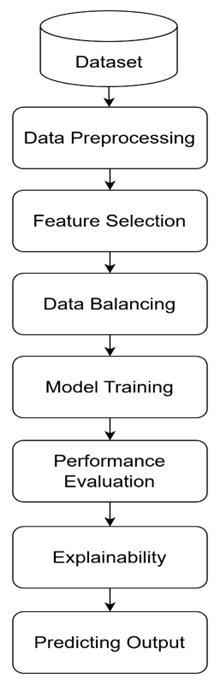
The proposed system is designed as a structured and sequential framework for early prediction of liver disease usingadvancedmachinelearningtechniques.Itfocuseson improvingpredictionaccuracy,handlingreal-worldmedical data challenges, and providing interpretability to support clinical decision-making. The overall workflow of the proposed system is illustrated in Fig-1, which shows the majorstagesinvolvedfromdatacollectiontofinalprediction.
Thearchitectureoftheproposedsystemfollowsastep-bystep pipeline starting from dataset acquisition and ending with the prediction output. As shown in Fig-1, the system consists of the following major components: dataset collection, data preprocessing, feature selection, data balancing, model training, performance evaluation, explainability,andpredictionoutput.
Initially,theliverdiseasedatasetiscollectedandanalyzedto understand its structure and characteristics. Data preprocessingisthenperformedtohandlemissingvalues, removenoise,normalizefeatures,andimproveoveralldata quality. This step is essential to ensure reliable model trainingandaccuratepredictions.
After preprocessing, feature selection is applied using Recursive Feature Elimination (RFE) to identify the most relevantclinicalattributesrelatedtoliverdisease.Selecting optimalfeatureshelpsreducedimensionality,improvemodel efficiency,andenhancepredictiveperformance.
Toaddresstheissueofclassimbalancecommonlypresentin medicaldatasets,thesystememploysahybriddatabalancing techniqueknownasSMOTE-ENN.Thisapproachgenerates syntheticminorityclasssampleswhileremovingnoisyand misclassifiedinstances,resultinginabalancedandcleaner datasetsuitablefortraining.
International Research Journal of Engineering and Technology (IRJET) e-ISSN: 2395-0056
Volume: 13 Issue: 01 | Jan 2026 www.irjet.net p-ISSN: 2395-0072
Oncethedatasetisbalancedandoptimized,itisusedtotrain the LightGBM model. LightGBM is a powerful boosting algorithm that provides fast training, high accuracy, and robustness when dealing with large and complex medical datasets. It effectively captures non-linear relationships betweenclinicalfeaturesandliverdiseaseoutcomes.
Aftermodeltraining,performanceevaluationiscarriedout usingstandardmetricssuchasaccuracy,precision,recall,F1score, and ROC-AUC to assess the effectiveness of the proposed system. These metrics help in comparing the proposed approach with existing traditional machine learningmodels.
To improve trust and transparency, Explainable Artificial Intelligence(XAI)techniquesusingSHAPareintegratedinto thesystem.SHAPexplainsthecontributionofeachfeatureto the final prediction, both at global and individual levels, making the model’s decisions more interpretable and clinicallymeaningful.
Finally,thetrainedmodelgeneratesthepredictionoutput, indicatingwhetherapatientislikelytohaveliverdiseaseor not.Thiscomprehensiveandinterpretableframeworkmakes theproposedsystemsuitableforreal-worldclinicaldecision support.
This section explains the detailed implementation of the proposed liver disease prediction system. It describes the tools,preprocessingsteps,andfeatureselectionprocess,data balancing strategy, model training procedure, and explainabilityintegrationusedtobuildarobustandreliable prediction framework. The implementation is designed to handle real-world medical data challenges such as noise, imbalance,andlackofinterpretability.
The proposed system is implemented using the Python programming language due to its flexibility and wide adoptioninmachinelearninganddatascienceapplications. Pythonprovidesa richecosystemoflibrariesthatsupport efficientdataprocessing,modeldevelopment,andevaluation.
TheNumPylibraryisusedfornumericalcomputationsand arrayoperations,whilePandasisemployedfordataloading, cleaning, and manipulation. Scikit-learn is used for implementingpreprocessingtechniques,RecursiveFeature Elimination (RFE), performance evaluation metrics, and baselinemachinelearningmodels.TheLightGBMlibraryis utilizedfortrainingthegradientboostingmodel duetoits efficiencyandsuperiorperformanceonstructuredmedical datasets. For model interpretability, the SHAP library is
integrated to explain predictions and analyze feature contributions.
The implementation is carried out in a standard Python development environment, ensuring reproducibility and scalabilityforfutureenhancements.
Datapreprocessingisacriticalstepintheimplementation,as medicaldatasetsoftencontainmissingvalues,noisyrecords, and inconsistent feature scales. Initially, the dataset is examinedtoidentifymissingvaluesanddatainconsistencies. Missing values are handled using suitable imputation techniquessuchasmedianreplacement,dependingonthe natureofthefeature.
Noiseandoutliersinthedataareidentifiedusingstatistical analysisandremovedtopreventnegativeimpactonmodel training. Numerical features are normalized to bring all attributes to a common scale, which helps improve convergenceandstabilityduringmodeltraining.Categorical features,ifpresent,areencodedusingappropriateencoding techniques.
This preprocessing stage ensures that the dataset is clean, consistent, and suitable for advanced machine learning algorithms, thereby improving prediction accuracy and robustness.
To reduce dimensionality and improve model efficiency, RecursiveFeatureElimination(RFE)isimplementedasan optimizedfeatureselectiontechnique.RFEworksbytraining amodelonthefullfeaturesetanditerativelyremovingthe least important features based on their contribution to predictionperformance.
Duringeachiteration,featureswiththelowestimportance scores are eliminated, and the model is retrained on the reducedfeatureset.Thisprocesscontinuesuntilanoptimal subset of features is obtained. By selecting only the most relevantclinicalattributes,RFEhelpsreducecomputational complexity,avoidoverfitting,andenhancethegeneralization capabilityofthemodel.
Theselectedfeaturesrepresentthemostinfluentialfactors contributing to liver disease prediction, making the model bothefficientandinterpretable.
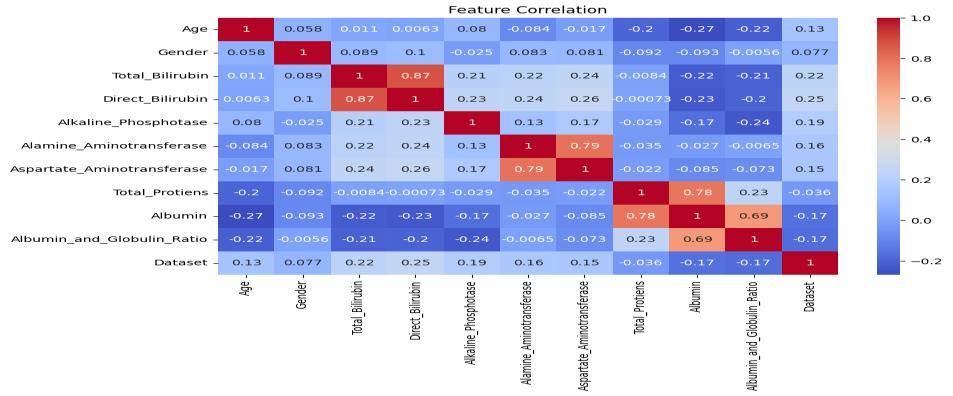
Inaddition,featureselectionplaysacrucialroleinreducing model complexity and improving predictive reliability, especially when dealing with high-dimensional medical datasets. By eliminating redundant and less informative attributes,RFEhelpsminimizeoverfittingandenhancesthe model’s ability to generalize to unseen patient data. Fig-2
International Research Journal of Engineering and Technology (IRJET) e-ISSN: 2395-0056
Volume: 13 Issue: 01 | Jan 2026 www.irjet.net p-ISSN: 2395-0072
illustrates the correlation among clinical features, highlightingthepresenceofstronglycorrelatedvariablesin liver function tests. Based on this analysis, RFE effectively selects the most relevant features that contribute significantlytoliverdiseaseprediction,therebyimproving bothcomputationalefficiencyandmodelinterpretability.
3.4 Data Balancing Using SMOTE-ENN
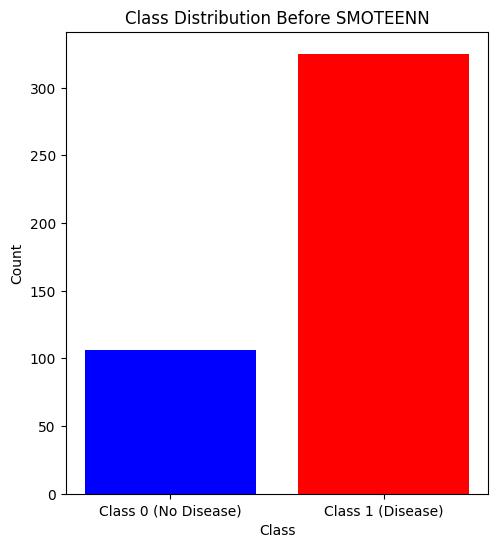
Oneofthemajorchallengesinliverdiseasepredictionisclass imbalance, where healthy patient records significantly outnumberdiseasedcases.Toaddressthisissue,theSMOTEENNhybriddatabalancingtechniqueisimplemented.
SMOTE (Synthetic Minority Over-sampling Technique) generates new syntheticsamples for the minorityclass by interpolatingbetween existing samples.This increases the representation of diseased cases in the dataset. However, oversampling alone can introduce noise. Therefore, ENN (EditedNearestNeighbors)isappliedafterSMOTEtoremove misclassifiedandnoisysamplesbasedonnearestneighbor analysis.
The combination of SMOTEand ENN results ina balanced and cleaner dataset that improves model learning and reducesbiastowardthemajorityclass.Thishybridapproach enhancespredictionreliabilityandrobustness.
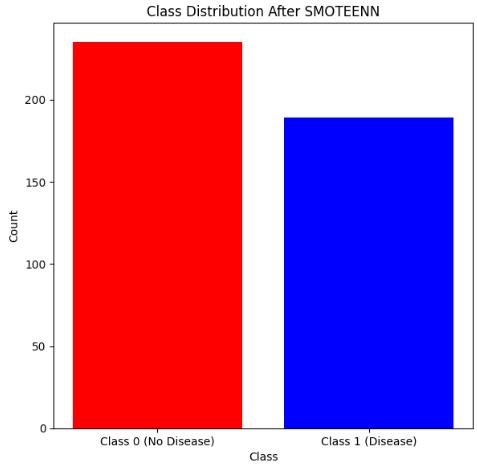
Afterpreprocessing,featureselection,anddatabalancing,the optimized dataset is used to train the LightGBM model. LightGBM is chosen due to its fast-training speed, low memoryusage,andstrongperformanceonhigh-dimensional medical data. It uses a gradient boosting framework that efficientlycapturescomplexnon-linearrelationshipsamong features.
Model hyperparameters such as learning rate, number of estimators,andmaximumdeptharetunedtoachieveoptimal performance. The trained model is then evaluated using standardperformancemetricstoensurereliability.
To improve transparency and clinical trust, SHAP is integrated into the implementation. SHAP explains model predictionsbyassigningimportancevaluestoeachfeature, both globally and for individual predictions. This enables healthcare professionals to understand why a particular predictionwasmade,makingthesystemmoreinterpretable andsuitableforclinicaldecisionsupport.
Thissectionevaluatestheeffectivenessoftheproposedliver disease prediction system using standard performance metrics and experimental analysis. The evaluation aims to measure the accuracy, robustness, and reliability of the proposed LightGBM-based model and compare its performancewithtraditionalmachinelearningapproaches.
To comprehensively evaluate the performance of the proposed system, multiple evaluation metrics are used. Accuracymeasurestheoverallcorrectnessofpredictionsby calculatingtheratioofcorrectlypredictedinstancestothe
International Research Journal of Engineering and Technology (IRJET) e-ISSN: 2395-0056
Volume: 13 Issue: 01 | Jan 2026 www.irjet.net p-ISSN: 2395-0072
total number of instances. However, accuracy alone is insufficientformedicaldatasetsduetoclassimbalance.
Precision is used to measure the proportion of correctly predicted liver disease cases among all predicted positive cases.Recall,alsoknownassensitivity,measuresthemodel’s ability to correctly identify actual liver disease patients. A high recall value is particularly important in medical diagnosis,asitreducestheriskofmissingaffectedpatients.
TheF1-scoreiscalculatedastheharmonicmeanofprecision and recall, providing a balanced evaluation of the model’s performance. Additionally, the Receiver Operating Characteristic (ROC) curve and the Area Under the Curve (AUC)areusedtoevaluatethemodel’sabilitytodistinguish between diseased and non-diseased cases across different classification thresholds. These metrics together provide a reliable and comprehensive assessment of the proposed system.
The experimental evaluation is conducted using the liver disease dataset after preprocessing, feature selection, and data balancing. The dataset is divided into training and testingsetstoevaluatethegeneralizationcapabilityofthe model.Thetrainingdataisusedtobuildthemodel,whilethe testingdataisusedtoassessitspredictiveperformanceon unseensamples.
Beforemodeltraining,RecursiveFeatureElimination(RFE) isappliedtoselectthemostrelevantclinicalattributes.The SMOTE-ENNtechniqueisthenusedonthetrainingdatato balance class distribution and remove noise. This ensures that the model is trained on a clean and representative dataset.
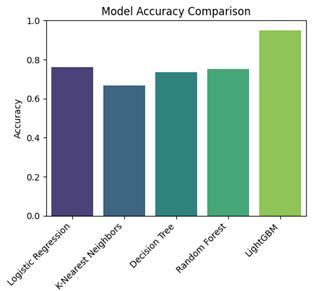
The LightGBM model is trained using optimized hyperparameters to achieve improved accuracy and robustness. For fair evaluation, the proposed model is comparedwithtraditionalmachinelearningclassifierssuch asDecisionTrees,SupportVectorMachines(SVM),Logistic Regression,andRandomForestunderthesameexperimental conditions. All models are evaluated using identical performancemetricstoensureconsistency.
A comparative analysis is performed to demonstrate the effectivenessoftheproposedapproach.Traditionalmachine learningmodelsoftenshowlimitedperformanceduetotheir inability to handle class imbalance and complex feature relationshipseffectively.ModelssuchasDecisionTreesand LogisticRegressionprovidemoderateaccuracybutstruggle withsensitivityandrecallinimbalancedmedicaldatasets.
Incontrast,theproposedLightGBM-basedsystemachieves higheraccuracy,improvedrecall,andbetterF1-scoredueto
optimizedfeatureselectionandhybriddatabalancing.The use of SMOTE-ENN significantly improves minority class detection, while RFE enhances feature relevance. The boostingnatureofLightGBMallowsittocapturenon-linear patterns and interactions among clinical features more effectivelythanconventionalclassifiers.
Overall,theexperimentalresultsindicatethattheproposed systemoutperformstraditionalmachinelearningmodelsin terms of predictive accuracy, robustness, and reliability, makingitsuitableforreal-worldliverdiseasepredictionand clinicaldecisionsupport.
Thissectionpresentstheexperimentalresultsobtainedfrom theproposedliverdiseasepredictionsystemanddiscusses theirsignificance.TheperformanceoftheLightGBM-based model is analyzed using multiple evaluation metrics and comparedwithtraditionalmachinelearningapproachesto demonstrateitseffectiveness.
The proposed system achieves improved prediction performance after applying advanced preprocessing, optimized feature selection, and hybrid data balancing techniques.TheLightGBMmodel trainedontheoptimized datasetdemonstrateshigheraccuracy,precision,recall,and F1-scorecomparedtobaselinemodels.
TheapplicationofRecursiveFeatureElimination(RFE)helps reduce irrelevant features, leading to faster training and improvedgeneralization.Additionally,theuseofSMOTE-ENN effectivelybalancesthedataset,resultinginbetterminority classdetectionandreducedbiastowardthemajorityclass. The ROC-AUC analysis further confirms that the proposed model has a strong capability to distinguish between liver diseaseandnon-diseasecases.
Overall, the obtained results indicate that the proposed approach provides reliable and consistent predictions, makingitsuitableforearlyliverdiseasedetection.
To understand the factors influencing model predictions, SHAP-basedfeatureimportanceanalysisisperformed.The analysis highlights key clinical attributes that contribute significantlytoliverdiseaseprediction.Featuresrelatedto liver function tests show strong influence on the model’s decision-makingprocess.
SHAPprovidesbothglobalandlocalexplanations,allowing the identification of features that have the highest impact acrossthedatasetaswellasforindividualpredictions.This interpretabilityenhancestrustinthemodelandsupportsits use in clinical decision-making. By understanding feature
International Research Journal of Engineering and Technology (IRJET) e-ISSN: 2395-0056
Volume: 13 Issue: 01 | Jan 2026 www.irjet.net p-ISSN: 2395-0072
contributions, healthcare professionals can gain valuable insightsintodiseasepatternsandriskfactors.
5.3
The experimental results clearly demonstrate that the integration of optimized feature selection, hybrid data balancing, and boosting-based learning significantly improves prediction performance. Traditional machine learningmodelsstrugglewithimbalancedandnoisymedical data,leadingtolowersensitivityandreducedreliability.
In contrast, the proposed LightGBM based framework effectivelyhandles these challenges by leveraging SMOTEENNfordatabalancingandRFEforfeatureoptimization.The inclusionofexplainableAItechniquesfurtherstrengthensthe clinicalapplicabilityofthesystembyprovidingtransparent andinterpretablepredictions. Althoughtheproposedsystemshowsstrongperformance,it isdependentonthequalityandsizeofthedataset.Training onlargerandmorediversereal-worlddatasetscouldfurther enhance generalization and robustness. Nevertheless, the resultsconfirmthattheproposedapproachisa promising solutionforearlyliverdiseaseprediction.
6.1 Conclusion
In this work, an efficient and interpretable machine learning–basedsystemforearlyliverdiseasepredictionhas been proposed. The system addresses major challenges associatedwithmedicaldata,suchasclassimbalance,noisy records, irrelevant features, and lack of transparency in model predictions. Advanced preprocessing techniques, optimized feature selection using Recursive Feature Elimination(RFE),andhybriddatabalancingwithSMOTEENN are employed to improve data quality and model robustness.
TheLightGBMmodelisusedasthecoreclassifierduetoits fast-trainingspeed,scalability,andstrongperformanceon
structured clinical data. Experimental evaluation demonstrates that the proposed approach achieves improved accuracy, recall, and F1-score compared to traditional machine learning models. Furthermore, the integrationofExplainableArtificialIntelligence(XAI)using SHAPprovidesmeaningfulinsightsintofeatureimportance andmodeldecisions,enhancingclinicaltrustandusability.
Overall, the proposed system proves to be a reliable, accurate,andinterpretable solutionforearlyliverdisease prediction and can effectively support healthcare professionalsindecision-making.
Although the proposed system shows promising results, there are several directions for future enhancement. The model can be trained and validated on larger and more diverse real-world clinical datasets to further improve generalization and robustness. Additional clinical and lifestyle-related features may be incorporated to enhance predictionaccuracy.
The system can be extended to predict different stages or types of liver disease rather than binary classification. Moreover,integratingdeeplearningmodelsandensemble approachesmayfurtherimproveperformance.Finally,the proposed framework can be deployed as a web-based or mobileclinicaldecision-supporttool,enablingreal-timeliver disease prediction with interpretable results for practical healthcareapplications.
[1] M.H.MohamedandB.H.Ali,“Towardanaccurateliver disease prediction based on a two-level ensemble stacking model,” Journal of Healthcare Engineering, 2024.
[2] P.M.O,M.K.Gavimath,andE.Thomas,“Liver disease prediction using ensemble technique,” International Journal of Engineering Research and Technology (IJERT),2024.
[3] E.DritsasandM.Trigka,“Supervisedmachinelearning models for liver disease risk prediction,” Applied Sciences,vol.13,no.4,2023.
[4] S.R.TanukuandA.A.Kumar,“Liverdiseaseprediction using ensemble technique,” in Proceedings of the 8th International Conference on Computing and Communication Systems,2022.
[5] S.TokalaandK.Hajarathaiah,“Liverdiseaseprediction andclassificationusingmachinelearningtechniques,” InternationalJournalofScientificResearchinComputer Science,EngineeringandInformationTechnology,2022.
International Research Journal of Engineering and Technology (IRJET) e-ISSN: 2395-0056
Volume: 13 Issue: 01 | Jan 2026 www.irjet.net p-ISSN: 2395-0072
[6] R. Kaur and B. Singh, “Liver disease prediction using machinelearningalgorithms,” International Journal of Computer Applications,2021.
[7] N. V. Chawla, K. W. Bowyer, L. O. Hall, and W. P. Kegelmeyer,“Smote:Syntheticminorityoversampling technique,” Journal of Artificial Intelligence Research, vol.16,no.1,pp.321–357,2021
[8] J. Dyson and M. Hudson, “The critical importance of earlydetectionofliverdisease,”Hepatology,vol.72,no. 3,pp.925–935,2020.
[9] G. Ke, Q. Meng, T. Finley et al., “Lightgbm: A highly efficientgradientboostingdecisiontree,”inAdvancesin Neural InformationProcessingSystems,vol.31,no.2, 2020,pp.3146–3154
[10] A.PatelandR.Singh,“Theroleofmachinelearning in advancing liver disease diagnostics,” Biomedical InformaticsInsights,vol.13,pp.1–12,2021