
International Research Journal of Engineering and Technology (IRJET) e-ISSN: 2395-0056
Volume: 13 Issue: 04 | Apr 2026 www.irjet.net p-ISSN: 2395-0072

International Research Journal of Engineering and Technology (IRJET) e-ISSN: 2395-0056
Volume: 13 Issue: 04 | Apr 2026 www.irjet.net p-ISSN: 2395-0072
Radha Jha , Deep Gad, Harsh Gupta, Sumedh Jagtap, Vaishali Rane
Diploma Student, Department of Computer Engineering, Thakur Polytechnic, Kandivali East-4001012
Diploma Student, Department of Computer Engineering, Thakur Polytechnic, Kandivali East-4001012
Diploma Student, Department of Computer Engineering, Thakur Polytechnic, Kandivali East-4001012
Diploma Student, Department of Computer Engineering, Thakur Polytechnic, Kandivali East-4001012
Head of Department (HOD) , Department of Computer Engineering, Thakur Polytechnic, Kandivali East - 4001012 ***
Abstract – LifeBridge is a comprehensive organ donation and transplant management platform designed to help healthcare systems grow, improve coordination, and analyze critical medical data. Today, the medical sector generates a massive amount of data, including donor health records, recipient waiting lists, organviabilitywindows,bloodgroupcompatibility,and hospital inventory. Managing this data manually is not only difficult and time-consuming but can also lead to fataldelaysduringthe"GoldenHour."
LifeBridge provides a centralized platform where hospitals,medicalcoordinators,anddonorscanmanage pledges, track organ status, and enhance life-saving decision-making. By integrating automated matching engines, the system reduces manual effort, making the transplant process seamless for medical professionals. Overall, LifeBridge demonstrates how the combination of digital frameworks and reactive data processing can transformtraditional,fragmentedorganregistriesintoa smart,efficient,anddata-drivenecosystem.
Furthermore, the system includes advanced algorithms to analyze historical donor data, identify compatibility trends, and provide predictive insights that support strategic clinical decisions. This enables hospitals to make better, faster choices when a donor becomes available. LifeBridge also features external diagnostic tools,suchas Proximity & Viability Simulation,where userscansetparameters suchasorgantype,transport distance, and blood group to view success probabilities and estimated delivery times. This helps medical teams check the feasibility of a transplant scenario without the actual depletion of resources or unnecessary risks, ensuring that every organ finds its perfectmatchintheshortesttimepossible.
Keywords: Organ Matching Engine, Artificial Intelligence in Healthcare, Data Visualization, Predictive Biocompatibility, Health Intelligence,
Inthecontemporarydigitalera,thehealthcaresector operates in a data-intensive environment where every clinical entry, donor pledge, and medical interactiongeneratesamassivevolumeoflife-critical information. This organ transplant data is inherently complexandmultidimensional.Asaresult,managing these sensitive datasets manually has become an arduous and time-consuming task that is prone to humanerror whereevenaminordelaycanresultin thelossofalife-savingopportunity.
In a high-stakes medical landscape, stakeholders cannotaffordtooverlookspecific variablesor ignore nuanced biological conditions;everydetail regarding donor compatibility, organ viability windows, and hospitalproximityisvitalfora successfultransplant. LifeBridge is designed to bridge this gap, offering a sophisticatedplatformthatmovesbeyondtraditional, static organ registries toward Active Medical Intelligence.
The core objective of LifeBridge is to develop an intelligent, reactive platform that enhances organ donation management, biological data analysis, and clinical decision-making through high-precision matchingalgorithmsanddigitalverification.
Integrated Management System: To develop a centralized platform that provides donor registration, recipient tracking, and hospital coordinationinasingle,unifiedsystem.
Real-Time Monitoring: To design a platform that provides live administrative dashboards, organ status tracking, and automated matching reports to ensure zero time-wastage during emergencies.
International Research Journal of Engineering and Technology (IRJET) e-ISSN: 2395-0056
Volume: 13 Issue: 04 | Apr 2026 www.irjet.net p-ISSN: 2395-0072
AI-Based Predictive Analysis: To integrate intelligent prediction models that identify biological compatibility trends, forecast organ viability windows, and optimize allocation strategiesbasedonclinicalurgency.
Enhanced Decision Support: To improve medical coordination through interactive visualizations, "Golden Hour" insights, and smart recommendations that assist hospital teamsinperformingsuccessfultransplants.
Geographic & Logistics Optimization: To provide location-based proximity mapping (using the Haversine formula) to calculate transport risks and provide real-time routing solutionsfortime-sensitiveorgantransfers.
Verification & Trust Framework: To implement a secure "Alpha-Badge" system that utilizes digital masking (SHA-256) to ensure donor legitimacy while protecting sensitive patient privacy.
In the domains of healthcare informatics, emergency response, and clinical logistics, there has been a significant growth of data-driven systems. These systems are designed to reduce the need for medical coordinators to switch between fragmented platforms, saving critical time by presenting structured and organized information regarding donor availability and recipienturgency.
Modern digital health ecosystems now contain specialized tools that assist hospitals in identifying compatibility trends, forecasting organ viability windows, and optimizing allocation strategies. LifeBridge generates automated matching solutions and assists with complex clinical queries through its integrated intelligence features. This system understands the nuances of biological data, analyzes matching parameters in real-time, and provides meaningful solutions along with high-precision charts and proximity maps, ensuring that medical teams have totalclarityduringthe"GoldenHour."
Instead of relying on traditional, paper-based registries or static databases, this platform provides a suite of reactive tools tomanageandanalyzelife-critical data including donor health history, recipient priority levels, andtheoverallefficiencyofthetransplantnetwork.
The LifeBridge ecosystem is designed to provide highprecision matching and clinical recommendations by
analyzing real-time donor and recipient data. The system architecture is composed of several integrated functional modules that ensure data integrity and operationalspeed.
User Authentication & Security Module: This module handles secure registration and login protocols.Itsupportsdistinctrolesfor Donors, Hospital Admins, and System Super-Admins To ensure the "Fortress of Trust," it utilizes SHA-256 masking forsensitivecredentialsand PII(PersonallyIdentifiableInformation).
Donor & Pledge Management Module: This allowsuserstoregistertheirconsentandinput detailed biological data. The module tracks the status of each pledge (Pending, Verified, or Matched) and updates the centralized SQLite databaseinreal-time.
The Matching Engine (Analysis Module): This is the core "Intelligence" of LifeBridge. It doesn'tjust filterdata;itexecutesa multi-layer algorithm:
o Biological Filter: Matches Blood GroupsandOrganTypes.
o Proximity Filter: Calculates the distance between donor and hospital usingthe Haversine Formula
o Urgency Filter: Prioritizes recipients basedonclinicalneed.
Visual Intelligence Dashboard: Instead of static tables, this module generates dynamic charts, graphs, and maps. It visualizes organ availability trends and geographical donor density, providing a 360-degree view of the transplantnetwork.
Automated Reporting & Documentation Module: Upon a successful match, the system generates a Match Clearance Certificate in PDFformat.Thisreportcontainsasummaryof the compatibility parameters, proximity data, and verification status, serving as a formal document for hospital boards to expedite surgery.
Decision Support System (DSS): Unlike traditional registries, LifeBridge generates actionable insights with specific reasons for a match, potential transport risks (based on distance), and AI-driven recommendations. This empowers medical teams to make faster, moreefficientlife-savingdecisions.
International Research Journal of Engineering and Technology (IRJET) e-ISSN: 2395-0056
Volume: 13 Issue: 04 | Apr 2026 www.irjet.net p-ISSN: 2395-0072
-
The front-end of LifeBridge is developed using Streamlit (Python-based framework) and React. The interface is designed for high-stress medical environments, providing visual data representations such as real-time compatibility charts, geographical donormaps,and"GoldenHour"countdowntimers.The focus is on zero-latency responsiveness and effective data visualization to assist medical coordinators in rapiddecision-making.
The backend handles the core matching logic and clinical processing. Implemented in Python, it utilizes Pandas and NumPy forcomplexbiological data manipulation. Scikit-learn is integrated to support predictive analysis for organ viability, while the Haversine Formula is used for highprecision proximity calculations between donor locationsandtransplantcenters.
The LifeBridge ecosystem utilizes a centralized, high-integrity data storage architecture to manage critical medical records and donor-recipient mappings.BysecuringsensitivePII,organviability windows, and cross-matching compatibility, the system ensures data remains immutable during the "Golden Hour." LifeBridge leverages a hybrid storage model utilizing SQLite for relational integrity and CSV-based datasets for rapid simulation to facilitate reliable retrieval of lifesavingdata.
To enhance system functionality and ensure life-critical precision, the LifeBridge platform integrates several externaltechnologiesandservices:
Google Generative AI (Gemini): Integrated to provide AI Co-Pilot assistance. This enables medical coordinators to obtain real-time guidance, compatibility recommendations, and access to risk-mitigation solutions during the "GoldenHour."
Geospatial Processing (Geopy & Folium): For location-basedanalysis,thesystemimplements mapping libraries such as Folium and PyDeck alongside Geopy. This is used for real-time geolocationprocessingofdonorsandhospitals,
utilizing GeoJSON data for regional donordensityvisualization.
PDF Generation (ReportLab): Integrated to produce automated, legally-compliant Match Clearance Reports, ensuring that all clinical data is documented for hospital board approvals.
The architecture of LifeBridge is engineered to provide high-precision matching and actionable clinical recommendations by analyzing multi-dimensional donor and recipient data. The system architecture is composed of several integrated functional modules designed to ensure medical-grade reliability and operationalspeed.
The system contains a comprehensive Security & User Management module, which facilitates secure registration and login protocols. It supports distinct functional profiles for Donors, Hospital Admins, and Super-Admins, protected by role-based access control andSHA-256datamasking.
The Matching & Analytics Module allows clinical coordinators to track donor availability and recipient urgency in real-time. By analyzing biological parameters, the system generates visual insights, including donor-density maps and organ viability trends.
Unliketraditionalregistries,LifeBridgegeneratesActive Medical Intelligence. This includes actionable insights with clinical reasoning,transport risk assessments,and AI-drivenrecommendations.Bycombiningreactivedata processing and real-time geospatial visualization, the platform offers a comprehensive solution for organ matchingandlife-savingdecision-making.
The LifeBridge platformdeliverscriticalfunctionalities designed to improve organ donation management, biological data analysis, and clinical decision-making. The system facilitates users to manage sensitive donor data efficiently, analyze compatibility performance, and provide visual insights. The key modules are Pledge Management, Matching Analytics, Automated Reporting, AI-Viability Intelligence, and Data Verification. These features allow clinical coordinators totrackdonoractivities,monitortransplanttrends,and enhancelife-savinginterventions.
By integrating these capabilities, the application assists medical professionals in making correct pairing decisions, optimizing transport strategies, and improving overall healthcare efficiency. The platform ensures that users can access important compatibility insights quickly, respond to urgent medical windows effectively, and maintain better control over their transplant operations. The location-based analysis is
International Research Journal of Engineering and Technology (IRJET) e-ISSN: 2395-0056
Volume: 13 Issue: 04 | Apr 2026 www.irjet.net p-ISSN: 2395-0072
implemented using mapping libraries such as Folium and PyDeck along with Geopy for high-precision geolocation processing and GeoJSON data for regional donor visualization. This comprehensive suite transforms fragmented registries into a smart, reactive, anddata-drivenmedicalecosystem.
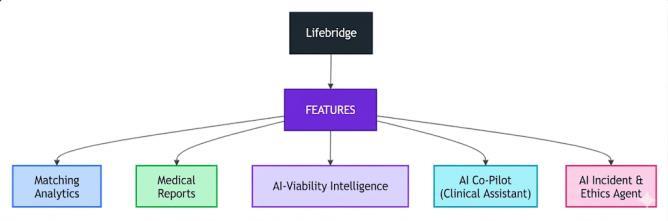
The AI-Viability Intelligence feature provides real-time data filtering for organ health parameters. The medical graph in this feature toggles between parameters such as Ischemic Time and Compatibility Ratios to highlight shifts in organ health, donor age, and physiologicalretention.Itallowsmedicalteamstozoom andview exactvaluesorthe"ViabilityMatrix"atwhich organ quality might decline. It converts basic medical dataintoactionablevisualinsights:
Dynamic Time-Range Filtering: Fully functional buttons to transform data to show historical transplant trends based on specific selectedperiods.
Toggling: Easily switch between Compatibility and Success Ratio views while maintaining consistenttrendlineoverlays.
Trend Tracking: Real-time calculation and rendering of viability averages. This feature uses a polynomial regression technique to categorizedataintoclinicalrisks,strengths,and strategic recommendations, helping stakeholders make quick, accurate life-saving decisionswithoutmanualcalculations.
The AI Co-Pilot feature acts as an intelligent assistant for transplant coordinators. Itanalyzes historical donor dataandprovidessmartsuggestions,suchasidentifying highly compatible recipients and predicting transplant success trends. This feature simplifies complex biological data analysis by presenting insights in an easy-to-understand format. It also includes LocationBased Analysis implemented using Folium and PyDeck with Geopy for high-precision geolocation processing. This visualizes which medical regions have the highest donor density and where the demand for specificorgansisgreatest.
The Data Import feature allows users to upload donor and hospital records primarily in CSV or digital format. After uploading, users can view immediate compatibility analysis and generate formal medical reports. It combines real-time analytics with AIgenerated insights to provide a combined view of transplant performance, including success rates and biological churn analysis. Reports can be securely verifiedusing SHA-256 masking (with future potential for blockchain)toensuretheauthenticityandintegrity ofeverylife-savingrecord.
The Incident Reporting feature in LifeBridge helps hospitals identify and manage unexpected events that may affect organ viability or transport, such as sudden logistical drops, biological mismatches, or regional supplydeclines.Thisallowsuserstorecordincidentsby selecting parameters like organ category and transport location. Once an incident is reported, the system analyzes historical and current data to identify causes and provide AI-based recommendations and risk analysis for faster clinical decision-making. The platform displays severity levels through dashboards, helping medical teams take corrective actions in a timelymanner.
The Information module in LifeBridge provides users with structured resources and clinical insights to stay informed, prepared, and proactive in managing transplant operations. It organizes critical donor data, recipient requirements, and organ viability metrics in a centralized platform. The module ensures transparency and improves understanding of the transplant network performancethrough:
Donor & Pledge Information: Provides detailed insights about current organ pledges, including bloodgroupdistributionandverificationstatus.
Recipient & Waitlist Insights: Displays data related to patient urgency, organ demand, and compatibility success rates, enabling hospitals toprioritizecriticalcases.
Logistics & Proximity Insights: Presents structured data on transport times, "Golden Hour" windows, and regional donor density to optimizeorgantransferstrategies.
Reports & Analytics Information: Offers summarizedreportsandvisualdashboardsthat convert complex biological data into understandableinsightsforsurgicalteams.
International Research Journal of Engineering and Technology (IRJET) e-ISSN: 2395-0056
Volume: 13 Issue: 04 | Apr 2026 www.irjet.net p-ISSN: 2395-0072
Clinical Updates & Feedback: Allows users to review system-generated matching insights and provide medical feedback, ensuring continuous improvement of thepairingalgorithm.
6.1 Programming and Framework
Python: Serves as the primary programming language for implementing the matching engine, biological data processing, and AI-based compatibility analysis.
Streamlit: Used to build the reactive, highperformance medical dashboard for real-time visualizationofdonor-recipientdata.
React and TypeScript: Employed to design a responsive and interactive user interface for hospital administrators,ensuringsmoothandsecurenavigation.
Node.js and Express.js: HandlebackendAPIrouting andserver-sidelogictoensureseamlesscommunication betweentheclinicaldatabaseandtheuserinterface.
6.2 Database and Security
The LifeBridge platform uses a centralized database systemtostoresensitivemedicalrecordsandanalytical reports securely. Technologies such as SQLite or Firebase are used for efficient data retrieval. The system implements SHA-256 cryptographic masking and role-based access control (RBAC) to protect user accounts and ensure authorized clinical access, maintainingtotaldataprivacyandsystemintegrity.
6.3 System Utilities
The platform utilizes specialized utilities to support healthcarelogistics.Mappingandgeolocationtoolssuch as Folium, PyDeck, and Geopy provide location-based donor analysis. Reporting utilities are used to generate automated PDF Match Clearance Certificates, ensuring that complex analytical tasks are converted intoactionablemedicaldocuments.
6.4 Data Processing and Analysis
LifeBridge employs advanced processing techniques to transform raw medical records into life-saving insights. Libraries such as Pandas and NumPy are used for clinical data cleaning and numerical computations. Scikit-learn supports predictive analysis for organ viability, ensuring accurate handling of large healthcare datasetsandreliablemedicalintelligenceoutputs.
6.5 AI and External Integration
Theplatformintegrates Google Generative AI topower the AI Co-Pilot, enabling coordinators to receive automated recommendations and query-based assistance. Polynomial regression models analyze historical data to identify matching trends, while
proximity simulation helps users evaluate transport risksbeforeinitiatingatransplant.
“This integration ensures scalability, intelligent automation, and enhanced medical intelligence capabilitieswithintheLifeBridgeecosystem.”
7.1 Data Collection
The LifeBridge system begins with data collection, where users upload donor datasets in CSV format or enter medical-related data into the platform. The collected data includes donor details, blood type, urgency, category, location, and compatibility metrics. This data is stored in a centralized database and used forfurtheranalysisandprocessing.Thestructureddata collection process ensures accuracy, consistency, and efficient handling of medical information for intelligent decision-making.
7.2 Data Preprocessing
After data collection, the system performs data preprocessing to prepare the dataset for analysis. This step includes data cleaning, handling missing values, formatting, and organizing the data into a structured form. Libraries such as Pandas and NumPy are used to transformraw medicaldataintomeaningful andusable information.Properpreprocessingensuresthatthedata is reliable and ready for predictive analysis and visualization.
7.3
In this stage, the system analyzes historical transplant datatoidentifytrendsandpatterns.Techniquessuchas polynomial regression and moving average calculations are used to forecast future organ viability and detect growthordeclineindonortrends.Theanalysishelpsin identifying risks, strengths, and life-saving opportunities, enabling users to make data-driven decisionsandimproveoverallmatchingstrategies.
The AI Co-Pilot module provides intelligent recommendations and automated insights based on analyzed data. It uses AI-based models and Google Generative AI to understand user queries and generate meaningful business suggestions. The system provides recommendations such as pricing strategies, product performanceinsights,andsalesimprovementstrategies, helping businesses make faster and more accurate decisions.
7.5
Themethodologyalsoincludesscenariosimulationand incident analysis to evaluate clinical risks and unexpected events. Users can test different medical conditions to estimate success, viability, and potential
International Research Journal of Engineering and Technology (IRJET) e-ISSN: 2395-0056
Volume: 13 Issue: 04 | Apr 2026 www.irjet.net p-ISSN: 2395-0072
risks before implementing strategies. The incident analysisfeatureidentifiesunusualmatchingpatternsor performance drops and provides recommendations to resolve them, ensuring better risk management and operationalstability.
7.6
Finally, the system presents the analyzed data through dashboards, charts, graphs, and PDF reports. Visualization tools help users easily understand transplant performance, trends, and predictions. The generated reports provide clear and actionable insights thatsupportclinicalplanninganddecision-making.This stepensuresthatcomplexdataisconvertedintosimple and understandable information for effective management.
8.1 Frontend Implementation
The frontend of LifeBridge is developed using React andTypeScript tocreatea responsiveand user-friendly interface. The system includes various UI components such as dashboards, navigation bars, feature sections, anddatavisualizationpanelsthatallowuserstointeract with the platform easily. The frontend is designed to providesmoothnavigation,cleardatapresentation,and interactive charts, ensuring that users can upload data, view analytics, and access AI-based insights efficiently. Modern styling frameworks and component-based architecture are used to enhance user experience and maintainsystemconsistency.
8.2 Backend
The backend of LifeBridge is developed using Node.js and Express.js to manage server-side operations and system functionality. It handles API routing, data processing, user authentication, and communication between the frontend and database. The backend ensures secure data transfer, efficient request handling, and smooth system performance. It also manages data storage, report generation, and integration with AI modules,enablingreal-timeanalysisandreliablesystem operations.
8.3
The LifeBridge AI module is implemented using Python and machine learning libraries to provide intelligent analysis and predictive matching insights. Pandas and NumPy handle medical data processing, while Scikit-learn supports predictive modeling for organ viability and recipient compatibility. The system applies regression and moving average techniques to forecast logistical trends and identify patterns in donor availability. Google Generative AI is integrated to enable the Pilot functionality, providing automated
recommendations and query-based assistance for medical coordinators, significantly enhancing lifecriticaldecision-makingandsystemintelligence.
The database of LifeBridge is designed to store and manage medical data, user information, donor details, and analytical reports in a secure and structured manner.TechnologiessuchasMongoDBorFirebaseare used for centralized data storage and efficient data retrieval, while CSV-based storage supports dataset upload and processing for analysis. The database ensures proper organization of clinical data, secure accesscontrol,andreliablestorage,allowingthesystem to perform accurate analysis and generate meaningful insights.
The LifeBridge platform integrates frontend, backend, AI modules, and database components to create a unified and efficient system. The frontend communicates with the backend through API requests, while the backend processes data and interacts with AI modules and the database to generate insights and reports. External technologies such as Google Generative AI, Streamlit dashboards, and mapping utilities are integrated to enhance system functionality. The complete system is designed to ensure smooth deployment, scalability, and efficient performance, enabling users to access real-time analytics, AI recommendations,andmedicalinsightsthroughasingle platform.
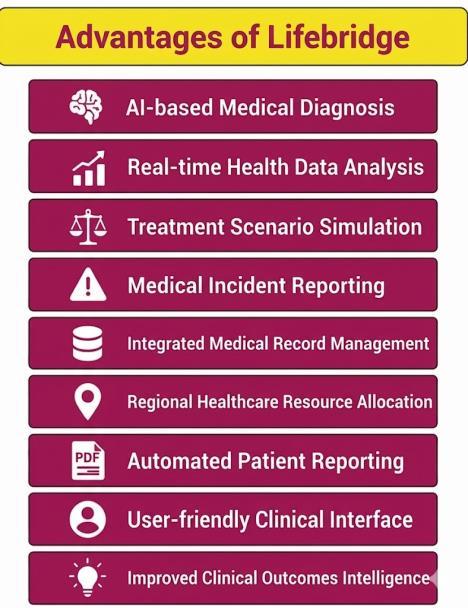
9 Advantages of Life-bridge AI
International Research Journal of Engineering and Technology (IRJET) e-ISSN: 2395-0056
Volume: 13 Issue: 04 | Apr 2026 www.irjet.net p-ISSN: 2395-0072
10.1 System Output Overview
The LifeBridge platform was successfully developed andtestedtoanalyzemedicaldataandgenerateclinical insights. The system processes uploaded datasets and provides analytical outputs such as donor trends, predictive analysis, scenario simulation, and incident reporting. The integration of frontend, backend, AI modules, and database ensures smooth functionality and reliable data processing. The results show that the platform can transform raw medical data into useful clinicalintelligenceandsupportdecision-making
10.2 Dashboard and Visualization Results
The dashboard provides basic visualization omedical data through charts and graphical representations. Users can view donor performance, transplant trends, and dataset summaries after uploading data into the system.Thevisualizationhelpsinunderstandingoverall network performance and identifying important patterns in matching data. Although the current dashboard includes essential visual components, furtherimprovementscanbemadebyaddingadvanced analyticsandreal-timemonitoringfeatures.
10.3 AI Growth Intelligence Results
The AI Growth Intelligence module analyzes historical medicaldataandgeneratespredictiveinsightsforfuture performance. The system uses machine learning techniques to estimate viability trends and provide recommendations for improving matching strategies. The results indicate that AI-based analysis helps users understand biological behavior, identify matching opportunities,andmakebetterclinicaldecisions.TheAI Co-Pilot feature also assists users by providing automatedsuggestionsandinsightsbasedonthedata.
10.4 Scenario Simulation Results
The scenario simulation module allows users to test different medical conditions and analyze possible outcomes. By adjusting parameters such as organ demand, proximity, and urgency, the system estimates success, viability, and risk levels. The results show that thismodulehelpsinevaluatingclinicalstrategiesbefore implementationandsupportsstrategicplanning.
10.5
The incident reporting module identifies performance issues such as sudden viability drops or operational risks in the dataset. The system generates alerts and analytical summaries to help users take corrective actions. The results demonstrate that incident monitoring improves system awareness and supports bettermedicalmanagement.
10.6
Theperformanceof LifeBridge wasevaluatedbasedon functionality, usability, and analytical capability. The system provides efficient data processing, simple user interaction, and reliable analytical output. The integration of AI and data analysis improves medical intelligence and reduces manual effort in transplant analysis. Overall, the system performs effectively in providing insights and supporting clinical decisionmaking.
The LifeBridge platform provides useful analytical and AI-based medical insights; however, the current version of the system has certain limitations that need to be addressed in future development. The system mainly depends on the quality and accuracy oftheuploadeddataset,andincorrectorincomplete datamayleadtoinaccurateanalysisandpredictions. The dashboard and visualization features are currently basic and do not support advanced realtime monitoring or dynamic filtering. The AI prediction model is based on limited machine learning techniques and may not provide highly accurateforecastsforcomplexorlarge-scalemedical environments. The system also requires internet connectivity and proper system resources to run smoothly,whichmayaffectperformanceon low-end devices. Additionally, the platform is still in the prototypestageanddoesnotsupportfullenterpriselevel scalability or integration with live medical databasesandAPIs.
The LifeBridge platform was developed to provide an intelligentandefficientsolutionfororganmanagement, data analysis, and clinical decision-making. The system successfully integrates data processing, visualization, AI-based analysis, and reporting features to transform raw medical data into meaningful insights. It helps hospitals monitor performance, identify matching opportunities, analyze risks, and make strategic decisions with reduced manual effort. The platform demonstrates how artificial intelligence and data analytics can improve traditional transplant management systems by providing predictive insights, scenario simulation, and automated recommendations. Although the current system has some limitations, it provides a strong foundation for future improvements such as real-time analytics, advanced AI models, and cloud-based deployment. Overall, LifeBridge proves to be a useful and scalable solution for modern medical intelligence and clinical analytics, supporting organizationsinachievingbetterperformanceanddatadrivendecision-making.
International Research Journal of Engineering and Technology (IRJET) e-ISSN: 2395-0056
Volume: 13 Issue: 04 | Apr 2026 www.irjet.net p-ISSN: 2395-0072
10. Conclusion
The LifeBridge system is developed to enhance organ donation management by integrating multiple clinical matching, logistics tracking, and medical awareness features into a unified digital platform. It incorporates functionalities such as real-time compatibility alerts, "Golden Hour" transport monitoring, SOS emergency responsefororganviability,clinicaloutcomeprediction, and Alpha-Badge verification services. This enables medical coordinators and hospital administrators to remaininformed,prepared,andhigh-performinginlifecriticalsituations.
By leveraging modern technologies including highprecision location-based services (Haversine Formula), real-time communication systems, and AI-driven Google Generative AI chatbotassistance theplatform ensures prompt support and improved clinical coordination. Furthermore, the integration of automated documentation features and standardized compatibility resources strengthens global transplant networksandpromotesproactivemedicalpractices. Overall, LifeBridge contributes toward buildinga more efficient healthcare environment by empowering medical professionals with accessible, technologydriven tools that enhance transplant safety, awareness, and surgical confidence. It demonstrates how the combination of reactive data processing and intelligent automation can bridge the critical gap between donor pledgesandsuccessfullife-savinginterventions.
[1] S. Russell and P. Norvig, Artificial Intelligence: A ModernApproach,4thed.,Pearson,2021.
[2]T.Mitchell,MachineLearning,McGraw-Hill,1997.
[3] J. Han, M. Kamber, and J. Pei, Data Mining: Concepts andTechniques,3rded.,MorganKaufmann,2011.
[4] F. Chollet, Deep Learning with Python, Manning Publications,2017.
[5]Python Software Foundation, “Python Documentation,”Available:https://www.python.org
[6] Streamlit Inc., “Streamlit Documentation,” Available: https://docs.streamlit.io
[7]Meta, “React Documentation,” Available: https://react.dev
[8]MongoDBInc.,“MongoDBDocumentation,”Available: https://www.mongodb.com/docs
[9]Google, “Firebase Documentation,” Available: https://firebase.google.com/docs
[10]Scikit-learn Developers, “Scikit-learn Machine LearningLibrary,”Available:https://scikit-learn.org
[11]Pandas Development Team, “Pandas Documentation,”Available:https://pandas.pydata.org
[12]NumPy Developers, “NumPy Documentation,” Available:https://numpy.org
[13]FoliumLibrary,“FoliumDocumentation,”Available: https://python-visualization.github.io/folium
[14] Geopy Documentation, “Geolocation Services for Python,”Available:https://geopy.readthedocs.io
[15]Google Generative AI, “Generative AI Documentation,”Available:https://ai.google.dev
[16]World Health Organization (WHO), “Guiding Principles on Human Cell, Tissue and Organ Transplantation,”Available:https://www.who.int
[17] NOTTO (National Organ and Tissue Transplant Organization), “Standard Operating Procedures for OrganMatchingandLogistics,”GovernmentofIndia.
[18]D. J. Power, “Decision Support Systems in Healthcare:ConceptsandClinicalResources,”2002.
[19] A. McAfee and E. Brynjolfsson, “The Healthcare DataRevolution:BigDatainLifeSciences,”2012.