
International Research Journal of Engineering and Technology (IRJET) e-ISSN: 2395-0056
Volume: 13 Issue: 04 | Apr 2026 www.irjet.net p-ISSN: 2395-0072

International Research Journal of Engineering and Technology (IRJET) e-ISSN: 2395-0056
Volume: 13 Issue: 04 | Apr 2026 www.irjet.net p-ISSN: 2395-0072
Bhagyashri Patil1 , Manish Ayer2 , Aditya Bhilore3, Payal Jorwar4, Ajit Pagar5
1,2,3,4Student, Department of Computer Engineering, Guru Gobind Singh College of Engineering and Research Centre,
5Assistant Professor, Department of Computer Engineering, Guru Gobind Singh College of Engineering and Research Centre, Nashik – 422009, Maharashtra, India
Abstract - Manual library entry in colleges is timeconsuming, prone to errors, and difficult to monitor accurately. LibAccess is a smart, barcode-based library entry system that automates student and teacher entries using barcode ID cards. The system consists of a PC or laptop application with a ReactJS frontend and FastAPI backend, a barcode scanner, and an SQL database to validate and store all data. When a user scans their card, the system checks the timetable and academic calendar, logs the entry, and displays real-time results such as access granted or class-skip alerts. If a student enters the library during scheduled class hours, an automatic email notification is sent to the teacher concerned Administrators can access a dashboard for managing users, timetables, and academic events, as well as view logs and generate reports in CSV, Excel, or PDF formats. LibAccess ensures accurate, real-time monitoring of library visits, reduces manual work, prevents class skipping, and improves administrative efficiency in educational institutions.
Key Words: Library Management, Barcode ID, Real-Time Monitoring, Automated Attendance, FastAPI, ReactJS, SQL Database, Class-Skip Alert, Student Tracking, Admin Dashboard.
In many educational institutions, library entry and attendance tracking are still managed using manual or partiallyautomatedmethods,whicharetime-consuming, prone to errors, and difficult to monitor accurately. Maintaining physical registers makes it challenging for administrators to generate timely reports and analyze libraryusageeffectively.
Toaddresstheselimitations,thereisagrowingneedfor automatedanddigitallymonitoredlibraryentrysystems thatcanprovidereal-timevalidationandaccuraterecord keeping. Barcode-based identification offers a costeffective and reliable approach for automating entry loggingwithoutrequiringspecializedhardware.
This paper presents LibAccess, a smart barcode-based library entry monitoring system designed to automate studentandfacultyentrieswhilevalidatingaccessagainst
academictimetablesandcalendars.Thesystemsupports real-time monitoring, automated logging, and administrative oversight, making it suitable for deployment in educational institutions. Its low-cost architectureandeaseofdeploymentenablecollegesand universities to improve library management and disciplineefficiently.
Libraryentryandattendancemonitoringsystemshavebeen studied extensively in academic research, with solutions rangingfromsimpleautomationtointelligentidentification techniques. Historically, earlier systems used manual registersforentrytracking,whichweresimplebutproneto humanerrorsandlackedautomation.Later,barcode-based systemswereintroducedtoautomateattendancetracking and reduce manual effort. These systems improved efficiency but were often limited in features such as realtimealertsandadministrativeanalytics.
Other research has explored the use of radio-frequency identification (RFID) technology to manage entries in educational settings. RFID systems can automate user identificationandrecordkeepingefficiently;however,they require specialized hardware, making them costly and difficult to maintain. Biometric approaches, including fingerprintandfacerecognition,havealsobeenappliedto attendance and access control. These methods provide highersecuritybyuniquelyidentifyingindividuals,butthey introduce challenges such as higher equipment costs, hygieneconcerns,andlimitedscalabilityinhigh-trafficareas likelibraries Morerecentworkinthisdomainhasfocused on web-based systems integrated with centralized databases, allowing administrators to monitor attendance records online and generate reports. While these systems improveaccessibilityandconvenience,theytypicallyrelyon manualschedulechecksandlackcontext-awarevalidation based on academic timetables. Some hybrid systems combine identification technologies with analytical dashboards to provide usage insights. However, these systemsgenerallyemphasizehistoricalanalysisratherthan real-time decision-making, making them less effective at detectingpolicyviolationssuchasclassskippingatthetime ofentry.
International Research Journal of Engineering and Technology (IRJET) e-ISSN: 2395-0056
Volume: 13 Issue: 04 | Apr 2026 www.irjet.net p-ISSN: 2395-0072
Overall, existing solutions often address specific problems such as automation or access control but lack a comprehensiveapproachthatintegratesidentification,realtime validation against academic schedules, alert notifications,andefficientanalytics.Theproposed LibAccess system isdesignedtofillthisgapbyofferingalightweight, barcode-basedmonitoringsolutionthatperformsreal-time entryvalidation,detectsdeviationsfromexpectedattendance behavior,andsupportsadministrativeoversightthroughlogs anddashboards.
Many educational institutions rely on manual or partially automated methods for library entry and attendance monitoring, which are time-consuming, error-prone, and lack real-time visibility. Existing digital systems do not validatelibraryaccessagainstacademictimetablesordetect class-skippingbehavioratthetimeofentry,whileadvanced solutionssuchasRFIDandbiometricsystemsincreasecost and complexity. Therefore, there is a need for a low-cost, real-time library entry monitoring system that ensures accurate validation, automated alerts, and efficient administrativeoversight.
TheproposedLibAccesssystemisasmart,barcode-based libraryentrymonitoringsolutiondesignedtoautomateand digitizelibraryaccessineducationalinstitutions.Thesystem replacesmanualentryregistersbyvalidatinguseraccessin real time using barcode ID cards issued to students and teachers.
LibAccessperformstimetable-awarevalidationbychecking scanned entries against academic schedules and calendar datatodetermineaccesspermissions.Allentryeventsare loggedautomatically,andclass-skippingbehaviorisdetected instantly.In suchcases,automatedemail notifications are senttothe facultyconcernedmembers.Anadministrative dashboard enables centralized management of users, timetables,andreports, ensuring efficient monitoring and improved accountability with minimal hardware requirements.
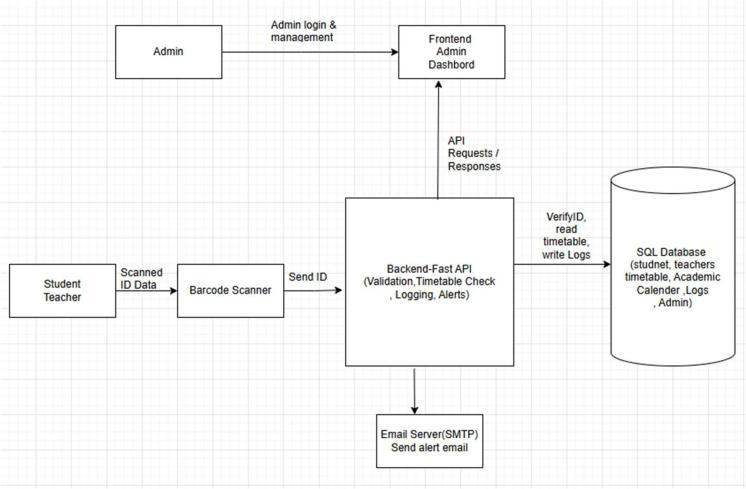
Figure 1 illustrates the overall system architecture of the proposed LibAccess library entry monitoring system. The architecture follows a modular design that separates user interaction, backend processing, data storage, and notification services to ensure scalability and efficient operation.
Studentsandteachersinteractwiththesystembyscanning theirbarcodeIDcardsusingabarcodescanner.Thescanned IDdataissenttothebackendapplicationdevelopedusing FastAPI, which acts as the central decision-making component.ThebackendvalidatestheuserIDbyverifying studentorteacherrecordsstoredintheSQLdatabaseand checks the academic timetable and calendar to determine accesspermissions.
Allscaneventsareloggedinthedatabaseformonitoringand reportingpurposes.Ifastudentaccessesthelibraryduring scheduledclasshours,the backendtriggersanautomated alertthroughtheSMTPemailservertonotifytheconcerned faculty member. Administrative users interact with the system through a web-based frontend dashboard, which communicateswiththebackendviaAPIrequeststomanage users,timetables,andviewlogsandanalyticalreports.This architecture enables realtime monitoring, automated validation, and centralized administrative control while maintainingalow-costdeploymentsuitableforeducational institutions.
This section describes the methodology adopted for implementingtheLibAccesssystem,focusingonreal-time barcode-based validation, timetable-aware decision making, and automated monitoring. The system is
International Research Journal of Engineering and Technology (IRJET) e-ISSN: 2395-0056
Volume: 13 Issue: 04 | Apr 2026 www.irjet.net p-ISSN: 2395-0072
developed using a combination of barcode scanning hardwareandasoftware-basedarchitectureconsistingofa ReactJSfrontend,FastAPIbackend,andanSQLdatabase. The methodology focuses on processing real-time user inputsinsteadofrelyingonhistoricalattendancerecords. UseridentificationisperformedthroughbarcodeIDcards, andsystemdecisionsaremadebyvalidatingscanneddata against stored academic schedules and calendar information. The complete workflow ensures accurate monitoring, automated alerts, and secure data managementwithminimalmanualintervention.
TheprimaryinputtotheLibAccesssystemisobtained throughbarcodeIDcardsissuedtostudentsandteachers. AwiredorwirelessbarcodescannerconnectedtoaPCor laptop is used to capture the barcode data. The scanner works as a keyboard input device and transfers the scannedIDdirectlytotheapplication.Thismethodensures fast, contactless, and error-free data collection. The collectedIDservesasthebasisforfurthervalidationand decisionmakingwithinthesystem.
Once the barcode ID is received, the frontend applicationforwardsthedatatothebackendserver.The backend processes the scanned ID by verifying its existence inthe Studentsor Teachersdatabase tables.It then checks the timetable and academic calendar to determinewhetherthescanoccursduringalecture,free time, holiday, or examination period. This validation ensuresthatsystemdecisionsarerule-basedandcontextaware. Invalid or unregistered IDs are immediately rejectedbythesystem.
Thebackendsystemplaysacrucialroleinvalidating scannedbarcodedataandmakinglogicaldecisions.When abarcodeisscanned,thebackendfirstcheckswhetherthe IDexistsinthedatabase.IftheIDisnotfound,thesystem immediately marks the entry as invalid and prevents furtherprocessing.Oncetheuserisverified,thebackend compares the scan time with the academic timetable stored in the system. This comparison helps determine whetherthestudentisscanningduringafreeperiodor
during scheduled lecture hours. The decision is made using predefined rules to ensure consistency. This timetable-basedlogichelpsinidentifyingclass-skipping behavior automatically. If a student enters the library during class time, the system records the event as a violation.Thissignificantlyreducestheneedformanual monitoringbystaffmembers.
Thebackendensuresthatteachersarenotrestrictedby timetablerules.Facultymembersareallowedtoenterthe library at any time. This role-based decision making makes the system fair, accurate, and suitable for realworldacademicenvironments.
Every entry scan in the LibAccess system is automaticallyrecordedinthedatabaseasalogentry.The log contains important details such as the user ID, role (student or teacher), scan time, entry status, and any relevantremarks.Thisensuresthatthereisapermanent recordofalllibraryaccessevents,whichcanberetrieved atanytimeformonitoring,auditing,oranalysis.Loggingis an essential part of the system because it creates accountability and provides a clear timeline of user activity.
Inadditiontorecordingscans,thesystemusesthelog data to detect unusual or rule-breaking behavior. For example, if a student scans their ID during a scheduled lectureorpracticalsession,thebackendidentifiesthisasa potentialclass-skippingevent.Thiseventisflaggedinthe logs with a specific status, which differentiates it from normal library visits. By structuring logs in this way, administrators can quickly review incidents and track patterns of behavior over time. The notification mechanismworksalongsidetheloggingsystemtoensure thatrelevantpartiesareinformedimmediately.Whena student enters the library during a scheduled class, the systemautomaticallysendsanemailtothesubjectteacher concerned. The email contains the student’s name, ID, department, subject, and the exact time of entry. This allows teachers to be aware of potential class-skipping withoutneedingtomanuallycheckrecordsorsupervise thelibraryphysically.
Furthermore,theloggingandnotificationsystemsupports reporting and analytics. Logs can be used to generate reportsfilteredbydepartment,date,time,ortypeofevent. These reports help administrators understand library usage trends, peak hours, and student behavior. By
International Research Journal of Engineering and Technology (IRJET) e-ISSN: 2395-0056
Volume: 13 Issue: 04 | Apr 2026 www.irjet.net p-ISSN: 2395-0072
combining real-time notifications with historical log analysis,LibAccessprovidesacomprehensivemonitoring and management tool that enhances discipline, accountability,andoperationalefficiency.
TheLibAccesssystemisevaluatedbasedonfunctional accuracy,responsetime,andreliabilityofalerts.Sincethe systemoperatesonreal-timerule-basedvalidationrather than prediction models, traditional machine learning evaluation metrics are not applied. Instead, system performance is assessed by verifying correct entry detection,accuratealertgeneration,andconsistencyoflog records.Theevaluationconfirmsthatthesystemefficiently automates library entry management while reducing manualeffortandimprovingdisciplinemonitoring.
LibAccess:ASmartBarcode-BasedLibraryEntryMonitoring System
1. Start
2. InitializetheLibAccesssystemonthePC/Laptop.
3. Waitforauser(Student/Teacher)toscanthebarcodeID card.
4. CapturethescannedIDfromthebarcodescanner.
5. ValidatethescannedIDwiththedatabase.
• If the ID is invalid, display “Access Denied” andlogtheattempt.
• IftheIDisvalid,proceedtothenextstep.
6. Identifytheroleoftheuser(StudentorTeacher).
7. IftheuserisaTeacher:
• Grantaccess.
• Recordentrydetails(ID,role,date,time)in thelogtable.
• Display“AccessGranted”.
8. IftheuserisaStudent:
• Checktheacademiccalendar.
i. If it is a holiday or examination day,grantaccessandlogtheentry.
ii. Otherwise, proceed to timetable validation.
9. Verifythestudent’stimetableforthecurrenttimeslot.
• Ifnolectureisscheduled,grantaccessandlog theentry.
• If a lecture is scheduled, proceed to classskippingdetection.
10. Detectclass-skippingconditions:
• Grantaccess.
• Send an automatic email notification to the concernedsubjectteacher.
• Logtheentrywiththeremark“ClassSkipping Detected”.
11. Storeallentrydetailsinthedatabaseforreportingand analytics.
12. Displayappropriatestatusmessages(“AccessGranted”/ “AlertSent”)onthescreen.
13. Returntowaitingstateforthenextscan.
The proposed LibAccess: A Smart Barcode-Based Library Entry Monitoring System is designed to operate using minimalandcost-effectivehardware,makingitsuitablefor deployment in educational institutions without requiring specializedinfrastructure.Thesystemreliesoncommonly availablecomputingdevicesandstandardbarcodescanning equipmenttoensureeaseofadoptionandlowmaintenance cost.
The hardware requirements for implementing the system areasfollows:
• Processor:IntelCorei3orhigher.
• RAM:Minimum4GB.
• Barcode Scanner: Wired or wireless (USB/Bluetooth)1D/2Dbarcodescanner.
• PC/Laptop:Usedtorunthe LibAccessapplication andreceivebarcodescannerinput.
• Internet Connection: Required for database synchronizationandautomatedemailnotifications.
Thebarcodescannerfunctionsasakeyboardinputdevice, allowing seamless integration with the system without requiringadditional drivers orspecializedhardware. This hardwaresetupensuresreliablereal-timeoperationwhile maintainingaffordabilityandsimplicity.
To improve the LibAccess system, a small hardware prototypehasbeencreated.Thisprototypeshowshowthe
Volume: 13 Issue: 04 | Apr 2026 www.irjet.net p-ISSN: 2395-0072
systemcan controlareallibrarydoor,notjusttrackdata digitally. It connects the barcode scanning process with a physicaldoormechanism.
In this setup, when a user scans their ID card, the system checks the barcode. If the ID is valid, the door opens automatically using a motor. This helps demonstrate how thesystemcanbeusedinreal-worldsituationsforsecure entry.
The prototype uses a barcode scanner connected to a microcontroller, which controls a servo motor. The servo motoractslikeadoorbyopeningandclosingbasedonthe scanresult.
Componentsusedinthisprototype:
• BarcodeScanner(1D/2D):UsedtoscanIDcardsof studentsorteachers
• ESP32 Microcontroller: Works as the main controllerthatprocessesthedataandcontrolsthe system
• Servo Motor: Used to simulate the opening and closingofthedoor
• Breadboard: Helps in connecting all components withoutsoldering
• JumperWires:Usedtomakeconnectionsbetween components
• USB/Data Cable: Provides power and is used to programtheESP32
Thehardwareprototypeworksbyconnectingthebarcode scanner, main system, and ESP32 microcontroller in real time. When a user scans their ID card, the system checks whetherthe ID isvalid or not.If the accessisapproved, a signal is sent to the ESP32 through Wi-Fi or serial communication.TheESP32thencontrolstheservomotor, whichopensthedoor.Afterafewseconds,themotormoves backandclosesthedoor.IftheIDisnotvalid,nosignalis sent, and the door stays closed. This setup shows how an automaticdoorsystemcan be builtusingsimpleandlowcosthardware.
TheLibAccesssystemisimplementedusingmodern,opensourcesoftwaretechnologiestoensurescalability,reliability, and ease of maintenance. The software components are selected to support real-time processing, secure data handling,andsmoothuserinteraction.
Thesoftwaretoolsandtechnologiesusedinthesystemare listedbelow:
• Operating System: Windows 10 / Windows 11 / Linux
• Frontend Technology: ReactJS (HTML, CSS, JavaScript)
• BackendFramework:FastAPI(Python)
• Database:MySQL
• DevelopmentTools:VisualStudioCode,Postman
• EmailService:SMTP-basedemailserviceforalert notifications
• ApplicationType:Web-basedapplication
The use of FastAPI enables efficient request handling and fastbackendprocessing,whileReactJSprovidesaresponsive and user-friendly interface. The integration of these technologiessupportsreal-timevalidation,automatedalerts, andreliablesystemperformance.
Thissectiondescribesthepracticalimplementationofthe proposedLibAccesssystem.Thesystemisimplementedasa webbased application integrated with barcode scanning hardware to automate library entry monitoring. The frontend interface is developed using ReactJS, while the backend services are implemented using FastAPI. A relational SQL database is used to store user information, timetables,academiccalendardata,andentrylogs.
The barcode scanner functions as an input device that capturesuserIDdataandforwardsittotheapplicationfor validation.Thebackendprocesseseachscaninrealtimeby verifyingusercredentialsandevaluatingaccesspermissions basedonacademicschedules.Allaccesseventsarerecorded automatically, and alert notifications are generated when class-skippingbehaviorisdetected.
International Research Journal of Engineering and Technology (IRJET) e-ISSN: 2395-0056
Volume: 13 Issue: 04 | Apr 2026 www.irjet.net p-ISSN: 2395-0072
Administrative users interact with the system through a dashboard that enables management of users, timetables, and academic events, as well as monitoring of access logs andreportgeneration.Thefollowingfiguresillustratekey interfacesandoutputsoftheimplementedsystem.
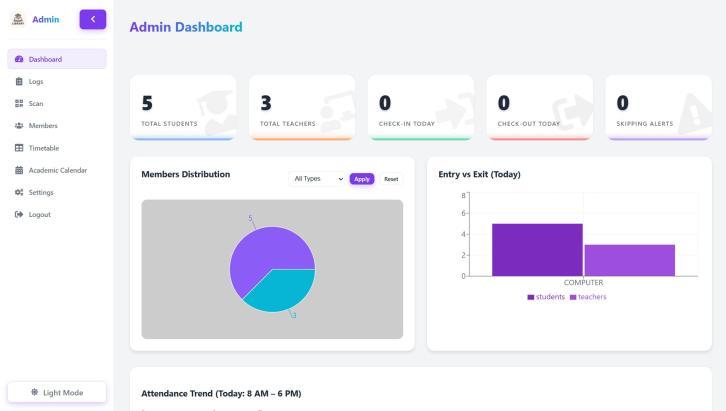
Fig -2 :DashboardPage
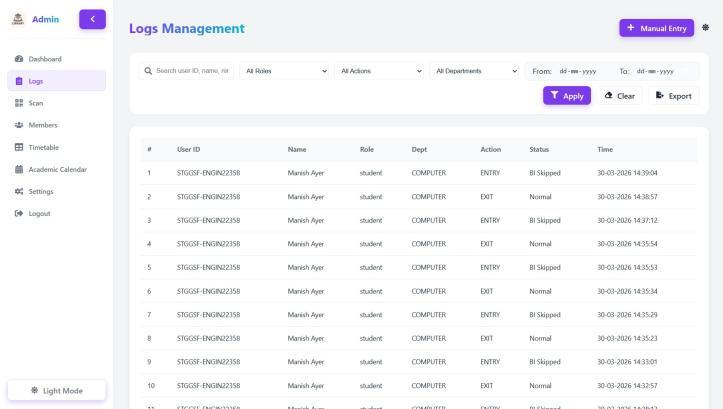
Fig-3 :LogsPage
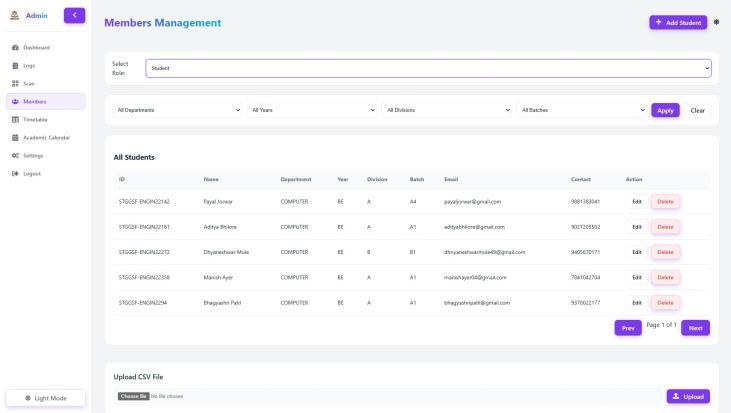
Fig -4 :MembersPage
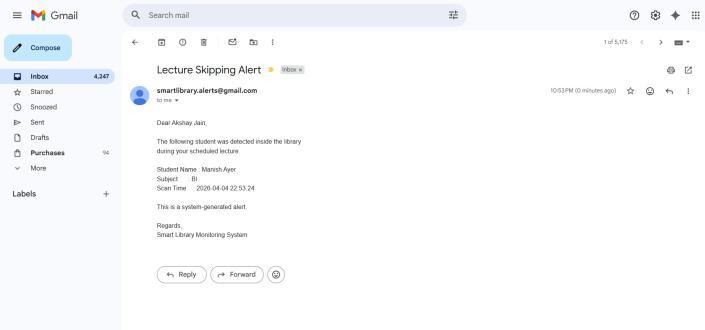
-5 :SkippingLectureMai
This section presents the results obtained from implementingtheproposedLibAccesssystemandevaluates its performance based on functional accuracy, response time,reliability,andeffectivenessindetectingclass-skipping behavior. Since the system operates using real-time, rulebasedvalidationratherthanpredictiveormachinelearning models, the evaluation focuses on correctness of access decisions and system responsiveness under normal operatingconditions.
TheLibAccesssystemwastestedusingmultiplevalidand invalid barcode ID cards for both students and teachers. During testing,the systemaccuratelyvalidatedregistered users and rejected unregistered or invalid IDs. Role identificationbetweenstudentsandteacherswascorrectly performed in all test cases. Access decisions were consistently made based on timetable and academic calendar data, ensuring correct classification of normal entriesandclass-hourviolations.Theseresultsconfirmthe functionalaccuracyoftheproposedsystem.
The response time of the system was measured as the duration between scanning a barcode and displaying the access decision on the screen. The use of a lightweight FastAPIbackendandoptimizeddatabasequeriesresultedin minimalprocessingdelay.Theaverageresponsetimewas observedtobe lessthanonesecond,whichissuitable for real-time library entry scenarios and ensures smooth operationduringpeakusagehours.
International Research Journal of Engineering and Technology (IRJET) e-ISSN: 2395-0056
Volume: 13 Issue: 04 | Apr 2026 www.irjet.net p-ISSN: 2395-0072
Class-skippingdetectionisakeyfeatureoftheLibAccess system. During evaluation, all instances where students attemptedtoaccessthelibraryduringscheduledlectureor practical sessionswere correctlyidentified. In suchcases, automatedemailnotificationsweresuccessfullysenttothe respectivesubjectteachersinrealtime.Thisdemonstrates the effectiveness of the timetable-based validation mechanism in detecting and reporting class-skipping behaviorwithoutmanualintervention.
Allscanevents,includingvalidentries,invalidattempts, and alert-triggered entries, were reliably recorded in the system database. Each log entry contained essential informationsuchasuserID,role,scantime,entrystatus,and remarks. The availability of complete and structured log data supports report generation, monitoring, and future analyticaluse.Nodatalossorinconsistentloggingbehavior wasobservedduringsystemoperation.
Theperformanceoftheproposedsystemwascompared withthetraditionalmanuallibraryentrymethod,asshown inTable1
Table -1: ComparisonofManualSystemandLibAccess System
Parameter ManualSystem LibAccessSystem
EntryRecording ManualRegisters AutomatedDigital Logs
ErrorProbability High Negligible
Real-Time Monitoring NotAvailable Available
Class-Skip Detection NotPossible Automatic Report Generation Time-Consuming Instant Administrative Effort High Low
The comparison highlights that LibAccess significantly improves efficiency, accuracy, and monitoringcapabilityovermanualsystems.
The results demonstrate that the proposed LibAccess system successfully automates library entry monitoring whileprovidingreal-timevalidationandalertgeneration.Its fastresponsetime,accuratedetection,andreliablelogging makeitsuitablefordeploymentineducationalinstitutions. Thesystemachievesthesebenefitsusinglow-costhardware andalightweightsoftwarearchitecture,makingitapractical andscalablesolution.
The proposed LibAccesssystemoffersseveral advantages over traditional and existing library entry monitoring approaches.Byautomatingentryloggingandvalidation,the system significantly reduces manual effort and minimizes humanerrorsassociatedwithregister-basedmethods.The useofbarcode-basedidentificationensuresfastandreliable user authentication without requiring expensive or specializedhardware.
The system provides real-time monitoring and timetableawarevalidation,enablinginstantdetectionofclass-skipping behavior and automated alert generation. Centralized logging and report generation improve administrative efficiency and support data-driven decision making. Additionally,thelightweightarchitectureandlowhardware requirementsmakethesystemcost-effective,scalable,and easytodeployineducationalinstitutionsofvaryingsizes.
TheLibAccesssystemcanbeeffectivelydeployedinavariety of academic and institutional environments where controlled entry monitoring and attendance tracking are required.Majorapplicationareasinclude:
• Collegeanduniversitylibrariesforautomatedentry management
• Academic institutions for monitoring student movementduringclasshours
• Educational campuses requiring real-time attendanceandaccessvalidation
• Librariesandstudycenterswithrestrictedaccess policies
• Institutionalfacilitiesthatrequirerule-basedentry monitoringandreporting
International Research Journal of Engineering and Technology (IRJET) e-ISSN: 2395-0056
Volume: 13 Issue: 04 | Apr 2026 www.irjet.net p-ISSN: 2395-0072
Theseapplicationsdemonstratethepracticalusefulnessof the system in improving discipline, accountability, and operationalefficiency.
ThisresearchpresentedLibAccess,asmartbarcode-based library entry monitoring system designed to automate libraryaccess,detectclass-skippingbehavior,andprovide real-time administrative oversight. The system integrates barcode-basedidentificationwithtimetable andacademic calendarvalidationtoensureaccurateandrule-basedaccess control.
The implemented system demonstrated high functional accuracy,fastresponsetime,reliablelogging,andeffective alertgenerationwithoutrequiringexpensivehardwareor complex infrastructure. By reducing manual effort and improving monitoring capabilities, LibAccess enhances operational efficiency and accountability in educational institutions.Theresultsindicatethattheproposedsolution is practical, cost-effective, and suitable for real-world deploymentinacademicenvironments.
[1] S.Elaskari,M.Imran,A.ElaskriandA.Almasoudi,“Using Barcode to Track Student Attendance and Assets in Higher Education Institutions,” Procedia Computer Science,vol.184,pp.226–233,2021.
[2] S.SriMahalakshmi,V.Ramani,K.MohanSaiRaj,N.B.L. Priya,B. Bhagya Lakshmi, ”Attendance Management System”,International Journal of Creative Research Thoughts(IJCRT) Volume12,Issue6June2024.
[3] Prof. Ravi Khatri,Tauqeer Shaikh,Nishit Gundecha,Om Kathe,Khushi Tiwari, ”QR Code Based Access Control System”, Published in IJIRMPS (E-ISSN: 2349-7300), Volume11,Issue2,March-April2023.
[4] Adarsh Singh (Earlham College, Richmond, Indiana),”SmartLibraryManagementSystemusingQR Code”,2022.
[5] Chris Paul,Mandar Godambe,”Barcode Scanning System”,November2021.
[6] Abhishek Verma,Virendra Kumar Verma,Priya Gupta,”Real-TimeAtten-danceSystemUsingQRCode andIoT”,TIJERFebruary2024,Volume11,Issue2.
[7] Y. Li,S. Mishra,”Smart Library Architecture Based on InternetofThings(IoT)”,February2024.
[8] MohammadNehalHasnineetal.,”AReal-TimeLearning AnalyticsDash-boardforAutomatedSystems”,Sensors 2023.
[9] Ahmadsahban Rafsanjani,Norshaliza Binti Kamaruddin,Hazlifah Mohd Rusli,Mohammad Dabbagh,”QsecR:SecureQRCodeScannerAccordingto aNovelMaliciousURLDetectionFramework”,IEEE,vol 11,2023.
[10] ManojAhire,RushikeshMore,ShubhamDhamale,Vedant Aher,”Library Attendance and Management System”, International Research Journal of Modernization in Engineering Technology and Science,Volume:06/Issue:01/Jauuary2024.